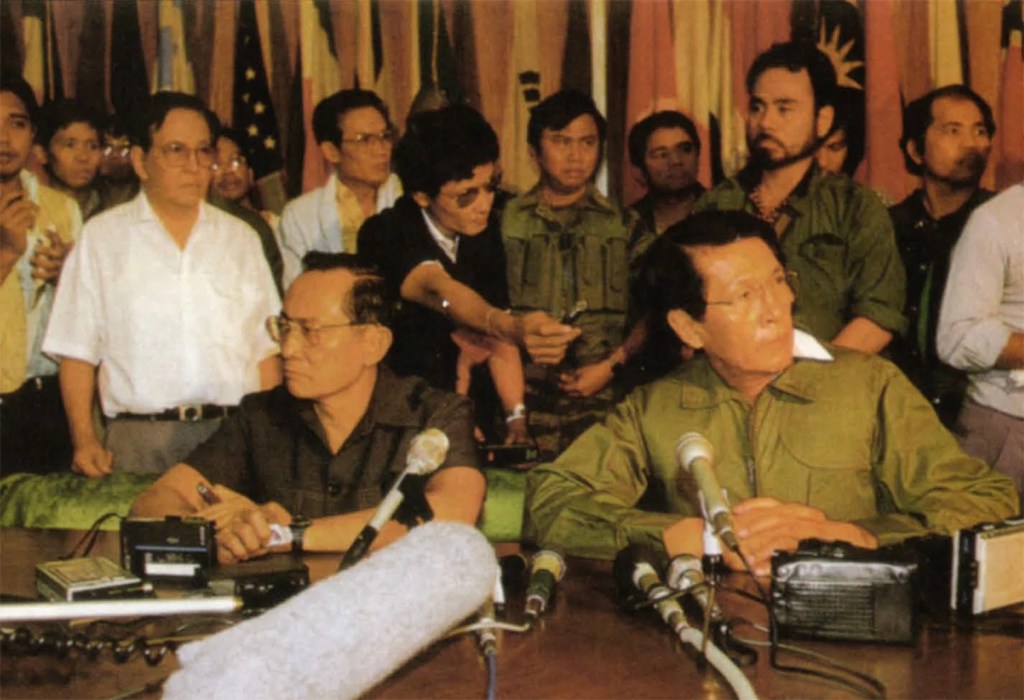
Start of the People Power Revolution in the Philippines. A tense military standoff in Manila engulfed the Government of President Ferdinand E. Marcos after the Minister of Defense and the Deputy Chief of Staff of the armed forces renounced his rule. Surrounded by loyal troops, Defense Minister Juan Ponce Enrile and the Deputy Chief of Staff, Lieutenant General Fidel V. Ramos, announced that they were resigning in protest against what they said was a rigged presidential election and years of abuses by the Marcos Government. News of their action drew a throng of cheering civilians to the Defense Ministry headquarters, where the two men stationed themselves with a group of soldiers who pledged their support. Early today, as the two men remained at the Defense Ministry at suburban Camp Aguinaldo and a nearby constabulary command post, Camp Crame, Mr. Marcos announced that a plot to storm the presidential palace and assassinate him had been smashed. “Stop this stupidity and surrender,” he said in an appeal to his two new opponents. “We are in control of the situation.”
On the evening of February 22, after receiving confirmation of Enrile and Ramos’ defection from Quezon City assemblywoman Cecilia Muñoz-Palma, activist and former actor Butz Aquino proceeded to Camp Aguinaldo to attend their second press conference. Upon offering his assistance to the two, Enrile answered: “We need all the support we can get.” After the conference, Aquino asked permission from Radio Veritas reporter Jun Taña to speak on the air through telephone, upon which he issued a call-to-action for the public, including his “friends in ATOM, BANDILA and FSDM”, to gather at the Isetann department store in Quezon City and begin a march to Camp Aguinaldo.
Some minutes after Aquino’s statement, Cardinal Sin went on Radio Veritas and issued another call-to-action, exhorting Filipinos to aid Enrile and Ramos by going to the section of EDSA between Camp Crame and Aguinaldo and giving them emotional support, food and other supplies. For many, this seemed an unwise decision since civilians would not stand a chance against a dispersal by government troops. Many people, especially priests and nuns, still trooped to EDSA.
Steps to protect the Defense Minister were joined by a Philippine colonel, who said he first heard of plans to arrest Mr. Enrile a few days ago. Colonel Tirgo Gador, assigned to an army unit in the northern province of Cagayan, said a move against Mr. Enrile also threatened the entire “reform” movement of the military officers to which he belonged. Quietly, to avoid alerting his superiors, Colonel Gador spirited more than 100 of his soldiers by bus from Cagayan to Camp Aguinaldo, the Philippine military headquarters in northern Manila. Early today, along a darkened corridor of the Defense Ministry building there, they joined dozens of other soldiers ready to protect Mr. Enrile in case of an attempt to arrest him.
The White House signaled today that it supported two Philippine military leaders who resigned from the Government and who called on President Ferdinand E. Marcos to resign because of fraud in the elections February 7. In an unusual statement, issued with President Reagan’s approval, the White House moved closer to calling for Mr. Marcos to give up office. It said statements by the two former high Marcos aides reinforced Administration concern that the fraud in the elections, carried out mostly by the Marcos party, was “so extreme as to undermine the credibility and legitimacy of the election and impair the capacity of the Government of the Philippines to cope with a growing insurgency and a troubled economy.” The White House, in effect, endorsed the remarks made by the former Defense Minister, Juan Ponce Enrile, and the former Deputy Chief of Staff, Lieutenant General Fidel V. Ramos, by summarizing them without qualifications in its statement and by pointedly not referring to Mr. Marcos’s rebuttal.
Removal of medium-range missiles from Europe and Asia by the United States and the Soviet Union over the next three years was proposed by President Reagan in a letter to Mikhail S. Gorbachev, the Soviet leader, Administration officials said. President Reagan, in a letter to Soviet leader Mikhail S. Gorbachev, is calling for elimination of medium-range missiles in Europe as a “constructive first step” toward worldwide curbs on the nuclear arms race, the Associated Press quoted an unnamed U.S. official as saying. The letter was largely a response to the Soviet leader’s proposal on January 15 urging the elimination of all nuclear weapons by the year 2000. Mr. Reagan rejected the Soviet proposal to freeze British and French medium-range nuclear forces, the American officials said. Reagan is planning a statement to the nation on the subject Wednesday. Reagan’s decision was reportedly described as based on the advice of most of his senior arms control experts, who see an agreement on medium-range missiles as the most likely way to move the Geneva negotiations off dead center. Administration officials indicated it was also intended to put the Soviet Union on the defensive in nuclear arms control as both sides start preparations for the next summit meeting between Mr. Reagan and Mr. Gorbachev in the early summer or fall.
Since he took power 11 months ago, Mikhail S. Gorbachev has attacked economic problems with a zeal unmatched since Nikita S. Khrushchev disbanded entire layers of bureaucracy 25 years ago. But despite all the zeal it has become apparent that he plans no fundamental changes in the centralized Soviet economy, according to Western economists and diplomats. And without profound change, they said, it is not likely that the Soviet economy can achieve the ambitious growth objectives set by Mr. Gorbachev and become more competitive with the West. Sounding at times more like an evangelical preacher than a Communist leader, he has campaigned against corruption and alcoholism, exhorted workers to double their efforts, abolished Government agencies, dismissed scores of senior managers and talked bluntly about economic failings. When the Communist Party convenes its 27th congress in Moscow on Tuesday, it is expected to approve, with little revision, a highly ambitious program for economic development through the year 2000. The plan includes specifics for development over the next five years, with longer-term priorities through the end of the century.
The Soviet Communist Party congress that begins in Moscow on Tuesday has generated often anxious comparisons among all six Soviet allies in Eastern Europe with the epochal sea change that came when Nikita S. Khrushchev delivered his secret “sins of Stalin” speech at his own inaugural party congress exactly 30 years ago. The party leaders of the Eastern bloc countries, their aides, and, in some instances, their rivals, will be paying very close attention as Mikhail S. Gorbachev, at 54 years old the youngest Soviet leader since Stalin took power, seeks to set the tone and tempo for his Communist Party. Within the next four months, four of the Eastern bloc leaders will be presiding over their own party congresses. The cues emerging in Moscow over the next few days will no doubt shape discussions at the congresses in those four countries — East Germany, Czechoslovakia, Bulgaria and Poland — on such key issues as foreign policy, scientific and technological development, economic change and trade with the West. One area of obvious concern in the bloc is what has been called the age issue. The average age of the six party leaders of the Eastern bloc countries is 70, and these men had long been accustomed to dealing with aged leaders in Moscow as well.
An Italian Government prosecutor accused a Bulgarian airline official today of having lied when he told Italian investigators that he was not present when Pope John Paul II was shot. The prosecutor, summing up the case against the official, Sergei I. Antonov, also said Bulgaria had destroyed documents central to testing Mr. Antonov’s account. If found guilty, Mr. Antonov faces life imprisonment, and such a verdict would reinforce the case that Bulgaria’s intelligence service plotted the shooting of the Pope on orders from the Soviet Union. That has been the contention of Mehmet Ali Agca, the Turk who was convicted of wounding the Pope and who later turned state’s witness.
Israeli forces have withdrawn from all areas of Lebanon north of the so-called security zone just above the Lebanese border, the military announced tonight. The pullback brought to an end a week of extensive armed searches through dozens of Shiite Moslem villages for two Israeli soldiers who were captured while on patrol in the zone last Monday. Several battalions of ground troops and armor, supported by air and naval cover, took part in the operation, the biggest incursion into Lebanon since Israeli troops withdrew last year from all of Lebanon except for the Israeli-proclaimed security zone. A military source said the operation had exhausted all available means without turning up any trace of the captured soldiers. An Israeli soldier and a sailor were killed during the incursion. Israeli accounts said 14 guerrillas were killed.
King Hussein said Palestinians should decide whether the Palestine Liberation Organization should continue to lead them. In an interview in Amman, Jordan’s King said he would “respect” a decision to preserve the P.L.O. as the “sole legitimate representative” of the Palestinian people, but he said another “apparatus” to express their wishes would also be welcomed. The King’s remarks were seen as an unmistakable challenge to Yasser Arafat’s leadership of the P.L.O. “The Palestinians must now make a decision,” the King said. “Are they happy with creeping annexation of their land by Israel and their possible expulsion from Palestine? If they’re unhappy, what do they want us to do about it?”
The breakdown of the peace effort between King Hussein of Jordan and Yasir Arafat has improved the chances of healing the rift inside the Palestine Liberation Organization and improving the P.L.O.’s relations with Syria, according to Palestinian officials and reports by Arab press organizations. “The farther Arafat moves away from Amman, the closer he becomes to his opponents in the Palestinian guerrilla movement,” a Palestinian source said here today. The source said feelers had already been sent out in an effort to start a dialogue within the P.L.O. about closing Palestinian ranks. The Marxist Democratic Front for the Liberation of Palestine, apparently with backing from the Soviet Union, is trying to act as a go-between in contacts between Mr. Arafat, the P.L.O. chairman, and rival guerrilla factions.
Jordan’s military force, which is relatively small but highly trained and technologically advanced, is increasingly irritated by the failure of Congress to go through with President Reagan’s proposed $1.9 billion weapons sale, according to senior air force and army officers. Late last month, United States Government and Congressional sources said the Administration had indefinitely put off the proposed sale because it was virtually certain that the sale would be blocked by Congress. Congress had passed a resolution linking any sale to an agreement that King Hussein engage in “direct and meaningful negotiations” with Israel. The Jordanian officers, many of whom have close ties with the American armed forces, said they still hoped Jordan would get the American arms, which they say Jordan desperately needs. But they said that there was disappointment among King Hussein’s advisers over the lack of Congressional approval and that as a result, the credibility of the United States as a reliable security partner had suffered.
A top-ranking Iraqi general charged today that Iranian troops dug into the city of Fao were using chemical weapons against counterattacking Iraqi troops. The officer, Maj. Gen. Maher Abdul Rashid, commander of the Third Army Corps, said the Iranians used “mustard gas and a similar kind of gas” on Friday night, firing the chemical weapons at the Iraqis in mortar rounds. Iran has previously said that it had the capacity to manufacture such weapons and that it would use them if necessary. Iraq used a form of mustard gas, forbidden since World War I by the Geneva Convention, to stop an Iranian offensive through the marshes of southern Iraq.
Prime Minister Rajiv Gandhi, who has enjoyed nearly universal praise for his political skills, has run into an unusual storm of criticism over several recent steps and missteps. Mr. Gandhi’s aides are now saying that the Prime Minister’s “honeymoon” with the press and his political opposition, which has continued since he took office on Oct. 31, 1984, has at last come to an end. “The euphoria has to stop,” Mr. Gandhi, 41 years old, acknowledged to the magazine India Today in a recent interview, sounding somewhat philosophical over the turn of events. Protested Opposition leaders refused to meet with Mr. Gandhi on the eve or the opening of Parliament this week and then boycotted the Prime Minister’s speech on the opening day. Instead, they and several thousand supporters took to the streets to protest Mr. Gandhi’s policies. Their action was aimed at protesting a decision by the Government on February 1 to increase prices on gasoline and other petroleum products just as worldwide oil prices were collapsing. The Finance Ministry defended the price increases as necessary to curb oil imports, reduce energy consumption and provide revenues for economic development. But a senior official acknowledged that the announcement was badly timed and poorly explained to the public.
Indonesia has begun to sink boats whose crews are found to be transporting for profit refugees who are fleeing Vietnam, according to diplomats and refugee officials in the region. The officials say the refugees are brought ashore by the Indonesian authorities before the boats are sunk. The officials also say no genuine refugee boats are sunk. The tough measures are intended as a warning to the Vietnamese before calmer weather in the South China Sea, the officials say. May, June and July are months when crossings are most frequent, with 4,000 to 5,000 Vietnamese boat people arriving each month. More than 250,000 Vietnamese have come here in the last decade. All are resettled abroad. Indonesian authorities have been frustrated in attempts in the last six months to secure the cooperation of Hanoi in stopping an increasing trade in refugees, carried out by what appears to be a fleet of more powerful boats.
The South Korean Government put a leading opposition politician under house arrest for the fourth time in 10 days today, confined several others to their homes and sealed off entrances to opposition party offices in a continuing effort to crush a petition drive for a constitutional amendment. Early this morning, the police surrounded the home of Kim Young Sam, a prominent opposition leader who had planned to meet this afternoon with foreign journalists. Kim Dae Jung, another key opposition leader, remained under house arrest for the 10th day. According to Hong Sa Duk, a spokesman for the opposition party, nine other opposition lawmakers were confined to their homes today. At the same time, the police again blockaded the offices of the New Korea Democratic Party, the elected opposition party. Kim Young Sam and the nine legislators were later freed from house arrest, aides and party officials told Reuters. But hundreds of police officers still surrounded Kim Dae Jung’s house, witnesses said. Mr. Hong said he believed the police acted again today because they thought that opposition party members were going to display a sign promoting their illegal petition drive for a constitutional amendment.
A Chinese pilot fled to Seoul, South Korea, in his MIG-19 fighter after breaking away from his squadron during a training flight in northeastern China. Officials in Seoul said South Korean jets intercepted the MIG, piloted by Chien Pao Chung, and drove off two North Korean fighters chasing it. They said that Chien apparently wants to settle in a third country, but they would not identify it. Observers speculated that Chien will end up in Taiwan, which often hands out rewards in gold to military men who flee mainland China.
China said Friday that it would try the co-pilot of a twin-engined airliner belonging to the Soviet airline Aeroflot that was hijacked on an internal flight in the Soviet Far East in December and forced to land in Manchuria. The Foreign Ministry announced that Chinese “judicial organs” had investigated the incident and concluded that the co-pilot, identified as Shamil Alimuradov, “committed the crime of unlawful seizure of a civilian aircraft.”
President Reagan makes a radio address to the Nation on Grenada and Nicaragua.
Leftist guerrillas threw dynamite from speeding cars at the U.S Embassy in Lima, Peru, and other foreign missions, government offices and local headquarters of the governing party in the capital. No one was reported hurt in the bombings, which capped three days. of rebel attacks in mountain and jungle provinces that killed 11 people, according to official reports. Officials said that in addition to the U.S. Embassy, the blasts occurred at the embassies of West Germany, India, Spain and Argentina; the Lima bureau of the New China News Agency and two offices of President Alan Garcia’s American Popular Revolutionary Alliance party.
The government of Chad reported that it captured about 1,000 prisoners in last week’s fighting with Libyan-backed rebels. Ten prisoners shown to reporters in N’Djamena, the capital, said they were Chadians who had been forced to fight on the rebel side. One said, “Those who refused to fight were shot by the Libyans.” The government described last week’s flare-up in the civil war, fought sporadically for 20 years, as a Libyan attack, but prisoners said Chadians were doing most of the actual fighting.
Black nationalist Nelson Mandela does not expect South Africa to free him from prison in the coming weeks or months and wants speculation on the matter to stop, his daughter said. The daughter, Zindzi Mandela, and Mandela’s wife, Winnie, visited the African National Congress leader in prison at Cape Town, where he has served 23 years of a life sentence for plotting sabotage. Persistent rumors have lately suggested that the white minority regime is about to release Mandela, but Zindzi Mandela said, “There is nothing new.” She added that her father asked for an end to guesses about his freedom.
The European Space Agency, recovering from last September’s unsuccessful mission, sent two commercial satellites into orbit from the agency’s jungle space center in South America. After launching from Kourou, French Guiana, the three-stage Ariane-1 rocket put in orbit a French SPOT satellite for Earth observation and a Swedish Viking scientific satellite designed to study the Earth’s magnetic field and the aurora borealis, or northern lights. The launch was the 16th of an Ariane rocket and the 12th successful launch of the Ariane series; the 15th veered off course and was destroyed.
New theories about wind and cold weather have become a major focus of the Presidential commission investigating the explosion of the space shuttle Challenger. The new focus on cold comes amid reports that temperatures as low as 8 degrees Fahrenheit below zero were recorded on a strut of the shuttle’s right-side booster rocket just before the liftoff; previous estimates put the temperature at 7 to 9 degrees above zero. Low temperatures at launching on the morning of Jan. 28 are thought by some aerospace experts to have contributed to a failure of the Challenger’s right-side booster rocket, leading to the explosion that killed the seven crew members. The theory now emerging among commission members and aerospace experts is that winds blowing over the Challenger’s external tank of supercold liquid fuel might have “refrigerated” the nearby right-side booster. The rubbery O rings that seal the joints between the four segments of the boosters are sensitive to cold, and speculation is that refrigeration might have caused them to fail, allowing flames to escape the booster and touch off the explosion.
The nation’s governors attacked President Reagan’s budget as “a one-way street” that shifts responsibilities to the states without providing the money to pay for them. A report called “Federalism and the States 1986” said the governors agreed that reducing the federal deficit must be a high priority. They also renewed their call for consideration of defense cuts and tax increases as steps toward that goal. The report was released by Tennessee Governor Lamar Alexander, chairman of the National Governors Association, the day before the opening of the group’s annual winter meeting in Washington.
The President and First Lady watch the movie “A Chorus Line” together.
The Senate Armed Services Committee is ready to propose sweeping changes in the organization of the nation’s military establishment, including the Defense Department, the military services and the role of Congress, according to Senate officials. The proposals are intended to give the Secretary of Defense more control over the Pentagon, enhance the authority of the Chairman of the Joint Chiefs of Staff and reduce some Congressional involvement in managerial decisions. The Senate officials said that committee members approved the following key provisions of a measure drawn up by the Armed Services Committee in closed sessions last week:
— The Chairman of the Joint Chiefs of Staff would be assisted by a deputy who would outrank the chiefs of the four services, who are the other members of the Joint Chiefs. The Joint Chiefs’ staff, which is now controlled now by the services’ heads as a committee, would come under the authority of the Chairman alone. Moreover, the Chairman would have the formal right to give his own military advice directly to the President, in addition to that of the chiefs as a group.
— Staffs of the Army, Navy and Air Force departments and several military agencies would be cut at least 10 percent and possibly up to 25 percent in both military and civilian personnel.
— The Secretary of Defense would be allowed to assign duties and titles to assistant secretaries, a right now retained by Congress.
— The leaders of the unified, four-service combatant commands that conduct military operations would be subject to confirmation by the Senate, rather than being appointed by the President alone. Presidential Commission’s Report
The committee will also recommend that the military authorizing and appropriating functions of Congress, now vested in two separate committees in each chamber, would be merged into one under the Senate and House Armed Services Committees. A two-year military budget would replace the current one-year budget.
Taxpayers spent at least $9.28 million on worldwide trips for traveling members of Congress in 1984-85, with Europe the favorite destination, a watchdog group reported. Travel by House members accounted for $8.23 million or 88% of the total, including a $118,331 trip to Ireland last March by an 11-member entourage headed by House Speaker Thomas P. (Tip) O’Neill Jr., “to celebrate St. Patrick’s Day.” Nancy Drabble, director of Congress Watch, said the report was compiled from official travel expense records published in the Congressional Record but that actual cost of foreign travel by lawmakers “probably is double when you include all costs.”
An autopsy showed that convicted spy Larry Wu-tai Chin died of asphyxiation in his cell after tying a plastic trash bag over his head, the U.S. Marshals Service said. Chin, a retired CIA translator who was awaiting sentencing after being convicted February 7 of spying for China, took the bag from a wastebasket in the day room of the Prince William-Manassas Regional Adult Detention Center in Virginia near Washington, authorities said.
About 100 Democratic leaders from across the country went to class at Harvard’s John F. Kennedy School of Government in Cambridge, Massachusetts, to discuss how to manage an industrial economy and how to recapture the White House. It was the second day of a two-day session set up by the party’s policy committee to let leading Democrats hear from the experts and one another about promoting growth, international competition and rebuilding the nation’s industry.
Eastern Airlines, facing a Wednesday strike deadline by pilots and a shutdown threat from creditors, has received a buy-out offer, Chairman Frank Borman told leaders of three unions. He did not identify the suitor, a union official said. “The cash portion of the offer is represented to be substantial” and the board of directors is meeting today to consider the offer, Larry Schulte, chairman of the Air Line Pilots Association Master Executive Council, said. An Eastern official who refused to be identified confirmed that an offer had been made but gave no details.
Three Colombian men were arrested in the wake of the machine-gun killing of a drug informant, Adler (Barry) Seal, 45, in Baton Rouge, Louisiana, bringing the number of reported arrests to six. An FBI spokesman, Cliff Anderson, identified the three as Bernardo Antonio Vasquez, 32; John Jairo Cardona-Garcia, 22, and Luis Carlos Quintero-Cruz, 33. Vasquez was charged with obstructing justice and the others were detained as illegal aliens pending further investigation.
The National Guard has pulled out of Austin, Minnesota, after a 33-day peacekeeping mission at the strikebound Geo. A. Hormel & Co. plant, an exercise that cost state taxpayers $1.4 million. But pickets continued their six-month-long vigil at plant gates. About 1,500 members of Local P-9 of the United Food and Commercial Workers union walked off their jobs on August 17. As the last National Guardsmen pulled out of thestrike-torn city Friday, about 200 students left their classrooms to march in support of striking meatpackers at the Geo. A. Hormel & Company plant here. Governor Rudy Perpich, who sent the National Guard troops in Jan. 20, had ordered them withdrawn by the weekend.
The National Highway Traffic Safety Administration has expanded its investigation into the sudden acceleration of automobiles to include vehicles made by six manufacturers. Sudden acceleration has been found to occur when an automatic transmission is moved from “park” into “drive” or “reverse” and also while vehicles are moving. In some cases, according to complaints from motorists, immediate braking did not stop the vehicles. The Center for Auto Safety, a Washington-based consumer group that has spurred the Federal agency to widen its inquiry, traces more than 75 deaths and more than 1,000 injuries to sudden acceleration.
Agreements signed by the Campbell Soup Company and a farm workers’ union will end a labor dispute that dates to 1968, the union’s president says. Baldemar Velasquez, president of the Farm Labor Organizing Committee, based in Toledo, Ohio, said Friday that agreements with Campbell included provisions for wage increases, medical insurance and paid holidays for 550 migrant workers who pick tomatoes and cucumbers.
Almost from the moment on February 10 when the news broke that a Westchester County, New York woman had died after taking a cyanide-laced Tylenol capsule, Johnson & Johnson found itself racing to stay in control of a rapidly changing situation. As consumer fears mounted, the company had to move quickly to ensure public safety yet prevent the episode from becoming a staggering blow. What has become clear, through interviews with James E. Burke, the company chairman, and other Johnson & Johnson officials, is that once the company found itself embroiled in yet another product-related death, following a spate of similar crimes in 1982, the aim was to control consumer reaction, exercise damage control and make the best of a bad situation. It was not always easy, nor was it accomplished without sharp disputes among executives, with some of them shouting at each other in discussions over what to do next. Corporate managers always have to strike a balance between the demands of various constituencies: customers, employee groups, suppliers and shareholders. But how Mr. Burke and Johnson & Johnson reacted in the latest Tylenol crisis offers a glimpse into the process in the midst of a highly charged atmosphere.
The Phillips Petroleum Company created the town of Phillips six decades ago to refine oil pumped from the Texas Panhandle. The company built houses for its workers, a park and the swimming pool at the school, fixed the streets and gave college scholarships to students. Now the creator and patron of Phillips, Tex., would be its destroyer. The company has told the 1,500 residents that remain in the town that it needs the land it owns under their houses and that they have until August 31 to move their homes somewhere else.
A tense and somber mood has settled over refugees from Thursday night’s break in a levee alongside the Yuba River in California, which sent 26,000 people fleeing their flooded homes in Linda and Olivehurst near here. In makeshift evacuation centers at this Air Force base, nearly 5,000 of them are getting by on coffee, Kool-Aid and C rations as they wait to see when they can go home and what they have to go home to. Most are not optimistic.
Photos of Uranus from Voyager 2 provide strong evidence of an ocean of superheated water 5,000 miles deep enclosing a rocky but largely molten core roughly the size of Earth. Although the existence of that ocean had been hypothesized for some time, the new data are the strongest yet. The ocean is thought to be formed of melted comets.
Born:
Miko Hughes, American child actor (“Pet Sematary”, “Mercury Rising”), in Apple Valley, California.
Rajon Rondo, NBA point guard (NBA Champions, Celtics, 2008, and Lakers, 2020; NBA All Star, 2010-2013; Boston Celtics, Dallas Mavericks, Sacramento Kings, Chicago Bulls, New Orleans Pelicans, Los Angeles Lakers, Atlanta Hawks, Los Angeles Clippers, Cleveland Cavaliers), in Louisville, Kentucky.
 History Diaries