As has been the case often recently, poor winter weather curtails operations in Greece and Albania today, 21 February 1941. Both sides are looking to launch offensives soon, with the Italians steadily building up forces for a major offensive.
Churchill telegrams Foreign Minister Anthony Eden with the advice, “Do not consider yourselves obligated to a Greek enterprise if in your hearts you feel it will only be another Norwegian fiasco.” It is a moment of reason, but it comes too late. Britain has already committed herself to the Greek defense. And the Greek defensive deployment tries to hold too far forward; the superior German formations will soon make them pay. Worse yet, the weakening of British strength in Libya leaves an opportunity for an audacious German commander to roll back the British gains of the Winter.
British Chiefs of Staff to CIGS: “…anxious that Rumanian oilfields should be bombed if only lightly, as a prelude to subversive activities in Rumania which are timed to begin on 28th February. There are two difficulties: 1. We should require use of Greek aerodromes, which might result in German retaliation. 2. It would be necessary to violate Bulgarian air. Foreign Office raise no objection.”
Strong and seemingly well-founded hints that Germany and Great Britain are massing men and weapons for a major contest in the Balkans within the very near future came last night from Balkan and Middle Eastern capitals. A reliable diplomat in Belgrade, Yugoslavia, declared the Germans had put considerable numbers of pontoons across the ice-free Danube River and that a movement of a German expeditionary force into Bulgaria toward Greece and the Mediterranean would come shortly. His information was followed in a few hours by a Turkish official radio broadcast to the effect the British are holding their victorious Army of the Nile ready in Egypt for a quick dash to help Greece. A Reuter British news agency-dispatch from Belgrade said that “according to one unconfirmed report, German troops have been crossing into Bulgaria, across the Danube at the Bulgarian town of Ruse, since 4 p.m. Friday.” Ruse is opposite Giurgiu, Rumania, where the Germans have built pontoon bridges. That something big is brewing in the Middle East has been indicated by the arrival there of Foreign Secretary Anthony Eden and General Sir John Dill, chief of the British imperial general staff. They are there for “big decisions” with Gen. Sir Archibald P. Wavell, designer and executor of the brilliant campaign against the Italians in Libya. German motorized troops in columns many miles long moved through Rumania toward the frontier of Bulgaria beyond which lies Britain’s ally, Greece.
Colonel Leclerc’s Free French force continues pounding away at the El Tag fortress in Kufra. The Italians in the fort can do nothing about the mortars and 75mm field gun firing from 1.5 and 3 km away, respectively.
Operation MC 8, a supply convoy to Malta, concludes without a hitch today. Light cruisers HMS Orion, Gloucester, Ajax, and destroyers Mohawk, Nubian and Diamond arrive in the predawn darkness. They deliver 1300 troops in total (two battalions), and the Germans and Italians apparently never notice. The ships (except for Diamond) head back out at dusk.
All available native and Italian manpower in Eritrea, Ethiopia and Italian Somaliland is being called to the defense of the east African empire against the British. The most threatening of Britain’s thrusts is that into Eritrea where a garrison of Italian and natives still is reported holding out in Cheren against mechanized British forces. British forces driving into Eritrea were estimated at 100,000 men in an official Italian statement. These include colonials and natives “amply supplied with motor trucks, artillery and tanks.” In Ethiopia native manpower was sought, dispatches from east Africa said, with the backing of tribal chieftains opposed to the return of Haile Selassie. Throughout east Africa Italians who went there to colonize were pictured as laying down their tools to take up arms against the invaders in the manner of American colonists fighting the Indians. The Rome statement, reviewing recent fighting in Eritrea in an apparent effort to explain Italian reverses, said the British were massing for a new assault on Cheren, key point on the route to Asmara, Eritrea’s capital.
British forces invading Italian Somaliland now have breached Italy’s Juba river front in two places, general headquarters announced today, and “operations from both these bridge heads are developing satisfactorily.” The point of the new crossing of this natural defense line was not disclosed, but it was said to have been north of the original cross-river thrust, which was in the Gelib area, north of the river mouth town of Chisimaio, now held by the British. The Juba River traverses western Somaliland from north to south about 100 miles within that southernmost colony of Italy’s east African empire. It had been the main line of resistance to the British offensive. The G.H.Q. communique added but little to what is known of the offensives in Eritrea and Ethiopia, in Italian east Africa, and in Libya, hundreds of miles to the northwest on the Mediterranean shore. It said that 5,576 Fascist colonials and 745 Italians, including 47 officers, had been captured on the Eritrean front between January 20 and February 20 and that “many prisoners have been taken in the areas of the blue Nile, the upper Nile and in the Gojjam area (Ethiopia).
The Indian 7th Infantry Brigade attacks the Italian 112th Colonial Battalion at Cub Cub but makes little progress.
British aircraft carrier HMS Formidable, in the Red Sea awaiting transit through the Suez Canal while it was swept for mines, launched 7 Albacore aircraft to attack the harbor of Massawa, Eritrea, Italian East Africa, causing little damage. The Luftwaffe mining of the Suez Canal has achieved a tremendous amount for the small investment involved.
Prime Minister Robert Menzies finally makes it to London, a month after he set out from Melbourne. He is staying in the same suite at the Dorchester previously occupied by Wendell Willkie. Menzies notes that “So far I have seen only a few bombed places” and “Day raids have for the time been practically discontinued, and the street traffic… seemed almost normal.” He has lunch with several cabinet ministers, noting that Minister of Labour and National Service Ernest Bevin “would be a great hand with a fractious union, but I would think of limited mental powers.” He also finds Lord Woolton “quiet and perhaps a little deaf,” while Home Secretary Herbert Morrison “is rather arresting, smallish, humorous, broadminded.”
Lord Harlech becomes the High Commissioner in South Africa.
The German Grüne Polizei, local Dutch police and assorted German paramilitary organizations such as the WA (“Weerbaarheidsafdeling”) are incensed by Jewish self-defense groups on the Waterlooplein injuring their comrades on the 20th. The Germans begin the process of rounding up 425 hostages, all young Jewish men and send them to Kamp School. After spending time there, the men will be sent to various concentration camps in Germany. Two will survive the war.
Olive oil, cooking fat and butter rations are halved In Italy.
The Norwegian government breaks diplomatic relations with Rumania.
Maxim Litvinov, the former Soviet Commissar for Foreign Affairs, has been further downgraded by Stalin be being expelled from the central committee. Litvinov, a Jew married to an Englishwoman and bitterly opposed to Hitler, is an embarrassment to Stalin in his dealings with the Führer. Tellingly, Litvinov’s place is filled by V. G. Dekanozov, ambassador to Germany and an architect of the 1939 Ribbentrop/Molotov Pact.
Polina Molotova, the wife of the current, hardline Foreign Affairs Commissar, Vyacheslav Molotov, has also been sacked. Apparently not intended as a slap at her husband, the dismissal likely is due to the fact that she is Jewish, and also because Stalin dislikes her for personal reasons. Polina also is suspected of being a spy, apparently stemming from knowing some (unidentified) foreign spies. The fact that Polina is an outspoken Zionist probably doesn’t help her cause, considering that Stalin is trying to improve relations with Hitler.
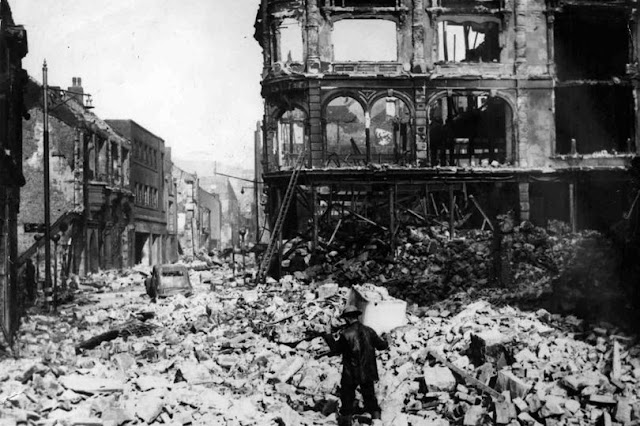
The three-day Swansea Blitz ended with 230 killed and 409 wounded, but the strategically important docks and oil refineries were largely unaffected. Swansea, Wales, United Kingdom was attacked for the third consecutive and final day. After dark, the Luftwaffe completes its three-day attack on Swansea, Wales. As on the other nights, the bombers appear over the city around 19:50 and continue the attack until after midnight. Known as The Three Nights’ Blitz, the attacks result in 230 dead (of 167,000 residents), 409 injured and 7000 homeless. The entire city center of about 41 acres is completely destroyed by 1273 high explosive bombs and 56,000 incendiary bombs. It is the worst sustained bombardment in Wales.
If there is a silver lining for the British, it is that the fire watchers organized by the Swansea Council prevent the incendiaries from combining to create a firestorm. This shows that, with adequate intervention, incendiary bombs can be greatly reduced ineffectiveness. In addition, the vital dock facilities and oil installations are largely unscathed. The number of casualties also is relatively light due to the presence of numerous Anderson and domestic shelters, some built before the war. Swansea is a textbook study on how to suffer a devastating aerial assault while containing the consequences as much as possible due to good preparation.
The Luftwaffe also raids Skálafjørður, also known as Kongshavn (King’s harbor) in Eysturoy, Faroe Islands. The British have oil installations there, along with associated shipping. They sink 398-ton anti-submarine trawler HMS Lincoln City, while anti-submarine trawler HMS Leicester City shoots down one of the attacking German planes.
A Messerschmidt Me-321 Gigant fitted with 8 bolt on hydrogen-peroxide rockets capable of providing 1102 pounds thrust for 30 seconds, was towed along a one mile runway behind a four-engined Junkers 90 (itself regarded as underpowered) and became airborne at some 100 mph. The tow was dropped at 2000 and the Gigant made a wide circuit of Leipheim airfield for 20 minutes at 87 mph.
RAF Bomber Command dispatches 1 Blenheim during daylight to oil depot at Ghent which turned back.
RAF Bomber Command dispatches 34 Wellingtons overnight to Wilhelmshaven; 19 bombed; 1 lost. Wilhelmshaven diary has no entry. 42 Hampdens minelaying off Brest. No losses. Minor Operations: 7 Whitleys to Diisseldorf, 7 Blenheims to airfields in France and Holland, 3 Wellingtons to Boulogne. 1 Wellington lost.
Air Chief Marshal Arthur Longmore sends the Air Ministry in London a telegram criticizing air supply to the Middle East. It is well known that Longmore feels that sending planes to Greece is a waste of time, and he is rapidly rising on Churchill’s list of officers to get rid of.
Destroyer HMS Boadicea departed Scapa Flow at 2100 for Rosyth to carry out repairs to her boilers. The destroyer arrived at Rosyth on the 22nd and was under repair until 3 March.
Destroyer HMS Clare, which departed Plymouth on the 20th, was damaged in a collision with British steamer Petertown (5221grt) in 50-47N, 4-50W. Destroyer Clare arrived at Plymouth on the 22nd. The destroyer was repairing and converting to a long range escort until 14 October 1941 at Portsmouth.
German aircraft attacked the British facilities at Skaalefjord. These facilities included British oiler War Pindari and oil facilities. Anti-submarine trawler HMS Lincoln City (398grt, P/T/Lt F. A. Seward RNR) was sunk by German bombing at Thorshavn. Anti-submarine trawler HMS Leicester City (422grt) shot down a German bomber.
U-552 (K.Kapt. Erich Topp), on its first mission (though Topp previously commanded U-57), is heading out for its station along the convoy routes when it is spotted on the surface by RAF aircraft. The submarine takes some minor damage and continues with its mission. This is an omen of things to come, for U-boats are vulnerable while in transit to their patrol stations because they must make the trips on the surface.
The tanker Scottish Standard (Master John Ward), a straggler from convoy OB.287, was damaged by bombs from a German Fw200 Condor aircraft (I./KG 40) in 59°19N/16°14W. Five crew members were lost. The master, 37 crew members and one gunner were picked up by HMS Montgomery (G 95) (Cdr H.F. Nash, (retired), RN) and landed at Oban. The abandoned tanker was sunk the following day by U-96.
Submarine HMS Cachalot was on patrol off Vestfjord.
Ocean boarding vessel HMS Registan arrived at Gibraltar with French steamer Fort Richepanse (3485grt), which she had captured in 30-47N, 18-59W on the 9th.
Battleship HMS Malaya relieved Force H escorting convoy WS.6A and remained with the convoy until 1 March when the convoy arrived at Freetown. Convoy WS.6B joined at Freetown. On 3 March, the convoy departed Freetown escorted by light cruisers HMS Phoebe and HMS Birmingham and armed merchant cruiser HMS Cathay. Heavy cruiser Cathay was relieved by heavy cruiser Cornwall on 11 March. Sent ahead as a fast section, steamers Scythia, Almanzora, Bergensfjord, Llangibby Castle, and Ruahine arrived at Capetown on 21 March. They departed after watering for Durban on 22 March, escorted by light cruiser Phoebe. The section arrived at Durban on 26 March, and arrived at Capetown on 22 March.
The Capetown convoy sailed on 27 March escorted by heavy cruiser HMS Dorsetshire. On 1 April, the Durban section sailed escorted by heavy cruiser HMS Cornwall and light cruiser HMS Phoebe. The two sections rendezvoused on 2 April. Heavy cruiser Dorsetshire was detached on 7 April to Durban. Steamers Llandaff Castle and City of Athens were detached to Mombasa on 8 April. On 10 April, steamer Talamba (8018grt) joined the convoy from the Seychilles escorted by light cruiser HMS Glasgow. The light cruiser remained with the convoy until 13 April. Light cruiser Phoebe was detached on 10 April. Heavy cruiser HMAS Canberra was with the convoy on 10 April only. Heavy cruiser Cornwall was detached on 17 April. At Perim, the convoy dispersed and the ships proceeded independently.
Light cruiser HMS Emerald was relieved in convoy WS.5B by heavy cruiser HMS Hawkins.
Battleship HMS Warspite was docked at Alexandria for repairs. The battleship was undocked on the 24th.
Aircraft carrier HMS Formidable aircraft raided Massawa.
Submarine HMS Ursula attacked a convoy of Italian steamers Sabbia (5788grt) and Silvia Tripcovich (2365grt), which departed Trapani on the 21st escorted by torpedo boat Montanari. Submarine Ursula damaged Italian steamer Sabbia in 35-47N, 11-16E. The submarine was damaged in the counterattack. Steamer Silvia Tripcovich continued, unescorted. Steamer Sabbia, accompanied by torpedo boat Montanari, arrived at Tripoli on the 24th.
In Washington, President Roosevelt, at a press conference, criticized Senators for allegedly divulging testimony given by General George C. Marshall, Chief of Staff, before the Senate Military Affairs Committee, and raised the question of the responsibility of the press with regard to the publication of military information. He sent to the Senate the nominations of Pierre DeL. Boal to be Minister to Nicaragua and Wesley Frost to be Minister to Paraguay and left for a week-end at Hyde Park.
The Senate heard Senators Gillette, Brooks, and Bulow oppose the Lend-Lease bill, received the Bankhead bill providing government loans on wheat, cotton, tobacco and rye, and recessed at 4:45 PM until noon tomorrow.
The House was in recess.
While controversy continued unabated between the White House and its critics over steps for strengthening national defense through greater material aid to Britain, the Senate Military Affairs Committee unanimously approved today a resolution ordering an investigation of alleged discrimination in awarding rearmament contracts. This was one development today of several growing out of the increasing defense effort. President Roosevelt asserted that the American cause was being injured through the publication by newspapers and radio of what he termed inaccurate accounts of secret testimony before Congressional committees. The President referred specifically to reports of statements reputedly made by General George C. Marshall, Chief of Staff, to the Senate Military Affairs Committee yesterday, in which he was said to have disclosed that Army and Navy fighting planes of the latest types are to be sent to strengthen American defenses in the Pacific. While the President branded these accounts inaccurate and harmful he did not say they lacked factual basis.
Three Senators, two Democrats and a Republican, told the Senate today that passage of the Lend-Lease bill would certainly lead the United States into war. Senator Gillette of Iowa, one of the Democratic opponents of the measure, said that an outright declaration of war would be preferable to the course the Administration had in mind, and that he himself would favor such a declaration if he were convinced that “Great Britain is fighting our war.” He added that he would “give every dollar I possess in the world and gladly offer my own individual life in the bargain” if he could aid Great Britain, Greece and China in their struggle against the Axis powers. In his present position, however, he felt that he must be guided by the fact that he was a representative of the American people and that he must make his decision “with full knowledge that action taken by me will react on the welfare and happiness of the American people.” Senator Brooks of Illinois, a Republican making his maiden speech in the Senate, told the Senators that his father, two brothers, one of whom was killed in the Marines, and he himself had served overseas in the last war. He mentioned the denunciations of Chancellor Hitler and the desires to crush him which he has heard Senators express during the current debate.
Wendell L. Willkie said today that he believed the swing of Republicans to the support of the Lend-Lease bill was symbolical of a trend within the party away from isolationism.
The U.S. government announced today that it would purchase an undisclosed quantity of South American canned meat for the expanding army and navy a move which was expected to help cement relations with such beef-producing nations as Argentina. Although any move to buy such meat has hitherto been a sore point with members of congress from western range states, Senator O’Malley, Wyoming Democrat, immediately announced that a number of livestock men had consulted appeared to have no objection to today’s move. Referring to speeches he has made in the past against the purchases of South American canned beef, he said: “The situation is different now. We didn’t have any such army then.”
President Roosevelt arrived tonight for a weekend of conference at his Hudson valley home with Harry L. Hopkins, his personal envoy to Britain.
Churchill complains in a note to Harry Hopkins about having to give up “all our direct investments” to the Americans. “Is this really necessary?” he writes. It really is necessary. Despite his plaints, the British government authorizes the transfer. This effectively places the financial future of Great Britain in American hands — where, to be honest, it has been throughout the conflict.
For the second time within twenty-four hours the Fisher Body Corporation in Lansing, Michigan ceased operations just before noon today, and the Oldsmobile division of the General Motors Corporation, dependent upon it for materials, curtailed its activities, after worker slowdowns.
U.S. Navy aircraft carrier USS Enterprise (CV-6) stands 10-15 miles off Oahu and launches 31 USAAC Curtiss P-36 Hawk fighters. Taking off in flights of three, the fighters will be based at Wheeler Field in the Wahiawa District near Pearl Harbor (next to Schofield Barracks). Wheeler lies just north of the naval base. This is the first time in US Navy history that a regular USAAC fighter is flown off a carrier’s deck in a ferrying operation — something the British have been doing with some regularity in the Mediterranean. Looking ahead, some of these fighters will be present and get into action on 7 December 1941. The P-36 fighter is approaching obsolescence. The USAAC already has a better fighter, the P-40, in service. However, at this time, the P-36 is considered the basic American fighter.
The Japanese Consulate in Honolulu is a hotbed of spies. Today, Consul Ojiro (Otohiro) Okuda sends his first true spy message to Tokyo. He observes fleet movements in Pearl Harbor from a hill hear his office, then sends the information to the IJN. The message notes the recent comings and goings of warships in the harbor, and also provides a detailed list of the ships currently in the harbor (which must have taken some effort to compile), to wit:
“Seven battleships (three of the New Mexico class, two of the Pennsylvania class, one each of the Oklahoma and California classes); four heavy cruisers, (two of the New Orleans class and two of the Portland class); ten light cruisers, (four of the Honolulu class; six of the Omaha class of which one is in drydock); thirty destroyers; three destroyer tenders; aircraft carriers, Yorktown and Enterprise; one troop transport; one submarine tender; (no submarines were visible).”
It takes quite some military knowledge to distinguish between different classes of ships, including cruisers, so Okuda likely received extensive training in Japan before assuming his position in Hawaii. The military planners in Tokyo find Okuda’s information useful but do not wish to compromise him, so they consider sending a military aide to make the observations.
U.S. Army officer Omar Bradley is promoted to the rank of brigadier general.
A “substantial proportion” of the social science textbooks now used in the high schools of this country tend to criticize our form of government and hold in derision or contempt the system of private enterprise, Dr. Ralph West Robey, assistant professor of banking at Columbia University, said yesterday in summarizing his personal conclusions from abstracting the textbooks for the National Association of Manufacturers.
Promising young stars Robert Young and Dean Jagger team with Randolph Scott in Fritz Lang’s “Western Union,” which opens today. It is a rare 20th Century Fox technicolor film (there remain very few color film cameras in Hollywood) and is filmed on location in House Rock Canyon, Arizona and Kanab and Zion National Park, Utah. Reviews of the time generally focus on how colorful and vivid the film is — the acting and story are distinctly secondary. Several Native Americans appear in the film, including Chief John Big Tree and Chief Thundercloud. The Academy Film Archive will preserve the “Western Union” in 2000. Lang, incidentally, left Germany in 1934 in disgust at the German regime’s control over the film industry despite being offered the plum position of head of UFA by Propaganda Minister Joseph Goebbels.
Buster Keaton stars in Columbia Pictures’ “So You Won’t Squawk,” a two-reeler directed by Del Lord, a veteran director for Mack Sennett. It also opens today.
Major Sir Frederick Grant Banting, inventor of insulin and a top aviation medicine researcher, perishes from wounds and exposure suffered following a 20 February 1941 Lockheed Hudson crash in Musgrave Harbour, Newfoundland. The plane’s engines fail, causing the bomber to come down in a remote forested area. Banting survives in the frigid weather for a day, into 21 February 1941, before succumbing. Banting, who had just re-enlisted despite being in his forties, was on his way from Gander to London to serve as a liaison between the medical services of Canada and Great Britain. It is a terrible way to go, a Nobel Laureate wasting away in the wilderness.
The apparent intention of the American republics to preserve the Pan-American “neutrality zone” was reported tonight to be a major obstacle to the establishment of a British blockade base in the West Indies. British authorities, believing that supplies from South America are escaping the blockade by shipment through the Far East and Russia to Germany, have been considering setting up a contraband control station at Trinidad or some other British possession in the Caribbean area. Ship cargoes passing through the Panama canal from South America into the Pacific would thereby become subject to inspection and seizure in the absence of satisfactory proof they were not destined for Germany. Some authorities fear, however, that the establishment of a base in American waters might bring the war into the western hemisphere and might hamper inter-American shipping. An indication that the American republics intend to support the neutrality zone idea came today from Sumner Welles, under-secretary of state. He disclosed that, in accordance with the Panama declaration, a majority of the American governments had agreed to join in a collective protest to Great Britain over the recent seizure of the French merchant vessel Mendoza off the Brazilian coast while it was seeking to run the blockade to France.
German heavy cruiser Admiral Scheer sank British steamer Canadian Cruiser (7148grt) in 6-36S, 47-18E. Admiral Scheer, having sunk two ships about 2000 km east of Madagascar on the 20th, today sinks a third. It is 7178-ton Canadian freighter Canadian Cruiser. The entire crew becomes POWs. The Canadian Cruiser notifies the Royal Navy of its plight, causing nearby patrolling cruiser HMS Glasgow to head toward the spot.
Britain is shifting air reinforcements to the Far East, informed quarters reported today, to counter reported Japanese threats in the Pacific where Australian Prime Minister Robert Gordon Menzies warned the government “elements of danger” exist. Other R.A.F. units are said to be moving to Africa and Greece to join those already there in meeting German aerial assistance to Italy on the Mediterranean fronts.
In a memo to Permanent Under-Secretary of State for Foreign Affairs Alexander Cadogan, Prime Minister Winston Churchill inquires about a digest of intercepted phone calls between different foreign embassies in London. The British are tapping the Thai Embassy phones, and the Thais have conversations with the Japanese and Nepalese embassies which involve top secret information about Japanese war plans. This appears to be a primary source of British information about Japanese plans.
Reliable travelers arriving from Saigon, French Indo-China, asserted today that Japan’s military and political grip on French Indo-China is being strengthened daily and that foreign residents of Saigon are convinced Japan is preparing to strike at the East Indies with Saigon as a sea and air base. These sources said the Japanese who entered Saigon on the pretext of mediating the border conflict between Indo-China and Thailand already had completely undermined French authorities and now are dictating the colony’s internal and external affairs, duplicating conditions in northern Indo-China. With Japanese warships tied up at Saigon and others patrolling the coast, and with Japanese bombers at the Saigon airport, the French have been reduced to the roles of puppets, the travelers said.
The Japanese consulate in Honolulu sends a message to Tokyo stating that “The capital ships and others departed from Pearl Harbor on the 13th and returned on the 19th. (It is said that they will depart again on the coming Wednesday and return on the following Wednesday).” The message also contains a list of the ships in the harbor.
The Japanese press accused the United States and Britain today of heading a four-power scheme intended to “encircle” this country, and Foreign Minister Yosuke Matsuoka declared that continued British and American defense preparations in the south Pacific would create a situation “attended by considerable danger.” A commentator in the newspaper Nichi Nichi asserted that “the Anglo-Saxons” were cleverly trying to split Japan away from the German-Italian axis, remarking: “What we should fear is neither warplanes, bombing planes nor parachute troops but the plots and schemes under which Britain and the United States attempt to collapse the tripartite alliance by utilizing their first rate art of propaganda.”
The absence of Premier Prince Fumimaro Konoye from the Japanese Diet on a plea of Illness was the subject of polite but definite comment today by the important newspaper Asahi, which said, “there seems to be room for criticism of his continued absence and his occasional illness at the most critical times.”
Born:
Haldane Robert Mayer, United States Circuit Judge, in Buffalo, New York.
Died:
Frederick Banting, 49, Canadian medical scientist and Nobel laureate, of wounds from a plane crash.
Dow Jones Industrial Average: 120.24 (+0.25)
Naval Construction:
The Kriegsmarine (German Navy) Type IXC U-boat U-511 is laid down by Deutsche Werft AG, Hamburg (werk 307).
 History Diaries