The name German Africa Korps (Deutsches Afrikakorps) was established for German forces in North Africa. General Rommel begins sending patrols out of Tripoli to look for the British — who are more interested in Greece than they are in the Afrika Korps.
The Free French Army under Colonel Leclerc continues to invest the El Tag fortress at Kufra. The French are bombarding the fortress with a 74 mm field gun and several mortars.
The Greeks stage a minor attack west of Klisura, Albania, on 19 February 1941. However, the Epirus Army makes little progress against the Italian 11th Army.
While the front remains locked in the status quo, the British are furiously working on plans to help Greece and break the stalemate. Secretary of State Anthony Eden and Chief of the Imperial General Staff Field Marshall Sir John Dill, both in Cairo to help with this project, meet with General Alan Cunningham (brother of the Admiral) and Middle East Commander General Archibald Wavell (American observer “Wild Bill” Donovan also is in town). Bowing to the inevitable, Wavell expresses the willingness and ability to start transferring troops.
Britain may seek to transfer formidable land and air forces into Greece before Adolph Hitler can consolidate his Balkan diplomacy and move to force the Greeks into a dictated peace with Italy, it was intimated in British quarters last night. Determined to keep their foothold in the Balkans, the British were reported in informed British quarters to be preparing to fight it out against the Germans on Greek territory, if necessary. British Foreign Secretary Anthony Eden, Chief of the General Staff John Dill, Commander-in-Chief Middle East General Archibald Wavell, and Mediterranean Fleet chief Admiral Andrew Cunningham met in Cairo, Egypt to discuss diverting forces from North Africa to aid Greece. The British political leaders are strongly in favor of sending all that can be spared and Wavell, the military commander who is responsible, believes that this can be done effectively and is, therefore, prepared to recommend it.
British Prime Minister Churchill sends a memo to Permanent Under-Secretary for Foreign Affairs Alexander Cadogan in which he writes that it is “impossible” for the British Army to both advance into Tripoli and assist Greece at the same time. Churchill expresses doubt that Greece actually will accept aid, but vows to send “whatever troops we can get there in time.” Further advances in North Africa, he says, “may well happen,” but only after Greece makes some kind of arrangement with Italy and Germany.
Greece is determined to fight to the end against Italy, well-informed Greek quarters said today in denying categorically that any German pressure had been put on the Athens government to make peace with Italy. The new Bulgarian-Turkish declaration of neutrality and non-aggression has not altered existing commitments among the Balkan nations, these quarters said. No word on armistice terms or that formal German demands had yet been served on the Athens government. Any British aid rushed to Greece from North Africa, these diplomats said, probably will be too late to bolster the Greeks enough to permit them to refuse the German pressure.
At Malta, Governor Lieutenant General Dobbie telegrams a proposal to the War Office to impose compulsory conscription.
The German News Bureau reports that traffic through the Suez Canal has been seriously hampered as a result of German air attacks. The high command reports that two vessels have been sunk in the middle of the canal while its harbors and freight yards have been extensively damaged. Its information is surprisingly accurate, noting the shipping losses that have closed down sections of the canal. While hardly a surprise, this shows they have good agents in the vicinity, most likely among the Arab population which throughout the war shows an affinity for the German cause.
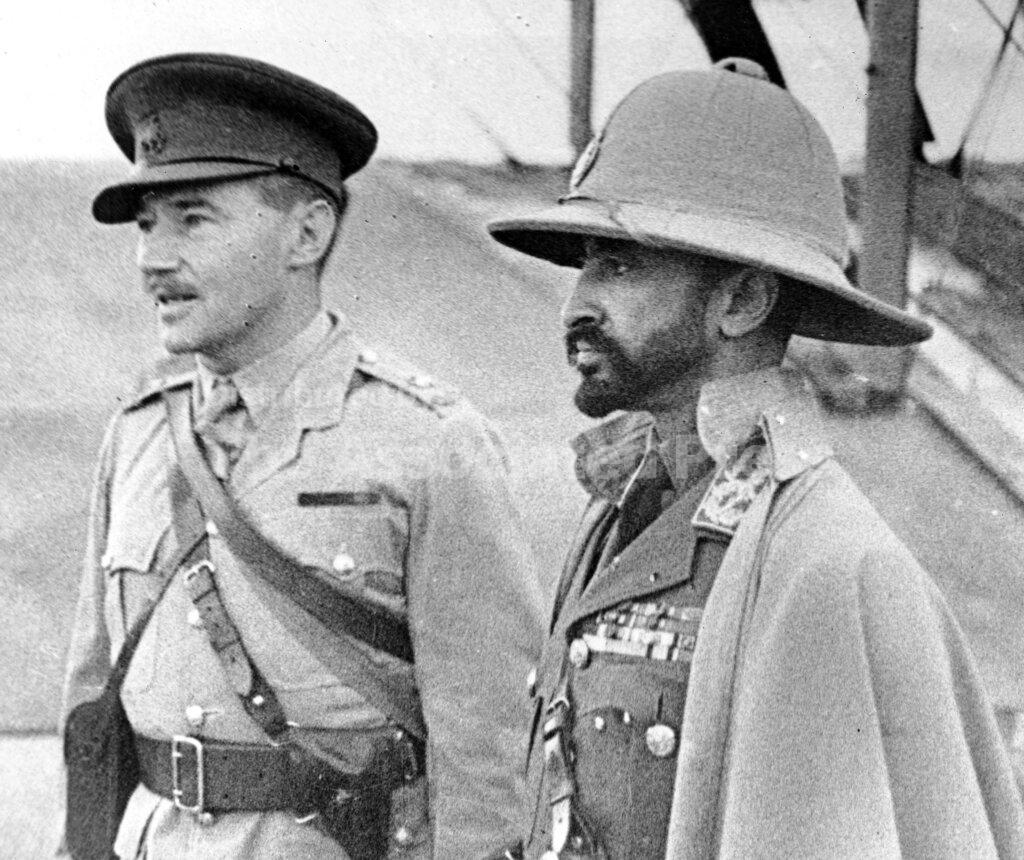
Emperor Haile Selassie, who was brought back to Abyssinia in January to help organize resistance to the Italians, arrives at Dangilla. He is protected by Brigadier Orde Wingate’s Gideon Force. As expected, he proves wildly popular among the native population. During the next two weeks they harass the Italian troops around Bahrdar Giorgis and Burye with considerable success. The Italians have four brigades in the area and the Gideon Force is only 1700 strong. Cunningham’s troops cross the river Juba and head towards Mogadishu, Italian Somaliland.
Gold Coast troops find a crossing of the Juba River at Mabungo. After furious bridge-building before dawn (it is known as “Union Bridge”), “A” Company of 1st Transvaal Scottish break out of a small bridgehead toward the Jumbo-Jelib road. Before they reach the road, however, the Italians (193rd Colonial Infantry Battalion) open fire, supported by artillery (four light field guns). In 3 hours, Italian Artillery fire over 3,000 rounds. The British get half a dozen armored cars across the river and disperse the native troops. The British take two wounded, while the Italians lose four officers and forty dead native troops. This opens the crossing completely, and during the afternoon the British cross the river in strength. Jumbo lies just ahead, and many Italian troops flee during the night. This leaves it easy prey for the British troops. Other British troops also cross the Juba and head towards Mogadishu.
The port of Kismayu, previously captured, opens to Allied shipping.
Prime Minister Winston Churchill memos Secretary of State for Dominion Affairs Viscount Cranborne about Cranborne’s proposed visit to Eire. Churchill clearly feels the visit would be pointless and notes that Cranborne either would have to lie, or “make many inconvenient admissions” about “the hard policy which it is our duty to pursue.” Churchill concludes that Cranborne can raise the issue of a visit to Ireland with the Cabinet — which of course Churchill controls completely.
Churchill expresses outrage that the author of a pamphlet expressing positions antithetical to those of the government (meaning Churchill) has not been disciplined under Defence Regulation 18B. The Duke of Bedford, Churchill writes, should be treated “with severity.” Bedford espouses such heretical notions as negotiating peace with Hitler. By reference to Sir Oswald Mosley, Churchill makes clear that he believes Bedford belongs in prison. Throughout the war, Churchill takes a very dim view of anything that criticizes him or the progress of the war.
Australian Prime Minister Robert Menzies flies from Freetown to Lisbon en route to London. He notes that Lisbon recently suffered a hurricane, which sank one of the two flying boats that had been available to transport him. He meets with local Ambassador Sir Ronald Campbell, who urges him to look with favor on Marshal Petain, who “has done well” after an unavoidably rocky beginning.
The owners of the Amsterdam ice cream salon Koco, Ernst Cahn and Alfred Kohn, defended themselves against the German Grüne Polizei that stormed into their establishment. Several of the policemen were injured in the fight. The German occupation authorities took revenge by arresting 425 Jewish men and sending them to concentration camps. This action sparked a large scale protest strike known as the “Februari Strike” which began on February 24, 1941 and lasted until February 27, 1941.
Four Danish youths were sentenced today to prison terms ranging from six months to two years for beating or starting fights with German soldiers.
The Turkish press insisted tonight that the Turkish-Bulgarian non-aggression agreement in no way affected Turkey’s relations with Greece and Britain and that Bulgaria would attempt to prevent any German march towards Greece. The official Turkish radio said that the axis, in reporting the pact, “has taken advantage of it for its own purposes.” Turkey’s British ally, on the contrary, “has not taken this attitude, but has said that she was fully informed of the negotiations .and in full agreement with them,” the radio commentator said.
A prominent former official of the French government asserted today that France “is at the point of fighting against Great Britain,” probably in the Mediterranean, as the result of strong German demands. (The “former official” appeared to be Pierre Laval, who is known to favor France’s reentry into the war on Germany’s side and whose ouster as French vice-premier on December 14 precipitated a serious crisis in French-German relations which remains unsolved.)
The three-day Swansea Blitz began. German bombers began a three-day campaign against the port city of Swansea, Wales, United Kingdom. The German Luftwaffe started the bombing known as the “three nights Blitz” of Swansea in South Wales. Over these three nights of intensive bombing, the Swansea town center was almost completely obliterated. After a long period without any apparent strategy, the Luftwaffe resumes its campaign against particular moderate-sized cities. This is despite snowstorms during the day which largely keeps RAF Bomber Command grounded. Weather conditions over England and the Continent can be dramatically different.
Just as cities like Coventry and Bristol have borne the brunt of concentrated Luftwaffe attacks, now it is Swansea’s turn. This becomes known as “The Three Nights’ Blitz.” The bombers appear at 19:30 and target 41 acres around the city center — there is no subtlety about this attack. The historic heart of the city is destroyed.
British tug Queenforth is damaged and sinks during the Swansea attacks. It comes to rest in shallow water and is refloated in 1942.
RAF Coastal Command bombs Brest and Calais.
The Luftwaffe engages in a dogfight involving Bf 110s of III,/ZG 26 and Hurricanes of Australian No. 3 Squadron. The Germans lose a Zerstörer but shoot down two Hurricanes for their first two victories in North Africa.
The Luftwaffe attacks Benghazi. Australian destroyer HMAS Stuart suffers damage from a near miss, but the damage is negligible.
In an attempt to obtain transport and communications aircraft for the Middle East theatre, the Air Ministry is trying to buy second-hand on the US market, but there are few available. The available communications aircraft are: Nine Lockheed Lodestars, 16 Bristol Bombays, three Lockheed Electras and a lone DC-2. The DC-2 was a DC-2-112, msn 1244, that had been delivered to Transcontinental and Western Airlines (TWA) in July 1934 registered NC13718 and assigned fleet number 308. The aircraft was purchased by Cox and Stephenson (was this the New York spy outfit?) for the British Purchasing Committee on 19 February The aircraft was assigned the RAF serial number DG471 and assigned to No. 31 Squadron, a transport unit based at Lahore, India. The squadron moved to Drigh Road in Karachi India on 26 March 1941 and then back to Lahore.in September 1941. This particular DC-2 was destroyed when it crashed on 24 October at Drigh Road. The British Purchasing Commission actually acquired 21 surplus DC-2s between November 1940 and September 1941.
U-69, commanded by Kapitänleutnant Jost Metzler, sank British steamer Empire Blanda (5693grt), which was straggling behind convoy HX.107, in the North Atlantic. At 0818 hours the unescorted Empire Blanda (Master George Alan Duncan), a straggler from station #24 in convoy HX-107 since 18 February, was hit on starboard side amidships by one G7e torpedo from U-69 while steaming in rough seas about 160 miles south of Iceland. The ship had been missed with a spread of two torpedoes at 0744 hours and a single torpedo at 0801 hours, so the U-boat went closer to fire the fourth torpedo from a distance of only 400 meters and was almost hit by falling debris because the ship sank by the bow within 20 seconds after four heavy detonations that presumably were boiler explosions. The master, 37 crew members, one gunner and one passenger were lost. The 5,693-ton Empire Blanda was carrying scrap iron, steel, and explosives and was bound for Grangemouth, England.
U-103, commanded by Korvettenkapitän Viktor Schütze, sank Norwegian steamer Benjamin Franklin (7034grt), which was straggling behind convoy HX.107, in 58-50N, 16-30W. At 2222 hours the unescorted Benjamin Franklin (Master Alf Anderssen), a straggler from convoy HX-107 due to bad weather, was struck on port side in the engine room by one G7e torpedo from U-103 about 120 miles northwest of Rockall. The ship had been chased for nine hours and missed with a first torpedo at 2146 hours. The U-boat waited for the ship to sink, but then fired its last torpedo as coup de grâce at 2321 hours that hit on the starboard side under hatch #4, where 1700 barrels of aceton were stowed. The ship disintegrated in an enormous explosion, but all crew members had already abandoned the ship after the first hit in two lifeboats, which were later separated in heavy weather with snow and strong winds. On 26 February, the seven sailors in one of them were picked up by HMS Pimpernel (K 71) (Lt F.H. Thornton, RNR) and landed at Liverpool two days later. The remaining survivors were rescued by the Egyptian steam merchant Memphis, but on 28 February her engines were disabled in heavy weather and she foundered northwest of Ireland in 56°40N/10°30W. All on board were lost. On the morning of 21 February 1941 the Italian submarine Barbarigo (CC Giulio Ghiglieri) came across a raft with seven Norwegian survivors in approx. position 58°25N/16°55W and gave them two boxes of biscuits. It is possible that these were the seven men from Benjamin Franklin that were later rescued by HMS Pimpernel. The 7,034-ton Benjamin Franklin was carrying general cargo, including lead, explosives, and aircraft parts and was bound for Liverpool, England.
Admiral Lütjens in command of Operation BERLIN, with two battlecruisers (Gneisenau and Scharnhorst) prowling the North Atlantic shipping lanes, is frustrated. He can’t find any targets on the most heavily traveled route to Great Britain. He decides to turn west to see what turns up.
Light cruiser HMS Dido and destroyers HMAS Napier and HMS Bedouin departed Scapa Flow at 2100 to escort the battleship HMS Queen Elizabeth from Rosyth to Scapa Flow. Destroyer HMS Somali, completing boiler cleaning at Rosyth, joined the escort to Scapa Flow.
Destroyer HMS Echo arrived at Scapa Flow at 0800 from Loch Alsh after duty escorting the minelayers in operation SN.68.
Destroyer HMS Electra departed Scapa Flow for Aberdeen to escort troopship Amsterdam. However, due to mining in the approaches to Aberdeen, destroyer Electra was diverted to the Humber for docking and repairs.
Destroyer HMS Boadicea arrived at Scapa Flow at 1800 from Plymouth to carry out working up exercises.
Destroyer HMS Quantock arrived at Scapa Flow from Greenock at 1500 to carry out working up exercises.
Sloop HMS Pelican was damaged by mining twelve miles off Harwich. The sloop was towed to Sheerness and was under repair until 1 December 1941.
Heavy cruiser HMS Devonshire began refitting at Liverpool which was completed on 22 May.
Submarine HMS Tigris sank French steamer Jacobsen (523grt) off Bayonne and French steamer Guilvinec (3181grt) sixty miles west of St Nazaire in 44-48N, 3-01W.
In late February to the first week of March, Submarine depot ship HMS Forth and submarines were sent to Halifax. The submarines were to revive the early war practice of assigning a submarine to cover HX convoys. Submarine HMS Severn arrived at Halifax on the 27th. Free French submarine Surcouf arrived at Halifax on 3 March. Submarine HMS Thunderbolt departed Holy Loch on the 19th and arrived at Halifax on 5 March. Submarines HMS Porpoise, HMS Taku, and HMS Tribune departed the Clyde on 24/25 February. Submarine Taku broke down en route and returned. Submarines Porpoise and Tribune arrived on 11 March. Submarine HMS Talisman departed Holy Loch on 6 March and arrived at Halifax on 26 March. Depot ship Forth departed Aultbrea on 2 March. Dutch submarine HNLMS O-15, already at Halifax, was also assigned to this Flotilla.
Sub Lt N. D. M. Parsons and Petty Officer A. Ashby were killed when their Skua of 801 Squadron, en rute from Donibristle to St Merryn, crashed in fog at Elidir Fach, near Llanberis.
The German 1st MTB Flotilla with S.28, S.101, and S.102 made a sortie against the British east coast. British steamer Algarve (1355grt) was sunk by S.102 near Sheringham Light Float, and the entire crew lost.
British steamer Gracia (5642grt) and British tanker Housantonic (5559grt) were sunk by German bombers in 59-39N, 7-24W from convoy OB.287. The entire crew was rescued from Gracia. Three crewmen from tanker Housantonic were lost.
Dutch steamer Karanan (395grt) was damaged by German bombing six miles southwest of Lizard. One crewman and two gunners were lost. The steamer was towed to Falmouth.
British steamer Fulham II (1596grt) was damaged by a mine off Tyne Piers. One crewman was lost. The steamer went ashore at Frenchman’s Point. The steamer was later refloated and proceeded to Jarrow in tow.
British tanker Athelsultan (8882grt) was damaged by German bombing 2¼ miles 120° from May Island. The steamer anchored in Methil Roads later that day.
During the night of 19/20 February, British tug Queenforth (204grt) was damaged by German bombing in King’s Dock at Swansea. The tug was raised in 1942.
For Operation MC.8 the following British forces were deployed. Aircraft carrier HMS Eagle with a destroyer screen departed Alexandria to exercise flying prior to the Main Fleet’s departure.
Force A was composed of battleships HMS Barham and HMS Valiant and destroyers HMS Jervis, HMS Janus, HMS Jaguar, HMS Ilex, HMS Hereward, HMS Hero, HMS Hasty, HMS Dainty, and HMS Decoy, departing Alexandria at 1630. Aircraft carrier HMS Eagle joined the force at sea. Force A was to cover the operation.
Force B was light cruisers HMS Orion, HMS Gloucester, and HMS Ajax and destroyers HMS Nubian, HMS Mohawk, and HMS Diamond. Four hundred and ten Army personnel were embarked on Orion, three hundred and seventy four on Ajax and six hundred and fifty seven on Gloucester. Also, carried by this force were 130grt of equipment, seventeen Bren carriers and other vehicles, sixty motor cycles, a large quantity of Italian and other guns and ammunition. A crew for destroyer HMS Imperial, twenty submarine torpedoes, a number of Maltese ratings, one LL minesweeping gear was carried aboard the ships. Force B departed Alexandria at 1730.
At Malta, supply ship Breconshire, steamer Clan Macauley, and destroyers HMS Hotspur and HMS Havock were brought away. These ships departed Malta at dusk on the 20th. Anti-aircraft cruiser HMS Coventry joined this force. Despite air attacks on this group, they safely arrived. Cruiser Coventry, destroyer Havock, and store ship Breconshire arrived at Alexandria at 0745/23rd. Steamer Clan Macauley and destroyer Hotspur arrived at Port Said at 1630; destroyer Hotspur then proceeding to Alexandria.
Force B arrived at Malta at 0630/21st. After unloading the force departed at 1900. Destroyer HMS Diamond remained at Malta for refitting. Destroyers HMS Mohawk and HMS Nubian were detached from Force B during the night of 21/22 February and joined Force A at daylight on the 22nd. On their arrival, destroyers HMS Decoy and HMS Hereward were detached to Suda Bay. Light cruiser HMS Gloucester was detached for Suda Bay on the 22nd. On the 22nd, destroyers HMS Dainty and HMS Hasty were relieved by destroyers HMAS Stuart and HMAS Vampire. The earlier destroyers proceeded to duties off Tobruk. An air strike by aircraft carrier HMS Eagle during the night of 22/23 February on Rhodes was cancelled due to bad weather. Force B arrived at Alexandria at 1000/23rd and Force A at 1830.
Australian destroyer HMAS Stuart was damaged by the near miss of a German bomb off Benghazi. The destroyer spent no time out of service.
Submarine HMS Upholder made an unsuccessful attack on an Italian steamer south east of Gulf of Gabes.
Light cruiser HMS Phoebe was detached from convoy WS.6A to refuel at Gibraltar. The light cruiser departed that same day and rejoined the convoy.
Convoy AC.1 left Benghazi due to air attacks and poor facilities escorted by anti-aircraft cruiser HMS Coventry, corvettes HMS Gloxinia and HMS Hyacinth, and two trawlers. Both corvettes had been damaged by the explosion of mines in their sweeps. The convoy would be met later in the day by destroyers HMAS Stuart and HMAS Voyager, and arrived at Tobruk on the 20th. Monitor HMS Terror remained at Benghazi as an anti-aircraft guard ship.
Convoy HX.110 departed Halifax. Battleship HMS Ramillies joined the convoy on the 21st. The battleship was detached on 3 March. Destroyers HMS Harvester, HMS Havelock, and HMS Hesperus joined the convoy on 6 March and destroyer HMS Hurricane joined on 8 March. Destroyer Harvester was detached on 8 March and destroyers Hesperus and Hurricane on 10 March. Anti-submarine trawler HMS Huddersfield Town joined on 8 March and destroyer Havelock and the trawler were detached when the convoy arrived at Liverpool on 11 March.
In Washington today, President Roosevelt signed the bill increasing the national debt limit to $65,000,000,000, sent to the Senate the nomination of G. Howland Shaw to be Assistant Secretary of State, and discussed steel production with Irving S. Olds and Benjamin Fairless of the United States Steel Corporation.
The Senate debated the Lend-Lease bill, hearing Senator Bailey, who opposed repeal of the arms embargo, advocate intervention now in the European war, and recessed at 5:03 PM until noon tomorrow. The Appropriations Committee reported a $395,357,775 Deficiency Bill carrying $375,000,000 for relief.
The House passed the bill authorizing 3345,228,500 in improvements to naval bases in the Atlantic and Pacific Oceans and adjourned at 3:43 PM until noon tomorrow. The Judiciary Committee heard William S. Knudsen on the defense labor situation.
Three southern senators backed the Lend Lease bill today, and one of them, Senator Bailey, North Carolina Democrat, asserted that the utmost help should be given to England even if the ultimate result is war. “I am hoping this intervention may not mean war,” he told a suddenly hushed and solemn senate. “But if it does, I am ready for it.” Great Britain is standing virtually alone against a combination of forces whose one purpose is world revolution, he said. And if Britain falls, he added, America, “a lone republic in a totalitarian world,” will be in peril. “It is intervention,” he said of the measure. “It is not neutrality. It is the reversal of the policy that we laid down in the Neutrality Act and for which I stood here and spoke in great sincerity and in all earnestness. “It is intervention. We may not regard it as war, and intervention is not necessarily war. There is a difference between intervening and being an armed belligerent. “However, it is not to be denied. that the totalitarians may regard it as an act of war. What of it if they do? The totalitarian powers are not moved by provocation. Provocation means nothing. They will move without provocation just as quickly as with provocation, and they have done it over and over again.”
President Roosevelt signed today the bill raising the Federal debt limit to $65,000,000,000 from $49,000,000,000, and authorizing for the first time in the country’s history the issuance of taxable Federal securities. By the President’s action, the nation’s per capita obligation can go to about $500, from the present $377. Federal bonded indebtedness was $46,040,167,402.32 on Monday, the last day for which figures are available, as against $42,298,568,363.34 on February 17, 1940. This was an increase of $3,741,599,036.98 in a year. Signing of the measure ended a dispute which has raged for years as to whether interest from Federal securities should be taxed on the same basis as income from other sources. The government moved swiftly today to arrange the refunding of outstanding obligations with taxable securities, including Treasury bills, notes and bonds, thus replacing “tax exempts” as soon as call dates permit.
A plan to develop naval outposts at Guam and Samoa won speedy and unanimous House approval today after the navy’s high command recommended strongly that any protest by Japan against the Guam project be “totally disregarded.” In sharp contrast to the furor created at two past sessions when the house rejected requests for harbor developments for Guam, there was not a word of protest when the item went through today in a bill to authorize a $242,000,000 naval base development program. The measure now goes to the Senate. Unusual criticism of the Japanese as individuals developed on the house floor during the relatively brief debate. While Representative Faddis, Pennsylvania Democrat, was urging a strong United States policy toward Japan, Representative Gore, Tennessee Democrat, arose and interrupted: “I am glad the gentleman is paying his respects to these scrubby, contemptible, squint-eyed sons of the Rising Sun.”
While opposing war, Mrs. Franklin D. Roosevelt said yesterday, there were “some things” worth dying for and indicated that it might be better for this country to go to war if it were necessary to save Britain from defeat.
William S. Knudsen, director of the Office of Production Management, today told the House Judiciary Committee that no legislation was needed to deal with labor strife in defense industries and positively advised against it.
Printed notices that the Ford Motor Company would “cease and desist” from discouraging organization work among its employees by the United Automobile Workers-C.I.O. and otherwise comply with an order of the National Labor Relations Board were posted today in departments of the company’s plants.
Representatives of between 10,000 and 12,000 C.I.O. steel workers will meet tomorrow “to decide on action to combat the lockout of employees” at the Bethlehem Steel Company’s Lackawanna, New York, plant, Lorne H. Nelles, international representative of the Steel Workers Organizing Committee, announced tonight.
Deliveries of planes to the Army and Navy and the British during January totaled 957, out of a total production of 1,036 craft of all types, William S. Knudsen, director general of the Office of Production Management, reported today.
U.S. Navy Rear Admiral Purnell attends a conference which included Army, Navy, and Air Force representatives from the U.S., UK, Australia, New Zealand, and the NEI.
Rear Admiral William P. Blandy relieves Rear Admiral William R. Furlong as Chief of the Bureau of Ordnance.
The U.S. Coast Guard Reserve is established.
The battleship USS Washington (BB-56), the second of six battleships of 35,000-ton displacement each which are under construction, will reportedly go into commission May 15, seven months ahead of the commissioning time specified in the original contract.
New Japanese Ambassador Nomura gives his first press conference in Washington. He tries to be reassuring, saying that there need not be war in the Pacific if the U.S. does not want it.
The American Volunteer Group under Claire Chennault is going to be based in Rangoon. The first shipment of P-40s leaves New Jersey for Burma.
A Japanese offer of mediation has been addressed formally to the British Foreign Office, Richard Austen Butler, Foreign Undersecretary, revealed in the House of Commons today. He stated that it was under study. In the course of the discussion in the House of Commons on Britain’s relations with foreign countries Mr. Butler disclosed that the government was studying “a special message” from Japanese Foreign Minister Yosuke Matsuoka. He stated that this message was couched “in courteous terms.” The indication that the note was an offer of mediation was contained in Mr. Butler’s statement that it followed the lines of yesterday’s statement in Tokyo by Koh Ishii, Cabinet spokesman.
Japanese excitement over the posting of heavy British imperial forces at Malayan battle stations ran high today amid official Japanese army charges that the British had committed a “belligerent action.” Simultaneously Britain turned a courteously cold shoulder to a Japanese offer to mediate the war with Germany Japan’s axis partner. Sailors of Japanese warships at Saigon, French Indo-China, remained close to their anchorage instead of wandering throughout that port as usual. Japanese officials at Saigon dashed about for hours yesterday from their hotels to the Japanese-occupied Saigon airport, to the Japanese consulate, and to the 5,170-ton Japanese cruiser Nagara but all that a Japanese military official in Saigon would say was that “we are not informed that the Australians have arrived at Singapore.”
Admiral Kichisaburō Nomura expressed the personal belief today, at the first press conference he has held since he became Japanese Ambassador, that there would not be a war between the United States and Japan, provided the United States did not take the initiative in the fighting.
Acting Australian Prime Minister A.W. Fadden, speaking at the annual dinner of the Royal Automobile Club tonight, summed up the War Council’s warnings on the Pacific situation as indicating that the war might suddenly spread and bring the conflict overnight near or even to Australian shores.
Dow Jones Industrial Average: 117.94 (-1.04)
Born:
David Gross, American physicist and Nobel laureate (2004, for discovery of asymptotic freedom in the theory of the strong interaction), in Washington, District of Columbia.
Imre Szöllősi, Hungarian sprint canoeist (Olympics, 2 silver medals, 1960, bronze, 1968), in Budapest, Hungary (d. 2022).
Warren Powers, AFL safety (AFL Champions-Raiders, 1967 [lost Super Bowl II]; Oakland Raiders) and coach (Washington State University 1977, University of Missouri 1978-1984), in Kansas City, Missouri (d. 2021).
Stephen Dobyns, American author and poet (“Cold Dog Soup”), in Orange, New Jersey.
Naval Construction:
The U.S. Navy coastal minesweeper USS Waxbill (AMc-15) [ex-Leslie J. Fulton] is recommissioned and placed in service.
 History Diaries