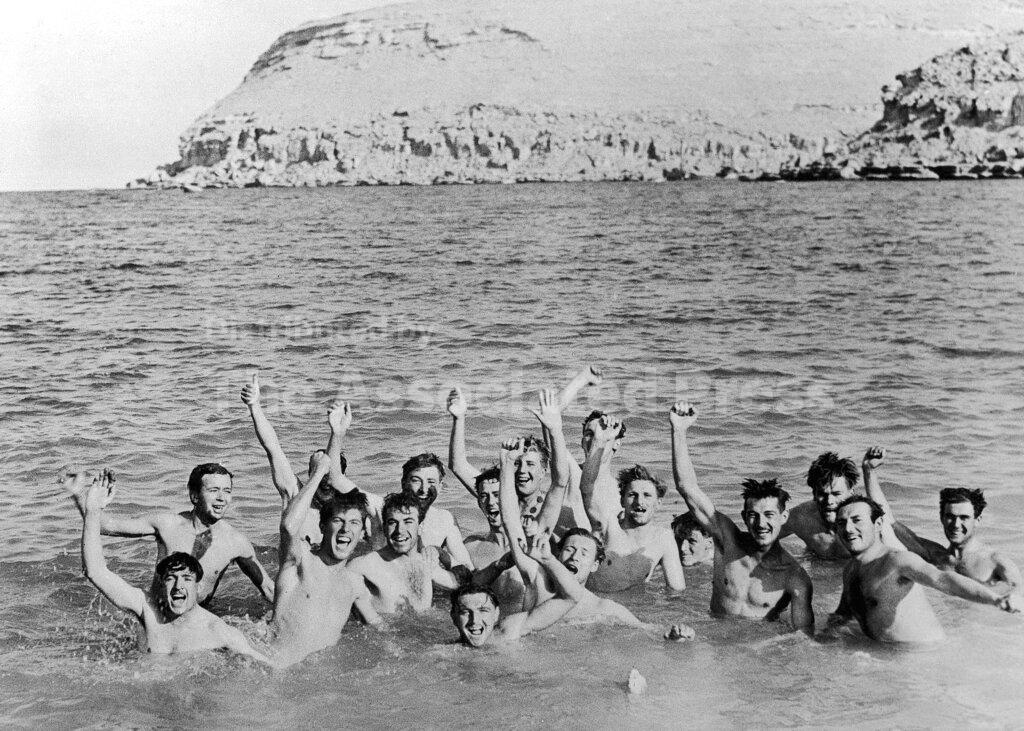
The German troops fighting in North Africa officially received the name Afrika Korps. The German 5th Light Division (later renamed the 21st Panzer Division) was formed for operations in North Africa. General Rommel’s forces in Tripolitania pursuant to Operation Sunflower receive their new title: Afrika Korps. General Rommel formally organizes the 5th Light Division in Tripolitania. Already his forces have encountered advance British forces at Sirte, but the British have stopped advancing.
In any event, the British are looking east, not west. British Middle East Commander General Archibald Wavell briefs General Thomas Blamey, General Officer Commanding I Australian Corps, on his plans for Greece. Wavell is planning to send 2nd New Zealand Division, the 1st Armored Brigade, the Independent Polish Brigade, and the 6th and 7th Australian Divisions, all commanded by the 1st Australian Corps. This is to be called “Lustre Force.”
Wavell tells Blamey that he already has talked to Australian Prime Minister Robert Menzies about this — which, if so, Menzies only refers to obliquely in his voluminous diary (and he has quite a bit to say about it when he finally reaches London later in February). They did indeed talk recently in Cairo, though whether or not Wavell told Menzies about the extent of this operation is unknown. Menzies might choose not to discuss the issue in his diary for security concerns (though he talks about everything else), so its absence there is not determinative. However, just how honest Wavell is being when he implies the Australian government is already solidly behind this plan remains somewhat murky.
New Zealand Major General Bernard Freyberg already has been briefed about this Lustre Force operation, and much later comments:
“There was no question of our being asked if we agreed. We attended and were given instructions to get ready to go … At that meeting my opinion was never asked. I was told the bare facts … In any case I never expected to be asked my opinion by the Commander-in-Chief [Wavell]. He was far from co-operative. He had the secrecy mania.”
David Horner, High Command — Australia’s Struggle for an Independent War Strategy, 1939–1945, Sydney, 1982, p.67. In Wavell’s defense, he knows about Ultra and is honor-bound to treat the source of his information with the utmost secrecy.
The Free French under Colonel Leclerc in southwest Libya continue investing the fortress at Kufra. The fortress of El Tag is well-defended with hundreds of soldiers, but the reserve captain commanding the Italian troops is unprepared. The French have the advantage of a 75 mm field gun which is firing away from 3 km away, as well as 81mm mortars sited 1.5 km away.
In Malta, the Admiralty declares a wide zone between North Africa, Italy, and Sardinia an area where surface vessels can be attacked on sight. This greatly expands the area from the original unrestricted warfare zone in the Adriatic.
South African 1st Division captured Mega, Abyssinia. In Abyssinia, the South African forces from Kenya have been advancing on Mega for some time. Today, they quickly take it, netting about a thousand prisoners. This opens the main road to Addis Ababa. On the Juba River line, the Italians counterattack the South African 1st Infantry Brigade.
There is little ground fighting on the Albanian Front aside from artillery barrages on 18 February 1941.
German war material has begun passing into Bulgaria over Yugoslav railways, it was reported reliably today, as diplomatic circles heard accounts of redoubled German efforts to make Greece come to terms with Italy. Long lines of sealed railway cars were said to have rolled over the German-Yugoslav frontier en route to Bulgaria as a part of the agreement reached in the interview at Berchtesgaden, Germany, last week between Adolf Hitler and Yugoslav Premier Dragisa Cvetkovic.
Adolf Hitler met with tank generals and tank designers at his residence Berghof in southern Germany. He insisted on using larger (either 50-millimeter or 75-millimeter) high velocity guns for Panzer III and Panzer IV tanks. He also demanded some soldiers to be released from the front to man tank factories. Adolf Hitler calls a meeting at the Berghof relating to tank designs in the Panzerwaffe (armored forces). He asks the Generals and industry men there to up-gun the Mark III and Mark IV tanks — the main battle tanks of the Wehrmacht, the Panzer I and II now being considered obsolete. Specifically, he wants a 60 mm gun in the Panzer III and a 75 mm gun in the Panzer IV. The tank designers object. General Keitel also objects that the project would require 20,000 skilled workers that are not available. Hitler brooks no objections, however, and tells everyone to get moving on the project, find men for the work and train them. This is a critical decision that dramatically improves the Wehrmacht’s prospects in Operation BARBAROSSA.
This is a significant meeting because it punctures holes in two pet theories by some historians. First, apparently, there is no mention at this meeting of building a much larger tank. This explodes the claims by some latter-day historians that Hitler ordered work done on the Tiger tank due to British tanks encountered in France almost a year before this meeting. The urgency lies in simply improving the existing stock of panzers, which the military leaders agree should be good enough already but, well, improvements are never a bad thing, so why not?
Second, the meeting shows that, at least at this point in the war, Hitler really does have better ideas than his generals and others in some military areas. In hindsight, there is absolutely no question that the panzers need to be upgraded in order to tackle the tasks allotted to them. While the Wehrmacht has all sorts of difficulties later in the year, they would have been far worse if the work had not begun now on improving the panzerwaffe. Not upgrading the panzers before Operation BARBAROSSA would have been a cataclysmic error — and much more work should have been done in this error beyond simply putting new guns in the existing panzers.
IG Farben meets with Schlesien-Benzin Co. The topic is creating a Buna Werke (factory) to manufacture synthetic oil. The locations discussed Auschwitz, which one of the Schlesien-Benzin directors (Josenhans) comments:
“The inhabitants of Auschwitz consist of 2000 Germans, 4000 Jews and 7000 Poles… The Jews and Poles, if industry is established there, will be turned out, so that the town will then be available for the staff of the factory… A concentration camp will be built in the immediate neighborhood of Auschwitz for the Jews and Poles.”
There already is a camp at Auschwitz, but the company men are dismayed by the quality of the potential labor force there. However, Reichsmarschall Hermann Göring also approves the use of the Auschwitz workers today and feels they are good enough, so construction is soon underway.
The atmosphere remains tense in Amsterdam, where German soldiers and Dutch police have been battling to retain control. While not quite an uprising, there have been numerous street incidents over the past week, with rebels taking control of certain locations.
Chief of Staff of the German Norwegian Army Oberst Erich Buschenhagen arrives for a two-week visit in Finland. He meets the Finnish military leadership, and the purpose is to probe the possibility of Fenno-German military cooperation. The two countries share a border in the far north and thus have mutual defense issues. However, the real purpose of the talks is to probe Finnish willingness to join Operation BARBAROSSA against the Soviet Union.
The great fire of Santander left 35,000 people homeless in Spain. This gives some strength to Francisco Franco’s arguments to Hitler that Spain is not ready to enter the conflict.
Soviet Commander Pavlov asks for road-building operations in the western USSR to be speeded up.
Demands for a reorganization of Communist party units to wipe out “bottlenecks” that have slowed down Soviet industrial output were made today by a dozen high leaders before the first national Communist party conference held since 1939.
Prime Minister Menzies continues his epic journey from Melbourne to London. Today, he flies from Lagos to Freetown, which he describes as “a considerable and modern looking town with a fine spacious harbor.”
Air activity is light today over England and France again due to the continuing poor weather. A few Luftwaffe planes drop a few bombs and strafe a train in East Anglia.
RAF Bomber Command bombed Basel, Switzerland on 16 December 1940, killing four women. It also bombed Zurich on 22 December, killing 22 people. Today, the British ambassador delivers a note to the Swiss Federal Council in Bern expressing “deep regret” for these attacks and agreeing to pay for damages. Later scholarship suggests that at least the first bombing wasn’t quite as accidental as the British pretended at the time; they were targeting a ball-bearing factory in Basel which was suspected of supplying the German war machine. As with many aerial attacks of the time, the bombers completely missed the factory and hit a residential area instead.
The Italian air force stages a massive raid against Benghazi. Combined with other recent raids to mine the harbor, this compels the British to close the port and rely upon Tobruk and other ports further east. Since the British are not advancing any more, this is not a major problem.
German aircraft mined the Suez Canal in Egypt, forcing the transit of carrier HMS Formidable into the Mediterranean Sea to be delayed. The Luftwaffe mines the Suez Canal again. The first operation was quite successful, and so is this one. Royal Navy aircraft carrier HMS Formidable is ready to pass the canal to join the Mediterranean Fleet, but this keeps it in the Red Sea.
The RAF raids Italian airfields in the Dodecanese Islands.
U-96, commanded by Kapitänleutnant Heinrich Lehmann-Willenbrock, sank British steamer Black Osprey (5589grt), which was straggling behind convoy HX.107, in 61-30N, 18-10W. At 0227 hours the unescorted Black Osprey (Master Sidney Whayman Parks) was missed by one G7a torpedo from U-96 about 130 miles south of Iceland. The ship had been on her first transatlantic voyage under British flag in station #71 of convoy HX-107 when she lost contact to the convoy due to bad weather on 10 February. The Germans assumed that the torpedo had hit but failed to detonate when the ship stopped, but unknown to them the funnel of Black Osprey had caught fire at 0130 hours and the crew stopped the ship in very poor visibility to get the fire under control and this apparently caused the torpedo to miss. After 90 minutes they managed to put the flames out and proceeded, but the U-boat attacked again and fired one G7e torpedo at 0325 hours. The torpedo struck on the port side between #1 and #2 holds, blew off the hatches and caused the ship to settle by the bow with a slight list to port. The master, 35 crew members and one gunner (the ship was armed with two machine guns) immediately began to abandon ship in all four lifeboats with some difficulties due to rough seas after sending a distress signal. Some men fell overboard and the port forward lifeboat was washed back on the fore deck which was already awash at that time. The weather was so bad that the survivors broke several oars in a heavy swell when they tried to row. The ship sank by the bow about 12 minutes after being hit by the torpedo. The U-boat then left the area without questioning the survivors as the ship was already identified by her distress signal. The lifeboats soon lost contact with each other, but the survivors in the port aft boat sighted flares from one of the other boats during the second night and spotted it the following morning. However, this was the last time they were seen as only the eleven occupants of the port aft boat were picked up by the Norwegian motor merchant Mosdale after being 53 hours adrift, at 0600 hours on 20 February. The survivors were so exhausted and cold that they couldn’t move and had to be carefully hauled on board by lines tied around them by the chief officer of the Norwegian ship who had climbed down into their lifeboat. The ship had altered course after picking up the distress signal and even circled around for some considerable time in a fruitless search for the missing lifeboats before proceeding to Barry, where the survivors were landed on 22 February. The master, 24 crew members and one gunner were lost. French destroyer Mistral was sent to search for this steamer. The search was unsuccessful and the destroyer refueled at Reykjavik. The 5,589-ton Black Osprey was carrying steel and trucks and was bound for Newport, England.
U-103, commanded by Korvettenkapitän Viktor Schütze, sank British steamer Seaforth (5459grt) in 58-48N, 18-17W. At 2133 hours the unescorted Seaforth (Master Walter Minns) was hit amidships by one torpedo from U-103 south of Iceland and sank quickly after being hit in the stern by a coup de grâce at 2150 hours. The ship had been spotted in heavy seas at 1355 hours and missed by a first torpedo at 2130 hours. The U-boat observed that lifeboats were launched after the first hit, but the master, 46 crew members, two gunners and ten passengers were lost. Destroyers HMS Maori and HMS Zulu at 2300/18th, were ordered to abandon the steamer Siamese Prince search and search for this steamer. At 1040/20th, the destroyers were ordered to return to Scapa Flow, carryout an anti-submarine search en route. The destroyers arrived at Scapa Flow at 1000/21st. The 5,459-ton Seaforth was carrying West African produce and was bound for Liverpool, England.
Kriegsmarine Admiral Lütjens, commanding Operation BERLIN in the North Atlantic, searches today for eastbound Convoy HX.111 in the shipping lanes. He is ready for action but finds nothing. He intends to keep searching tomorrow.
Destroyers HMS Matabele, HMS Eskimo, and HMS Tartar departed Scapa Flow at 0530 to meet battleship HMS Rodney in 61-40N, 25-00W, arriving from HX.108 convoy duty. All four ships arrived back at Scapa Flow at 0300/23rd.
Light cruiser HMS Arethusa departed Scapa Flow at 2200 to join convoy OG.53, which had departed on the 15th, and arrived at Gibraltar on 1 March.
Dutch tanker Taria (10,354grt) was damaged by German bombing in 55-20N, 15-50W. The tanker arrived at Rothesay Bay 20 February where the oil was transferred to another vessel.
Light cruiser HMS Glasgow departed Aden to collect Force Z (British troopships Glengyle, Glenearn, and Glenroy) at Durban.
Convoy OB.288 departed Liverpool, escorted by destroyer HMS Georgetown. Destroyers HMS Achates and HMS Antelope, corvettes HMS Heather and HMS Picotee, and anti-submarine trawler HMS Ayshire joined on the 19th. The convoy was dispersed on the 22nd.
Convoy SC.23 departed Halifax, escorted by armed merchant cruiser HMS Ascania. On 6 March, destroyer HMS Ambuscade, sloop HMS Aberdeen, corvettes HMS Aubretia and HMS Hollyhock, and anti-submarine trawlers HMS Daneman, HMS King Sol, HMS Lady Lillian, HMS St Apollo, and HMS Visenda joined the convoy. The armed merchant cruiser was detached on 8 March. On 8 March, destroyers HMS Beverley and HMS Harvester joined the escort, and arrived at Loch Ewe on 9 March. Destroyers Ambuscade, Beverley, and Harvester, sloop Aberdeen, corvette Aubretia, and trawler St Apollo were detached on 9 March. Corvette Hollyhock and the rest of the trawlers were not detached until 10 March, and arrived at Loch Ewe on 9 March.
Convoy SL.66 departed Freetown escorted by armed merchant cruiser HMS Cormorin to 10 March. Light cruiser HMS Kenya departed Gibraltar on the 28th to join the convoy. On 10 March, destroyers HMS Montgomery, HMS Vivien, HMS Wanderer, and HMS Witch and corvettes HMS Nasturtium, HMS Perwinkle, and HMS Primrose joined the convoy and escorted it to arrival on 14 March.
In the U.S. capital today, President Roosevelt conferred with Admiral Harold R. Stark, Chief of Naval Operations, and Rear Admiral Robert I. Ghormley on naval aid to Great Britain, and with W. Averell Harriman, whose appointment to go to London and act as “expediter” of the British end of the Lend-Lease program he announced later at a press conference. He also saw Bernard M. Baruch, Norman Davis, and Charles P. Taft.
The Senate debated the Lend-Lease bill and recessed at 5:13 PM, until noon tomorrow. An Appropriations subcommittee approved the $396,240,000 Urgent Deficiency Bill carrying funds for the Works Progress Administration.
The House passed the bill providing for reapportionment of House seats and adjourned at 4:32 PM, until noon tomorrow. The Rules Committee granted right of way to the Vinson bill authorizing the strengthening of Atlantic and Pacific naval defenses.
Senator Vandenberg of Michigan and Senator Clark of Missouri, the one a Republican and the other a Democrat, today appealed to a grimly earnest senate to reject the lease-lend bill because, they, said, it would place the United States upon the brink of full involvement in the European war. Senator Nye, North Dakota Republican, followed them with a demand that President Roosevelt must disclose whether he is “entertaining the notion of a permanent alliance with Great Britain.” Nye, too, charged that the measure was a “war bill” and one which would put the United States “fully into the bloody business of licking Adolf Hitler.”
Senate Republicans today publicly rebuked Wendell L. Willkie for supporting the British aid bill. Potshots at the 1940 Republican presidential candidate were taken by Senators Vandenberg, Michigan Republican, and Nye, North Dakota Republican. Vandenberg, unsuccessful candidate for the 1940 nomination, referred to Willkie as the president’s “clipper ambassador.” Nye called him “that great expert on European affairs.” A minority report of the senate foreign relations committee, offered by Senator Johnson, California Republican, who backed Willkie for the presidency, said his testimony before the committee in support of the bill was a “one-man circus intended to influence the citizens.”
Secretary Jones told the House Currency and Banking Committee today that the United States is “In the war, or at least nearly in the war” and is “preparing for it.” Mr. Jones made the remark as he was explaining the need for speedy passage of a bill permitting the Federal Housing Administration to insure defense housing mortgages up to $100,000,000. He had the official stenographer strike out the words from the committee’s formal record. Members of the committee asked about the cost of such housing and the gravity of the need. Representative Gifford of Massachusetts wanted to know why defense workers in many cases could not find homes in existing communities. “We’re in the war,” Mr. Jones said; “at least we’re nearly in the war; we’re preparing for it; when you do that, you’ve got to throw money away.” Committee members did not question Mr. Jones at all about his statement.
Averill Harriman becomes President Roosevelt’s latest choice to be his special representative in London.
Within the next two weeks the United States will have an army one million strong, the mightiest since World War I days and only 400,000 short of the goal set for June 1, War Department officials said tonight. This rapidly expanding force includes regulars, draftees and national guardsmen and reservists called to active duty.
Present methods of administrating the priorities system in defense operations threaten to disrupt the tank-building program around which the Army has built its plans for development of mechanization. A $20,000,000 tank factory on the outskirts of Detroit, designed to produce 1,000 twenty-five-ton tanks a year, will be completed, as far as construction is concerned, by April 1. Delays encountered in obtaining delivery on machinery, however, raise a question whether tanks will be rolling out of the factory by early Fall. Most of the essential machinery was ordered in August. About one-third of it has been delivered. Civilian and Army officials here think that another third will come in on schedule, but they are most uncertain about the final third. All the machinery must be on hand before production can start, else there can be no assembly-line operation at all.
Admiral King states that the American security zone has been extended eastwards as far as longitude 26 W. This is more than 2,300 miles from the American coast at New York and only 740 miles from the coast of Europe at Lisbon, and it includes the Azores.
Eleven American air and sea bases in the Pacific and the Alaska and Caribbean regions are to be isolated as naval defense areas under executive orders issued by the President.
The U.S. Coast Guard Reserve is established.
U.S. Navy Rear Admiral William P. Blandy becomes Chief of the Bureau of Ordnance.
Washington’s official reaction to Japan’s statement of peaceful intentions and her offer to mediate was set forth by Undersecretary of State Welles, who said that this government was more interested in deeds than in words. He indicated that this policy not only applied to Japan but also might serve as notice to the world regarding where the United States stood.
The Japanese statement was viewed by informed observers in Tokyo as possibly an attempt by Foreign Minister Matsuoka to pour oil on troubled waters and as a tacit admission that the Japanese Government felt it had been put on the defensive regarding its southward policy.
The Japanese press asserted today “four-power encirclement of our country is a plain fact.” These declarations, referring to the United States, Britain, Australia and the Netherlands government-in-exile, followed official reiteration of Japan’s determination to establish a sphere of mutual prosperity in East Asia. Only yesterday, Vice Foreign Minister Chuichi Ohashi was quoted by Domei, Japanese news agency, as stating these four governments “seem intent on suppressing Japan” and that Japan might “be obliged to face the issue.”
Japanese Navy units in the Gulf of Siam were reported heavily reinforced today and a Netherland authority forecast land and sea blows at Singapore, Britain’s Far Eastern Gibraltar, and at the Netherlands Indies in the “very near future.”
Thousands of Australian troops arrive at Singapore aboard the Queen Mary. The men are from General Gordon Bennett’s Australian 8th Infantry Division, including parts of the 22nd Infantry Brigade (2/18th, 2/19th, and 2/20th Battalions). Australian troops, 12,000 strong, arrived in Singapore today to reinforce the British garrison. Already the 11th Indian Division has arrived in the theater, and the III Indian Corps headquarters under Lieutenant-General Sir Lewis Heath is due to be set up in May. The build-up of British strength is in response to the growing menace of Japanese military expansion to the south. Nazi Germany has been urging the Japanese to attack Singapore at once. The southward advance of Japan continues to cause anxiety in Australia at a time when the greater part of the Australian forces is engaged in the Middle East. The Singapore base is regarded by Australians as the keystone of defense against Japan, and Britain has assured Australia that if a Japanese attack appeared imminent, a British battle fleet would be sent at once to Singapore. However, the clear need exists for an army and air force strong enough to hold out in Singapore and Malaya until the fleet arrived. Australia decided therefore to contribute a brigade of infantry to the garrison.
New Zealand Division light cruiser HMS Achilles departed Sydney escorting a liner. Off Cape Van Dieman, the cruiser was detached and proceeded to Auckland arriving on the 23rd.
Dow Jones Industrial Average: 118.98 (-0.20)
Born:
Homer Jones, NFL wide receiver (Pro Bowl, 1967, 1968; NFL record: career yards per reception: 22.3; New York Giants, Cleveland Browns), in Pittsburg, Texas (d. 2023).
Leo Marentette, MLB pitcher (Detroit Tigers, Montreal Expos), in Detroit, Michigan (d. 2014).
Herb Santiago, Puerto Rican-American pop vocalist (Frankie Lymon & Teenagers — “Why Do Fools Fall In Love”), in San Juan, Puerto Rico.
Irma Thomas [Lee], American R&B and soul singer (“It’s Raining”), in Ponchatoula, Louisiana.
David Blue [Cohen], American folk musician (Cupid’s Arrow), in Providence, Rhode Island (d. 1982, of a heart attack).
Died:
George Minne, 74, Belgian sculptor.
Naval Construction:
The Royal Navy LCT (Mk 2)-class landing craft, tank HMS LCT 132 is laid down by Stockton Construction (Thornaby, U.K.).
The U.S. Navy Aloe-class net tender USS Mahogany (YN-18, later AN-23) is launched by American Shipbuilding Co. (Cleveland, Ohio, U.S.A.).
The Kriegsmarine (German Navy) Type IXC U-boat U-502 is launched by Deutsche Werft AG, Hamburg (werk 292).
The Royal Navy Fairmile B-class motor launch HMS ML 180 is commissioned.
The Kriegsmarine (German Navy) Type VIIC U-boat U-203 is commissioned. Her first commanding officer is Kapitänleutnant Rolf Mützelburg.
The Royal Navy Flower-class corvette HMS Veronica (K 37) is commissioned. Her first commanding officer is Lieutenant Commander (retired) Duncan Frederick White, RNR. In early 1942 she will be transferred to the U.S. Navy and become the USS Temptress (PG-62).
The Royal Navy “L”-class destroyer HMS Gurkha (G 63), originally laid down as the HMS Larne (G 63), is commissioned. Her first commanding officer is Commander Charles Nugent Lentaigne, RN.
 History Diaries