Viktor V. Grishin, ousted in December as the party chief of the city of Moscow, was also dropped today from the ruling Politburo. The move was likely to be the last major personnel shuffle before a party congress opening Tuesday. Mr. Grishin’s retirement was announced after a Central Committee meeting that also reviewed the keynote speeches to be made next week by Mikhail S. Gorbachev, the Soviet party leader, and by Prime Minister Nikolai I. Ryzhkov, as well as the new party program and five-year plan. The Central Committee made Boris N. Yeltsin, the new Moscow city chief, a candidate, or nonvoting, member of the Politburo. Mr. Yeltsin, who is 55 years old, was a national party secretary in charge of construction before being moved to the Moscow city job, one of the top regional posts. Mr. Yeltsin thus remained a member of the Soviet leadership group, which consists of the candidate and full members of the Politburo, the policy-making body, and the Central Committee’s Secretariat, which carries out policy. Since assuming the Moscow post, Mr. Yeltsin has been touring the city, dropping into stores or riding buses to demonstrate his concern for the everyday problems of Muscovites. He is rumored to have ordered public transport officials to use buses and subways. At a meeting of his party organization last month, he accused city officials of a broad range of failings, from corruption to red tape.
A bomb exploded in an American’s car at a checkpoint of the United States Embassy here Tuesday night, but no one was wounded, embassy officials said. The bomb was planted in the trunk of a car driven by an embassy employee. Portuguese guards found the bomb during a routine check as the employee was driving into the embassy compound around 7 P.M., the officials said. The employee and the guards quickly moved away from the car moments before the bomb exploded with a deafening roar, sending flames 100 feet into the air, destroying the car and rattling the main embassy building 100 yards away, the officials said. “They were saved because the guards did as they had been told and didn’t try to disconnect the bomb,” said Dan L. Traub, the press attaché at the embassy. The Lisbon police said that by early this morning no one had claimed responsibility but that suspicion focused on the Popular Forces of April 25, a leftist terrorist group also known as FP-25. The group has attacked the United States Embassy and installations of the North Atlantic Treaty Organization in the past.
Prosecutor Antonio Marini, saying he had “certain, sure and unequivocal evidence” that Musa Serdar Celebi helped organize and finance a plot in 1981 to assassinate Pope John Paul II, today demanded that Mr. Celebi be sentenced to life in prison. Mr. Celebi, the former head of a right-wing group of workers in West Germany popularly known as the Gray Wolves, is one of seven defendants in the eight-month trial here investigating the supposed conspiracy. Mr. Marini said on Monday that he would also seek a life sentence for a fugitive Turk, Oral Celik, and a more lenient sentence for Omer Bagci, another Turk who is accused of smuggling into Italy the gun used by Mehmet Ali Ağca, the Pope’s convicted assailant. Mr. Marini has not yet requested sentences for three Bulgarian defendants, including Sergei I. Antonov, the former Rome station chief of Bulgaria’s state airline and the only Bulgarian present here for the trial.
Yelena Bonner’s passport, stamped to show a three-month visa extension, arrived in her mail in Newton, Massachusetts, confirming reports that the Soviets would allow her a longer U.S. stay so she can continue medical treatment. Her son-in-law, Efrem Yankelevich, said Bonner, wife of dissident physicist Andrei D. Sakharov, is due back in the Soviet Union by June 2.
More than four years after his arrest and jailing in San Francisco, a panel of the Federal Court of Appeals for the Ninth Circuit ruled today that William Joseph Quinn may be extradited to Britain to face trial on charges of murder of a police officer. The court, however, ordered Mr. Quinn’s case returned to the District Court for determination as to whether the statute of limitations had run out on charges of conspiracy to cause explosions before extradition is permitted. Mr. Quinn, an American, is charged in Britain with the 1975 slaying of a police constable in London. He is also charged with involvement, in association with a unit of the Provisional Irish Republican Army, in a series of letter bombs that injured a British judge and a newspaper employee in 1974. The court said that the crimes do not meet the test of being “offenses of a political character” that would bar extradition under the current treaty with Britain, in part because they did not occur in Northern Ireland. Mr. Quinn’s lawyer, Patrick S. Hallinan, said he would ask the entire Ninth Circuit to hear the appeal.
Hundreds of Israeli troops carried out a second day of intensified ground, naval and air operations today to rescue two soldiers captured by guerrillas in southern Lebanon, But the armed search, which began soon after the soldiers were ambushed Monday, again turned up no trace of the missing men.] Prime Minister Shimon Peres, speaking of the captured soldiers, vowed that Israel would not rest “until we exhaust all the possibilities of discovering their whereabouts and seizing the guilty. In Beirut, a Muslim fundamentalist group called the Islamic Resistance Front took responsibility for seizing the two soldiers. The organization, an alliance of Shiite and Sunni Muslim fundamentalist groups led by the pro-Iranian Party of God, later issued a statement threatening to kill one of the captured soldiers if Israeli troops did not withdraw from southern Lebanon within 24 hours. In a communique read on Lebanese television, the group said the two captured Israelis were badly wounded and were under medical care. Lebanese television broadcast pictures of a wounded man who was said to be one of the Israelis, but there was no confirmation of his identity.
Anatoly B. Shcharansky, the Jewish activist who was freed last week after nine years in Soviet confinement, expressed annoyance Monday at the assertions of some Israeli newspapers that he was being made the captive of the extreme religious right. Some people who are making his appointments are friends of his wife, Avital, and are involved with Gush Emunim, the rightist group. Mr. Shcharansky said in an interview that they had not tried to influence him.
A Soviet teenager jailed for advocating the tenets of Western European Communists. A Latvian arrested for passing a petition for a nuclear-free zone in the Baltic republics. A Roman Catholic priest sentenced for teaching religion to children. Armenians jailed for promoting a referendum on whether their republic should remain Soviet. A man sentenced to seven years for protesting the exile of Andrei D. Sakharov, the physicist. These were some of the political and religious prisoners who shared Anatoly B. Shcharansky’s prison cells and labor camps during his nine years of confinement. As he talked about them in an interview Monday, he was animated and precise as he talked fondly of fellow prisoners, giving their names and lengths of sentences.
President Hafez al-Assad of Syria was quoted today as saying that he and President Francois Mitterrand had reached an agreement earlier this year to free six French hostages in Lebanon, but that it fell through when the Muslim kidnappers backed out on the deal. “After a lot of effort, we reached an agreement with the people concerned,” President Assad said in an interview published today by the daily Liberation. “The hostages should have been released but the kidnappers went back on their word.”
Iranian and Iraqi troops were locked in fierce battles near the southern Iraqi city of Basra, with both combatants reporting successes on the 10th day of Iran’s major offensive into Iraq. Iraqi commanders, however, admitted in an army newspaper that their attempts to recapture lost territory are being measured only in inches. A senior Israeli official said in Jerusalem that Iran’s latest offensive could prove decisive if it cuts off Baghdad from supply routes.
Foreign Minister Tariq Aziz of Iraq today called Iran’s nine-day-old offensive into Iraq a “grave escalation” that “unmasks the lies and prevarications which Iran has used throughout six years of continued aggression against Iraq.” Addressing a meeting of the Security Council, Mr. Aziz said that Iran’s objectives are aimed not only against Iraq, but also against all countries in the region.
Thirty-eight Iranian soldiers, some as young as 16, have been flown to European clinics for treatment of injuries suffered during recent attacks said to involve chemical weapons in the Iran-Iraq war. Iranian officials here said the victims were in clinics in Switzerland, West Germany, Austria and Sweden for treatment of lung, skin and eye injuries. Medical officials at the university hospital in Lausanne said three Iranian soldiers taken there were suffering skin burns of the sort caused by mustard gas, which Iran has charged Iraq cyanide during recent fighting in violation of the 1925 Geneva protocols. Iraq has denied the charge.
Soviet air raids on villages near Afghanistan’s western city of Herat have killed or wounded more than 200 civilians, Western diplomatic sources said in Islamabad, Pakistan. The diplomats, speaking on condition they not be identified, attributed their accounts to reports from Kabul, the Afghan capital, and said the raids were carried out February 7 and 8. They said heavy fighting followed the air raids and that guerrilla leaders reported that 170 Afghan soldiers were captured or had surrendered to the rebels. No guerrilla losses were given.
Several dozen Afghan students were evicted today from the Afghan Embassy garage that they had occupied overnight in protest of orders from Kabul that some among them return home before finishing their studies. Before their expulsion by Polish authorities, the students told Western reporters that they had hoped to see Mohammmed Farouq Karmand, the Afghan Ambassador to Poland, to complain about the orders to return immediately to Kabul.
Congressional pressure mounted in Washington today for an end to United States assistance to the Philippine Government of President Ferdinand E. Marcos, but the White House said it was “far premature” to cut off aid and close the two United States military bases there. The growing emotion on Capitol Hill was demonstrated tonight when the Senate agreed to vote Wednesday on a resolution condemning the “widespread fraud” in the Philippine voting and requesting President Reagan to convey the Senate’s findings to Mr. Marcos. Another key Congressional figure added his voice to the criticism of the Manila Government when Representative Dante B. Fascell, Democrat of Florida, the chairman of the Foreign Affairs Committee, wrote to President Reagan, urging him to suspend all aid to the Philippines. Mr. Fascell maintained that the United States would suffer “inevitable damage” if it failed to distance itself from Mr. Marcos. Mr. Fascell was part of a chorus of voices on Capitol Hill today urging a cutoff of aid to the Marcos Government, a chorus that included Senator Jim Sasser, Democrat of Tennessee, who insisted that the United States end its support for the “corrupt, authoritarian regime” of Mr. Marcos.
The Philippines’ economic troubles worsened today in the aftermath of the recent presidential election as the country’s currency fell to its lowest point in years. The Philippine peso dropped in foreign-exchange trading to 22.04 against the dollar, a decline of slightly more than 2 pesos from Monday, equivalent to 10.3 percent. While the decline was not unexpected, this one proved to be steeper than many bankers had anticipated. Economists blamed it on post-election jitters, capital flight overseas and adverse reaction to a recently bloated money supply that helped finance a surge of government spending during the campaign. Some analysts predicted further weakening of the peso.
Roving bands of youths protesting the makeup of the new Haitian Government raced through the streets of the capital today, forcing the closing of schools that had reopened Monday. Later, soldiers used tear gas to disperse about 300 young people staging an anti-government demonstration in front of army headquarters near the presidential palace. About eight canisters exploded in front of the youths and they moved off without incident. It was the first government move against street rallies, most of which have been celebrations of the overthrow of the Duvalier dictatorship 11 days ago. The trouble, which lasted about three hours, broke five days of calm in the island nation, now run by a military-dominated council that took control on February 7 from Jean-Claude Duvalier, who fled to France.
President Reagan said today that the United States must do more to assist the Nicaraguan rebels, saying they could not fight the Government in Managua with “Band-Aids and mosquito nets.” Marking the start of a campaign to secure military financing for the rebels, Mr. Reagan said Congress must lift restrictions that prohibit such assistance and must increase nonlethal aid to the rebels. Mr. Reagan’s remarks, at the start of a meeting with Republican Congressional leaders, came as Larry Speakes, the White House spokesman, asserted that Nicaragua had recently received a “massive influx” of sophisticated weapons from the Soviet Union and Cuba. He said the weapons had caused “quite a toll in dead and wounded.”
The State Department offered to accelerate U.S. military aid to Chad in its war against Libyan-backed guerrillas. It also echoed French charges that the airport at N’Djamena, the capital, was bombed by Libyan warplanes and not, as Libya contends, by guerrilla aircraft. Chadian President Hissen Habre’s government, meanwhile, thanked France for heeding its call for military assistance. An estimated 500 French troops have been sent to Chad since the weekend.
The House approved a resolution calling for a halt in military aid to Liberia until a fairly elected civilian government is established in the African country, a longtime U.S. ally. The non-binding resolution is similar to a measure approved by the Senate last December. It also calls for granting economic aid only if Liberia makes democratic reforms. The current leader, Samuel K. Doe, took power in a military coup in 1980 and declared himself president of a civilian government after a disputed election last October. He later put down an attempted coup.
The United States is supplying covert aid to rebels fighting the Marxist government of Angola, a Reagan Administration official said — the first public statement that the CIA program has begun. The Reagan Administration told Congress today that it had decided to provide rebels in Angola with antiaircraft and antitank missiles. The purpose, Administration officials say, is to prevent the Communist-backed Angolan Government from achieving “a military solution.” In testimony before the Senate Foreign Relations Committee, Chester A. Crocker, the Assistant Secretary of State for African Affairs, for the first time acknowledged publicly what had been unofficially reported — that there has been a basic Administration decision to provide covert military aid to the rebel forces led by Jonas Savimbi. The amount of aid is believed to be about $15 million and will be provided out of Central Intelligence Agency funds. The step does not need formal Congressional approval. The Senate and House intelligence committees have already been notified that the Administration intends to provide the aid, Congressional sources said.
Bishop Desmond M. Tutu interceded between the police and black protesters today, persuading thousands of people holding a mass rally to disperse rather than risk confrontation with heavily armed soldiers and policemen. The episode was only the latest crisis in this black township near Johannesburg’s white suburbs, where the authorities said today that 19 people had been killed in three days of rioting. The death toll was the worst this year from a single area. Army units threw a cordon around the township after a third day of riots Monday that left the bleak and dusty segregated area reverberating to the sound of gunfire.
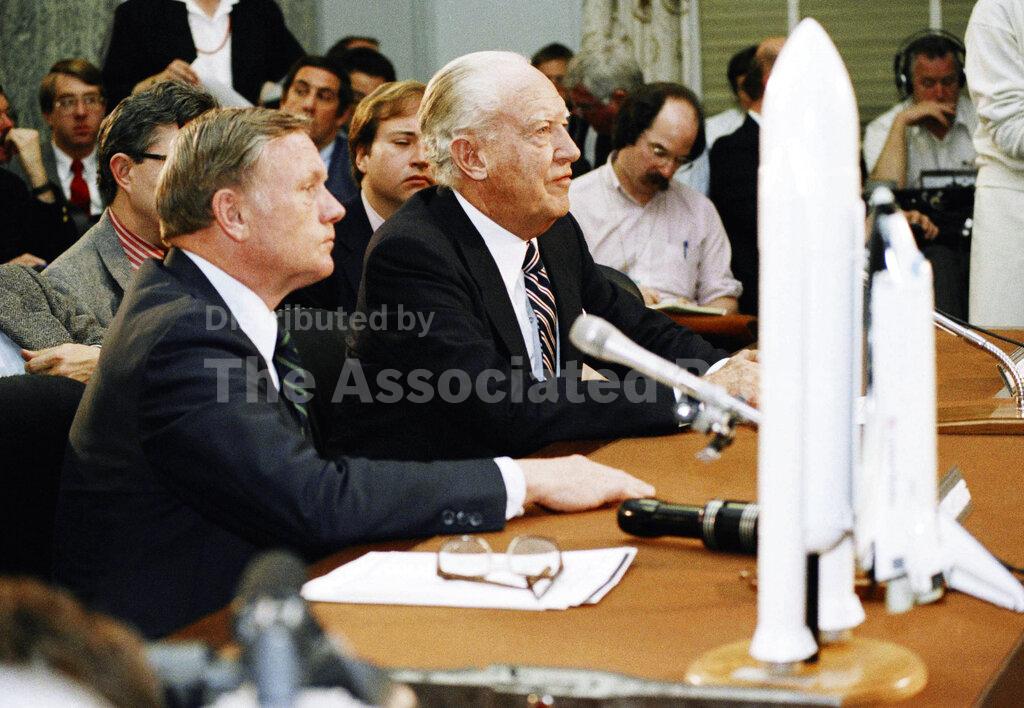
The top Morton Thiokol engineer present at the Kennedy Space Center before the Jan. 28 liftoff of the space shuttle Challenger said tonight that he had argued for hours with space agency officials not to launch the craft because of low temperatures. He said that he persisted even after his own superiors had overruled him and given the agency a go-ahead. The engineer, Allan J. McDonald, a 26-year veteran of Morton Thiokol Inc., which made the solid-fuel booster rockets for the shuttle, said that at a closed session last Friday before the Presidential panel investigating the explosion he recounted his “somewhat heated” exchanges with officials of the space agency. He said in a telephone interview tonight that those exchanges centered on the rocket seals that have become a major suspect in the explosion that killed the shuttle’s seven crew members.
Mr. McDonald, who is the director of Thiokol’s solid-fuel rocket motor project, also said he turned over to the commission detailed notes made in the course of his dispute with the officials of the National Aeronautics and Space Administration. He said he first warned NASA officials about potential dangers after calculations performed by Morton Thiokol engineers in Utah showed that the temperature of the O rings, which seal joints in the booster rockets, was about 30 degrees Fahrenheit. That is about 23 degrees lower, he said, than the temperature of the rings in a January 1985 shuttle launching that resulted in the largest amount of ring erosion ever seen by NASA officials. The O rings are the leading suspect in the apparent failure of the right-hand solid-fuel booster rocket. It is now believed that they may have set off events that led to the fireball that consumed the Challenger.
The top shuttle official testified he was not told about low temperature readings on one of the Challenger’s booster rockets the morning of its disastrous launching. The official, Jesse W. Moore, told a Senate panel that special teams made inspections at 1:30 AM, 7 AM, and 11 AM. During those inspections, agency witnesses acknowledged, the teams measured temperatures as low as 7 degrees Fahrenheit at the lower rocket, near the seams that some investigators believe may have failed. Dr. William R. Graham, acting director of the National Aeronautics and Space Administration, cautioned that the readings were made with optical infrared devices that were “not easy instruments to operate” and he warned that measurement errors “could be quite substantial.”
A member of the Presidential panel investigating the Challenger accident conducted a special investigation here today into reports that abnormally low temperatures were recorded on the launching pad before the space shuttle was launched. The presence here of the panel member, Dr. Richard P. Feynman, highlights the growing concern that cold temperatures may have played a major role in the explosion of the Challenger January 28, killing the seven astronauts. Launching pad technicians using an infrared temperature sensing device discovered unusually cold spots on the lower part of the Challenger’s right-hand solid-fuel booster rocket shortly before the spacecraft began its fatal flight, sources said today. But the readings, which indicate that the right booster’s skin was surprisingly colder than that of the left booster rocket, were not passed along to higher officials of the National Aeronautics and Space Administration who later made the decision to launch the Challenger, space agency officials testified at a hearing in Washington today.
Lawyers for the Senate, the House of Representatives and the Comptroller General of the United States filed appeals with the Supreme Court today defending the constitutionality of a new budget-balancing law whose key provision was struck down by a lower court earlier this month. The lawyers urged the Supreme Court to uphold the law, which requires that the deficit be reduced in large installments over the next five years to achieve a balanced budget by 1991. On February 7, a three-judge panel of the Federal District Court here declared the law unconstitutional “on the ground that it vests executive power in the Comptroller General, an officer removable by Congress” through legislation. The Comptroller General is head of the General Accounting Office, an auditing and investigative agency. He is appointed by the President, with the advice and consent of the Senate, for a term of 15 years.
President Reagan participates in an off-the-record luncheon in the Oval Office study with Arnaud de Borchgrave, Editor in Chief for the Washington Times.
President Reagan participates in a Domestic Policy Council meeting.
White House Chief of Staff Donald T. Regan said: “I do not hate Lee Iacocca’s guts,” but he openly acknowledged friction with the Chrysler chairman on a number of issues. Regan, in an interview, insisted the White House played no part in the firing of Iacocca from a government advisory board on the restoration of the Statue of Liberty and Ellis Island. In firing Iacocca last week, Interior Secretary Donald P. Hodel said the Chrysler chairman could not serve both as chairman of the advisory board and chairman of a private foundation that has raised money to finance the refurbishing.
The Farm Credit System, the nation’s largest agricultural lender, today announced a net loss of $2.69 billion for 1985, by far the biggest in the system’s 70-year history. The loss, which was as predicted, is one more sign that the economic crisis gripping much of American farming is not abating, agricultural economists said. Several of them, including Edwin Jaenke, who headed the Farm Credit Administration in 1969-75, predicted that this year’s loss could exceed $3.5 billion if the farm economy does not improve. Such a drain would exhaust the system’s reserves of $3.4 billion, the economists said, and without federal help the system would collapse.
The Reagan Administration is attempting for the first time to kick an entire hospital out of the Medicare system on the ground that it is providing substandard care. The San Diego County Mental Health Facility in California was ordered barred from the Medicare program for three years by the Health and Human Services Department, but the hospital is contesting the order issued Jan. 27. In ordering the sanction, which would bar the hospital from receiving Medicare funds, the agency said care at the hospital was judged to be “inappropriate, unnecessary or not meeting recognized professional standards.”
The Environmental Protection Agency said it had sent Congress a bill to extend the stalled Superfund toxic waste dump cleanup program for another year. The proposal followed the lines of proposals EPA officials already have discussed with committees in the House and Senate. The House and Senate have been unable to agree on how to finance a five-year renewal of the Superfund program, and, since last October 1, the program has been running on leftover funds. The EPA bill would provide $861 million, the amount agreed on by Congress for the current fiscal year, to be spent in the 12 months starting April 1.
A federal safety official said that the nation’s transportation workers should not have any alcohol in their blood while they are on duty — a marked departure from the blood alcohol standards that now vary from one industry to another. “The American people deserve no less than the most highly trained and clearheaded men and women at the throttle of this nation’s transportation system,” Patricia A. Goldman, National Transportation Safety Board vice chairman, told a Senate hearing.
A black sailor was sentenced to life in prison for fatally stabbing a white lieutenant in the back aboard a Navy frigate at sea. Petty Officer 3rd Class Mitchell T. Garraway Jr. was spared the death penalty by an eight-member military jury that deliberated for four hours. The same panel convicted Garraway, 22, of Suitland, Maryland, on January 30 of premeditated murder in the slaying of Lieutenant James K. Sterner with a footlong Marine survival knife. The Navy has not used capital punishment since two 1849 hangings.
Teen-age childbearing cost the nation more than $16 billion last year, and the 385,000 children who were the firstborn of adolescents in 1985 will receive $6 billion in welfare benefits over the next 20 years, said a study released in Washington. A typical baby born to a teen-ager last year will receive $15,620 in welfare payments and other government support by the time the child reaches age 20, according to the study released by the privately financed Center for Population Options.
The first recipient of two artificial hearts underwent surgery to reposition the pump, which was pressing against a large vein, hospital officials said. Bernadette Chayrez, 40, “came through the surgery great,” said Nina Trasoff, a University Medical Center spokeswoman in Tucson. Chayrez remained in critical condition after her fifth operation in 16 days. The second artificial heart implant was performed after a transplanted human heart failed.
Governor Rudy Perpich today ordered the Minnesota National Guard to remove its troops from the Geo. A. Hormel & Company plant by the end of the week. In announcing that he had instructed th National Guard to end its operations gradually in Austin, Governor Perpich said, “We have come through this extremely tense situation with no serious injuries, and that was the sole purpose of our response.” About 200 of the 800 guardsmen called out remained at the Austin plant today as 1,000 replacement workers entered the plant without trouble. Local P-9 of the United Food and Commercial Workers struck the Hormel plant here August 17 in a dispute over wage cuts and working conditions.
A Chicago judge was found guilty today of extortion and mail fraud, becoming the fourth judge convicted as part of an investigation of corruption in the Cook County court system. A federal jury returned the verdict against Judge Reginald J. Holzer of Cook County Circuit Court after 18 hours of deliberations that began Friday. The 58-year-old judge was accused of shaking down litigants and their attorneys for more than $150,000 in “loans” from 1974 to 1984. He is one of nine judges indicted in the investigation. One pleaded guilty, four have been convicted, one was acquitted and three are awaiting trial.
Talks between the United Steelworkers of America and a Canadian can-manufacturing company continued today in a effort to head off a strike, while a walkout by about 13,600 American workers entered its second day. Leon Lynch, vice president of the Pittsburgh-based international union, said he was not optimistic that negotiations in Hollywood, Florida, between the union and Continental Can of Canada Ltd. would avert a strike before the deadline at 12:01 AM Thursday. Officials of the Toronto-based company were not available to comment, secretaries said. The company’s 1,850 workers are employed at 12 plants. The strike against 75 American companies in 20 states began early Monday when union local presidents rejected offers of $400 year-end bonuses instead of wage increases.
An association of companies that make nonprescription drugs said today that its members had no intention of following the lead of Johnson & Johnson in withdrawing capsules from the market. “It simply is not the solution,” said John T. Walden, the spokesman for the pharmaceutical group, the Proprietary Association. Mr. Walden did not criticize Johnson & Johnson, which announced on Monday that it would no longer market its Tylenol or other nonprescription drugs in capsules. The company said it acted to prevent the kind of tampering that recently killed a Westchester County woman who took cyanide-laced capsules of Extra-Strength Tylenol.
The director of the Office of Management and Budget said today that the homeless of America were a problem for state and local governments, not for the Federal government. In testimony before the House Budget Committee, James C. Miller 3d, the budget director, added that “there are a number of grants we have” to help local governments with programs for the homeless. But when he named one, the Community Services Block Grant, he was told by a Democratic member of the committee that the Reagan Administration had proposed eliminating this grant in its budget for the fiscal year 1987, which was prepared under Mr. Miller’s supervision. Before now, statements by President Reagan and his aides, have fueled criticism of the Administration attitude toward the homeless. The Department of Housing and Urban Development estimated in May 1984 that 250,000 to 350,000 people were homeless in America, a figure critics said was low.
The most explosive storm system to hit the region in decades battered the West over a broad front today, causing flooding, mud slides, high winds and avalanches from central California to northern Utah. At least 10 people have died or are missing as a result of violent storms that began sweeping off the Pacific Ocean Thursday night and have drenched the region relentlessly since then. Meteorologists expect heavy rain at least through Thursday. According to disaster assistance officials, tens of thousands of families in California, Nevada, Utah and southern Oregon have been forced from their homes by overflowing rivers and reservoirs or by huge mud slides.
Military helicopters and boats converged on the flooded resort town of Guerneville, California today to evacuate hundreds of residents made homeless by the rampaging Russian River. In National Guard Hueys and Chinooks, rescuers moved out cold and weary people who had spent the night in a Roman Catholic Church, either on Red Cross cots or on the hard pews. Carrying pets or a few possessions, in plastic bags or suitcases, they boarded at an improvised landing site, a cemetery uphill from the church. They left behind homes and belongings inundated by the record-breaking flood that came after six days of steady rain in northern California.
Anti-smoking ad airs for 1st time on TV, featuring Yul Brynner: he died of smoking-induced lung cancer on 10th October 1985.
San Antonio guard Alvin Robertson scores NBA’s 2nd quadruple double-20 points, 11 rebounds, 10 assists & 10 steals in 120–114 win over Phoenix Suns.
Stock prices rose sharply on Wall Street yesterday, with the Dow Jones industrial average posting its third straight double-digit gain, as investors reacted once again to weakness in oil prices. The price of crude fell sharply again yesterday, sending interest rates lower and stock prices higher, as investors cheered the lower inflation that should result. “The market’s unbelievable,” said one trader after yesterday’s session. “It just doesn’t go down.”
Dow Jones Industrial Average: 1678.78 (+14.33)
Born:
Brandon Flowers, NFL cornerback (Pro Bowl, 2013; Kansas City Chiefs, San Diego Chargers), in Delray Beach, Florida.
Matt Slauson, NFL guard and center (New York Jets, Chicago Bears, San Diego-Los Angeles Chargers, Indianapolis Colts), in Sweet Home, Oregon.
Blake Comeau, Canadian NHL right wing (New York Islanders, Calgary Flames, Columbus Blue Jackets, Pittsburgh Penguins, Colorado Avalanche, Dallas Stars), in Meadow Lake, Saskatchewan, Canada.
Mike Card, Canadian NHL defenseman (Buffalo Sabres), in Kitchener, Ontario, Canada.
Kyle Weaver, NBA shooting guard (Oklahoma City Thunder, Utah Jazz), in Janesville, Wisconsin.
 History Diaries