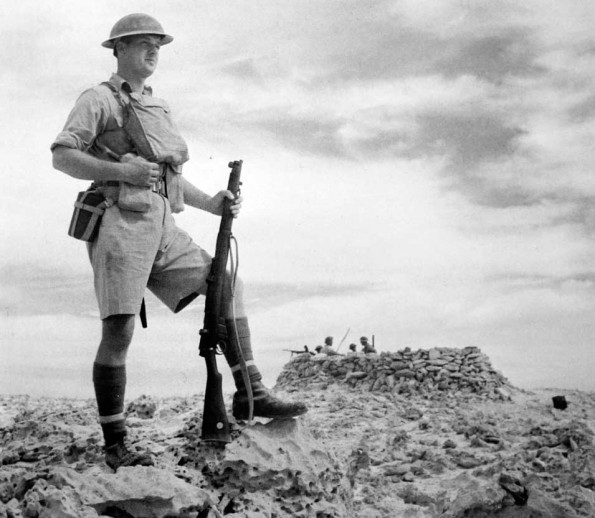
The British have been deliberating about sending troops to Greece for weeks, and now they finally are in a position to start telling some of their allies about their plans. They inform New Zealand General Bernard Freyberg that he will command the expeditionary force. Freyberg is a legendary officer, much admired by the British, who currently commands the New Zealand Division.
The decision to dispatch a British Expeditionary Force to Greece was communicated to General Bernard Freyberg VC, General Officer Commanding New Zealand Division. The force initially was planned to consist of the New Zealand Division, 1st British Armoured Brigade, 6th Australian Division, Polish independent Brigade Group and 7th Australian Division. However Erwin Rommel’s sudden advance into the Cyrenaica of Libya would result in the Poles and 7th Australian Division being held back to defend Tobruk.
The Battle of Trebeshina ended in Greek victory. Greek forces along the Albanian front have taken new heights in the central sector and captured 330 Italian prisoners, most of them Blackshirts and Alpini, a government spokesman said early today. After a very long and difficult struggle, on 17 February 1941 the Greeks complete the recapture of the Trebeshina massif. Overall, it has been an almost Pyrrhic victory, though. The Cretan 5th Infantry Division suffers terribly during the struggle, with 5776 casualties, and is effectively destroyed. Naturally, the Italians lose many men as well, but they just have to hold their positions and wait for the Germans eventually to bail them out by invading Greece from another direction. For the Italians, the battle has become a matter of national pride, and they vow to recapture the mountains and surrounding territory in the Spring.
An Italian Auto-Saharan Company detachment counterattacked Free French and British forces near Kufra, Libya, but the attack ended in failure. Colonel Leclerc in southwestern Libya is heading for their ultimate target of Kufra. Leclerc has about 350 men, but the Italians are aware they are coming. The Italian Saharan company of 70 men intercepts Leclerc’s force with 20 mm guns in ten armored AS37 cars. After a vicious firefight, the French lost many of their trucks but are able to continue forward when the Italians at Kufra stay inside their fort and don’t help the Sahariana. Leclerc’s men surround the fort, El Tag, and place their only artillery piece, a 75 mm gun, about 3000 meters from the walls. The French also place several 81 mm mortars about 1500 meters from the fort. The Saharan company attacks again but is beaten off again. The French settle down to a siege.
The South African 5th Infantry Brigade continues attacking toward Mega, while the 1st Infantry Brigade manages to cross the Juba River at Yonte against fierce Italian opposition.
Winston Churchill has a busy day sending memos and pontificating to all and sundry about his pet concerns.
During the war council meeting today, Churchill cautions against worrying about “divisions” in the military (as opposed to brigades or corps and so forth). The gist of his oration on this point is that the term “division” can refer to vastly different forces.
Churchill also memos CIGS General Ismay and Cabinet Secretary Sir Edward Bridges cautioning them not to reveal the source of their information about Japanese decrypts, information which apparently was sent around the office. He wants all copies tracked down and the information suppressed, all the way down to identifying what copying machine was used and “who gave the orders for it to go in this form.” Naturally, he doesn’t want the Japanese to know the British have broken their codes.
Ireland also is on Churchill’s mind. He memos General Ismay that the Germans might invade Ireland before they invade England, which would give the British the “immediate pretext” to invade Ireland — something that Churchill appears eager to do. He urges Ismay to use “every scheme of which military and naval ingenuity are capable to move more troops across the Irish Channel” whether the Irish want them there or not. In fact, the Irish have made plain that they do not want to be involved in the British war.
Churchill also memos Viscount Cranborne and Sir Kingsley Wood to implement economic sanctions against southern Ireland “to make Southern Ireland realized how great a wrong they were doing to the cause of freedom by their denial of the ports” to the Royal Navy. At this point, it seems as if Churchill is much more interested in invading Ireland than Hitler ever is.
Churchill to CIGS: “What are the arrangements in British Columbia for dealing with the Japanese colony there should Japan attack? The matter is of course for the Canadian government, but it would be interesting to know whether adequate forces are available in that part of the Dominion. About thirty years ago, when there were anti-Japanese riots, the Japanese showed themselves so strong and so well organised as to be able to take complete control.”
Australian Prime Minister Robert Menzies is continuing his epic, month-long journey from Melbourne to London. Today, he stops over in Lagos, where he meets fellow Australian Sir Bernard Bourdillon, the Governor. Bourdillon blames the British fiasco at Dakar in September 1940, and a related incident in which French cruisers were allowed to cruise out of Mediterranean past Gibraltar to reinforce the Vichy French forces there, on unclear instructions from Winston Churchill. To be fair, Bourdillon has a point, as the British attitude toward Vichy France seems confused at best. Menzies seems quite impressed with Bourdillon and wonders if he and similar governors are “consulted enough.” In fact, they are probably not consulted at all, as Churchill likes to run his own shop.
Admiral Sir Percy L. H. Noble replaced Admiral Sir Martin Dunbar-Nasmith as commander of the Royal Navy’s Western Approaches Command. Admiral Noble’s responsibility was the safety of the merchant convoys to Great Britain and to increase U-boat kills. Admiral Dunbar-Nasmith remained at Plymouth as the Commander-in-Chief, Plymouth.
Turkey and Bulgaria signed a friendship agreement in Sofia, Bulgaria. Under pressure from Germany, Turkey also agreed to not protest German troop movements through Bulgaria. The heavy emphasis in mutual goodwill and friendly relations in the treaty signed in Ankara this afternoon is a reflection of the deep mistrust Turkey and Bulgaria have long felt for each other. Bulgaria has never ceased to fear that one day Turkey will seek to regain the territory lost after the Great War and in the Balkan Wars before it, while the build-up of German troops in Bulgaria in recent weeks has alarmed the Turks, who are worried that the Germans’ next blow will be delivered in the Balkans and threaten Turkey.
The threat of an all-out axis offensive aimed at crushing the British empire, perhaps with simultaneous blows in Europe and the Orient, was made bolder Monday by two diplomatic developments in non-belligerent capitals. Turkey, mutual aid partner of Britain in the Mediterranean, got together with Bulgaria in a declaration of friendship and non-aggression which may rule out Turkey as Britain’s ally and give Adolf Hitler a go-ahead signal in the Balkans. Russia and Japan began negotiations for a trade treaty and a solution of their “problems” which may lead to a non-aggression pact between these two bitter enemies and thereby make it possible for Japan to take an active role in joint axis operations against Britain.
Japan makes an offer to mediate the European conflict, just as it has been mediating the border war in Indochina. Nobody takes Japan up on the offer.
General Oshima arrives as minister to Germany, his second appointment there. Oshima is viewed by the Germans as very sympathetic to their war aims.
Adolf Hitler is thinking big. He dreams of capturing India from the British, and in fact, has been sending presents (such as a motorcar) to some princes in the region. He orders his military staff to explore the feasibility of advancing through Afghanistan to India.
French modernist author and ferocious anti-Semite Louis-Ferdinand Céline writes in La Gerbe, “Are the Jews responsible for this war or not? Let us have the answer down black on white, you acrobatic scribblers.”
The cargo ship Gairsoppa was torpedoed and sunk west of Ireland by the German submarine U-101.
The Luftwaffe raids London with 50 bombers, its largest raid in some time. Small formations of German raiders crossed the cold and cloudy Straits of Dover tonight and scattered hundreds of incendiaries and a few high explosives in the London area. The attack continued for more than three hours, and soon after it subsided the all-clear sounded. Several districts in the capital and on its outskirts reported bombings. Early reports indicated damage was light.
RAF Bomber Command dispatches 5 Blenheims during daylight; 4 turned back; 1 lost.
U-101, commanded by Kapitänleutnant Ernst Mengersen, sank British steamer Gairsoppa (5237grt), which was straggling behind convoy SL.64, three hundred miles southwest of Galway. At 0008 hours the unescorted Gairsoppa (Master Gerald Hyland) was hit on the starboard side just behind the bridge in #2 hold by one G7a torpedo from U-101 about 300 miles southwest of Galway Bay, Ireland. The ship had been in convoy SL-64 which was slowed down by bad weather and running low on coal, she was detached alone to Galway on 15 February. At 1800 hours on 16 February, the U-boat spotted the ship but had troubles to hit the target due to heavy seas and missed with a spread of two torpedoes at 2328 hours and one G7e torpedo at 2332 hours. The Gairsoppa caught fire and settled slowly by the bow after being hit in the third attack, but Mengersen decided to give up further attacks when a coup de grâce missed at 0020 hours, assuming correctly that the burning freighter will sink anyway in the heavy seas. The survivors managed to abandon ship in three lifeboats before she sank within 20 minutes. However, two of the boats were never seen again and its occupants presumably perished in the cold and bad weather. The boat in charge of the second officer set sail with eight Europeans and 23 Lascars aboard, but after seven days most had died of exposure and only four Europeans and two Lascars were still alive when the boat reached land on 1 March. Sadly, it capsized in the swell and surf of Caerthillian Cove on The Lizard, Cornwall and all occupants drowned except the second officer, who was rescued unconscious by a coastguard. The bodies of two Europeans and the two unidentified Lascars were recovered and buried in the Landewednack Churchyard. The master, 82 crew members and two gunners were lost. The 5,237-ton Gairsoppa was carrying pig iron, tea, general cargo, and 200 tons of silver ingots and coins and was bound for London, England.
U-103, commanded by Korvettenkapitän Viktor Schütze, sank Motor tanker Edwy R. Brown (10,455grt), which was straggling behind convoy HX.107, in 61N, 18W. At 0633 hours the Edwy R. Brown (Master Andrew Chalmers), a straggler from convoy HX-107, was hit amidships by one torpedo from U-103 in bad weather southeast of Iceland. The U-boat had missed the zigzagging tanker with a first torpedo at 0615 hours. The ship continued after being hit and only stopped after two torpedoes struck behind the bridge at 0640 hours and set her on fire. The Germans observed how the crew abandoned ship in two lifeboats and waited for the ship to sink, but she remained afloat even after being struck amidships by a fourth torpedo at 0758 hours. Schütze gave up further attacks when a coup de grâce fired at 0833 hours failed to detonate and left the burning wreck in a sinking condition. The master, 47 crew members and two gunners were lost. The 10,455-ton Edwy R. Brown was carrying petroleum products and was bound for Liverpool, England.
U-69, commanded by Kapitänleutnant Jost Metzler, sank British steamer Siamese Prince (8456grt) in 59-53N, 12-12W. At 2119 hours the unescorted Siamese Prince (Master Edgar Litchfield) was hit forward on port side by one G7a torpedo from U-69 while steaming in very rough seas with a moderate swell at 13 knots about 150 miles north-northwest of Rockall. The U-boat had chased the ship for more than five hours and she even remained afloat after being hit on port side aft by another torpedo at 2141 hours. The ship sank by the bow five minutes after being hit on starboard side amidships by a third torpedo at 2212 hours. The Germans had observed how the crew abandoned ship in lifeboats, but no survivors were ever found. The master, 56 crew members, two gunners and nine passengers were lost. French destroyer Mistral was sent to search for this steamer. Destroyers Maori and Zulu departed Scapa Flow at 0545/17th to search for this steamer. Nothing was found of the steamer. The 8,456-ton Siamese Prince was carrying general cargo and was bound for Liverpool, England.
The Germans have quite a small fleet at work in the Atlantic. It involves numerous supply ships serving both heavy cruisers (currently three are on the loose: Gneisenau, Scharnhorst, and Admiral Scheer) and armed raiders. Today, German tanker Nordmark meets supply ship Alstertor to refuel it. The Nordmark has been towing captured British refrigerated ship Duquesa, which was taken full of meat and dairy products. However, all good things must come to an end, and today the Nordmark cuts loose the 8651-ton ship, not because it was out of food, but because there was no longer any fuel to power the refrigeration equipment — making it a stinky mess around the Equator. Some accounts state that Admiral Scheer sank the Duquesa upon encountering it on 18 December, but in fact, the refrigerated ship was taken as a prize and became legendary in the Kriegsmarine as the “floating delicatessen” which kept the crews of several ships well-fed for two months.
The weather is terrible. This causes all sorts of problems both for ships and for crews abandoning their sinking ships.
German raider Pinguin, in the south Atlantic, is joined by German supply ship Alstertor. Together, they sail for the Indian Ocean.
Destroyer HMS Atherstone departed Londonderry at 0500 for Scapa Flow, arriving at 1810.
Light cruiser HMS Arethusa arrived at Scapa Flow from patrol.
German tanker Nordmark replenished German supply ship Alstertor (3063grt) at sea. Tanker Nordmark slipped the tow of captured British refrigerator ship Duquesna.
British steamer Kyle Rona (307grt) was lost to unknown cause n the Irish Sea.
British steamer Ren Rein (156grt) was lost on a mine three and a half miles east of Manacles off Falmouth. Two crewmen were lost.
Light cruisers HMS Orion and HMS Ajax departed Piraeus to cover the movement of convoys AN.15 and AC.1 during the night of 17/18 February. The cruisers then proceeded to Alexandria.
Destroyers HMS Jervis, HMS Mohawk, and HMS Jaguar proceeded to Alexandria. Heavy cruiser HMS York, anti-aircraft cruiser HMS Bonaventure, and destroyer HMS Janus returned to Suda Bay. Destroyer Janus was later recalled to Alexandria to participate in Operate MC.8.
Monitor HMS Terror arrived at Benghazi.
Submarine HMS Parthian departed Alexandria on a reconnaissance mission for Operation ABSTENTION under the orders of the Rear Admiral, 3rd Cruiser Squadron.
Force H relieved the escorts of convoy WS.6 A. Battleship HMS Rodney proceeded to escort arriving convoy HX.108. The convoy was met on the 18th. Destroyers HMS Electra, HMS Eclipse, and HMS Brilliant, formerly with the battleship, arrived at the Faroes on the 17th and then on to Scapa Flow arriving on the 18th at 0730. All three destroyers had minor weather damage. Light cruiser HMS Edinburgh departed Scapa Flow on the 20th and at noon on the 23rd relieved battleship HMS Royal Sovereign of the TC.9 escort. Heavy cruiser HMS Norfolk escorted two North Atlantic convoys. Light cruiser HMS Phoebe remained with convoy WS.6 A as through escort.
Convoy WS.6B departed with steamers Yoma (8139grt) and Adda (7816grt) from Liverpool and Northumberland (11,558grt), Burma (7821grt), and Llanstephan Castle (11,299grt), and armed merchant cruiser HMS Cilicia from the Clyde escorted by light cruiser HMS Mauritius, which had departed Scapa Flow on the 15th. Destroyers HMS Hesperus and HMS Hurricane escorted the convoy from the 17th to 20th. Destroyers ORP Piorun, ORP Garland, and HMS Legion escorted the convoy from the 18th to 20th. Steamer Burma returned to the Clyde on the 18th. Armed merchant cruiser Cilicia was detached on the 20th. Corvettes HMS Clematis and HMS Calendula joined the convoy on 3 March and escorted it to Freetown, and arrived at Freetown on 5 March with light cruiser Mauritius and joined convoy WS.6 A.
Canadian troop convoy TC.9 of Warwick Castle (20,107grt), Duchess of York (20,021grt), Orontes (20,097grt), Dempo (17,024grt), and Johann Van Oldenbarneveldt (19,429grt) departed Halifax with battleship HMS Royal Sovereign and armed merchant cruiser HMS Wolfe (16,418grt). The armed merchant cruiser was detached on the 18th. Light cruiser HMS Edinburgh, which departed Scapa Flow on the 20th, relieved battleship Royal Sovereign on the 23rd. On the 24th, destroyers HMCS Assiniboine, HMS Havelock, HMCS Restigouche, and HMCS Ottawa joined the convoy. Destroyer Havelock was detached the next day. The three Canadian destroyers remained with the convoy until 26 February. On the 25th, light cruiser HMS Aurora and destroyers HMS Echo, HMS Eclipse, HMS Inglefield, and HMS Leopard joined the convoy; destroyer Leopard was with the convoy only on the 25th. Destroyer Mistral joined the convoy on the 26th. Destroyer HMS Churchill escorted the convoy in the Western Approaches. Light cruiser Aurora departed the Faroes and destroyers Inglefield, Echo, and Eclipse departed Scapa Flow at 0445/24th at to give additional escort to convoy TC.9. The convoy reached the Minches in the evening of 24 February. Light cruiser Edinburgh and the destroyers proceeded to Scapa Flow arriving at 0100/27th. Light cruiser Aurora took the convoy into the Clyde and arrived at Greenock on the 27th.
Convoy BN.16 departed Aden, escorted by destroyer HMS Kingston and sloops HMS Grimsby and HMS Parramatta. The convoy was dispersed on the 20th.
Today in Washington, President Roosevelt discussed plans for aid to Britain under the leaselend bill with Secretaries Stimson, Knox, Morgenthau and Wickard, Harry L. Hopkins and Harold D. Smith, Director of the Budget. He conferred with Congressional leaders on the legislative situation. He sent to the Senate the nomination of Carroll L. Wilson to be Director of the Bureau of Foreign and Domestic Commerce and of Matthias F. Correa to be United States District Attorney for the Southern District of New York.
The Senate began debate on the Lend-Lease bill and recessed at 5:29 PM until noon tomorrow.
The House began debate on the Gathings Reapportionment Bill, received the Tolan bill, designed to regulate treatment of migrant workers, completed Congressional action on the bill to increase the national debt limit to $65,000,000,000 and adjourned at 4:58 PM until noon tomorrow.
The U.S. Senate starts debating the Lend-Lease Bill. Before galleries that had to be admonished repeatedly against demonstrations but to a Senate that sat in grim silence, proponents of President Roosevelt’s lease-lend bill opened debate on the measure in the upper body today by proclaiming the intent behind it as defeat for Adolf Hitler through aid to Britain and her allies, even at the risk of war for the United States. A tense and attentive U.S. Senate heard Senator Pepper, Florida Democrat, declare today that if the Lend-Lease bill failed to save England, the United States would go ahead and “save them anyway.” He did not say specifically whether he meant the United States would go to war, if necessary, but he asserted that the American people would not let Hitler conquer England. “Whether we like it or not,” he said, “they’ll drive us into action. Call it war, or not call it war, the American people will not let England fall to Hitler.”
President Roosevelt began to set up administrative machinery today to extend the swiftest and most efficacious aid possible to Great Britain as soon as the Lend-Lease bill is enacted. His attention has been devoted practically exclusively to this particular problem ever since the arrival of Harry Hopkins from London late Sunday. According to White House attachés, the President and Mr. Hopkins talked until 2 AM. It was assumed that they canvassed the entire range of impressions gained by Mr. Hopkins during his month’s stay in Great Britain. Mr. Hopkins is staying at the White House, and he and the President got only a few hours’ sleep before continuing their discussions at breakfast in Mr. Roosevelt’s study this morning. After breakfast the President received Vice President Wallace, Senator Barkley of Kentucky, the majority leader; Speaker Rayburn and Representative McCormack of Massachusetts, Democratic floor leader, for the usual Monday morning legislative conference.
Earl Browder, American Communist No. 1, lost his appeal to the Supreme Court today from a passport fraud conviction and his last chance to escape a four-year prison term and a $2,000 fine unless the court should grant a rehearing. Without a dissenting vote, the court waved aside the legal argument upon which the appeal was based and upheld the convictions of both Browder and an associate, Welwel Warszower, alias Robert William Wiener of New York. Before handing down the Browder decision the court delivered an important opinion curbing the federal trade commission. It held that the commission could not extend to intrastate trade the fair practice rules it imposes upon interstate business, which the commission sought to do on the ground that unfair practices in intrastate trade affected interstate commerce.
It is the fixed policy of the United States Government that the German Government is responsible for the material welfare of the people of regions occupied by Nazi troops, Under-Secretary of State Sumner Welles declared today. For some time it has been understood that the State Department held this view in connection with the various plans that have been advanced for sending American food supplies to the occupied areas, but the policy had never been stated so unequivocally as Mr. Welles pronounced it. The German obligation exists under every precept of international law and common sense, Mr. Welles pointed out, adding that the American public would do well to bear it in mind whenever such questions are raised.
Mrs. Franklin D. Roosevelt today suggested that people begin thinking about doing without various commodities such as new automobiles and aluminum kitchen utensils when present stocks are exhausted.
In his 14th title defense Joe Louis KOs Gus Dorazio in the 2nd round at the Convention Center, Philadelphia to retain NYSAC heavyweight boxing crown.
Formal conversations for a trade treaty between Russia and Japan were started today and Japanese informants said that most of the problems between the two nations already had been solved or were in a process of settlement.
Gravely concerned about developments in the Far East, which are inducing some Japanese quarters to urge upon Japan immediate steps to “meet the worst eventualities,” the Japanese Government, through its official spokesman, Koh Ishii, today issued a statement suggesting termination of all war (in Europe) and offering Japan’s services as mediator if such services are called for. At the same time the statement put the blame for the present situation on Britain and the United States and suggested that the United States should restrict its activities to the Western Hemisphere as one means of mitigating the present tension.
Japanese Foreign Minister Matsuoka Yosuke states that the white race must cede Oceania to the Asiatics. “This region has sufficient natural resources to support from 600 million to 800 million people. I believe we have a natural right to migrate there” says Matsuoka. Oceania, of course, includes Australia, the Dutch East Indies, and New Zealand. Thus, the Japanese basically are telling all Europeans that they are not wanted in the Pacific and that they feel entitled by “natural right” to occupy lands now claimed by others.
It appears unlikely that Japan can be in a position for at least some weeks and possibly months to make another major move in her southward advancement program such as an attack on Singapore or the Netherlands Indies, seasoned analysts of Far Eastern affairs in Shanghai believe.
The Far Eastern war of nerves eased slightly in Japan today with the press adopting a noticeably milder treatment of news since the cabinet information bureau’s advice to Japanese residents in North and South America not to be disturbed by “irresponsible and sensational reports” of increasing tension between Japan and the United States. The newspaper Asahi printed a story that Japanese residents were beginning to withdraw from the Dutch East Indies, but gave the dispatch a subordinate place. All papers however gave prominence to news that Secretary of State Hull had conferred with the British, Australian, and Dutch envoys. The headlines read: “Four-Power Defense Talks” and Yomiuri declared that “an anti-Japanese joint policy was discussed.”
Dow Jones Industrial Average: 119.18 (+0.63)
Born:
Heidi Biebl, German alpine skier (Olympics, gold medal, women’s downhill, 1960), in Oberstaufen, Germany (d. 2022).
Dick Westmoreland, AFL cornerback (AFL Champions-Chargers, 1963; AFL All-Star, 1967; San Diego Chargers, Miami Dolphins), in Charlotte, North Carolina.
Billy Guy Anderson, AFL quarterback (Houston Oilers), in Palmer, Texas (d. 1996, of amyotrophic lateral sclerosis (known popularly as Lou Gehrig’s disease).
Dave Wissman, MLB outfielder and pinch hitter (Pittsburgh Pirates), in Greenfield, Massachusetts.
Claude Cardin, Canadian NHL left wing (St. Louis Blues), in Sorel, Quebec, Canada.
Naval Construction:
The Royal Australian Navy Bathurst-class minesweeper-corvette HMAS Castlemaine (J 244) is laid down by the Williamstown Dockyard (Williamstown, Victoria, Australia).
The U.S. Navy Cleveland-class light cruiser USS Birmingham (CL-62) is laid down by the Newport News Shipbuilding and Dry Dock Company (Newport News, Virginia, U.S.A.).
The Royal Fleet Auxiliary Dale-class fleet tanker RFA Dewdale (X 51; postwar A151) is launched by Cammell Laird (Birkenhead, England, U.K.).
The U.S. Navy Accentor-class coastal minesweeper USS Marabout (AMc-50) is launched by the Herreshoff Manufacturing Co. (Bristol, Rhode Island, U.S.A.).
The Royal Navy Fairmile B-class motor launch HMS ML 252 is commissioned.
The Royal Navy harbor defence motor launch HMS HDML 1005 is commissioned.
The Royal Navy Hunt-class (Type II) escort destroyer HMS Avon Vale (L 06) is commissioned. Her first commanding officer is Lieutenant Commander Peter Alison Ross Withers, RN.
 History Diaries