The United States expects to sign an accord on West German participation in the U.S. Strategic Defense Initiative by mid-March, and agreements with Italy, Japan and Israel are likely to follow by summer, U.S. Under Secretary of State William Schneider told a conference of British industrialists in London. Britain is the first — and so far only — ally to agree to allow its industries to cooperate in research on President Reagan’s proposed program of space-based defensive weapons, known as “Star Wars.”
President Reagan finishes up a hand-written seven page letter to General Secretary Gorbachev.
At least 65,000 people in Barcelona and thousands more in other Spanish cities conducted simultaneous demonstrations, organized by the Pro-Peace Committee, to demand that the Socialist government take Spain out of the North Atlantic Treaty Organization. Demonstrators throwing stones and eggs smashed windows at the U.S. Consulate in Barcelona. Six police officers were injured and eight protesters were arrested, police said. Spain has been part of NATO since 1982. A referendum on the issue is scheduled for March 12.
Mario Soares had finally escaped the crush of well-wishers early this morning and had secluded himself with his family and a few others in a back room of the mansion that served as his campaign headquarters here. Mr. Soares had just been elected Portugal’s first civilian President in 60 years, and the chants of thousands of supporters whom he had addressed earlier from a balcony could still be heard on the street outside. The political career of Mr. Soares, a center-left Socialist, had been largely written off four months ago, when the Government he had headed as Prime Minister was voted out in a landslide defeat. For Mr. Soares, a paunchy 61-year-old whom the right-wing opposition ridiculed as “chubby cheeks,” this was a moment to savor.
Helmut Kohl is under investigation in a political corruption case, a West German prosecutor announced. He said an inquiry was under way to determine whether Chancellor Kohl gave false testimony to a legislative panel looking into the laundering of political contributions. State prosecutors in Koblenz, West Germany, said they are starting an investigation into allegations that Chancellor Helmut Kohl gave false testimony to a parliamentary corruption inquiry. The probe grew out of charges by Otto Schily, a leader of the opposition Greens party, that Kohl misled an inquiry by the Rhineland-Palatinate state parliament into illegal party donations. Kohl denied the charges.
An Italian Government prosecutor said today that he would seek a life sentence for a fugitive Turk accused of helping coordinate what the prosecution says was a conspiracy to assassinate Pope John Paul II. On the fifth day of his summation, the prosecutor, Antonio Marini, said he would ask for a life sentence for the Turk, Oral Celik, 26 years old, whose whereabouts is unknown and who is being tried in absentia. Mr. Celik is considered a key defendant because Mehmet Ali Ağca, the Turk convicted of shooting the Pope, has testified that Mr. Celik was with him in St. Peter’s Square when the shooting occurred on May 13, 1981, and may also have fired at the Pope. Mr. Ağca, whose credibility as a witness is an issue in the trial, has testified that Mr. Celik participated in meetings held in Bulgaria in 1980 during which the purported plot was conceived.
France continued to press the United States today to take Jean-Claude Duvalier, the former President of Haiti, off its hands. A French presidential aide, Guy Penne, said in a radio interview that the United States must find a home for Mr. Duvalier if no other country will grant him political asylum. “It is only because we thought of the Haitian people that Duvalier is here,” Mr. Penne said. “His fate is of little interest to us.” When Mr. Duvalier fled Haiti, the French said they would give him temporary asylum for eight days, a period that ended Saturday.
Lebanese guerrillas ambushed a group of Israeli soldiers today in Israel’s so-called security zone in southern Lebanon, and reports here said two of the Israelis were captured. They are believed to be the first Israeli military personnel captured in Lebanon since the months following the Israeli invasion in 1982. The incident prompted an almost immediate Israeli sweep through at least 10 Shiite Moslem villages in southern Lebanon. Witnesses and United Nations peacekeeping authorities in the area said the operation involved 600 troops backed by transport helicopters, gunships and armor. In Beirut, the state-controlled radio reported that six Israeli soldiers had been killed in the ambush, but there was no confirmation of the report.
The situation in southern Lebanon is more explosive than it has been since Israel invaded the country in 1982, according to United Nations peacekeeping officials in the southern Lebanese city of Tyre and in Jerusalem. “We’re sitting on a time bomb,” said a senior United Nations military observer with long experience in Lebanon. “There is more tension throughout the south, and we anticipate an explosion of violence at any time, especially as the weather improves.” Since the Israelis pulled out of most of Lebanon last April, the southern port city of Sidon has become a sort of magnet for both Palestinian guerrillas and Islamic fundamentalist militiamen, according to United Nations observers in the area. But the most serious development in the south, the peacekeeping officials said, is growing pressure on Amal, the mainstream Shiite militia group, by more radical Muslims who in the last year have infiltrated what used to be Amal territory.
After six years, the Afghan war has begun coming home. The outlines may be hazy — the size of the Soviet force, the scale of the fighting, the casualties and the Western reports of Soviet atrocities are not widely known here, or are dismissed as Western propaganda. Yet in conversations with Russians the war has become more familiar and tangible. Although the Soviet Union has made no statistics public, hundreds of thousands of Soviet youths, most of them draftees, are known to have gone and returned from the dusty and dangerous mountains to the south. Thousands have been wounded and killed. Some have returned crippled, some troubled.
Indian police battled Hindu rioters in Jammu, about 300 miles north of New Delhi, and Hindu and Muslim mobs clashed in Sehore, about 370 miles southwest of the capital, leaving four people dead and more than 200 injured. The violence, in its fourth day, grew out of a court decision permitting Hindus to worship at a shrine in Uttar Pradesh state that is claimed by Muslims. Earlier, in attacks in two towns outside the Sikh holy city of Amritsar, Sikh extremists killed a right-wing Hindu leader and a Hindu worker for Prime Minister Rajiv Gandhi’s party.
The South Korean Government and opposition political leaders clashed again today as the police broke up an opposition meeting, placed a Government critic under house arrest and took scores of opposition politicians into custody. The critic, Kim Young Sam, a prominent opposition leader, was placed under house arrest and prevented from attending a meeting at the Council for Promotion of Democracy, a group with close ties to the opposition party.
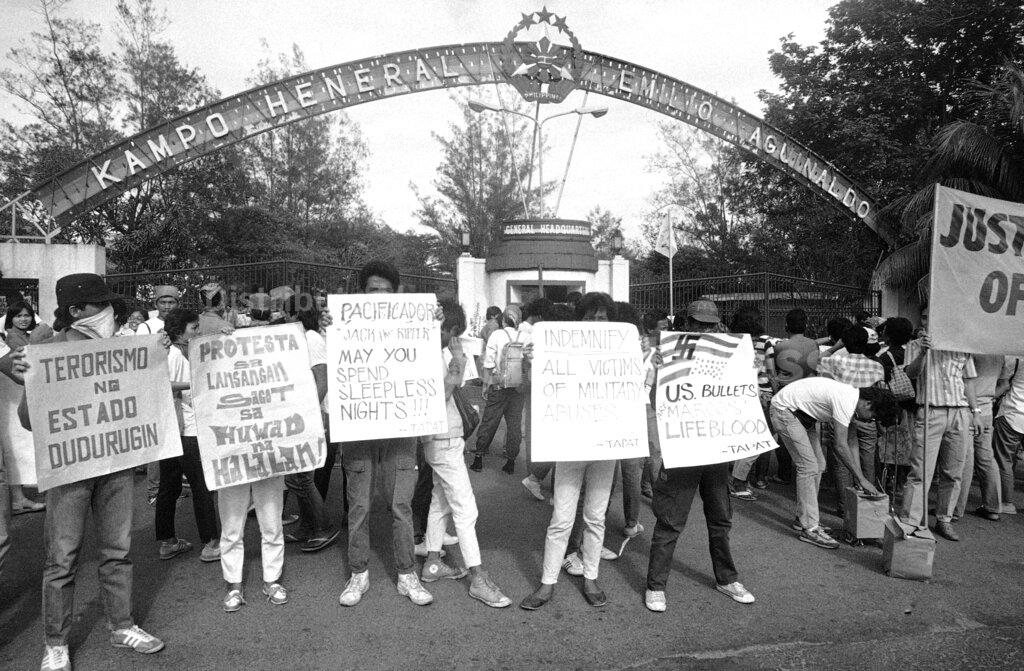
Philip C. Habib met in Manila with President Ferdinand E. Marcos and Corazon C. Aquino. Mr. Habib, President Reagan’s special envoy, also met with the Archbishop of Manila, Jaime Cardinal Sin, and with Jose Concepcion Jr., the director of NAMFREL, a citizens’ poll-watching group that has disputed Mr. Marcos’s assertion that he won the February 7 election. President Reagan’s special envoy, Philip C. Habib, met separately today with President Ferdinand E. Marcos and Corazon C. Aquino, both of whom said later that the American had assured them he was here only to gather information in the aftermath of the presidential election. Mr. Habib had no public comment after the meetings. But the Malacanang Palace said that in a two-hour meeting this morning Mr. Habib said the United States “was not interested in any way in telling us how to run our affairs.” In a 55-minute meeting in the afternoon, one of her advisers said Mrs. Aquino received him with some skepticism, saying, “What can I do for you, Ambassador Habib?”
Special Philippine investigators were sent to look into the slayings of a dozen opposition figures in the Quirino region of northern Luzon Province. The team’s forensic pathologist and a colonel from Manila were playing tennis. An opposition political leader asked when they would begin investigating the dozen killings. After the tennis game, the colonel replied.
U.S. Senator Richard G. Lugar, who headed a delegation of observers in the Philippine elections, said today that President Ferdinand E. Marcos should step aside if he is unwilling to hold new and fair elections. “It seems to me, the very best thing that could be done is to once again institute an election procedure,” Senator Lugar said in a televised interview on “The MacNeil/Lehrer Newshour” of the Public Broadcasting Service. “Now if elections are impossible,” the Senator continued, “then it seems to me, at some point, President Marcos ought to consider the fact that he has lost the confidence of the Government of the United States and that he ought to step aside.”
The Central Bank in Manila raised interest rates sharply, and the bank’s governor said the economy would slow as a result and probably not grow at all. Economists and business people predicted that the Philippines economy would decline in 1986 for a third successive year, weakening President Marcos.
A Soviet seaman was missing and believed drowned today after the sinking of the Soviet cruise liner Mikhail Lermontov on Sunday. Prime Minister David Lange of New Zealand launched an inquiry into the grounding of the Soviet cruise liner Mikhail Lermontov, which struck a visible reef and sank in New Zealand’s Cook Strait with the confirmed loss of one Soviet seaman. Passengers who abandoned the liner said they could see waves breaking over the reef minutes before the accident. The captain of the ship, which carried 739 passengers and crew, told Moscow’s evening television news that a New Zealand pilot chose the course that caused the accident.
Leftist guerrillas claimed responsibility for the weekend slaying of American Peter Stryker Hascall in San Salvador, rebel radio reported. Hascall, 35, who had lived in San Salvador for five years, died of a bullet wound in the chest Saturday. The rebels charged that Hascall was one of 55 U.S. trainers of the Salvadoran army. However, a U.S. Embassy official said he was a seaman who may have worked as an adviser to the Salvadoran navy.
A fire swept through a 13-story office building in downtown Rio de Janeiro, killing at least 14 people and forcing hundreds to flee, authorities said. Three people trying to escape the flames jumped 10 floors to their deaths. The other dead were reported burned or asphyxiated inside the building. About 40 people were rushed to Souza Aguiar Hospital, some with “very serious” burns, a spokesman said. Fire officials, hampered by smoke and darkness, planned to resume the search for victims this morning. The cause of the fire has not been determined.
An airplane described by the French as Libyan dropped a bomb today on the airport in Ndjamena, the capital of Chad. Hours later, Defense Minister Paul Quiles announced that France would send a squadron of military planes and what was termed “a deterrent force” to Chad. The announcement came a day after 200 French troops arrived in Ndjamena. They were the first French soldiers to return since France withdrew its forces 15 months ago. Defense Minister Quiles said a Jaguar fighter-bomber and two Mirage F-1’s had already reached Ndjamena. He said the bombing of Ndjamena airport had been carried out by a Soviet-made Tu-22 and had caused minimal damage. The Libyan press said the raid was the work of Chadian rebel forces. But the French authorities dismissed this, saying that the raid was apparently Libyan retaliation for the French destruction Sunday of an airstrip in northern Chad used by Libya to supply rebels fighting the French-supported Chadian Government of Hissen Habre. Mr. Quiles, speaking with reporters, said France did not intend to retaliate directly against Libya.
White civilians armed with shotguns and pistols said today that they had opened fire on blacks who attacked their factory in this black township, possibly wounding at least one black. The report came as the death toll from a weekend of rioting in segregated black townships rose to at least 14. The tally, one of the highest in months, brought to more than 100 the number of blacks killed in township violence and protest since Jan. 1. Alexandra, near Johannesburg’s affluent northern suburbs, echoed to gunfire today as police officers in armored trucks turned their guns on youths who set fire to cars and homes.
An “alarming lack of communication” in the space agency before the launching of the shuttle Challenger was the primary motive behind the request to exclude top agency officials from major roles in the investigation, a source close to the Presidential commission studying the disaster said today. The source, who spoke on the condition he not be named, said members of the commission were “startled” to learn that contractors’ warnings against launching the shuttle in cold weather were not passed along to senior officials who made the decision to launch the craft. “This alarming lack of communication,” the source said, “was the primary motivating force” behind a decision Saturday by William P. Rogers, the commission’s chairman, to ask the National Aeronautics and Space Administration to exclude from its own investigating panels the key personnel involved in the decision to go ahead with the launching. “The commission is deeply concerned about the entire manner in which information, specifically information about the flight-worthiness of the spacecraft, was handled,” said the source. “It is deeply concerned about whether information was passed along to the appropriate persons.”
Prospects for the nation’s economy this year, which many experts found troubling as recently as a month ago, have abruptly brightened with the sharp decline in oil prices. Almost daily now, Government and business gauges of the economy’s performance spew out encouraging statistics showing faster growth, lower inflation and stable interest rates — all pointing to a stronger and healthier year than analysts were predicting as 1986 began. Even more important, some economists say the country may be positioned to return to the kind of recession-free, low-inflation conditions it last enjoyed in the late 1950’s and early 1960’s, before spending for the Vietnam War and the soaring oil prices of the 1970’s knocked the economy off balance. “The Boom Begins,” says the February newsletter sent out to investors by Richard A. Levine of Sanford C. Bernstein Inc., a Wall Street firm. “Six months ago,” said Richard B. Hoey, chief economist at Drexel Burnham Lambert Inc., “I thought that we might have a recession in 1987. But I’ve changed that. I think we could have six years of growth right through 1988.”
Johnson and Johnson, maker of Tylenol, announced it would no longer sell over-the-counter medications in capsule form, following the death of a woman who had taken a cyanide-laced capsule. Johnson & Johnson yesterday discontinued the manufacture and sale of all its over-the-counter medications in capsule form to prevent the kind of tampering that recently killed a woman who took cyanide-laced capsules of Extra-Strength Tylenol. The company also offered, at its expense, to replace about 15 million packages of its capsule products in stores and homes across the nation with caplets, which are oval-shaped tablets coated to make them easier to swallow. It said it hoped to rebuild the lost capsule market in less tamper-prone caplets and tablets. The phamaceutical concern, which markets scores of products and had sales of $6.4 billion last year, estimated that its withdrawal from capsules would cost $100 million to $150 million, after taxes. This will include the expenses of replacing six kinds of capsules already on the market and of retooling its plants, as well as other costs in trying to rebuild its market position.
AIDS victim Ryan White, appearing on network news shows, told national television audiences he wants to be treated as a normal person when he returns to school under a health official’s ruling, but a meeting was called for Wednesday night by the parents of some students at Western Middle School near Kokomo, Indiana. The parents apparently are seeking a way to keep the 14-year-old AIDS patient out of the classroom and away from their children. White, an Indiana teen-ager who has AIDS, said in a television appearance yesterday that he just wanted to be treated “like everybody else.” His mother said that might not be possible because of objections still being raised by other parents.
Promoters are exploiting farmers with scams ranging from bogus mortgage schemes to doctrines of race hatred for fees up to $1,000. Those who sell the method call it “pro se” litigation, meaning that the farmer represents himself in court. Their arguments are typically based upon interpretations of Biblical scriptures as “common law,” including variations on the theme that banks commit usury by charging interest on loans. State law-enforcement officials say there is little or no evidence that such an approach works. Some fear that it is only the latest attempt to capitalize on the despair of the Farm Belt, where hard times have historically attracted promoters of radical economic and political doctrines. Indeed, the people now offering do-it-yourself legal advice sometimes share precepts and forums with activists preaching violent political action.
Right-wing hate groups have chosen five states in the Northwest as a “whites-only nation” to be rid of Jews and other minorities, a coalition of religious and civil rights leaders charged in Seattle. The coalition warned that Washington, Oregon, Idaho, Montana and Wyoming are particularly vulnerable to the racist efforts because they have large white populations suffering from unemployment, particularly in rural areas. The active hate groups are the Ku Klux Klan, The Covenant, the Sword and the Arm of the Lord, the Aryan Nations Church, The Order and the Duck Club, the coalition said.
Democratic Party fund-raising took a nose dive in 1985, reversing gains made in recent years against a powerful Republican money machine. Battered by a landslide defeat in the presidential election, the Democratic National Committee raised only $7 million in 1985, less than a third of its 1984 total. Committee Chairman Paul G. Kirk Jr. contended that 1985 was a rebuilding year, and said prospective givers have been convinced that the Democrats are “serious about our political business, and they are prepared to invest in it.”
About 13,600 striking steel workers set up picket lines at 75 can company plants nationwide after union representatives in Hollywood, Florida, were unable to negotiate a contract agreement on wages, pensions and other issues. The United Steelworkers’ coast-to-coast walkout affected 75 plants of the National Can Co., American Can Co., Crown, Cork & Seal and Continental Can U.S., which manufacture food, beverage and other metal containers in 20 states, said Leon Lynch, international vice president of the union. The strike by about 13,300 workers across the country began minutes after union local presidents in Bal Harbor, Florida voted 57 to 38 to reject an industry pattern-setting contract offer by the National Can Corporation, the third largest of the four companies, with 2,200 steel workers on its payroll. An industry official said no immediate shortages were expected.
Federal Aviation Administration officials toughened a two-week-old air-worthiness order and said that all U.S. airlines must look for cracks in the internal frames of aging Boeing 747 jumbo jets. The revised order came two weeks after the FAA ordered domestic airlines to check for cracks in the external metal skin of the forward body of all 747s that have logged more than 10,000 landings. Although the original FAA directive called only for external visual inspections, some airlines also found cracks in the rib-like frames inside the skin.
Three jurors in the Boston trial of five people accused of racketeering found news articles about the case between boxes of evidence today, the first day of deliberations by the panel, which was sequestered. Federal District Judge David S. Nelson, who is presiding over the trial of Gennaro J. Angiulo, three of his brothers and another man, halted deliberations for three hours as he questioned jurors privately, said Anthony Cardinale, Mr. Angiulo’s attorney.
Defiant meatpackers in Austin, Minnesota, entered the seventh month of their strike against Geo. A. Hormel & Co., but the parent International Union said the strikers have been “poorly served” by their local. The $1-million flagship processing plant is operating without incident with the company using just over 1,000 employees — about half of whom are replacements hired since the strike began. The president of the A.F.L.-C.I.O. expressed strong reservations today about the tactics being used by meatpackers in their six-month struggle with Geo. A. Hormel & Company. The leader of the labor federation, Lane Kirkland, said in his first public comment on the bitter strike: “I am entirely confident that the international union in this case has given wise and sound advice.” The parent union, the United Food and Commercial Workers, has opposed the Austin local’s efforts to extend picketing to other Hormel plants and to the company’s bankers, and has objected to the use of an outside consultant in the strike. The Austin workers, who are paid more than many meatpackers, have turned down a wage proposal accepted at other Hormel plants.
A top Republican Party official said in Scotia, New York, that Chrysler Corp. Chairman Lee A. Iacocca is “difficult to work with” and had made it virtually impossible for her foundation to raise money for the restoration of the Statue of Liberty. Eunice Whittlesey, former executive director of the New York Statue of Liberty Celebration Foundation and an executive committee member of the state Republican Party, said: “The other foundation — Iacocca’s — felt they were going to control everything.”
Inez Jean Sanders has celebrated her 10th birthday at home, five years after being kidnapped by an acquaintance of her mother. “It’s a miracle,” her mother, Connie Sanders of Winter Haven, Florida said after being reunited with the girl in Los Angeles. “I’m never letting go again.” According to the Federal Bureau of Investigation, the girl was abducted in Phoenix, Ariz., and later abandoned by Renee Lynne McCarney. Miss McCarney, who was staying in a motel in Phoenix, had befriended Mrs. Sanders, who was on her way to California with her daughter after a divorce. Mrs. Sanders left the girl with Miss McCarney to return to her parents’ home in Lake Wales, Florida, for 10 days in December 1980, according to bureau records. When she returned to Phoenix, her daughter and Miss McCarney had checked out of the motel, the authorities said. Mrs. Sanders, after a fruitless search, called the police, who notified the F.B.I. A year ago, after receiving no word of Inez Jean, Mrs. Sanders reported her case to the National Center for Missing and Exploited Children in Washington. On January 24 a caseworker at the center called and said California social workers thought they had found her daughter living in a foster home in Los Angeles.
Waves of storms rolling in off the Pacific continued to drench California yesterday, with at least four people dead and three missing in floods, mud slides and high surf. National Guardsmen helped sandbag homes as hundreds fled to higher ground. Two major rock slides shut Interstate 80 in California’s Sierra Nevada. Heavy snow and wind across the mountains of the West created avalanches that closed several highways and cost a man’s life in Wyoming. A rock slide at Emigrant Gap in California forced the westbound California Zephyr to halt in Truckee, and then bactrack to Reno, , an Amtrak spokesman said. About 600 people were aboard. Some points have had more than a foot of rain since the storms began last week. Up to eight feet of snow has fallen on some mountains, and winds exceeded hurricane force of 75 miles an hour, with gusts up to 123 miles per hour in Colorado.
The Howard Stern Radio Show returns to NYC morning radio (WXRK 92.3 FM).
Having already prepared to confront each other in salary arbitration, Don Mattingly and the Yankees reached agreement on a one-year contract for $1,375,000 early today. The agreement came shortly after midnight, or less than 10 hours before their arbitration hearing was scheduled to begin. “All I wanted the Yankees to do was meet me halfway on a one-year deal,” Mattingly, who had come to New York for the arbitration, said in a telephone interview about 30 minutes after saying yes to the Yankee offer. “When they did that, that was fine. I didn’t want to go through the aggravation and get started with what happened last year to me.”
Born:
Jon Weeks, NFL long snapper (Pro Bowl, 2015, 2025; Houston Texans, San Francisco 49ers), in Bethpage, New York.
Brett Kern, NFL punter (Pro Bowl, 2017, 2018, 2019; Denver Broncos, Tennessee Titans, Philadelphia Eagles), in Grand Island, New York.
Died:
Red Ruffing, 80, American Baseball Hall of Fame pitcher (6-time MLB All-Star; World Series 1932, 1936–1939, 1941; New York Yankees), from stroke related problems.
Paul Stewart, 77, American stage, radio, and screen character actor (“Citizen Kane”; “Kiss Me Deadly”), director, and producer (“The Cavalcade of America”), of a heart attack.
 History Diaries