British and German troops engaged each other in North Africa for the first time in a skirmish near Sirte.
German Chancellor Adolf Hitler meets the Yugoslav Premier Cvetkovic and his Foreign Minister Cinkar-Markvic at Berchtesgaden to urge them to join the Tripartite Pact. They still refuse to commit their country, in the hope that Hitler will soon be preoccupied with relations with the Soviet Union and that they can get aid from Britain and the USA.
Yugoslavian Regent Prince Paul learned from his ministers today the details of Adolf Hitler’s immediate plans for Yugoslavia and the Nazis’ army in Rumania made ostensibly final preparations for a move in the Balkans. The prince conferred throughout the afternoon with his premier, Dragisa Cvetkovic, and foreign minister, Aleksander Cincar-Karkovic, who were just back from a talk with Hitler at Berchtesgaden. What Cvetkovic and Cincar-Karkovic told the regent was an official secret, but authoritative quarters privately admitted that the German terms were expected to be disclosed as nothing short of full economic and political “collaboration” with the axis. Reports from Greece whose government called up yesterday many classes of army reservists indicated that the Greeks were stepping up their offensive against the Italians in Albania, possibly hoping to rush through a military decision before their country was called upon to fight another force on another front. Germans of military age and dressed in civilian clothes continued to appear in Bulgaria in small numbers. The official response to inquiries about these quiet visitors was that they were “just traveling salesmen.
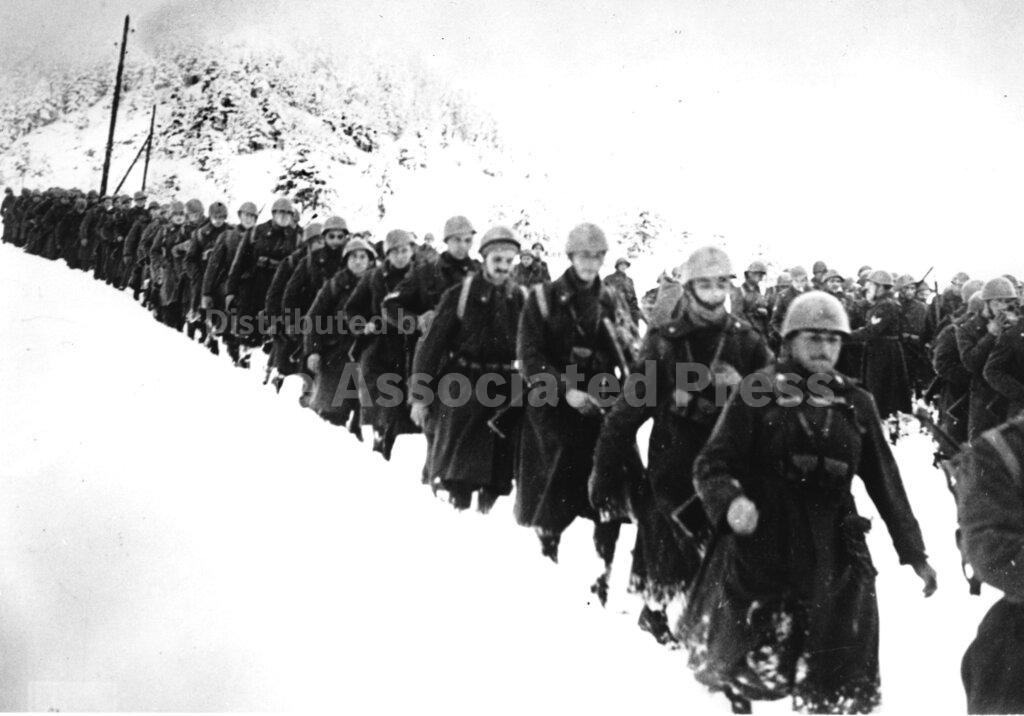
Three hundred Italian prisoners including “many officers” were taken on the Albanian front today, the Greek high command reported tonight. Greek troops stormed fortified positions protected by barbed wire and drove the Italians back in a series of local actions, it was added. Along the central sector, said a government spokesman, the general Greek offensive gathered force. The new Greek Epirus Army (I and II Corps) fights hard in the Klisura Pass area on 15 February 1941. However, the front has stabilized everywhere despite both sides desperately trying to push the enemy back.
British General Platt suspended the piecemeal attacks on Italian positions at Dongolaas Gorge near Keren, Eritrea, Italian East Africa. Instead, he began to plan for a larger offensive. The British remain stuck before Keren, Eritrea. However, they continue advancing slowly in other areas in East Africa.
Convoy WS.5B (a Winston Special troop convoy) departs from Durban. It has nine troopships..
The Nazi administration in Austria inaugurates its plan to deport Austrian Jews to Polish ghettos by sending approximately 1,000 Jews to the ghetto which had been set up in Opole, Poland.
Tensions remain high. German sympathizers (the WA and German Grüne Polizei) and opponents continue to engage in scuffles throughout the city. The enclosure of the Jewish Ghetto has been a prime factor in stirring up demonstrations.
A Zurich diplomatic source said tonight food supplies’ are being concentrated in large amounts at northern Bulgarian centers with instructions they be ready by February 25. The source said he believed the supplies might mean German troops would occupy Bulgaria February 25, or Shortly thereafter. The supplies were said to have been ordered sent to nine different key points in northern Bulgaria. The informant believed the supplies were not intended for Bulgarian troops because only a few Bulgarian soldiers have been sent to the region. Most Bulgarian forces are concentrated in the south, near the Turkish frontier. It was said that one large Bulgarian meat company had been ordered by the government to assemble about $250,000 worth of livestock at certain points in the north. To make certain that the livestock was assembled by February 25, it was said, the company was authorized to pay as much as 30 per cent above market prices for cattle, sheep, hogs and goats.
Italy forced the United States to close consulates in Naples and Palermo.
The Antonescu government early today was reported to be detaining British Minister Sir Reginald Hoare in Rumania which, effective today, is to be regarded as “enemy territory under an official British board of trade order. Rumanian circles here said the Bucharest government had refused to allow Hoare to leave Rumania until at least six members of the Rumanian legation staff in London are safely out of Britain. The order temporarily detaining the British minister was said to have been issued by Rumanian Premier General Ion Antonescu but, owing to the late hour, it was impossible to obtain British official confirmation.
A great fire broke out in the Spanish city of Santander. There are 115 deaths.
Australian Prime Minister Robert Menzies is in Khartoum, and records in his diary that he visits a memorial today to the 21st Lancers during a past border war. Among the names inscribed on it is that of Winston Churchill, who he is on the way to see.
The Communist party opened its eighteenth all-union conference in the Kremlin tonight amid Soviet press predictions that it would play an “historical role” in bolstering Soviet might.
German cruiser Admiral Hipper arrived at Brest, France, after a short but successful cruise that sank 8 Allied ships totaling 34,000 tons.
Greek-American singer Maria Callas makes her professional opera debut as Beatrice, in Franz von Suppé’s “Boccaccio” at the Olympia Theatre in Athens, Greece.
The Luftwaffe attacks the Northumberland mining district. About 130 bombers appear over the coastal area. While it is not a major raid by London standards (which also receives some attention today), it is large by local standards and causes numerous casualties. The Luftwaffe loses a Heinkel He 111P from 6./KG 4 (5J+GP) which crashes at South Shields. There are several deaths, and a land mine that the Heinkel was carrying explodes and causes devastation.
RAF Bomber Command dispatches 5 Blenheims during daylight; 1 bombed Calais docks. 1 aircraft lost.
RAF Bomber Command dispatches 73 aircraft overnight — 46 Wellingtons and 27 Whitleys — to the Holten oil plant at Sterkrade. 1 Wellington and 1 Whitley lost.
RAF Bomber Command dispatches 37 Blenheims and 33 Hampdens overnight to Homberg; the local oil plant was difficult to identify because of searchlight glare but 40 aircraft bombed. No losses.
RAF Bomber Command dispatches 43 aircraft overnight to the Boulogne docks; many fires seen. No losses.
Other bombers mount a propaganda mission to Poland, dropping leaflets over Cracow and Katowice.
Coastal Command bombs the docks at Calais, and the RAF mounts Rhubarb raids during the day.
The RAF bombs Lindos Harbor, Rhodes.
U-123, commanded by Kapitänleutnant Karl-Heinz Moehle, sank British steamer Holystone (5462grt) in the North Atlantic. At 0038 hours on 15 February 1941 the unescorted Holystone (Master John Stewart Bain), dispersed from convoy OB-284 on 13 February, was hit on port side aft by one torpedo from U-123 about 500 miles south-southwest of Iceland. The U-boat had unsuccessfully attacked the Penolver from the same dispersed convoy on 14 February and was chasing this ship when spotting the Holystone. Moehle decided to go after the bigger freighter, but then missed her with five single fired torpedoes between 2215 hours on 14 February and 0012 hours on 15 February. The sixth torpedo eventually struck the ship which disappeared in a very heavy explosion, presumably caused by the detonation of the magazine for the stern gun. The master, 35 crew members and four gunners were lost. The 5,462-ton Holystone was carrying ballast and was bound for Halifax, Nova Scotia.
German battlecruisers Scharnhorst and Gneisenau continue refueling from tankers Esso Hamburg and Schlettstadt. Admiral Lütjens is contemplating his next move south toward the shipping lanes.
Submarine HMS Cachalot laid 50 mines off Norway in minefield FD.30 in 67-55-15N, 14-14-50E and 67-54-42N, 14-43-15E. She also made an unsuccessful torpedo attack at Fro Havet.
German heavy cruiser Admiral Hipper arrived in Brest after sinking eight ships of 34,042grt. Destroyers HMS Kelly, HMS Kipling, HMS Kashmir, and HMS Jackal had departed Plymouth to intercept her, but no contact was made. The heavy cruiser was sent to Germany through the Channel in March to refit her turbines.
Destroyers HMS Intrepid, HMS Impulsive, and HMS Icarus of the 20th Destroyer Flotilla departed Scapa Flow at 2115 for Plymouth, and arrived at 0900/18th.
The 1st Minelaying Squadron of minelayers HMS Southern Prince, HMS Port Quebec, and HMS Agamemnon departed Loch Alsh at 1815 to lay minefields SN.7B and SN.68 A, escorted by light cruiser HMS Aurora and destroyers HMS Brighton, HMS Lancaster, HMS Charlestown, and HMS Echo. They were covered by light cruisers HMS Edinburgh, which departed Scapa Flow at 0429 on the 15th and HMS Nigeria which had departed Reykjavik after refueling at 0900/14th. The minefield was laid on the 17th, and the ships returned to harbor on the 18th; Edinburgh and Nigeria at 1617 and Aurora at 1914.
Steamer Stock Force (983grt) was damaged by German bombing near Outer Dowsing Float, Humber.
A sequence of odd collisions takes place in roughly the same place which results in the loss of three ships. British 286-ton freighter Marguerite, in a convoy, collides with freighter Robert off Flamborough Head, Yorkshire. The Marguerite sinks and there are two deaths, with Robert picking up the survivors. British 958-ton collier Woodstock then is involved in a sequence of incidents in Robin Hood’s Bay which results in a lot of damage. It collides with British 1509-ton freighter Paris, causing Paris to sink (it is beached but written off). It then collides with French freighter André Thomé, and the Woodstock sinks quickly from a huge tear below the waterline. It is unclear exactly what went on in this sequence of incidents. Three collisions in such a short period of time and involving the same ships, well, that is unusual.
German tanker Nordmark replenished German armed merchant cruiser Pinguin at sea. Pinguin still has several captured Norwegian whalers that need prize crews. Nordmark itself has the captured “floating delicatessen” refrigerated ship Duquesa, renamed as Herzogin. The ships hook up for several days.
Destroyers HMS Hereward and HMS Decoy arrived at Alexandria from Operation SHELFORD.
Destroyer HMS Jervis, HMS Jaguar, HMS Janus, and HMS Mohawk patrolled in the Kithera Straits during the night of 15/16 February.
Monitor HMS Terror departed Derna for Benghazi, escorted by destroyers HMAS Stuart, HMAS Voyager, and HMAS Vampire.
Convoy WS.5B with nine troopships departed Durban escorted by Australian heavy cruiser HMAS Australia and light cruiser HMS Emerald. On the 21st, heavy cruiser HMS Hawkins joined the convoy. Emerald and four transports were detached to Mombasa.
Convoy OG.53 departed Liverpool escorted by destroyers HMS Leamington, HMS Sabre, and HMS Scimitar, sloops HMS Egret and HMS Folkestone, corvettes HMS Anemone, HMS Delphinium, HMS Dianella, HMS Gladiolus, and HMS Verbena, and anti-submarine trawlers HMS Northern Gem, HMS Northern Wave, HMS St Kenan, and HMS Wellard. Light cruiser HMS Arethusa departed Scapa Flow at 2200/18th, joined the convoy on the 21st and accompanied it to Gibraltar. Scimitar was detached on the 19th, Sabre on the 20th, Leamington, Egret, Nemone, Dianella, Gladiolus, Northern Gem and Northern Wave on the 22nd, and Verbena on the 24th. Verbena arrived at Gibraltar on the 28th after losing touch with the convoy and temporarily joined the 13th Destroyer Flotilla. She arrived at Gibraltar on 1 March, escorted by Arethusa, Folkestone, and Delphinium.
Churchill telegrams to Roosevelt: “Many drifting straws seem to indicate Japanese intention to make war on us or do something that would force us to make war on them in the next few weeks or months. …this is a war of nerves designed to cover Japanese encroachments in Siam and Indo-China. … I do not think that the Japanese would send large military expedition necessary to lay siege to Singapore. The Japanese would no doubt occupy strategic points and oil fields in Dutch East Indies….They would also raid Australian and New Zealand ports and coasts.” Churchill wants American warships to be stationed at Singapore to stave off the Japanese threat.
He later states:
“But the attack which I fear the most would be by raiders, including possibly battle-cruisers, upon our trade routes and communications across the Pacific and Indian Oceans.”
Churchill concludes:
“Some believe that Japan in her present mood would not hesitate to court or attempt to wage war both against Great Britain and the United States. Personally I think the odds are definitely against that, but no one can tell.”
He asks Roosevelt to impress upon the Japanese that any war against Great Britain would involve the United States as well — something that Roosevelt already has broadly hinted to Japanese Ambassador Nomura.
Development of Guam and Samoa, Pacific islands, as naval aviation “lookout stations” was recommended unanimously today by the house naval committee after it heard secret testimony from the navy high command regarding the far eastern situation. The committee’s recommendations were made in approving legislation authorizing expenditure of approximately $400,000,000 for expansion of many existing naval shore bases and establishment of new facilities. Chairman Vinson, Georgia Democrat, cautioned members of the committee against discussing, even among themselves, the proceedings of the secret session.
The concern of the United States over the tense situation in the Far East was emphasized today by conferences of Secretary of State Hull with the British, Australian and Dutch envoys. Viscount Halifax, the British ambassador, and Richard G. Casey, the Australian minister, held an hour’s joint discussion with Hull.
The growing tension in the Balkans and in the Far East has apparently decided Administration leaders in the Senate to resist with all force any attempt to amend the Lend-Lease bill so as to enumerate, specifically or by general description, the countries which might be aided under its terms, as was suggested by Wendell L. Willkie.
U.S. Chief of Naval Operations Admiral Harold R. Stark wrote to Admiral Husband E. Kimmel on the subject of anti-torpedo baffles for protection against torpedo plane attacks on Pearl Harbor stating: “Consideration has been given to the installation of A/T (anti-torpedo) baffles within Pearl Harbor for protection against torpedo plane attack. It is considered that the relatively shallow depth of water limits the need for anti-torpedo nets in Pearl Harbor. In addition, the congestion and the necessity for maneuvering room limit the practicability of the present type of baffles. A minimum depth of water of 75 feet may be assumed necessary to successfully drop torpedoes from planes. 150 feet of water is desired. The maximum height planes at present experimentally drop torpedoes is 250 feet. Launching speeds are between 120 and 150 knots. The desirable height for dropping is 60 feet or less. About 200 yards of torpedo run is necessary before the exploding device is armed but this may be altered.” In the same letter Stark underlined the fact that the depths of water in which torpedoes were launched in the successful attacks at Taranto were between 14 and 15 fathoms; that is, 84 to 90 feet of water. A letter of similar tenor was sent by the Chief of Naval Operations to the commandants of various naval districts, including the 14th Naval District.
Charges of attempting to interfere with the national defense were filed against three confessed train wreckers today as details of an alleged plot to extort $50,000 from Southern Pacific railroad were disclosed. Dan O’Connell, chief special agent for Southern Pacific, told the story of the attempted extortion at a hearing at which Owen McHenry, 33, Bernal Carter, 20, and Kenneth Lennon, 20, pinsetters in a Sacramento bowling alley, were held under $50,000 bail each for federal grand jury action. The jury meets March 10 to consider charges of train wrecking, extortion, and “attempting to wreck or destroy a national defense utility,” filed against the trio. The three were arrested In connection with an attempt to wreck Southern Pacific trains in the Dutch Flat section of the California gold country last Saturday. F.B.I. and railroad police said they confessed tearing up a rail and removing spikes. The damage was discovered before the Pacific Limited reached the area. O’Connell said at the hearing that in mid-January the railroad company received a note at its San Francisco headquarters demanding $50,000 under threat of sabotage to its property.
Henry Ford said today the United States should give England and the axis powers “the tools to keep on fighting until they both collapse.” The 77-year-old automobile manufacturer, making his annual visit to his plantation and experimental farm here, said in an exclusive copyrighted interview with Staff Writer Harold Martin of the Atlanta Constitution he “sincerely hopes” that neither England nor the axis powers will win the struggle. “There is no righteousness in either cause,” he said. “Both are motivated by the same evil impulse, which is greed. It is not the little people who are doing the fighting and the suffering who are the greedy ones. They are innocent of that. Their only guilt is idleness. Idleness has made them stupid and stupidity has made it easy for the big ones, the greedy ones, to lead them into war. If we can keep both sides fighting long enough until they cannot fight any more, then maybe the little people will open their eyes. Then they can see that they have been the dupes of this international clique of greed and we have its members in this country, too who have tricked them into war. Maybe then they will revolt and free themselves and save themselves from being led into destruction again as soon as they have rested and recovered for a generation or so.”
The United States, in a stab toward closer collaboration with Great Britain in the development of new war weapons, today sent Dr. James B. Conant, president of Harvard University, on a mission to London to exchange scientific information of vital interest to the two nations. President Roosevelt sends a mission headed by Harvard University President James Bryant Conant to Great Britain to facilitate the sharing of technology. Also included in the mission are Frederick L. Hovde from Purdue University and Carroll L. Wilson from MIT. This follows on the Tizard Mission from Great Britain that brought the United States cutting edge technology. One of Roosevelt’s biggest successes during the war is his focus on advanced technology, though he chooses different areas to concentrate on than the Axis does.
Harold Ickes recommends to Roosevelt that the Interior Department be responsible for the defense of the Philippines.
Omar Bradley is promoted from lieutenant colonel to brigadier general, bypassing the rank of colonel, and sent to command Fort Benning. Bradley has been Assistant Secretary, General Staff since July 1939.
The experimental Curtiss XP-46A fighter makes its first flight. While early models of the P-40 were being produced, Curtiss began testing a follow-on design, the XP-46. As it offered no particular improvements over the latest P-40s, the program was cancelled. The performance during trials of the XP-46 was subsequently found to be inferior to the upgraded P-40 (designated P-40D, using the P-46 engine).
An advance echelon of the US Marine Corps 1st Defense Battalion departed San Diego, California, United States aboard USS Enterprise (CV-6) for Johnston Island and Palmyra Atoll via Pearl Harbor, U.S. Territory of Hawaii.
Camp Barkeley, Texas is activated. It is an infantry training post in Taylor County Texas. Construction began on 17 December 1940, and it will be declared surplus on 21 March 1945.
The U.S. Congress approved the construction of a new base for the U.S. Marine Corps’ Fleet Marine Force at New River, North Carolina, United States.
Naval Air Station, Kaneohe Bay, Oahu, T.H., is established, Commander Harold M. Martin in command.
The Japanese vice-consul in Honolulu, Otohiro Okuda, dispatched a message, which was addressed to the Foreign Ministry for routing to the General Staff and the chief of Japanese Naval Intelligence, American Section, Captain Kenji Ogawa. This relayed second hand information that the Roosevelt Administration would declare war on Japan sometime between the sending date and the end of the first week of March.
Warner Bros. releases “The Haunted Mouse,” a Looney Tunes production by Tex Avery (animation by Sid Sutherland). It features the voices of Mel Blanc as the Black Cat (if you have a mouse, you need a cat!) and Walter Tetley as the Haunted Mouse. This is the first writing credit for Michael “Mike” Maltese, who some consider the greatest cartoon writer of all time for his plays on words and original stories. It is Avery’s first black and white cartoon in four years as Warners spreads out the work to different directors — Tex leaves the story shortly after.
Duke Ellington and his Famous Orchestra record “Take the ‘A’ Train” at RCA Victor’s Hollywood, California, studio today. This is one of big band’s all time classics and becomes the Duke’s theme song. The tune is written by Billy Strayhorn. This is only the first of several commercial recordings, but the most famous and enduring. The song has been under development since 1939 when Ellington wrote down travel instructions for Strayhorn to his house which included the directive “Take the A Train.”
British Ambassador Sir Robert Leslie Craigie was reported today to have cautioned Foreign Minister Yosuke Matsuoka against any menacing maneuvers by Japan toward British possessions in the far east. Sir Robert saw the Japanese foreign minister late yesterday, presumably on instructions from London. The exact details of their meeting were not disclosed. Simultaneously, Japanese newspapers reported under Bangkok, Thailand, datelines rumors of an imminent Anglo-Japanese clash. Domei, Japanese news agency said that “fears of a possible British invasion of Thailand were mounting” because of the presence of British troops near the Thai border and the reported sighting of a British warship in the Gulf of Siam.
Dow Jones Industrial Average: 118.55 (+0.89)
Born:
Brian Holland, American pianist, songwriter, and producer (Holland–Dozier–Holland — “Heat Wave”; “Where Did Our Love Go”; “You Keep Me Hanging On”), in Detroit, Michigan.
Florinda Bolkan [Bulcão], Brazilian model and actress (“The Damned”; “The Last Valley”; “The Word”), in Uruburetama, Brazil.
Wallace Dickey, AFL tackle (Denver Broncos), in San Antonio, Texas.
Died:
Guido Adler, 85, Bohemian-Austrian musicologist and writer.
Naval Construction:
The Royal Fleet Auxiliary Dale-class fleet tanker RFA Easedale (X 105; A105 postwar) is laid down by the Furness Shipbuilding Company (Haverton Hill, Stockton on Tees, England, U.K.).
The Royal Navy Assurance-class rescue tug HMS Jaunty (W 30) is laid down by Cochrane & Sons Shipbuilders Ltd. (Selby, U.K.).
The Royal Navy Bar-class boom defense vessel HMS Barford (Z 209) is laid down by W. Simons & Co. Ltd. (Renfrew, Scotland).
The U.S. Navy Barnegat-class small seaplane tender USS Unimak (AVP-31) is laid down by the Associated Ship Builders Inc. (Seattle, Washington, U.S.A.).
The Kriegsmarine (German Navy) Type VIIC U-boat U-256 is laid down by Bremer Vulkan-Vegesacker Werft, Bremen-Vegesack (werk 21).
The Kriegsmarine (German Navy) Type VIIC U-boat U-660 is laid down by Howaldtswerke Hamburg AG, Hamburg (werk 809).
The Kriegsmarine (German Navy) Type VIIC U-boat U-765 is laid down by Kriegsmarinewerft (KMW), Wilhelmshaven (werk 148).
The Royal Navy Flower-class corvettes HMS Fritillary (K 199) and HMS Genista (K 200) are laid down by Harland & Wolff Ltd. (Belfast, Northern Ireland).
The U.S. Navy net tender USS Ash (YN-2, later AN-7) is launched by the Lake Washington Shipyard (Houghton, Washington, U.S.A.).
The U.S. Navy net tender USS Hazel (YN-24, later AN-29) is launched by the American Shipbuilding Co. (Cleveland, Ohio, U.S.A.).
The Royal Navy MMS I-class motor minesweeper HMS MMS 17 (J 517) is launched by the Wivenhoe Shipyard Ltd. (Wivenhoe, England, U.K.).
The Royal Navy Flower-class corvette HMS Lobelia (K 05) is launched by Alexander Hall & Co. Ltd. (Aberdeen, Scotland). She is transferred to the Forces Navales Françaises Libres (Free French Naval Forces) and commissions in June as the Lobelia (K 05).
The Royal Navy Flower-class corvette HMS Bergamont (K 189) is launched by Harland & Wolff Ltd. (Belfast, Northern Ireland).
The Royal Navy “L”-class (Flotilla leader) destroyer HMS Laforey (G 99) is launched by Yarrow Shipbuilders Ltd. (Scotstoun, Scotland).
The U.S. Navy Gleaves-class destroyer USS Ingraham (DD-444) is launched by the Charleston Navy Yard (Charleston, South Carolina, U.S.A.).
The Kriegsmarine (German Navy) Type VIIC U-boat U-78 is commissioned. Her first commanding officer is Kapitänleutnant Adolf Dumrese.
The Nihon Kaigun (Imperial Japanese Navy) Shimushu-class escort ship HIJMS Ishigaki (石垣) is commissioned. Her first commanding officer is Commander Fujitani Yasumi.
 History Diaries