Sir Kingsley Wood has announced that the war is costing the people of Britain £ 10,500,000 per day. This is more than double the daily expenditure of a year ago.
Churchill intervenes directly with Secretary of State for War David Margesson regarding Kermit Roosevelt, President Theodore Roosevelt’s son and President Franklin Roosevelt’s fifth cousin, once removed. In 1939, Kermit enlisted in the British Army as a Second Lieutenant in the Middlesex Regiment, but the doctors have indicated that he should be disqualified from serving on health grounds. Churchill writes that his case is a “matter of political consequence” and “if he wishes to go on with us he should be allowed to do so.” The issue of Presidential relatives serving in the military will recur at several points throughout the war, and anything having to do with the Roosevelt name is of extreme sensitivity. Kermit does, in fact, have serious health problems, but they relate to depression as much as anything physical.
Minister of Labour and National Service Ernest Bevins has been trying to make the shipbuilding process more efficient. British merchant shipping losses have been horrendous, and yesterday’s sinking of seven merchant ships by German cruiser Admiral Hipper is symptomatic of the challenges facing the convoys. Today, Bevins receives a proposal to decasualize the ports in order to make them work more efficiently. However, as with Bevins’ other attempts at reform, this proposal is resisted and gets nowhere. This leaves shipping, Britain’s lifeblood, dependent upon US ships and shipping production.
Continuing his extreme skepticism about the necessity to maintain a large force in North Africa, Churchill memos General Ismay about a convoy being formed, of whose composition he writes “I do not approve.” This is a continuation of Churchill’s outspoken concern about the “tooth to tail” ratio in the Middle East Command, which he implies repeatedly at this stage of the war is full of unnecessary useless mouths. He points out specific units being carried in the convoy (apparently a Winston Special convoy, though it is not identified in the memo) that he views as “non-combatants” due to lack of equipment and thus dead weight. Churchill proposes sending fewer troops in such convoys and more equipment, given that there are troops already on the ground in Egypt that are at loose ends due to lack of equipment.
Air Ministry to RAF HQ Cairo: “”We have received appeal from Greece for immediate air assistance in the battle in Albania due to start today. …immediate despatch of 33 Sqn. and use of Wellingtons from aerodromes near Athens against Italian aerodromes and port of Valona.”
Australian Prime Minister Robert Menzies, having broken his journey from Melbourne to London in Cairo, meets with British Middle East Commander General Archibald Wavell. Menzies observes (in his diary) that the general is “clearly contemplating the possibility of a Salonika (Greece) expedition.” This seems to be news to Menzies of at most casual interest as if Wavell has mentioned it only as side operation, not a major strategic initiative.
The implication is that Menzies — the national leader of the Australian troops now carrying the brunt of the fighting during Operation Compass — has been kept “out of the loop” on the wrangling about whether to send Middle East troops to Greece. Such moves are imminent, and RAF units already are being switched to Athens. This seems like something that the Prime Minister of Australia should be kept informed about, given that his troops are directly affected. However, it is the only reference in Menzies’ entire diary about discussions with Wavell regarding any such “expedition.”
Greek troops were reported today to have reached strategic heights north of and beyond Tepeleni, Albania, after heavy fighting and threatened to outflank the Italian defenders of that town. The Italians were reported to have brought up heavy batteries to defend Tepeleni, which controls the highway to the Fascist port of Valona, Albania. The Italians used armored units in the central sector where the terrain allowed, it was said. While the front is quiet on 13 February 1941, the Italians are preparing a major effort in the Klisura Pass region for the 14th. This has become the focal point for the entire campaign, as the Greeks, despite some successes, have been unable to advance beyond it to take the vital Italian port of Valona. The RAF raids airfields at Durazzo and Tirana.
The Greek I and II Corps are combined into Epirus Army. Western Macedonia Army controls units to the north.
Many in the British Middle East Command are quite upset about the halt of operations imposed by Whitehall on the 12th. Admiral Cunningham notes that he is “most bitterly disappointed at the turn this Libya campaign has taken.” He takes some comfort from the fact that “I know it was not due to any naval shortcomings (we had just landed just landed 2,500 tons of petrol and over 3,000 tons of other stores at Benghazi and had doubled the amount we had guaranteed to land daily at Tobruk).” In light of later events, it is instructive to see that commanders at the time viewed the diversion of resources away from a continuing victorious campaign in Libya as questionable. It is fair to point out that the British military leadership in both London and Egypt uniformly wish to continue Operation COMPASS all the way to Tripoli.
The Luftwaffe continues planting magnetic mines in Benghazi harbor. The Royal Navy, however, has opened the port for convoys despite numerous sinkings at Tobruk from such mines.
At Keren, Eritrea, Lieutenant-General William Platt decides to pause his Indian troops’ attacks on the Italian troops defending Dongolaas Gorge. He reduces his troop count in order to ease the supply situation by sending the 5th Indian Division back to the railhead at Kessala. The British begin assembling troops on all sides of Keren. It will take some time, however, for other forces to assemble and threaten Keren from the rear. Undeniably this has been an Italian defensive victory, but all it promises to do is buy some time, not stop the British offensive rolling through East Africa.
British advances continue elsewhere without too much hindrance from the Italians. Bulo Erillo, Somalia (south of Mogadishu) falls to the Gold Coast 24th Infantry Brigade.
New progress in the 3-column British drive to cut Italian Eritrea to pieces was reported today by the Middle Eastern command, and the royal air force told of a bombing offensive extending from the island of Rhodes to the Eritrean front. British columns besieging Cheren, which commands the approaches to Asmara, the Eritrean capital, were said to have improved their positions in the hills covering the town by successful local attacks. A parallel westward advance farther to the south, the British reported, drove toward Arresa, some 50 miles southwest of Asmara. Imperial troops pushing down from the north parallel to the Red sea were reported to have thrown back heavy Italian counterattacks launched in an unsuccessful effort to dislodge the British from control of the highway junction of Elgena. In southern Ethiopia, the British reported, South African troops “continue successfully to extend” the area of their penetration.”
Reports that Germany is seeking passage for German troops through both Yugoslavia and Bulgaria in order to get at Greece and the eastern Mediterranean shores reached diplomats as Yugoslavia’s premier and foreign minister began “requested” conferences with the Nazi leadership in Germany. Diplomatists with usually reliable sources of information in government quarters said Premier Dragisa Cvetkovic and Foreign Minister Alksander Cincar-Markovlc will discuss passage of German troops from Rumania through the Yugoslavian railway junction of Nis, thence by rail down the Vardar river valley toward Greece and the important Aegean seaport of Salonika. There were unconfirmed reports that King Boris of Bulgaria might follow the Yugoslavs to Germany today. In any event, Sofia dispatches said that Bulgaria, with Italian and German backing, now is trying to get British-allied Turkey to promise not to fight if the Germans start through Bulgaria toward the Dardanelles. An indication Turkey was not prepared to fight to prevent the Nazi armies reaching Greece and the Mediterranean through Bulgaria and Yugoslavia was seen in an announcement that Nazi-controlled Rumania had agreed to send 160,000 tons of oil to Turkey immediately, a deal hardly to be expected if Germany believed Turkey would be lined up against her soon.
The British minister to Sofia said in a statement that “If the Germans occupy Bulgaria and make it a base against our ally, obviously we shall have to break off relations with Bulgaria and take whatever measures the situation requires..”
Unrest in Amsterdam continues. The German occupation forces in Amsterdam complete their closure of the Jewish Quarter with barbed wire, barring it to all gentiles. Checkpoints are in place so that nobody goes in or out without permission.
German authorities ordered all gentiles out of the old Jewish quarter of Amsterdam around Waterloo square today, raising the possibility of a moated ghetto of 50,000 inhabitants. The German order, it was stated, was the result of street fighting in which Dutch Nazis and armed opponents from Waterloo square clashed on February 9, and of a series of drubbings which the Jews gave Nazis in that district in the ensuing two days. Nazi shop windows were smashed in the rioting. It is estimated that about half of Amsterdam’s 100,000 Jews live in the Waterloo square district. The population of Amsterdam is about 800,000. Traffic to and from the Waterloo square district can be controlled by raising or lowering canal drawbridges.
Galtier-Boisiére, a collaborator, dines at a fashionable Paris restaurant on the quais. “The room was crowded. Sitting at the bar, Léon-Paul Fargue, a cigarette stuck between his tortoise like lips, was waiting for a table. An enormous Fritz, who, it seems, was Lieutenant Weber, Führer of the Franco-German press, was treating his friends to champagne. No restrictions. Forbidden beefsteaks were hidden under fried eggs. A nouveau-riche clientele. The finest wines flowing. Fat cats are on top in the New Order. With cash, plenty of cash, one can always stuff one’s face as much as one likes, while housewives stand in line for hours in the snow for turnips.” Luxury restaurants are allowed to serve meat openly on payment of a special 10% levy to the Secours Nationale.
King Alfonso XIII, who left Spain in 1931, renounces the Spanish throne in favor of his son Juan.
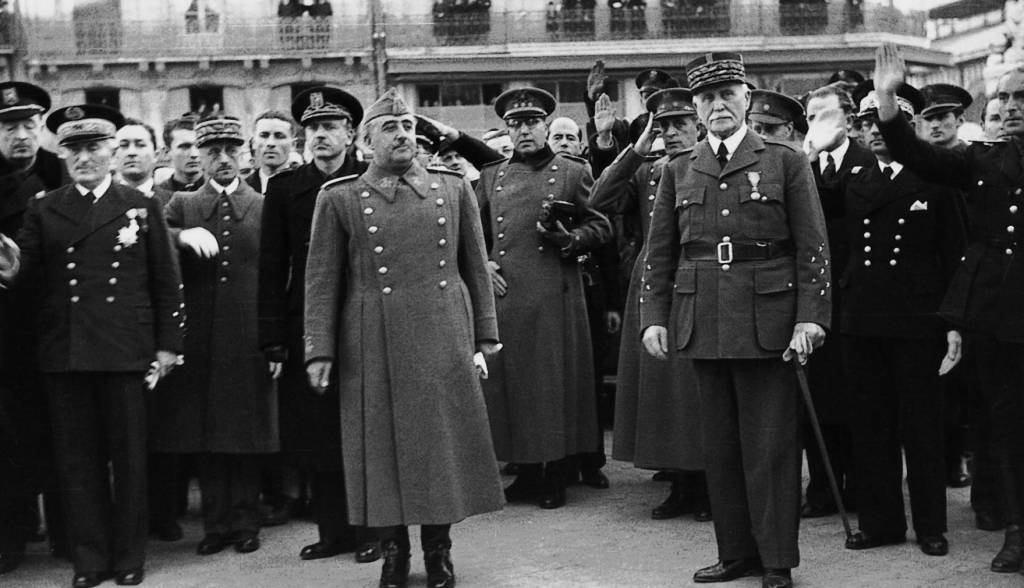
Spanish dictator General Francisco Franco meets Vichy French Premier Marshal Henri Pétain in Vichy “to discuss matters relating to the prosecution of the war.” After winding up his talks with Mussolini (Italy), General Franco (Spain) meets Petain (Vichy France) at Montpellier. The three nations basically have nothing whatsoever in common, but Hitler has high hopes that the three dictators will find some kind of common ground in fighting the British.
The Germans order Vichy to break off economic discussions with Britain. The Germans have gotten wind of Marshal Petain’s backdoor negotiations with the British. In no uncertain terms, the Germans tell the French to stop it.
The aqueduct in Calabria, Italy, attacked by British paratroops three days ago is back in use. The Italians have worked extremely quickly to repair the damage to the aqueduct on the Tragino River caused during Operation Colossus on 11 February. Today, the aqueduct goes back in service. Throughout World War II, the British will obsess about attacking dams and other water infrastructure, with extremely mixed results.
Admirals Arturo Riccardi of Italy and Erich Raeder of Germany meet at Merano to discuss naval co-operation. Grand Admiral Erich Raeder meets with his Italian counterpart, Admiral Arturo Riccardi, at Merano. They discuss naval cooperation in the Mediterranean, a matter of urgency due to the new Afrika Korps in Libya. Shipping from Naples to Tripoli will be a major determinant in the limits of General Erwin Rommel’s success in North Africa.
General Nikolai Vatutin becomes Soviet Deputy Chief of the General Staff (Stavka).
The Luftwaffe mounts its first major raid in weeks, attacking London after dark. The attacks in residential districts cause heavy casualties, as many people have been lulled into a false sense of security by the recent quiet period and have returned to their homes at night. During the day, Bf 109s again have some fun with the Dover barrage balloons, and one Messerschmitt is damaged by a Spitfire while doing so.
German combat planes successfully attacked British airports and troop encampments in Libya Wednesday, the official news agency DNB reported, early today. Direct hits were claimed on airport barracks, grounded British bombers and troop centers, causing “considerable damage and losses.”
The Luftwaffe attacks Malta multiple times throughout the day. The attacks are spread out across the island. A Wellington and a Whitley bomber are damaged during the attacks, and three bombs apparently intended for Ta Qali airfield fall on Imtarfa Hospital, killing three patients, seriously wounding six, and lightly wounding another six. Many of the patients are military personnel.
Operation COMPOSITION begins. Fourteen Fairey Albacore from HMS Formidable sink 5723-ton Italian freighter Monacalieri at Massawa in Italian East Africa. They also cause minor damage to several other ships. The RAF loses two Albacores, the six aircrew becoming POWs.
This is the first of several raids, the second on 21 February and the third on 1 March, all usually lumped under the “Operation COMPOSITION” codename (which technically only applies to this raid). HMS Formidable is en route from Vice Admiral R. Leatham’s East Indies Fleet to Alexandria to replace the damaged HMS Illustrious, but the crew has time on its hands because the Suez Canal remains closed due to Luftwaffe mining.
Separately, aircraft from HMS Eagle torpedoed and damaged 590-ton German freighter Askari, one of the ships fleeing from the advancing British in Italian Somaliland, on the 12th. The crew managed to get the Askari back to Kismayo and beach it today, but the ship is written off. The Eagle’s aircraft also combine with heavy cruiser HMS Hawkins and HMS Shropshire to sink 6268-ton Italian freighter Pensilvania. Just like Askari, Pensilvania is hit off Mogadishu, beached, and declared a total loss and broken up. Italian freighters Erminia Mazzella, Manon and Savoia, other refugees from Kismayu, also are captured.
U-96, commanded by Kapitänleutnant Heinrich Lehmann-Willenbrock, sank motor tanker Clea (8074grt), which was straggling behind convoy HX.106, in the Northwest Approaches. At 1508 hours on 13 February 1941 the unescorted Clea (Master Leonard Walter George Boyt) was hit on port side amidships by one G7e torpedo from U-96 about 190 miles south of Iceland. The tanker immediately caught fire and completely broke in two. The U-boat surfaced and sank both halves with a total of 83 rounds from the deck gun, the after part sank at 1659 hours and the fore part sank at 1731 hours after further holes were fired into the side with the anti-aircraft gun. The Germans had observed how the crew abandoned ship in four lifeboats after the torpedo hit, but no survivors were ever found. The master, 56 crew members and two gunners were lost. The 10,516-ton Clea was carrying Admiralty fuel oil and was bound for Scapa Flow, Scotland.
U-103 damaged motor tanker Arthur F. Corwin (10,516grt), straggling behind convoy HX.106, in 60-25N, 17-11W. At 1625 hours on 13 February 1941, U-103 (Schütze) damaged the Arthur F. Corwin (Master John Lawrence Gant) with two torpedoes southeast of Iceland. The U-boat then left the burning tanker in a sinking condition.
U-96 sank the Arthur F. Corwin three hours later. At 1950 hours the same day, U-96 came across the wreck of this tanker which was still afloat and sank her with two coups de grâce. The master, 44 crew members and one gunner were lost. The 10,516-ton Arthur F. Corwin was carrying motor fuel and was bound for Avonmouth, England.
Anti-aircraft ship HMS Cairo departed Scapa Flow at 1330 for Greenock on completion of working up exercises.
Anti-aircraft ship HMS Curacoa departed Scapa Flow at 1100 to provide cover for convoy WN.83. At 2200, the ship transferred to convoy EN.71. In Pentland Firth at 0930/14th, ship Curacoa left convoy EN.71. While transferring to convoy WN.84, damage was caused by heavy seas and she returned to Scapa Flow, arriving at 1330.
Heavy cruiser HMS Norfolk arrived at Scapa Flow after duty in the South Atlantic.
Destroyer HMS Anthony was damaged by splinters from a near miss of a German bomb at Glasgow. The destroyer spent no time out of service from this damage, but did begin refitting at Glasgow.
Anti-submarine trawler HMS Rubens (320grt, T/Skipper H. G. Pyle RNR) was sunk by German bombing in 48-50N, 14-20W. The trawler had separated from convoy OG.52 as a result of a misunderstood signal. Pyle, P/T/Sub Lt C. E. Oates RNR, T/Sub Lt D. H. Owens RNVR, all the ratings were lost in the trawler.
Destroyer HMS Ripley was damaged in a collision with destroyer HMS Burwell and anti-submarine trawler HMS Notre Dame De France (433grt) at Devonport. The destroyer was repaired at Devonport completing on 3 March.
British steamer Westcliffe Hall (1900grt) was damaged by German bombing 2¼ miles 10° from Whitby High Light. She arrived in the Tees with steering gear damaged.
British steamer Cape Rodney (4512grt) was damaged by German bombing off Girdleness.
Light cruiser HMS Gloucester departed Alexandria for Port Said to fit damaged cruiser HMS Liverpool’s DCT. The light cruiser returned to Alexandria on the 15th with the unit in place.
British operation COMPOSITION: Aircraft carrier HMS Formidable air attacked Massawa. Italian steamer Moncalieri (5723grt) was damaged by the bombing and later scuttled. A/Sub Lt (A) J. H. Jefford, Sub Lt (A) C. P. Simpson, Leading Airman F. H. Shiel of 826 Squadron and A/Sub Lt (A) D. M. R. Wynne-Roberts RNVR, P/T/A/Sub Lt (A) M. G. C. Keeley RNVR, Leading Airman W. M. Brown of 829 Squadron were shot down and made prisoners of war. They were liberated when Massawa fell to British forces in April.
Convoy OB.286 departed Liverpool, escorted by destroyer HMS Wolverine, sloop HMS Fleetwood, and corvettes HMS Arbutus, HMS Camellia, and HMS Erica. Destroyer HMS Harvester joined on the 15th. The convoy was dispersed on the 17th.
Convoy HX.109 departed Halifax, escorted by armed merchant cruiser HMS Ausonia, destroyer HMCS Annapolis, and patrol vessel HMCS Otter. The destroyer and the patrol vessel were detached on the 14th. On 26 February, destroyers HMS Burnham, HMS Douglas, and HMS Malcolm, corvettes HMS Clarkia, HMS Mallow, and HMS Petuna, and anti-submarine trawler HMS Northern Spray joined the escort. The trawler was detached later that day. On the 2nd, destroyer Douglas was detached, destroyers Burnham and Malcolm and corvettes Clarkia and Petunia were detached. Corvette Mallow was detached when the convoy arrived at Liverpool on 4 March.
Today in Washington, President Roosevelt conferred with Secretary Knox on the question. of naval aid to Britain. He signed the bill appropriating $175,000,000 for clothing and personnel equipment for the Army, sent to the Senate the nomination of Jerome Frank to be Judge of the United States Circuit Court of Appeals at New York and transmitted to Congress requests for several appropriations, including $10,000,000 to enable the Tennessee Valley Authority to increase its power output.
The Senate approved the Tydings resolution for a study of the relationship between government revenues and spending, heard discussion of the Lend-Lease bill and recessed at 3:20 PM, until noon tomorrow. The Foreign Relations Committee reported the Lend-Lease bill, the Finance Committee approved the bill raising the debt limit to $65,000,000,000 and the Temporary National Economic Committee heard Thurman Arnold, Assistant Attorney General, on problems arising under the anti-trust laws.
The House approved the $1,146,394,496 Treasury-Post Office appropriation bill, heard discussion of the Lend-Lease bill and adjourned at 3:14 PM, until noon on Monday.
The Senate Foreign Relations Committee approved the lease-lend bill, 15 to 8, today and urged its passage with an assertion that it “is not a war measure, but a practical safeguard aimed at keeping out of war.” Making a formal report to the senate, the committee majority said the welfare of the nation can best be served by a foreign policy based upon the two fundamental principles that: “The United States must strive In all ways reasonably possible to stay at peace with all the world; and the United States must, in its own interests, supply effective material aid to those countries whose defense is vital to our defense.”
The Knox-Willkie dispute over transfer of additional U. S. destroyers to Great Britain brought a formal White House statement tonight that President Roosevelt is “thoroughly informed concerning the question of British destroyer needs.” The statement was issued by White House Secretary Stephen T. Early. He denied that any controversy existed among the president, Secretary of the Navy Frank Knox and Wendell L. Willkie relative to availability of the small warships. On Tuesday before the Senate Foreign Relations Committee, Mr. Willkie advocated sending five or ten American destroyers a month to Britain and testified that Prime Minister Churchill agreed they were needed. Yesterday at a press conference Secretary Knox declared against “any further depletion of the United States Fleet,” which, he held, would be unbalanced by transfer of further destroyers. Mr. Willkie immediately authorized the statement that a high authority had agreed with him that more destroyers could be spared for Britain. The President conferred with Secretary Knox today for an hour and a half at luncheon. On leaving the White House Secretary Knox said: “I have not changed my opinion at all.” He referred all other questions to Mr. Roosevelt.
Senator Burton K. Wheeler of Montana, who will probably act as floor leader of the forces opposed to passage of the Lend-Lease bill, charged today that radio commentators in discussing the measure had been “quite one-sided on the great issue.”
The President’s Lend-Lease bill has received increasing sentiment in its favor during the past ten days, a new nation-wide survey by the American Institute of Public Opinion has shown, according to Dr. George Gallup, the institute’s director.
The United States can support a national defense program of $15,000,000,000 a year, or more if necessary, without checking savings or reducing the standard of living of the people, provided punitive and destructive taxes are not saddled on the country and private industry is not hampered by bureaucratic control and excessive restrictions, according to a report and addresses last night at a dinner of the American Taxpayers Association in the Hotel Astor.
The unprecedented demand for magnesium for defense orders caused the division of priorities of the Office of Production Management to declare today a preferential status of this product for defense purposes. E. R. Stettinius Jr., director of the priorities division, notified companies of the decision, which strengthens a step taken yesterday when it was requested that both magnesium and aluminum be reserved for defense purposes.
To meet demands for power occasioned by defense needs in addition to peacetime requirements, President Roosevelt asked Congress today for an additional appropriation of $10,000,000 for the Tennessee Valley Authority, and Secretary Ickes announced “a wholesale expansion” of the production program, designed to speed it up “not by weeks or months but by years.”
Combinations of labor unions among themselves and with employers are levying tribute from the lowest brackets of the income groups of the United States by raising the price of necessities, said Thurman W. Arnold, Assistant Attorney General, in testimony today before the Temporary National Economic Committee.
The motion picture “Buck Privates” opens at the Loew’s State Theater in New York City. Directed by Arthur Lubin, this comedy stars Bud Abbott, Lou Costello, Lee Bowman and the Andrew Sisters. This picture is the first in which Abbott and Costello star.
U.S. Navy light cruisers USS Brooklyn (CL-40), USS Philadelphia (CL-41), and USS Savannah (CL-42) and stores issue ship USS Antares (AKS-3) arrive at Midway with the remainder of the 3d USMC Defense Battalion (Lieutenant Colonel Robert H. Pepper, USMC).
American Samoa’s Governor, Captain Laurence Wild, replied to the Chief of Naval Operations Admiral Harold R. Stark’s directive of December 20, 1940 “by recommending the establishment of a Native Insular Force separate and distinct from the Fita Fita Guard, which was to function under and to be paid by the Government of American Samoa.” This force subsequently came into being as the First Samoan Battalion, U.S. Marine Corps Reserve.
The Imperial Japanese Navy “S” Operation continued. The heavy cruisers HIJMS Suzuya, HIJMS Mikuma, HIJMS Mogami, and HIJMS Kumano made a port call at Saigon, French Indochina. The operation was designed to put pressure on the Vichy French colonial government in the wake of the naval Battle of Koh Chang between the Vichy French and Thailand.
Concern was manifested in diplomatic quarters today over developments in the Far East that pointed to a possibility that Japan might be undertaking a further movement in her southward expansion, this time aimed more closely toward the Netherland Indies or the British base at Singapore.
Reliable foreign sources declared today that Anglo-Japanese relations in the Pacific are approaching a crucial stage as a result of Japanese assistance to Nazi sea raiders and Japan’s military pressure on Singapore, Britain’s great far eastern naval base. Fear that the European war might spread to the orient “at any moment” was voiced in high occidental diplomatic quarters today. It apparently was based on belief that Japan will join Germany and Italy in a simultaneous “knock out” offensive against the British Empire. A reliable occidental informant said that “a Japanese battle fleet” was concentrated off Haiphong, Indo-China, Thursday, but that “nothing was known of the reasons” for the demonstration. Japanese said a number of their warships were in the Haiphong area in connection with measures for enforcement of the armistice agreement between Thailand and French Indo-China which was arranged by Japan.
The United States government sought anew today to induce Americans to leave the Far East as Australian officials at Sydney declared that “the war has moved into a new stage involving the utmost gravity.” In the foreign diplomatic corps here there were two interpretations of the Australian statement. Some said they saw signs that Japan might strike soon toward Singapore, Britain’s great naval bastion in the Pacific, or toward the Netherlands East Indies. Others felt the statement might be intended primarily for home consumption; to stir the Australians to even greater efforts in the British-axis war.
Dow Jones Industrial Average: 121.1 (-1.51)
Born:
Bo Svenson, Swedish-American actor (“North Dallas 40”, “Walking Tall”), in Goteborg, Sweden.
Andrea Conte, First Lady of Tennessee, in Great Barrington, Massachusetts.
Dick Evey, NFL defensive end and defensive tackle (Chicago Bears, Los Angeles Rams, Detroit Lions), in State College, Pennsylvania (d. 2013).
Jim Brenneman, MLB pitcher (New York Yankees), in San Diego, California (d. 1994, of a heart attack).
Sigmar Polke, German painter, in Oleśnica, Poland (d. 2010).
David Jeremiah, American televangelist, in Toledo, Ohio.
Sigmar Polke, Polish painter and photographer, in Oels, Poland (d. 2010).
Died:
Blind Boy Fuller, 36, American Piedmont blues musician, of sepsis and kidney failure.
Naval Construction:
The Royal Navy Bar-class boom defense vessel HMS Barrymore (Z 73) is launched by W. Simons & Co. Ltd. (Renfrew, Scotland).
The Royal Navy Fairmile B-class motor launch HMS ML 143 is commissioned.
The U.S. Navy patrol yacht USS Argus (PY-14) [ex-Haida] is commissioned. Her first commanding officer is Lieutenant Commander Harold Haskell Connelley, USN.
The Kriegsmarine (German Navy) Type VIIC U-boat U-557 is commissioned. Her first commanding officer is Oberleutnant zur See Ottokar Paulshen.
The Nihon Kaigun (Imperial Japanese Navy) Type A1 submarine I-9 is commissioned. Her first commanding officer is Commander Toyojiro Oyama.
The Royal Navy Flower-class corvette HMS Alisma (K 185) is commissioned. Her first commanding officer is A/Lieutenant Commander Maurice George Rose, RANVR.
 History Diaries