The second German convoy, consisted of ships Adana, Aegina, Kybfels, and Ruhr with German troops on board, departed Naples, Italy for North Africa. Italian destroyer Camicia Nera and torpedo boat Procione escorted the transports.
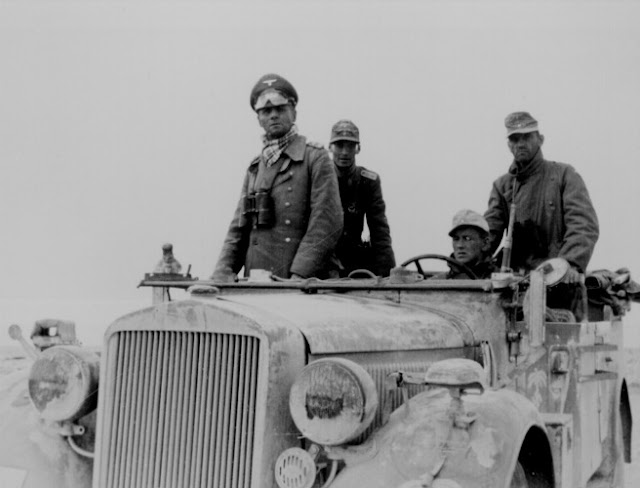
General Erwin Rommel arrives in Tripoli, Libya on a Junkers Ju 52, to take command of the armored section of the Deutsches Afrika Korps. This section will comprise a Panzer and a Motorized Infantry Division. He assumes command and receives assistance from the Fliegerkorps X and long range aircraft from Sicily to fight the overextended British. To deceive British spies, he had his troops parade in Tripoli. But, he had them march around the same block over and over, as well as with both real and dummy tanks, thus making his forces appear larger. “Something had to be done to bring the British offensive to a halt,” he wrote. By now the British had moved as far as El Agheila, 400 miles from Tripoli. The German 5th Light Division includes 9,300 Germans, 130 tanks, 111 guns and 2,000 vehicles (80 German aircraft are also included). The Italian “Ariete” and “Trento” Divisions arrive as well. The “Ariete” is composed of 6,949 men, 163 tanks, 36 field guns, 61 anti-tank guns and the Brescia Infantry Division. Rommel has 100,000 Italians, 7,000 Italian trucks supplying munitions to the front, 1,000 Italian guns and 151 Italian aircraft. Garibaldi is named Commander in Chief for Libya.
Rommel has his men march around the town square repeatedly to make it appear that he has more men than he actually does. He also has them drive real and fake German tanks. This is an old German trick, first practiced in the Rhineland in the 1930s when the Luftwaffe would fly the same few planes overhead to make it appear as if it had more forces than it actually did. Naturally, the Germans can assume that there are many British sympathizers among the local populace, word will get out, and appearances are important. The British are 400 miles from Tripoli, but there is virtually nothing standing between them and the few Germans in North Africa aside from Italian troops who have proven themselves completely ineffective.
As has been the case for several days, however, the real action is taking place in capitals across Europe and North Africa. In a note to British Middle East Commander General Archibald Wavell, British Prime Minister Winston Churchill sets forth current priorities:
“[Y]our major effort must now be to aid Greece and/or Turkey. This rules out any serious effort against Tripoli, although minor demonstrations thitherwards would be a useful feint…. concentrate all available forces in the Delta in preparation for movement to Europe.”
This change in priorities from North Africa to Greece is, as Churchill knows, opposed not only by Wavell but by his closest military advisers in London. However, Churchill is acting on his own initiative. He concludes his instructions to Wavell with alternative moves in case the Greeks prove uncooperative regarding British troop inflows (as they have in the past):
“[T]hen we must try to save as much from the wreck as possible. We must, at all costs, keep Crete and take any Greek islands which are of use as air bases. We could also reconsider the advance on Tripoli. But these will only be consolation prizes after the classic race has been lost.”
Thus, Churchill makes clear that Greece itself is only a pawn in the struggle against Hitler, and only useful in that regard. In essence, he proposes making war on Greece itself if it stands in the way of fighting Hitler on Greek soil.
The British are leaving a loose end in Tripoli… and it is going to cost them.
The halt order to General Wavell that arrives today from Churchill and the General Staff forces Wavell to completely re-direct his efforts away from Libya. Brigadier Dorman-Smith, General Wavell’s liaison to XIII Corps, finally arrives in Cairo after his 570-mile drive from General O’Connor’s advanced headquarters. His instructions are to attempt to secure permission for O’Connor’s troops to continue westward. Instead, after being kept waiting all day by Wavell, Dorman-Smith walks in to find that Wavell is no longer interested in Libya at all. Motioning to maps of Greece that have replaced maps of North Africa on his walls, Wavell says, “You find me busy with my spring campaign.”
In fact, today does mark a definitive end to Operation COMPASS. Some Italian troops have been holding out at Beda Fomm despite their hopeless position. Today, the last of them surrender. Throughout the campaign, including the very end today, the Italians have outnumbered the British by roughly 20,000-3000.
Churchill’s letter of introduction for Middle East commander General Wavell is illuminating as to colloquialisms in use at the time. He writes:
“Request you will take all possible precautions for safety of our two Envoys having regard to nasty habits of Wops and Huns.”
In another note to Wavell, Churchill offers his “heartfelt congratulations” on taking Benghazi, but forbids any further advances beyond “demonstration attacks.”
General Rommel later writes:
“If Wavell had now continued his advance into Tripolitania, no resistance worthy of the name could have been mounted against him — so well had his superbly planned offensive succeeded.”
Of course, the Germans could not know that Wavell was gung-ho for taking Tripolitania, but it was solely the decision of Churchill to stand pat and divert units elsewhere. Some consider this 12 February 1941 order to stop at Benghazi to be one of the greatest British military blunders of the war.
Australian Prime Minister Robert Menzies, on his extended journey from Melbourne to London, returns from Benghazi to Cairo. He experiences “My first Air Raid” before leaving the former, a visit at dawn by some minelaying bombers. The Royal Navy at this time is sending ships from Alexandria and Suda Bay in Operation Shelford to sweep Benghazi Harbor.
Free French Headquarters announced: “Our forces in Chad Province [French Equatorial Africa] have continued their operations in southern Libya with the support of our aircraft. A motorized column under the command of Colonel Leclerc has won ground and occupied bases around Kufra.” Almost 600 miles of desert separate Kufra from the border of Chad, and the Sahara poses many obstacles to military operations in the area.
Indian and Italian troops continued the fighting on the north side of the Dongolaas Gorge and in Happy valley on the south side of the gorge near Keren, Eritrea, Italian East Africa. Subadar Richpal Ram (b. 1899), 6th Rajput Rifles, displayed great bravery leading an attack in which he died, despite having his right foot blown off. He had shown similar courage in an assault five days earlier. Even when he was fatally wounded he still encouraged his men on to victory. Captain Ram would be posthumously awarded the Victoria Cross.
The battle at Keren continues. Today, the 5th Indian Division’s 29th Indian Infantry brigade is brought up from Barentu and added to Major-General Beresford-Peirse’s 4th Indian Division. The plan is for troops already on the scene to create a gap in the Italian defenses, through which the 29th Infantry can pour through and overwhelm the Italian defenses.
It doesn’t go quite like that. At 05:30, the British artillery roars and the 4/6th Rajputana Rifles advance toward the west side of the Dongolaas Gorge. The objective is the Acqua Col, a spot that connects Italian strong-points on either side. Things go wrong right from the start, though: the initial surge carries to the crest of the feature, but there the troops are subjected to murderous crossfire. The 4/11th Sikh Regiment comes at the Col from the side but is stopped cold. The Indian troops are forced to retreat again, leaving them with nothing to show for heavy casualties incurred in several days of desperate fighting.
Lieutenant-General William Platt now has tried to force both sides of the gorge twice, with no success. He decides to build up his supplies and troops and try a set-piece battle at a later date. Platt sends the 29th Infantry Brigade back to Barentu, which is served by a railway line and can be more easily supplied. The British sit down to devise a new strategy.
The town of Afmadu, about 100 miles north of Kismayu is taken by the King’s African Rifles.
Elsewhere in Eritrea, British forces take Elghena south of Port Sudan.
Anthony Eden and General Dill leave for a tour of Greece, Turkey and Egypt. The British Foreign Secretary and Chief of Imperial General Staff left London, England, United Kingdom for Cairo, Egypt to coordinate military assistance to Greece. They were also trying to create an anti-Axis agreement, which would soon be rebuffed by Yugoslavia and Turkey.
German troops were reported by military observers to stand nearly 600,000 strong in Rumania tonight and the ice which formed the last serious obstacle to a Nazi crossing into Bulgaria was fast vanishing from the Danube under premature spring warmth. This enormous increase in the accepted estimate of German strength in Rumania was based upon new information that, supplementing the 200,000 men sent into the country by the end of December, the German command recently has dispatched 25 fresh divisions, requiring movement of an average of 40 trains a day through Hungary. From Ruse, the Bulgarian port on the Danube facing Rumania, it was reported that the river was now wholly ice-free, and German bridge pontoons were placed along the Rumanian bank. Much of the equipment carried by the German forces is of French make, having been seized after the French collapse last year. The Germans’ next move, now the ice has broken on the Danube, is to float pontoon bridges in the river to enable troops to enter Bulgaria, under a secret agreement reached with the Bulgarian government four days ago. The Germans have promised the Bulgarians a slice of Greek territory to give them access to the Aegean Sea — but only after the war. The massive German move into the Balkans has set off a wave of speculation that Hitler may be about to go to the rescue of his Italian ally, who has been badly mauled by the Greeks. Some observers, however, believe that Hitler, despite his treaty of friendship with Stalin, is planning to invade the Soviet Union.
Prime Minister Winston Churchill takes questions in the House of Commons. He states that
“I can recall no occasion when the question of peace aims or reconstruction has been mentioned by any of the representatives of the American Government.”
Churchill also memos the Foreign Office conceding that he has received “no reply” to offers made to Vichy French General Weygand. On another topic, he urges the foreign office to be prepared to supply food to Spain in order to induce them to support the Allied cause.
Churchill’s Assistant Private Secretary, Jock Colville, notes in his diary today that there was “great opposition” to Churchill’s veto of any attempt by XIII Corps to complete the conquest of Libya. He mentions that CIGS Sir John Dill “felt so strongly about it that he was almost thinking of resigning.” Colville notes that sending insufficient forces to Greece runs “the risk of another Dunkirk.”
Britain dipped deep into her manpower reserve tonight, disclosing youths 19 years old will be called for military service almost immediately, and pressed the pre-spring air offensive against industrial Germany with waves of bombers. In the House of Lords, Lord Moyne, the government leader and new colonial secretary, disclosed the imminent call-up for 19-year-olds. Oldsters of 37 to 40 will be summoned soon afterward, he said, to swell the 4,000,000 men Britain already has under arms for the defense and offensive campaigns to come.
First injection of penicillin into a patient is performed by British physician Charles Fletcher at Radcliffe Infirmary in Oxford, England. Howard Florey’s team administers penicillin for the first time to a patient (43-year-old Reserve Constable Albert Alexander) at the Radcliffe Infirmary in Oxford. While a policeman, Alexander incurred his infection to the face while pruning roses in his garden. The experiment is a success, but the patient dies (not enough penicillin available).
Work will proceed on this promising drug for infections. Penicillin, the first true antibiotic, was discovered by Alexander Fleming in 1928 and developed at Oxford by Florey, Ernest Chain, and others. Florey will travel to the United States during the summer to interest the Americans in developing the antibiotic further.
The street battles in Amsterdam continue. The Wehrmacht works with local Dutch police to quarantine the Jewish quarter of the city with barbed Wire. Police checkpoints are set up, and nobody goes in (unless they are Jewish) or out.
The official press agency reported today that police were inquiring into disorders which occurred in Amsterdam within the last few days. From The Hague came a report of the arrest of a leather merchant and several other persons for “a provocative attitude toward German soldiers.”
A meeting was held between the representatives of the German occupation authorities and Jewish leaders of Amsterdam. At the meeting an order was issued to establish a Joodsche Raad (Jewish Council) in Amsterdam with Jewish leaders Abraham Asscher, Dutch Jewish businessman, and Professor David Cohen in position of responsibility. The Joodsche Raad had to mediate the occupation government’s orders to the Dutch Jewish community and, beginning in July 1942, to help organize the selection of Jewish deportees from the Netherlands to the concentration and extermination camps.
The Belgian government-in-exile breaks diplomatic relations with Rumania.
The Italian government asks that U.S. consulates at Palermo and Naples be moved to Rome rather than be located on a sea coast. This purportedly is due to the recent Royal Navy raid on Genoa, which makes the entire Italian seacoast insecure.
Spanish Dictator General Francisco Franco and Italian Premier Benito Mussolini confer in Rome “on all problems interesting the two governments at the present historic moment.” Premier Mussolini of Italy and Francisco Franco, Spain’s chief of state, arrived at a “complete identity of views” upon European, matters in two meetings at Bordighera, on the Italian Riviera, a Spanish communique announced. Mussolini made another attempt to persuade Spain to join the Axis and enter the war. Franco once again insisted that his country was simply not in a position to do so.
Former King of Spain Alfonso XIII, living in exile in Rome, renounced the throne in favor of his third son Juan. Alfonso was deposed by the Second Spanish Republic. Juan, known to history as Infante Juan, Count of Barcelona. Juan is the father of Juan Carlos I, the future king of Spain rather than Juan due to the post-war intervention of Franco.
In Moscow, the Kremlin shook up the high command of the Soviet Red Army, promoting to chief of the general staff the man who declared on Dec. 11 that Russian troops on the western border facing Germany and the Balkans must stand constant guard “so that no tricks of foreign enemies can catch us unprepared.” The new chief is General Georgy Konstantinovich Zhukov, former commander of the Kiev military district, which borders the Balkans. The former Chief of the General Staff, General Kirill Meretskov, is named Deputy People’s Commissioner of Defense.
Internal security specialist Viktor Abakumov, head of the UNKVD of Rostov Oblast, arrives at the Moscow headquarter of the NKVD. His new role is as a Senior Major of State Security. He will be working closely with Lavrentiy Beria.
German cruiser Admiral Hipper attacked the unescorted convoy SLS 64 west of Gibraltar and sank six steamers.
Air activity continues to be light in Europe due to the winter weather. The Luftwaffe sends a few planes over England at night, and for most of them, if they drop bombs, nobody notices. The RAF, which has been more active than the Luftwaffe lately, largely stays on the ground both during the day and night.
RAF Bomber Command dispatches 1 Blenheim during daylight to oil depot on Kiel Canal which turned back.
At Malta, the increased German presence in the Mediterranean is made plain by the first appearance of Bf 109 fighters over the island. A dozen 7,/JG 26 fighters escort a Fliegerkorps X bombing raid during the afternoon and shoot down three Hurricanes — the worst losses suffered by the RAF on the island to date. The Bf 109 pilots are veterans of the Channel Front and among the best fighter pilots of the time. They are led by ace Oblt. Müncheberg, who gets one of the victories.
With four German heavy cruisers (Admiral Scheer, Admiral Hipper, Gneisenau and Scharnhorst) on the loose in the Atlantic, the Royal Navy is as stretched as at any point of the war. Force H from Gibraltar departs into the Atlantic to cover Convoy HG.53, which has been under incessant attack by the Luftwaffe and U-boats. Late in the day, it is redirected to cover Convoy WS.6, a troop convoy bound for the Middle East — the other convoy would have to be left to its own devices.
Anti-aircraft ship HMS Curacoa departed Scapa Flow at 0600 to meet convoy EN.70 and provide anti-aircraft support from daylight until the convoy arrived in Pentland Firth. The ship arrived back at Scapa Flow at 1320.
Force H with battlecruiser HMS Renown, aircraft carrier HMS Ark Royal, light cruiser HMS Sheffield, and destroyers HMS Wishart, HMS Jersey, HMS Foxhound, HMS Firedrake, and HMS Fury departed Gibraltar to cover convoy HG.53. That evening, Force H was ordered to cover convoy WS.6, relieving battleship Rodney. Battlecruiser Renown and aircraft carrier Ark Royal covered convoy WS.6 from 17 to 21 February. Light cruiser Sheffield was detached on the 13th. The destroyers returned to Gibraltar on the 16th.
German heavy cruiser Admiral Hipper made attacks on yet unescorted SLS.64 of 19 steamers. Heavy cruiser Admiral Hipper sank British steamer Warlaby (4876grt) in 37-12N, 21-20W, British steamer Westbury (4712grt) in 37-10N, 21-20W, British steamer Oswestry Grange (4684grt) in 37-10N, 21-20W, British steamer Shrewsbury (4542grt) in 36-46N, 20-12W, British steamer Derrynane (4896grt) in 37-12N, 21-20W, Norwegian steamer Borgestad (3924grt) in 37-10N, 21-20W, and Greek steamer Perseus (5172grt) in 37-10N, 21-20W. Three crewmen were rescued from the steamer Warlaby. Five crew members from steamer Westbury were lost. Five crewmen were lost on steamer Oswestry Grange. Thirty seven survivors landed at Madiera by British steamer Lornaston (4934grt). Twenty crewmen were lost from steamer Shrewsbury. All of the crew from steamer Derrynane was lost. All the crewmen from steamer Borgestad were lost. Fourteen crew members were lost on the Greek steamer. British steamer Lornaston (4934grt) was damaged by the heavy cruiser in 37-12N, 21-20W. Ocean boarding vessels HMS Camito, HMS Corninthian, HMS Cavino, and HMS Maron were sent to search for survivors from this convoy. Ocean boarding vessel Camito rescued some of the survivors from the British ships. Light cruiser HMS Sheffield was sent to escort the surviving ships of the convoy. She arrived back at Gibraltar on the 17th. Battleship HMS Malaya, escorted by destroyers HMS Firedrake, HMS Foxhound, and HMS Jersey, was detached from Force H to escort convoy HG.53. Battleship Malaya and her destroyers returned to Gibraltar on the 15th. The convoy was joined by destroyers HMS Leamington and HMS Sabre and corvette HMS Anemone from convoy OG.53 and sloop HMS Londonderry. Force H was involved in escorting convoy WS.6 A for a time and was relieved on the 19th by battleship Malaya, which departed Gibraltar on the 17th.
Ocean boarding vessel HMS Marsdale departed Gibraltar on Western Patrol.
British fishing vessel Caledonian (8grt) was lost on a mine.
Submarine HMS Tigris sank French fishing trawler Rene Camaleyre (243grt) in 43-30N, 1-42E in the Bay of Biscay.
For Operation SHELFORD, Light cruisers HMS Orion and HMS Ajax departed Alexandria at 0730 to rendezvous in the Aegean in 34-00N, 21-00E with heavy cruiser HMS York, anti-aircraft cruiser HMS Bonaventure, and destroyers HMS Jervis, HMS Jaguar, HMS Janus, and HMS Mohawk which departed Suda Bay at 1700 to join. Gunboat HMS Aphis entered Benghazi Harbor at daylight on the 12th. Armed Boarding Vessel HMS Chakla (with Senior Naval Officer, Inshore Squadron, Captain A. L. Poland) with destroyers HMAS Stuart, HMAS Voyager, and HMAS Vampire, minesweeper HMS Fareham, and minesweeping corvettes HMS Peony and HMS Hyacinth departed Tobruk at 0730 to arrive at Benghazi early on the 13th.
British troopship Ulster Prince arrived at Alexandria with prisoners from Tobruk.
British steamer Cingalese Prince (8474grt) departed Haifa for Tobruk, unescorted. The steamer was carrying a number of lighters and other important cargo. Destroyer HMS Dainty was sent from Alexandria to escort the steamer.
Light cruiser HMS Glasgow departed Alexandria for Port Said and Suez. She had received partial repairs only for her December 1940 torpedo damage. The cruiser was being detached for convoy work only.
British gunboat HMS Cricket arrived at Port Said to join the Mediterranean Fleet. However, due to her poor condition, she remained at Port Said and was placed in care and maintenance status on the 18th.
Submarine HMS Utmost damaged Italian steamer Manfredo Campiero (former Mauly, 5463grt) off Tripoli in 35-41N, 23-01E.
The 2nd Afrika Korps convoy departed Naples with steamers Adana (4205grt), Aegina (2447grt), Kybfels (7764grt), and Ruhr (5954grt) escorted by destroyer Camicia Nera and torpedo boat Procione, and arrived at Tripoli on the 14th.
French submarines Iris, Venus, Pallas, and Ceres departed Toulon on the 6th and arrived at Oran on the 9th. They departed Oran on the 11th, escorted by armed trawler La Havraise and passed Gibraltar on the 12th. They arrived at Casablanca on the 13th.
Italian steamers Integritas (5952grt), Marghera (4531grt), and Carso (6275grt) were scuttled at Kismaya. Steamer Carso was salvaged by the British as Empire Tana.
In Washington today, President Roosevelt conferred with Edward J. Flynn, Chairman of the Democratic National Committee, Senator Lucas and other officials.
The Senate Foreign Relations Committee considered amendments to the Lend-Lease bill and the Temporary National Economic Committee heard Thurman Arnold, Assistant Attorney General, on the government’s antitrust program.
The House passed the $338,140,000 Deficiency Relief Appropriation Bill, considered the $1,146,394,496 Treasury-Post Office Appropriation Bill, and adjourned at 4:17 PM until noon tomorrow.
Still seeking more votes for the Lend-Lease bill, administration leaders in the senate today offered its opponents a surprise concession which, they said, would give congress firmer financial control over ‘the aid-to-Britain program. In essence their proposal, approved late in the day by a senate foreign relations subcommittee, would require that the president obtain both “authorizations” and “appropriations” from congress. Senator Barkley of Kentucky, Democrats leader, explained that first the president could ask for authority to enter into contracts for the manufacture of supplies and their delivery to Britain. Later he would ask specific appropriations, listing the number and kinds of equipment. The modification, Its backers said, would remove any basis for charges that the lease-lend bill itself was a “blank check” to the president to spend unlimited amounts in supplying defense items to countries whose defense he deems vital to the defense of the United States.
Meanwhile, there was a sharp repercussion from Wendell L. Willkie’s proposal that 5 or 10 destroyers be transferred to England each month. Secretary Knox bluntly told reporters the navy could “spare no more destroyers” and still maintain a “balanced” fleet.” As secretary of the navy, he said, his position was “against depleting our navy further.” The Willkie suggestion was nevertheless, reported to be receiving serious consideration in some administration quarters, and there was much speculation whether it might not have been discussed at last night’s meeting between Willkie and Roosevelt.
Wendell L. Willkie declared tonight that the democratic way of life could not survive in America if it was vanquished in Britain and challenged the Republican Party to take a positive stand on, and lead in, the fight for aid to Britain. “Have you got it in you?” he cried to a crowd of 2,200 persons attending the National Republican club’s fifty-fifth annual Lincoln day dinner at the Waldorf-Astoria. Willkie just returned from a fact-finding trip to the British isles where he conferred with persons ranging in rank from King George VI to “the man in the pub,” called Prime Minister Winston Churchill ‘the man whom I think is the greatest public figure in the world.”
Admiral Kichisaburo Nomura, the new Japanese Ambassador, paid his first ceremonial call on Secretary of State Cordell Hull today after his arrival yesterday to assume his duties. The meeting lasted exactly four minutes, one of the shortest on record for an initial call.
Attorney General Jackson today ordered that new deportation proceedings be started against Harry Bridges, west coast C.I.O. leader who has been a center of controversy for years. In congress and elsewhere charges have been made that Bridges, a native of Australia, was a Communist. Bridges has denied the allegations. A 2,500-word report prepared by J. Edgar Hoover, director of the F.B.I., will form the basis of the government’s case. The contents of the report have not been made public, but Jackson said it contained “new and additional evidence.”
President Roosevelt has expressed the conviction that Britain will win the war within five or six months — if the nation can hold out until Summer, it was said here today by Bertram Cruger, American banker, who is the London representative of the British War Relief Society in the United States.
[Franklin Roosevelt needs to put the bong down. Britain at this point has NO clear path to victory, and will not until Hitler simplifies things by bringing in both the USSR and U.S. against him.]
Rear Admiral Emery S. Land, Chairman of the Maritime Commission, was assigned by President Roosevelt today to the task of fully coordinating facilities for ocean transportation. He will continue to perform his duties as head of the Maritime Commission.
Thomas E. Dewey, one of the leading candidates for the Republican Presidential nomination last year, speaking tonight at the Capitol’s Lincoln Day dinner, advocated passage of the Lend-Lease bill with such reservations as would unite the two major parties and the country on the Administration’s all-out aid to Britain policy.
Demands of California congressmen for the establishment of a “junior” naval academy on the west coast were rebuffed today by the navy department. Rear-Admiral Chester W. Nimitz, chief of the navigation bureau, told a delegation of 11 house members that the department was satisfied that the present academy at Annapolis, Md., could satisfy the need for officer personnel and that therefore the department could not support the proposal.
The Office of Production Management today took steps to safeguard the nation’s supply of aluminum and magnesium, and one result may be a smaller supply of aluminum products on the shelves of retail dealers.
Police closed the case of General Walter G. Krivitsky today after they said further investigation had produced additional support for their original conclusion the former Soviet secret agent took his own life. Lieutenant George Darnall, chief of the homicide squad, said that “so far as police are concerned the case is closed.”
It is reported that there are 858 corporations and 1,091 corporation executives in the U.S. accused by the government of criminal violation of anti-trust laws. It is also shown that the government had indicted 84 unions and 336 union officials on similar charges.
Santiago, Chile celebrated the 400th anniversary of its founding.
The U. S. consulate-general sent circulars today to American residents of Shanghai “urgently” advising American women, children and non-essential men to “withdraw to the United States.” The circulars were sent “both in the interests of safety and convenience of American nationals and in the interests of national security.”
There has come a notable improvement in Soviet-Japanese relations. Around Christmas time they were not too good and there was momentarily a startling hitch in negotiations for renewal of the fisheries agreement, which is vital for Japan.
Temporary relief from apprehensions that have been daily growing more somber about the future in the Pacific is shown in the Japanese reception. to President Roosevelt’s remarks on the occasion of the arrival in Washington of the Japanese Ambassador, Admiral Kichisaburo Nomura. The President’s clear “no,” when he was asked if he thought war would break out in the Pacific is the highlight of the newspaper Asahi’s message reporting the White House press conference. When asked if he considered the danger of war in the Pacific imminent, the President’s answer, as retranslated from the Japanese report, was, “Such an eventuality is unthinkable.” Significance is also seen in the President’s attitude when he described as hypothetical the question whether assistance to Britain would continue even if war occurred in the Pacific. Those points, and the President’s assurance that assistance to Britain would continue in any case, are singled out for special attention in the Japanese press, which in this manner reveals how the President’s words express the Japanese people’s hopes that war with the United States may be avoided.
Meanwhile, planning continues in Japan for Operation Z.
New Zealand Division light cruiser HMS Achilles departed Wellington with convoy ZT.2. The convoy safely arrived at Sydney on the 18th.
New Zealand Division light cruiser HMS Leander relieved Light cruiser HMS Dauntless of the escort of a troopship three hundred miles east of Ceylon. The cruiser and the troopship arrived at Colombo on the 12th.
Born:
Ron Lyle, American boxer, in Dayton, Ohio (d. 2011).
Mike Joyce, MLB pitcher (Chicago White Sox), in Detroit, Michigan.
Dennis Sullivan, American mathematician (2022 Abel prize for work on topography), in Port Huron, Michigan.
Naomi Uemura, Japanese adventurer and mountain climber who was the 1st to reach the North Pole solo and the 1st to raft the Amazon River solo, in Hidaka, Empire of Japan (d. 1984).
Died:
Richhpal Ram, 41, Indian recipient of the Victoria Cross (killed in action in Keren, Eritrea).
Naval Construction:
The U.S. Navy 77-foot Elco patrol motor torpedo boat USS PT-27 is laid down by the Electric Boat Company Ltd. (Elco Works), (Bayonne, New Jersey, U.S.A.).
The Kriegsmarine (German Navy) Type VIIC U-boat U-301 is laid down by Flender Werke AG, Lübeck (werk 301).
The Kriegsmarine (German Navy) Type VIIC U-boat U-659 is laid down by Howaldtswerke Hamburg AG, Hamburg (werk 808).
The U.S. Navy harbor tug USS Tazha (YT-147) is launched at Consolidated Shipbuilding Corp., Morris Heights, New York.
The Вое́нно-морско́й флот СССР (ВМФ) (Soviet Navy) “M” (Malyutka)-class (3rd group, Type XII) submarine M-117 is launched by Krasnoye Sormovo (Gorkiy, U.S.S.R) / Yard 112; completed by Marti Yard (Nikolayev, U.S.S.R.) / Yard 198.
The Вое́нно-морско́й флот СССР (ВМФ) (Soviet Navy) “M” (Malyutka)-class (3rd group, Type XII) submarine M-122 is launched by Krasnoye Sormovo (Gorkiy, U.S.S.R) / Yard 112; completed by Molotovsk (Moltovsk, U.S.S.R. / Yard 402.
The Royal Navy Flower-class corvette HMS Starwort (K 20) is launched by A & J Inglis Ltd. (Glasgow, Scotland); completed by Kincaid .
The Royal Navy Flower-class corvette HMS Aster (K 188) is launched by Harland & Wolff Ltd. (Belfast, Northern Ireland).
The Royal Navy “P”-class destroyer HMS Penn (G 77) is launched by Vickers Armstrong (Newcastle-on-Tyne, U.K.); completed by Vickers Armstrong (Barrow-in-Furness, U.K.).
The U.S. Navy Gleaves-class destroyer USS Woolsey (DD-437) is launched by Bath Iron Works (Bath, Maine, U.S.A.).
The U.S. Navy “O”-class submarine USS O-7 (SS-68) is recommissioned as a training boat.
The Royal Navy Fairmile B-class motor launch HMS ML 163 is commissioned.
The Royal Navy Bangor-class (Reciprocating-engined) minesweeper HMS Bude (J 116) is commissioned. Her first commanding officer is Lieutenant Commander (retired) Frederick Arthur Ivone Kirkpatrick, RN.
The Kriegsmarine (German Navy) Type VIIC U-boat U-651 is commissioned. Her first commanding officer is Kapitänleutnant Peter Lohmeyer.
The Royal Navy Flower-class corvette HMS Amaranthus (K 17) is commissioned. Her first commanding officer is Lieutenant Nicholas Bryan John Stapleton, RNR.
The Royal Australian Navy “N”-class destroyer HMAS Nestor (G 02) is commissioned. Her first commanding officer is Commander George Scott Stewart, RAN.
 History Diaries