British Middle East Commander General Archibald Wavell requests permission from the Chief of the Imperial General Staff to continue Operation Compass into Tripolitania in western Libya. Whitehall denies this request, as Prime Minister Winston Churchill is more interested in sending troops to Greece.
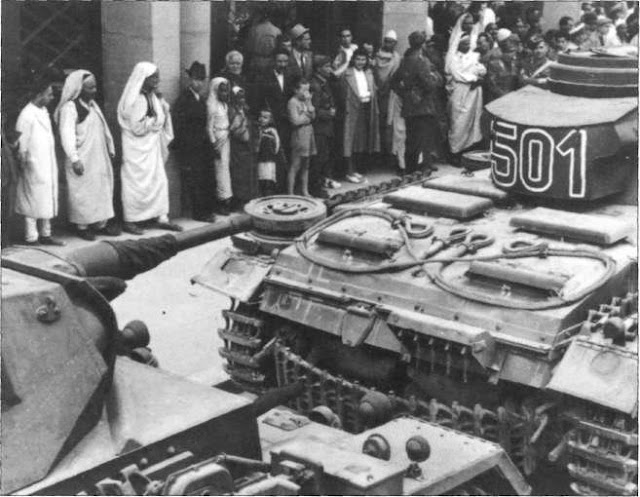
The first troops of the German 5th Light Infantry Division land at Tripoli, Libya. The British decision to halt their offensive is made just in time — for the Wehrmacht. Today, the German convoy which departed from Naples with a stopover in Palermo arrives in Tripolitania as part of Operation SUNFLOWER (UNTERNEHMEN SONNENBLUME). The transports carry troops of the 5th Light Division, the vanguard of General Erwin Rommel’s Deutsches Afrikakorps (DAK). This is the first time that German troops have been on North African soil. These troops would still be quite vulnerable before they are reinforced — if the British were to attack. Royal Navy submarine HMS Unique spots the troop convoy and attacks one of the ships, German transport Ankara, but misses. Allied attacks on troop convoys from Naples will be a prime cause of the DAK’s issues in North Africa.
General Rommel, en route to Tripoli, arrives in Rome. German Propaganda Minister Joseph Goebbels has given him a camera and some color film, which Rommel intends to make use of.
The Italians never wanted the Germans involved in their “empire” of North Africa, but the situation has changed drastically over the past few months due to Italian reversals there and in Albania. Mussolini accepts the resignation of Commander-in-Chief of Italian North Africa Rodolfo Graziani, who flew out of Tripoli. Graziani was to be replaced by General Italo Gariboldi, previously the commander of the 5th Army in Tripolitania. Graziani felt humiliated and disgraced but was convinced that he had been betrayed by enemies in Rome.
“Free French” headquarters in London announced that a motorized column under Colonel LeClerc had completed a march of 600 miles across the desolate Libyan desert and taken several of the oases of the Kufra area which dot southeastern Libya and afford Italian forces their chief means of intercommunication.
Australian Prime Minister Robert Menzies resumes his extended journey from Melbourne to London. He arrives today in Benghazi, where he meets with General Iven Mackay, commander of the Australian 6th Infantry Division. This division captured Bardia, Tobruk, and Benghazi, and Menzies somewhat cattily comments in his diary that the General’s “tactics are highly praised, but [he] looks as gently ineffectual as ever.” He dines with General O’Connor, commander of XIII Corps, of whom he notes:
“He did this job [conquer Cyrenaica], but Wavell has received all the credit…. Wavell will probably get a peerage while this man gets a CB but that is the way of the world.”
Menzies notes that life has changed little in Benghazi for the residents there, with “good Australians slapping down their money on the bar of a hotel conducted by a ‘conquered’ Italian.”
The Albanian front remains stable on 11 February 1941, which effectively is of benefit to the Italians. The wrangling about what to do in Greece continues in London. Prime Minister Winston Churchill feels that the British should insert “at least 4 Divisions, rising to 6 or 10 in the summer.” He wishes to “make an offer of assistance to the Greeks” and proposes sending guns and a squadron of American Curtis Tomahawk P-40 fighters there. Foreign Secretary Anthony Eden and General Sir John Dill both set agree to visit Cairo and Athens to coordinate the expected troop movements.
The Greeks are looking at the Bulgarian border and considering their own defensive military options. The Italians, meanwhile, are determined to defend the key port of Valona (Vlorë and are planning another counteroffensive in the next few days. To date, Italian counteroffensives in Greece have been unmitigated disasters, making no progress and winding up costing the Italians territory. However, the contest for the Trebeshina Heights near the Klisura Pass has produced some minor defensive successes for the Italians, who are fighting much better now than earlier in the campaign.
British fighting in southern Ethiopia and across the desolate South Libyan Desert, reported daring marches today which threatened anew to tear Italy’s empire to shreds. The battle at Keren, Eritrea continues. British Indian troops are faced with the tactical problem of forcing their way through the narrow Dongolaas Gorge in order to enter the Keren Plateau. The 3/1st Punjab Regiment takes the top of Sanchil, a low peak overlooking the gorge and have men on the sides of Brig’s Peak next to it. However, the Indians are faced with murderous crossfire from both sides of the gorge, as the Italians occupy the heights all around them. While they might be able to hold their ground despite this, the approaches to the peaks are flat ground which exposes anyone crossing it to machine gunfire. Thus, no matter how much they bring with them, the Indians eventually run low on supplies. The Italians rain mortar and artillery fire on the Indian troops throughout the day. Finally, the Italian Savoia Grenadiers advances on the Indian troops and forces them off of both Brig’s Peak and Sanchil.
By day’s end, the Indian troops wind up back where they started at Cameron Ridge. This reversal, identical to the first attempt to take the peaks several days before, does not interfere with plans to attack the other (right) side of the gorge on the 12th.
In Italian Somaliland, South African and Gold Coast troops (East African 22nd Infantry Brigade) complete the capture of Afmadu at the north end of the Juba River. The South African Air Force heavily supports these attacks.
Churchill sends General Ismay a note suggesting that “an Anti-Mussolini or Free-Italian” force be organized in Cyrenaica using Italian POWs. He views this as “world propaganda.” It is unclear where he came up with this idea, but he might not be flattered to be told that this is an old Soviet and Imperial Japanese tactic.
Churchill also complains to Minister of Shipping Ronald Cross about an incident involving a ship that refused to sail around from Liverpool to London. Agreeing with the captain’s reasoning, Churchill points out the immense value of the ship’s cargo to the war effort (19,677 sub-machine guns and about 2.5 million cartridges). Churchill notes that “I always follow the movements of these important cargoes.” Prime Minister Churchill to Minister of Shipping:
“Is it true that the steamship ‘New Toronto’, which arrived at Liverpool, was ordered to proceed north-about to London, and is it true that this order was only cancelled as a result of the protest of the captain, who pointed out the enormous value of his cargo, which contained, inter alia, 19,677 sub-machine guns and 2,456,000 cartridges? The arrival of these ships with large consignments of invaluable munitions ought to receive your personal attention in every case.”
In Operation Colossus, British paratroopers blew up the Tragino aqueduct in southern Italy. All but one were captured during their escape, remaining prisoners of war until 1943. The aqueduct they destroyed would soon be repaired and returned to service.
British monitor HMS Erebus conducted a bombardment on the invasion port of Ostend, Belgium between 0100 and 0140 hours. The Royal Air Force, in its biggest sustained offensive since September, also heaped destruction on the Nazi “invasion front” early today after combined naval and air bombardments had set ablaze the Belgian port of Ostend and Germany’s industrial city of Hannover. For the sixth consecutive night Adolf Hitler’s channel invasion ports were being ripped by tremendous explosions that rocked houses on the English shore. The new all-out assaults on Hitler’s massed invasion strength along the French, Dutch and Belgian coasts, bringing into action the guns of Britain’s home fleet and swarms of bombing planes, were said to be nearly as savage as those of last September when the British claim to have “shattered” German preparations for an invasion.
Rudolf Hilferding, prominent socialist, Jew, and once German Minister of Finance under the Weimar Republic died of unknown circumstances after being tortured and severely maltreated in the Gestapo dungeon of La Santé in Paris. Hilferding is a prominent Jewish socialist from Austria who upon the accession of Hitler to power fled to Denmark, then Switzerland, then Paris. He would have been safe in Zurich, but he left there for Paris in 1939 (many expected Hitler to invade Switzerland in 1939). The Vichy French arrested him, and the Vichy government turned him over to the Gestapo on 9 February despite Hilferding securing an emergency visa to emigrate to the United States. The Gestapo tortured him at La Santé for two days, leading to his death. Hilferding’s wife, Rose, died in the Auschwitz concentration camp in 1943.
Jews fought Germans and Dutch fascists in Amsterdam’s Waterlooplein. Tensions between local German supporters and those defending Jewish interests have been sparking over the last week. Pitched battles break out today in Amsterdam’s Waterlooplein. Pro-German Dutch militia “Weerbaarheidsafdeling” (defense section) is prominent in these attacks, targeting the old Jewish section of the city. Those fighting against the WA are effective, mortally wounding WA member Hendrik Koot (he dies of his wounds on 14 February).
Rumors were circulating in Vichy that Spanish leader Generalissimo Francisco Franco and Vichy leader Philippe Pétain were negotiating an armistice between Great Britain and Italy. If this is the case, though, nothing seems to come of it.
A Reuters (British news agency) dispatch quoting reliable sources in Belgrade, Yugoslavia, said 1,000 German airplanes had landed in Bulgaria up to Monday and that most Bulgarian airdromes had been taken over by the Germans. Thousands of German troops, the dispatch said, have entered Bulgaria from Rumania since February 1. It was believed, also, that some tanks had been shipped by the Danube.
The British submarine HMS Snapper was lost in the Bay of Biscay to either a naval mine or a depth charge attack.
The Luftwaffe mainly stays on the ground today, as has been the practice for much of 1941 so far. A few bombs are dropped in the east and southeast of England, while the Luftwaffe attacks shipping off the Scottish coast.
RAF Bomber Command dispatches 6 Blenheims during daylight to Channel ports turned back.
RAF Bomber Command dispatches 79 Hampdens, Wellingtons and Whitleys overnight to Bremen but only 27 claimed to have bombed. No aircraft lost but 22 aircraft — 11 Wellingtons, 7 Whitleys and 4 Hampdens — crashed in England when unexpected fog descended on most of the bases. Most of their crews parachuted safely but 5 men were killed.
RAF Bomber Command dispatches 18 Wellingtons and 11 Hampdens overnight to Hannover. No losses. 1 Wellington to Rotterdam bombed there.
RAF Coastal Command attacks the seaplane base at Thisted, Jutland.
An American, James Alton Jepson of Decatur, Georgia, has been serving with the Royal Canadian Air Force as an observer. Sergeant Jepson enlisted on 15 April 1940 in Ottawa, then was shipped to England with his unit. He goes missing today on a mission and is never found.
Striking at night here for the first time, Italian planes bombed the nearby port of Piraeus last night and Athenians calmly took shelter in the underground vaults of that ancient city. Officials said some casualties were caused when bombs struck a populous center of the port city five miles southwest of here but that property damage was negligible.
At Malta, there are some minor Luftwaffe attacks on St. Paul’s Bay that cause minor damage to a seaplane base and petrol lighter. Antiaircraft fire downs a Junkers Ju 88.
Two Malta-based RAF reconnaissance pilots, Flying Officer Adrian Warburton of 431 Flight (now 69 Squadron) and his observer/navigator, Sergeant Frank Bastard, are decorated. Warburton receives the DFC, while Bastard receives the Distinguished Flying Medal. Bastard is the navigator who took over as pilot (without any training) and successfully landed the plane after the pilot (apparently Warburton) was rendered unconscious. As usual in the British military, the senior officer in such a situation invariably receives a plum award when a subordinate is decorated — as Menzies noted (see above), “that is the way of the world.”
Monitor HMS Erebus, escorted by destroyers HMS Quorn, HMS Eglinton and one other, bombarded Ostend between 0100 and 0140 in Operation PX.
Convoy OB.285 departed Liverpool, escorted by destroyers HMS Arrow, ORP Blyskawica, and Mistral and anti-submarine trawlers HMS Daneman and HMS St Apollo. Destroyer Blyskawica was detached on 13 January. Most of the other escorts were detached prior to dispersal on the 17th when only destroyer Mistral was still with the convoy.
Submarine HMS Snapper ( Lt G.V. Prowse) was sunk by German minesweepers M.2, M.13, M.25 southwest of Ushant in 47-52N, 5-47W after Snapper fired torpedoes at the minesweepers. Prowse, Lt E. B. Talbot, Lt E. A. E. Ashby RNR, Sub Lt G. M. H. Alston, Warrant Engineer D. P. Halloran, thirty seven ratings were lost with the submarine.
British steamer Iceland (1236grt), a straggler from convoy HG.53, was sunk by German heavy cruiser Admiral Hipper between Portugal and the Azores in 37-03N, 19-50W. The crew was taken prisoner.
Minelayer HMS Plover laid minefield ZME.16 in the Irish Sea. This series continued in February with the minelayer laying ZME.17 on the 15th, ZME.18 on the 18th, ZME.19 on the 21st, ZME.20 on the 24th. This series continued in March and April.
British trawler John Dunkin (202grt) was sunk by German bombing 13 miles N by E of Buckie. One crewman was lost.
British trawler Eamont (227grt) was badly damaged by German bombing in 58-15N, 3-26W. The entire crew of ten was rescued. The trawler dragged ashore in bad weather on the 12th and broke in two.
British steamer Cantick Head (488grt) was damaged by German bombing thirty miles northwest of Kinnaird Head.
British steamer Jamaica Producer (5464grt) was chased by a German submarine in 59-25N, 9-07W. Destroyer HMS Jackal was sent to assist her. No damage was done to the steamer. Destroyer HMS Burnham was sent to search for the submarine in 59-25N, 9-07W. Destroyer Burnham was unable to locate the submarine. She left the area to join the escort of convoy HX.106. Destroyer Jackal after an unsuccessful search proceeded to Skaalefjord.
Force H arrived at Gibraltar after RESULT. Italian Admiral Iachino, which had been at sea with considerable forces, was misled by aerial reports which mistook French convoys for Force H. Force H had escaped undamaged.
Destroyers HMS Ilex and HMS Hero departed Alexandria for exercises.
Destroyer HMS Hereward was sent from Tobruk to Alexandria to collect the advance clearance party for Operation SHELFORD, the clearance of Benghazi harbor. The destroyer arrived at Alexandria at 0100, collected the personnel and the stores from armed boarding vessel HMS Fiona and departed at 0430. Destroyer HMS Decoy left Tobruk with minesweeping trawlers HMS Arthur Cavanagh and HMS Milford Countess for Benghazi.
Submarine HMS Triumph departed Malta on a special operation. The operation was cancelled on the 13th and the submarine was recalled.
Submarine HMS Truant made two unsuccessful attacks against Italian steamer Bainsizza in 33-36N, 12-53E and 33-46N, 12-57E. The steamer had departed Tripoli at 0830/11th for Palermo and Naples with Sabaudia, Motia, and Utilitas, escorted by escort ship Deffenu and torpedo boat Missori. After the attacks, the convoy returned to Tripoli until 2330 that night. The remainder of the convoy’s passage was uneventful.
Submarine HMS Unique unsuccessfully attacked German steamer Ankara arriving in convoy (see entry 8 February) off Tripoli.
Naval whaler HMS Southern Floe (344grt, T/Lt J. E. J. Lewis, SARNVR) was sunk on a mine off Tobruk. Lewis, T/Sub Lt D. N. Walton, SARNVR, T/Sub Lt A. E. Fairley, SARNVR, T/Sub Lt I. M. Innes, SARNVR, all but one rating, which was later picked up by destroyer HMAS Voyager, were lost with the whaler.
French large destroyer Terrible departed Toulon and arrived at Oran on the 12th. She departed on the 14th and arrived at Casablanca on the 15th. The destroyer went on and joined Force Y at Dakar, arriving on the 25th, replacing large destroyer Audacieux which was damaged on 23 September during MENACE.
Destroyer HMS Thracian and minelayer HMS Man Yeung laid mines in the approaches to Hong Kong.
In Washington today, President Roosevelt conferred with Wendell L. Willkie on conditions in Europe and discussed the labor situation as it pertains to the national defense program with Sidney Hillman, associate director of the Office of Production Management. With Mrs. Roosevelt, he hosted tonight at the annual Army and Navy Reception at the White House.
The Senate Foreign Relations Committee heard Mr. Willkie, Mayor La Guardia of New York, and President Conant of Harvard University support the Lend-Lease Bill.
The House completed Congressional action on the bill establishing Coast Guard military reserves, approved the resolution continuing the Dies Committee until April, 1942, and appropriated $150,000 for the committee, considered the WPA Deficiency Appropriation Bill, and adjourned at 4:56 PM until noon tomorrow.
Wendell L. Willkie backed the Lend-Lease bill today with a call for some modifications and told the senate foreign relations committee that if Britain falls, America inevitably will be at war a month or two later. The United States should send all its bombers except those needed for training and 5 or 10 destroyers a month, he said, adding that if we sit back and withdraw within ourselves, there is no telling where the “madmen who are loose in the world” may strike next. But with American assistance England can and will win, he said. Wendell Willkie, corporate lawyer and 1940 Republican candidate for U.S. President, gave testimony at the last session of the public hearings by the Senate Foreign Relations Committee on the Lend-Lease Bill. Willkie had just recently returned from a trip to Great Britain. Willkie read a prepared statement in which he stated that Nazi Germany would win the Battle of Britain if Britain were left without help from America. In this event, the totalitarian powers would soon control the world and eventually demoralize the economic system of the United States. Willkie repeated his confidence that England would survive in case aid came from America. He proposed that the United States give effective aid to Britain by sending five to ten destroyers a month to her as well as making available patrol bombers. He concluded his statement by asking for three revisions of the Lend-Lease Bill: (1) fixing a time limit on the powers granted to the Executive; (2) retention of authority to terminate by concurrent resolution the powers granted; and (3) apportioning the amount of money usable under the Lend-Lease Bill from current appropriations.
A declaration that “the United States must pledge itself to insure the defeat of the Axis powers” as the only sure method of preserving “the free way of life” within its borders was made by James B. Conant, president of Harvard University, in testifying today before the Foreign Relations Committee in favor of the Lend-Lease bill. This statement brought questions from Senators who fear that enactment of the proposed legislation will involve the United States in war. Senator Vandenberg asked whether Dr. Conant meant “a conclusive defeat on the Continent of Europe.” The educator replied that this might not be necessary and that what he advocated was putting “the Axis powers in a position where they cannot threaten the free way of life in this country.” Such a result might be obtained by administering a decisive defeat from the air alone. “Whatever might be the method,” Mr. Vandenberg persisted, “you are asking us to pledge a military victory on the Continent of Europe?” “Quite so,” was the reply.
Wendell Willkie conferred with President Roosevelt tonight for more than an hour and a half “about the English situation,” as the Republican presidential candidate of last fall described it afterwards. Willkie said he had explained to the president British production methods which he considered “very efficient” as he observed them on his recent trip to England. Asked whether he would accept a defense post in the administration, Willkie replied: “Don’t talk about it. It has never been suggested and from my standpoint there’s nothing to it.”
U.S. President Franklin D. Roosevelt, U.S. Secretary of War Henry L. Stimson, U.S. Secretary of the Navy William “Frank” Knox, U.S. Chief of Naval Operations Admiral Harold R. Stark, and U.S. General of the Army George C. Marshall decided to warn all Americans out of such sensitive areas as Rangoon, Burma, and Singapore. This decision was rescinded due to the arrival of the new Japanese ambassador, Admiral Kichisaburo Nomura.
The new Japanese ambassador to the United States, Admiral Nomura Kichisaburo, arrived in Washington D.C. Nomura was met by representatives of the German and Italian embassies as well as officials of the U.S. State Department. Nomura’s arrival was coincided with a campaign by German radio broadcasts apparently aimed at increasing tensions between the United States and Japan. The Germans quoted Japanese newspapers of accusing U.S. diplomats of trying to encircle Japan and as saying that America has held the knife to Japan’s throat for far too long. The BBC in London countered that Japan’s recent moves have been inspired by Germany.
In a response to a question at his press conference, U.S. President Franklin D. Roosevelt responded that if the U.S. were forced into a war in the Pacific it would not affect deliveries to Britain. In a response to an additional question Roosevelt responded that he did not think there was a danger of such a war. In an apparent answer to reported axis attempts to involve Japan in war with the United States, President Roosevelt asserted today such a conflict in the Pacific would not reduce American aid to Great Britain. He said he saw no danger of an American-Japanese war. The president refused to elaborate on his brief comment, made at a press conference in response to questions only a few hours after the new Japanese ambassador, Admiral Kichisaburo Nomura, had arrived to take up his post.
Chairman Martin L. Dies, Texas Democrat, of the House Committee on un-American activities collapsed in his office late today a few hours after the House had voted to extend the life of his committee for another 15 months. He was found unconscious on a couch when his secretary returned from lunch. Two physicians and Mrs Dies were summoned at once. He was revived quickly but the doctors remained in attendance. Dies has been ill for some months and has spent considerable time at his Orange, Texas, home recuperating. He was stricken a few months after he left the House floor where he appealed for the continuation of his committee. The chamber voted 353 to 6 to continue the group after bitterly debating the virtues of the committee’s investigations.
Creation of machinery similar to that of the World War National War Labor Board to adjust labor disputes on defense projects was advocated today by William Green, president of the American Federation of Labor. Mr. Green coupled his suggestion with word that the federation’s executive council had approved a statement of policy strongly opposing all anti-strike or compulsory arbitration legislation. The council’s statement embraced in its condemnation, without mentioning it by name, the Vinson bill proposing a thirty day “cooling off” period before strikes are permitted on defense jobs, as well as other bills offered by Representatives Hoffman of Michigan and Howard W. Smith of Virginia. The purpose of the “cooling off” period was denounced as an attempt to impose “compulsory arbitration” on labor. Opponents of organized labor, according to the statement, were seeking to use the defense emergency to deprive labor of the results of its long struggles.
A greatly accelerated expansion of plants manufacturing defense articles during the last month was indicated today by the National Defense Advisory Commission, and a further expansion in the plants manufacturing magnesium for use in military planes was being sought by two agencies.
There is a major gas leak in South Philadelphia which erupts into an explosion and fire. A row of eight houses is destroyed on Greenwich Street. The lots are cleared, and the lots remain empty for many years, used by neighborhoods to park their cars or grow vegetables. At least four people die, including a policeman, James J. Clarke, trying to rescue a mother and her two daughters.
U.S. President Franklin D. Roosevelt signed Executive Order 8678 that authorized the Commissioner of the Interior of Puerto Rico to convey certain lands to the United States for use as a naval air base, and other purposes.
Sir Shenton Thomas, Governor of the Straits Settlements and High Commissioner for Malaya, warned again today that war might spread to the Far East. Speaking before the Federal Council at Kuala Lumpur he said that possibly before its next meeting “the battle will have begun which will decide our fate and our lives in this country.” “I do not know how far we might be involved, but it is our duty to stand shoulder to shoulder and face the future calmly, similar to those in Britain and Libya, who, despite overwhelming odds, have their faces resolutely set toward victory,” he said.
Military observers in Japan interpret the British strengthening of air forces in Northern Malaya as intended to forestall Japanese acquisition of bases in Thailand or Southern Indo-China as the outcome of the Tokyo mediation conference.
Facing, in the words of Premier Prince Fumimaro Konoye, “the most dangerous situation since its foundation,” when the issues of war or peace are held here to be in the balance, Japan today celebrated the 2601st anniversary of the founding of the Japanese Empire.
In the Dutch East Indies, the military authorities for some reason go on a high military alert. They suddenly close all ports to Japanese shipping, order Dutch vessels to safe waters, put the military on alert and take other actions. The Japanese are not planning anything, however.
Royal Navy destroyer HMS Thracian and minelayer HMS Man Yeung lay mines outside Hong Kong Harbor.
Dow Jones Industrial Average: 122.61 (-1.58)
Born:
Sergio Mendes, Brazilian jazz musician (Brazil ’66 — “The Look of Love”, “Never Gonna Let You Go”), in Niteroi, Brazil (d. 2024).
Sammy Ellis, MLB pitcher (All-Star, 1965; Cincinnati Reds, California Angels, Chicago White Sox), in Youngstown, Ohio (d. 2016).
Ulf Sterner, Swedish National Team and NHL left wing (Olympics, 1960, silver medal, 1964; New York Rangers), in Deje, Sweden.
Glenn Randall Jr., American stuntman (Boba Fett in “Return of the Jedi”; “The Mask of Zorro”; “Poltergeist”; “Planet of the Apes” films).
Died:
Rudolf Hilferding, 63, Austrian-German Marxist economist( SPD Minister of Finance), in Gestapo custody.
Naval Construction:
The U.S. Navy Gleaves-class destroyers USS Aaron Ward (DD-483) and USS Buchanan (DD-484) are laid down by the Federal Shipbuilding & Drydock Co. (Newark, New Jersey, U.S.A.).
The Kriegsmarine (German Navy) Type VIIC U-boat U-80 is launched by Bremer Vulkan-Vegesacker Werft, Bremen-Vegesack (werk 8).
The Royal Navy “U”-class (Third Group) submarine HMS Ultimatum (P 34) is launched by Vickers Armstrong (Barrow-in-Furness, U.K.).
The Royal Fleet Auxiliary Sprite-class tanker RFA Nasprite (A 252) is commissioned.
The Kriegsmarine (German Navy) Type IXC U-boat U-68 is commissioned. Her first commanding officer is Kapitänleutnant Karl-Friedrich Merten.
The Royal Netherlands Navy Tromp-class light cruiser HNLMS Jacob Van Heemskerck is completed. She was hastily commissioned while still incomplete during the German invasion of the Netherlands, on 10 May 1940. She is completed as an anti-aircraft escort ship. Her commander is now Kapitein-Luitenant Ter Zee (Commander) Jonkheer Edzard Jacob van Holthe, RNN.
 History Diaries