The Reagan Administration expressed impatience today with the failure of the Soviet Union so far to agree on a date for the planned visit of Mikhail S. Gorbachev to the United States this year. The Government has been saying that preparations for the next summit meeting have been proceeding without trouble. But today, as a result of comments from Moscow, some annoyance was evident. Mr. Gorbachev has been dropping hints that there may not be any point in having another meeting unless there is significant progress on arms control. Senator Edward M. Kennedy, Democrat of Massachusetts, who met with Mr. Gorbachev last week, conveyed the Soviet leader’s comments in a news conference Saturday. Tass, the Soviet Government’s press agency, in reporting on the Kennedy-Gorbachev session, said the Soviet leader stressed the need for “practical results” at the next summit meeting. “Otherwise,” Tass said, “such a meeting would be devoid of meaning.” Charles E. Redman, a State Department spokesman, commented today: “We believe that preparations for General Secretary Gorbachev’s visit to the United States this year should proceed as agreed at last November’s meeting. Obviously, agreement on a date is an important part of these preparations, and we would like the Soviets to move ahead on this issue.”
Swans and ducks paddled among chunks of ice in the Havel River under the green metal spans of the Glienicke Bridge today. Occasionally, an American or French military vehicle would rumble across the bridge from Potsdam, making a seemingly effortless transit from a Soviet command post behind the Berlin wall to the American sector of West Berlin. On Tuesday at about noon, if there are no last-minute hitches, Anatoly B. Shcharansky, the Soviet dissident, and three Germans accused of spying for the West will arrive at the Potsdam side of the snow-dusted Glienicke Bridge and be inspected by Francis J. Meehan, the United States Ambassador to East Germany. On the American side of the divided bridge, Wolfgang Vogel, a dapper East Berlin lawyer, will check the identities of five Warsaw Pact intelligence agents, who will be driven to the wintry site in United States Mission vehicles.
Jewish emigration from the Soviet Union fell in January for the second month, with 79 arrivals registered at a Vienna transit center, the Intergovernmental Committee for Migration reported in Geneva. It said that 19 of the new arrivals went to Israel and the remaining 60 to Rome to secure documents for entry to other countries. There were 92 Jewish emigrants from the Soviet Union last December and 128 in November, a committee official said.
The largest Mafia trial in history, with 474 defendants, opens in Palermo, Italy, under tight security in what is seen as the Italian government’s biggest challenge to the criminal organization. It is said to be the first trial of its kind in which key Italian Mafia figures have agreed to turn state’s evidence, breaking the traditional code of silence-omerta. The accused Mafiosi, 119 of whom are still fugitives, face charges ranging from criminal association to drug trafficking, extortion and murder. The first hearing was held today in a heavily fortified courtroom built for the trial at a cost of about $18 million. The court building, behind the ramparts of the Ucciardone jail, was protected by more than 2,000 police officers from all over Italy. The trial is expected to last a year.
A judge in London ordered the seizure of the assets of a major Fleet Street printing union and fined it $35,000 for ignoring a court order to stop disrupting delivery of Rupert Murdoch’s British newspapers. Murdoch, in an effort to break union power, moved his operations last month to two high-technology plants and fired all his printers. The Society of Graphical and Allied Trades then ordered its members throughout the country not to distribute Murdoch papers. Judge Michael Davies found the union guilty of contempt for ignoring an injunction to withdraw the order.
Dutch millionaire art collector and convicted war criminal Pieter Menten was awarded $46,000 by an Irish court in a 1979 case of arson at his 50-room mansion in County Waterford. Menten, 86, was released last year after serving two-thirds of a 10-year prison sentence in the Netherlands for the murder of Polish Jews during World War II. He filed a claim against the county for failing to protect his property.
Prime Minister Shimon Peres has urged the granting of more autonomy to Palestinians of the occupied West Bank and Gaza Strip, Israel’s armed forces radio reported. According to leaked reports of a briefing that Peres gave to a parliamentary committee, he called for the appointment of Arab mayors in the West Bank towns of Hebron, Ramallah and El Bireh. However, Palestinians and some Israelis rejected the idea. Rashid Shawa, deposed Gaza City mayor, called for elections, and Israelis of such disparate views as hardline Foreign Minister Yitzhak Shamir and Labor Defense Minister Yitzhak Rabin expressed misgivings.
The new regime in South Yemen announced that a former head of state, Abdul-Fattah Ismail, was killed within hours after fighting broke out January 13 in the radical Mideast nation. Ismail, 49, was the hardline Marxist ideologue named by the former leadership as the mastermind of a coup that began that day against strongman Ali Nasser Hasani. Aden radio quoted a statement by the governing Yemen Socialist Party announcing Ismail’s “martyrdom” and a three-day state of mourning beginning today.
Iran said today that it had captured a strategic island in the Shatt al-Arab waterway, and Iraq acknowledged that Iranian forces had established a “shaky foothold” across the wide river in an overnight offensive. Iran’s official press agency said Iran had captured the island of Umm al-Rasas, in Iraqi territory west of the Shatt al-Arab, which is strategic because of “its important oil installations.” It later quoted a military communique as saying Iran’s forces were “fully stationed in the island and are prepared to suppress any enemy counteroffensive.”
Pope John Paul II ended a 10-day journey through India today with a mass in this stronghold of Hindu radicalism and an appearance in nearby Bombay, the main commercial center. In his remarks here, the Pope urged priests to avoid “leadership roles in the secular spheres of society.” In Bombay, he urged a group of priests and nuns to abide by “the simplicity and humility of your poverty” and told young people to avoid “apathy and indifference” and to dedicate themselves to a “special concern for the poor and the downtrodden.” This evening, John Paul left on a special charter flight to Rome at the end of what Vatican officials said was one of the most unusual of John Paul’s 29 foreign journeys.
At least 900 Indian opposition party workers were arrested here today during a widely observed daylong work stoppage called to protest price increases. The protest, which was marked by scattered violence, closed markets, schools, theaters and businesses throughout the capital. Many Government employees were also said to have stayed home. A police spokesman said that at least 50 people had been charged with rioting and damaging public property. He said most of the others arrested were likely to be freed either later tonight or on Tuesday without being formally charged. At least 100 buses were attacked by protesters, who smashed windows and deflated tires, forcing the passengers to flee. No casualties were reported in the incidents. The rightist National People’s Party called the strike, which was later supported by other opposition groups, including the two Communist parties, and labor unions.
Fire raged through a Japanese seaside hotel early today, trapping and killing 24 people, the authorities said. The fire broke out in a three-story annex to the Daitokan Hotel in Atagawa, a resort on the Izu Peninsula about 50 miles southwest of Tokyo.
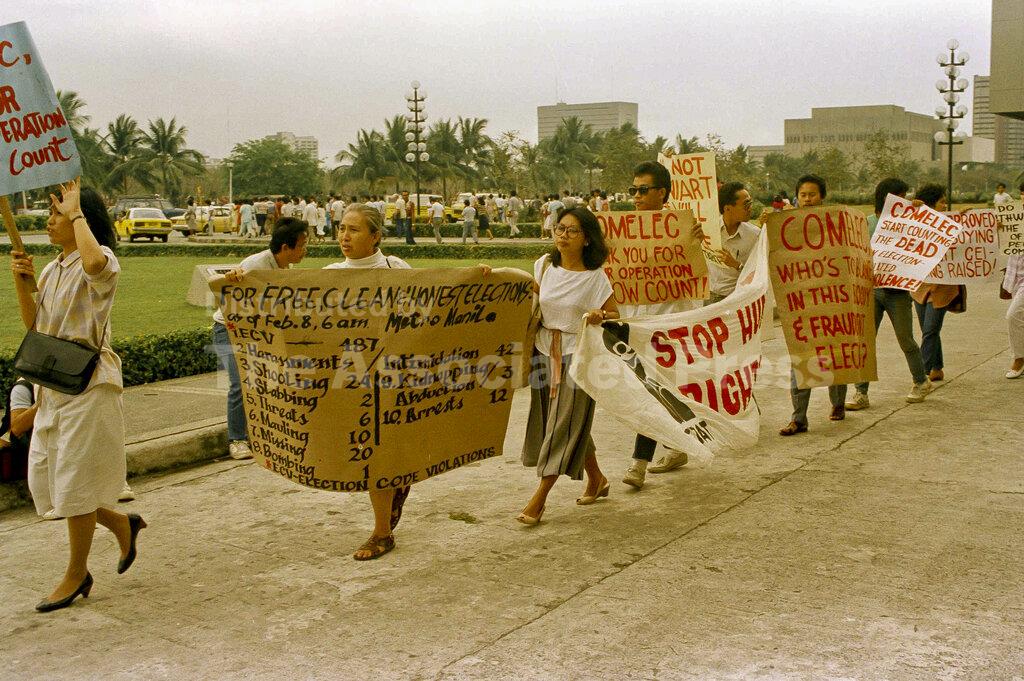
The Philippine presidential election was put to the National Assembly for certification after three days of violence and widespread reports of vote-rigging by backers of President Ferdinand E. Marcos. Both President Marcos, whose forces dominate Parliament, and Corazon C. Aquino have claimed victory. But within minutes, legislators began arguing over procedure, and their official vote count was postponed until tomorrow. Under the Philippine Constitution, the assembly is empowered to receive the unofficial vote count at any point after election day. It then has up to 15 days to affirm the tally’s accuracy and declare a winner. At a news conference today, Mrs. Aquino appealed to “all friends of democracy and supporters of freedom abroad” not to “make the mistake, in the name of shortsighted self-interest, of coming to the support of our failing dictator. “May I also reassure the world that we mean to conclude this business as we began it, peacefully but determinedly. In this time of need, we will learn who our real friends are. Understand that we have won and will take power. Marcos is seeking constitutional respectability for his shameful electoral theft. In the name of democracy, we will not let him.”
Although the official outcome of the Philippine presidential election appears to be far from settled, most Filipinos from both parties believe that President Ferdinand E. Marcos, intends to remain in power by whatever means necessary. Indeed, he told an American television interviewer on Sunday that “pulling out has never been one of the ideas I have considered.” For the moment, his course of action appears to have been to slow down the “quick counts” that have been reporting a slight election lead for his opponent, Corazon C. Aquino, to marshall his forces to deliver a more favorable count, and to gain a declaration of victory from the National Assembly. He would then be prepared to try to ride out protests from his opponents, hoping they would eventually subside.
President Reagan reserved judgment today on reports of fraud by supporters of President Ferdinand E. Marcos in the Philippine election, and called on both sides to “work together to form a viable government.” Speaking with regional editors, Mr. Reagan said: “In spite of all these charges, there is at the same time the evidence of a strong two-party system now in the islands.” He expressed hope that President Marcos and his opponent, Corazon C. Aquino “can come together to make sure the government works.” White House officials said Mr. Reagan would comment on the situation in a news conference Tuesday after conferring with Senator Richard G. Lugar, the head of a group of American election observers. The Senator returned from Manila today.
The leader of Haiti’s four-day-old interim Government said today that the new ruling body was committed to the development of a “real and functional democracy.” In a brief address at the formal installation of a 16-member Cabinet that is to help administer this country of six million people, the leader, Lieutenant General Henri Namphy, promised free elections. He said that Haiti’s democracy would be “founded on absolute respect for human rights, press freedom, the existence of free labor unions and the functioning of structured political parties.” General Namphy, speaking in French at the huge presidential palace in downtown Port-au-Prince, did not say when elections would be held. But he said the interim Government was “eager to hand over power to a democratically elected government.”
Right-wing businesses in El Salvador called a two-hour strike today to protest a visit by former President Jimmy Carter, who is on a tour of Central America. Some 200 rightists, many waving placards reading “El Salvador Hates You, Carter,” gathered on Sunday night in front of the residence of the American Ambassador, Edwin G. Corr, to demonstrate against Mr. Carter’s visit. United States Embassy guards fired tear gas to disperse the crowd. No injuries were reported. Salvadoran rightists blame Mr. Carter for the country’s civil war, which started in 1979 while he was President. Mr. Carter, who arrived from Nicaragua with his wife, Rosalynn, on Sunday night, met today with President Jose Napoleon Duarte.
Eight Latin American foreign ministers met today with Secretary of State George P. Shultz to urge that the Reagan Administration halt its aid to anti-Government rebels in Nicaragua and instead back a negotiated settlement in Central America. Specifically, the foreign ministers want the Administration to resume direct talks with the Nicaraguan Government. The United States broke off the talks last year. The visit by the foreign ministers, representing Colombia, Mexico, Panama, Venezuela, Argentina, Brazil, Peru and Uruguay, comes less than a month after they met in Caraballeda, Venezuela, where they worked out a new regional peace initiative. Just before meeting with Mr. Shultz, the Peruvian Foreign Minister, Allan Wagner Tizon, said the foreign ministers were particularly interested in whether “the United States was willing to collaborate” with the effort “in the areas which affect them more directly.”
Three North American Indian activists denounced the Nicaraguan Government today and said they would step up their activities against it. The three activists, who said they had just concluded a monthlong clandestine trip through eastern Nicaragua, said at a news conference that the Sandinistas were systematically bombing Indian villages in the Atlantic Coast region. The activists, who made their trip with Brooklyn Rivera, a leader of Miskito Indian rebels, said they had held public meetings in several villages and had heard accounts of executions, torture and other abuses by Government forces. Sandinista military officers have said Government bombing is limited in scale and aimed exclusively at military targets.
More than 350 people were arrested in Lima as Peruvian troops enforced the first day of a curfew aimed at curbing attacks by leftist guerrillas. Security was tight, and patrols were told to shoot pedestrians who ignored orders to halt and to fire on cars not flying white flags to make them clearly visible.
Libyan forces attacked Chadian Army troops today in central Chad, the Chadian Government announced tonight in a communique received in Paris. Foreign Minister Gouara Lassou said in the communique that Libyan troops had attacked Chadian positions at Kouba Olanga, 350 miles northeast of Ndjamena, the capital. “It is likely that other positions of our forces will be attacked in the coming hours and days,” he said. Libya has troops in northern Chad in support of rebels led by former President Goukouni Oueddei against the Government of Hissen Habre. Kouba Olanga is an outpost on the main road to Faya Largeau, a rebel stronghold 480 miles from the capital. The Government communique said the executive bureau of Chad’s ruling party had called for vigilance and a “general mobilization.”
The charred bodies of five black men, their arms and legs bound with wire, were found outside the South African city of Port Elizabeth. They were believed to be members of the small Azanian National Youth Unity group and victims of renewed black political infighting. Two other group members were hacked to death with axes and machetes over the weekend. Residents said the killings seemed to have resulted from a confrontation between political groups that say they are allies but disagree on tactics and on the extent to which violence is a legitimate political weapon. Three deaths were reported in another black township close to Port Elizabeth, apparently as the result of a feud against youthful militants who espouse the cause called Black Consciousness. A spokesman for the Azanian group accused the United Democratic Front of the killings, but the anti-apartheid organization denied the charge. “This is definitely the worst case we have ever had of this type of mass killing,” a local police spokesman said.
An Air Force report presented to the space agency two years ago sharply criticized safety planning for the space shuttle and said the chance of a catastrophic accident involving the shuttle’s solid rocket boosters was one in 35. The main author of the report, who is a space agency consultant, said the probabilities in the study were borne out by the explosion of the shuttle Challenger on January 28 just after takeoff in the program’s 25th flight. Among 14 possible major shuttle failures, the report said, booster failure was the most likely. The principal author of the report was a consultant to the National Aeronautics and Space Administration. The report was prepared for the Air Force, which relayed it to NASA. The Presidential commission’s investigation of the cause of the crash focused today on how the space agency handled warnings of problems with the rockets, officials said. Experts on risk say that the 1-in-35 chance of major failure would make the shuttle one of the most dangerous of major technological enterprises. The figure is roughly that faced by test pilots, according to these experts. Interviews with NASA officials and other safety experts indicate that the agency did not make the major safety changes in risk analysis urged by the report. Those changes mainly concerned wide use of the most rigorous method of safety analysis, called fault trees. NASA had no comment on this specific study. But spokesmen said that its own assessments put the risk figure much lower.
After the Challenger’s right booster rocket malfunctioned, its base tore away from the huge tank carrying volatile fuels and the rocket’s nose, pivoting, punctured the tank and caused the space shuttle’s explosion, according to Aviation Week and Space Technology. The magazine, a highly respected industry weekly, said space agency investigators believed that white-hot flames from a leak in the booster, or stresses from the abnormal plume of fire, severed the struts that attached the lower part of the booster to the external fuel tank. As the 149-foot booster pivoted outward, its nose swung in and ruptured the external fuel tank. Several spokesmen at various facilities of the National Aeronautics and Space Administration, continuing to maintain a strict silence on the accident investigation, said they could not comment on the report. They said all knowledgeable officials were tied up in meetings with investigators into the explosion.
The Presidential commission studying the explosion of the space shuttle Challenger is now focusing on how the space agency handled warnings of problems, Administration officials close to the investigation said today. The decision to open this avenue of inquiry came at a private hearing. It is related to reports that the National Aeronautics and Space Administration had been warned by its own engineers and analysts last year of problems involving safety seals on the booster rockets, but continued to launch additional shuttle missions. The officials said the commission sought today to determine whether the warnings were strong enough to have alerted NASA officials about dangers and to learn NASA’S mechanisms for examining the reports.
Three Challenger astronauts’ lives: When Dick Scobee went home to Auburn, Washington, for a family reunion in October, he told people that, with 109 astronauts in the shuttle program, his next flight into space might be his last. An aunt who was present, Naomi Allen, recalls that her nephew, who had never wanted to be anything but an airplane pilot, was nonetheless content. “He said he had acquired everything he wanted in life,” she said. Dick Scobee, the little boy who hung so many model airplanes from the ceiling of his room that anyone entering would bump his head on them, died at the command controls of the ultimate airplane, the shuttle Challenger. That he should have risen to such prominence is a source of some marvel to many who knew him when he was young. He was a good but not brilliant student who worked hard. He was a slow football player, but if no one else showed up for practice, Dick Scobee did. Without the privilege of going to the Air Force Academy, he became a pilot and officer the hard way, starting as a enlisted man repairing propeller engines.
This part of the country invites flight, with its warm, buoyant air currents and table-flat fields ready-made for landing strips. The wide Atlantic sky is speckled with motion, from the graceful dance of sea birds to the sharp, swift flight of military aircraft. As a North Carolina farm boy, Mike Smith learned to work the land, but grew to love the sky. He learned to fly as a teen-ager, soaring in a small plane over the sandy spits and pine forests of the Outer Banks, not far from where the Wright Brothers first took to the air. “Flying is just something that came natural to Mike,” said his brother Patrick, 39 years old, himself a jet pilot. “It didn’t matter whether it was small airplanes or a jet, he just really loved to fly.” Once, as quarterback of the Beaufort Sea Dogs, he stopped a football game to watch an airplane. “Mike looked up, saw a big military plane and called time-out,” said Tom Hewitt, who coached the junior varsity team. “He just had to take a look,” Mr. Hewitt said. “I can just imagine him thinking, ‘Boy, I’d love to be up in that thing.’ ” On his 16th birthday he completed his first solo flight, earning his student pilot license before his automobile driver’s license. Six days later, Alan B. Shepard Jr. became America’s first man in space. Mike Smith was determined to follow him.
Growing up on the Kona coast of Hawaii, Ellison Shoji Onizuka picked coffee beans, played basketball and dreamed of hurtling through space in an imaginary supercharged craft. No one knew where the idea came from, including his parents. “He had it inside of him, like a dream,” said his mother, Mitsue Onizuka. “We didn’t understand it, but he knew what he would do.” Three decades later, in January 1985, Lieutenant Colonel Onizuka rocketed into the sky aboard the space shuttle Discovery. As one of a handful of minority applicants selected for training by NASA, he became the first Hawaiian, the first Japanese-American and the first Buddhist astronaut. He was quietly and frankly proud of that heritage; in turn, many people who were Hawaiian or Japanese American or Buddhist saluted him as one of their own. He presided over their festivals, spoke at their functions, practiced their religion and continually thanked them for helping him along his way. The horror of the Challenger explosion has now cast him as a hero to many in those communities, and family members and friends say such a thing would have astonished him.
President Reagan, expressing confidence that the technology exists to offer “every precaution” against radiation leakage, said that certain areas of the country will have to accept their proximity to future hazardous-waste disposal sites. “We’ve got to have the confidence someplace along the line that we know enough now that we’re not going to make this hazardous threat to any section of the country,” Reagan told a group of out-of-town journalists. “But some places are the ones that we’re going to have to pick,” he said. Three sites — in Hanford, Washington, Deaf Smith County, Texas, and Yucca Mountain, Nevada — are the proposed finalists for the first nuclear waste depository.
President Reagan receives a report from the Blue Ribbon Commission on Defense Management.
President Reagan hosts a luncheon for regional editors and broadcasters.
The government imposed regulations on railroad employees, for the first time prohibiting them from reporting to work drunk or drugged, and banning consumption of alcohol or other drugs on the job. The new rules go into effect 12 years after the National Transportation Safety Board, an independent federal panel, urged the Transportation Department to adopt them. Since 1975, the government has recorded 48 train accidents caused by drunk or drug-impaired workers. These resulted in 37 deaths, 80 injuries and $34 million in property damage. The regulations, which were fought by railroad unions, also require railroad workers involved in major accidents to undergo testing for alcohol and drug use.
The Army halted its use of the “Hummer” all-purpose vehicle because of brake-pedal failures, marking the first major glitch to affect the vehicle that replaced the venerable jeep. The brake failures on two vehicles at Ft. Jackson, South Carolina, did not result in accidents or injuries, an Army spokesman said. New brake pedals will be installed on about 1,400 of the carriers in use at two U.S. bases, the Army said.
Government agents have arrested five people suspected of involvement in laundering money in connection with a multimillion-dollar drug trade centered in Los Angeles and Miami, Federal prosecutors said today. According to Robert C. Bonner, the United States Attorney in Los Angeles, and Leon B. Kellner, the United States Attorney in Miami, Federal agents since last September have seized 254 pounds of cocaine and $11.6 million in cash in connection with the case. Mr. Bonner said the cash was the largest amount ever seized “in a single coordinated drug case.” The five men include three Venezuelan nationals arrested in Miami Friday, another Venezuelan arrested in Los Angeles the same day and a fifth man, described as a Uruguayan, who was picked up in New York City. They have been charged with conspiracy in connection with violations of Federal laws on currency reporting and disguising the sources of money.
West Virginia’s attorney general was indicted in Charleston on eight counts of violating election laws by “shaking down” his employees for money to pay off a campaign debt. Attorney General Charlie Brown, a Democrat, was indicted by a grand jury on eight misdemeanor violations of a state law prohibiting elected officials from soliciting contributions from their employees.
A federal judge in Phoenix sentenced a man to 10 years in prison for assaulting an FBI agent in a scuffle that led to the slaying of the first woman FBI agent to be killed in the line of duty. Kenneth Don Barrett, 27, of Nevada, fought with FBI agent Lowell Bruce Atkins, who was trying to serve a warrant for his arrest, and a gun was fired. Other agents rushed to lend assistance and FBI agent Robin Ahrens, 33, was killed by gunfire from other officers, FBI officials said.
Five teenagers pleaded guilty today to participating in a vigilante group that said it was trying to fight crime and drug use by such tactics as threatening students and bombing cars. State District Judge Don Leonard, admonishing each defendant to “behave yourselves,” said he would take at least a month to decide sentences. The police said members of the group known as the Legion of Doom, among them honor students and athletes from prominent families, used violence in an attempt to rid Paschal High School of crime and drugs. The five were among eight boys accused in the case involving 33 felony and misdemeanor counts. According to indictments returned on graduation day last May, the allegations included threatening a student with a gun, bombing cars, damaging school property and killing a cat. The other cases are pending.
Eastern Airlines flight attendants asked a Federal district judge today to award them $33 million in back pay they contend was illegally deducted from their paychecks in 1985. Judge Eugene Spellman is expected to rule within the week, said David Butler, a spokesman for the Transport Workers Union, which represents the attendants. The lawsuit stems from a 1983 agreement under which three unions accepted pay cuts of at least 18 percent in 1984. The attendants say the airline illegally continued the deductions in 1985. A spokesman for Eastern, Jerry Cosley, said the wage cuts were necessary if the airline is to survive.
For the first time since meatpackers began a bitter strike nearly six months ago, hog slaughtering resumed here today at Geo. A. Hormel & Company’s flagship plant in Austin, Minnesota. “It went very smoothly,” said Deryl Arnold, the plant manager. He said that more than 900 people reported for work today and that the company hoped to have a full complement of 1,025 workers by Tuesday or Wednesday. About 1,500 members of Local P-9 of the United Food and Commercial Workers Union went on strike August 17 and the plant reopened January 13 with replacement workers.
Major Chicago contract inquiries are being pressed by local, state and Federal law-enforcement officials. The Cook County State’s Attorney has announced he is looking into whether some of Mayor Harold Washington’s top aides conspired to conceal a city revenue official’s acceptance of a $10,000 bribe.
The man accused of gunning down an interracial couple in Madison, Wisconsin in August 1977 said at his trial today that he had concocted a confession to the crime. The defendant, Joseph Paul Franklin, said he did so to get out of a federal prison where he was serving life sentences for murdering two black men in Utah. Mr. Franklin, 35 years old, is charged with killing Alphonse Manning Jr. and Toni Schwenn, both 23, in a Madison parking lot. He was acquitted in 1982 in the shooting of Vernon Jordon, then head of the National Urban League, in Fort Wayne, Indiana.
A federal district judge today overturned the 1943 conviction of a Japanese-American who defied government orders for internment in World War II. Judge Donald S. Voorhees vacated the conviction of Gordon Hirabayashi on charges of failing to register for evacuation to an internment camp, although he let stand his conviction for violating a curfew that required Japanese-Americans to remain in their homes from 8 PM to 6 AM each night. Judge Voorhees said that when Mr. Hirabayashi, a native of Seattle, appealed the convictions to the United States Supreme Court four decades ago, the government failed to disclose information relevant to the case.
An alliance of Eskimos, fishermen, environmentalists and eight coastal states, including Alaska, is preparing for the second round of a lawsuit to keep offshore oil rigs out of Federal waters near Bristol Bay, said to be the richest salmon fishery in the world. At the alliance’s request, Federal District Judge James von der Heydt last month issued a preliminary injunction halting the Interior Department’s sale of 5.6 million acres of the outer continental shelf in the North Aleutian Basin, on the southwestern edge of Bristol Bay between mainland Alaska and the Alaska Peninsula. Judge von der Heydt ruled that there was evidence that the Interior Department had not adequately studied potential effects on native subsistence hunting and fishing in the region, in violation of the Alaska National Interest Lands Conservation Act. Interior Secretary Donald P. Hodel and oil companies also named in the suit have challenged the ruling at the United States Court of Appeals for the Ninth Circuit in San Francisco. Lawyers say the appeal could be heard early next month.
A storm sweeping eastward from the southern Plains brought snow and freezing rain to wide areas of the nation’s midsection. Roads from Texas to Tennessee were icy, and many schoolchildren and adults stayed home. Eight people were reported killed and one person was missing and presumed dead in weather-related accidents, authorities said. Countless highway mishaps occurred as trucks jackknifed on slick overpasses and cars slid into each other, police said.
“John Lennon: Live in NYC” album is released posthumously.
Dow Jones Industrial Average: 1626.38 (+12.96)
Born:
Christopher Abbott, American actor (“Poor Things”, “Girls”), in Greenwich, Connecticut.
Jeff Adrien, NBA power forward (Golden State Warriors, Houston Rockets, Charlotte Bobcats, Milwaukee Bucks, Minnesota Timberwolves), in Brookline, Massachusetts.
Josh Akognon, NBA point guard (Dallas Mavericks), in Greenbrae, California.
Roger Allen, NFL guard (St. Louis Rams, Tampa Bay Buccaneers), in Raytown, Missouri.
Dalier Hinojosa, Cuban MLB pitcher (Boston Red Sox, Philadelphia Phillies), in Isla de la Juventud, Cuba.
Duke Welker, MLB pitcher (Pittsburgh Pirates), in Kirkland, Washington.
Jarod Palmer, NHL right wing (Minnesota Wild), in Fridley, Minnesota.
Died:
“Uncle” Art Satherley, 96, British-American record producer (1968 Academy of Country Music Award).
Brian Aherne, 83, British actor (I Confess, Titanic, Juarez).
 History Diaries