Churchill broke five months of radio silence today. He explained his absence from the airwaves by talking of “deeds, not words.” It was a speech of praise and encouragement for both the forces and the civilians. “We have stood our ground and faced the two dictators in the hour of what seemed their overwhelming triumph, and we have shown ourselves capable, so far, of standing up against them alone.” The Prime Minister reserved particular praise for the victory two months ago over the Italians in Libya: “In barely eight weeks a campaign which will long be studied as a model of the military art, an advance of over 400 miles has been made.” He went on to speak of the vital importance of American aid, concluding: “We shall not fail, or falter; we shall not weaken or tire. Neither the sudden shock of battle, nor the long drawn trials of vigilance and exertion will wear us down. Give us the tools and we shall finish the job.” Churchill declared tonight in a world radio address that Great Britain would “finish the job” of defeating Adolf Hitler without the help of an American expeditionary force. On this point Churchill was emphatic. American aid in the form of supplies now seems assured, he said, to clinch a British victory. “In the last war the United States sent 2,800,000 men across the Atlantic, but this is not a war of vast armies, hurling immense masses of shells at one another,” the prime minister declared. “We do not need the gallant armies which are forming throughout the American union. We do not need them this year, nor next year, nor any year that I can foresee.” But Britain does need “an immense and continuous supply of war materials” and to get them needs more shipping facilities, he said.
He mentioned Bulgaria and the difficulty of convincing that nation that with Germany it would be on the losing side, after a happy description of British successes in Africa and the defense work at home. “We may be sure,” he went on, “that the war is soon going to enter upon a phase of greater violence. Hitler’s confederate, Mussolini, has reeled back in Albania. But the Nazis, having absorbed Hungary and driven Rumania into a frightful internal convulsion, are already upon the Black Sea. A considerable German army and air force is being built up in Rumania, and its forward tentacles have already penetrated Bulgaria with what we must suppose is the acquiescence of the Bulgarian government. Airfields are being occupied by German ground personnel numbering thousands, so far as to enable the German air force to come into action from Bulgaria. Many preparations have been made for the movement of German troops into or through Bulgaria. And perhaps this southward movement has already begun. If all the Balkan people, aided by Britain and Turkey, stood together, he declared, “it would be many months before a German army and air force of sufficient strength to overcome them could be assembled in the southeast of Europe. And in those months,” he added grimly, “much might happen. Much will certainly happen as American aid becomes effective, as our air power grows, as we become a well-armed nation, and as our armies in the east increase in strength.”
Interestingly, Churchill also refers to Laval, who he calls the “French Quisling,” as turning France into a “doormat” for Hitler. Laval, of course, is known to history as a great collaborator, but at this time he is not in the Vichy French government at all. This comment betrays a certain lack of knowledge by the British as to what is actually happening in Vichy France.
Australian Prime Minister Robert Menzies, breaking his journey from Melbourne to London in Egypt, has dinner with Middle East RAF chief Sir Arthur Longmore. They listen to Winston Churchill’s “give us the tools” broadcast. Menzies’s review is not kind. He is not impressed with Churchill’s tone, finding it to be a “hymn of hate” which appeals to the “lowest common denominator among men.” Menzies scribbles down that he does not like the recent appointment of Malcolm McDonald as High Commissioner to Canada, feeling that “Winston likes Yes Men.” Overall, it is clear that Menzies feels that Churchill is becoming autocratic and inflexible — an appraisal shared by many closest to Churchill as well.
Britain’s rapidly advancing army of the Nile, its speed apparently unchecked, reported today it had smashed almost one-third of the way between captured Benghazi and Tripoli, Libya’s capital and last major stronghold, seizing five more generals and uncounted thousands of prisoners. Occupation of El Agheila by “advanced elements of our armed forces” while others still were mopping up the battlefields south of Benghazi was reported in a general headquarters communique. This placed the British vanguards part way around the Gulf of Sidra, about 180 miles southwest of Benghazi, on the tortuous coastal road which crosses 680 miles of desert waste to Tripoli. El Agheila, a town of about 1,000 population with barracks for Carabinieri, an emergency landing field and a wireless station, is the last place of importance before the expanse of the Sirtica desert lying in the British path. Seat of a district governor, the town is only 10 miles from the border of Tripolitania, Libya’s westernmost province.
British forces capture El Agheila, Cyrenaica but stopped there. The British advance comes to a halt at El Agheila. There is little Italian opposition to prevent a further move, but General Archibald Wavell, Commander in Chief Middle East Command, is being compelled to withdraw troops which will be sent to Greece. He is also responsible for the campaign in East Africa and for making some provision for the defense of Palestine. In the near future, this will demand more of his attention because of German activity in Iraq and Syria. This ended Operation COMPASS which in ten weeks succeeded in pushing the Italian Tenth Army out of Egypt and eliminating it as a fighting force. During the campaign the Italians lost around 3,000 killed and 130,000 captured, as well as approximately 400 tanks and 1,292 artillery pieces. The British West Desert Force’s losses were limited to 494 dead and 1,225 wounded. The British failed to exploit the success of Operation COMPASS as British Prime Minister Winston Churchill ordered the advance stopped at El Agheila and began withdrawing troops to aid in the defense of Greece.
Erwin Rommel was promoted to the rank of Generalleutnant. Operation Sunflower, the installation of Wehrmacht troops in Tripolitania, continues. General Erwin Rommel’s first load of troops is at sea out of Naples. They are scheduled to land in North Africa in a couple of days. This would be an excellent convoy for the Royal Navy to intercept, and indeed they have large naval forces not far away — but they are far to the north, bombarding Genoa rather than where the real action is. Rommel, meanwhile, receives a promotion to Generalleutnant, befitting his new status as an Army Group commander.
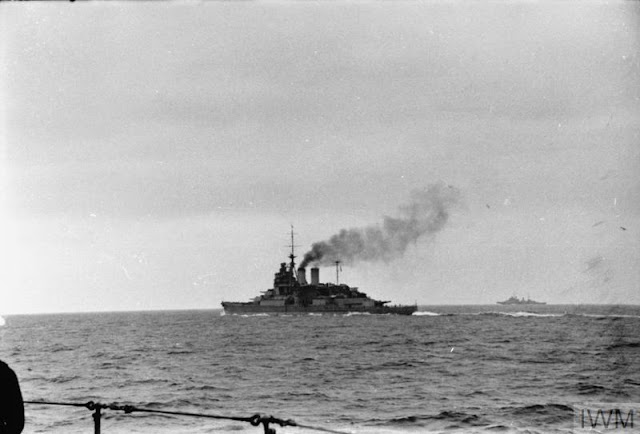
British Force H, including two battleships and one cruiser, with carrier HMS Ark Royal supporting from a distance, bombarded Genoa, Italy at 0815 hours. 273 15-inch shells and 782 6-inch shells were fired. Four merchant ships and a training vessel were sunk, 18 ships were damaged, harbor facilities and nearby industrial areas were damaged, and the cathedral was also hit. 144 Italians were killed, most of whom were civilians. The British lost 1 Swordfish torpedo bomber. Italian battleships Vittorio Veneto, Cesare, and Doria, supported by cruiser and destroyers, were launched to intercept the British fleet but failed to find them.
Admiral Iachino is at sea with battleships Vittorio Veneto, Cesare and Doria. He learns of the attack on Genoa only two hours after it ends — why this extremely important news took so long is unclear — and the signal incorrectly tells him that that the Royal Navy ships are heading west along the coast. In fact, Admiral Somerville is heading southwest. The two fleets miss each other completely, though the Italians at first mistake a number of French freighters for the Royal Navy ships and prepare for action.
At the naval operations room in Rome, a Captain Bragadin made the following notation:
“The bombardment of Genoa inflicted serious damage on the city. In the harbor four steamers and the old training ship Garaventa were sunk. Fortunately, the most important target, the Duilio, which was still under repair after Taranto, was not hit. There were grave moral effects throughout Italy, all the more because, whilst the efforts of our aircraft were appreciated, not a word was announced about the search made by our naval squadron. As a result of such silence the Italian people thought — in so many words — that the navy had run away.”
Of course, the Italian Navy had not run away, and under slightly different facts a major naval engagement may have resulted. However, Bragadin is a bit too blithe in his summary about where to pin the blame for the Italian navy’s inability to act effectively. Failure by shore observers to notify the Italian battle fleet of the attack in a more timely fashion, and failure to track the Royal Navy’s subsequent movements, were faults just as grievous to any kind of effective defense as would have been “running away” — the effect was the same.
Italian officials declined tonight to confirm or deny British reports that Genoa had been shelled.
The front in Albania remains quiet on 9 February 1941, and the real activity is hundreds and thousands of miles away. Middle East Commander Archibald Wavell, in Cairo, responds to a telegram from the British Military Mission in Cairo inquiring whether he would be willing and able to send forces to Greece and/or Turkey quickly, if necessary. Wavell — despite well-known reservations about ending a winning campaign in Libya in favor of an assumed one in Greece — replies in the affirmative. He indicates that he has one armored brigade group and the New Zealand Division (two brigades) available immediately, with other troops available in March and April. The competition for resources between Greece and North is becoming white-hot on the British side, and the growing implied threat of a German invasion of Greece is becoming almost as effective German aid to Mussolini (in North Africa) as would be an actual invasion of Greece.
The Indian troops at Keren in Ethiopia take a breather today, regrouping and recalibrating. Having been pushed back on both sides of Dongolaas Gorge, it is clear that either a different strategy or greater force is required to dislodge the Italian defenders. The attackers settle on a strategy of focusing on the left side of the gorge, which is dominated by a string of peaks.
Admiral Darlan became the new Vice Premier of Vichy France. Marshal Philippe Petain today announced that he had appointed Admiral Francois Darlan as not only vice-premier, but also minister for foreign affairs, replacing Pierre-Etienne Flandin. And to underline Darlan’s triumph in the backstairs conflict with the former vice-premier, Pierre Laval, the marshal designated the admiral as his successor. A year ago Darlan seemed the cheerful ally of the Royal Navy. Born into a family that has held commissions in the French navy since Trafalgar, Darlan was head of the officer’s training school, and in the 1930s helped to re-equip the fleet with new ships, including Strasbourg and Dunkerque. However, he was embittered by the British sinking of “his” ships at Oran last July.
Laval turned down a spot in the cabinet on the 8th, so he may have been the one who Petain had in mind for the Flandin slot — and, when told at that time by Petain that Darlan was taking his former position of Vice Premier, decided that half a loaf was worse than none. He does have a steady pro-German orientation. Darlan, for his part, is a shady character, who throughout the war plays a devious game of courting the Allies and Germans, in turn, depending on who will offer him the best chances of advancement. The strategy certainly is working for the moment.
Flandin’s dismissal — which it almost certainly was — is a bit odd because he only occupied the position for two months as the replacement for Laval. Perhaps he was only intended as a stop-gap while Petain got over whatever personal issues Petain had with Laval. This essentially ends Flandin’s career — which, given the course of events for those who remained in the government, was not the worst thing that ever happened to him.
Rudolf Hilferding, prominent socialist, Jew, and once German Minister of Finance under the Weimar Republic was handed over to the Gestapo by the police of the Vichy government in southern France and, despite of their emergency visa to enter the United States of America, taken to the Gestapo dungeon of La Santé in Paris. Hilferding would die on February 11, 1941 of unknown circumstances after being tortured and severely maltreated.
For administrative purposes, Luxembourg is united with Koblenz-Trier.
Dutch Nazis assisted by German soldiers raided and vandalized the pro-Jewish Alcazar café in Amsterdam, which refused to hang “No Entry for Jews” signs in front of café and where the works of Jewish artists were still appearing. The police intervene and suffer 23 casualties.
Feelings against the German occupation are simmering in Amsterdam, and this attack is one of several “provocations” in Jewish neighborhoods. This violence is gradually escalating, with the Dutch pro-German movement NSB and its streetfighting arm, the WA (“Weerbaarheidsafdeling” — defense section) on one side, and Jewish self-defense groups and their supporters on the other.
The Spanish press displayed today a dispatch from Rabat, French Morocco, saying that all of French North Africa would find it difficult to resist joining “free French” forces if Germany occupies all of France. The dispatch, transmitted by E.F.E., official Spanish news agency, said that “confusion” was growing in French North Africa and that it had been “systematically exploited” by the British.
Official Bulgarian quarters declared early today in answer to the speech of British Prime Minister Winston Churchill that the only German soldiers now In Bulgaria are a few officers and men who for a long time have been training the Bulgarian army to use equipment sold by the Reich.
The Luftwaffe ends an extended period of dormancy with night raids on Plymouth, Birmingham and Humberside. The attack apparently damages light cruiser HMS Neptune in Plymouth Harbour, which just arrived in port for a refit, but the damage is not significant.
RAF Bomber Command dispatches 11 Blenheims during daylight; 4 aircraft bombed various targets. No losses. The RAF sends a Rhubarb raid (offensive patrol) over Calais that does not result in any losses by either side.
The RAF resumes its rabid and so-far fruitless attacks on the German battleship Tirpitz, which dangles like a pinata just out of reach at Wilhelmshaven. 13 British aircraft from Scampton, Lincolnshire attacked battleship Tirpitz at Wilhelmshaven, Germany. The air crews reported to have caused damage, but in actuality no hits were scored.
RAF Bomber Command dispatches 23 Hampdens overnight to Wilhelmshaven; the target was cloud-covered and only 1 aircraft claimed to have bombed there; 13 other aircraft bombed estimated position of target. Wilhelmshaven diary has no entry. No losses.
7 Staffel of JG 26, led by Oblt. Müncheberg, arrive in Sicily. They are based at Gela Airfield and will supplement Fliegerkorps X indefinitely.
U-37, commanded by Kapitänleutnant Asmus Nicolai Clausen, sighted convoy HG.53 east of the Azores. Submarine U-37 sank steamers Courland (1325grt) and Estrellano (1983grt) in 35-53N, 13-13W. At 0430 hours on 9 February 1941, U-37 fired two G7a torpedoes at two ships in convoy HG-53 about 160 miles southwest of Cape St. Vincent, Portugal and sank both ships, Courland and Estrellano. At 05.00 hours, one G7e torpedo was fired, but it missed the ships in station #61 and #31 and did not hit a ship beyond them, as Clausen thought.
Three men of the 25 crew members, two gunners and seven passengers aboard Courland (Master Robert Cecil Smith) were lost. 31 survivors were picked up by Brandenburg which was sunk by the same U-boat the next day. The only survivor of the second sinking was a passenger from Courland, who was picked up by HMS Velox (D 34) (LtCdr E.G. Roper, DSC, RN) and landed at Gibraltar. The 1,325-ton Courland was carrying general cargo and steel was bound for London, England.
Five crew members from Estrellano (Master Fred Bird) were lost. The master, 20 crew members and one gunner were picked up by HMS Deptford (L 53) (LtCdr G.A. Thring, DSO, RN) and landed at Liverpool. One crew member died of wounds aboard the sloop and was buried at sea on 10 February. The 1,983-ton Estrellano was carrying general cargo and canned fish was bound for Liverpool, England.
German Kondor bombers sank British steamers Jura (1759grt), Dagmar I (2471grt), Varna (1514grt), and Brittanic (2490grt), and Norwegian steamer Tejo in 35-42N, 14-38W. Fifteen crewmen and two gunners were lost on steamer Jura. Four crewmen and one gunner were lost on steamer Dagmar I. One crewman was lost on the steamer Brittanic. All crewmen on steamer Varna were rescued. Steamer Varna did not sink until 16 February in 44-55N, 22-30W. Four crewmen were lost on steamer Tejo. Submarine HMS Velox picked up twenty six survivors from these ships and arrived back at Gibraltar on the 13th. This incident is prime evidence of the utility of having U-boats and patrol aircraft working together. The Kriegsmarine has requested more aircraft, but Reichsmarschall Hermann Göring, defending his Luftwaffe fiefdom, has only given them one small unit.
Admiral Lütjens in command of battle cruisers Scharnhorst and Gneisenau heads northwest in order to elude any pursuers from the abortive attack on Convoy HX-106. The Royal Navy does have many ships looking for them, but they are far to the east. Lütjens’ plan is to head northwest to a point relatively close to western Greenland, then return south to the shipping lanes nearer to Canada than last time.
Destroyer HMS Escapade departed Scapa Flow at 2145 to search for the survivors of a crashed aircraft off Wick. No trace was found. Troopship Amsterdam departed Scapa Flow at 2300 and destroyer Escapade joined her and escorted her to Aberdeen. The destroyer arrived back at Scapa Flow at 1600.
Anti-aircraft ship HMS Curacoa departed Scapa Flow at 0945 to escort convoy WN.81 until dark. The ship then escorted convoy EN.69 from off Buchan Ness to Pentland Firth. At 1030/10th, the ship transferred to convoy WN.82 and remained with it until dark. At 2330/10th, the ship arrived back at Scapa Flow.
In Operation RESULT, Genoa was bombarded by battlecruiser HMS Renown and battleship HMS Malaya of Force H from 0714 to 0744. Italian battleship Duilo was at Genoa at this time, but was not damaged in the bombardment. Light cruiser HMS Sheffield bombarded Pisa. Aircraft from aircraft carrier HMS Ark Royal, which was escorted by destroyers HMS Duncan, HMS Isis, and HMS Encounter, raided Leghorn and laid mines in the entrance to La Spezia. A/Sub Lt (A) N. G. Attenborough, A/T/Sub Lt (A) S. W. Foote RNVR, and Leading Airman G. W. Halifax in a Swordfish of 820 Squadron were lost in the Ark Royal raid on Leghorn. Destroyers HMS Jupiter and HMS Firedrake were off Majorica simulating radio traffic for Force H.
Armed boarding vessels HMS Rosaura and HMS Chakla, escorted by destroyer HMAS Voyager, departed Alexandria for Tobruk. British troopship Ulster Prince with 1300 troops, escorted by destroyer HMAS Stuart, departed Alexandria for Tobruk.
Submarines HMS Usk and HMS Truant off Tripoli and HMS Utmost off Tunisia made unsuccessful attacks on Italian shipping.
British steamer Crista (2590grt) was damaged on a mine at Tobruk.
Ocean boarding vessel HMS Maron departed Gibraltar for Western Patrol.
Italian coastal steamers IV Novembre (61grt), Tenax (115grt), Rosanna (205grt) were lost in stranding on the Sirte coast.
Convoy OB.284 departed Liverpool, escorted by destroyers HMS Vanoc and HMS Volunteer, sloop HMS Aberdeen, and corvettes HMS Fleur De Lys and HMS Tulip. Destroyer HMS Caldwell joined on the 10th. Sloop Aberdeen and the corvettes were detached on the 12th. The escort was detached on the 13th when the convoy dispersed.
Convoy BN.15 departed Aden, escorted by sloops HMS Shoreham and HMS Yarra, and arrived at Suez on the 16th.
Convoy HX.108 departed Halifax, escorted by armed merchant cruiser HMS Maloja and corvettes HMS Mayflower and HMS Snowberry. The armed merchant cruiser was detached on the 18th. Battleship HMS Rodney proceeded with the convoy on the 18th to 20 February. On the 24th, destroyers HMS Montgomery, HMS Wanderer, and HMS Witch and anti-submarine trawler HMS York City joined the convoy. Corvette HMS Periwinkle joined the escort on the 25th. Corvette Periwinkle was detached on the 26th. The remainder of their escort was detached when the convoy arrived at Liverpool on the 27th.
Both HMS Mayflower and HMS Snowberry were Flower-class corvettes. Both ships had recently been delivered from Canadian shipyards and were subsequently completed in British yards on the Tyne River. Mayflower was fitted with a ‘dummy’ 4-inch gun built of wood for the transit to the U.K., an infamous example of the inferior condition of the early wartime Emergency Expansion Plan warships of the RCN. Although guns were acquired later, technological inferiority plagued the RCN until relatively late in the war.
The battle over the Administration’s Lend-Lease bill for aid to Britain and her allies moves this week to the Senate side of the Capitol, with the immediate conclusion expected to be a favorable report on the modified House measure from its Foreign Relations Committee before or by the end of the week. With the Senate expected to get the measure by next Monday at the latest and possibly by Saturday of this week, the big question here now is how long that body will debate it before it comes to the inevitably expected conclusion of passage-and passage in essentially the form which the House gave it. Despite planned drives by opposition groups to modify it drastically and announced intentions to defeat it — which no one believes can get anywhere — the bill is expected finally to go to conference with possibly only one important change in it as it came from the House last night. This would be the striking out of the amendment of Representative Dirksen, Republican of Illinois, providing that any Presidential powers granted under it may be repealed by a concurrent resolution of both houses. Such a resolution would require only a majority vote in each and would not be subject to a Presidential veto, which would require a two-thirds vote of both bodies to overcome. The House Democratic leadership accepted this amendment with the best grace it could muster when it went through against its wishes while a large number of Democrats were out for lunch.
Prime Minister Winston Churchill’s speech was hailed tonight by proponents of the British-aid measure as “reassuring” and “magnificent.” Non-interventionists challenged his declaration that Great Britain will not need American troops in her struggle against Germany and Italy. Consensus was that the address would not influence senate action on the aid bill. It was passed by the house on Saturday.
Wendell L. Willkie, home from a “see for myself” tour of England and Eire, said today he had heard “no talk expecting, anticipating or suggesting that the United States become an active ally in warfare with Britain.” The 1940 Republican presidential candidate said he went abroad 18 days ago “as a private citizen on my own responsibility and I’m coming back the same way.” Willkie declared that those who drew the issue of aid to Britain on a basis of war or no war for the United States were being “unrealistic.” He expressed the belief that “if we do not give aid to Britain, we shall probably become involved in war.”
The mechanical skills of America’s army of workers, largely unwanted during the years of depression, have been turned by the threat of war into the nation’s most important resource for defense. From industries throughout the country the cry has gone up for more and more trained men. But there aren’t any more trained men. To meet the demand, a vast program of training in which industry, government, labor and the schools are participating, has been drawn up and started in operation. More than 200,000 workers already have completed courses in the schools that have been organized into the program by the Federal Government, and 100,000 others are enrolled now. By June 30, at least 1,000,000 more, Washington officials predict, will have learned to do the things that must be done in our factories if we are to have the planes, ships, guns that we need. This vast effort is changing the whole pattern of life for uncounted young men. The bright boy who, a few years back graduated from high school into joblessness, now is finding a place in the world where he is wanted. The pool of the idle, accumulated in many industrial communities in the depression years, is being drained off.
The American Youth Congress tonight cheered charges that the administration plans to “destroy democracy and take the nation into a war which 85 percent of the people do not want.” “The lend-lease bill and the conscription act are steps toward the death of democracy in the United States and the rise of a Fascist dictatorship,” Fred Keller, a Spanish civil war veteran, said. As many of the 5,300 delegates as could jam into the 3,000-capacity Turner’s fight arena, cheered every denunciation of the administration and shouted down speakers who sought to defend it.
Senator Reed Smoot, co-sponsor of the infamous 1930 Smoot-Hawley Tariff Act and defeated in the 1932 election, passes away. At the time of his death, he was third in the line of succession for the leadership of the LDS Church and is buried in Provo, Utah.
Howard Heinz, president of the H. J. Heinz Co. of Pittsburgh, died tonight in Jefferson hospital. Dr. Henry K. Mohler said the industrialist, who was 63, died from a cerebral hemorrhage that occurred this morning.
At the Jimmie Foxx Jungle Club course in Ft. Lauderdale Tiger coach Mervyn Shea wins the annual baseball players’ golf tournament. He shoots 4-under on the last 9 holes to win the 36-hole competition, 2–1, over Lloyd Brown. Shea had to beat Wes Ferrell, who won the tourney in 1937, ’39 and ’40, while Brown beat Heinie Manush to make the finals. Gee Walker wins the driving contest with a 278 yard drive, while host Foxx wins the pitching contest by hitting a ball closest to the pin.
In the Battle of Southern Honen, the Japanese 11th Army is retreating to its base at Hsinyang, and the Chinese 5th War Area is pursuing it. However, the Chinese maintain their distance and allow the Japanese to return to their base. This is a well-established pattern, with the Japanese making occasional raids (often called “rice offensives”) and then taking their ill-gotten goods back to their lines.
Two waves of Japanese bombers today attacked the northern section of Kunming, terminus of the Burma Road. Damage was reported not extensive and casualties light.
It is stated in some circles in Shanghai that the usefulness of the Burma Road to China is about at an end. The Japanese state that their naval and military bombers have effectively reduced all the bridges across the Mekong River and its tributaries to wrecks, that in most cases, are a mile or more downstream from their original positions. At first Japanese reports of the demolition of these bridges were regarded by foreign observers as fabricated, paralleling numerous other Japanese accounts. Now dispatches from Chungking declare that vital points on the Burma Road have been destroyed by Japanese air activity. Such vital points, the Japanese say, include the chief suspension bridge over the Mekong River and other smaller bridges over various smaller rivers.
Amid reports of growing tension in the Far East between Japan and the “Anglo-American bloc,” the Soviet Union opened negotiations today for a trade treaty with Japan.
Born:
Sheila James Kuehl, American politician and actress (“The Many Loves of Dobie Gillis”, “Broadside”), in Tulsa, Oklahoma.
Died:
Reed Smoot, 79, American senator and leading figure of the LDS Church.
Howard Heinz, 63, American industrialist and president of the H. J. Heinz Co.
 History Diaries