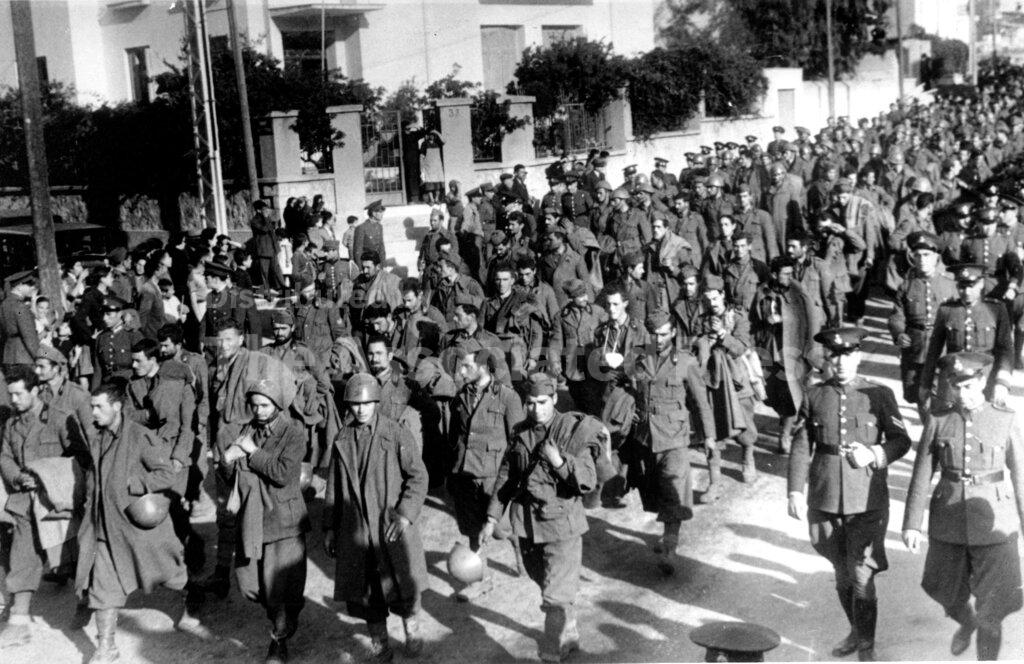
Once again, the British army in Libya has an immense logistical problem of sorting out and transporting massive numbers of Italian prisoners of war. Having captured Benghazi and eliminated the Italian 10th Army, the British appear to have the ability to clean the table in Libya and eliminate the Axis presence in North Africa (leaving aside the Vichy French to the west, who technically are not part of the Axis). General O’Connor is anxious to do this and has sent his liaison with Wavell back to Cairo to ask permission to continue the attack. While waiting for this approval, O’Connor on his own initiative sends 11th Hussar patrols westward. They make it as far as 130 miles east of Sirte, finding no opposition and only scattered Italian troops and equipment. Troop enter the Cyrenaica border town of Agheila and find it deserted. RAF No. 830 Squadron based on Malta raids Tripoli, losing a plane (the crew becomes POWs), while other RAF forces raid Maritza, Rhodes, and Calato.
Chief-of-Staff North African theater command General Giuseppe Tellera, also acting commander of Italian 10th Army, is killed. Tellera himself rode into battle in an M13 tank during the furious but ultimately unsuccessful three-day battle to break through the British roadblocks at Beda Fomm, which prevented 10th Army’s further retreat and led to its ultimate surrender. The battle was characterized by repeated — though poorly-coordinated — frontal attacks by the Italian armor, and during one of these Tellera’s vehicle was disabled, and the general mortally wounded. He was found inside the tank by the British after the battle ended, and died in the hospital the following day.
The first German troops and equipment for North Africa are loaded up in the port of Naples, Italy, bound for North Africa. German troops began departing Naples for North Africa. Generalleutnant Erwin Rommel, in charge of Operation SUNFLOWER, prepares to begin shipping his forces across the Sicilian Strait to Tripoli. The first three transport ships for the journey are loaded in Naples and set sail. While not yet called the Afrika Corps, this can be said to be the first movement of that force to North Africa. At this point, the Germans cannot make use of Tunisia because they do not have permission from the Vichy French authorities there. Preparations are made to send the rest of the troops of the 5th Light Division across to Tripolitania within a few days. The Italian 5th Army has four divisions at Tripolitania, and a few thousand men have escaped from the disaster of the 10th Army. Events have shown that it does not matter how many Italian troops there are, they cannot fight effectively and should be easy prey for O’Connors hardened warriors.
If O’Connor had been able to send XIII Corps ahead quickly against no resistance, it is conceivable that he could occupy the entire Libyan coast before the Wehrmacht even arrives. However, without Wavell’s approval, O’Connor is unable to do that. Whether O’Connor will ever get that approval is an open question, given Prime Minister Churchill’s obsession with sending troops from North Africa to Greece to support the Greeks against an anticipated German invasion via Bulgaria.
The British said tonight the purpose of their North African campaign to end any Italian threat to Suez has been achieved with the Italians driven from all eastern Libya. The next phase of the desert drive is problematical. British and Australian soldiers still are busy “mopping up” the battlefield south of Benghazi. The Italian forces there have been cut off from retreat, their resistance has collapsed and they are “surrendering in large numbers.” Several thousand have been brought into the captured naval and military base but military sources so far have given no accurate estimate of the number.
The official Italian radio reported tonight that a Fascist offensive against the British was “being prepared” in unspecified areas of North Africa. The high command acknowledged the loss of Benghazi, saying that the town had been evacuated to spare the civilian population. The stunning news that Benghazi, Libya, has fallen is broken to the Italian people in today’s war bulletin. It is the greatest and most bitter defeat in twenty years of Fascism, but the press takes the line that it is not decisive. In fact, the Lavoro Fascista states bluntly that the British could drive up to Tripoli and that the war would go on.
The series of student demonstrations in Rome ended today when small groups of exuberant youths were broken up at their schools by the police before they could get started. Orders were out to stop the demonstrations.
The Italian fleet, led by battleships Veneto, Cesare, and Doria, puts to sea from La Spezia. They conduct a more-or-less routine patrol west of the Bonifacio Strait.
General Cunningham, operating north of Sardinia on Operation Grog (formerly Result), makes a feint toward Sardinia, then continues on toward Genoa. The ships, led by battleship Malaya and aircraft carrier Ark Royal, should be in a position to attack the city and nearby installations at dawn on the 9th.
A night offensive into which the Italians hurled 15,000 men in a desperate attempt to recapture positions west of Klisura, Albania, was crushed by Greek forces, reports from the front said tonight. The attack, which was attempted after daylight forays had failed, was said to have cost the Italians more than 1,000 dead. Fighting continues around Tepelenë on 8 February 1941, but the Italian defenses there are holding firm. Things are quiet elsewhere on the battlefield, but much is going on behind it. The new Greek government takes a different approach than the Metaxas government and asks the British if they can talk some more about the size of British forces to be inserted on the Greek mainland. British Prime Minister Churchill is delighted at this sudden chance to achieve his dream and put British troops into action in the Balkans.
There is activity on the other side as well. The Bulgarian government signs an agreement granting permission to the Wehrmacht to set up its 12th Army on its territory for an attack into Greece. Undercover German troops have been scouting the frontier for some time for good locations. The weather is too rough for any operations at the moment, but the Wehrmacht has a large troop presence in Romania which can quickly slide into position in Bulgaria. The situation with Yugoslavia remains up in the air, as nobody knows if the Yugoslavs will decide to join the Tripartite Pact or continue their somewhat hostile attitude.
At Keren in Ethiopia, the 4th (Outram’s)/6th Rajputana Rifles Indian troops begin the day holding an advanced position to the right of the Dongolaas Gorge which provides a narrow entryway through the mountains. However, this position is subject to fire from surrounding heights in three directions. This is dangerous both for the troops themselves and, more importantly in terms of sustainability, for those bringing up supplies from the rear. At 04:30, having run out of ammunition, the Indian troops evacuate the Acqua Col and retire to the less exposed positions in Happy Valley (Scescilembi Valley) where they began their attack This will be the last significant activity for a couple of days, as the Italians have now forced back attack on both sides of the Gorge and appear determined to hold it. The Indian troops regroup and take the time to plan a new strategy.
Bulgaria agreed to allow German troops to transit within its borders.
Great Britain has informed Bulgaria that her military objectives will be subject to aerial bombardment if the German army crosses into Bulgaria, diplomatic quarters reported today. The declaration was understood to have been made by the British legation here, but no comment was available from that quarter. Further, the British were reported to have asserted that Britain would like to spare Bulgaria, but that passage of German troops through this country naturally would necessitate British military action, even thought it would be “distasteful” to the British to bomb Bulgarian territory. The British legation was understood to be ready to leave Bulgaria at a moment’s notice.
Philippe Pétain offered Philippe Laval a cabinet seat in the Vichy government, but the offer was declined.
Pro-German Pierre Laval has snubbed overtures from Chief of State Henri Philippe Petain, it was disclosed tonight, and as a result, Admiral Francois Darlan will attempt to form a cabinet excluding the swarthy former vice-premier and other engineers of the peace with Germany. Laval always has favored closer collaboration with Germany and even before the war was strongly anti-British.
Radio presenter and National Socialist Max Blokzijl begins Nazi propaganda on Dutch national radio (executed for it in 1946)
German battlecruisers Scharnhorst and Gneisenau detected Allied convoy HX.106, but did not attack due to the presence of British battleship HMS Ramillies.
Prime Minister Robert Menzies continues his epic journey from Melbourne to London. He currently has broken his journey in North Africa for a while, and today is that takes place at recently captured Tobruk. He notes that it is so cold that the “R.A.F. men are wearing sheepskin overalls.”
Prime Minister Winston Churchill makes a couple of appointments. Lord Moyne, Churchill’s long-time friend and confidante, is made Secretary of State for the Colonies. The Duke of Norfolk becomes the Joint Parliamentary Secretary at the Ministry of Agriculture. Churchill has a decided tendency to put his old cronies in positions where the occupants may have to rubber-stamp his own decisions.
Alfred Ernest Brown, Chairman of the National Liberal Party and Secretary of State for Scotland, becomes the Minister of Health. Brown is the more interesting choice. Previously he had served as Parliamentary Secretary to the Ministry of Health and many other positions in the government, but his leadership of the National Liberal Party becomes a disaster for that party during the 1940s. He is notorious for his loud voice and pretty much is a familiar face in governmental circles.
Half a million Poles from the Russian-occupied belt of the former republic, east of Warsaw, have been deported to Siberia in the first year of the Russian occupation and dumped there to get along as best they can or to perish if they are not strong enough to survive. The mass deportations began shortly after the Red Army occupied the eastern areas of Poland and are still continuing. Their intensity varies according to the transportation available. Due to the rigid ban on all communication between Russianized Poland and the outside world, it is only now that the facts concerning the deportations and the terrible condition of the victims in their new environment are coming out. They have been gleaned from letters from Siberia reaching the United States direct and Polish consular offices still maintained in Teheran, Stockholm and Shanghai
Air activities are light today in Northwestern Europe. RAF Bomber Command sends 15 bombers to raid Mannheim during the night. The Luftwaffe, meanwhile, conducts only scattered missions against British shipping during the day, and light activity over York and the West Coast after dark.
No. 263 Squadron equipped with the Westland Whirlwind Mk I, makes its first kill, an Arado 196, with the type. In the process, the Whirlwind also crashes.
RAF Bomber Command dispatches 9 Blenheims during daylight to Holland and Germany; 2 aircraft bombed at Flushing and Rotterdam. No losses.
RAF Bomber Command dispatches 15 Hampdens overnight to Mannheim; the target was cloud-covered and no bombing results were seen. No losses.
At Malta, the Luftwaffe attacks Hal Far and Luqa airfields during the day, damaging both bases. The raids last into the night and also hit some civilian targets, including St. Vincent de Paule hospital and The Leper Hospital. There is one civilian death.
In Operation BERLIN, German battlecruisers Scharnhorst and Gneisenau sighted convoy HX.106 east of Newfoundland at 0830 hours. Battleship HMS Ramillies, in the escort of the convoy, sighted and reported the battleships. No attack was attempted. The lookouts inform Admiral Lütjens that battleship HMS Ramillies is among the escorts, and Lütjens, onboard the Gneisenau, follows orders not to fight capital ships and orders a retreat. However, in a rare bit of both initiative and disobedience by a Kriegsmarine commander, KzS Hoffmann of the Scharnhorst decides to make a run at the Ramillies to try to lure it away from the convoy so that the Gneisenau can attack it. He closes to within 23,000 meters — the extreme range of a battleship — before Lütjens restores order and orders Hoffmann away.
The two ships slip off to the northwest and are not pursued by the Ramillies, which continues escorting the convoy to the east. Lütjens believes that the convoy has spotted Scharnhorst and Gneisenau, which would bring the entire Royal Navy after them. However, the British in fact only spotted the Scharnhorst, which the British lookout misidentifies as the Admiral Hipper (they do look almost identical). The problems of British military intelligence cascade here, as they have no idea of the whereabouts of Scharnhorst and Gneisenau and, for all they know, the two ships are still in port. Since only one ship was seen, the Admiralty also assumes it was the Admiral Hipper, known to be a single raider on the loose, and the Admiralty reacts in a measured fashion.
Thus, the compounding British errors work to Scharnhorst and Gneisenau’s advantage and they retire unmolested into the misty morning. The Royal Navy does dispatch a good part of the Home Fleet to the vicinity, but those ships are far away and the German ships have the entire ocean in which to hide. The German battlecruisers began searching for convoy SC.22 expected to soon arrive in the area.
Light cruiser HMS Galatea (CS 2), battlecruiser HMS Repulse, light cruisers HMS Nigeria, HMS Arethusa, and HMS Aurora, and destroyers HMS Matabele, HMS Punjabi, and HMS Eskimo departed Scapa Flow at 1830 for position 62-30N, 16-00W. Battleship HMS Nelson, light cruisers HMS Mauritius and HMS Dido, and destroyers HMS Electra, HMS Eclipse, and HMS Tartar departed at 1900 to reach a position seventy miles 140° from CS.2. Battleships HMS Rodney and HMS King George V and destroyers HMS Bedouin, HMS Maori, HMS Zulu, HMS Brilliant, and HMS Boreas departed Scapa Flow during the forenoon of 9 February to reach position 65-00N, 8-30W. Light cruiser HMS Edinburgh was ordered to leave convoy WS.6 A and join the battleship group. Destroyers HMS Kelly, HMS Kipling, and HMS Kashmir departed Plymouth at 0140/9th for Scapa Flow. Destroyer HMS Jackal departed Plymouth at 0800/9th. Destroyers HMS Intrepid, HMS Icarus, and HMS Impulsive were ordered to Scapa Flow from the Humber. The destroyers arrived at Scapa Flow at 1130/10th. Submarines HMS Urge and HMS Cachalot were ordered to patrol areas off Stadlandet. The British 801 Squadron which had just arrived in Cornwall were ordered to return to Hatston. The Squadron arrived back at Hatston on the 10th. Destroyers Kelly, Kashmir, and Kipling arrived at Skaalefjord at 1800 to refuel at Skaalefjord on the 10th. The three K destroyers were ordered to depart Skaalefjord at 2220 to search for a submarine reported by battleship Nelson in 60-59N, 12-44. Destroyer Jackal was ordered to join the Ks at this location. At 0300/10th, British steamer Empire Producer reported she was being chased by a submarine in 59-25N, 09-07W. Destroyers Kelly, Kashmir, Kipling, and Jackal were sent to this position. On the 10th at 2045, light cruiser Mauritius attacked a submarine contact in 60-59N, 12-44W. Destroyers Jackal and Kelly were sent to search for the submarine attacked by light cruiser Mauritius. After no contact, the Fleet returned to Scapa Flow, less destroyer Boreas which joined the destroyer Kelly group and light cruisers Arethusa and Nigeria sent to Reykjavik at 2100/12th to refuel prior to resuming patrol. Light cruisers Dido and Mauritius arrived at 1650/11th.
Battleship HMS Nelson and destroyers HMS Electra, HMS Eclipse, and HMS Tartar arrived at Scapa Flow at 1825/11th. At 1830/11th, light cruiser HMS Edinburgh arrived at Scapa Flow. At 2045/11th, battleships HMS Rodney and HMS King George V with destroyers HMS Bedouin, HMS Zulu, HMS Maori, HMS Inglefield, and HMS Brilliant arrived at Scapa Flow. On the 12th, destroyer HMS Jackal arrived at Scapa Flow at 130 to refuel. She departed at 2100 to rejoin destroyer Kelly at Londonderry, where she arrived at 1600/13th. Destroyers HMS Kelly, HMS Kashmir, HMS Kipling, and HMS Boreas were submarine hunting in area 59-23N, 8-45W. Following the sweep, destroyer Boreas was to be detached to Scapa Flow and the other destroyers proceeded to Londonderry. However, destroyer Boreas developed boiler defects and the search was called off. The destroyer was sent to Scapa Flow, escorted by destroyer Kipling. Destroyers Kelly and Kashmir proceeded to Londonderry, via the Minches. On the 13th, off Dunnet Head, destroyer Kipling with destroyer Boreas in tow rendezvoused with tug Bandit. Destroyer Kipling proceeded to Londonderry arriving at 0830/14th. Destroyer Boreas in tow of tug Bandit arrived at Scapa Flow at 2100. Light cruisers HMS Aurora and HMS Galatea arrived at Scapa Flow at 0138 on the 13th. Battlecruiser HMS Repulse and destroyers HMS Eskimo, HMS Matabele, and HMS Punjabi arrived at Scapa Flow at 0310/13th. Destroyer Punjabi was docked with defects which prevented her from sailing through the end of February.
Destroyer HMS Somali departed Scapa Flow at 2030 for repairs at docking at Rosyth.
Minesweeper HMS Hebe, which had just completed a major refit and was en route for trials was damaged in a collision with an unknown ship in Great Fraserburgh Bay. The minesweeper was repaired at Rosyth from 8 to 22 February.
Belgian steamer Henri Jaspar (5760grt) was damaged by a mine off Sully Island in 51-23N, 03-09W. One crewman was missing. The steamer was beached at Sully Island. She was later refloated and docked at Cardiff on the 23rd.
In operations of 830 Squadron from HMS St Angelo, Sub Lt (A) C. C. Thornton RNVR, was shot down in a raid on Tripoli. Thornton and Leading Airman F. W. Pickles were made a prisoner of war.
Italian battleships Veneto, Cesare, and Doria with destroyers Maestrale, Libeccio, Grecale, and Scirocco of the 10th Destroyer Division and Granatiere, Fucliere, Bersagliere, and Alpino of the 13th Destroyer Division departed from La Spezia. Destroyer Camicia Nera of the 11th Destroyer Division departed Naples and joined. Italian heavy cruisers Trento, Trieste, and Bolzano with destroyers Corazziere and Carabiniere of the 12th Destroyer Division departed Messina. These forces rendezvoused west of Bonifacio Strait on the 9th.
The first convoy of Afrika Korps troops departed Naples with German steamers Ankara (4768grt), Arcturus (2596grt), and Alicante (2140grt) escorted by destroyer Turbine and torpedo boats Orsa, Cantore, and Missori. The convoy put into Palermo to avoid Force H on the 8th, remaining until 10 February. The convoy was unsuccessfully attacked by Malta aircraft on the 14th when the convoy was returning.
Submarine HMS Ursula made an unsuccessful torpedo attack on Italian shipping off Tunisia.
Submarine HMS Rover made an unsuccessful torpedo attack on Italian shipping off Calabria.
Polish steamer Warsawa (2487grt) and British petrol ship Hanne (1360grt) departed Alexandria for Tobruk, escorted by Australian destroyer HMAS Vampire.
Dutch tanker Adinda (3359grt) was damaged by two mines at Tobruk. Seventeen crew members were lost. Tanker Adinda departed Tobruk on the 26th escorted by tug St Issey. They arrived at Alexandria on the 27th. The tanker was temporarily repaired at Alexandria and Suez and was sent on to Bombay in September for permanent repairs.
Former Italian steamer Rodi (3220grt) was damaged by a mine exploding close aboard in Tobruk Harbor.
Ocean boarding vessel HMS Marsdale arrived at Gibraltar from Western Patrol.
Convoy OB.283 departed Liverpool, escorted by destroyers HMS Burnham, HMS Saladin, HMS Sardonyx, and HMS Skate, corvettes HMS Kingcup and HMS La Malouine, and anti-submarine trawlers HMS Northern Pride, HMS St Elstan, and HMS Vizalma. Destroyer Burnham was detached on the 11th. The remainder of the escort was detached when the convoy dispersed on the 12th.
Convoy SC.22 departed Halifax, escorted by submarine HMS Severn, which was detached later that day. Destroyers HMS Achates, HMS Antelope, and HMS Georgetown and corvette HMS Heather joined on the 24th. The destroyers were detached on the 28th. Anti-submarine trawler HMS Leeds United joined the convoy on the 28th, and arrived at Liverpool on the 28th.
The U.S. House of Representatives voted 260 to 165 to approve H.R. 1776, commonly known as the Lend-Lease bill. The House passed the momentous bill empowering President Roosevelt to lease, lend or otherwise transfer the ‘sinews of war to embattled states whose defense he deems vital”. On the final vote, 236 Democrats and 24 Republicans were recorded for the bill. Voting against it were 135 Republicans, 25 Democrats, 1 American Labor, 3 Progressives and 1 Farmer-Labor. In the end, the win is lopsided, contrary to the expectations of a close vote. The news rockets around the world, showing that Great Britain’s financial issues now are at an end for the duration of the conflict.
In a speech that was the highlight of the thirty-first anniversary celebration of the Boy Scouts of America President Roosevelt declared tonight that while the government was assuming “major responsibility” in the national defense program, it “cannot and should not preempt those fields of private endeavor that have become an indispensable part of life in America.”
Harry Hopkins, President Roosevelt’s latest envoy, takes his leave of Great Britain.
Facing an early opportunity to testify on the Lend-Lease bill before the Senate Foreign Relations Committee, Wendell L. Willkie was flying to New York last night aboard the Dixie Clipper of Pan American Airways. The plane, which took off from San Juan, Puerto Rico, at 8:53 o’clock (E.S.T.) last night, was expected to arrive at La Guardia Field around 6:45 o’clock this morning.
John G. Winant, Ambassador-designate to the Court of St. James, yesterday predicted victory for democracy in the war, but warned that it would then be necessary to “conquer the peace” by building a “democratic world of tomorrow” based upon social justice and economic security.
Former Governor Alfred M. Landon, Republican candidate for the Presidency in 1936, told the Senate Foreign Relations Committee today that he had parted company with President Roosevelt’s foreign policy, which he had previously supported, over the administration Lend-Lease bill.
Willis van Devanter, former associate justice of the United States Supreme Court who retired in 1937, died suddenly tonight of a heart attack. He was 81 years old. Van Devanter, who was appointed to the Supreme Court by President Taft in 1910, left the court under provisions of the statute permitting justices over 70 who had served 10 years to retire at full pay of $20,000 a year. He had been in poor health since his return from a visit of several weeks to New York, when he presided over the federal district court there, but his death was unexpected.
The U.S. Navy today awarded a $2,800,000 cost plus fixed fee contract to the Pacific Bridge Co., San Francisco, for construction of a graving drydock at the San Diego destroyer base.
The Tigers release outfielder Earl Averill and sign outfielder Hoot Evers, out of the University of Illinois. Averill will be signed by the Braves, then released April 29.
The submarine USS Grampus began patrolling in the Caribbean Sea.
Malcolm MacDonald becomes the new British High Commissioner to Canada, replacing Sir Gerald Campbell. Campbell switches to become the British Consul General to the United States, a position he had held from 1931-38. Campbell is a sort of raconteur who gets on well with the Americans, and nothing is as important to the British war effort as the “special relationship” with the United States.
Argentina has agreed to provide Spain with 120,000 bales of cotton as a prelude to a “more extensive plan of commercial relations,” under which Spain expects to acquire later large quantities of wheat, meat and other Argentine products, it was announced tonight.
At the continuing Battle of Southern Honen, the Japanese 11th Army continues its scorched-earth policy and retreats toward Hsinyang.
Light cruiser HMS Danae completed refitting at Singapore.
Dow Jones Industrial Average: 124.71 (+0.41)
Born:
Nick Nolte, American actor (“Rich Man, Poor Man”, “The Thin Red Line”, “48 Hrs”), in Omaha, Nebraska.
Tom Rush, American folk and blues singer-songwriter, and guitarist (“Circle Game”; “No Regrets”), in Portsmouth, New Hampshire.
Died:
Willis Van Devanter, 81, Associate Justice of the United States Supreme Court from 1911 to 1937.
Naval Construction:
The Royal Navy LCT (Mk 2)-class landing craft, tank HMS LCT 131 is laid down by Stockton Construction (Thornaby, U.K.).
The Kriegsmarine (German Navy) Type VIIC U-boat U-602 is laid down by Blohm & Voss, Hamburg (werk 578).
The Royal Canadian Navy Flower-class corvette HMCS Dawson (K 104) is launched by the Victoria Machinery Depot Co. Ltd. (Victoria, British Columbia, Canada).
The Kriegsmarine (German Navy) Type VIIB U-boat U-83 is commissioned. Her first commanding officer is Oberleutnant zur See Hans-Werner Kraus.
 History Diaries