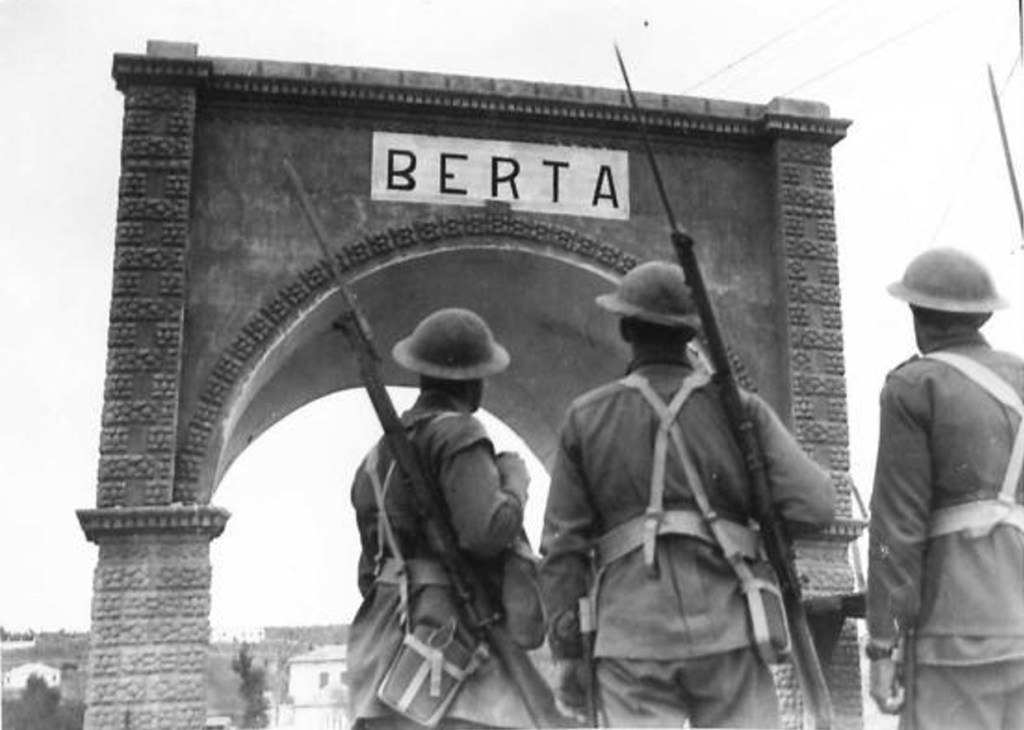
The Battle of Beda Fomm ended in British victory. The Italian Special Armored Brigade saw some initial success in a dawn attempt to break out of the encirclement of the Italian Tenth Army on the Benghazi-Tripoli road in Libya, but the breakthrough was quickly contained by Allied field guns. The 25,000-strong Italian Tenth Army formally surrendered before the end of the day. Agedaba falls to the British. At 11 am the Italian Chief of Staff surrenders to the HQ of 4th Armored Brigade. Later General Annibale Bergonzoli surrenders along with the rest of 10th Army. 20,000 men, 6 generals and a vast horde of weapons, transport and supplies along with a shower caravan and mobile brothel with a dozen women. The cost of the battle to 7 Armoured Div. was nine men killed and 15 wounded. It was a brilliantly orchestrated attack, which took the Italian defenders entirely by surprise when British armor — traversing barren and waterless tracks from Tobruk — suddenly appeared at Beda Fomm cutting any chance of Italian retreat. Australian infantry and tanks then swept in from the north to join the British from the south and west. With Benghazi taken O’Connor’s men continue westwards — advanced units have arrived at Sirte, with Tripoli itself now under threat.
The situation is fluid, but running against the Italians as the day begins. Shortly before dawn, the British 7th Support Group attacks the north end of the Italian convoys heading south from Benghazi on the Via Balbia. At the same time, the 2nd RTR moves south along the western side of the road while the 1st RTR moves east. The stage is set for compressions and destruction of the Italian forces unless they can break out quickly.
The Italians do try to break out. Supported by artillery, the Italian medium tanks overrun British positions of the blocking Combe Force, taking out numerous antitank guns. However, the following Italian infantry is more vulnerable, and the British rain fire on them to force them undercover. The Italian M13 medium tanks make it through the British positions, sweeping across the British officer’s mess and the like. However, the British armor arrives, stopping the Italians at El Magrun, about 24 km (15 miles) south of Ghemines. Italian 10th Army is stopped, surrounded, and the surrenders begin at 11:00.
In all, the Italians lose 25,000 men taken prisoner, 93 guns, 107 tanks either captured intact or destroyed, and all of the senior Italian command staff (Lieutenant-General Annibale “Electric Whiskers” Bergonzoli of the XX Motorized corps and General Valentino Babini of the Italian Special Armored Brigade (Brigata Corazzato Speciale) are captured, while 10th Army Commander General Giuseppe Tellera is killed in his M13 tank.
This concludes the battle of Beda Fomm and the utter destruction of the Italian 10th Army. Almost as an afterthought, the Australian 6th Infantry Division takes evacuated Benghazi. General O’Connor of XIII Corps immediately sends the 11th Hussars further to the west to take out isolated Italian garrisons at Agedabia and El Agheila. However, O’Connor does not have the authorization to proceed to Tripoli, so he can only send out patrols along the 40 or 50 miles down the coast road to Sirte.
O’Connor dispatches Middle East commander Archibald Wavell’s former Brigade Major (now a brigadier serving as Wavell’s personal liaison officer to XIII Corps) back to Cairo to get that permission. However, it is a long, difficult 570-mile trip by road (for some reason no planes are available) and an answer may take as long as a week. To announce the victory at Benghazi, O’Connor sends the famous signal:
“Fox killed in the open.”
It is another epic catastrophe for Italian arms, thought the Italians have at least tried to fight with some skill in this engagement for the first time during Operation Compass. Italian commander in North Africa Marshal Rodolfo Graziani submits his resignation, though whether or not this is strictly his idea is open to debate. It puts more pressure on Germany’s Operation Sunflower, the insertion of German troops into Libya to backstop the remaining Italian garrison, which now is under the command of General Erwin Rommel, with Wehrmacht troops due on North African soil within a fortnight.
Free French troops under General Leclerc besiege the Italian garrison at Koufra.
Two Italian counter-attacks upon Greek positions along the Albanian front were repulsed today, a Greek government spokesman reported tonight. An Italian advance post was captured, he said. Weather has held up operations successfully started by Greek 5 Division with capture of Zrebeshinj Mountain. Floods had against swept away bridges, Greek II Corps having to be supplied from Koritsa instead of Janinna. When weather improves further advance of 5 Division westward should secure fall of Tepelene. Italians now have equivalent of 30 Divisions in Albania. The entire front is fairly stable as of 7 February 1941. The fierce winter weather prevents major engagements. The status quo favors the Italians, who are hanging on to their position in Albania by their fingertips. The Italians are planning another counterattack after the massive advances by the Greeks in the Trebeshina area, but it will take some time to prepare. This area is the key to the entire Albanian campaign, as it lies along the valley which leads to the vital Italian port of Valona (Vlorë). Most activity at this point consists of artillery exchanges and RAF attacks.
Already, the Italians have frustrated the most ambitious Greek plans, as they wished to capture Valona and wind up the Italian position in Albania by mid-February. The timing is important because Greek (and British) intelligence suggests that the Germans may be ready to invade Greece through Bulgaria as early as 15 February. This is not the case, but the Greeks don’t know this.
British and Indian troops continued to hold the Cameron Ridge near Keren, Eritrea, Italian East Africa, which was a ridge named after the British infantry regiment Queen’s Own Cameron Highlanders which had initially taken it at the start of the Battle of Keren. On the other side of the Gorge, Indian 4th Division launched an attempt to flank the Italian troops at Dologorodoc Fort by moving through the Scescilembi Valley. The British attack on Keren continues. The tactical problem is to take the Dongolaas Gorge which serves as a sort of portal to the town itself. Surrounded by mountains controlled by the Italians, the gorge is a tough nut — but the British are confident that the Italians will fold quickly as they have everywhere else.
The day begins with the 3/14th Punjab Regiment advancing to take Brig’s Peak, the middle of three peaks (left to right) that overlook the gorge. However, the Italians send the 65th Infantry Division “Granatieri di Savoia” (Granatieri di Savoia) in a counterattack. The Italians have the advantage of supporting fire from other peaks nearby, and the Indian troops must move supplies and reinforcements over the exposed ground. The Indian troops are pried off Brig’s Peak and sent back to their starting point, Cameron Ridge. This now is a more secure position because of the addition of the 1st (Wellesley’s)/6th Rajputana Rifles there. However, Cameron Ridge itself is exposed to downward fire from several nearby peaks and it is not an easy thing to stay there.
On the other (right) side of the Dongolaas Gorge, the British also attack. Late in the day, the 4th (Outram’s)/6th Rajputana Rifles advance through Happy Valley (Scescilembi Valley) on the far right and take Acqua Col. Tactically, this is an attempt to outflank an Italian strongpoint at Dologorodoc Fort. The Acqua Col also is a key position because it serves as a link between two summits, Mount Selele and Mount Falestoh. The Indian troops retain control of the Acqua Col as the day ends, but the Italians are in a strong position to counterattack there, too, raining fire down on the Indian troops.
In Abyssinia, the British continue advancing along the Gondar Road. In British Somaliland, the British advance as well.
Prime Minister Robert Menzies continues his epic journey from Melbourne to London. Today he flies to Alexandria and makes note of the dusty conditions — which are causing the RAF and armored forces all sorts of problems. Menzies meets Admiral Cunningham, who he describes as “the No. 1 personality I have so far encountered on this journey.” After this, he flies down to Cairo for another dinner with General Wavell. Menzies has mixed feelings about Wavell, noting that “with his left eye closed and his almost unbreakable silence he is an almost sinister figure.” Churchill most likely would concur. It is a good night for dinner, though, as they can celebrate the fall of Benghazi to Australian troops. Very good timing.
Command headquarters for the Royal Navy’s Western Approaches is moved from Plymouth to Liverpool. This conforms with the fact that more convoys since the fall of France are coming through the Northwest Approaches rather than the Southwest Approaches, which are closer to the U-boat bases in France. Having the headquarter near the port of arrival simply makes sense.
British Prime Minister Winston Churchill has his staff arrange a stunt for the media. During dinner, he places a call to a random passenger on a train, which is recorded for broadcast. It is all carefully choreographed — the passenger is chosen and briefed at the prior station — but the stunt shows the deep interest that the government has in public relations. This also ties in with certain governmental reforms to be announced on the 8th, as in, “Oh, you see a problem? Well, I’ll take of it tomorrow!” This kind of stunt may seem rather obvious now, but it was somewhat novel at the time.
Admiral Darlan has been negotiating with the Germans to take over as head of the Vichy Government (under the overlordship of Marshal Petain, who everybody understands is more a figurehead than a real leader). German Ambassador Otto Abetz indicates today that Darlan would be acceptable as a French leader, but Germany does not want to dispose of former leader Pierre Laval just yet. Laval, meanwhile, remains a powerful force in French government circles but technically a private citizen.
Bulgaria ordered a new restriction of train service tonight amid widespread reports that the German army was planning to enter this country. Foreign Minister Ivan Popoff, taking cognizance of such rumors, was understood to have told parliament members at a private meeting that he was unable to say “what may lie in the future.” The foreign minister’s statement was made as rumors of impending German action flooded Sofia. One traveler from the Rumanian frontier said German troop activity indicated an intention of moving soon, perhaps in 48 hours. But an American traveler said a pontoon bridge being laid across the Danube had not been completed, and that troop movements across the river from Rumania into Bulgaria would not be possible in the near future. At any rate, residents along the Bulgarian bank of the Danube said all was quiet at a late hour tonight.
The Luftwaffe makes a few scattered raids along the northeast coast of Scotland and East Anglia, but generally is quiet.
RAF Bomber Command dispatches 37 Wellingtons overnight to Boulogne, 27 Hampdens to Dunkirk. Good bombing results claimed at both targets. 2 O.T.U. sorties. No losses. A thundering overnight attack on the Germans’ French coast “invasion bases” of Dunkerque and Boulogne was reported officially today after waves of R.A.F. bombers raced across the mist-choked English channel in a two-hour surprise raid. The Germans were said to have been caught apparently off guard, because of the weather, which was believed responsible for the lack of Nazi aerial activity. “There is nothing to report,” a communique said of the home front. But the raid on the French coast ports, pounded by the R.A.F.’s heaviest bombs, was described as on a “considerable scale.” Parachute flares from the attackers gave the first inkling to coastal observers in England that a raid was on, They were the first warning, to the Germans, too, for it was only when the flares were seen that Nazi searchlights went into action. Weather conditions had made the probability of an attack last night extremely slim. The Strait of Dover was wrapped in the worst fog of the year all day and tonight a thick mist still lay along the French coast. But above the mist the flashes of exploding bombs, the bursts of German anti-aircraft shells and streams of tracer bullets lighted the French coast almost without pause during the raid. The bomb flashes were reflected even in the shop windows of one English coastal town.
The first Fairey-built Bristol Beaufighter IF fighter (T4623) built at the Fairey factory in Stockport near Manchester, England, United Kingdom made its maiden flight. The Ministry of Aircraft Production is extremely enthusiastic about the Bristol Beaufighter and has set up “shadow factories” to produce it in addition to the Bristol facilities at Filton (which have been a favorite Luftwaffe target). These shadow facilities include production lines operated by the Fairey Aviation Company. Today, the first Beaufighter IF fighter (T4623) made by Fairey makes its maiden flight at Stockport, Greater Manchester.
On Malta, a mysterious force of eight Armstrong Whitworth Whitley bombers lands with 38 paratroopers. They are to participate in “Operation Colossus,” which nobody on the island knows about.
German battlecruisers Scharnhorst and Gneisenau continue heading south from the vicinity of Greenland toward the shipping lanes. The British have no idea where they are and apparently think they are further east. However, while vulnerable, the Allied convoys nearby have beefed-up escorts which could give the German ships a nasty surprise. In any event, some kind of action is imminent.
Anti-aircraft ship HMS Cairo arrived at Scapa Flow at 1100 to work up after refitting.
British steamer Bay Fisher (575grt) was sunk by German bombing three and a half miles northeast of Bell Rock. Seven crew and one gunner were lost.
British steamer Scottish Cooperation (513grt) was damaged on a mine two miles southwest of Workington Pier, Solway Firth. The steamer was beached and then returned to Workington later on the 7th.
German raider Kormoran, with captured vessel Duquesa and operating off the Cape Verde Islands, begins a three-day rendezvous with supply ship Nordmark. This is a somewhat unusual meeting, as Nordmark is the recipient of supplies as much as the giver of the same. The Kormoran, fresh from Germany, has brought U-boat spare parts that are needed at the U-boat base in Lorient. In addition, the Kormoran transfers 170 of the 174 prisoners it has taken so far (four Chinese prisoners remain on board as laundrymen). The British crew from the British Union leave their pet monkey behind in gratitude for honorable treatment during their captivity. Among other random items, a piano from Duquesa is transferred to the Kormoran. It is all a very comfortable meeting during the happy times for German operations in the Atlantic.
Australian light cruiser HMAS Perth arrived at Alexandria for inspection by the Australian Prime Minister. The light cruiser was docked for refitting and repairs from 7 to 23 February for the bombing damage received at Malta on 16 January.
Destroyers HMS Jervis, HMS Janus, HMS Jaguar, and HMS Mohawk departed Alexandria at 0100 to act as an anti-submarine force, then proceed to Suda Bay. The destroyers were ordered to sweeps of the Kithera and Elaphonisos Channels during the night of 8/9 February, through Kaso Straits and around Rhodes on 9/10 February, sweep through Scarpanto Straits and around Stampalia on 10/11 February. The sweep on 9/10 February was cancelled due to bad weather. These sweeps were supported by heavy cruiser HMS York and anti-aircraft cruiser HMS Bonaventure. On 11/12 February, a sweep of Kithera Channel was conducted.
Netlayer HMS Protector departed Suda Bay to load anti-torpedo nets captured at Tobruk and transport them to Alexandria.
Anti-aircraft cruiser HMS Carlisle departed Aden for Suez for repairs prior to reinforcing the Mediterranean Fleet. The cruiser could operate on only one propeller shaft. The cruiser arrived at Suez on the 11th and was docked. It was found that one shaft would have to be renewed, due to the half of the starboard A bracket bush was missing. The shaft was removed and a cover plate was fitted on the hull gland. A replacement was brought from Malta on anti-aircraft cruiser HMS Bonaventure in March. However, Carlisle was unable to be docked for the work until 0825 on 13 March. The anti-aircraft cruiser was undocked at 1700 on 15 March.
Armed merchant cruiser HMS Letitia was badly damaged in a grounding on Litchfield Shoal at Halifax during a winter gale. The cruiser was refloated on the 9th and arrived at Halifax that day. No dockyard space was available and repairs were not begun until 15 April. The ship departed Halifax on 24 April for Newport News. The cruiser was arriving on 30 April for repairs and conversion to a troopship completed on 1 December.
Today in Washington, President Roosevelt conferred with John G. Winant, newly appointed Ambassador to Great Britain; William Green, president of the American Federation of Labor, and Thomas H. McDonald, Public Roads Commissioner. He issued an Executive order empowering the director of selective service to assign to nonmilitary work all conscientious objectors to noncombatant service.
The Senate was recessed. Its Foreign Relations Committee approved the nomination of Mr. Winant, continued its hearings on the Lend-Lease bill, and received the Stimson letter dealing with sales of American planes to Great Britain.
The House considered amendments to the Lend-Lease bill and adjourned at 5:10 PM until 11 AM tomorrow. The Rules Committee began consideration of the resolution to extend the Dies committee investigation of un-American activities.
The U.S. administration leadership tonight suggested and the House of Representatives quickly adopted a sharp limitation on the extent to which, under the Lend-Lease bill, President Roosevelt may transfer to other nations American military and naval equipment already on hand or appropriated for. The limit fixed was one-tenth of total appropriations for defense for the fiscal year 1941, The exact figure was left subject to some dispute, but all agreed that the appropriation total lay between $12,000,000,000 and $13,000,000,000. Hence the transfer limitation is from $1,200,000,000 to $1,300,000,000, to be determined exactly later. Thus, as the bill stood at the close of the day, the value of any present naval or military equipment or equipment provided for in the vast appropriations heretofore made will be computed before it can be sent to England. And no more than about $1,300,000,000 worth of it may be so transferred.
The battle of words between President Roosevelt and Senator Wheeler, Montana Democrat, over the British aid bill broke out anew today when the senator said that If the chief executive “is so anxious to find out who is aiding Germany” he should support an investigation of German interests in American defense industries.
A united Republican stand on the Lend-Lease bill seems improbable at this juncture despite the conviction that Wendell L. Willkie hopes for non-partisan action on the measure.
The American Youth Congress, opening a three-day “town meeting of youth,” tonight vigorously condemned the Lend-Lease British aid bill and the Selective Service Act as ‘un-American.” More than 2,000 young men and women from all parts of the country cheered speakers who assailed the British assistance measure as ‘a more deadly and certain path to plowing under every fourth boy than the Morgan war-loans of 1917.” Denied the use of government buildings which they had without charge in previous years, the Congress met in Turner’s arena, a hall used for prize fights. Communist opposition to U.S. aid to Great Britain will be sharp and strident until June 1941, when, with the German invasion of the USSR, western communists will overnight become among the most cynically ardent advocates of U.S. aid for the Allies (and above all, for the Soviets).
Two New Yorkers told the Senate Foreign Relations Committee today that entry by the United States in the European conflict would bring on civil war in the country, and that the internal struggle would probably start in New York City.
President Roosevelt today moved to put conscientious objectors against military training to work at civilian jobs. The objectors will be put to work in camps, one of which will be located at San Dimas, California. Selective Service Director Clarence A. Dykstra was authorized in an executive order “to establish, designate or determine work of national importance under civilian direction” for those young men who claim to be conscientiously opposed to either combatant or non-combatant military training, Dykstra is given power to an extent necessary to put these conscientious objectors to work to utilize the various services of the federal government.
General of the Army George C. Marshall sends a letter to Ltieutenant General Walter C. Short, the new commander of the US Army’s Hawaiian Department (he replaces General Herron today). The letter states “the fullest protection for the Fleet is the rather than a major consideration.” He continues:
“My impression of the Hawaiian problem has been that if no serious harm is done us during the first six hours of known hostilities, thereafter the existing defenses would discourage an enemy against the hazard of an attack. The risk of sabotage and the risk involved in a surprise raid by Air and by submarine constitute the real perils of the situation. Frankly, I do not see any landing threat in the Hawaiian Islands so long as we have air superiority.”
This is a very prescient letter.
Secretary of the Navy Henry L. Stimson also forwards a copy of a 24 January 1941 letter from Secretary of the Navy Frank Knox to him to General Short. That letter also warns against the likelihood of hostilities beginning at Pearl Harbor. Stimson instructs both Short and Admiral Kimmel, CINCPAC, to secure the islands against surprise attacks and cooperate with each other and with local authorities.
In fact, (later investigations conclude that) neither Kimmel nor Short lift a finger to cooperate with each other or anyone else in any meaningful way to secure the islands against air attack. This will all become of intense scrutiny after the events of 7 December 1941. Short, for his part, later feels that he acted appropriately despite these clear warnings and instructions from his superiors because he did not receive effective warnings of Japanese attacks and throughout his tenure had insufficient resources to secure the islands anyway.
This is an endless topic, but might as well point out here that the US Senate eventually exonerated both Kimmel and Short by a 52-47 vote on 25 May 1999, stating that they had performed their duties “competently and professionally.” Both men, of course, were long deceased by that point, and there seems to have been some lingering suspicions behind the vote that the real blame for Pearl Harbor lay not in Hawaii, but in Washington, D.C.
The U.S. Naval Academy class of 1941 was graduated four months early because of the national emergency.
Fleischer Studios, for Paramount Studios, releases Popeye the Sailor in “Quiet! Pleeze,” animated by Willard Bowsky and Lod Rossner with a story by Milford Davis.
Terrytoon Studios releases “Mississippi Swing,” in which African Americans have some fun while picking cotton. Yes, while picking cotton. Caution, the cartoon is not by any stretch of the imagination politically correct in the 21st century. This is part of unchangeable history and included here as such for educational purposes only.
Samuel Barber’s Violin Concerto premieres publicly with Eugene Ormandy leading the Philadelphia Orchestra and soloist Albert Spalding at the Academy of Music in Philadelphia, Pennsylvania.
Frank Sinatra & Tommy Dorsey orchestra record “Everything Happens to Me”.
The savage Battle of Southern Henan reaches its climax. After 13 days of bitter fighting, Chinese forces have crushed a major Japanese offensive in central China intended to make Japan’s garrison at Wuhan safer. The Chinese 5th War Area take Sinyang and points further north. This is a key point on the Wuhan-Peking railway line and puts the Japanese garrison at Wuhan in peril. The Japanese army, meanwhile, moves from Tangho to Tungpo. By this morning Chinese troops had re-occupied Sinyang and all points north. The strategically crucial city along the Wuhan-Peking railway had fallen on 25 January when three Japanese divisions broke through Chinese lines before advancing and taking the town. The turning-point in the battle for southern Henan came when Japanese forces suffered heavy losses as they attempted to take Fangcheng to the northwest of Sinyang and were forced to retreat.
Admiral Mineo Osumi, Japanese supreme war councilor, has been killed in the crash of a naval plane in Kwangtung province, China, the navy ministry announced today. Six other naval officers, including Rear Admiral Hikojiro Suga, died in the crash. The officers were inspecting the Chinese war front and were en route from Canton to Hainan when the crash occurred, the ministry said.
Peace talks between Vichy French Indochina and Thailand open under the auspices of Japan, a week after an armistice was signed. While the Thai/Vichy French border war is over thanks to the Armistice signed aboard a Japanese warship on 31 January, there is still the matter of the actual terms of that peace. The Japanese again act as moderators, as the two sides begin to hammer out an agreement in Tokyo that both can live with. Everybody seems to understand that the Japanese are the real power in the region, the British, Dutch and Americans have no say whatsoever.
Foreign Minister Yosuke Matsuoka opened the peace conference between Thailand and Indo-China this afternoon with an emphatic reaffirmation of Japan’s Greater East Asia policy. In response Prince Varnaidyakir Srisena invented a new phrase, “Prosperity for each, stability for all,” to describe Thailand’s conception of Japan’s policy.
U.S. Admiral Thomas C. Hart is ordered to insist on U.S. command of any Allied fleet which arose from the discussions with British and Dutch representatives he was conducting in the Netherlands East Indes. Admiral Hart is negotiating with the Dutch authorities in the East Indies regarding future military cooperation. The Dutch have strong naval forces in the Pacific and would be extremely useful in the event of hostilities. The British also have naval forces at Singapore and Hong Kong, though at the moment they are fairly light. Chief of Naval Operations Admiral Stark orders Hart to insist on overall US command of any joint Allied fleet in the region. The Dutch, however, feel they are best suited to command operations.
New Zealand Division light cruiser HMS Achilles departed Auckland escorting a liner towards Panama. The cruiser was detached at Chatham Island and returned to Wellington to refuel.
Dow Jones Industrial Average: 124.3 (-0.46)
Born:
Jim King, NBA point guard and shooting guard (NBA All-Star, 1968; Los Angeles lakers, San Francisco Warriors, Cincinnati Royals, Chicago Bulls), in Tulsa, Oklahoma.
Dan Grimm, NFL guard (Green Bay Packers, Baltimore Colts), in Perry, Iowa (d. 2018).
Leslie Lamport, American computer scientist (distributed systems; Turing Award, 2013), in New York, New York.
Died:
Aimée Crocker, 78, American socialite and adventurer.
Giuseppe Tellera, 58, Italian general (died of wounds sustained in action the previous day during the Battle of Beda Fomm).
Naval Construction:
The U.S. Navy 77-foot Elco patrol motor torpedo boat USS PT-30 is laid down by the Electric Launch Company Ltd. (Elco), (Bayonne, New Jersey, U.S.A.).
The Вое́нно-морско́й флот СССР (ВМФ) (Soviet Navy) “K” (Katjusa)-class submarine K-55 is launched by Baltiyskiy Zavod (Leningrad, U.S.S.R.) / Yard 189.
The Kriegsmarine (German Navy) Type VIIC U-boat U-564 is launched by Blohm & Voss, Hamburg (werk 540).
The Kriegsmarine (German Navy) Type VIIC U-boat U-652 is launched by Howaldtswerke Hamburg AG, Hamburg (werk 801).
 History Diaries