South of Benghazi, in the Battle of Beda Fomm, the Italian 10th Army is trapped on the main road (the Italo Balbo) between the Australian 6th Infantry Division behind them and the Combe Force in front of them. The retreating Italian column is strung out along 7 miles of the road. The Italians have new tanks and a 4:1 advantage in numbers, but their tanks — though new — are inferior and the Italian tactical situation dire. The Italian tanks should have been able to overwhelm the British but had been sent in piecemeal and not as a single force.
Lieutenant-General Annibale Bergonzoli in command of the XX Motorised corps tries to break out first thing in the morning, making a diversionary frontal attack while sending the Babini Group (mainly tanks) through the desert to try to get behind Combe Force. However, the British have brought up 32 cruiser tanks and 42 light tanks, and the Italians make little progress. The Australians, meanwhile, reach Benghazi and attack it from the north.
The Italians continue evacuating Benghazi, sending a greater force to the southwest, but the British block on the main road to the south holds. Italian M13 tanks arrive from the city, but many are quickly knocked out — the Italians quickly lose 40 tanks. The Italian artillery proves effective against the British cruiser tanks, though, and Italian vehicles manage to make some progress over rough terrain to the south. A running battle develops, with some Italian vehicles making a run for Tripoli, others surrendering, and more British armor arriving. In confused actions, the Italians make some progress, but the mass of British armor remains intact and draws a tighter cordon around the Italians.
While Operation Compass is an astounding success, it also has imposed a huge strain on the British forces. While the Italians are not much of an obstacle, the climate and terrain are. The desert air becomes loaded with sand at regular intervals, playing havoc with aircraft and other engines. The Middle East Command’s RAF headquarters wires Whitehall today, noting that problems are developing with engine maintenance. Simply operating in the desert without adequate engine filters and equipment specially designed for such conditions is softening the British up for a possible counterstroke by fresh Axis forces.
O’Connor orders a fast-moving detachment — about a brigade group in strength — along the main road from Barce to Benghazi and on to Ghemines, to complete the encirclement of the Italians.
Many histories place today as when the British capture Benghazi. That, however, seems a bit premature. The Italians are evacuating the city, but it remains in their hands as the day ends. In any event, the actual date of the “fall” of the city is of little moment, as the Italians have no intention to defend it.
7th Support Group of British 7th Armoured Division captured Sceleidima; these captures further secured the envelopment of the Italian Tenth Army.
Telegram from HQ RAF ME to the Air Ministry: “We continue to attack Italian Air Force and harass his retreating army, Cyrenaica, Abyssinia and Eritrea. Every available operational aircraft, including Gauntlets, employed full intensity. Only squadron with defensive role is No. 33 Hurricane defending Alexandria and Suez Canal, where German mine laying has sunk three ships in the canal and temporarily blocked it. There is a great shortage of spares, tools and equipment of all sorts … no less than 32 Merlins now in depots awaiting spares before overhauls can commence. …behind programme in Blenheims (over 90). Mohawks out of sight with major engine defect and Tomahawks unknown quantity.”
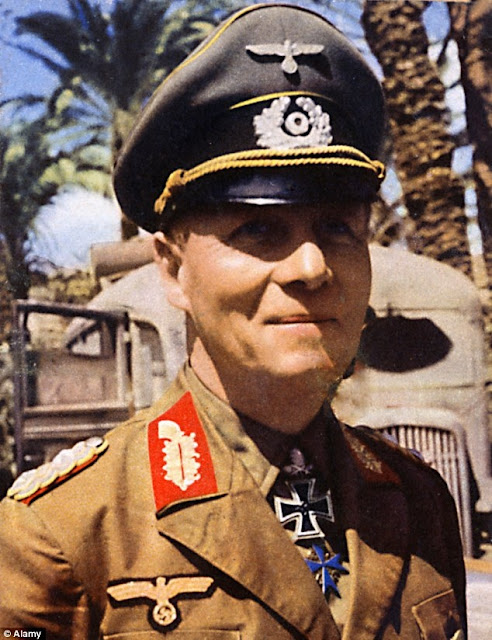
The Germans launched Operation SONNENBLUME (‘SUNFLOWER’), the dispatch of German troops to North Africa. This called for the organization and transfer of a German force to reinforce Italian forces in North Africa. German Chancellor Adolf Hitler put Major General Erwin Rommel in command of the new German Afrika Korps to rescue the Italians in North Africa. This force consisted of the 15th Panzer Division and 5th Light Motorized Division.
The Operation SUNFLOWER force is envisaged as a supplement to the Sperrverband (blocking detachment) previously authorized in Fuhrer Directive No. 22 of 11 January 1941. This is just a couple of divisions, the 5th Light Afrika Division (Generalmajor Johann von Ravenstein) and elements of the 15th Panzer Division (Oberst Maximilian von Herff). None of those troops have reached North Africa yet, but the 5th Light Division is almost ready to go. The North African Wehrmacht force (later named Afrika Korps (DAK)) is not intended as a war-winning effort by itself, but simply as a way of stiffening Italian troops already there so that the Italian position can be maintained and the Italians perhaps encouraged to fight better.
Rommel apparently is not Hitler’s first choice to lead this new operation. Lieutenant General Friedrich Paulus, deputy chief of the German General Staff (Oberquartiermeister I), later recalls that he was offered the position first, but turned it down. However, when discussing it with his wife, she apparently says that being a secondary theater, North Africa is not a place where a General could ever make a name for himself. Russia — that was the place for a German General to really succeed.
Operations in Greece remain at a standstill on 6 February 1941. The weather is inhibiting both sides. The Greeks have captured the gateway to the strategic port of Valona, the Klisura Pass, but so far they have been unable to capitalize on this success. The Greeks are planning another attack for the middle of the month. At this point, the Greek hopes to capture Valona fast so that they can shift forces to the Bulgarian frontier to oppose an expected German invasion there have been frustrated despite early indications of success. The RAF bombs Italian positions west of the Telepini Heights which the Greeks have recently recovered despite fierce resistance from Italian Blackshirts.
Greek warriors are pounding at the very gates of Tepeleni, border dispatches said tonight, after their guns set aflame that vitally important Albanian town commanding the road leading to the Adriatic port of Valona, 28 miles away. The harassed Italians, trying desperately to stem the Greek advance, were reported to have made attack after attack. here and nearer the coast, only to be thrown back with staggering losses. Italian General Ugo Cavallero has thrown everything he has into the battle of Tepeleni because he realizes the fate of the entire Fascist venture in Albania hinges on success or failure there, Greek sources say. In the Devol valley sector, in central Albania, the Greeks and Italians fought toe-to-toe with bayonets throughout the day, advices reaching here said, with considerable losses on both sides and without change In original positions.
Near Keren, Eritrea, Italian East Africa, Indian 3rd Battalion of 14th Punjab Regiment attacked Brig’s Peak but was pushed back by Italian 65th Infantry Division “Granatieri di Savoia”. At Keren, Eritrea, the British troops (the 11th Indian Brigade of the 4th Indian Division) are supplemented by the arrival of the 5th Indian Infantry Brigade. The Indian soldiers retain an exposed position to the left of the Dongolaas Gorge which controls entry to Keren proper, much like a drawbridge and gate control entrance to a castle. However, while the British are off to a good start, the Italians have heavily fortified positions in the surrounding heights and retain a tight grip on the gorge itself, which, because of the terrain, the British troops cannot bypass. The Indian troops rest after their march from Agordat and prepare for a major attack on the 7th.
The British House of Commons voted for the first £1,600,000,000 war credit of the year.
Prime Minister Winston Churchill continues his war against the British press. He sends a memorandum to Information Minister Alfred Duff Cooper noting a recent BBC report that apparently gave hints as to future British strategy in North Africa. He tells Duff Cooper to “clean up your arrangements and tone up your men.”
Prime Minister Robert Menzies continues his long journey from Melbourne to London. Today, he is in Cairo. Menzies has dinner with British Middle East Commander General Wavell and RAF chief Longmore, among others. Menzies notes in his diary that his talk “seems encouraging to these Generals & Marshals.” His words of encouragement are probably very welcome by the Middle East command team, as London has been far from encouraging recently with all of its talk about the supposedly inefficient “tooth to tail ratio” and switching forces to Greece.
Adolf Hitler made his final appeal to Francisco Franco to bring Spain into the war on the Axis side. Adolf Hitler already basically has given up on Operation FELIX due to the logistical requirements of preparing for the upcoming Operation BARBAROSSA. However, today he sends another lesson to Caudillo Francisco Franco. In it, Hitler says that England has no intention of helping Spain, while German already has promised 100,000 tons of grain. He concludes that “the British power in Europe is broken,” and that the Wehrmacht is “the mightiest military machine in the world.”
Hitler issued War Directive No. 23:
The Supreme Commander of the Armed Forces.
Berlin. 6th February, 1941. 10 copies
Directive No. 23 — Directions For Operations Against The English War Economy
- The Effect Of Our Operations Against England To Date: (a) Contrary to our former view, the heaviest effect of our operations against the English war economy has lain in the high losses in merchant shipping inflicted by sea and air warfare. This effect has been increased by the destruction of port installations, the elimination of large quantities of supplies, and by the diminished use of ships when compelled to sail in convoy. A further considerable increase is to be expected in the course of this year by the wider employment of submarines, and this can bring about the collapse of English resistance within the foreseeable future. (b) The effect of direct air attacks against the English armaments industry is difficult to estimate. But the destruction of many factories and the consequent disorganisation of the armaments industry must lead to a considerable fall in production. (c) The least effect of all (as far as we can see) has been made upon the morale and will to resist of the English people.
- Consequences For Our Own Future Operations: In the course of the next few months, the effectiveness of our naval operations against enemy merchant shipping may be expected to increase thanks to the wider use of submarines and surface ships. On the other hand, we are unable to maintain the scope of our air attacks, as the demands of other theatres of war compel us to withdraw increasingly large air forces from operations against the British Isles. It will therefore be desirable in future to concentrate air attacks more closely and to deliver them chiefly against targets whose destruction supplements our naval war. Only by these means can we expect a decisive end to the war within the foreseeable future.
- It must therefore be the aim of our further operations against the English homeland to concentrate all weapons of air and sea warfare against enemy imports, as well as to hold down the English aircraft industry and, where possible, to inflict still further damage on it. For this purpose it will be necessary: (a) To destroy the most important English harbours for imports, particularly port installations, and ships lying in them or being built. (b) To attack shipping, especially when homeward bound, by all methods. (c) Systematically to destroy the key points of the aircraft industry, including factories producing antiaircraft equipment and explosives. These duties must still be carried out by such forces as remain available for operations against England, even should a large proportion of the Airforce and a smaller proportion of naval forces be withdrawn in the course of the year for employment in other theatres.
- For the execution of these tasks, it should be noted: (a) The sinking of merchantmen is more important than attack on enemy warships. The same is true of the use of aerial torpedoes. By reducing the available enemy tonnage, not only will the blockade, which is decisive to the war, be intensified, but enemy operations in Europe or Africa will be impeded. (b) When attacks against ports or aircraft factories have obviously been successful, they will be repeated again and again. (c) By continuous laying of minefields the enemy’s feelings of uncertainty and loses will be increased. (d) After attacking the large import harbours, efforts will be made, as far as the range of aircraft allows, to prevent the transfer of supplies to smaller ports. Only when the weather or other conditions prevent attack on the targets designated in paragraph 3 will attacks be made on other armaments plants, towns of particular importance to the war economy, and dumps in the interior of the country, and transport centres. No decisive success can be expected from terror attacks on residential areas or from attacks on coastal defences.
- Until the beginning of the regrouping of forces for Barbarossa, efforts will be made to intensify the effect of air and sea warfare, not only in order to inflict the heaviest possible losses on England, but also in order to give the impression that an attack on the British Isles is planned for this year.
- Special orders will be issued for cooperation between naval and air forces in reconnaissance over the sea.
- Directive Number 9 of 26th May, 1940, and Directive Number 17 of 1st August, 1940, are no longer valid.
Signed, Adolf Hitler.
Several hundred students, shouting “Down with democracy!” and crying vivas for Mussolini, Hitler and Italy’s king, marched today from the tomb of the Italian unknown soldier through Rome’s principal streets toward the American embassy, but turned into a side street without passing the embassy itself. Among the signs they carried was one bearing the inscription: “Stand by the Duce!”
The Nazi-supported French party of National Popular Concentration warned today that Adolf Hitler may establish gauleiter rule over France unless the Vichy government quickly accepts Pierre Laval as its leader. A spokesman of the new party, set up by Laval’s supporters in opposition to Marshal Henri Philippe Petain, demanded that the French government return to Paris with Laval as its chief authority, leaving the 84-year-old Petain as a mere figurehead
Armed with a threat to send the formidable French fleet to Africa beyond Germany’s reach, Admiral Francois Darlan arrived in Paris tonight to seek a compromise on Nazi-supported demands which would install Pierre Laval as virtual dictator of France. The French navy minister and chief confidant of Marshal Henri Philippe Petain reached Paris shortly before 7 p.m. bearing an offer from the 84-year-old marshal which would make Darlan premier and restore the olive-skinned Laval to his former post of vice-premier. Under the proposed compromise Petain would surrender to Darlan his direct control of the government, remaining only as titular chief of state, and Laval would be brought back into the Vichy regime in a secondary role. There was belief In many quarters that Laval, a shrewd bargainer, would reject the proposal and that in the end he might succeed in obtaining the post of foreign minister which Petain would give to Darlan. The threat of the fleet quitting Toulon and going to Africa is perhaps Darlan’s best argument in his Paris talks. He has made it clear in recent days, as the French-German crisis neared its climax, that he will never voluntarily surrender a single warship or a single naval base such as Bizerte to any demand or challenge, whether it may come from the axis or from Britain. The United States government’s interest in the grave turn in German relations with defeated France was shown today, while Darlan was en route to Paris. Admiral William D. Leahy, U. S ambassador, conferred with Marshal Petain at his own request, seeking first-hand information about the negotiations and Laval’s demands.
The Bishops of Norway begin to resist the German occupying forces.
The Spanish bread shortage neared a crisis today when the newspaper Madrid admitted that Spain had more bread during the Civil War under the Republican regime and explained that the Republicans had ships to bring in wheat. In many sections of Spain there is no bread. Although most Madrid families are still able to buy it, the loaves are virtually uneatable. Apparently the flour is supposed to be composed mostly of ground-up chick-peas mixed with barley, rye or some such cereals.
Rumanian Premier Ion Antonescu struck at the rebellious Iron Guard with death penalty decrees today as rumors spread that Horia Sima, leader of the revolt of January 21-23, was plotting a new insurrection as a fugitive.
Colonel William J, Donovan, the American observer who is traveling extensively in southeastern Europe and the near east, has been prevented from traveling through Syria by express orders of the French government at Vichy, a reliable informant said today. (The eventual position of the untested French army in Syria, like that in north and west Africa, is nebulous, but both Gen. Maxime Weygand in Africa and Gen. Henri Dentz in Syria have called upon soldiers and civilians to obey Chief of State Petain at Vichy, rather than be swayed by “free French” appeals from London. Syria might become a battleground if Germany should try to strike at the Suez canal through southeastern Europe and the Levant.) Donovan, who now is in Jerusalem, left Ankara Monday night.
RAF Bomber Command dispatches 25 Wellingtons overnight to Boulogne, 24 Whitleys to Dunkirk. The force attacking Boulogne included a Photographic Reconnaissance Unit Wellington but its cameras failed. 1 Wellington lost.
The Luftwaffe does little during the day or after dark.
The RAF establishes the Directorate of Air Sea Rescue aka Air Sea Rescue Services (ASRS) aka the RAF Search and Rescue Force. This force operates closely with Coastal Command.
U-107, commanded by Kapitänleutnant Günter Hessler, sank Canadian steamer Maplecourt (3388grt) in 55-39N, 15-56W. At 1752 hours on 6 Feb 1941 the unescorted Maplecourt (Master Enrys Herbert Humphreys), a straggler from station #84 in convoy SC-20, was hit just aft of the engine room by one stern torpedo from U-107 and sank rapidly by the stern about 120 miles west of Rockall. The U-boat had chased the ship for about eight hours and missed with one torpedo during a first submerged attack at 1353 hours. The Germans observed how the survivors managed to abandon ship in two lifeboats, but they were never seen again: the master, 35 crew members and three gunners were lost. The Maplecourt was reported missing and erroneously presumed sunk in 55°39N/15°56W. The 3,388 ton Maplecourt was carrying general cargo and steel and was bound for Preston, England.
German battlecruisers Scharnhorst and Gneisenau refuel from tanker Schlettstadt south of Cape Farewell, Iceland and proceed south toward the shipping lanes. Admiral Lütjens, in command of Operation Berlin, decides to first attack the HX and SC convoys between Canada and Great Britain. He heads to the southwest, closer to the North American mainland than previous naval battles south of Greenland.
The Allies still have no idea where the German raiders are, though they are looking for them furiously. The Germans are under standing orders to avoid engagements with capital ships and certainly do not want to draw any attention until they strike a convoy. While most convoys have few escorts at all in the mid-Atlantic, and fewer still have battleship escorts, it is impossible to know in advance which do and which do not have protection, and what degree of protection they have. Thus, as much as anything, the two German ships are heading into the unknown.
Battleship HMS King George V, escorted by destroyers HMS Somali, HMS Eclipse, and HMS Eskimo arrived at Scapa Flow at 1300. The fourth destroyer, HMAS Napier, was detached north of the Minches to the Clyde arriving at 1400.
Seven ships departed Avonmouth, five ships from Liverpool, ships from the Clyde to form Convoy WS.6A. The convoy was composed of steamers Llandaff Castle (10,786grt), Nova Scotia (6796grt), Ascanius (10,048grt), Leopoldville (11,509grt), Consuelo (4847grt), Opawa (10,354grt), City of Athens (6558grt), Burdwan (6069grt), Kina II (9823grt), Cape Horn (5643grt), City of Marseilles (8317grt), Scythia (19,761grt), Almanzora (15,551grt), Norwegian Bergensfjord (11,015grt), Llangibby Castle (11,951grt), Ruahine (10,870grt), and Salween (7063grt). The convoy was escorted by heavy cruiser HMS Norfolk and light cruisers HMS Phoebe, HMS Edinburgh, and HMS Birmingham. Cruiser Edinburgh was to proceed with the convoy as far as Freetown, then return. Cruiser Birmingham was to proceed with the convoy to Capetown. Destroyer HMS Broadwater escorted the convoy from 6 to 9 February. Destroyers HMS Cottesmore, HMS Atherstone, and HMS Keppel escorted the convoy from 6 to 12 February. The destroyers arrived at Londonderry at 1330/13th after the escort duty. Destroyers HMCS Restigouche and HMCS St Laurent escorted the convoy from 7 to 12 February. Destroyers HMS Legion and ORP Piorun escorted the convoy from 8 to 12 February. Destroyer ORP Garland escorted the convoy from 8 to 9 February. Light cruiser Edinburgh was detached for fleet operations after the enemy sighting by battleship HMS Ramillies. When convoy SLS.64 was attacked on the 12th, the convoy turned back for twenty four hours. Battleship HMS Rodney and destroyers HMS Electra, HMS Eclipse, and HMS Brilliant, which departed Scapa Flow on the 12th, were with the convoy on the 15th until dusk on the 16th.
Destroyer HMS Beagle departed Scapa Flow at 1400 for Aberdeen. At 2300, the destroyer met steamer Ben My Chree and escorted her to Lerwick. The ships arrived at Lerwick at 0950. The destroyer remained to escort the steamer back to Aberdeen. Destroyer Beagle was recalled from Lerwick on the 8th and arrived off Scapa Flow at 1730. She was sent to Aberdeen to meet troopship Amsterdam and escort her to Scapa Flow. The destroyer and troopship arrived at Scapa Flow at 0900/9th. Destroyer Beagle then sailed at 1130 for Liverpool for refitting. Destroyer Beagle arrived at Liverpool at 0900/10th.
Anti-aircraft ship HMS Curacoa departed Scapa Flow at noon and joined convoy WN.80 far as the latitude of Buchan Ness. The ship arrived back at Scapa Flow at 0400/7th.
The German 2nd MTB Flotilla made a sortie against the English east coast with S.30, S.54, S.58, S.59. British steamer Angularity (501grt) was sunk by German S.30 off the east coast between Ipswich and Newcastle. One of the crewmen was picked up by the S-boat and taken prisoner. Two crewmen were lost.
Force H departed Gibraltar in three groups for the bombardment of Genoa, Operation RESULT. Group 1 was composed of battlecruiser HMS Renown, battleship HMS Malaya, aircraft carrier HMS Ark Royal, and light cruiser HMS Sheffield. Group 2 was destroyers HMS Fearless, HMS Foxhound, HMS Foresight, HMS Fury, HMS Encounter, and HMS Jersey. Group 3 was destroyers HMS Duncan, HMS Isis, HMS Firedrake, and HMS Jupiter. Groups 1 and 2 departed with convoy HG.53 into the Atlantic, but turned back into the Mediterranean. The convoy continued escorted by destroyer HMS Velox and sloop HMS Deptford. Group 3 carried out an anti-submarine search east of the Straits of Gibraltar and then joined Groups 1 and 2.
Heavy cruiser HMS York and anti-aircraft cruiser HMS Bonaventure departed Alexandria for Suda Bay to operate in the Aegean. These cruisers relieved light cruisers HMS Ajax and HMAS Perth which proceeded to Alexandria, arriving that day.
Destroyers HMS Decoy and HMS Diamond departed Alexandria for duty in the Inshore Squadron in the Western Desert.
British hoppers No.34 (1500grt) and No.39 (1500grt), which was involved in minesweeping, were sunk in the Suez Canal on mines. T/Electrician Sub Lt A. H. Jones RNVR and one rating were lost on No.39.
Convoy HG.53 departed Gibraltar, escorted by destroyer HMS Velox and sloop HMS Deptford. The destroyer was detached on the 11th. The convoy was joined on the 18th by sloop HMS Londonderry, on the 20th by destroyer HMS Fury, and on the 22nd by destroyers HMS Leamington and HMS Sabre and corvette HMS Anemone. Destroyer Fury was detached on the 23rd, and arrived at Liverpool on the 24th.
In Washington today, President Roosevelt sent to the Senate the nomination of John G. Winant to be Ambassador to Great Britain, and other nominations in the diplomatic service; signed the bill providing funds for building 200 cargo ships for the merchant marine, and conferred with George M. Harrison, president of the Brotherhood of Railroad Clerks.
The Senate confirmed the nomination of Claude V. Parsons to be first assistant administrator of the United States Housing Authority, and adjourned at 12:47 PM until noon on Monday. The Foreign Relations Committee heard Colonel Charles A. Lindbergh, Colonel Robert B. McCormick and Hanford MacNider in opposition to the Lend-Lease bill.
The House of Representatives considered amendments to the Lend-Lease bill and adjourned at 5:43 PM until 11 AM tomorrow.
Colonel Charles A. Lindbergh testified before the Senate Foreign Relations Committee to once again oppose the Lend-Lease bill, saying that such aid would only deplete American defenses and prolong the war without materially affecting its course. Colonel Lindbergh today urged defeat of the administration’s British aid bill because Britain is fighting “a war which I do not feel she possibly can win” regardless of how much help she gets from the United States. He told the Senate Foreign Relations Committee the legislation would unnecessarily prolong the European war and would so weaken American defenses as to make an invasion attempt possible. He summarized his position in these words: “If this is our war in Europe, we should fight it; I don’t think it is our war, so I don’t want us to fight it.” A hushed, standing-room-only crowd listened intently for four hours as the graying “Lone Eagle” parried questions from administration-supporting committeemen and elaborated on his theme. He testified after Colonel Robert R McCormick, publisher of the Chicago Tribune, told the committee it was “fantastic” to suggest that an invasion of this country might be attempted. Referring to geographic and military obstacles to any such effort. McCormick added: “Even if we did not have these overwhelming strategical advantages, this panic over possible German attack would not be justified.”
Wendell L. Willkie is reported to be seeking the cooperation of Republicans in Congress to effect an agreement on changing the lease-lend bill so that the Republican party can present an almost united front in support of amendments when the bill reaches the Senate. Messages sent from London by Mr. Willkie to Republican leaders here indicated that he desired the views of the party on amendments which would not destroy the purpose of the legislation but would limit the powers of the President. He did not wish to stand alone, they explained, on amendments which he might propose in offering his views to the Foreign Relations Committee next week, Before he testified, upon his return from England, he will have the benefit of the views of not only the Republican Senate leaders and his running-mate, Senator McNary, but also the opinions of Republicans in the House.
After demonstrating today its ability to write the terms of the Lend-Lease bill to aid Britain and her Allies, the Democratic side slipped a cog and permitted tentative adoption of an amendment designed to give Congress the power, through concur rent resolution, to rescind at any time any or all powers sought to be given to the President to effect his program. The vote was 148 to 141. Except for this one slip, which occurred when sixty-five Democrats went out to lunch, the Administration forces overrode all opposition. They approved amendments they favored, and, one after another. defeated all those of the opposition, including one for a substitute bill.
The House adopted amendments proposed by the Democrats of the Foreign Affairs Committee as follows: Setting a two-year limit, or until June 30, 1943, on the period in which the President may contract for arms and equipment for Britain. Setting a five-year limit, or until July 1, 1946, on the delivery of these items. Requiring that the President consult the chiefs of the Army, and Navy before sending defense items abroad. Stating that the aid measure does not grant powers to the President to order naval vessels to convoy ships to belligerent ports.
John Gilbert Winant is appointed the new ambassador to Britain. President Roosevelt nominates John Gilbert “Gil” Winant as Joseph Kennedy’s Ambassador to the Court of St. James. Winant is publicly on record as supporting Roosevelt’s own view that Great Britain constitutes the “front lines” against Hitler, and its war effort should be supported wholeheartedly without any thought of negotiation or the possibility of Great Britain losing. This is directly contrary to Kennedy’s view that England was sure to lose to Germany and should be negotiating, not fighting.
Secretary Stimson prophesied today that the country would soon see an enormous speeding up of airplane production due to preparatory steps which had been in progress for months, and to which, he said, the British and French had made great contributions.
Net earnings of General Motors Corporation before income and excess profits taxes last year were the highest in the history of the company, according to a preliminary annual report for 1940 made public yesterday by Alfred P. Sloan Jr., chairman of the company.
Benjamin (Benny the Boss) Tannenbaum, gangster aide of Louis (Lepke) Buchalter and Jacob (Gurrah) Shapiro, fur racketeers, who was held in high bail during the Lepke-Buchalter prosecution to prevent intimidation of witnesses and to shelter him from others of the gang, was shot and killed in a terrific struggle last night as he was minding a friend’s 4-month-old baby in a ground floor apartment at 40 Featherbed Lane, the Bronx.
A huge, four-motored Army Boeing B-17B Flying Fortress bombing plane, equipped with experimental apparatus to reduce hazards of Arctic flying, smashed into Ragged Top Mountain today, 19 miles west of Lovelock, Nevada, killing its crew of eight.
At the Brentwood Country Club, PCL manager Jigger Statz and American Association outfielder Fern Bell tie for first place with a 77 in the Baseball players golf tournament in Los Angeles. Newt Kimball is a stroke behind. Bell wins the long drive contest with a 280-yard bell ringer.
A Trans-Canada Airlines Lockheed 14-H2 Super Electra aircraft crashed near Armstrong Airport in Ontario, Canada, killing all 12 aboard. The aircraft operated on a domestic flight from Montreal to Winnipeg with en route stops at Ottawa, Toronto and North Bay. En route the aircraft developed engine trouble, forcing the crew to divert to Armstrong Airport.
The United States and Mexico, it was reported authoritatively today, expect to sign a comprehensive “good neighbor” agreement in the very near future, settling all major economic and financial questions now outstanding.
The first regional conference of the River Plate countries closed today after signing nine conventions, one recommendation and sixteen resolutions. Members of the Latin-American diplomatic corps enthusiastically describe the conference as one of the most successful inter-American assemblies ever held.
Lauchlin Currie, administrative assistant to President Roosevelt (and secretly working for the Soviets) arrived by airplane from Hong Kong at 8:30 AM today to begin an investigation of China’s financial and economic position. Currie is accompanied by Emile Despres, senior economist in the division of research and statistics of the Federal Reserve board. The two men arrived here in a China National Aviation Corp. plane after flying to Hongkong on an American clipper plane. Currie’s mission to China as a personal representative of the president was announced in Washington January 23 and was believed to be connected with credits pledged by this country to the Chungking authorities to stabilize Chinese currency.
Having completely cut off China’s supply route via Mira Bay, the Japanese apparently were advancing rapidly on Waichow today, mainly from Tamshui, which was captured by the landing force, and from Sheklung on the East River, while aircraft were heavily bombing Waichow’s defenses. The Japanese landing force was reportedly augmented by the debarkation of more troops and guns, owing to increased Chinese resistance, while Japanese troops also were moving into action from the British border. The operations were developing on a large scale and it was estimated that 10,000 Japanese troops were converging on Waichow.
Chinese reports said today thousands of additional Japanese troops had been landed at Bias Bay, northeast of Hong Kong, and had poured into the interior, where Japanese forces were said to be converging on Waichow. Chinese dispatches earlier had said crack units of China’s Thirty-fifth Army, which distinguished itself against the Japanese in Kwangsi Province, were being rushed to the defense of Waichow.
A Domei (Japanese news agency) dispatch from Hankow today reported that Japanese troops operating from Ichang, on the Yangtze River above Hankow, had killed 1,600 Chinese soldiers and routed 4,000 others from positions northwest of Ichang.
The Chinese 5th War Area takes possession of Nanyang, burnt to the ground by the departed Japanese 11th Army. Central (Chinese) News Agency dispatches today reported at least 4,000 Japanese soldiers had been killed in a battle between advance Japanese units and Chinese troops near Nanyang, important city in Southwestern Honan Province. The agency said the Japanese, who had advanced northward along the Peiping-Hankow Railway, were retreating rapidly southward.
The British War Cabinet minutes for today mention a report by the Secretary of State for Foreign Affairs Anthony Eden about Japan. According to Eden, the Japanese government has told its Embassy staff in London to be ready to “leave the country at short notice,” and that Washington has been apprised of this information. A separate diary entry by Sir Alexander Cadogan addresses this more bluntly: “Some more very bad-looking Jap telephone conversations, from which it appears they have decided to attack us.”
Admiral Kichisaburō Nomura, radiating confidence that the United States and Japan would remain at peace, arrived in San Francisco to the welcome of high military officials today en route to his new post as Japanese Ambassador to Washington. Aboard the Kamakura Maru, escorted to the Golden Gate by two United States destroyers, the Admiral returned a smiling “No” to all questions as to whether he believed war with Japan a possibility and said in a prepared statement: “There is no question whatsoever outstanding between the two countries which cannot be settled in an amicable and satisfactory manner through a timely display of statesmanship by the responsible people on both sides.” He was welcomed on shipboard by representatives of the Army, Navy and the city of San Francisco. Later at his hotel he received Lieutenant General John L. Dewitt, commanding general of the Fourth Army, and Rear Admiral A J. Hepburn, commandant of the Twelfth Naval District. He returned the call on the two officers at their respective headquarters this afternoon, receiving a nineteen-gun salute at the Presidio.
Nomura is one of the sadder figures of the coming war. He genuinely like America and was opposed to war. President Roosevelt, who as Assistant Secretary of the Navy knew Nomura back in his Washington, D.C. years, welcomed the appointment of the fellow Navy man whom he liked as an honest man. Throughout much of 1941, Nomura negotiated with United States Secretary of State Cordell Hull to prevent the war between Japan and the United States. Nomura attempted to resolve issues including the Japanese conflict with China, the Japanese occupation of French Indochina, and the U.S. oil embargo against Japan. Nomura’s repeated pleas to his superiors to offer the Americans meaningful concessions were rejected by his government, while Hull and his boss Roosevelt were far from yielding themselves. On November 15, 1941, Nomura was joined by a “special envoy” to Washington, Saburō Kurusu.
Nomura, and in fact the entire Japanese Foreign Office, was kept in the dark as to the Imperial Japanese Navy’s impending attack upon Pearl Harbor. Nomura and Kurusu had to decode the radioed message of Japan’s breaking off of the negotiations with the United States, which practically meant war. Tokyo failed to emphasize the importance of getting the message to Washington before the attack. The embassy had also refused to hire local typists to maintain secrecy. It was sent from Japan on Monday, December 8, Japan time, and received while the Washington embassy’s technical support staff were still on their Sunday off. The remaining staff on duty, unfamiliar with English and the embassy decryption methods, took longer than expected to decode the message and get it to Nomura, who stated it was for these reasons why he was unable to deliver the message until after the actual attack had taken place.
In his memoirs, Hull credited Nomura for trying sincerely to prevent the war. While the Japanese consulate struggled to decipher their own code, Washington had broken it and Hull knew how Nomura was being used by Tokyo as a convenient time-buying ploy. All in vain, but Nomura, who understood the U.S. and respected it, always hoped for the breakthrough for peace and believed it was possible.
Dow Jones Industrial Average: 124.76 (+0.62)
Born:
Dan Conners, AFL-NFL linebacker (AFL Champions-Raiders, 1967 [lost Super Bowl II]; AFL All-Star, 1966, 1967, 1968; Oakland Raiders), in St. Marys, Pennsylvania (d. 2019).
Dave Berry [Grundy], British pop singer and teen idol (“Memphis, Tennessee”, “The Crying Game”), in Woodhouse, Yorkshire, England, United Kingdom.
Gigi Perreau, American actress (Journey to Center of Time), in Los Angeles, California.
Spencer Silver, American scientist and inventor of Post-it® Notes, in San Antonio, Texas (d. 2021).
Stephen Albert, American composer, in New York, New York (d. 1992).
Died:
Maximilien Luce, 82, French artist; Banjo Paterson, 76, Australian bush poet, journalist and author.
Naval Construction:
The U.S. Navy SC-497-class (110-foot wooden hull) submarine chaser USS SC-507 is laid down by the Mathis Yacht Building Co. (Camden, New Jersey, U.S.A.).
The U.S. Navy Accentor-class coastal minesweeper USS Ostrich (AMc-51) is laid down by the Herreshoff Manufacturing Co. (Bristol, Rhode Island, U.S.A.).
The Kriegsmarine (German Navy) Type IXC U-boat U-176 is laid down by AG Weser, Bremen (werk 1016).
The Royal Navy “Q”-class destroyer HMS Quickmatch (G 92) is laid down by J.S. White & Co. (Cowes, U.K.). She is transferred to the Royal Australian Navy upon completion and commissions as the HMAS Quickmatch (G 92).
The Royal Navy harbour defence motor launch HMS HDML 1017 is commissioned.
The Royal Navy tug HMS Alligator (W 51), lead ship of her class of 2, is commissioned.
The Royal Navy Shakespeare-class minesweeping trawler HMS Coriolanus (T 140) is commissioned. Her first commanding officer T/S/Lieutenant William Douglas Bishop, RNVR.
The Kriegsmarine (German Navy) Type VIIC U-boat U-556 is commissioned. Her first commanding officer is Kapitänleutnant Herbert Wohlfarth.
The Royal Navy Hunt-class (Type I) escort destroyer HMS Quantock (L 58) is commissioned. Her first commanding officer is Lieutenant Commander David Josceline Algernon Heber-Percy, RN.
 History Diaries