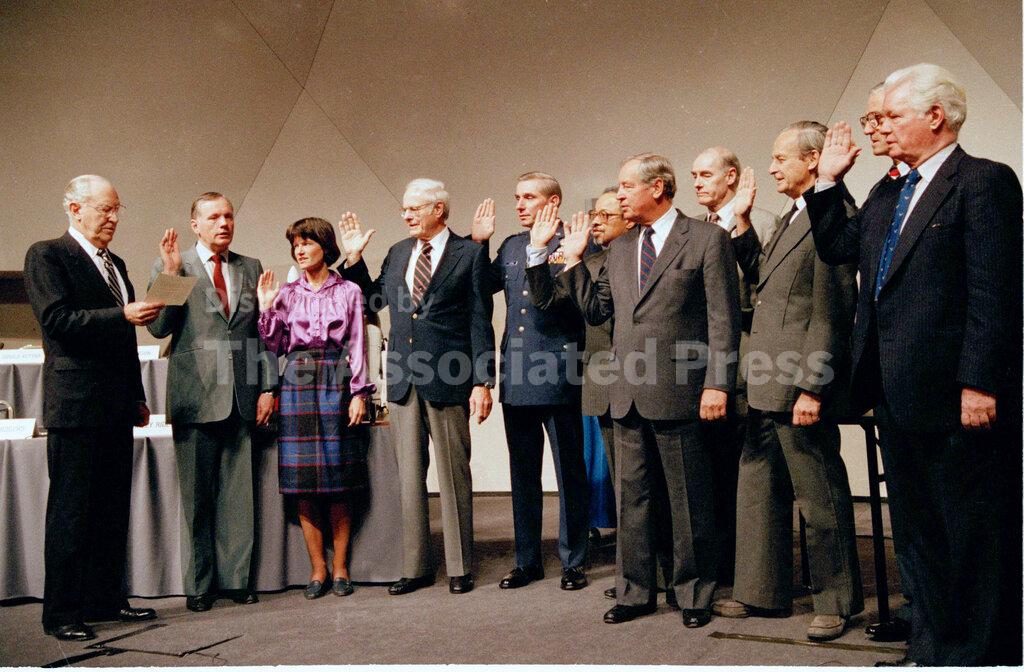
Space agency officials testified that they held a telephone call with the manufacturer of the Challenger’s booster rockets the day before the launching because of concern that seals on the boosters might have been weakened by cold. At the first meeting of the Presidential commission investigating the explosion of the shuttle and the deaths of seven astronauts, officials also acknowledged that temperatures in the mid-20’s caused a water pipe to break and required that most water lines be kept open to prevent freezing; a substantial amount of ice formed where the lines drained at one side of the launching pad, the officials said. But the space officials insisted that a series of technical reviews the day before the flight and an ice inspection January 28, the day of the flight, led to an agreement among space officials and manufacturers that neither the low temperatures nor the ice on the pad threatened the shuttle’s safety. Weather was one of the major topics of discussion as seven experts from the National Aeronautics and Space Administration testified about the explosion and destruction of the Challenger some 73 seconds after it lifted off from the Kennedy Space Center.
In other testimony at the daylong session at the National Academy of Sciences, space officials said there is essentially no way astronauts can escape a shuttle launching in the first two minutes, until the solid-fuel booster rockets have completed burning. Their testimony appeared to be directed at the suggestion made by some NASA critics that a better system of sensors might have alerted the astronauts and enabled them to detach their shuttle from its rockets and fuel tanks before the explosion. Prodded by a number of specific questions from commission members, the witnesses spent considerable time describing the cold weather conditions that some observers and industry spokesman have speculated could have played a role in the disaster, possibly by causing changes in the solid fuel or stresses in various components of the shuttle system. Both Jesse W. Moore, associate administrator for space flight, the agency’s top shuttle administrator, and Arnold D. Aldrich, manager of shuttle integration at the Johnson Space Flight Center in Houston, testified that cold and ice were considered at various technical and management meetings but not deemed a hazard to the mission.
In its first public hearing, President Reagan’s newly appointed commission to investigate the space shuttle disaster immediately homed in on some of the key unresolved questions surrounding the explosion of the Challenger. But officials of the National Aeronautics and Space Administration who appeared before the commission sometimes seemed taken aback by the specificity of the interrogation and offered only general responses, interspersed with repeated promises to track down additional information. “We’re not really ready yet to go into depth,” said one NASA official who was sitting in the audience of the all-day session at the National Academy of Sciences headquarters.
Many Kennedy Space Center visitors in the last 10 days have come on a pilgrimage, not only to bear witness to the nation’s worst space disaster, but also to reaffirm their faith in the nation’s space feats. All through the day tourists gather in small knots before the framed memorial that lists the seven names: Scobee, Smith, McNair, Jarvis, Resnik, Onizuka and McAuliffe. They take photographs, the flash exploding off the glass, and speak in quiet, almost reverent tones, their voices drowned by the shouting of children and the chatter of tour groups moving through the large hall. Spaceport U.S.A., the visitors’ center for the Kennedy Space Center, is one of Florida’s busiest tourist attractions, drawing about two million people a year. There is a large, glass-walled exhibition hall, and outside is a forest of sleek, white hulled-rockets, towering monuments to the nation’s earliest space triumphs.
The search for surface wreckage from the space shuttle Challenger was moved to the coastal waters off North Carolina today, while recovery ships working near the coast of Florida continued to hunt for pieces of wreckage along the ocean bottom. The National Aeronautics and Space Administration had no new reports on whether ships working in deep water, about 40 miles off the coast, were able to identify what could be a key piece of sunken wreckage from the space shuttle Challenger, which exploded Jan. 28 with seven crew members aboard. Four-foot seas, strong winds and rain slowed NASA’s efforts to send remote cameras underwater to examine what it believes to be the right-side solid-fuel booster rocket of the shuttle.
A proposed American counteroffer to Moscow’s plan to eliminate nuclear weapons by the year 2000 has been proposed by President Reagan for allies to consider. Officials said the plan called for eliminating American and Soviet medium-range missiles from Europe and for cutting the Soviet SS-20 missile force in Asia by 50 percent. It rebuffs some of the suggestions made by Mr. Gorbachev for the first phase of his three-stage plan. The response, now being discussed with the allies, was suggested by the Arms Control and Disarmament Agency. The proposal is contained in a confidential directive by President Reagan that was issued Tuesday. It was one of three possible approaches considered at a White House meeting Monday, officials said. The two others were proposed by Defense Secretary Caspar W. Weinberger and by Secretary of State George P. Shultz. “The President has reviewed a number of options and identified a response that appears to hold out the greatest possibility for making progress in areas that would serve the United States interest,” an official said. He cautioned that a final decision would be made only after the current allied consultations. Paul H. Nitze, adviser to Secretary of State Shultz, has been sent to discuss the plan with European allies, and Edward L. Rowny, former arms negotiator, has been dispatched to consult with Asian and Pacific nations.
The next East-West summit meeting should produce practical results rather than broad statements about reducing the threat of nuclear war, Mikhail S. Gorbachev said, the Soviet press agency reported. The agency, Tass, said that Mr. Gorbachev, the Soviet leader, had made the statement in a meeting with Senator Edward M. Kennedy, Democrat of Massachusetts, who is here for a three-day visit. Tass said Mr. Gorbachev had emphasized that “verbal tribute alone to the understanding of the danger of the present-day situation is no longer enough.” The agency added that he had “stressed that the next Soviet-American summit meeting should yield practical results, otherwise it would have no sense.” The two leaders are expected to meet later this year. Tass also reported that Mr. Gorbachev had said the Soviet Union set no conditions in negotiations to reduce medium-range nuclear weapons except that Britain and France pledge not to increase their nuclear arsenals or transfer such weapons to other countries.
The Warsaw Pact modified its stand today at the East-West talks on cutting conventional forces in Central Europe as both sides expressed optimism about an agreement. A spokesman for the Soviet bloc said it would accept lower initial troop cuts than in its earlier statements and would consider an extra method of verification. The offer fell short of NATO demands, particularly on verification, but a Western spokesman said there were “good signals in the air.” The Warsaw Pact now calls for a first-phase cut of 11,500 in Soviet forces and of 6,500 in United States forces. NATO wants to cut United States forces by only 5,000. The cuts would apply to troops stationed in East and West Germany, Czechoslovakia, Poland and the Benelux countries. Diplomats agree that a new sense of purpose has entered into the 19-nation talks, aimed at eventually cutting the forces of the two military alliances to 900,000 men each in Central Europe. For the first time in the talks, which began in 1973, the two sides are proposing a similarly structured agreement with a first-phase cut followed by a commitment not to increase forces over a period of three years. The main issue is expected to be verification.
Three East European Governments have informed the United States that they are taking travel measures against American diplomats and other officials in retaliation for steps taken by Washington last month against them, diplomats said today. The latest moves will produce tighter surveillance on American official representatives trying to move around in some Soviet bloc countries, the diplomats said. They are almost tit for tat for restrictions imposed by the Administration to help the Federal Bureau of Investigation keep closer track of Communist officials. The Aministration was responding to concerns in Congress and security agencies that the East Europeans were working for the Soviet Union, particularly in trying to gain access to high technology in parts of the United States, such as the Silicon Valley region in California, that are closed to Soviet representatives.
The French Government assigned a small army of police today to guard key points in Paris in an effort to increase security after three bombing attacks in as many nights in crowded districts of the city. Interior Minister Pierre Joxe said several thousand extra police and militia members had been mobilized to reinforce security in train stations, airports, museums, exhibition centers and on board special vacation trains due to leave for holiday spots this weekend. “Terrorists are hoping to upset the public, and they are doing it,” Mr. Joxe said in a television interview here. “But they also hope to intimidate the Government, and they will not.”
American Black Muslim leader Louis Farrakhan was detained by British officials for almost 11 hours when he landed at London’s Heathrow Airport en route to Nigeria. Farrakhan stirred U.S. controversy last year with anti-Jewish remarks. He was invited to address a black group in London last month but was barred by Britain, which said his presence would not be “conducive to the public good.” Officials, apparently believing he intended to hold a news conference between flights, escorted him and his party from his plane and then escorted him to his Nigeria flight.
The United States deplored Israel’s interception of a Libyan civilian jet but vetoed a U.N. Security Council resolution that would have condemned the Israeli action. Ten of the 15 council members supported the resolution and four nations — Britain, France, Denmark and Australia — abstained in the vote that came after three days of debate. Before casting the veto, U.S. Ambassador Vernon A. Walters told delegates that “although the United States opposes Israel’s action in this case,” it rejected the Arab-backed resolution because it failed to take into account that the interception of an aircraft might be justified in some cases.
Israeli and Egyptian officials reported progress in talks on terms for arbitration to resolve their dispute over a sliver of Red Sea beach in the Sinai called Taba. “There is a great deal of progress. We have done good work and we will continue,” the director general of Israel’s Foreign Ministry, David Kimche, said in Cairo after meeting with Egyptian Foreign Minister Esmat Abdel Meguid. The meeting on the Taba dispute was called “fruitful and businesslike” by Meguid, who said he thought a separate committee had made progress on improving relations between the two countries.
Lebanese President Amin Gemayel said today that he had no intention of resigning under pressure from his Syrian-backed opponents and would serve out his term. “I know I am taking risks but I am ready to face them,” he said at his office in suburban Baabda. An account of the President’s statements was given by the state-controlled Radio Lebanon. The 43-year-old Mr. Gemayel has served half of his six-year term, which expires in 1988.
The State Department said that Cuban troops may have supported a Marxist faction that toppled the government of South Yemen last month. “There are reports that Cubans have been active in logistics support and in maintenance of equipment for the rebel forces,” the department said. It was the first time that U.S. authorities had reported the presence of Cubans in the fighting. The State Department previously said reports indicated that Soviet troops were “involved in combat situations in support of rebel forces.”
An Iranian helicopter gunship attacked a Cypriot tanker in the Persian Gulf, killing four crewmen and injuring another, shipping executives in Bahrain said. The crewmen died when an Iranian missile slammed into the crew’s quarters on the 34,622-ton tanker Avocet. Crewmen abandoned the burning ship in lifeboats and were rescued by passing vessels. The shipping officials said that 36 crewmen were aboard the Avocet, which was bound for Kuwait to load oil. The vessel was about 10 miles from Qatar’s offshore Roston oil field when the Iranian gunship attacked. Both Iran and Iraq have attacked Persian Gulf shipping in their war, which began in 1980.
Pope John Paul II, visiting India, prayed for the souls of those who died in the 1984 poisonous gas leak at Bhopal, calling it one of the “tragedies that accompany man’s efforts to make progress.” Almost the entire population of Mangalore, a largely Christian city on the Arabian Sea, turned out to greet the pontiff on the sixth day of his 10-day tour of India. The Pope, who flew from Panaji, 190 miles away, was unable to bring his bulletproof van and rode past cheering crowds in an open jeep. Papal security has been tight due to death threats from Hindu militants.
A key South Korean anti-government leader announced today that he would join the main opposition group, the New Korea Democratic Party. The opposition leader, Kim Young Sam, who announced his decision to join the opposition party at a news conference here, is expected to lead the party toward a more confrontational stance with the government on several sensitive political issues. Mr. Kim, a former president of the party, was banned from political activity after the Government of President Chun Doo Hwan came to power in 1980. The ban was lifted after general elections last February. Mr. Kim stayed away from direct political activity, however, in support of Kim Dae Jung, the country’s best known anti-government activist, who has been banned from any political participation.
Filipinos voted today in a bitterly contested election marked by reports of fraud and violence, the outcome of which many people said could lead to further polarization. Both candidates, President Ferdinand E. Marcos, and his opponent, Corazon C. Aquino, have indicated that they might not concede defeat if the results show they lost. As reports came in from around the country, a picture emerged of a heavy turnout, with people determined to cast their ballots despite some organizational confusion and many incidents of intimidation and fraud at the polling places. A citizens’ poll-watching group charged with monitoring the level of fraud in the election, issued a statement saying the polling had been characterized by “large-scale harassment and intimidation.” “In many areas,” the group said, “the following has been noted: Voters lists cannot be found, indelible ink turned out to be removable, voters are not allowed to vote.”
President Jean-Claude Duvalier summoned the United States Ambassador today, prompting speculation that the Haitian ruler was preparing to leave the country. A spokesman for the United States Embassy would not comment on the meeting. Guy Mayer, a Government spokesman, denied that Mr. Duvalier was planning to leave Haiti. In the last 10 days, as many as 50 people have been killed and more than 100 injured in demonstrations to bring down the government. Last Friday, Larry Speakes, the White House spokesman, erroneously reported that Mr. Duvalier had fled the country. The United States envoy had also met with Mr. Duvalier on the day the rumors of his departure spread.
Foreign Minister Roelof F. Botha, voicing opposition to Reagan Administration policies toward South Africa, renewed a call today for a regional conference to negotiate settlements of the conflicts in Angola and South-West Africa. Mr. Botha’s comments on American attitudes reflected a deepening hostility toward Washington among some senior government officials. This has been provoked by the imposition of limited American sanctions last year, and by what are seen as earlier about-faces by Washington, such as the withdrawal of support for South Africa’s invasion of Angola in 1976. Some of the government’s black opponents express anti-American sentiments, too, charging that the American policy, which the Administration calls constructive engagement, protects and supports the government of minority whites. Foreign Minister Botha said his country could be ruled by a black if white rights are protected.
President Reagan said today that he would seek further deregulation of the nation’s banks and the dismantling of the government’s elaborate farm support bureaucracy. In his annual Economic Report to Congress, Mr. Reagan also said the Administration would renew its efforts to deregulate prices of natural gas, which Congress has rejected, and seek further deregulation of the trucking industry. More ‘Privatization’ He said he has established a special White House committee to explore more “privatization” of government services than those listed in his new budget. The budget proposed the sale of several electric power authorities and the Elk Hills, California, and Teapot Dome, Wyoming, petroleum reserves
Saying he feels “just like I’m 39,” President Reagan celebrated his 75th birthday today with a six-layer cake in the morning, a surprise gift in the evening and an enduring wish that Thomas P. O’Neill Jr., the Speaker of the House, would offer him “a great present — his approval of everything we’ve done.” Mr. Reagan spent the day pressing his legislative and budget agenda while joking frequently about his age. At one point, Mr. Reagan, who received birthday greetings from Mikhail S. Gorbachev of the Soviet Union and about 100 other world leaders, said he was “a little amazed” at the events of his lifetime. But Mr. Reagan observed that he still felt like a young man. Mr. Reagan is the nation’s oldest sitting President.
The President and First Lady attend the 34th Annual National Prayer Breakfast.
The President and First Lady participate in a photo opportunity with members of the delegation of Christian Democrats.
The Senate Armed Services Committee has expressed support for a proposal to make sweeping changes at the highest levels of the Defense Department, but has stopped short of accepting a staff proposal to replace the Joint Chiefs of Staff with a new military advisory panel, Senate sources said. The committee has yet to take a final vote on the proposals, but after two days of study it has instructed its staff to make what have been described as relatively minor changes in much of the proposed legislation.
The Senate passed and sent to the White House legislation that would put health warnings on snuff and chewing tobacco and ban their broadcast advertising. Acting by voice vote after little debate, the Senate approved a compromise bill that was passed Monday by the House. The measure is aimed at curbing the growing popularity of smokeless tobacco among children and teenagers. Witnesses told a House subcommittee that television endorsements by athletes have led many teenage boys to believe smokeless tobacco is a safe way to enjoy tobacco without risking health or athletic capability.
Vice President Bush said he stood by “the concept” behind his recent attack on Governor Cuomo, but he acknowledged he should have chosen his words more carefully. In a speech last month, Mr. Bush criticized the New York Governor for complaining that ethnic prejudice lay behind the observation that he, as an Italian-American, would have a hard time getting elected President. Mr. Bush’s advisers say his political activities will be carefully managed in the coming months to avoid incidents that could reinforce the negative reactions that emerged from the Cuomo episode and other recent events. In an interview aboard Air Force Two on Wednesday as he flew to Alabama and Mississippi for a series of Republican fund-raising events, Mr. Bush said that he had been stung by the harsh reaction to some of his recent political statements. But he insisted that it had not damaged him politically, saying, “This, too, shall pass.”
Cuts in the V.A. mortgage program are being made to comply with spending restrictions under the new balanced-budget law. The Veterans Administration said it was imposing curbs on its home-loan guarantee program that would sharply curtail the size and availability of insured mortgages for veterans. The changes are being taken to comply with spending restrictions under the balanced-budget law, the agency said, and officials said the limits could also mean that V.A. loans would be denied to thousands of qualifying veterans this year. With its new restrictions, the V.A. will place a $90,000 limit on the size of home loans that the agency will insure. No V.A.-backed refinancing of existing V.A.-insured loans will be allowed.
Interior Secretary Donald P. Hodel today proposed a five-year offshore oil and gas exploration program that would slow sales of drilling rights and exclude 15 areas from the leasing program. The new plan, which calls for 27 sales from 1987 to 1991, is a modification of last year’s draft and is considered to mark a midway point in a two-year process preparing for adoption of a new leasing program. Further modifications are expected, including the eventual inclusion of an agreement being negotiated by representatives of the Interior Department with legislators who want to limit drilling off the California coast.
A retired C.I.A. analyst testified that he stole classified documents from the agency for more than a decade and gave them to the Chinese in a personal campaign to improve Peking-Washington relations. The defense and prosecution in Mr. Chin’s espionage trial both rested their cases today, and the jury of nine women and three men is scheduled to receive the case Friday. In an extraordinary hour and a half of testimony, Mr. Chin admitted nearly every action he was accused of in his indictment on espionage and tax charges. But he said his intent was to help both the United States and China.
Five members of a racist, right-wing group that purportedly sought to overthrow the United States Government were sentenced today to prison terms ranging from 40 to 100 years. The members of the neo-Nazi group, the Order, were convicted under a Federal antiracketeering statute. Federal investigators had accused the group of carrying out a series of violent acts, including murder and armored car robberies, in an attempt to bring about a racist revolution. One of the five defendants, Gary Lee Yarbrough, 30 years old of Sandpoint, Idaho., told Federal District Judge Walter T. McGovern that no matter what happened in court today, the movement would grow. “Blood will flow and it grieves me,” he said.
Twenty-seven striking meatpackers and their supporters were arrested after the National Guard briefly blocked access to the Geo. A Hormel & Co. plant in Austin, Minnesota. The strikers attempted to make citizen’s arrests of a city police officer and at least two guardsmen. The demonstration came a day after Hormel officials and union leaders held their first meeting in three weeks, but reported no progress. About 1,500 union members went on strike August 17 in a dispute over wages.
Federal aviation officials today ordered the nation’s airlines to inspect hundreds of aircraft with certain Pratt & Whitney engines to look for cracks that could cause a major part of the engine to break loose. The part is a combustion chamber outer case, a large metal sleeve that encases the combustion chambers of the engine. Such a part figured in an incident last Oct. 20 involving an Eastern Airlines DC-9 jetliner in which a section of the engine failed and pealed back in a takeoff from Tampa, Florida. There were no injuries. The Federal Aviation Administration directive applies to many of the JT-8D engines that are on about 1,000 Boeing 727’s, 350 Boeing 737’s and 580 DC-9’s in the United States. A spokesman for the aviation agency said the order, which requires only a visual inspection, should not affect airline service.
A hatch beneath a coal silo in Fairview, West Virginia was opened accidentally today, and five men who were standing on top of the pile suffocated as tons of the finely processed coal collapsed and engulfed them, the authorities said. The pile collapsed when a worker threw a switch that simultaneously started an adjacent conveyor and opened a door at the bottom of the silo, said John McGrath of the Federal Mine Safety and Health Administration, which was investigating the accident at the Consolidated Coal Company.
Living in Centralia, Pennsylvania, where an underground coal fire has burned for years, is unusually unhealthy, a study released today has found. The six-month study, conducted in 1984 by Pennsylvania State University’s Milton S. Hershey Medical Center, found that residents suffered a greater incidence of health problems, including respiratory and gastrointestinal diseases, hypertension, depression and anxiety, than did residents of Marion Heights, a coal town near Centralia. Dr. Siegfried Streufert, a professor of behavioral sciences who directed the study, said the health problems could have been caused by fumes released by the fire, by stress or by a combination of both.
A federal judge in Newark voided Kiwanis International’s male-only membership rules and barred the businessmen’s service club from punishing a New Jersey chapter for admitting a female member. “A membership sign of ‘men only’ can be as offensive and repugnant as the sign ‘whites only,” U.S. District Judge H. Lee Sarokin said in his opinion. The ruling, based on New Jersey’s anti-discrimination law and applicable only within the state, involves a Bergen County Kiwanis chapter.
A federal grand jury indicted three men on civil rights charges in a fire that damaged a home that had been occupied by a black family in a predominantly white Philadelphia neighborhood. The December 12 fire damaged a home that Charles Williams and Marietta Bloxom and their daughter had left two weeks earlier after hundreds of whites gathered outside shouting, “Move! Move! Move!” The blaze destroyed most of the family’s possessions.
A Federal judge in Mississippi, accused of influence-peddling and perjury, called himself a poor businessman and flatly denied doing a favor in exchange for a lucrative oil deal, according to tapes played by his defense team today. “I very deeply resent any insinuation of any kind that I would do anything of that kind,” Federal District Judge Walter L. Nixon said in one of the tapes played at his trial. “Not only are there no facts to support it, but this has really hurt and caused pain to my children and my wife and myself.” The Government says Judge Nixon, accepted $60,000 in oil and gas interests in three wells from Wiley Fairchild, a business executive, in exchange for the judge’s help in trying to get state drug charges dropped against Mr. Fairchild’s son, Drew.
Darrell Cabey, 20, the most seriously wounded of the four youths shot by subway gunman Bernhard H. Goetz, returned to his mother’s Bronx apartment after 13 months in a New York hospital. Cabey, who is paralyzed and suffered brain damage, said he felt “terrible.” Goetz claimed he fired because he feared he was going to be mugged when at least one of the four asked him for $5. A judge threw out charges of attempted murder against Goetz but that action is being appealed.
Ma Anand Sheela, former personal secretary to the Indian guru Bhagwan Shree Rajneesh, and two other former leaders of the sect returned to the United States yesterday to face charges that include trying to kill the guru’s doctor. The three women, escorted by United States marshals, arrived at Kennedy International Airport in New York on a flight from Frankfurt and then boarded flights to Portland, Oregon.
11.5 million workers lost jobs because of plant shutdowns or relocations from 1979 to 1984 and only 60 percent of them regained jobs in those years, according to a new Congressional study. In a key finding, the study said a large proportion of the displaced were middle-aged workers in manufacturing “with long and stable job histories.”
Free-agent pitcher Al Holland, who saved just 5 games for 3 teams last season, signs with the Yankees.
Dow Jones Industrial Average: 1600.69 (+7.57)
Born:
Alice Greczyn, American actress (“The Lying Game”) and founder of Dare to Doubt, in Walnut Creek, California.
Tony Johnson Jr., American mixed martial artist (KOTC heavyweight champion 2010), in Killeen, Texas.
Jamaal Anderson, NFL defensive end (Atlanta Falcons, Indianapolis Colts, Cincinnati Bengals), in Little Rock, Arkansas.
Lawrence Sidbury, NFL defensive end (Atlanta Falcons, Tampa Bay Buccaneers), in Cheltenham, Maryland.
Reshard Langford, NFL safety (Kansas City Chiefs), in Madison, Alabama.
Kanekoa Texeira, MLB pitcher (Seattle Mariners, Kansas City Royals), in Kula, Hawaii.
Died:
Dandy Nichols [Daisy Sander], 78, British actress (“Till Death Us Do Part”, “Confessions of a Window Cleaner”).
Frederick Coutts, 86, Scottish 8th Salvation Army General.
Minoru Yamasaki, 73, American architect (World Trade Center, NYC), of stomach cancer.
 History Diaries