Reagan Administration officials say that the Soviet Union has been sending mixed signals on whether the United States space-based missile defense program is a barrier to an agreement on reducing medium-range nuclear weapons. On the one hand, the Americans said, the Soviet negotiator in Geneva on medium-range weapons, Aleksei A. Obukhov, has not made a special point that the United States must renounce its research in the space-based program, widely known as “Star Wars,” as a condition for an accord on medium-range weapons. On the other hand, Yuli A. Kvitsinsky, who heads the Soviet team in Geneva dealing with space weapons, “was unmistakable” when he stressed the two issues were linked in a recent visit to West Germany, according to an American official.
The official Soviet press agency condemned President Reagan’s State of the Union address today and warned that proposed increases in American defense spending would intensify the arms race. In a series of dispatches from Washington and commentaries from Moscow-based analysts, the agency, Tass, said the Administration was ignoring Soviet proposals to eliminate nuclear weapons by the end of the century and accused Mr. Reagan of embarking on a program to achieve military superiority. An unsigned dispatch from Washington about Mr. Reagan’s address to Congress on Tuesday said, “President Reagan advocated a buildup of United States military might and an intensification of the arms race, including its spread to space. “For lack of other arguments in favor of spending huge funds for nonproductive and dangerous military purposes, Reagan again turned to the the myth about a ‘Soviet threat.’ “
Italy has expelled a Soviet diplomat and the Rome manager of the Soviet airline Aeroflot after accusing them of spying, Italian Foreign Ministry sources reported. The Soviet Embassy in Rome said First Secretary Viktor Kopytin and Aeroflot official Andrei Chelukhin were told to leave Italy “without any valid motive.” The expulsions followed France’s announcement Saturday that four Soviet diplomats in Paris had been told to leave. Moscow has ordered out four French diplomats in retaliation. The orders expelling the Russians cited actions not consistent with their official status, Italian officials said. Although the accusation was not made explicitly in the expulsion order, officials in the Foreign Ministry and the Prime Minister’s office confirmed that espionage was involved. The precise nature of the espionage has not been revealed. However, a senior Italian Government official said, “We do not expel people simply because they belong to an organization like the K.G.B. We take action only when there is evidence of a specific activity.”
Richard N. Perle, assistant secretary of defense, charged that Britain’s main opposition Labor Party is the biggest threat to agreement on security between the United States and its European allies. Perle said in a speech in London that divergence on arms issues could occur if certain parties came to power in Europe, adding, “The British Labor Party is unique in its potential in this respect…. The aggressive unilateralism it advocates is the only sort of threat I can imagine.”
A bomb went off at a popular book and entertainment specialty store here tonight, wounding at least 9 people, 3 of them seriously. It was the third such incident in a crowded area of Paris in as many days, and made it clear that this city had been plunged into a campaign of random terror directed at its best-known and most commonly frequented commercial areas. Tonight’s blast followed the pattern of other incidents both in December and earlier this week. In each case, the bomb was set to go off in a well-known commercial area at a normally crowded hour. he perpetrators of the terror campaign seem to have chosen a different Parisian landmark during each of the last three nights, none of them having any political significance but each highly symbolic of the daily life of this city.
President Reagan moved today to mend ties with West Germany’s opposition Social Democratic Party by meeting with Johannes Rau, the party’s candidate for Chancellor in next year’s election. Mr. Rau said later that the President had expressed his desire to maintain good relations with the German opposition as well as with the Government of Chancellor Helmut Kohl. This was a departure for Mr. Reagan, who snubbed the party’s chairman, former Chancellor Willy Brandt, during a visit to West Germany in May. The President refused to see Mr. Brandt after demonstrations led by the Social Democratic Party struck anti-American themes. Mr. Rau is anything but abrasive, however. He speaks in conciliatory tones, offering a sense of balance to his entreaties for disarmament and improved East-West relations. A centrist with the avowed mission of reversing his party’s recent leftward drift, he has declared his firm desire to see West Germany remain part of the North Atlantic alliance and has rejected any coalition partnership with the anti-NATO Green Party. In remarks today, he avoided singling out pro-American governments for criticisms on human rights.
Defense Minister Yitzhak Rabin, defending the Israeli interception Tuesday of a Libyan executive jet, said today that Israel was determined to continue to use what he called “unconventional” measures against terrorism. Mr. Rabin spoke in defense of the action, in which Israeli planes intercepted the jet near Cyprus and forced it to land at an airfield in northern Israel. Officials said Israeli intelligence believed that one or more Palestinian terrorists were aboard. The plane was actually carrying seven Syrian Government officials and two pro-Syrian Lebanese militia officials.
Israel’s Parliament rejected an attempt by religious parties to redefine who is a Jew after Prime Minister Shimon Peres warned that the move could split Jews around the world. The Knesset voted 61 to 47 against an amendment to the Law of Return, which automatically grants citizenship to Jews emigrating to Israel, that would have redefined Jewish identity to exclude people converted by non-Orthodox rabbis. The move sparked protests from American Jews, most of whom belong to the Reform and Conservative movements.
A Muslim fundamentalist militia released six U.N. peacekeeping troops hours after announcing that it had shot down their helicopter “by mistake” in southern Lebanon. The Islamic Coalition movement identified the U.N. personnel as three Italians pilots plus two Finns and a Swede, and it said the aircraft was mistaken for one belonging to the Israeli-backed South Lebanon Army. The Islamic Coalition, a Sunni Muslim force, is part of a Syrian-sponsored alliance of leftist and Muslim factions opposed to the South Lebanon Army, a predominantly Christian militia.
A report by Amnesty International has accused Moroccan authorities of systematically torturing political prisoners and denying them access to their families, lawyers and doctors. Illegal detention and torture have continued unabated in Morocco since the 1970’s, the report by the London-based human rights organization said. Although the report says that periods of detention are limited by the Moroccan Code of Criminal Procedure, Amnesty International asserts that authorities are regularly exceeding these legal limits, particularly in the cases of people jailed for political or religious dissent. According to the organization, these prisoners are often held incommunicado for months, and in some cases years, at a time. In a statement written in response to the report, the Moroccan Ambassador to the United States, Maati Jorio, expressed his concern “about the hostile propaganda effort directed once again by Amnesty International.” He called the report an effort to tarnish Morocco’s image in the United States.
Soviet pilots may have bombed the Aden airport in support of hardline Marxist rebels who toppled South Yemen’s head of state, Ali Nasser Hasani, Jane’s Defense Weekly reported. Such Soviet support “is believed to have turned the scales in the savage fighting,” the British magazine said. Quoting unidentified Mideast sources, Jane’s said that “up to 100 Soviet advisers may have been casualties” in the two weeks of fighting last month between the two Marxist factions.
Pope John Paul II, paying homage to St. Thomas the Apostle at a hilltop shrine and greeting a multitude at a seaside mass, called on the Indian Government today to live up to its Constitution’s guarantees of religious freedom. Moving into southern India, where the country’s Roman Catholic minority has its strongest hold, the Pope drew the largest crowds of his five-day-old trip. A crowd put at more than half a million people stretched nearly two miles down a beach on the Bay of Bengal as John Paul said mass just 50 yards from the gently breaking waves. Earlier, the Pope used diplomatic but pointed language to raise the bitterly contested issue of religious discrimination, including the church’s right to preach and seek converts.
Indonesia’s Foreign Minister is preparing to open a new round of discussions with Hanoi this month aimed at developing a formula for ending the fighting in Cambodia. The official, Foreign Minister Mochtar Kusumaatmadja, is to leave Thursday for a “working visit” to the United States to discuss the war and other issues with American officials. He said in an interview today that he believes the Soviet Union and China may be more disposed toward trying to find a realistic solution for Cambodia. The war there between Vietnamese troops and Cambodian guerrillas is in its eighth year. Mr. Mochtar has long held the view that a “better atmosphere” between Vietnam and Washington would help solve the Cambodia problem.
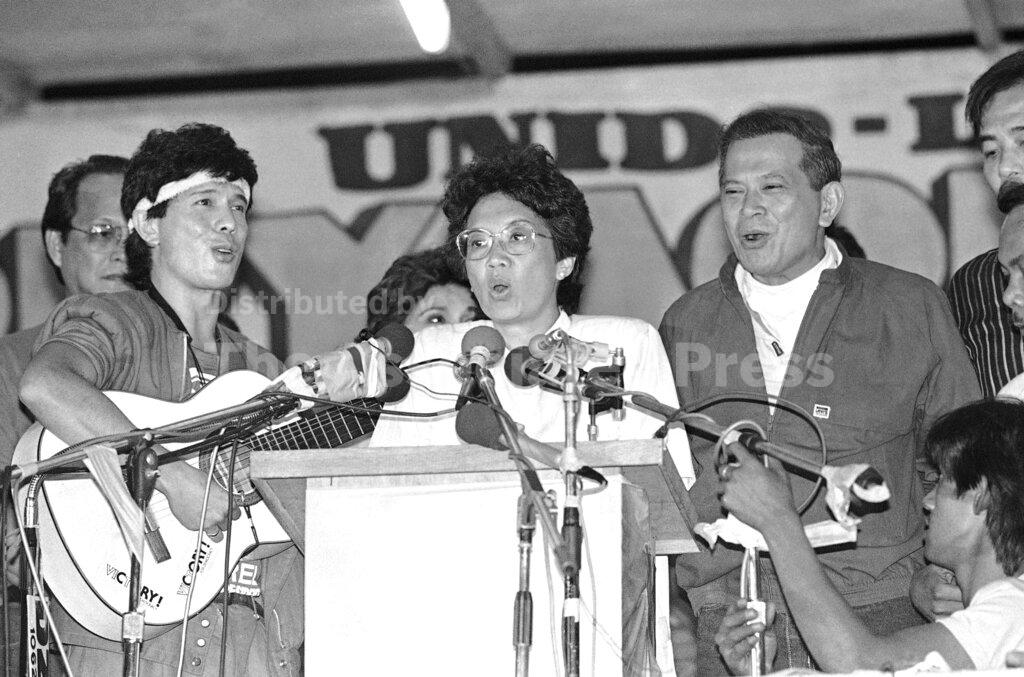
ABC’s “Nightline” airs interviews with Filipino presidential candidates Corazon Aquino and Ferdinand Marcos. The Philippine presidential campaign began — and nearly ended — on American television. Last Nov. 3, President Ferdinand E. Marcos said on the ABC News program “This Week” that he would call for a special election “to settle all these childish claims to popularity.” Three months later, after a heated campaign in which issues of vital interest to the United States were highlighted, the last battle between Mr. Marcos and his challenger was over an American television debate. After first agreeing to debate his opponent, Corazon C. Aquino, on the ABC News “Nightline” program, Mr. Marcos backed out, citing a law against electioneering on the day before the vote. An ABC News spokesman in New York said Mr. Marcos had “reneged” on his agreement to debate, and both candidates subsequently taped separate interviews.
An intense 57-day presidential campaign concluded today with a mass rally here by President Ferdinand E. Marcos and a statement by the country’s most influential churchman that was a virtual endorsement of the challenger, Corazon C. Aquino. The candidates are required to stop campaigning on Thursday, the day before 26 million Filipinos are to vote in an election that both sides say may determine the future of the country’s democratic institutions. Scattered incidents of minor violence were reported along a pro-Marcos motorcade through the city and along an Aquino motorcade through the countryside, illustrating the rise in tensions as the election approached. The battle lines have been so sharply drawn in the short campaign, between those who have held power for 20 years and those who want change, that there are strong indications that neither side is prepared to accept defeat.
Along with Philippine citizens groups and official poll-watchers, the 20 American political professionals and academics who arrived here today to monitor the presidential election face a prodigious task. The voting, scheduled for Friday, will be in 86,000 precincts scattered through 7,000 islands across terrain ranging from pristinely tropical to harshly metropolitan. The political process has been affected by many forces, from sermons in Roman Catholic churches to ambushes by Communist insurgents. Concern over fraud has been such that the citizens watchdog group, the National Movement for Free Elections, commonly known as NAMFREL, plans to have its monitors chain themselves to the new see-through voting boxes to bar any attempts at tampering.
President Jean-Claude Duvalier of Haiti has requested political asylum in Switzerland, Greece and Spain but has been turned down, Government spokesmen in those countries said today. There were unconfirmed reports that Mr. Duvalier, who declared a state of siege in Haiti last Friday amid widespread protests against his rule, had also sought asylum in Italy and Argentina. In Haiti, Adrien Raymond, the Minister of Information, denied as “completely ridiculous” reports that Mr. Duvalier had sought political asylum in Greece or Switzerland. A Foreign Ministry official said it was “not true” that Mr. Duvalier had sought asylum anywhere. A senior State Department official said that to the best of his knowledge Mr. Duvalier had not asked to come to the United States. Last Friday the White House announced that Mr. Duvalier had fled Haiti after a week of riots but later acknowledged that the report, based on rumors in Haiti, was incorrect.
Leftist guerrillas in El Salvador said today that they had shot down an American-made Hughes-500 helicopter, one of the most destructive weapons in El Salvador’s civil war. But the Salvadoran Army denied the report. The rebel radio Venceremos said its forces shot down the helicopter in the north of the eastern San Miguel Province Tuesday. But an armed forces spokesman said the aircraft had to make a forced landing because of mechanical problems and its two crew suffered light injuries. El Salvador has at least eight of the helicopters.
Eight months after being elevated to the rank of Cardinal, Miguel Obando y Bravo has suddenly become the object of strong political attacks by Sandinista authorities in Nicaragua. The criticism, in remarks by Government leaders and articles in the Sandinista press, has been set off by Cardinal Obando’s trip to the United States. In his visit, he has met with several church officials and other leaders, including the United Nations Secretary General, Javier Perez de Cuellar, to denounce what he describes as persecution of the Roman Catholic Church in Nicaragua. “Cardinal Obando is a political leader, and he is acting politically,” said Vice President Sergio Ramirez Mercado last week. “He is part of the Reagan Administration’s plan to win financing for the counterrevolutionary groups seeking to overthrow the Sandinista regime.”
The 600 members of a feared Guatemalan security police unit were taken into custody for investigation today, a police source said, and there were reports that the unit would be abolished by the new civilian President, Vinicio Cerezo. Relatives and friends of members of unit, the technical investigations department of the national police, said the 600 agents were taken Tuesday from their headquarters to the second police barracks.
Suspected leftist rebels assassinated a retired army intelligence officer in Lima, and Peru’s President Alan Garcia said he may declare a state of emergency in the capital in response to recent guerrilla violence. The official news agency, Andina, said that Ruben Izquierdo Martinez was shot to death by two leftist guerrillas. No group was specified, but Sendero Luminoso, a Maoist group, has been blamed for many assassinations.
South African police jailed nearly 11,000 anti-apartheid activists without charges in 1985, nearly 10 times as many as in the previous year, a monitoring group said in Johannesburg. Another 25,000 were arrested on charges stemming from political violence and rioting, the Detainees’ Parents Support Committee said in its survey of security actions taken last year. Meanwhile, a spokesman for the National Union of Mineworkers said hundreds of black miners have been fired for staging a strike at a gold mine near Johannesburg.
President Reagan sent to Congress today a 1987 budget that would shrink the size of the Government and seemed certain to set off a battle of wills between the White House and Capitol Hill. Even before the President submitted his plan, which would cut domestic spending so that military spending could rise, tension between Congress and the White House was exceptionally high because of pressures created by the new law aimed at eliminating budget deficits by 1991. Treasury Secretary James A. Baker 3rd added to this tension this morning by rejecting the idea of early negotiations toward a compromise that could include a tax increase. Mr. Reagan also heightened the likelihood of conflict by delivering a Budget Message that lectured Congress about a deficit that most legislators believe was created over the past five years by Mr. Reagan’s program of increasing military spending while cutting taxes. His budget envisions spending $994 billion with a deficit of $143.6 billion, just under the deficit ceiling imposed by the new law.
The enormous Federal deficit and the new budget-balancing law that is designed first to reduce and ultimately to eliminate the deficit dominated President Reagan’s State of the Union Message on Tuesday night, dominated the budget he submitted today and may very well dominate the remainder of his second term. Weighing the State of the Union for the fifth time, the President evaluated it in the rich cadences of the committed evangelist. But the inescapable burden of the account books made the budget a far more sober document, full of potential for strife as it makes its way through the tortuous passages of government. In his State of the Union address, Mr. Reagan spoke exuberantly of “this great American comeback.”
Americans would pay more for many services if Congress adopts President Reagan’s proposed 1987 budget. There would, for example, be higher fees for use of national parks, higher Medicare premiums and higher transit fares.
The proposed budget has no chance of Congressional passage in the form sought by President Reagan, according to Republican and Democratic leaders.
The proposed Pentagon budget was greeted with derision by Congressional Democrats, who said President Reagan’s request was unrealistic, and with skepticism by some budget analysts, who said it appeared to understate the likely amount of military spending.
An energy tax appeared more likely as President Reagan said he was “willing to look at” imposing a fee on imported crude oil while Treasury Secretary James A. Baker 3d said that a tax on gasoline could not be ruled out. But both of them stressed that a tax would be acceptable only if the money were used to keep any tax bill approved by Congress revenue neutral.
Secretary of State George P. Shultz was told today by key members of Congress that the State Department’s request for a $2 billion increase to increase security at United States Embassies has virtually no chance of approval. Representative Dante B. Fascell, Democrat of Florida, the chairman of the Foreign Affairs Committee, told Mr. Shultz that the likelihood of Congressional support of the budget increases for the management of foreign affairs was “slim and none.” In a three-hour hearing outlining the Administration’s foreign-policy goals for this year, Mr. Shultz found himself spending considerable time defending the requests for increases in the State Department budget. Smallest of Cabinet Budgets The State Department has the smallest budget of any Cabinet agency, usually running about $2 billion yearly. But because of the bombings at United States Embassies abroad, the Administration is seeking an increase in security services and new building costs of some $2 billion for the 1987 fiscal year, including a supplemental grant of $780 million for the current fiscal year.
President Reagan addresses 250 selected employees of the Department of the Treasury outlining future policy objectives.
President Reagan attends a Domestic Policy Council meeting.
Events before the launching of the Challenger on January 28 and technical changes made the liftoff different from all preceding ones in the five-year shuttle program. The time between launchings was the shortest ever, which some experts suspect may have taxed ground crews and led to worker fatigue. Also, the temperature was the coldest, the payload was the heaviest and the shuttle was one of the lightest. Finally, the launching pad used for the Challenger, which exploded a little more than a minute into its flight, killing the seven astronauts aboard, had never before sent a shuttle aloft. Known as 39-B, it differed structurally in some respects from the main pad.
The House ethics panel approved separate preliminary inquiries into allegations that Representative Fernand J. St Germain, chairman of the Banking Committee, and two other Congressmen had misused their office. The two other Representatives are James Weaver of Oregon and William Boner of Tennessee, both Democrats, as is Mr. St Germain, who is from Rhode Island.
Sidney Fitzwater, nominated by President Reagan for a lifetime federal judgeship, faced tough questioning on Capitol Hill on charges he participated in a scheme to discourage blacks from voting. The appearance before the Senate Judiciary Committee was the second for Fitzwater, whose nomination for a seat on the U.S. District Court in Dallas has met increased opposition from minority groups and Democrats.
The Federal Aviation Administration will reevaluate whether it should provide the military with more detailed information about safety incidents involving aircraft chartered by the military to fly troops worldwide, an FAA official said at a hearing of a House panel. Members of the panel had raised questions about whether the FAA could have provided additional information about the history of Arrow Air operations before the December 12 crash in Newfoundland that killed 248 people.
Safety practices in charter airlines and the entire airline industry were sharply criticized at the first Congressional hearing on the Dec. 12 air crash in which 248 American soldiers were killed in Newfoundland. It was also the first time that the Pentagon publicly accepted responsibility for the care of military personnel on chartered flights.
A knife-wielding man commandeered a Delta Air Lines jumbo jet as it landed in Grapevine, Texas, and held the 232 people aboard hostage before releasing the captives unharmed, officials said. The man, identified by the FBI as Ralph A. Hughes of Fort Lauderdale, Florida, who allegedly held a knife to a steward’s neck, was arrested by airport police nearly two hours after the jet landed around nightfall. An airport spokesman said officials did not know if the man had made any demands and said he appeared to be mentally disturbed. The plane, bound for Los Angeles from Fort Lauderdale, with a stop in Dallas, had 221 passengers and a crew of 11.
The president of Dartmouth College today ordered students opposed to the school’s South Africa-linked investments to remove their shantytown from the college green. The president, David McLaughlin, said in a letter he expected the shacks to be removed after the winter carnival, which begins Thursday and ends Sunday. “The shanties are, for many, contributing to a feeling of divisiveness at a time when we should be coming together,” Mr. McLaughlin said.
Female membership in the Rotary International was rejected for the fifth time by the service club of nearly 1 million members begun 81 years ago by a lonely bachelor and three businessmen. A “clear majority” of 433 delegates from 54 countries turned down by voice vote at their meeting in Chicago a proposal to change rules that prohibit women from joining, said Rotary spokesman Jack Giles.
Leaders of striking Hormel meatpackers met with company negotiators to discuss how to end their 5 ½-month strike, while replacement workers streamed past National Guardsmen into the Austin, Minnesota, plant for a third day. The meeting was the first between the two sides since January 11. “Anytime you have a meeting, you hope to have some type of breakthrough,” said Hormel official Charles Nyberg. He said, however, that he was not optimistic about the talks.
President Reagan announced today that he had asked the Surgeon General of the United States to prepare a “major report” on AIDS and that the Administration was committed to finding a cure for the disease. “One of our highest public health priorities is going to continue to be finding a cure for AIDS,” Mr. Reagan told hundreds of employees at the Department of Health and Human Services. “We’re going to continue to try to develop and test vaccines and we’re going to focus also on prevention.” Mr. Reagan added, “In this regard, I’m asking the Surgeon General to prepare a major report to the American people on AIDS.”
The largest and most thorough study of members of the families of AIDS victims completed to date provides “conclusive” evidence that the fatal disease does not spread through close, day-to-day personal contact, according to the leader of the research team. The study examined in more detail than ever before the extent to which family members hugged and kissed AIDS patients and shared toothbrushes, drinking glasses, beds, towels and toilets with them. Together with other evidence, it indicates that the risk of transmitting acquired immune deficiency syndrome through household contact is “virtually nonexistent,” said the senior author of the report, Dr. Gerald H. Friedland of the Montefiore Medical Center in the Bronx. In blood tests conducted in the study, only a 5-year-old girl, out of 101 people who shared homes with AIDS patients, showed signs of infection with the AIDS virus. The child, whose mother had the disease. had suffered related disorders since she was an infant and almost certainly was born with the infection, the doctors concluded.
Four tornadoes spawned by fast-moving thunderstorms struck East Texas around Houston, killing one person and injuring dozens of others as they tore down homes, buildings and power lines, authorities said. Twisters hit two apartment houses, several homes and a doctor’s office in Tomball late in the afternoon, and about 90% of the houses in town suffered some damage, said Police Chief Derwood Kennedy. “The wind threw a 7,000- or 8,000-pound tractor in the air, and the clouds were green and the hail was like snow,” said Steve Hawkins of Spring.
For years frequent airline travelers in the Middle West extolled Detroit Metropolitan Airport and its uncrowded terminals, roomy parking lots and quick getaways as a welcome contrast to busier airports. Now, in part as a result of airline deregulation, the airport’s long concourses are bustling. There are more cars in its vast parking lots. And with the two largest airlines that serve Detroit planning to combine their schedules, some Detroit travelers are worried that the days of trouble-free flying may be over.
Dow Jones Industrial Average: 1593.12 (-0.11)
Born:
Ryan Webb, MLB pitcher (San Diego Padres, Florida-Miami Marlins, Baltimore Orioles, Cleveland Indians, Tampa Bay Rays), in Clearwater, Florida.
Reed Sorenson, American stock car racing driver, in Peachtree City, Georgia.
 History Diaries