The Challenger’s booster rockets were not designed for use when the temperature of their propellent was below 40 degrees Fahrenheit, according to the rockets’ manufacturer. On the morning of the launching, the outside temperature was at the freezing mark after two nights in which the space shuttle awaited launching in sub-freezing weather. It is unclear whether the propellant had become as cold as the surrounding air. An engineer with the National Aeronautics and Space Administration said yesterday that the rocket’s interior did not have a temperature gauge to inform ground controllers about the condition of the propellant. The news came amid reports that as long as two years ago some NASA engineers were concerned about dangers posed by vibrations and rapid pressure changes in the rockets. According to several reports that NASA officials have refused to confirm, an unusually sensitive pressure meter was placed in the boosters for several shuttle flights starting in 1983. The meter was later removed, and agency officials have not made public the results of that study. The manufacturer’s disclosure yesterday refocused attention on whether the launching site was too cold for the Challenger to take off safely. It also appeared to give credibility to the theories of several rocket scientists that a combination of factors — including cold that may have cracked the rocket’s solid fuel, and strong pressure changes that may have widened the crack — could have led to a “burn through” of the rocket’s thin skin. That flame, in turn, could have touched off a larger explosion of the adjacent liquid-fuel tank, consuming the Challenger and its crew.
Search teams reported today that sonar soundings in the ocean near here may have discovered one of the two solid-fuel booster rockets from the space shuttle Challenger, which exploded over the ocean a week ago today. The one-sentence statement from the National Aeronautics and Space Administration here did not say where the finding had been made, whether the booster was intact or which of the shuttle’s two boosters it was believed to be. The recovery of the booster could be critical, since the investigation into the incident has so far focused on evidence that some sort of rupture in the shuttle’s right-side booster rocket led to the explosion.
The National Aeronautics and Space Administration did not use the most thorough method of safety analysis available to pinpoint potential failures on the space shuttle Challenger, according to top present and former agency officials and risk experts. That method, some of the outside experts said, would have been more likely to pinpoint all important problems in the shuttle’s solid-fuel booster rockets, where a failure is a prime suspect in the explosion that destroyed the spacecraft on January 28 and killed all seven members of its crew. These outside experts are not making accusations that NASA’s procedures led in some specific way to the disaster nor do they accuse the agency of failing in its duty to assure the crew’s safety. But they do say that NASA’s safety assessment methods are not the most rigorous, and some express concern about this. The most thorough method of assessing safety, according to risk experts, employs extensive computer analysis to describe all possible catastrophes and then to trace back all the potential failure sequences that could cause those accidents. This very complex and costly “fault tree analysis” suggests ways to avoid those sequences.
Suddenly the image of the space agency has changed. For years the National Aeronautics and Space Administration has symbolized all that is best in American technology and American technical management. The Pentagon and its military contractors might manufacture costly weapons that did not work. Other industries might produce a frightening nuclear accident at Three Mile Island, a chemical disaster in Bhopal, India, electronics that could not compete with the Japanese or automobiles that needed to be recalled. But NASA seemed above such mundane shortcomings. The agency projected an image of almost superhuman technical and managerial proficiency: clean-cut as an astronaut, laconic and resourceful in the face of danger, hypercautious in minimizing the risks, computerized at the cutting edge of technology, sophisticated in its public relations strategy, squeaky-clean in its integrity. All that is beginning to change, at least temporarily, after the explosion of the space shuttle Challenger. The first reaction was shock that the accident could have happened and grief for the victims. But inevitably, as happens in all major disasters, the agency and its contractors were suddenly put under a microscope, and blemishes began to appear. “NASA’s image as a totally safe, always can-do agency is being damaged by the fact that the accident occurred,” said David Webb, a space policy analyst who is a member of the National Commission on Space, which is charged with developing long-range space plans for the nation.
United States and NATO officials say recent proposals from Moscow have improved prospects for progress on a chemical weapons ban at the Conference on Disarmament, which resumed here today. The officials said a proposal on January 15 by Mikhail S. Gorbachev, the Soviet leader, had enforced an impression gained at the summit conference in November of a possible easing in the Soviet stance on verification, a crucial issue in negotiations on a chemical weapons treaty. Western diplomats have noted that Mr. Gorbachev spoke specifically of production centers in his January 15 statement, prompting speculation that the Russians may be willing to discuss verification procedures. The Conference on Disarmament, which has sought a treaty banning the production, storage and use of chemical weapons since 1968, resumed after a week of discussions between American and Soviet negotiators. “Expectations have certainly been raised in the chemical weapons negotiations, partly by the summit statement and also by the titillating comments of Mr. Gorbachev,” a senior United States official said. “That also seems to be reflected in the preliminary consultations.”
President Reagan will send two officials to consult with allies in an effort to form a response to the Soviet proposal to eliminate nuclear weapons by the year 2000. A senior Administration official, briefing reporters before Mr. Reagan’s State of the Union Message, said one of the envoys, Paul H. Nitze, would leave Wednesday to consult with allies in Western Europe, and the other, Edward L. Rowny, would leave the same day to confer with allies in Asia.
Senator Edward M. Kennedy arrived in Moscow today on a three-day visit amid expectations that the Soviet Union might allow some dissidents and others to emigrate. With Anatoly B. Shcharansky, a Jewish activist, expected to be freed from labor camp on Tuesday in an East-West exchange involving intelligence agents, Senator Kennedy was reported today to have agreed to accept a Soviet invitation on condition that steps be taken to ease the plight of a number of people on a list he provided to the Soviet Embassy. Senator Kennedy is in Moscow at the invitation of the Supreme Soviet, the national legislature, and is scheduled to meet with Mikhail S. Gorbachev, the Soviet leader. According to a source familiar with the trip, the Massachusetts Democrat included on his list a number of Soviet citizens who have connections to Massachusetts and are seeking to emigrate or are otherwise in difficult straits. This raised the question of Dr. Andrei D. Sakharov, the physicist, whose relatives live in Newton, Massachusetts.
Secretary of State George P. Shultz asked Congress to approve a $4.4-billion anti-terrorist security improvement program at U.S. embassies abroad, a 45% spending boost that includes fortified new buildings and 1,300 new security-related jobs. Shultz said he is subjecting his entire budget to “intense scrutiny” and “scrubbing everything” in order to make room for the security improvements, which he said are absolutely essential if the United States is to continue to conduct diplomatic business abroad. But Senator Alan Cranston, Democrat of California, said that because of the Gramm-Rudman deficit reduction act calling for deep spending cuts throughout the government, “I don’t see that flying” unless cuts are made in the $15 billion foreign aid request and in other activities.
Prime Minister Felipe Gonzalez defended Spanish entry into the North Atlantic Treaty Organization today in a heated debate in Parliament. Mr. Gonzalez and the leader of the conservative opposition, Manuel Fraga, exchanged, angry assertions and the Prime Minister demanded that the opposition leader retract an accusation that a referendum March 12 on NATO membership was “fraudulent.” Mr. Gonzalez asserted that he saw membership as fundamental to Spanish security. He said that Spain would maintain its policies of banning nuclear weapons in the country, staying outside NATO’s military command and negotiating a reduction in the authorized 12,500 American troops here.
Spain’s Jaime de Pinies, president of the U.N. General Assembly, appointed an 18-member panel to review the administrative and financial workings of the United Nations, which is facing one of the worst financial crises in its 40-year history. Because of unpaid dues, the organization entered the new year with a $225-million shortfall in a budget of more than $800 million. The panel, which is to issue a report by September, includes Jose Sorzano, a former deputy U.S. representative to the United Nations, and Vasiliy Safronchuk, the current Soviet deputy representative.
A bomb ripped through a crowded bookstore in the Latin Quarter tonight, wounding four people, the police said. It was the second explosion in a crowded Paris shopping area in two nights. A bomb exploded Monday night in a shopping arcade on the Champs-Elysees, wounding eight people, three of them seriously. Late Monday night an unexploded bomb, described as potentially powerful, was found in the Eiffel Tower and was defused by the police. Today a previously unknown group calling itself the Committee of Solidarity With Arab and Middle Eastern Political Prisoners took responsibility for the attack on the shopping arcade. The claim was made in a letter to Agence France-Presse.
Oil prices fell on world markets today as a two-day OPEC meeting broke up here amid indications that the group would do nothing to restrain production. In hectic trading on spot and future markets, crude oil prices neared the $15-a-barrel level, their lowest since before the Iranian revolution of 1979. Prices in the glutted oil market have been sliding since November, when they were near $30 a barrel, aggravating frictions within the 13-member Organization of Petroleum Exporting Countries. The five-member OPEC committee that met here issued a statement saying that the organization’s “fair share of the world market” should be “higher than the self-imposed production ceiling of 16 million barrels a day” agreed to at the group’s last full meeting in December. The statement said the group “also agreed on the ways and means of reaching this objective,” but it disclosed no details.
Edward M. Kennedy is in Moscow reportedly looking to a resolution of a number of emigration cases. People close to the Democratic Senator from Massachusetts said he had accepted a Soviet invitation on condition that progress be made to ease the plight of a number of Soviet citizens on a list he had given to the Soviet Embassy in Washington.
In Tel Aviv, the 10-member inner Cabinet cleared the way for the resumption of talks with Egypt today when it agreed on directives to the Israeli negotiators. Prime Minister Shimon Peres said in a radio interview later that the Israeli negotiators would go to Cairo on Wednesday to seek an agreement on the definition of the central question to be adjudicated by international arbitrators in the dispute over the Taba beach on the Gulf of Aqaba.
A bomb exploded this morning in Ramat Gan, a suburb of Tel Aviv, wounding three women. The time bomb had been placed in a trash container at a station for buses to Tel Aviv. It went off at 7:30 AM, during the morning rush hour.
An American Jew’s affinity for Israel may form part of the basis on which he can be deprived of American citizenship, according to a legal brief presented by the State Department. The argument is made in a 41-page document laying out the department’s reasoning in its effort to revoke the citizenship of Meir Kahane, the Brooklyn-born rabbi who has been elected to Israel’s Parliament on a platform of expelling Arabs from Israel and the West Bank.
Israeli jets intercepted a Libyan jet over the Mediterranean and forced it to land in Israel. Israeli officials said the goal had been the capture of a Palestinian terrorist. They said the plane was thoroughly searched for seven hours. When no terrorist was found, the plane and its occupants were allowed to continue on its flight. They said the Israeli Army released the plane after it discovered that the only passengers aboard were seven Syrian politicians and two low-ranking, pro-Syrian Lebanese militia officials, in addition to a three-man crew. “We did not achieve our aim,” Defense Minister Yitzhak Rabin told a parliamentary meeting tonight. The military sources said the plane, which was intercepted near Cyprus and forced to land at an airfield in northern Israel, was searched for seven hours before it and the passengers and crew were allowed to continue their flight from Tripoli, Libya, to Damascus, Syria.
Libya denounced Israel’s diversion of a civilian Libyan plane as a “low and ugly crime” and accused the United States of aiding the “Zionist air pirates” in the seizure. A broadcast on Libya’s state-controlled radio charged that American Navy ships had told the Israelis about the flight path of the plane. Tripoli Radio interrupted its normal broadcast early this afternoon to announce that a Libyan Arab Airlines plane carrying Abdullah al-Ahmar, Assistant Secretary General of Syria’s governing Baath Arab Socialist Party, had been forced down en route from Tripoli to Damascus. “Vessels of the United States Navy, which had been maneuvering off the Libyan coast, provided information about the Libyan plane to the Zionist air pirates,” a broadcast in Arabic on the state-controlled radio declared. In a Libyan radio broadcast late tonight, Libya served notice of its intention to retaliate against the “Zionist air piracy” and America, Israel’s “partner in crime.”
The U.S. State Department said today that “as a matter of general principle” the United States opposed the interception of civilian planes in peacetime, but it avoided criticizing Israel for forcing down the Libyan plane. Eight hours after the event, a spokesman said interceptions could be justified only in some “very narrow counterterrorism cases,” when there is “the strongest and clearest evidence that terrorists are on board.”
An Egyptian court sentenced four Libyan intelligence agents to 25 years in prison at hard labor for conspiring to assassinate a group of prominent Libyan political exiles, including former Prime Minister Abdel-Hamid Bakoush. Three other agents, tried in absentia, were sentenced to terms of 10 to 15 years. The Libyans were arrested last November as they prepared to storm a villa near Alexandria where the exiles were meeting. They were arrested after a double agent who had guided them across the Egyptian frontier alerted police to the assassination mission. Egyptian President Hosni Mubarak told reporters, “Egyptian law must be applied to those who do wrong on Egyptian soil.”
Western diplomats said today that Afghan rebels had stepped up their activities in Kabul with rocket attacks in the area around the Soviet Embassy. The diplomats said at least one civilian was killed when rebels hit Kabul airport with rockets and machine-gun fire on January 27. Six or seven rockets landed in Kabul in the area of the Soviet Embassy four days later, but no details of damage were available. They said one Soviet-made 122-millimeter rocket landed Friday on the grounds of the American Embassy. No casualties were reported, but some windows were broken. One diplomat said this appeared to be part of an attack on the nearby airport, where two rockets were heard to land soon afterward. The diplomats said both the guerrillas and the troops had suffered heavy casualties in fighting in the past two weeks in the strategic valley north of Kabul.
Pope John Paul II traveled to this hill town today, nearly 360 years after the first Christian missionaries braved headhunters and disease to make the initial forays into India’s distant northeast. The Pope, in the fourth day of his journey through India, arrived to a flag-waving welcome from tens of thousands of enthusiastic Catholic tribespeople and others who lined the streets of the city, sang and danced to honor him. “When the first missionaries came to this region they encountered great varieties of people and cultures that were quite unfamiliar to them,” the Pope said, referring to the diverse racial and cultural groups of the region. “The early missionaries zealously implanted the Gospel message into each cultural milieu,” the Pope said. That message, he said, now coexists throughout the region “in harmonious dialogue with local traditions.”
As Corazon C. Aquino ended her presidential campaign with a mammoth rally here that drew hundreds of thousands of singing supporters, the Government announced that the military was prepared to deploy troops on election day. The announcement reversed an earlier assurance by the armed forces Chief of Staff, Gen. Fabian C. Ver, that the armed forces would remain in their barracks during the voting on Friday, and it raised immediate protests here that the military would now be poised to influence the outcome. The move puts General Ver, President Ferdinand E. Marcos’s cousin and most trusted military officer, in a controlling position during the election. The rally in central Manila for Mrs. Aquino, which drew as many as a million people according to some estimates, was one of the largest in Philippine history.
Experts from the U.S. Army and the Royal Canadian Mounted Police have finished searching the site of the December 12 air crash in Gander, Canada, that killed 248 U.S. soldiers and eight crew members, officials said. The most dramatic discovery was of two previously overlooked bodies found during the first week of the search. So far, 140 soldiers and seven crew members have been positively identified. Most of those aboard the chartered DC-8 were from the 101st Airborne Division, returning from peacekeeping duties in the Mideast. The cause of the crash has not been established.
Cuban President Fidel Castro, warning he will not tolerate “negligence, laziness, inability or irresponsibility,” launched his harshest attack ever on inefficiency and bureaucracy in his country. In a four-hour speech opening the 3rd Communist Party Congress, Castro cited disappointing export levels, unnecessary imports, bad service and poor-quality consumer goods. On the plus side, he said that the economy has grown in the last five years by an annual average of 7.8%. He also asserted that his government has met the food, health, housing and educational needs of the island’s 10 million residents.
Guatemalan and Mexican experts traveled to their nations’ border to determine whether a series of earthquakes there might trigger an eruption of the 13,388-foot Tacana volcano. More than 100 tremors and minor earthquakes have rumbled through the area, which contains a fault line, since the weekend, the Guatemalan Seismological Institute reported. No one has been injured. Tacana has not had major activity for 10 years; in 1976, an earthquake series that activated the fault line killed more than 20,000.
Haiti’s President, moving to quell unrest, has turned to a dreaded secret police unit that had been restrained. The police unit, known as Tontons Macoutes, have assumed most of the patrols in this capital, either strolling the sidewalks, rifles slung over their shoulders, or speeding through the streets in unmarked cars. The state of siege declared here last week gave them power of detention and, some say, license to kill. Haitians and foreigners here say that many of the estimated 50 people killed in Port-au-Prince since Friday were shot by the Tontons.
Most businesses in the capital and many factories were closed today in what merchants and foreign diplomats said was the most extensive shutdown of commerce in the three decades of the Duvalier family dictatorship. Jean-Claude Duvalier, the 34-year-old President, reportedly met this afternoon at the Presidential Palace with Commerce Minister Raymond Thomas and other Cabinet members. They were said to be considering a response to the latest pressure in a two-month-old drive to topple the Government.
A joint force of leftist guerrillas from Colombia, Ecuador and Peru tried to overrun a town in southwestern Colombia on Monday but was beaten back by Government soldiers, an army spokesman said today. He said that at least 28 people had been killed in the two days of fighting, including seven government soldiers and at least 21 rebels. Twenty people were reported wounded. The rebel group America Battalion, said by its leaders to comprise leftist rebels from Colombia, Ecuador and Peru, tried to capture the town of Morales in Cauca province early Monday. The rebels were repelled by Government troops, and as they retreated they ran into army reinforcements from nearby cities backed by helicopter gunships, tanks, armored vehicles and ground-attack planes, the army spokesman said.
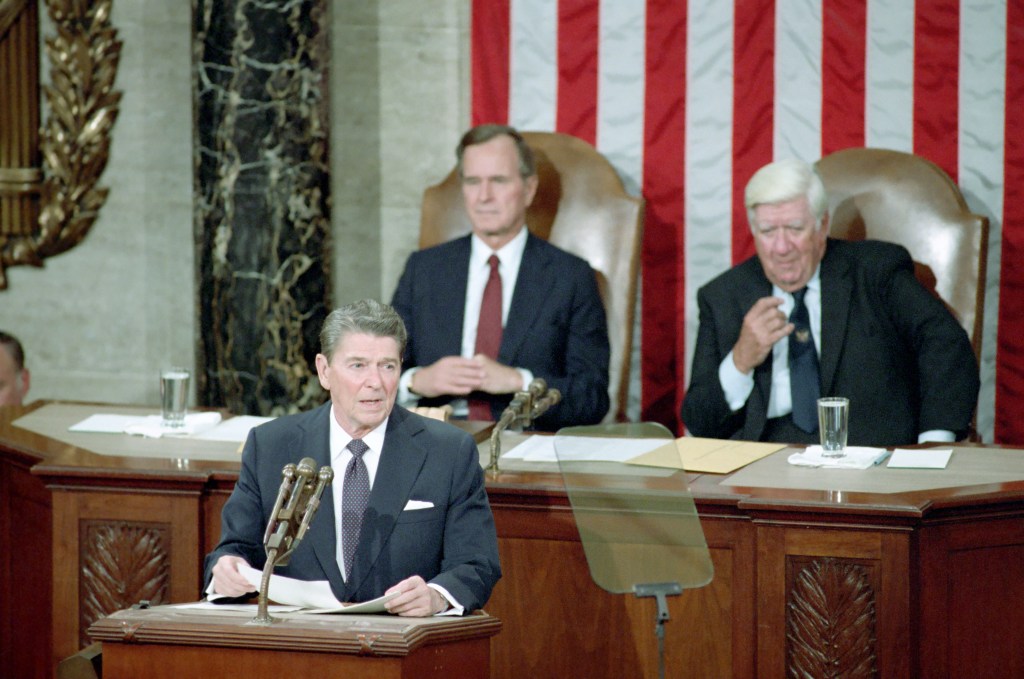
President Reagan delivers his State of the Union Address before a Joint Session of Congress. President Reagan appealed tonight to Republicans and Democrats to unite in an effort to control Government spending, saying, “It’s time we reduced the Federal budget and left the family budget alone.” In his annual State of the Union Message to Congress, Mr. Reagan singled out support of the American family as a major theme of the remainder of his second term. He cited the family as the “moral core” of a restoration of the nation’s confidence in the future. “Tonight, we look out on a rising America — firm of heart, united in spirit, powerful in pride and patriotism,” Mr. Reagan said in a nationally televised speech before a joint session of Congress. “America is on the move!” Although the speech contained few details, Mr. Reagan proposed a study of the nation’s welfare system and what he termed the “web of dependency” among recipients; ordered a Government review of the possibility of providing insurance for the elderly against “catastrophic illness,” and directed the Treasury Secretary, James A. Baker 3d, to determine if the nations of the world should meet to discuss the alignment of their currencies to thwart “wild currency swings.”
Democratic leaders tonight painted a portrait of America that was starkly different from the picture sketched out by President Reagan in his State of the Union Message. While the President saw a nation marked by prosperity and economic growth, his political opponents spotlighted problems of farm foreclosures, lost jobs and staggering budget deficits. “The best social service agency is a family that’s together,” said Senator George J. Mitchell of Maine, the moderator of the Democrats’ response to the President televised after his address. “The best social program is a good job,” Mr. Mitchell said. “But the policies of the Administration are having the opposite effect. They’re driving more families into hard times and apart, and they’re causing American jobs to move overseas.”
The Defense Department today sent Congress budget documents showing that for the first time the space defense research effort that President Reagan has made his highest military priority is also the largest single program in his weapon budget. The documents provide the first details of what Defense Secretary Caspar W. Weinberger calls an effort to “regain the momentum” in the military buildup, with proposed increases in appropriations amounting to 12 percent in the fiscal year 1987 and 42 percent through 1991. The proposal includes a $4.8 billion appropriation for the antimissile research effort known officially as the Strategic Defense Initiative, a 75 percent increase over the current fiscal year. The program would grow the following year to $6.3 billion. Congress appropriated $2.75 billion for the current year.
President Reagan said tonight that his Administration would search for new ways to help poor people “escape the spider’s web of dependency” on Government welfare programs. In his State of the Union Message, Mr. Reagan also said he wanted to find ways for the Government and private industry to work together in providing insurance to protect people against the costs of “catastrophic illness.” Neither domestic policy initiative would have any visible effect on spending levels in the President’s budget for the fiscal year 1987, which he sends to Congress on Wednesday. But they could lead to changes in later years.
President Reagan places a call to Mrs. Cheryl McNair, widow of the mission specialist killed in the explosion of the Space Shuttle Challenger.
A retired Central Intelligence Agency analyst accused of spying for the Chinese gave Peking highly classified documents in a personal effort to speed reconciliation between China and the United States, his lawyer asserted today. In contrast to the defense statement on the first day of the trial of the retired analyst, Larry Wu-Tai Chin, the Government charged that Mr. Chin had led a double life for 30 years, spying for money and causing “exceptional damage” to national security. Jacob Stein, Mr. Chin’s attorney, said in his opening statement in the Federal trial here that Mr. Chin would testify about his efforts to assist Chinese factions led by Zhou Enlai that favored better relations with the United States. Unveiling the defense strategy for the first time, Mr. Stein acknowledged that Mr. Chin had given secret documents to the Chinese, including a secret message to Congress from President Nixon that indicated fundamental changes in American policy toward China.
At least eight persons were killed and one was critically injured in a thunderous explosion that demolished a furniture and appliance store in Crystal Springs, Mississippi, and sent a huge mushroom cloud into the sky. “We think it is a natural gas leak, but it is under investigation,” Fire Department Captain Mike Cole said. Cole said firefighters brought the flames under control within 30 minutes and were sifting through the rubble at the Watkins Furniture and Appliance Store in downtown Crystal Springs, a small town near Jackson, searching for more victims.
A mounting number of doctors joined a work slowdown to protest Massachusetts’ soaring malpractice insurance premiums, and patients who were refused orthopedic surgery at affected hospitals rushed to major medical centers. An estimated 25% to 50% of the obstetricians and orthopedic surgeons in the state are withholding services. The Legislature has vowed to address the crisis by April 30. The doctors are particularly angry over a December 27 ruling by the state Division of Insurance that hiked some malpractice premiums by more than 60% retroactive to 1983.
The U.S. Justice Department took legal action to stop a New York county from enforcing a law barring next week’s emergency evacuation test for the Shoreham nuclear power plant. Justice officials filed a motion in federal court saying the law unconstitutionally gives county officials “veto power” over the test, set for February 13. State and county officials contend it would be impossible to safely evacuate local residents in case of a serious accident at Shoreham because Long Island is cut off on three sides by water, meaning people could only flee toward the congested New York City area.
The lack of an air traffic controller at the main Augusta, Georgia, airport should not have caused a Piedmont Airlines pilot to land at the wrong airport, a Federal Aviation Administration official said, and the agency was investigating the incident. Steve McDowell, the pilot of a Boeing 737 en route from Charlotte, North Carolina, to Augusta with 106 passengers, mistakenly landed the plane at Daniel Airfield instead of Bush Airfield, the primary Augusta airport 6 miles away.
Rep. Guy V. Molinari (D-New York) called a new Pentagon contract to Arrow Air “unconscionable” after the Newfoundland crash last December 12 that killed 248 U.S. servicemen and said he has proof the carrier had numerous mechanical problems. Molinari said logbooks and maintenance records he has obtained show a series of problems with various aircraft systems in the weeks before the fatal accident. A House Armed Services subcommittee scheduled hearings for today into Pentagon air charter policies.
A judge stayed jail sentences for leaders of a meatpackers union as striking workers obeyed restrictions on picketing outside the Geo. Hormel & Co. plant. About 100 National Guardsmen blocked off the street leading to the main entrance at the company’s flagship plant in Austin, Minnesota. The ruling by Mower County District Judge Bruce Stone permitted returning and replacement employees to report to their jobs without any incidents.
Mississippi Governor Bill Allain said he had permitted a blue-law repeal bill to become law without his signature, ending state regulation of Sunday business operations beginning July 1. Allain said he had taken no action on the bill “because I was fearful that, by signing it, I was in favor of all businesses in Mississippi being open on Sunday.” The new law will allow local governments to enact their own Sunday business regulations if they choose.
The prosecution rested its case today in the trial of a Federal district judge on charges of influence peddling and perjury, and the defense was denied a request for a directed verdict of acquittal. The motion for acquittal was denied by Federal District Judge James H. Meridith. The Government charges that the defendant, Judge Walter L. Nixon Jr., who has been on the Federal bench since 1968, accepted $60,000 in oil and gas interests in three wells for a wealthy businessman, Wiley Fairchild, in exchange for Judge Nixon’s help in trying to get state drug charges dropped against Mr. Fairchild’s son, Drew.
A dealer in rare Mormon documents was charged with first-degree murder in the booby-trap bombings that killed a bishop and the wife of another bishop last October. Officials said the dealer, Mark W. Hofmann, had surrendered at Salt Lake City-County Jail. Prosecutors hope to hold him without bail.
Massachusetts officials have not decided whether to appeal a judge’s ruling reinstating physical punishments for five autistic students at a special care institute. Last September, after the Massachusetts Office for Children banned physical punishments for students of the Behavior Research Institute, based in Providence, Rhode Island, attorneys for the institute and parents of six students asked Judge Ernest Rotenberg of Bristol County Probate Court to make exceptions on the ground that the students’ behavior had regressed.
After more than two decades of investigations and litigation, the Teamsters Central States, Southeast and Southwest Pension Fund says it has virtually severed its financial ties with Las Vegas, the town that union money was said to have built. Last week the fund, which has e $6.4 billion in assets and is the nation’s largest private multiemployer pension plan, received a $37.5 million repayment on its loan to the owners of the Aladdin Hotel, the fund’s final such loan to a Las Vegas casino, according to George W. Lehr, the fund’s executive director. “The fund is now totally out of casino investments anywhere,” said George W. Lehr, the executive director of the Central States fund.
The government rested its case against Dr. Donal M. Billig today after hearing testimony from the commanding officer of Bethesda Naval Hospital that before being suspended from performing heart operations Dr. Billig had agreed to reduce his surgical activity. Dr. Billig, former head of heart surgery at Bethesda, is on trial in a military court on five counts of involuntary manslaughter involving patients who died in or after heart surgery. Dr. Billig, a Navy commander, is to begin his defense when the court-martial resumes Monday.
For nearly 20 years, Paul Tomai worked at the Duquesne Works of the United States Steel Corporation, a huge, dark complex that spreads along the flats by the Monongahela River in the depressed steelmaking city of Duquesne, Pennsylvania. He worked hard, worked himself up. He was a millwright, then a pipefitter, then a welder. But in 1984, U.S. Steel shut the furnace and the rest of the works, saying the facility was outmoded and not sufficiently profitable. It cost the jobs of 2,850 workers, Mr. Tomai among them. People in the valley organized. The Tri-State Conference on Steel, an unusually energetic coalition, gained extensive attention as an example of how workers, unionists, and community and church activists could confront the problem of plant closings, which number in the tens of thousands and have cost millions of jobs. It did not work out. And that the celebrated effort failed is a telling indication of the difficulty — some would call it hopelessness — confronting American steel and other heavy manufacturing in a changed business climate, and the plight facing blue-collar workers throughout the industrial states. For the companies, it means having to abandon, at least in part, the businesses that made them great. For the employees, it means devastation.
Charles Manson, the convicted cult murderer, today lost his sixth bid for parole after he unexpectedly attended a hearing at which he was described as a “caged, vicious, wild animal.” A three-member panel of the California Board of Prison Terms met privately for about 30 minutes before announcing they had found the 51-year-old convicted murderer unsuitable for parole from his life sentence. They set his next hearing for the maximum period of three years. Mr. Manson, who wore long gray hair, a beard and a swastika on his forehead, told the panel that if was released he might go to Libya, Iran or “join the revolution down south somewhere and try to save my life on the planet Earth.” Mr. Manson and four of his followers were convicted in the August 1969 slayings of actress Sharon Tate and four of her guests, plus the slayings of two other people in a separate attack the next night. Before the panel reached its decision, Stephen Kay, chief deputy district attorney in Los Angeles County, said Mr. Manson was “like a caged, vicious, wild animal who, if released, would once again be free to prey on innocent victims.”
Tests showed traces of cocaine, marijuana and a powerful painkiller in Rick Nelson’s blood after the New Year’s Eve airplane fire that killed the singer, his fiancée and five band members, officials said today. Reports released by the National Transportation Safety Board showed small amounts of cocaine and a compound of the prescription painkiller Darvon in Mr. Nelson’s blood and urine samples.
38th NHL All-Star Game, Hartford Civic Centre: Wales Conference beats Campbell Conference, 4-3 (OT); MVP: Grant Fuhr, Edmonton Oilers, Goaltender.
The Dow Jones industrial average moved above the 1,600 level for a brief period yesterday before profit taking and highly sophisticated arbitrage activity pulled it back and gave Wall Street its first loss in three sessions. Activity in the stock market remained brisk, but Jack Baker, the head trader at Shearson Lehman Brothers, said automatic buying and selling programs coming out of the big brokerage firms again dominated the action and caused wild price swings. The Dow had been up as much as 9 points in the morning, when it topped the 1,603 mark, but finished at 1,593.23, down 1.04 points. The blue-chip average, however, was down more than 13 points at one point in the afternoon when the bond market suddenly weakened and when investors apparently became jittery over President Reagan’s State of the Union Message last night.
Dow Jones Industrial Average: 1593.23 (-1.04)
Born:
Nick Hayden, NFL defensive tackle (Carolina Panthers, Cincinnati Bengals, Dallas Cowboys), in Hartland, Wisconsin.
Jerome Simpson, NFL wide receiver (Cincinnati Bengals, Minnesota Vikings, San Francisco 49ers), in Reidsville, North Carolina.
Steven Oleksy, NHL defenseman (Washington Capitals, Pittsburgh Penguins), in Chesterfield, Michigan.
Jordan Smith, MLB pitcher (Cincinnati Reds), in American Fork, Utah.
 History Diaries