From February to March, 72,000 Jews are expelled from the towns throughout the Warsaw region and herded into the ghetto. Almost 400,000 Jews are now crowded into the Warsaw ghetto under the most appalling conditions.
Göring orders the expulsion of Jews from the city of Auschwitz to create housing for construction workers for the I.G. Farben factory.
General Hans von Funck reports to Führer headquarters on his fact-finding mission to Libya and on the critical position of the Italian forces in North Africa.
Italian troops are retreating from Benghazi to Barce, and their movements are spotted by RAF aerial reconnaissance. Middle East Commander General Archibald Wavell returns to Cairo from Nairobi in the evening and approves General O’Connor’s plan to send his XIII Corps armored units south of Green Mountain to try to intercept the rapidly retreating Italians. O’Connor quickly assembles a force under Lieutenant Colonel J.F.B. Combe (the “Combe Force”) to strike out for Msus and Antelat within a couple of days.
A violent step-up in the tempo of British air attacks in Libya was announced today in the prelude to another grand assault aimed this time at Benghazi. The area to Benghazi from fallen Derna and far beyond 700 miles within Libya to Tripoli was the theater of this new aerial offensive, intended to clear the way for British mechanized troops striking westward and to disorganize the Italians far behind their lines. The royal air force announced that “several” tons of bombs had been loosed upon Tripoli, the capital of western Libya and a vital communications center, and that “hundreds’” of bombs had fallen upon Benghazi’s air center, the long-punished airdrome at Barce. Aerial reconnaissance by the RAF reports long columns of Italian transport moving westwards to Barce and tanks are spotted entraining at Barce station.
The Battle of Trebeshina ramps up on 1 February 1941. The Cretan 5th Division, operating as part of II Corps, seizes Trebeshina from the defending Italian Blackshirts, while the 15th Division captures the village of Bubeshi. The Greeks are engaged in a very costly attempt to take the Trebeshinë massif which will take time, effort and a lot of lives. The Italians are fighting more effectively than they have at any time during the campaign. The weather is horrendous, especially at the higher altitudes, crimping operations.
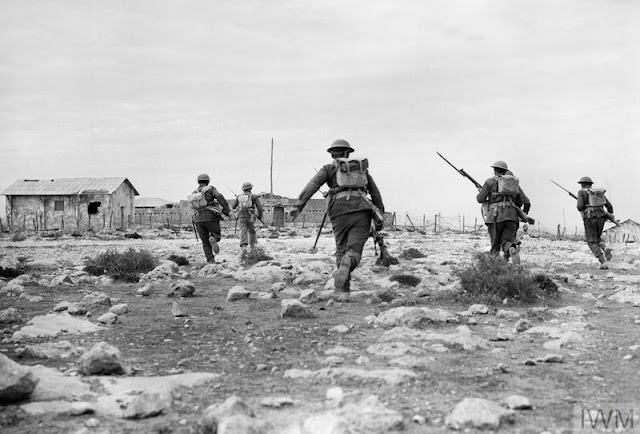
Indian 4th Division captured Agordat, Eritrea, Italian East Africa while Indian 5th Division captured Metemma, Abyssinia. With the mass of defeated Italian troops fleeing from the Mount Cochen defensive line just breached by General Sir William Platt’s Indian 4th and 5th Infantry Divisions, the British 4th Indian Division take Agordat and 5th Indian takes Metemma in Eritrea. This is a key road junction which joins the roads through the two different passes through the mountains used by the two British divisions independently. The Italians left a small garrison in Agordat of about 1000 men. They are captured with 14 damaged tanks, 43 guns and all of the supplies of the base.
The Italians of the 4th Colonial Division are running for Keren, but the plains beyond the mountains are much more difficult to defend against superior forces. The Italians at Barentu use a road that turns into a mule track which forces them to abandon all their vehicles. After this point, they basically retreat cross-country toward Keren.
In Abyssinia (Ethiopia), South African troops take Gorai and El Gumu.
2nd Lieutenant Premindra Singh Bhagat (1918-75) of the Royal Bombay Sappers and Miners won the first Victoria Cross for the British Indian Army in WW2 for a “…continuous feat of sheer cold courage” clearing 15 minefields and 55 miles of roads in 48 hours.
British Prime Minister Winston Churchill continues to obsess about the proportion of British troops in support services in the Middle East. He sends a memo to Secretary of State for War David Margesson complaining in which he purports to be “astonished’ that Margesson has not replied to a previous lengthy memo “paragraph by paragraph and point by point.” He reiterates:
“[E]very effort should be made to secure the highest economy, and deductions drawn from the peculiar condition of the fighting, and the rapid advance made in Libya, do not necessarily apply to a campaign in Thrace or behind the Bosphorus.”
Churchill sends another memo to Minister of Economic Warfare Hugh Dalton expressing a desire to strangle Germany’s copper supplies. Churchill sees a problem in South American copper exports going to Japan and the Soviet Union, from where they can make their way to Germany. He suggests purchasing the South American copper rather than leaving it for others.
Captain William Derek Stephens was named the commanding officer of HMS Mauritius.
Vera Atkins joins the French section of the Special Operations Executive as a secretary. Previously, she has been an Air Raid Precautions warden in Chelsea.
A French version of the Nazi Party was formed in Occupied France today. It is called the ‘Rassemblement National Populaire’ (RNP) [Popular National Assembly], and its aims include “co-operation with Germany” and “protection of the race”, that is, anti-Semitism. Based near the Gare St Lazare, the German-sponsored RNP is led by Marcel Deat, and members include a veteran’s leader, Jean Goy. So far, however, the French seem reluctant to join the new party.
General Maxime Weygand, the colonial military commander of the Vichy government, urged his French African army of 500,000 men today to pay no heed to appeals that they enter the war against the Italians. Instead, he charged his men to support the “national revolution” of Marshal Philippe Petain; to stay out of a fight which, he said, was “ended” for France with the armistice with Germany and Italy. Weygand replied by radio to a broadcast from London Friday night in which the “free French” leader, General Charles de Gaulle, had asked the French in Africa to attack the Italians from the west and thus “help complete the conquest of Libya.”
Georgy Zhukov was appointed chief of the Red Army’s General Staff. Fresh off a highly successful performance in war games, Georgy Zhukov becomes the Red Army’s Chief of the General Staff. Zhukov also is the Deputy Minister of Defense. General Kirponos replaces him as head of the Kieve Special Military District. Zhukov replaces Meretskov, who temporarily is on the outs with Stalin. General Chuikov becomes a chief military adviser to the Chinese High Command.
Members of the Ossebrandwag (“Ox-wagon Guard”) (OB) riot in Johannesburg, with 140 soldiers seriously hurt. The OB is a Boer militant group that, according to later documents, is:
“…based on the Führer-principle, fighting against the Empire, the capitalists, the communists, the Jews, the party and the system of parliamentarism… on the base of national-socialism.”
The OB is openly against the British war effort, but this is the first time that they actually start a riot. The Union government begins cracking down on the OB after this, setting up internment camps.
Responding to a warning call from British freighter Troilus, Royal Navy authorities send aircraft carrier HMS Formidable and heavy cruiser HMS Hawkins to investigate the tanker lanes of the Persian Gulf. The Troilus had spotted German raider Atlantis, disguised as Norwegian freighter Tamesis. However, the Atlantis did not attack the Troilus, and the heavy British warships, operating as Force K, return to base.
RAF Bomber Command dispatches 3 Blenheims during daylight; 1 aircraft bombed a ship off the Dutch coast but scored no hits. No losses. Coastal Command raids Brest — perhaps looking for the Admiral Hipper, which left during the day. There is little Luftwaffe activity during the day.
RAF Bomber Command dispatches 13 Wellingtons overnight to Boulogne but cloud obscured bombing results. No losses.
In Britain, the Air Training Corps was established to provide pre-entry training for cadets over the age of 16 intending to enter the Royal Air Force or Fleet Air Arm.
Oberstleutnant Benno Kosch was named the commanding officer of the German Kampfgeschwader 55 wing.
Wellington bombers based on Malta attack Tripoli. On the island, the government closes the Three Cities during the night as a security measure, as it is largely abandoned due to bomb damage during the Illustrious Blitz. This is a protective measure for the nearby dockyards, the fear being that saboteurs could use the Three Cities ruins as a staging area for diversions from an invasion.
Fighter strength in Malta has increased from the worst days of 1940. The island has been reinforced with the air squadron from the battered HMS Illustrious and currently includes:
— 28 Hurricanes of No. 261 Squadron
— 3 Fairey Fulmars and 4 Gloster Gladiators of No. 806 Squadron.
Ten of the planes are out of service, though, and the Illustrious is no longer available to provide aerial support.
The garrison strength on Malta is 802 officers and 14,767 other ranks.
U-48, commanded by Kapitänleutnant Herbert Schultze, sank Greek steamer Nicolaos Angelos (4351grt) in 59N, 17W. At 2125 hours on 1 Feb 1941 the unescorted Nicolas Angelos, a straggler from convoy OB-279, was hit near the bridge by one torpedo from U-48 about 130 miles northwest of Rockall after being missed by a first torpedo at 2058 hours. The U-boat waited for the crew to abandon ship and then fired 28 rounds from the deck gun from 2150 to 2215 hours. The ship caught fire and sank by the bow at 23.04 hours. Schultze observed how the survivors set sail in their lifeboat, but they were never found. The 4,351-ton Nicolas Angelos was bound for New York, New York.
Destroyers HMS Somali, HMS Eclipse, HMS Eskimo, and HMAS Napier departed Scapa Flow at 0830 to meet battleship HMS King George V in 62N, 25W at 1600/3rd and escort her to Scapa Flow. Destroyer Napier was detached from the escort and arrived at Greenock at 1400/6th. The battleship and the three destroyers arrived at Scapa Flow at 1300/6th.
Destroyer HMS Keppel departed Scapa Flow at 0200 to escort armed merchant cruiser HMS California from the Butt of Lewis to her patrol position. Following this duty, the destroyer arrived back at Scapa Flow at 1520/3rd.
Anti-aircraft ship HMS Curacoa departed Scapa Flow at 1300 to escort convoy WN.77 until dark. The ship returned to Scapa Flow at 2300.
Submarine HMS Sealion unsuccessfully attacked a German convoy off Stadlandet in 62-11N, 5-24E.
German heavy cruiser Admiral Hipper departs from Brest on another raiding mission. This is Hipper’s second raiding mission, the first having ended in late December after mediocre results. This makes four German heavy warships in the Atlantic at once — Admiral Hipper, Admiral Scheer, Gneisenau, and Scharnhorst — for the first time in the war. However, they are widely dispersed (except for the latter two ships acting in concert) and thus the effects of having all this firepower on the loose at once are somewhat diluted. German battleships Bismarck and Tirpitz are approaching readiness for missions as well, and if they break out to join the four cruisers, the Kriegsmarine would have the possibility of seriously disrupting the Allies’ convoy operations and also of defending themselves against the Royal Navy.
German raiders Scharnhorst and Gneisenau remain in the far north on Operation Berlin. They have rendezvoused with tanker Adria, but rough weather continues to prevent them from topping off yet. After they complete their fuel replenishment, the two heavy cruisers will head for the Denmark Strait to break out into the Atlantic.
The Mediterranean Fleet departed Alexandria as a diversion for operations by Force H in Operation MC.4. Light cruiser HMS Orion, anti-aircraft cruiser HMS Bonaventure, destroyers HMS Ilex, HMS Hero, and HMS Hereward departed Alexandria at 0300. After leaving harbor, the destroyers proceeded to the northeast to sweep the waters around Rhodes on the night of 1/1 February. The destroyers were then to proceed to Suda Bay to arrive by 0700/2nd. The cruisers proceeded past Kaso Strait and then turned towards Suda Bay and met the three destroyers at 0430/2nd. Battleships HMS Warspite and HMS Barham, aircraft carrier HMS Eagle, and destroyers HMS Jervis, HMS Juno, HMS Janus, HMS Nubian, HMS Mohawk, HMS Diamond, HMS Defender, HMS Wryneck, HMAS Vendetta, and HMAS Vampire with light cruiser HMS Ajax, Australian light cruiser HMAS Perth, and destroyer HMS Jaguar departed Suda Bay at 2200/1st and joined the Main Force. When these ships joined the Main Force, destroyer Wryneck was detached to return to Alexandria, via the Western Desert. Anti-aircraft cruiser Bonaventure was detached to return to Alexandria due to her shortage of ammunition. At 1800/2nd, light cruisers Orion, Perth, and Ajax with destroyers Ilex and Hereward were detached to cover the movements of destroyers Defender and Decoy. Destroyer Hero was detached from the Orion force to the Main Force. RAF personnel were embarked on destroyer Defender which was proceed to Malta for refitting. The destroyer arrived at 0800/3rd. Destroyer Decoy was brought out from Malta, joining the Main Force at 1100/3rd. At 0900, Vice Admiral, Light Forces rejoined the Main Force. At 0930, light cruisers Ajax and Perth were detached for duty in the Aegean and to cover convoys. Destroyers Vampire and Vendetta were detached to fuel at Suda Bay and then escort convoy AS.14 to Alexandria and Port Said. At 1800/3rd, light cruiser Orion, with defects, and destroyer Ilex, with her anti-submarine gear out of action, were detached to Alexandria.
At 1800, destroyer HMS Hasty and corvettes HMS Hyacinth and HMS Salvia departed Suda Bay escorting British steamers Ethiopia and Levernbank. Destroyer HMS Dainty, after towing tanker Desmoulea to Suda Bay, departed Suda Bay at 1400 to join convoy AN.14 before dark.
Convoy OB.281 departed Liverpool, escorted by destroyers HMS Montgomery, HMS Wild Swan, and HMS Witch and corvettes HMS Campanula, HMS Periwinkle, and HMS Pimpernel. The escorts were detached on the 5th when the convoy dispersed.
Convoy BN.14 departed Aden, escorted by light cruiser HMS Caledon, destroyer HMS Kingston, and sloops HMIS Indus and HMS Shoreham. The convoy was dispersed on the 3rd.
U.S. Chief of Naval Operations Harold Rainsford Stark sends Admiral Kimmel a warning dated today that was contained in a 27 January 1941 communication from the U.S. ambassador in Tokyo to the State Department:
“The Peruvian Minister has informed a member of my staff that he has heard from many sources, including a Japanese source, that in the event of trouble breaking out between the United States and Japan, the Japanese intend to make a surprise attack against Pearl Harbor with all of their strength and employing all of their equipment. The Peruvian Minister considered the rumors fantastic. Nevertheless he considered them of sufficient importance to convey this information to member of my staff.”
By coincidence, Admiral Yamamoto is meeting on this very topic with his own staff today on this topic.
Certain passage of the Lend-Lease Bill in the House next week was predicted today as Secretary Knox told the Senate Foreign Relations Committee that he was “positive” the Axis would invade the Western Hemisphere if Britain were overwhelmed and that “the odds would be against us” in meeting an Axis attack. To repel it “we would have to strain every nerve.” The Secretary of the Navy, whose testimony was completed today, declared he was “tremendously worried” lest our aid to Britain might be too late. “The British Navy and British Isles” are our first line of defense, he said, and helping that line to hold is the “primary objective” of the Lend-Lease Bill. The cost would be “a saving and a good investment, even if we never get a dollar or a penny back,” he stated, urging speed in the enactment of the measure. Discussing possibilities of invasion of the Western Hemisphere, Secretary Knox pointed out that Dakar, French West Africa, was “only 1,600 miles” from South America, where, he said, the Axis would establish bases before an attack on the United States. Efforts by us to prevent this would mean a fight for control of the seas, he declared.
The Lend-Lease Bill will pass the House by a minimum margin of fifty votes, it was predicted today by Representative Boland of Pennsylvania, the Democratic whip, and all amendments not acceptable to the Administration forces on the Foreign Affairs Committee will be rejected. This estimate drew the concurrence of Representative Bloom of New York, chairman of the committee, who will be in charge of the legislation on the floor. In the Senate, where a stiffer fight is expected, the opponents have not as yet decided on their strategy when the measure reaches the floor, but they are greatly heartened by the prolongation of the personal feud between President Roosevelt and Senator Burton K. Wheeler of Montana, who will probably act as their generalissimo. The Senate Foreign Relations Committee plans to continue its hearings through next week, when the House will be debating the bill on the floor, with most of next week’s witnesses drawn from the ranks of the opposition.
Senator Wheeler, Montana Democrat, denounced today as “a slanderous attack attributed to a dead man” the story related by President Roosevelt that the late William E. Dodd once quoted Wheeler as saying that Nazi domination of Europe was inevitable. The president, responding to a series of questions yesterday, told reporters he had been informed by Dodd, former ambassador to Germany, that Wheeler expressed such a view at a dinner party in 1934 or 1935. Asked whether Wheeler favored Nazi domination of Europe, the chief executive answered that inevitable was a pretty comprehensive word. Wheeler, who is recuperating from influenza at the home of Ambassador Joseph P. Kennedy at Palm Beach, Florida, said in a statement issued through his office that the accusation was “absolutely false.” He added: “This is a desperate attempt to discredit me because I stand unalterably for American peace and against the entry of the United States into any foreign war.” Wheeler is a leading Senate opponent of the administration’s aid-to-Britain bill.
William E. Dodd Jr. tonight confirmed President Roosevelt’s identification of Senator Burton K. Wheeler, Montana Democrat, as the “well known senator” who at dinner in 1935 said he was resigned to Nazi domination of all Europe. Dodd, son of the late William E. Dodd, former U.S. ambassador to Germany, said that a published serialization of his father’s diary, to which Mr. Roosevelt referred at his press conference yesterday, did not use Wheeler’s name, “but it is to be found in my father’s original manuscript.”
William Gibbs McAdoo, World War I cabinet officer, former senator and distinguished in law, finance and shipping, died today after a heart attack. At 77 still the tall, straight, active figure that he was at 50 when he entered public life as President Wilson’s Secretary of the Treasury, McAdoo had come to Washington from his California home to attend President Roosevelt’s third inauguration. He had had two warnings of a weak heart, one a minor attack suffered in Honolulu about a month ago, but he appeared to be in perfect health last night. He became ill about 2 AM and died at 10:15 AM at his hotel.
Pleading for speed in aid to England, Secretary of the Navy Knox said today he was “positive” there would be an axis attack on the western hemisphere in event Britain fell, and declared “the odds would be against” United States success in repelling it. “We’d have to strain every nerve,” the navy secretary told the senate foreign relations committee in response to a question from Senator Nye, North Dakota Republican, as to whether hemisphere defense would be “hopeless.” “Can we act in time to save Britain if this awful crisis predicted for the near future comes to pass?” Nye asked at another point. (Knox and others have predicted a crisis within 60 to 90 days.) “Frankly, I don’t know,” Knox replied. “I’m tremendously worried.”
General Order 143 split the United States Fleet into separate Atlantic, Pacific and Asiatic Fleets. The Navy Department announces reorganization of U.S. Fleet, reviving old names Atlantic Fleet and Pacific Fleet; Asiatic Fleet remains unchanged.
The Roosevelt administration raised the status of the U. S. Patrol Force in the Caribbean to fleet status and enhanced the resources in the region. The U.S. Navy began to develop naval facilities in Guantanamo Bay, Cuba; San Juan, Puerto Rico; and St. Thomas, Virgin Islands at a rapid pace.
Marine Corps expansion occurs as the 1st and 2d Marine Brigades are brought up to division strength. The U.S. Marine Corps brigades stationed on the east and west coasts of the United States were reorganized as the 1st and 2nd Marine Divisions, respectively; it was the first time the USMC organized units on the divisional level. To the south on the island of Cuba, the U.S. Marine Corps 4th Defense Battalion arrived at Guantanamo Bay from Parris Island, South Carolina, United States. The 1st Marine Division, based aboard the battleship USS Texas, is activated under the command of General Holland Smith. It is created from the 1st Marine Brigade. The division’s units, however, are scattered about the Pacific. The 2nd Marine Division, under the command of General Clayton Vogel, also forms from the 2nd Marine Brigade.
Rear Admiral H. Fairfax Leary relieves Rear Admiral Husband E. Kimmel as Commander Cruisers Battle Force.
Admiral Husband E. Kimmel relieves Admiral J.O. Richardson as Commander in Chief U.S. Fleet in battleship USS Pennsylvania (BB-38) at Pearl Harbor, T.H. The change of command took place with Kimmel reading the orders authorized by President Franklin D. Roosevelt into a CBS News radio microphone. Kimmel replaced Admiral James O. Richardson. Richardson was relieved after he protested the fleet’s forward deployment to Pearl Harbor from its traditional base in San Diego, California to President Franklin D. Roosevelt and to other politicians in Washington, arguing that about the burden of defending a perimeter so far removed.
A quiet warning, “there is much to be done,” replaced the customary roar of saluting guns as Admiral Husband Edward Kimmel became commander-in-chief today of the United States’ three-ocean navy. The warning came from Admiral James O. Richardson as he relinquished command of the world’s mightiest fleet to his 58-year-old friend in the midst of a crucial period in American history. “All of you,” Admiral Richardson told the officers and men of the fleet, “can take pride in the work accomplished under trying conditions. The path ahead is not easy. There is much to be done.” Admiral Kimmel echoed the solemn note with confidence that the navy would be ready for anything, saying: “The days ahead will be busy ones. We will continue to so direct our efforts that we shall be fully prepared to accomplish any task which may be assigned to us.” The might of the fleet he commands was impressively displayed during today’s ceremony under the long 14-inch guns of the battleship Pennsylvania. Within gunshot of the flagship were massed most of the Pacific fleet’s striking force, more than 100 men-of-war aggregating about a million tons of steel. Overhead warplanes roared, all but drowning out Admiral Richardson’s leave-taking statement. “Our navy is the best,” Admiral Kimmel said after the ceremony, “and it will remain the best.”
Admiral William V. Pratt, former chief of naval operations, has been recalled from retirement to active duty and assigned to the navy’s general board. Admiral Harry E. Yarnell, former commander of the Asiatic fleet, and other top-ranking veterans similarly have been summoned back to active duty in recent weeks to help meet demands of the defense preparations.
Rear Admiral Ernest J. King was appointed Commander in Chief, the U.S. Atlantic Fleet and promoted to the rank of four-star admiral. He is good friends with Chief of Naval Operations Admiral Harold “Betty” Stark, and this relationship will come in quite handy in the future.
Vice Admiral Wilson Brown Jr. relieves Vice Admiral Adolphus Andrews as Commander Scouting Force.
Rear Admiral John H. Newton relieves Rear Admiral Gilbert J. Rowcliff as Commander Cruisers Scouting Force.
Construction of Fort Greely on Kodiak Island begins. The base is built as a coast defense base for the naval base on the island and is designed to accommodate 236 officers and 5, 592 enlisted men.
Auxiliary USS Bear (AG-29) and Interior Department motorship North Star depart Bay of Whales; they will proceed via different routes to rendezvous off Adelaide Island to evacuate Antarctic Service’s East Base (see 24 February). Having evacuated West Base, the Interior Department now sends auxiliary USS Bear to Adelaide Island to evacuate Antarctica Service’s East Base later in the month. It is, of course, high summer in the Antarctic.
“Downbeat” magazine reports that Glenn Miller has signed a new three-year contract with RCA Victor Records. The pact guaranteed Miller US$750 a side. Considering inflation, the $750 in 1941 is worth US$9,146 in year 2002 dollars.
The United States planned a third set of locks for the Panama Canal. Construction will be started but war events will overtake the project and it will be abandoned until the 21st Century.
Australian Prime Minister Robert Menzies continues his long journey from Melbourne to London. Today, he reaches Iraq, which is going through governmental turmoil and where a local official suggests that the locals may need a “show the flag” type of visit by Australian forces on their way to Egypt.
Subhas Chandra Bose arrived in Kabul, Afghanistan.
Japanese demands for naval base in southern Indo-China and Siam to facilitate possible moves against Singapore or the Netherlands Indies were anticipated today as reward for Japan’s mediation in the undeclared war between Siam and Indo-China. Reliable quarters said that Japan soon would send a fleet of 15 battleships, cruisers and auxiliary craft to patrol permanently the Gulf of Tongkin, southern Indo-China waters and the Gulf of Siam. It was expected that Japan would demand a base for these men o’war at the uncompleted French Cam Ranh Bay naval base.
Admiral Isoroku Yamamoto discusses Operation Z, the planned attack on Pearl Harbor, with his Chief of Staff. Currently, the plan goes under the name “Operation Hawaii.”
An Ordinance for the Temporary Administration of Agricultural Land was put into force in Japan. The devastation and conversion of agricultural lands came under control of this ordinance, and controls on planting and compulsory cultivation of abandoned agricultural land also began.
Rice rationing begins in Japan. This likely is related to the loss of fertilizer supplies due to the German attack on the phosphate facilities at Nauru in December 1940.
The U.S. War Department orders dependents to leave the Philippines. Sayre recommends American civilians return to the U.S. The War Department vetoes plan to base a heavy bomber force in the Philippines. General MacArthur recommends to Army Chief of Staff George C. Marshall that the entire Philippine Archipelago be defended. The extent of the U.S. military presence on the archipelago is under serious debate, with local commanders such as General MacArthur wishing a larger commitment, but the bureaucrats in D.C. preferring a smaller commitment there and at Guam due to the difficulty of defending isolated positions far across the Pacific.
The Manila Tribune said today Philippine officials were puzzled over the exodus of Japanese from the commonwealth, More than 2,000 Japanese were reported to have left the islands within the past six months, and observers said they believed the departures could be traced to uncertainty over developments in the international situation, the paper stated.
At Maug Island in the Mariana Islands, German raider Orion received one Japanese-built E8N float plane, purchased from Japan earlier that year, from German ship Munsterland. The German naval attaché to Japan, Vice-Admiral Wenneker, has purchased the Nakajima E8N floatplane for Orion, which receives it today at the Maug Islands in the Northern Marianas. This is the only instance where German forces operate with a Japanese plane.
Dow Jones Industrial Average: 123.28 (-0.85)
Born:
Anatoli Firsov, Russian ice hockey left wing (Olympic gold 1964, 1968, 1972; 8 x World C’ship gold), in Moscow, Russian SFSR, Soviet Union (d. 2000).
Franco Nones, Italian cross country skier (Olympic gold medal, 30k 1968; first non-Scandinavian and Soviet/Russian male to win Olympic cross-country gold), in Castello-Molina di Fiemme, Italy.
Dave Hill, AFL tackle (AFL Champions-Chiefs, 1966 [lost Super Bowl I], and 1969; Super Bowl Champions, 1969; Kansas City Chiefs), in Lanett, Alabama (d. 2022).
Joy Philbin, American actress, TV host, and wife of Regis Philbin (“Night and the City”, “Malibu Express”), in New York, New York.
Karl Dall, comedian, singer and television presenter, in Emden, Germany (d. 2020).
Jerry Spinelli, children’s novelist (“Stargirl”), in Norristown, Pennsylvania.
Died:
William Gibbs McAdoo, 77, American lawyer and statesman.
Naval Construction:
The U.S. Navy Fulton-class submarine tender USS Sperry (AS-12) is laid down by the Mare Island Navy Yard (Vallejo, California, U.S.A.).
The Royal Navy Bustler-class rescue tugs HMS Samsonia (W 23) and HMS Bustler (W 72) are laid down by Henry Robb Ltd. (Leith, U.K.).
The Royal Navy “S”-class (Third Group) submarine HMS Surf (P 239) is laid down by the Cammell Laird Shipyard (Birkenhead, U.K.).
The Kriegsmarine (German Navy) Type VIIC U-boat U-764 is laid down by Kriegsmarinewerft (KMW), Wilhelmshaven (werk 147).
The U.S. Navy Gato-class submarine USS Trigger (SS-237) is laid down by the Mare Island Navy Yard (Vallejo, California, U.S.A.).
The Royal Navy Flower-class corvette HMS Saxifrage (K 04) is laid down by Charles Hill & Sons Ltd. (Bristol, U.K.); completed by Richardson, Westgarth & Clark.
The U.S. Navy Aloe-class net tenders USS Locust (YN-17, later AN-22) and USS Palm (YN-23; later AN-28) are launched by the American Shipbuilding Co. (Cleveland, Ohio, U.S.A.).
The Royal Navy Isles-class minesweeping trawler HMS Hoy (T 114) is launched by Cook, Welton & Gemmill (Beverley, U.K.); completed by Amos & Smith.
The Royal Navy monitor HMS Roberts (F 40), name ship of her class of 2, is launched by the John Brown Shipbuilding & Engineering Company Ltd. (Clydebank, Scotland).
The Kriegsmarine (German Navy) Type IXC U-boat U-127 is launched by AG Weser, Bremen (werk 990).
The Royal Navy Fairmile B-class motor launch HMS ML 196 is commissioned.
The Royal Navy harbor defence motor launch HMS HDML 1004 is commissioned.
The Royal Navy harbor defence motor launch HMS HDML 1023 is commissioned.
 History Diaries