That Terrible Day in Florida
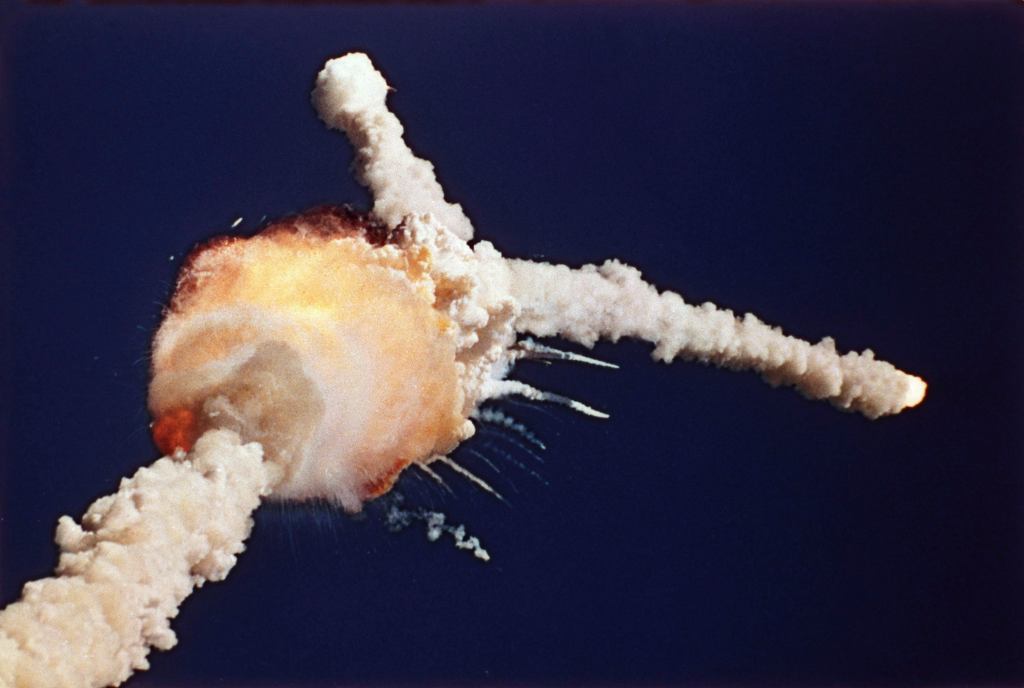
The NASA space shuttle Challenger exploded a minute and a quarter after liftoff from Cape Canaveral, Florida, killing all seven astronauts on board. The space agency offered no immediate explanation for the accident, but suspended all future shuttle flights while it conducted an inquiry. STS-51-L was planned as the first Teacher in Space Project flight in addition to observing Halley’s Comet for six days and performing a routine satellite deployment. The mission never achieved orbit; a structural failure during its ascent phase 73 seconds after launch from Kennedy Space Center Launch Complex 39B on January 28, 1986, destroyed the orbiter and killed all seven crew members — Commander Francis R. “Dick” Scobee, Pilot Michael J. Smith, Mission Specialists Ellison S. Onizuka, Judith A. Resnik and Ronald E. McNair, and Payload Specialists Gregory B. Jarvis and S. Christa McAuliffe.
During the ascent phase, 73 seconds after liftoff, the vehicle experienced a catastrophic structural failure resulting in the loss of crew and vehicle. The Rogers Commission later determined the cause of the accident to have been the failure of the primary and secondary (backup) O-ring seals on Challenger’s right Solid Rocket Booster (SRB). The failure of these seals allowed a flamethrower-like flare to impinge upon one of two aft SRB attach struts, which eventually failed, freeing the booster to pivot about its remaining attachment points. The forward part of the booster cylinder struck the external tank inter-tank area, leading to a structural failure of the Space Shuttle external tank (ET) – the core structural component of the entire stack. A rapid burning of liberated propellants ensued. With the structural “backbone” of the stack compromised and breaking up, the SRBs flew off on their own, as did the orbiter, which rapidly broke up due to overwhelming aerodynamic forces. The launch had been approved despite a predicted ambient temperature of 27 °F (−3 °C), well below the qualification limit of major components such as the SRBs, which had been certified for use only at temperatures above 39 °F (4 °C). Evidence found in the remnants of the crew cabin showed that several of the emergency Personal Egress Air Packs (PEAPs) carried by the astronauts had been manually activated, suggesting that forces experienced inside the cabin during breakup of the orbiter were not inherently fatal, and that at least three crew members were alive and capable of conscious action for a period following vehicle breakup. “Tracking reported that the vehicle had exploded and impacted the water in an area approximately located at 28.64° north, 80.28° west”.
At T+72.284 seconds, the right SRB pulled away from the aft strut that attached it to the ET, causing lateral acceleration that was felt by the crew. At the same time, pressure in the LH2 tank began dropping. Pilot Mike Smith said “Uh-oh,” which was the last crew comment recorded. At T+73.124, white vapor was seen flowing away from the ET, after which the aft dome of the LH2 tank fell off. The resulting release and ignition of all liquid hydrogen in the tank pushed the LH2 tank forward into the liquid oxygen (LOX) tank with a force equating to roughly 3,000,000 pounds-force (13 meganewtons), while the right SRB collided with the intertank structure. The failure of the LH2 and LOX tanks resulted in a type of explosion known as boiling liquid expanding vapor explosion (BLEVE), one where a large part of the liquefied gas evaporates almost instantly.
These events resulted in an abrupt change to the shuttle stack’s attitude and direction, which was shrouded from view by the vaporized contents of the now-destroyed ET. As it traveled at Mach 1.92, Challenger took aerodynamic forces it was not designed to withstand and broke into several large pieces: a wing, the (still firing) main engines, the crew cabin and hypergolic fuel leaking from the ruptured reaction control system were among the parts identified exiting the vapor cloud. The disaster unfolded at an altitude of 46,000 feet (14 km). Both SRBs survived the breakup of the shuttle stack and continued flying, now unguided by the attitude and trajectory control of their mothership, until their flight termination systems were activated at T+110. A major space shuttle malfunction was soon reported by flight controllers, according to a transcript of messages from the controllers on the ground to the Challenger’s commander. “Obviously a major malfunction,” a controller said. This was followed by “We have the report from the flight dynamics officer that the vehicle has exploded.”
Bundled against the cold Florida morning, Ed and Grace Corrigan watched with pride and nervous excitement as the space shuttle Challenger, carrying their daughter, Christa McAuliffe, and six other astronauts, thundered off the launching pad here. Then, 74 seconds into the flight, their excitement turned to disbelief, then horror. There was a puff of smoke and a muffled clap, audible in a viewing grandstand where the Corrigans and relatives of the other astronauts were sitting. There was a moment when nobody was sure what had happened. People around them were still cheering, raising their thumbs in a signal of victory. Then Lisa Corrigan, Mrs. McAuliffe’s sister, hollered and grabbed her father’s hand. Mrs. Corrigan leaned her head on the shoulder of her husband, whose sweater bore a large button with his daughter’s picture. “The craft has exploded,” an official of the National Aeronautics and Space Administration told Mrs. Corrigan. She turned and repeated the message to her ashen-faced husband, as more screams and crying broke the stunned silence around them. In a nearby building, Mrs. McAuliffe’s husband, Steven, their 9-year-old son, Scott, and 6-year-old daughter, Caroline, were also watching as the spacecraft exploded, showering debris into the ocean.
At the launching site was Dr. Charles Resnik, who teaches at the Medical College of Virginia in Richmond. His sister, Dr. Judith Resnik, a Challenger crew member, was to have taken a signet ring and heart locket into space for her 5-year-old nephew, Randy, and 2-year-old niece, Becky, said Dellana O’Brien, a principal at Randy’s kindergarten. The following family members of the astronauts were also among the more than 200 people invited by the astronauts to the launching: June Scobee, wife of Francis R. Scobee, and their two children, Kathie and Richard; Jane Smith, wife of Michael J. Smith, and their children, Scott, Alison and Erin; Lorna Onizuka, wife of Ellison S. Onizuka, and their children, Janelle and Darien; Cheryl McNair, wife of Ronald E. McNair, and their children Reginald and Joy; Marvin and Betty Resnik, parents of Judith A. Resnik, and Marcia Jarvis, the wife of Gregory Jarvis. James Scobee of Auburn, Wash., the brother of the mission commander, Francis R. (Dick) Scobee, preferred not to speak about the disaster. “We’re trying to make arrangements to fly to Houston,” he said, “and I know that although you have a job to do, I’d really not rather say anything.”
Scores of students at Concord High School in New Hampshire were gathered in the auditorium this morning, wearing party hats and cheering and blowing into noisemakers as the space shuttle Challenger roared into the sky with a social studies teacher from the school aboard. They cheered more when they saw a flash. Then an adult in the balcony — no one was sure who — realized that the flash was not the separation of a booster rocket, and yelled, “Shut up, everyone!” A silence descended in time for the students, teachers and administrators at the school where that teacher, Christa McAuliffe, had taught for three years to hear the announcer report, “The vehicle has exploded.” The room was still for a moment, hoping that the unexpected was impossible, that it just was not so, that “a terrible burden of tragedy,” as Charles Foley, the principal, put it, had not struck. Then some of the students and some of the faculty began to cry.
Debris from Challenger’s explosion was scattered so widely over the Atlantic Ocean that it was feared investigators may never recover enough of it to pin down the explosion’s cause. But suspicions quicky focused on the craft’s huge external fuel tank that carried more than 385,000 gallons of liquid hydrogen and more than 140,000 gallons of liquid oxygen at liftoff. The most logical explanation is that a large leak must have occurred either in the tank itself or in the pipeline and pumping system that carried liquid hydrogen to the orbiter’s three main engines. Barbara Schwartz, a spokesman for the Johnson Space Center, acknowledged that pure liquid or gaseous hydrogen cannot burn; only if the pure hydrogen carried in the rear section of the shuttle’s tank were allowed to come into contact with air, or with the liquid oxygen in the tank’s nose section, could it have burned or exploded.
The nation came together yesterday in a moment of disaster and loss. Wherever Americans were when they heard the news — at work, at school or at home — they shared their grief over the death of the seven astronauts, among them one who had captured their imaginations, Christa McAuliffe, the teacher from Concord, New Hampshire, who was to have been the first ordinary citizen to go into space. Shortly before noon, when the first word of the explosion came, daily events seemed to stop as people awaited the details and asked the same questions: “What happened? Are there any survivors?” In offices, restaurants and stores, people gathered in front of television sets, mesmerized by the terrible scene of the shuttle exploding, a scene that would be replayed throughout the day and night. Children who had learned about Mrs. McAuliffe were watching in classrooms across the country.
President Reagan writes in his diary:
“Then I was getting a briefing for a meeting I was to have with network anchors — an advance on the St. of the Union address scheduled for tonight. In came Poindexter & the V.P. with the news the shuttle Challenger had blown up on takeoff. We all then headed for a T.V. & saw the explosion re-played. From then on there was only subject — the death of the 6 crew & 1 passenger — Mrs. McAuliffe the teacher who had won the right to make the flight. There is no way to describe our shock & horror. We cancelled — I should say postponed the St. of the Union address til next week. Cong. closed down for the day. Nancys brother Dick, Patty & son Geoff were already on their way here for the speech also Maureen was here. Well they’ll all be back next week.”
President Reagan addressed the nation about the Challenger Explosion. In brief, nationally televised remarks from the Oval Office late this afternoon, Mr. Reagan, described by his aides as shaken by the disaster, promised “to continue our quest in space.” “There will be more shuttle flights and more shuttle crews and, yes, more volunteers, more civilians, more teachers in space,” he said. “This is truly a national loss. We mourn seven heroes. We mourn their loss as a nation together.”
President Reagan postponed the State of the Union Address he had planned for last night, saying that the day was for mourning and remembering the Challenger’s astronauts. The address was reschedued for next Tuesday.
A personal aside:
Why does the Challenger disaster leave me so heartsick?
There are many reasons. Plenty of obvious ones, to be sure. America lost seven of its brightest and best because a bloated bureaucracy more concerned with “optics” than getting it right made a horrific choice. This accident should NEVER have happened.
There are others, more personal to me.
For one, I was a total space nut as a kid. I watched launches beginning with Project Gemini, and probably before that, though I can’t remember that far back. I followed every Apollo mission from launch to splashdown. I still remember the moment Eagle landed at the Sea of Tranquility.
For another, there is Judith Resnik. She had flown on another shuttle flight before -51L, and the first time I heard her name I did a serious doubletake at my television. I knew someone in high school with a very, very similar name, and just for a moment it startled me. Not the same person, of course. But it prompted a curiosity about her.
If you don’t know much about Judy Resnik, look up her Wikipedia page and read it. She was an amazing person. A woman engineer, at a time when that was no easy thing to become. I’ll just drop in this one paragraph from that Wikipedia page:
“Recognized while still a child for her intellectual brilliance, Resnik was accepted at Carnegie Institute of Technology after becoming only the 16th woman in the history of the United States to have attained a perfect score on the SAT exam. She graduated with a degree in electrical engineering from Carnegie Mellon before attaining a PhD in electrical engineering from the University of Maryland.”
Perfect doesn’t mean a 1600 in this case. It means she answered everything correctly. No errors. Something only 15 other young women had ever done at this time.
She was a freaking genius.
Oh, and of course, she was absolutely beautiful, too, like my high school friend, which never hurt. What can I say? Pretty Jewish girls with dark hair… Might as well be Kryptonite.
In 1985, she and Dick Scobee, the commander of the Challenger on her final flight, came to the University of Arizona, where I was a grad student to give a talk. Scobee had gone to school at U of A back in the 1960s. I fully intended to go; but I got busy, and was not able to attend their talk. I hoped sometime to get another chance.
But no.
On the morning of 28 January 1986, I was in my office working on something when I decided to head over to the student center to get something to eat. It was a bit after 9:30 that morning in Tucson. I entered the building off the quad that runs down from the Old Main at U of A.
I had to pass through the television lounge to get to the food court area. There were always slacker kids plopped on the sofas, chatting and watching soap operas instead of going to class.
On this day, I caught an odd energy as I walked through. People were staring at the TV, silent and confused. I turned my head…
And on the screen were those horrible twisted plumes in the Florida sky. The SRBs were still pinwheeling wildly as they moved away from the main debris cloud.
I had watched shuttle launches since the first. I knew what it was supposed to look like. And this was not that. I knew at once that something was horribly wrong.
I stood rooted to the spot in horror as the first callout came: “Obviously a major malfunction…”
And I knew that there was no hope of surviving this sort of accident.
And then. “We have the report from the flight dynamics officer that the vehicle has exploded.”
And of course we know now that in fact at least a few of them were alive and conscious after the explosion. Some oxygen systems were activated, some switches were thrown on the panel in front of pilot Michael Smith. The crew was fighting to do something to regain control… but there was no hope. The crew compartment had been blown clear of the shattered shuttle. There were no engines. No electrical power. No wings. Just a hunk of metal with seven people in it, hurtling on a ballistic path, up to 65,000 feet in an arc, then inexorably downward, at terminal velocity.
Until the shattered crew compartment of Challenger hit the water below at 200 miles per hour.
There was no surviving that.
CNN’s Tom Mintier saying with a voice heavy with emotion, “I don’t want to have to tell you what I’m going to have to tell you…”
I felt, like most people, shock and grief. The rage came later, as the sordid saga of NASA and Morton Thiokol ignoring the engineers… “Put on your management hat,” came out. As Dr. Feynman rubbed NASA’s nose in it, dunking a rubber O-ring into ice water to show how it became brittle and could be crushed easily with just hand pressure.
NASA knew for years before this flight there was a vulnerability… and they did Nothing. And pushed to launch when the engineers told them it was courting disaster. And they killed seven good people.
January 28, 1986 was the day my childhood admiration of NASA died; only confirmed when another shuttle was lost because no one understood the full and obvious implications of KE = mv2.
I still want to see us explore space, even given the risks… but I would never really trust NASA as an organization again. Pournelle’s Iron Law had claimed another institutional victim.
And that, as much as anything else, leaves me sad.
And, forty years later, I’m now crying again as I write this.
The Soviet Union and the United States resumed two major arms conferences. A final session on European security and disarmament opened in Stockholm, with a September 19 deadline for an agreement. In Geneva, a new round of discussions began on the banning of chemical weapons. This two-week round is an intensification of U.S.-Soviet talks on chemical weapons held in 1984 and 1985. It follows a pledge by President Reagan and Soviet leader Mikhail S. Gorbachev to accelerate efforts to conclude a chemical weapons accord.. Donald Lowitz, chief of the United States delegation to the Geneva Conference on Disarmament, which opens here next week, met for nearly three hours at the United States Mission with the Soviet delegate, Viktor Israelyan, according to a statement released by the mission.
A panel of experts on nuclear weapons design, terrorism and intelligence matters will study the danger of terrorists’ stealing a nuclear bomb or the material to make one. At a news conference today, leaders of the group asserted that the risk of nuclear terrorism is increased by poor security at storage depots and weapons plants, and by the growing amount of weapons-grade plutonium that has been entering the commercial market after being separated from power plants’ nuclear waste. According to Paul Leventhal, a former Congressional staff member who is the group’s executive vice chairman, if current processing rates continue, there will be 400 tons of separated plutonium in private hands by the year 2000, twice the amount now contained in Soviet and American nuclear weapons.
A Rome-to-Venice overnight express train caught fire and was forced to stop in a tunnel shortly after leaving Rome. Most of the 400 passengers escaped unhurt. A passenger aboard the 16-coach train spotted the flames and pulled the emergency brake shortly before the train entered the tunnel near Capena station, about 15 miles northeast of Rome. All but two coaches were inside the 550-yard tunnel when the train stopped.
A 12.5 percent foreign aid increase for the next fiscal year, starting October 1, was requested of Congress by the Reagan Administration. If the increase is granted, the total foreign aid outlay would be $16.3 billion for fiscal 1987.
An adviser to Prime Minister Shimon Peres of Israel said today that Europeans had not pressed Mr. Peres during his tour to negotiate with the Palestine Liberation Organization. The adviser, speaking during Mr. Peres’s visit to West Germany, said Western European leaders seemed less interested in a role for the P.L.O. in future talks. The aide said four heads of government — Prime Ministers Margaret Thatcher of Britain, Ruud Lubbers of the Netherlands and Felipe Gonzalez of Spain and Chancellor Helmut Kohl of West Germany — had praised Mr. Peres for his efforts to seek talks with King Hussein of Jordan and moderate Palestinians not specifically linked to the P.L.O. The Israeli adviser’s remarks came as President Hosni Mubarak of Egypt, beginning a four-day European tour of his own, called on Western European countries to participate in an international Middle East peace conference.
A senior Lebanese Christian leader, former President Suleiman Franjieh, 85, added his voice to the chorus demanding the resignation of President Amin Gemayel. Franjieh, who has close ties to Syria, called Gemayel’s ouster the “only way out” of the crisis created when Christian militia leader Elie Hobeika was overthrown for joining Muslim militias in signing a Syrian-brokered peace agreement. Firing again broke out across the demarcation line that divides Beirut into Christian and Muslim sectors.
King Hussein of Jordan and Yasser Arafat, chairman of the Palestine Liberation Organization, continued their talks here today. But there was no sign of any breakthrough in resolving fundamental differences on the future of the Middle East peace process.
Libya’s leader has offered to help halt Arab terrorist operations in Europe if the United States promises not to attack Libya, Italy’s Prime Minister, Bettino Craxi, said. He said Colonel Muammar el-Qaddafi’s proposal was received in a message from the Maltese Prime Minister. The Italian Government said it received the Libyan leader’s proposal this morning in a message from the Maltese Prime Minister, Karmenu Mifsud Bonnici, who has been trying to serve as an intermediary between Libya and Italy after apparently coordinated attacks on the airports here and in Vienna on Dec. 27. A total of 20 people died as a result of the attacks, 5 of them Americans, and more than 100 people were wounded. A top aide to Mr. Craxi said the Italian Government was still evaluating Colonel Qaddafi’s message to determine “whether there is any substance behind his words.”
In a move with potentially serious economic implications for Libya, most of the Libyan subsidiaries of American oil companies operating here have temporarily suspended exports of their entitled allotment of oil, business executives and diplomats said today. These sources, who spoke on condition that they not be identified, said that only one of the five subsidiaries was still exporting oil. The suspension resulted from concern about the ramifications of President Reagan’s economic sanctions against Libya and the plunge in mid-January in the world price of oil from $25 a barrel on the spot market, where oil not under contract is traded, to $17 a barrel last week. Prices were a little over $20 a barrel today.
An International Red Cross team with 1.5 tons of medical supplies arrived in the South Yemen capital of Aden to try to help thousands wounded in 12 days of fighting between rival Marxist factions. Banks and government offices reopened for the first time in two weeks but schools, acting as temporary shelters for hundreds left homeless by the fighting, remained shut. Meanwhile, South Yemen’s new head of state, Haider abu Bakr Attas, toured the Central Bank and Treasury and called on all employees to return to work.
Soviet forces, using scores of tanks and supported by planes, attacked guerrillas in the eastern Afghan province of Nangarhar and drove them back, killing at least 30 rebels and wounding many more, Western diplomatic sources in Islamabad, Pakistan, said. The guerrillas said they destroyed six tanks, two helicopters and a jet in the January 17-20 fighting. In the western province of Herat, Afghan government forces discovered a major rebel hideout and killed 120 rebels, the diplomats said.
An Indian businessman who was arrested on espionage charges last October was charged today with passing sensitive information to United States diplomats. The businessman, Rama Swaroop, was named last year as a trade representative for Taiwan. He was known to have cultivated friendships with members of Parliament and to have transmitted information about Indian politics to foreign governments. Today was the first time that American diplomats were named as recipients of the information, but it was unclear whether the information was purchased or what the material was. A spokesman from the United States Embassy said it was embassy policy not to comment on such matters. The arrest of Mr. Swaroop has been an embarrassing episode for the Government of Prime Minister Rajiv Gandhi. This week, two senior ministers in Mr. Gandhi’s Cabinet resigned, apparently because it was disclosed they had befriended Mr. Swaroop. A charge document said today that Mr. Swaroop had passed the information over the last several years and that it included political developments, the functioning of Parliament and relations between the Central Government and the Indian states.
Evidence that family members of the candidates in the Philippine presidential campaign collaborated with the Japanese during World War II has emerged as a hotly contested issue in the final days of the race. Relatives of both the opposition presidential candidate, Corazon C. Aquino, and her running mate, Salvador H. Laurel, worked openly for the Japanese. Neither Mrs. Aquino nor Mr. Laurel has disputed the fact. President Ferdinand E. Marcos has pointed up these connections, saying his own record is, in contrast, one of patriotism and opposition to the Japanese occupation force. But United States Army documents that were disclosed last week indicate that Mr. Marcos’s own record is ambiguous on this point.
The family of the late Argentine banker David Graiver was awarded $82 million in damages and 40 lots of property as indemnification for confiscations by the former military regime. The civilian government accepted the out-of-court settlement, designed to prevent future litigation by members of the Graiver family, which was driven to ruin and imprisonment by the generals. The family had been accused of collaboration with Montonero guerrillas. Graiver reportedly died in a plane crash in Mexico in 1976. Six weeks later, his American Bank and Trust Company of New York collapsed, as did other banks in his overseas empire.
Angolan revolutionary and leader of UNITA, Jonas Savimbi visits Washington, D.C.
The Reagan Administration proposed for the first time publicly that it might be in the American national interest for the Chevron Oil Company to terminate the $2 billion annual business in Angola done by its subsidiary, Gulf Oil. A State Department official said the government was telling Chevron and other American companies in Angola that “they are in the middle of a war zone, that they are in the middle of a rather hot political debate in this country, and that they should be thinking about U.S. national interests as well as their own corporate interests as they make their decisions.” The statement, made at a news conference by Chester A. Crocker, Assistant Secretary of State for African affairs, differed from previous Government expressions of support for American businesses in Angola. Today’s statement seemed part of an effort to put renewed pressure on the Marxist authorities in Angola to agree to a diplomatic compromise with South Africa that would lead to the withdrawal of the 30,000 Cuban combat troops now in Angola.
Uganda National Resistance Army fighters moved eastward from the captured city of Jinja in pursuit of fleeing government soldiers. Diplomats said troops of the old government were putting up only token resistance. Uganda radio said a new president will be sworn in today. An aide to Yoweri Museveni, commander of the victorious rebels who took Kampala last weekend, said Museveni will be the new president. Ugandan rebels who overthrew the Government two days ago were reported today to have clashed with another rebel faction. Troops of the National Resistance Army, which seized control on Sunday, battled members of the Ugandan Freedom Movement on a road between Kampala and Jinja, according to Salim Saleh, a field commander of the Resistance Army.
The South African authorities reported today that many of the nation’s black high-school students, some of whom have been boycotting classes for almost two years, had returned to school. They students did so, in some cases, under the surveillance of army and police patrols, who have been the their main adversaries in months of unrest. The students were heeding a call issued by the Soweto Parents’ Crisis Committee and endorsed by the African National Congress, the most prominent of the outlawed guerrilla groups seeking the overthrow of the white government.
The Smithsonian Institution said today that it would sell its $10.6 million in holdings in international investment companies to meet criticism that the companies may have investments in South Africa. The decision was a victory for members of Congress who have asserted that the Smithsonian, which gets most of its funds from the Federal Government, should not be perceived as supporting apartheid.
In his secret long-range directive to the military, Defense Secretary Caspar W. Weinberger, has declared that President Reagan’s space-based missile defense program now shares the “highest priority” among Pentagon programs, equal in status to the five-year campaign to modernize nuclear missiles, Pentagon officials said today. The officials said the statement, in the classified annual “Defense Guidance” document, was a sign of the Pentagon’s determination to protect Mr. Reagan’s program, the Strategic Defense Initiative, from spending cuts as overall military budgets come under assault. The previous guidance document, issued last April, stated that the Pentagon would “actively pursue” an “intensive research program” aimed at protecting the United States against intercontinental missiles, but did not rank it among the Pentagon’s top priorities, according to Pentagon officials. Excerpts from the document were first reported this week in the magazine Armed Forces Journal and were confirmed by Pentagon officials.
A top White House official, in a rare public statement, said reports of a high-level Soviet defection to the West are untrue “to the best of the knowledge of the United States government.” The official, national security adviser John M. Poindexter, acted in response to weekend news reports that the CIA, in a major intelligence coup, had helped a high-ranking KGB officer defect to the United States last year.
Law-enforcement officials said today that a 25-year-old airman had been charged with espionage after he attempted to provide the Soviet Union with classified information about the reconnaissance capabilities of the Air Force, A Federal official said that the suspect, Airman 1st Class Bruce D. Ott of Beale Air Force Base in California, was arrested Wednesday after he contacted the Soviet consulate general in San Francisco and offered to provide Soviet agents with sensitive material involving national security. The Air Force not disclose the arrest until this week, saying that it did not routinely announce arrests of its employees. The authorities declined to comment when asked if Airman Ott had attempted to pass information involving two highly secret spy planes, the U-2 and its successor, the SR-71, based at Beale, which is about 50 miles north of Sacramento.
President Reagan meets with four young heroes who will be mentioned in the President’s State of the Union Address.
Social Security’s financial condition has improved so much that it plans this week to repay $10.6 billion that it borrowed from the Medicare trust fund in 1982, Federal officials said. The repayment comes sooner than had been expected when the 1982 loan was made.
The Internal Revenue Service said it collected a record amount of income data in 1985, snaring enough underpayments to eventually add $2.6 billion to government coffers. Virtually all the tax errors uncovered by the Information Return Program, which uses computers to compare income documents with tax returns, will be reviewed, the tax agency said. More than 8 million taxpayers, including about 1.5 million who fail to file returns, will be contacted.
A retrial for Louisiana’s Governor, his brother and three other defendants charged with racketeering and fraud was scheduled for March 10. Governor Edwin W. Edwards, his brother and three others face a second trial on federal racketeering and fraud charges after a federal judge refused to declare them innocent. The first trial ended December 18 with a hung jury. U.S. District Judge Marcel Livaudais set the new trial for March 10, rejecting the defendants’ arguments that the evidence presented in the first trial was too flimsy. Edwards and the others were accused in an indictment last year of illegally using their influence to obtain state certification for hospital and nursing home projects in which they held interests.
A top New York City official, embroiled in a bribery scandal and recovering from self-inflicted knife wounds that nearly killed him, temporarily turned over his office as president of the borough of Queens to his deputy. Donald Manes’ position as Democratic leader of one of the party’s strongest county organizations began to come apart after he nearly bled to death in a January 9 slashing he first said was done by abductors and later said was self-inflicted. Manes, 52, has not been charged with any crimes.
Philadelphia’s former police commissioner testified today at the trial of a surviving member of the radical group Move that a bomb dropped on the headquarters of the group was intended to drive members out of the fortified house, not to kill people. “I was out there to serve legally issued warrants,” the former commissioner, Gregore J. Sambor, said when asked by the Move member, Ramona Africa, if “you came to arrest me or drop a bomb on my family.” Miss Africa is acting as her own attorney in her trial on charges of conspiracy and assault stemming from the group’s confrontation with the police.
Union meatpackers posted only a few pickets outside Hormel’s flagship plant in Austin, Minnesota, and the governor began recalling National Guard troops as workers in two other states honored picket lines and the company announced record earnings. Striking Local P-9 of the United Food and Commercial Workers Union had expanded its picketing Monday to include plants in Ottumwa, Iowa, and Fremont, Neb. The company then fired about 265 workers who honored Local P-9’s roving pickets.
The Army’s assertions about recent tests of its new $1.6 million armored fighting vehicle were disputed today by a Congressional aide and a Pentagon official. The differences were disclosed in testimony before a panel of the House Armed Services Committee. Anthony R. Battista, a staff member of the committee with responsibility for the research and development of military systems, told the panel that the Bradley Fighting Vehicle had been tested in “an unrealistic manner.” “Very little has been done to demonstrate the effectiveness and survivability of the Bradley,” said Mr. Battista, a persistent critic of the program.
Hamilton Jordan, the White House chief of staff under President Carter, said today that he has been cured of lymphoma, cancer of the lymph system, through an experimental program at the National Cancer Institute. Mr. Jordan, 42 years old, showed reporters a written report from the doctors who treated him with a combination of eight drugs. “We can find no evidence of disease and have classified him in complete remission,” said the report, written by Dr. Robert Young, chief of medicine at the cancer institute in Bethesda, Maryland.
Spending on pollution control equipment created nearly 167,000 jobs last year, enough to make environmental protection the equivalent of one of the largest companies in the American economy, according to a report prepared by a Washington consulting firm, Management Information Services Inc. “The report illustrates that while many have been arguing over how badly environmental programs hurt the economy, a major profit-making, job-creating industry was being born,” the paper said.
An avalanche of freezing air made the temperatures fall to record lows across the Southeast yesterday, although most Florida citrus groves apparently escaped a killing frost, and in the Northeast utility crews worked to restore electricity cut by heavy snow. Along the East Coast, there have been at least 15 deaths from hypothermia or weather-related traffic accidents since Sunday. On Monday, the weather forced schools to close in at least 12 states. Low temperature records for the date yesterday were shattered across the South, into the 30’s in Florida and into the teens and lower elsewhere.
“Uptown… It’s Hot!” opens at Lunt-Fontanne Theater NYC for 24 performances.
Free-agent catcher Darrell Porter signs a one-year contract with the Texas Rangers.
Buddy Ryan, the Chicago Bears’ defensive coordinator, will leave the Super Bowl champions to take the head coaching job with the Philadelphia Eagles, a source said today. Although no official confirmation of Ryan’s appointment was available, Eagles officials have scheduled a news conference for Wednesday. The Eagles’ six-week search for a new coach has spawned numerous rumors, but, said the source, who is close to the team, Ryan’s appointment was “100 percent” certain.
Paul Hornung, whose golden boy image was tarnished in the 1960’s when it was disclosed he had bet on games, finally made it to the Pro Football Hall of Fame on his 15th attempt. When the results of this year’s voting were announced today, Hornung was elected along with four other former National Football League standouts: Fran Tarkenton, Doak Walker, Willie Lanier and Ken Houston. They will be enshrined at ceremonies on August 2.
Dow Jones Industrial Average: 1556.42 (+18.81)
Born:
Jessica Ennis, English athlete (Olympic gold medal, heptathlon, 2012; World Championship gold medal, 2009, 2011, 2015), in Sheffield, South Yorkshire, England, United Kingdom.
Nate Jones, MLB pitcher (Chicago White Sox, Cincinnati Reds, Atlanta Braves, Los Angeles Dodgers), in Butler, Kentucky.
Brandon Guyer, MLB outfielder (Tampa Bay Rays, Cleveland Indians), in West Chester, Pennsylvania.
Shruti Haasan, Indian actress and one of the highest paid South Indian cinema actresses, in Madras, India.
Died:
Francis Richard “Dick” Scobee, 46, U.S. Air Force officer and astronaut (NASA Group 8 (1978); STS-41-C, Challenger (1984); Commander, STS-51-L), in the Challenger space shuttle disaster.
Michael J. Smith, 40, U.S. Naval (aviator) Captain and astronaut (NASA Group 9 (1980); Pilot, STS-51-L), in the Challenger space shuttle disaster.
Ellison Onizuka, 39, American Air Force Lieutenant Colonel and astronaut (NASA Group 8 (1978); STS-51-C, Discovery (1985); Mission Specialist, STS-51-L), in the Challenger space shuttle disaster.
Judith Resnik, 36, American electrical engineer, software engineer, biomedical engineer, pilot and astronaut (NASA Group 8 (1978); STS-41-D, Discovery (1984); Mission Specialist, STS-51-L), in the Challenger space shuttle disaster.
Ronald McNair, 35, American astronaut and physicist (NASA Group 8 (1978); STS-41-B, Challenger (1984); Mission Specialist, STS-51-L), in the Challenger space shuttle disaster
Greg Jarvis, 41, American engineer and astronaut (Hughes Aircraft payload specialist; STS-51-L), in the Challenger space shuttle disaster.
Christa McAuliffe, 37, American teacher (NASA Teacher in Space selectee, payload specialist; STS-51-L), in the Challenger space shuttle disaster.
 History Diaries