Peruvian Minister to Japan Ricardo Rivera-Schreiber warns U.S. Ambassador to Japan Joseph Grew about a rumor he has heard at a diplomatic reception. It concerns a coming Japanese assault on Pearl Harbor. Grew swiftly cables Washington that:
“My Peruvian colleague told a member of my staff that he had heard from many sources including a Japanese source that the Japanese military forces planned, in the event of trouble with the United States, to attempt a surprise base attack on Pearl Harbor using all of their military facilities.”
He added that although the project seemed fantastic the fact that he heard it from many sources prompted him to pass on the information.
This information is provided to both Admiral Harold R. Stark, Chief of Naval Operations and Admiral Husband Kimmel, Commander-in-chief of the U.S. Pacific Fleet. They shrug it off. This type of information will be reviewed with great intensity in 1942 and thereafter. Kimmel, in particular, will have great cause to regret his own blasé attitude. However, this attitude is common around the world, as Joseph Stalin similarly discounted warnings at the end of December 1940 from his spy in Tokyo, Richard Sorge. In Washington, military intelligence was surprised only that Grew put credence in the source of the report and not in the supposition of the report.
Aboard his flagship the battleship HIJMS Nagato, Admiral Yamamoto Isoroku, the commander-in-chief of the Combined Fleet, discussed the logical and technical feasibility of an attack on Pearl Harbor. Admiral Yamamoto has a meeting with his staff aboard his flagship, the Nagato, about possible operations against Pearl Harbor. The main problem is that the harbor is considered too shallow for airborne torpedoes. However, some hope is offered by the recent British success at Taranto under similar conditions. The Chief of Staff of the IJN 11th Air Fleet, Onishi Takijiro, consults with one of his technical experts whether a torpedo attack by carrier planes would be possible. The staff officer, Kosei Maeda, says it is impossible. Onishi is unconvinced and summons Commander Minoru Genda. Genda thinks about it and says:
“[T]he plan is difficult but not impossible.”
Yamamoto, meanwhile, turns over the planning to Rear Admiral Ryunosuke Kusaka, who is more worried about the Pearl Harbor anti-aircraft defenses. Genda then suggests that the torpedo problem is fixable and that, to diminish the effectiveness of US defenses, the attack should be made by aircraft carriers parked off the coast and conducted early in the morning. There are other issues, such as the fact that the U.S. fleet would be sunk in shallow water and thus could be salvaged, with minimal loss of life, but Yamamoto is satisfied that the attack can be conducted. While not yet given a code name, this operation will proceed as Operation Z.
Following the capture of Tobruk, two brigades of the 6th Australian Division under Major General Iven Mackay pursued the Italians westwards and encountered an Italian rear guard at Derna.
The day goes well militarily for the Italians, perhaps their best day since the beginning of Operation COMPASS. The Italians holding out in Derna launch strong counterattacks, supported by heavy artillery fire, against the approaching Australians. The British troops, meanwhile, are operating at the end of extended supply lines and have much less artillery support. The Italian Babini Group infantry ambushes a column of Australian 6th Cavalry Regiment Bren carriers, killing four Australians and taking three as prisoners.
However, the British are building up their forces, and the Italian command is gradually peeling away their troops in fear of losing them like so many other troops in Egypt and eastern Libya. Having beaten the Babini Group armor back into Mechili, the 11th Hussars slides around the fortress to the right at Chaulan, between Mechili and Derna. This threatens the Italians at Derna with encirclement. General Annibale Bergonzoli loses his nerve and orders his troops defending Derna to begin preparing to retreat.
The Italian troops continue their suddenly effective conduct by harassing the advancing British at Derna and conducting a scorched earth policy by blowing holes and roads and waylaying the advancing Australians. They remain a strong presence at the northern edge of Wadi Derna near the city. However, the Australian 2/11 Battalion takes the key high ground at Fort Rudero above Derna, capturing five guns and 290 prisoners.
At Mechili, the Babini Group armor has fled, and the British 7th Armoured Division takes possession of the fortress. The British decide to stop and consolidate their position there before heading toward Benghazi.
The British supply situation in Libya is strained. It gets the prospect of relief today when the Royal Navy completes its minesweeping of Tobruk Harbor and the clearing of wrecks and opens it for use. Troopship Ulster Prince arrives to take on the Italian prisoners, while three freighters arrive with supplies. An old nemesis — not the Italians — interferes with the operations there: sandstorms.
Allied shipping docked in the harbor of Tobruk for the first time.
Italy’s “bold and daring” counter-offensive aimed at driving the Greeks out of Albania appeared, on the basis of Greek accounts, to be encountering a stone wall. United Press Correspondent Mary Merlin reported from the front lines that waves of attacking Fascists had been routed above Klisura and an Athens spokesman told of the hurling back of two heavy Italian attacks with “severe” Fascist losses In the region. Rome said nothing of importance was occurring on the Albanian fronts. The Italian counter-offensive at the strategic Klisura Pass completely fizzles on 27 January 1941 despite the presence of four army divisions and one fascist Blackshirt division (considered to be elite troops, like the SS, relative to Italian regular army troops). They make no progress, and the Greeks begin planning a continuation of their own offensive. The Greeks under Major Antonios Goulas capture two key heights, but the weather is brutal. The Italian Blackshirts capture the key Trebeshinë heights after Greek troops there are forced off by the weather.
The Italians bomb Argyrokastro, causing over 500 casualties.
Two Indian Divisions under Major General Platt attacked Agordat and two Indian Infantry Brigades attacked Barentu in Eritrea. The British advance from the Sudan has been held up at this mountain fortress and the bridge across the river Baraka at Agordat. The 4th and 5th Indian Divisions and the Sudan Defence Force began by retaking the border town of Kassala eight days ago. Next day they crossed the frontier. The 5th Indian Div. found Tessanai deserted, its garrison in retreat, and went onto Barentu. Forty miles north a flying column under Colonel Frank Messervy, “Gazelle Force”, penetrated as far as Keru Gorge before being stopped. There the British suffered their only set-back so far. 10th Indian Brigade, trying to outflank the Keru defenses, got lost, was strafed by planes, and its commander, Major General Bill Slim, retired with a bullet in his backside. It was two days before Messervy was through the gorge, his artillery fighting off a frontal cavalry charge on open sights. Now Messervy is outside Agordat and the 5th Indian outside Barentu.
Italy’s foreign minister, Count Galeazzo Ciano and other senior members of the Italian government arrive in Albania to take up active military commands. Ciano takes command of a bomber squadron. This measure is designed to boost morale. The Italian government, sensing a possible inflection point in the winter battles due to some minor recent tactical successes, pulls a motivational trick they have done before, both in earlier campaigns such as Ethiopia and also in Albania. Top government officials such as Foreign Minister Count Galeazzo Ciano travel to Albania to take up active military commands. Ciano, an experienced bomber pilot, takes over a bomber squadron. It is unclear if this is intended more to boost the morale of the troops on the ground in Albania, boost the morale/enthusiasm of the ministers, punish the ministers, or perhaps all three.
Italian manufacturing firm Caproni delivered midget submarines CB-1 and CB-2 to the Italian Navy at La Spezia, Italy. The Italian navy has not particularly distinguished itself so far in the war — mostly staying in port when there are many opportunities to challenge the British — but it excels at midget submarine operations.
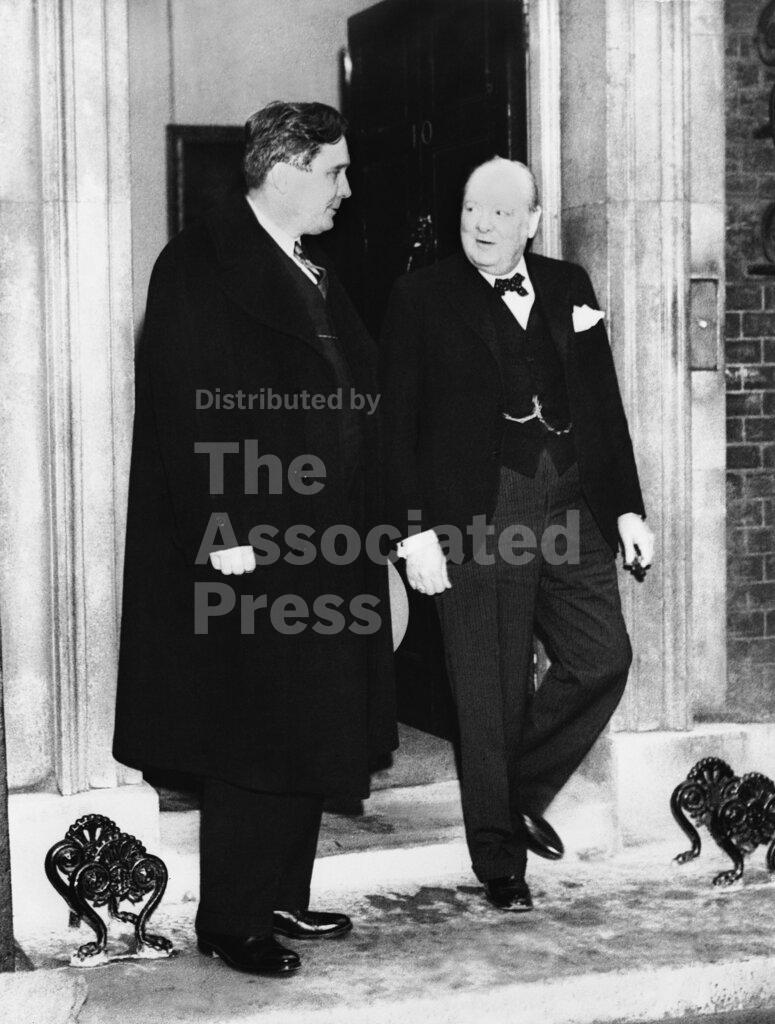
Private Citizen Wendell L. Willkie, displaying the same vigor and enthusiasm of Willkie the campaigner, conferred at length today with the top men of Britain’s war cabinet Prime Minister Churchill, Foreign Secretary Anthony Eden and Labor Minister Ernest Bevm. He will be received by King George, too, it was disclosed tonight, but the date of their meeting was not announced. In his first full day in this capital of empire, Willkie also sandwiched in a quick tour of the City of London, the financial district around St. Paul’s cathedral which was devastated by the German fire bombs raid of Dec. 29, and announced his intention to go to neutral Eire (Ireland) to see Prime Minister Eamon de Valera.
The Luftwaffe attacks the Walker Naval Yard at Newcastle. Aircraft carrier HMS Victorious is still under construction there, and there is a near miss. There are 31 dockworkers injured from shrapnel and flying glass, but the aircraft carrier is undamaged. One of the workmen later perishes.
2 Group, RAF Bomber Command ordered in the event of invasion, 21 Blenheims would be used to spray gas if necessary.
The prototype Avro Lancaster arrives at Boscombe Down for acceptance tests. It is fitted with triple fins and lacks either dorsal or ventral turrets. The prototype Avro Lancaster bomber (apparently still referred to as a type 683 Manchester Mk III with serial No. BT308) is flown from Woodford, where it made its first test flights, to Boscombe Down. There, the Aircraft and Armament Experimental Establishment (A&AEE) intends to swap in Rolls Royce Merlin X engines. Everybody is very excited about the huge improvements so far over the disappointing Manchester.
Almost the entire Jewish population of West and East Flanders and the city of Antwerp have been sent to concentration camps, it was reported today. The Jews were taken from their homes and placed in camps at Hasselt in the Province of Limbourg. The exact number affected was not known, but one report was that more than 40,000 had been rounded up. It was understood the measure was taken to eliminate Jews from regions where the Flemish nationalist movement is strongest because Jews are considered “obvious enemies of the Axis.”
All civil servants and state officials in Vichy France are ordered to swear an oath of allegiance to Marshal Petain. Constitutional Act No. 7 was passed in Vichy France, requiring state secretaries, high dignitaries and high officials to swear allegiance to the Chief of State. Article 3 stated that if any of them should prove “unfaithful to his obligations”, the Chief of State was empowered to impose penalties that included loss of political rights and detention in a fortress.
The preparatory work on the Danube bridges of Rumania to enable them to carry the Wehrmacht’s heavy tanks, begins.
Count Stephen Csáky, Hungarian Foreign Minister, died at 2:34 o’clock this morning. Uremic poisoning was said to have been the immediate cause of death. Grave anxiety was felt over his condition throughout the day yesterday and a bulletin issued by his physicians at 7 o’clock last night said that he was “sinking fast.” Count Csáky had been ill ever since he returned from Belgrade, Yugoslavia, where he went to sign the protocols of the Hungarian-Yugoslav friendship pact. Apparently he ate contaminated food on that trip, since his illness, upon his return, was diagnosed as ptomaine poisoning. The uremic condition was a complication of this, a doctors’ bulletin stated.
Premier-General Ion Antonescu today set up a new military regime for strife-torn Rumania and, from a sickbed, ordered sweeping reprisals that may send hundreds of Iron Guard rebels to death before army firing squads. Antonescu was suffering “fatigue” after crushing last week’s bloody rebellion as his new government was announced and drastic measures were taken to crush remnants of Iron Guard resistance. Every Iron Guard follower of Horia Sima who bore arms in the revolt faces a death sentence and all other participants will be sent to prison, it was understood. New German Ambassador Manfred Freiherr von Killinger actively backs the regime, though not with troops. In a rare instance of dissension within Hitler’s inner clique, Propaganda Minister Joseph Goebbels feels that Hitler should have backed the Iron Guard. His reasoning is that Antonescu supports the Freemasons, while the Iron Guard is more in line with Hitler’s own views. However, when he isn’t invading someone, Hitler always tries to remain within legitimate legal frameworks — after he has changed them to suit his agenda, of course — and supports Antonescu despite his tendencies toward moderation.
Hitler, however, also likes to keep his options open, so he has granted political asylum to Iron Guard leader Horia Sima — who Antonescu has had sentenced to death. The Iron Guard members prove useful to the Germans due to their extreme anti-Semitism, and they find gainful employment as camp guards at places like Buchenwald and Dachau.
Antonescu, meanwhile, now obviously has lost the temporary support of the main branch of the Iron Guard led by Sima. He moves to secure the support of some splinter groups of the Iron Guard who had opposed Sima for various reasons. The Codrenists, for instance, become his key ally. They are named for their leader Ion Zelea Codreanu, the father of the deceased Iron Guard founder who views Sima as a usurper to his son’s movement. However, Antonescu has difficulty winning the support of more moderate political groups in the country, and from this point forward his regime is basically becomes a military dictatorship with no claims to legitimacy within an elected government.
A New York Times report circulated claiming that the converted troopship RMS Empress of Australia had been torpedoed and was sinking 200 miles off Dakar. This was in error.
RAF Bomber Command dispatches 1 Blenheim to Antwerp during daylight but it turned back. It then had a combat with a Ju 88 off the Essex coast and claimed hits on it.
RAF Bomber Command attacks Hanover, one of many, many raids which batter this city throughout the war.
British Prime Minister Winston Churchill sends a memo to Sir Archibald Sinclair, Secretary of State for Air, and Hugh Dalton, Minister of Economic Warfare, with some suggestions for the air campaign. He notes:
“There must be a very great deal of railway traffic from Germany to Italy; coal alone should account for nearly 200,000 tons a week averaged over the year. It is obviously most important that this should be impeded in every way.”
Actually, it is not at all obvious that the RAF should attempt to disrupt the coal shipments at this time. Churchill’s blocking the coal shipments to Italy earlier in the war via the English Channel simply forced the shipments to be made by rail over the Alps, a much more secure route. That action also likely inflamed Italian public opinion against Great Britain. RAF Bomber Command has many high priority targets, and the rail lines over the Alps are difficult to disrupt (requiring precision bombing at the extreme range of current RAF bombers). This is another example of Churchill meddling in the military commands to little purpose.
The Fairey Swordfish of RAF No. 830 Squadron, operating out of Malta since the crippling of HMS Illustrious, sink 3950-ton German freighter Ingo off Cape Bon, Tunisia. The survivors are rescued by Italian torpedo boat Orione.
Light cruiser HMS Kenya and destroyers HMS Kelly and HMS Kashmir departed Plymouth to sweep for the German heavy cruiser Admiral Hipper. The light cruiser arrived at Greenock on the 31st.
Anti-aircraft ship HMS Curacoa departed Scapa Flow at 0600 for Liverpool to provide air escort for the battleship HMS Prince of Wales to Rosyth.
Minesweeping trawler HMS Darogah (221grt, T/Skipper J. Harrison RNR) was sunk on a mine eight cables 230° from No. 3 Sea Reach Buoy in the Thames Estuary.
British steamer Ringwall (407grt) was sunk on a mine in the Irish Sea, south of the Isle of Man.
British trawler Caerphilly Castle (275grt) was sunk by German bombing in 52-35N, 12-00W. Three crewmen were lost.
British barge Hedon (73grt) was lost.
Light cruiser HMS Ajax departed Alexandria for Suda Bay to join light cruiser HMAS Perth there. Light cruiser Ajax carried a quantity of supplies to establish the Fleet Air Arm aerodrome at Maleme.
Australian destroyer HMAS Voyager departed Alexandria to relieve destroyer HMS Defender on patrol in the Inshore Patrol.
Tobruk Harbour was opened to British sea traffic. Troopship Ulster Prince (3791grt) arrived and embarked prisoners at Tobruk. She departed the morning of 28 January for Alexandria. British ships Cingalese Prince, Rosaura, and Chakla arrived at Tobruk and unloaded personnel and stores. The disembarkation was hampered by a severe sandstorm.
Destroyers HMS Foresight, HMS Jersey, and HMS Encounter departed Gibraltar to patrol west of Cape Spartel. Destroyer HMS Foxhound departed Gibraltar escorting steamer Northern Prince until dark. The destroyer then joined the Cape Spartel patrol.
Swordfish of 830 Squadron from Malta sank German steamer Ingo (3950grt) off Cape Bon in 34-27N, 14-11E. Italian torpedo boat Orione arrived on the scene and picked up survivors.
Convoy FN.393 departed Southend, escorted by destroyers HMS Quorn, HMS Vanity, and HMS Versatile, and arrived at Methil on the 29th.
Convoy FS.397 departed Methil, escorted by destroyers HMS Valorous and HMS Vimiera, and arrived at Southend on the 30th.
Convoy FS.398 was cancelled.
Convoy HG.52 departed Gibraltar. On 20 February, destroyer HMS Winchelsea joined the convoy and escorted it to Liverpool, arriving on 15 February. There is no information on the other escorts of the convoy.
In Washington today, President Roosevelt conferred with Congress leaders on the Lend-Lease bill, and with General Frank T. Hines of the Veterans’ Administration and former Senator and Mrs. McAdoo. He canceled other appointments because of a cold.
The Senate completed Congressional action on the bill authorizing $300,000,000 in improvements in naval anti-aircraft protection, completed Congressional action on the bill providing for an increase in the number of appointments to the Naval Academy, confirmed the nomination of Frank C. Walker as Postmaster General, received the Wheeler-Nye resolution asking President Roosevelt to question belligerent nations on their war aims, adopted a resolution of sorrow over the death of Representative Simpson and adjourned at 12:55 PM until noon on Wednesday.
The Foreign Relations Committee heard Secretary Hull on the Lend-Lease bill and the Naval Affairs Committee approved bills authorizing improvements in naval anti-aircraft protection, construction of small patrol vessels, expansion of shipyards, etc.
The House heard Representative Simpson eulogized and adjourned in respect to him at 12:29 PM until noon on Wednesday. The Foreign Affairs Committee heard naval and military experts on the lease-lend bill.
The prospect that some changes will be made in the Lend-Lease bill during its consideration by Congress was considered virtually certain as the result of a White House conference tonight when leaders of the Democratic and Republican forces in the legislative branch sought President Roosevelt’s views on certain proposed amendments to the measure for aiding Britain and her allies. The discussion was prompted by a hope of speeding the bill to quicker action.
That changes would be made was inferred from brief oral comment after the conference by Senator Barkley of Kentucky, majority leader of the Senate, who was spokesman for the group. “We naturally do not want to weaken the bill,” he said. “We realize that no one could draw a perfect bill in its first stages. The main thing is to preserve the objective of the legislation.” e emphasized, however, that no commitments and no agreements were reached, adding that none was sought. Senator Barkley said there had been no intensive discussion of any particular phase of the bill but that practically every proposed amendment had been touched upon. These suggested revisions, he recalled, included:
- A time limit for the measure.
- A prohibition against United States naval vessels acting as convoys for British merchant ships.
- A limit on the appropriations to be voted in implementing the bill.
- The submission of periodic reports on its operation by the President to Congress.
Opposition to giving the President authority to take certain action notwithstanding prohibitions in other laws, also was discussed. This subject was not explained further but it was believed it had reference to the Neutrality and other statutes. The objective of the conference, Senator Barkley said, was to clarify several disputed points so that the leaders could in turn clarify them before Congress and the nation.
In his message to congress, President Roosevelt laid down this dictum as a fundamental tenet controlling the vast defense expenditures: “No person should be allowed to get rich out of this program.” The following day the “Big Four” defense chieftains echoed his emphatically with: “If there are those who think they can employ this emergency for any personal advantages, they must dismiss such thoughts.”
Senator Wheeler, Montana Democrat, said today he had been informed that “we have transferred five-sixths of all combat planes produced in the United States during 1940 to England and other countries.” This happened even without enactment of the “lend-lease-give bill,” he said in an address to the American Coalition. “We have transferred so many (planes) that the American air forces do not have a single completely modern plane equipped with fighting armor, self-sealing gas tanks and adequate firing power,” he said. “We have traded 50 destroyers to England while our naval strength lags behind the axis. We have transferred rifles, ammunition and other military equipment to England and all without the bill HR. 1776.”
Mrs. Eleanor Roosevelt told a Yale freshman forum tonight that “the President could take over Mr. Ford tomorrow, if an emergency existed.” The remark, which brought applause, came as a surprise during a question period following Mrs. Roosevelt’s address on “Youth’s Duty Toward Democracy.” The automobile manufacturer’s name was mentioned no more during the evening and there was no amplification. The President’s wife could not be reached for an explanation of her reference to Mr. Ford, but Professor Arnold Wolfers of Yale, host with Mrs. Wolfers to the First Lady, said he believed the manufacturer’s name was used only as an example of big business. Mrs. Roosevelt had been asked what would happen if opposition to the defense program developed on the part of labor.
Viscount Halifax, new British ambassador, said tonight his government had no secret treaties for territorial distribution after the war. The envoy made this statement to reporters at a press conference shortly after Senators Nye, North Dakota Republican, and Wheeler, Montana Democrat, had introduced a resolution calling on belligerents to make known their war aims and to disclose whether there were any “secret treaties for the division of territorial spoils.” Halifax, the former British foreign minister, indicated that he may soon define British war aims in detail for the first time. Briefly, he declared “our first war aim is to win the war and our main peace aim is, with others. to reconstruct the world so as not to have another one.” Asserting that Britons would not be fighting as they are “unless they thought they were fighting for democracy,” Lord Halifax discussed a personal meeting he had with Adolf Hitler in 1937. Hitler, he said, told him it was useless to try to improve Anglo-German relations as long as the British parliament and press were free to criticize Germany. “If that is your idea of what must be done,” Halifax said he told Hitler, “I think I’ve wasted my time and yours.” On the question of American aid for Britain, Halifax asserted that “it’s for you people to form your own opinion on how we are standing up and make up your own minds on what you are going to do to help us.”
This week, for the first time in history, senior U.S. and British military staff officers will meet in Washington, D.C. in secret to hammer out a common strategy in case the United States finds itself at war with Germany or Japan (or both) in alliance with Britain. The talks, known as “ABC1”, illustrate how quickly Washington is changing its view of the danger of war. On 12 November Admiral Stark, the chief of U.S. naval operations, sent “Plan Dog” to the navy secretary, Frank Knox, giving priority to war in the Atlantic and urging closer links with Britain.
Luftwaffe ace Baron Franz von Werra, who escaped from a POW train in Canada earlier in the month, has entered the United States after gaining the assistance of the German consular office in New York City. Today, after departing Ogdensburg, New York by train, he tours New York City under tremendous publicity after checking in at the Astor Hotel in Times Square. Von Werra still suffers from frostbite to his ears as a result of his crossing the St. Lawrence River in a small boat, propelling the boat with his hands, on Friday. He grandly tells the press that his intent is to be deported back to Germany and “shoot down some more [English] planes.” He is scheduled to appear before a federal grand jury in Albany on Thursday. This week may well be the only, or at least last, time that an active Wehrmacht officer openly strolls the streets of an American city.
U.S. Chief of Naval Operations Admiral Harold Stark ordered the 3rd Defense Battalion of the US Marine Corps to Midway, 1st Defense Battalion to Johnston and Palmyra, and 6th Defense Battalion to Pearl Harbor in Hawaii.
A conference on economic co-operation between the countries of South America opened in Montevideo. The conference lasted until February 6.
At the Battle of Southern Honan, the Japanese 11th Army continues its offensive. It captures several towns abandoned by the Chinese, including Chunshui, Shahotien, Chumatien, and Junnan.
Hostilities in the undeclared war between Thailand and French Indo-China will cease at 10 AM tomorrow, the French Government announced tonight. Armistice commissions will be appointed by both sides and negotiations will be opened in Tokyo as soon as possible under the presidency of French Ambassador Charles Arsene Henry. The armistice agreement followed acceptance by Bangkok and Vichy of an offer by Japan to mediate territorial disputes that had led to extensive border warfare.
Japanese Foreign Minister Matsuoka Yosuko asserted that his country would unswervingly hold to its plan for co-prosperity: “Has America any right to object if Japan does dominate the Western Pacific?,” “We must control the Western Pacific,” and that the U.S. should reconsider their prior actions: if the U.S. does not, there is “no hope for Japanese-American relations.”
Japanese Foreign Minister Yosuke Matsuoka’s most recent statement before the Japanese Parliament is commented on today by the German Foreign Office mouthpiece, DiplomatischPolitische Korrespondenz, which gives its full approval.
Dow Jones Industrial Average: 129.03 (+0.07)
Born:
Beatrice Tinsley, English-born New Zealand astronomer and cosmologist, in Chester, England, United Kingdom (d. 1981).
Nick Willhite, MLB pitcher (Los Angeles Dodgers, Washington Senators, California Angels, New York Mets), in Tulsa, Oklahoma (d. 2008).
Bobby Hutcherson, American jazz vibraphone and marimba player (“Little B’s Poem”; SFJAZZ Collective), in Los Angeles, California (d. 2016)
Died:
Count Stephen Csáky, 43, Hungarian Foreign Minister, of uremic poisoning.
Iver Holter, 90, Norwegian conductor (Oslo Philharmonic, 1886-1911), and composer (St. Hans Kveld).
Naval Construction:
The Kriegsmarine (German Navy) Type VIIC U-boat U-599 is laid down by Blohm & Voss, Hamburg (werk 575).
The Royal Fleet Auxiliary Dale-class fleet tanker RFA Ennerdale (X 73; postwar A 173) is launched by Swan, Hunter & Wigham Richardson (Wallsend, Tyne and Wear, U.K.).
The Royal Navy Dance-class ASW trawler HMS Tarantella (T 142) is launched by the Smith’s Dock Co., Ltd. (South Bank-on-Tees, U.K.).
The Royal Canadian Navy Bangor-class (VTE Reciprocating-engined) minesweeper HMCS Outarde (J 161) is launched by North Vancouver Ship Repairs Ltd. (Vancouver, British Columbia, Canada).
The Kriegsmarine (German Navy) Type VIIC U-boat U-371 is launched by Howaldtswerke AG, Kiel (werk 2).
The Royal Navy Flower-class corvette HMS Azalea (K 25) is commissioned. Her first commanding officer is Commander Lieutenant George Carlow Geddes, RNR.
 History Diaries