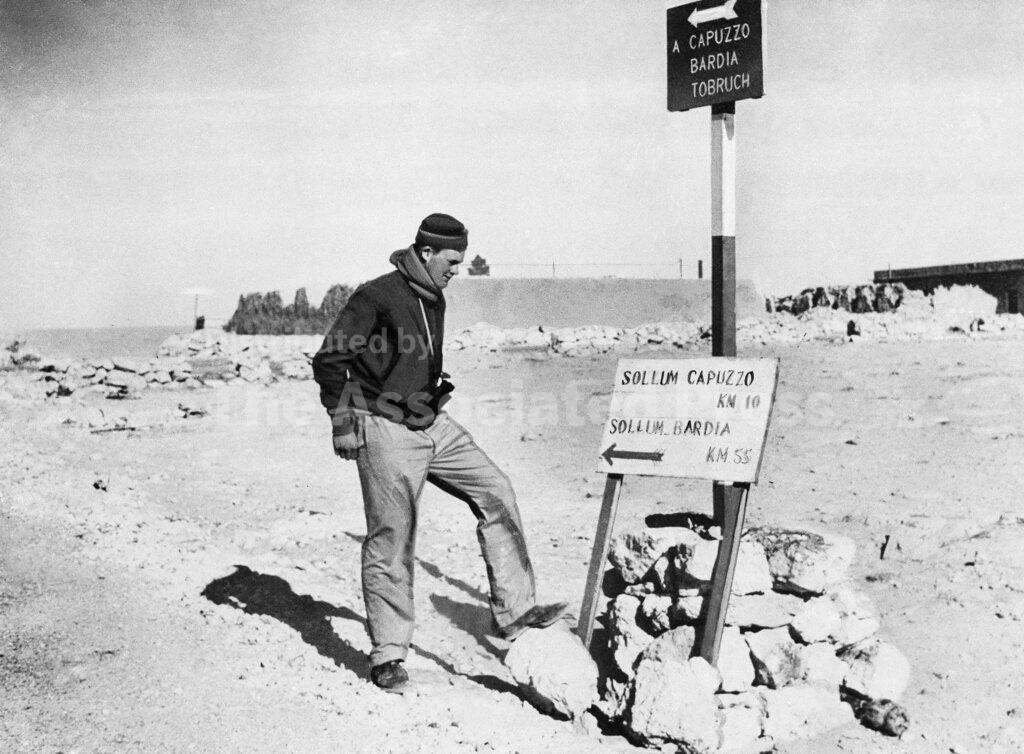
Allied troops captured Derna, Libya. In Libya, Italian troops evacuated Mechili while Allied troops closed on Derna. British troopship Ulster Prince (which would soon depart with Italian prisoners of war) and transports Cingalese Prince, Rosaura, and Chakla (the three brought in supplies and men) became the first Allied ships to arrive in the harbor of recently captured Tobruk, Libya. 100 miles to the northwest, Australian 6th Division captured Fort Rudero near Derna, capturing 290 Italian prisoners and 5 field guns, but the Italian garrison at Wadi Derna nearby continued to pose a serious threat. General O’Moore Creagh of British 7th Armored Division was ordered to cut the coastal road south of Benghazi.
Italian North African commander Marshal Rodolfo Graziani is told by his intelligence people that a massive British tank force is approaching Mechili. This report is greatly exaggerated, but Graziani decides not to take any chances with his main armored force. He orders a withdrawal despite the fact that the Italian Babini Group is holding off the British. The Italians thus voluntarily give up their most favorable defensive position in Libya on the Jebel Akhdar upland area. This action is described in two different ways: 1) the Italians escape the British 4th Armored Brigade of the 7th Armored Division, or 2) the British “let the Italians escape.” In reality, the Italians are not in many difficulties at any point and simply leave before they eventually are forced out.
Graziani makes the decision, however, to order General Giuseppe Tellera, the local commander, to continue defending Derna. The Babini Group is ordered to continue blocking the way west from the area. Tellera asks for more tanks (he has about 50 tanks and the false intelligence reports suggest that the British have 150 tanks approaching Mechili alone when they have only about 50 Cruiser tanks and 95 light tanks along the entire line), but this request is denied. With this decision, Graziani has made it impossible to hold Derna because the British troops can simply sweep around the city now that the Italian tanks are withdrawing.
Thus, the Australians continue outflanking the main Italian positions. The 2/4th Australian Battalion cuts the Derna-Mechili road and crosses Wadi Derna after dark. The Italians counterattack fiercely during the night with the 10th Bersaglieri of the Babini Group at Wadi Derna. They manage to blunt the Australian advance to encircle Derna from the south. The Italians finally are fighting, losing 40 Bersaglieri dead and 56 captured, but it is too late to save Derna. The withdrawal from Mechili uncovers the deep flank of the Derna position. Derna, a town of about 10,000 people, is in serious jeopardy now, particularly since their main infantry force, the 60th Infantry Division “Sabratha,” has been decimated in fierce fighting. However, the Italians continue to defend it.
The British plan is to get around Derna and cut the coast road from Derna to Benghazi. This will isolate the garrison and make its surrender inevitable. General O’Connor of XIII Corps gives the memorable order to General O’Moore Creagh of the 7th Armored Division:
“You are going to cut the coast road South of Benghazi, and you are going now!”
The Luftwaffe begins moving units south to help the Italians out in North Africa. Stab,/JG 27 and II,/JG 27 (Hptm. Wolfgang Lippert) begins moving to Bucharest, Romania as a stepping stone to the Middle East.
British Prime Minister Winston Churchill sends a long message to his Commander-in-Chief Middle East, General Archibald Wavell, in which he elucidates his growing worries about Greece. He writes that the Germans are:
“…already establishing themselves upon the Bulgarian aerodromes and making every preparation for action against Greece.”
Churchill is juggling the competing priorities of Libya and Albania, but it really is a false choice: he has a winning campaign in progress in the former, and basically no chance of affecting the outcome in the latter. He even has admitted recently, to Harry Hopkins, that victory in Greece is impossible against the Germans.
He further writes that:
“…sustaining of the Greek battle, thus keeping in the field their quite large army [becomes] an objective of prime importance…. [T]he massive importance of taking Valona and keeping the Greek front in being must weigh hourly with us.”
The bottom line, according to Churchill, is that Wavell must “conform [his] plans to larger interests at stake” because “the destruction of Greece would eclipse victories … in Libya and might affect decisively [the] Turkish attitude.” In fact, contrary to Churchill’s belief, Greece will remain little more than a sideshow to the decisive battles of World War II.
With this message, Churchill makes clear that his overriding objective at this stage is political, not military, and that winning a battle is not the same as winning the war. It is highly reminiscent of later reasoning by Adolf Hitler, who routinely places political objectives before military reality during the campaign in the Soviet Union.
Churchill replies to Wavell’s refusal of another South African division:
“… I thought you wanted to have a large strategic reserve in the Delta…there is no need to send another division to swell the troops in Kenya. … How can you expect me to face the tremendous strain upon our shipping, affecting as it does all our food and import of munitions, to carry divisions from England to the Middle East when a South African division would have less than half the distance to come?”
Evidently, Churchill is having a cranky day. However, the strained tone of his message underlies the strain that the British military is experiencing — despite its absolutely stunning successes in Libya — in the Mediterranean basin.
Italy mounts an unsuccessful counter-attack on the town of Klisura, Albania, captured by the Greeks two weeks ago. The Italians launch on 26 January 1941 their largest attempt yet to recover the strategic Klisura Pass in the center of the front. Greek II Corps, which now includes the 5th Division, struggles to retain control of the pass after effective attacks by the Italian Legnano Division. After picking up some ground, however, the Italian advances lose momentum and the troops fall back. Greek troops smashed in hand-to hand combat a violent Italian counterattack launched at dawn today by plane-ferried troops of Premier Mussolini’s new generalissimo in Albania to “strengthen the morale of his troops,” it was reported tonight. Dispatches from the front said the Greeks were pushing methodically onward into Albania north of Klisura. Some of the troops used in the assault, one of the strongest yet launched by the Italians since the war began almost three months ago, have just arrived from Italy, ferried across the Adriatic sea by plane.
The British continue advancing into Eritrea toward Agordat, taking Biscia. British soldiers pushing deeper into Italian Eritrea are within 10 miles of the rail center of Agordat while, far to the north, British forces are fighting the Italians at Derna, Libya, it was reported tonight. Military sources here said the British captured 100 prisoners in the latest thrust toward Agordat, making 700 prisoners reported taken in the 10-day campaign which has seen the Italians fall back more than 100 miles in front of the British. Agordat itself has little strategic importance but, as one of the chief cities of Italy’s oldest colony, its fall would have considerable effect on the natives of Eritrea and Ethiopia who are growing bolder every mile the British advance. The British were said to be moving rapidly. Military sources declared that with the Italians still retreating there were no obstacles to taking Agordat.
In Kenya, Cunningham writes a letter to Wavell proposing to capture the port of Kismayu around 12 February. The discovery of water at Hagadesu has released just enough transport to make it possible.
Wendell Willkie arrived in London. Wendell L. Willkie, showing the same exuberance as when he campaigned for the presidency last fall, arrived in England today “to do all I can to unite the United States and to give England all the aid that is possible in its struggle for free men all over the world.” His spirits were so buoyant on the flight from Lisbon, Portugal, that he couldn’t keep his seat. He paced up and down in the plane and even helped the navigators chart their course. He carries a personal, handwritten letter from President Roosevelt which has received a great deal of media attention. The letter contains a poem by American poet Henry Wadsworth Longfellow.
Princess Elizabeth grasped the control column of a Royal Air Force Hudson bomber — while it stood firmly within a hangar — during a visit to a flying station this afternoon with her parents, King George and Queen Elizabeth, and her sister, Princess Margaret Rose.
Churchill complains to the Ministry of Labour and CIGS about the slow progress on the installation of the latest and best guns at Dover. He tries to unblock the bureaucratic log jam which is holding up progress.
Churchill, on a very busy day, writes a memorandum showing that he is incensed by what he views to have been an insensitive radio broadcast by a “junior Minister” (Minister of Shipping Sir Ronald Cross) to the United States. He bans all Ministerial broadcasts other than by members of the War Cabinet without his personal approval. This also is an early sign that Cross’s position is in jeopardy.
Churchill sends a message to South African leader General Jan Smuts in which he writes that:
“…it has become apparent that Haile Selassie stands out as the only possible candidate for the throne of a new Abyssinia. The Emperor is, in all probability, the only enlightened Abyssinian Prince.”
Churchill notes that Selassie already has crossed the border and is leading an uprising against the Italian occupiers.
The Luftwaffe continues with only sporadic raids on England both during the day and at night.
Free from German raiders for six nights, London went into the seventh tonight with the feeling commonly expressed that “Hitler is up to no good,” possibly a grand slam attack. There was virtually no aerial activity over Britain during daylight. A single Nazi plane dropped a bomb on the northeast coast without causing damage or casualties. Many observers attributed the German silence to the bad continental weather, but it has been noted that the R.A.F. was able to fly and bomb the Nazi submarine base at Lorient, France, Friday night. Moreover, it is hard to believe that even the worst weather could ground the mass of the German air fleet, especially when the permanent Rhineland airdromes are equipped for blind flying and are only 400 miles from England. Other reasons advanced are the plight of Italy and Rumania have drawn many German aces and ground crews from western Europe and those left behind cannot keep up the raid tempo of the past months. If the Germans were willing to gamble on stopping the victorious march of the British and imperial Army of the Nile in Libya by sending large numbers of aircraft to help Italy this might be the real reason for the inactivity.
RAF Bomber Command sends 1 Blenheim in daylight to Holland which turned back.
RAF Bomber Command dispatches 10 Whitleys and 7 Wellingtons overnight to attack the main post office and telephone exchange in Hannover. No losses.
At 1115 hours on 23 January 1941 the unescorted Lurigethan (Master M. Kennedy), a straggler from convoy SLS.61 due to bad weather, was bombed and set on fire by a German Fw200 aircraft of I./KG 40 in 53°46’N/16°00’W, about 280 miles west of Galway Bay, Ireland. 15 crew members and one gunner were lost. The survivors abandoned ship in the lifeboats, but a boarding party later returned aboard in an attempt to save her. They managed to extinguish the fire amidships, but the fire in the cargo of cotton in #4 hold was out of control, the engine room was wrecked and the ship was slowly settling by the bow. The wireless operator rigged a temporary aerial and sent emergency messages that were heard by Milos, another straggler from the same convoy, which picked up 14 men from two lifeboats about four hours after the attack and landed them at Oban on 27 January. HMS Arabis (K 73) (LtCdr J.P. Stewart, RNR) was detached from convoy HG.50 to assist Lurigethan and eventually found the remaining survivors and the drifting and still burning wreck, picking up the men and staying in the vicinity to wait for a tug to arrive. During the night of 25-26 January, U-105, commanded by Kapitänleutnant Georg Schewe, was attracted by the glow of the fire and while investigating the scene spotted the escort nearby, which was unsuccessfully attacked with a spread of two torpedoes at 0207 hours. The U-boat then left the area after firing one torpedo that hit and sank the Lurigethan at 0320 hours.
Destroyer HMS Wallace (Lieut Cdr E G Heywood-Lonsdale) shoots down a Junkers Ju 88 and a Bf 110 off the East Coast, receiving a great deal of publicity for it.
Submarine HMS Cachalot laid fifty mines in minefield FD.28 in 62-57-30N, 6-52-40E off Bud.
Destroyer HMS Maori arrived at Scapa Flow at 1030 following refitting in the Tyne. Destroyer HMS Maori departed Scapa Flow with escort destroyers HMS Douglas, HMS Cottesmore, and HMS Meynell at 1745 to meet battleship HMS Prince of Wales off Liverpool and escort her to Rosyth. The destroyers were later recalled and the ships arrived back at Scapa Flow at 2300.
Destroyer HMS Inglefield arrived at Scapa Flow at 1730 from refitting in the Nore.
Anti-aircraft ship HMS Curacoa departed Scapa Flow at 1030 to escort convoy WN.74 until dark. The ship returned to Scapa Flow at 2230.
Destroyers HMS Jersey and HMS Jupiter arrived at Gibraltar from England.
British steamer Meriones (7557grt) was sunk by German bombing in 52-53N, 1-47E while ashore Haisborough Sands. The crew was all rescued. The steamer was a constructive total loss.
Dutch steamer Beemsterdijk (6869grt) was badly damaged on a mine twelve miles off Smalls bearing 290. Thirty nine crewmen of a forty two man crew were lost. The steamer anchored at 0930/27th in 51-17N, 6-23W. The steamer subsequently sank. The steamer probably sank on a British mine.
Swedish steamer Belgia (2023grt) in convoy FN.92 was damaged by German bombing near Sunk Light Vessel. The steamer drifted ashore at Frinton on the 27th on fire. Six crewmen were killed. Twenty survivors were rescued by destroyer HMS Cotswold. The steamer arrived at Harwich on 14 February in tow of two tugs. The ship was repaired and renamed Empire Bell.
In convoy FS.395, escorted by destroyer HMS Wallace and trawlers HMS Lord St Vincent and HMS Reids, British steamer Gwynwood (1177grt) was damaged by German bombing abreast No. B3 Buoy, Barrow Deep. The steamer arrived at Gravesend on the 28th leaking from near misses. British steamer Grangetoft (975grt) was damaged by German bombing off B4 Buoy, Barrow Deep.
British steamer Catford (1568grt) was damaged by a mine off Oaze Bank. The steamer beached. She was refloated and arrived at Gravesend on the 27th in tow.
British steamer Sandhill (586grt) was damaged by a mine in 53-43N, 3-15W.
On 26/27 January, German minelayers Tannenburg, Brummer, Konigin Luise, Hansestadt and Danzig escorted by torpedo boats T.12 and Falke and minesweepers M.15 and M.22 from Stavanger laid mines in defensive minefield POMMERN off Norway. On 27/28 January, the same minelayers, escorted by torpedo boats T.12 and T.5 laid minefield ODER.
Submarine HMS Upholder unsuccessfully attacked a steamer off Kerkenah.
Convoy OG.51 departed Liverpool, escorted by sloop HMS Leith and corvettes HMS Bluebell, HMS Candytuft, and HMS Tulip. The corvettes were detached on the 28th and the convoy was joined by destroyer HMS Westcott, which remained with the convoy until 29 January. On the 29th, destroyer HMS Volunteer joined the convoy and remained until 30 January. Corvette HMS Kingcup joined the convoy on the 31st and left that evening, and arrived at Gibraltar on 8 February, escorted by sloop Leith.
Convoy FN.392 departed Southend, escorted by destroyers HMS Cotswold and HMS Westminster and patrol sloop HMS Puffin. The sloop was detached on the 27th, and arrived at Methil on the 28th.
Convoy FS.396 departed Methil, escorted by destroyers HMS Vivien and HMS Woolston. Patrol sloop Widgeon joined on the 27th, and arrived at Southend on the 28th.
Convoy SLG.1 departed Freetown with troopships Kenya (9890grt) and Polish Sobieski (11,030grt) escorted by light cruiser HMS Dunedin and destroyers HMS Velox and HMS Vidette. On 2 February, corvettes HMS Geranium and HMS Jonquil joined, and arrived at Gibraltar on 5 February with the entire escort force.
Senators Wheeler, Montana Democrat, and Nye, North Dakota Republican, announced today that they would seek a senate expression in favor of the United States’ asking the warring nations to “proclaim publicly” their war aims. To this end, they said they would introduce a resolution tomorrow declaring the sense of the senate to be that the president request a statement of war aims from the axis powers, and from England, Greece, China and other “belligerent governments of 1941.” In a joint statement, the senators said these aims should be made clear “before this nation plunges from the brink into the holocaust of war.” “Most historians and students agree,” they added, “that the treaty of Versailles provoked the present war. Before the United States goes any further along the road to war we should have assurances from our potential allies that American boys will not be ploughed under European soil every 25 years.”
Consideration of the Lend-Lease arms bill will again occupy Congress during the coming week, Washington observers predicted. The Senate Foreign Relations Committee is scheduled to start an expected three weeks of open hearings today with testimony by Secretaries Hull, Morgenthau, Knox and Stimson and the House Foreign Affairs Committee will precede executive consideration of the bill with private testimony by the Army Chief of Staff, General Marshall; the acting chief of the Army Air Corps, General Brett, and the Chief of Naval Operations, Admiral Stark.
A complete code of fair practices for Federal administrative agencies was proposed in a statement of additional views attached to the report of the Attorney General’s Committee on Administrative Procedure as filed with, and transmitted to, Congress by Attorney General Jackson last Friday.
At least 1,200,000 men will be called to meet the selective service quota of 800,000 expected by July 1, because about 400,000 will be turned away owing to physical defects.
President and Mrs. Roosevelt tonight attended what was referred to as a “command” performance of the Broadway comedy “Old Acquaintance,” in which Jane Cowl and Peggy Wood had the starring roles.
A British War Relief benefit is held at the Scottish Rite Auditorium in San Francisco.
The Japanese 11th Army continues moving forward in the Battle of Southern Honan, capturing several towns. Domei, the Japanese news agency, reported tonight that a Japanese army had launched an offensive in Central China to crush 100,000 Chinese soldiers operating between the Peiping-Hankow Railway and the Han River. The Japanese, operating in ten columns, were said to have pierced the first Chinese lines. The offensive was launched from Sinyang in Honan Province. It was the fourth major Japanese offensive in the Honan and Hupei Province area within twenty months. The last Japanese operations in that zone ended in a Chinese victory last October. These sources said the Japanese casualties numbered between 15,000 and 20,000.
Japan’s Minister to Thailand declared tonight that his country did not expect a reward for attempting to settle difficulties between Thailand and French Indo-China, whose undeclared war continued although both belligerents had accepted Japanese mediation. The Minister, Yasusato Futami, said in a statement that Japan was prompted to offer her services by a desire for peace and stabilization in East Asia. He said Japan would try to effect a readjustment of the Thailand-Indo-China border according to the principles of justice but that details of proposals were not yet available. A Thai communiqué declared that hostilities were continuing on all fronts. It said “further territory was seized in the Champasak region; the Sisophon bombardment continued, and an advance was started in the Chandaburi sector.”
Foreign Minister Yosuke Matsuoka was quoted by Domei (Japanese news agency) today as saying “the department of friendly relations between Japan and the United States will remain an idle dream” so long as “America maintains her policy of regarding China, instead of the eastern Pacific, as her first line of defense.” Matsuoka testified before a House of Representatives budget committee, the agency reported, and in answering questions concerning recent statements by U. S. Secretary of State Hull described the secretary’s description of the Manchurian Incident as “such an obvious distortion of the facts that it will not bear the barest scrutiny.”
Australian Prime Minister Menzies continues his long journey to visit London, reaching Darwin by air today.
Born:
Scott Glenn, actor (“The Right Stuff”, “Silverado”, “Backdraft”, “Hunt for Red October”), in Pittsburgh, Pennsylvania.
George Gross, Romanian AFL defensive tackle (AFL Champions-Chargers, 1963; San Diego Chargers), in Weilau, Romania (d. 2010).
Gary Moeller, American football coach (University of Michigan, 1990-1994; University of Illinois, 1977-1979; NFL Detroit Lions, 2000), in Lima, Ohio (d. 2022).
Joan A. Steitz, American biologist, in Minneapolis, Minnesota.
Died:
Oscar Loew, 96, German agricultural chemist.
 History Diaries