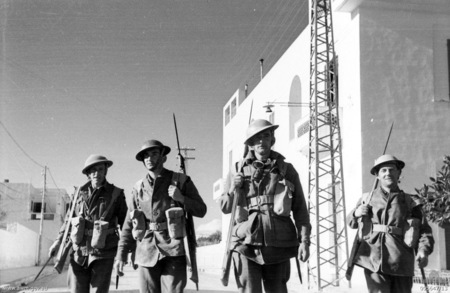
British armored cars, having fallen upon and broken an Italian tank column, were reported tonight to have reached Derna, Libya, 175 miles beyond the Egyptian frontier, under circumstances suggesting that it had been abandoned by the Fascists. During the day they met no resistance so far as could be learned. The Italian tanks were dispersed yesterday. While troops and guns were being advanced along the coast road west of Tobruk as fast as trucks could carry them, armored cars and light mechanized units swept past Martuba airdrome, which the Italians had been occupying only three nights ago.
The tank battle outside Mechili continues between the Italian Special Armored Brigade (Brigata Corazzato Speciale, or Babini Group) and the British 7th Hussars. The Italians had the upper hand on 24 January, destroying half a dozen Light Tank Mk VIs and forcing the British to retreat. Today, the British bring up larger Cruiser tanks — they have 50 — along with 2-pounder anti-tank guns portée and some 25-pounder field guns. The British set up below a ridge, and when the Italian tanks appear at the top, the British blast them. The Italians lose nine M13/40s and only destroy one Cruiser. Having lost radio contact with their command (General Giuseppe Tellera), the Italians return to Mechili. The British essentially win the battle, but they remain blocked by the fortress of Mechili.
Another related battle takes place to the north, at Derna airfield. The Babini Group’s supporting Italian infantry, the 60th “Sabratha” Division, takes heavy casualties against the 2/11th Australian Battalion and the 19th Australian Brigade. The Italians use their planes to good effect, and the flat ground makes the attacking Australians extremely vulnerable. The Italians hold their positions throughout the day despite the heavy casualties, but the British are bringing up more forces while the Italian force is being whittled away.
Both Greek and Italian forces report many cases of frostbite among the troops fighting in the mountains of Albania. Italian forces are reported to be also suffering through an outbreak of typhoid. Conditions are such that neither side can easily conduct offensive operations. Greek soldiers captured more than 100 prisoners in “successful local actions” in Albania and six Italian planes were shot down over the front and during a raid on Salonika, the Greek high command reported tonight. All Greek planes returned safely, it was said.
The Italians have built up their strength in the region of the Klisura Pass — considered to be the gateway to the Italian supply port of Valona — and are ready on 25 January 1941 to make a major push to recapture the critical pass. The Italian Legnano Infantry Division is making some progress on the heights west of Klisura, and area which the two sides have been contesting vigorously ever since the pass was taken by Greek II Corps. The Italians pull back slightly around Tepelini. The RAF bombs Boulsar, near Elbasan.
However, the weather is horrendous in the mountains. Not only are the Italians suffering from frostbite, but there also is an outbreak of typhoid fever. The Greek forces, of course, face the same conditions. However, they have the advantage of help from the local Albanian inhabitants, who strongly support the Greeks whom they view as liberators and often have family ties that cross the border.
Pursuing Italians into the Eritrean foothills, the British were reported over 100 miles inside that East African colony yesterday, nearly halfway to the Red sea port of Massawa. In the southwest sector of the East African offensive, the British were pushing into Ethiopia proper opposite Gallabat. Nigerian, Ghanaian, East African, and South African troops of 11th African Division under British General Harry Edward de Robillard Wetherall and 12th African Division under British General Reade Godwin-Austen crossed into the Italian Somaliland from Kenya. Italian troops withdrew 100 miles behind the Juba River in response.
The British troops continue advancing past the Keru Gorge toward Agordat, a key crossroad. The Italian troops are falling back on the city in disorder. Gazelle Force advances to Biscia.
The British open a new attack by Nigerian, Ghanaian, East African, and South African troops of 11th African Division under British General Harry Edward de Robillard Wetherall, as well as 12th African Division under British General Reade Godwin-Austen. They enter Italian Somaliland from Kenya. The Italians immediately withdraw behind the Juba River, 100 miles behind the border. This is the “Southern Front.”
The heavily damaged aircraft carrier HMS Illustrious (87) arrived in Alexandria for repairs.
British Admiral Sir John Tovey departed Scapa Flow, Scotland, United Kingdom at 2320 hours with a fleet to intercept German pocket battleships Scharnhorst and Gneisenau believed to be in the Iceland-Faroes passage.
Five Norwegian freighters complete their breakout from Gothenburg, arriving at Kirkwall, Scapa Flow under Royal Navy escort. The five ships are:
5460-ton Elizabeth Bakke
4718-ton John Bakke
6962-ton Tai Shan
4767-ton Taurus
6355-ton Ranja
The five freighters are under the command of British Captain R.D. Binney in Operation RUBBLE.
Force J, composed of the aircraft carrier HMS Hermes and light cruiser HMS Enterprise, is operating out of Dakar and searching for Admiral Scheer and other German commerce raiders. It doesn’t find them, but it does intercept Vichy French 8917 ton freighter Sontay and escort it to Durban.
The first British medal of the war awarded to an animal has gone to Chum the Airedale. He has been awarded the “Dogs’ VC” — the Bravery Medal of Our Dumb Friends’ League — for saving the life of Mrs. Marjorie French of Purley. Mrs French was trapped in her air-raid shelter after her home had been destroyed by a bomb. The first signs of rescue were two large paws digging fast and furiously. When he had cleared a large enough opening, Chum seized Mrs French by the hair and dragged her to safety. He did not wait around for rewards and it had taken Our Dumb Friends’ League a while to trace him. He is owned by Mr. and Mrs. Chant of Whyteleaf Road, Purley.
General Ion Antonescu, Rumania’s victorious dictator, offered the leaders of the Iron Guard rebellion today the bleak alternative of suicide or “mass punishment” at the hands of the state. Their chief, Vice-Premier Horia Sima, was reported variously as under arrest or in flight across Soviet Russia, but he and his associates were summoned by the premier to this strange self-judgment: “… You rebels! If you are true Iron Guardists punish yourself with true legionary punishment (and that by tradition is suicide) or otherwise you may be sure that I shall apply mass punishment myself.”
The Minister in charge of the British Legation in Sofia, Bulgaria, reports a conversation with the Greek Minister who believes that the Germans had decided not to invade Bulgaria. Pursuant to the original orders of the Wehrmacht of 11 December 1941, today was to have been when Field Marshal Wilhelm List was to have been ready to cross the Danube from Romania into Bulgaria. However, it is a cold winter, and rail traffic from Germany has been essentially stopped since 4 January, hurting logistical preparations. List only has about two armored and two infantry divisions in place. This is much too weak for an invasion, not necessarily because of Bulgarian strength, but because of the possibility that Turkey will intervene on Bulgaria’s side (or perhaps to occupy Bulgaria itself) with its dozens of divisions. In addition, the Romanian airfields are in terrible shape and insufficient to support the required Luftwaffe forces. The new date for the invasion of Bulgaria is fixed at 24 February, but it is unclear if these difficulties will clear up by then, either. An invasion of Bulgaria will not be necessary, of course, if Bulgaria decides to join the Tripartite Pact, to which its leaders are currently giving hard thought and beginning to lean in favor of joining.
The Luftwaffe only sends over a few attackers during the day and night.
RAF Bomber Command sends 8 Blenheims to oil targets in Holland during the day; all turned back.
RAF Bomber Command raids the U-boat pens at Lorient.
After dark, ten Fliegerkorps X Stukas, perhaps patrolling to find HMS Illustrious and its escorts (which all make port at Alexandria during the day), find other targets. They spot and attack British minelaying cruiser HMS Latona and several accompanying destroyers off Tobruk. Latona is damaged by a 500 kg bomb and sinks at 22:30 after the ship’s magazine blows up. There are 27 deaths. In addition, destroyer HMS Hero is damaged by near-misses. Illustrious, meanwhile, is now safe from air attack and can proceed via the Suez Canal to the United States for permanent repairs.
At Malta, an Italian Cant Z501 flying boat lands off Comino and the crew surrenders. The British go out and arrest them, but are puzzled about why the flying boat landed there (the crew never intended to surrender). The crew explains that they were lost and running low on fuel, and they mistook British searchlights for a signal from their base at Augusta. The large flying, incidentally, sinks in the rough seas.
The RAF on Malta begins air operations against Italian convoys to North Africa, though at first only reconnaissance is performed.
The burning and abandoned 3,564-ton British steam merchant Lurigethan, which was damaged by a German aircraft on January 23, was torpedoed and sunk by the U-105, commanded by Kapitänleutnant Georg Schewe, west of Ireland in the North Atlantic Ocean.
Battleship HMS King George V departed Chesapeake Bay to escort convoy BHX.104, which included 24 tankers, to England. On the 29th, the convoy was met by escort ships and the battleship proceeded to Scapa Flow.
Armed merchant cruisers HMS Wolfe and HMS Circassia departed the Clyde for Northern Patrol.
Anti-aircraft ship HMS Curacoa departed Scapa Flow at 0930 to escort convoy WN.73 until after dark. The ship arrived back at Scapa Flow at 2230.
French destroyer Ouragan departed Scapa Flow for Greenock following working up exercises. The destroyer arrived at 1000/26th.
German steamers Duisberg (7389grt) and Ingo (3950grt) departed Palermo escorted by armed merchant cruiser Lago Tana for Tripoli. From Trapani, armed merchant cruiser Caralis relieved Lago Tana.
Aircraft carrier HMS Illustrious and supporting forces arrived at Alexandria. Australian light cruiser HMAS Perth departed Alexandria the same day for Suda Bay to arrive during the morning of 26 January.
Netlayer HMS Protector, escorted by destroyers HMS Dainty and HMS Jaguar, departed Alexandria with the first half of the anti-torpedo boom for Suda Bay. On arrival at Suda Bay, the destroyers were detached to Kithera patrol.
Aircraft carrier HMS Hermes and light cruiser HMS Enterprise, operating as Force J, intercepted Vichy French steamer Sontay (8917grt) and took her to Durban.
Convoy FN.391 departed Southend, escorted by destroyer HMS Wolfhound and sloop HMS Londonderry. Patrol sloop HMS Widgeon joined on the 26th, and arrived at Methil on the 27th.
Convoy AS.13 departed Piraeus for Port Said, escorted by anti-aircraft cruiser HMS Coventry and destroyers HMS Wryneck and HMAS Vendetta. Minesweeper HMS Fareham joined the convoy from Suda Bay, and arrived on the 27th at Port Said with destroyer Wryneck. Anti-aircraft cruiser Coventry, destroyer Vendetta, minesweeper Fareham arrived at Alexandria at 0700/27th.
Convoy BS.13A departed Suez, escorted by sloop HMS Grimsby. The sloop was relieved by destroyer HMS Kandahar and sloop HMS Yarra. The convoy was dispersed on 1 February.
Convoy HX.105 departed Halifax, escorted by armed merchant cruiser HMS Ascania. On the 27th, submarine HMS Porpoise was with the convoy for that day only. The armed merchant cruiser was detached on 6 February.
There was no BHX.105; the merchant ships presumably going to the UK direct in BHX.104. Destroyers HMS Montgomery, HMS Wild Swan, and HMS Witch, and corvettes HMS Campanula, HMS Periwinkle, and HMS Pimpernel joined the convoy 6 February. The escort was detached on 9 February, and arrived at Liverpool on 9 February.
Viscount Halifax, the new British ambassador, asks the Secretary of State, Cordell Hull, for swift American aid. Lord Halifax, having arrived aboard the battleship HMS King George V at the Chesapeake Bay yesterday, today meets with US Secretary of State and presses the case for US aid to Great Britain. The administration is shepherding House Bill No. 1776, the Lend-Lease bill, through Congress to do just that.
William C. Bullitt told the House Foreign Affairs Committee that invasion of the Western Hemisphere by the Axis powers would be almost certain if the British Navy was eliminated and the Panama Canal blockaded before the United States was prepared. Bullitt said that “for our own self-preservation” the United States should ensure that Britain was not defeated. Declaring that the United States is faced with a “terrible, terrible urgency,” William C. Bullitt told the house foreign affairs committee today that if this country stepped up its production of military equipment to wartime levels Great Britain could defeat Germany. But if Britain falls, the tanned, baldish former ambassador to France said, invasion of the western hemisphere is “almost certain” and encirclement of the United States by totalitarian powers is assured. The foremost of a half dozen witnesses to testify today in behalf of the administration’s British aid bill, Bullitt read a prepared statement and then settled himself in a chair for nearly four hours to answer searching questions covering almost every aspect of the diplomatic world.
A newly completed national survey by the American Institute of Public Opinion, made as Franklin, D. Roosevelt was taking the oath of his Presidential office for the third time, indicates that he has reached the greatest heights of personal popularity ever measured in the seven-year — eighty-three-month — Roosevelt “vote of confidence index” kept by the institute, according to Dr. George Gallup, its director. 71% now approve of FDR.
Kenneth F. Simpson, 44, Republican congressman from the seventeenth New York district and former New York Republican chairman, died tonight. Simpson’s death, doctors said, was apparently due to heart trouble. He had returned ill recently from Washington, but his condition was not thought serious. Former associates of Simpson attributed his ill health to overwork during the recent national political campaign.
Special housing problems of thousands of industrial workers employed under the national defense program were discussed yesterday by Mrs. Franklin D. Roosevelt and labor and civic leaders at the tenth annual meeting of the National Public Housing Conference at the Hotel Roosevelt. Mrs. Roosevelt addressed the luncheon session and suggested that with new housing problems arising, “we should improve many of our local housing authorities to meet the new demands upon them.” She added: “I hope that having a housing coordinator in Washington may clear up some of these problems.”
The U.S. Army and Navy are expected to award contracts within the next few days for construction of a chain of eight naval, military and air bases, involving twenty different establishments, on British islands and territories in the Western Hemisphere.
In Lisbon, Wendell L. Willkie, who expects to fly to London early tomorrow, said tonight he was “for full aid to Britain and against appeasement.” In a press conference after a day of sightseeing and a chat with Premier Antonio de Oliveira Salazar, the “leader of the loyal opposition” in the United States reiterated: “The objective of giving full aid to Great Britain finds myself in full accord with President Roosevelt.” Mr. Willkie said he is going to Britain “to talk with public officials and get their viewpoint and with as many men-in-the-street as possible to see how they think and feel.” Mr. Willkie said his purpose was to “study British production methods and how they better can be made to coordinate with United States industry and, finally, to demonstrate my friendship for an interest in the British and their fate.” He said he was not going to Germany. Mr. Willkie spent forty minutes with Sir Ronald Campbell, British Ambassador to Portugal.
A message congratulating President Roosevelt on his inauguration for a third term was received from Emperor Hirohito of Japan, the State Department revealed today. A wish for “strengthened” United States-Japanese relations was contained in the communication.
Pope Pius XII elevates the Apostolic Vicariate of the Hawaiian Islands to the dignity of a diocese. It becomes the Roman Catholic Diocese of Honolulu.
Thirteen deaths were attributed last night to a snowstorm which late Friday swept over most of the nation east of the Rockies and continued in some sections yesterday. New England, where as much as 14 inches fell, listed seven dead. Four persons died in Pennsylvania and one in Iowa. A 16-year-old boy froze to death sleeping in an automobile in Kentucky. While snow fell in Nebraska, Kansas and Iowa during the day, California reported rain for the thirty-third day out of the past 40. The north central states, Ohio and Missouri and upstate New York expected more snow. Lower temperatures were forecast for New England.
It is Chinese New Year’s Day, and the Japanese decide to partake of the festivities in a particularly macabre way. The Japanese continue their scorched earth policy in China (the Three Alls Policy, the three “alls” being to “kill all, burn all, loot all”).
Panjiayu massacre: The Imperial Japanese Army conducted a massacre of the Chinese village of Panjiayu, Hebei, in accordance with the orders from General Yasuji Okamura that all Chinese villages suspected of harboring communist guerilla fighters were to be wiped out. 1,230 residents of Panjiayu, Hebei, China were massacred by troops of the Japanese Army.
Okamura, incidentally, is a fascinating/loathsome character for a number of reasons. He began the policy of “comfort women” for Japanese troops in China and, despite being convicted of war crimes, never is punished for those crimes on the personal order of Chiang Kai-shek.
Separately, the Japanese 11th Army opens an offensive against the Chinese 5th War Area in the region of Hsaiolintien, Mingkang, and Chengyang. This is known as the Battle of Southern Honan.
The doctrine that Japan cannot allow any other country to mediate or intervene in disputes between Asiatic nations was reaffirmed in the House of Representatives last night by Foreign Minister Yosuke Matsuoka. A similar claim was promulgated by the Foreign Office spokesman, then Eiji Amau, a few years ago.
Dow Jones Industrial Average: 128.96 (+0.44)
Born:
Buddy Baker, American auto racer (Daytona 500 1980; 19 x NASCAR Cup Series wins), in Florence, South Carolina (d. 2015).
Naval Construction:
The Kriegsmarine (German Navy) Type VIIC U-boat U-600 is laid down by Blohm & Voss, Hamburg (werk 576).
The Royal Canadian Navy Flower-class corvette HMCS Sudbury (K 162) is laid down by the Kingston Shipbuilding Ltd. (Kingston, Ontario, Canada)..
The U.S. Navy Iowa-class battleship USS Wisconsin (BB-64) is laid down by the Philadelphia Navy Yard. She will be the last battleship ever completed by the U.S. Navy.
The U.S. Navy transport ship USS Fomalhaut (AK-22) is launched as Cape Lookout, a Type C1 ship cargo ship, by the Pennsylvania Shipyards, Inc. (Beaumont, Texas).
The U.S. Navy Gar-class submarine USS Gudgeon (SS-211) is launched by the Mare Island Navy Yard (Vallejo, California, U.S.A.).
The Kriegsmarine (German Navy) Type VIIC U-boat U-79 is launched by Bremer Vulkan-Vegesacker Werft, Bremen-Vegesack (werk 7).
The Kriegsmarine (German Navy) Type IXC U-boat U-501 is launched by Deutsche Werft, Hamburg (werk 291).
The Royal Navy ocean boarding vessel HMS Hilary (F 22) is commissioned. Her first commanding officer is Commander Trevor Lewis Owen, RD, RNR
The Royal Navy Flower-class corvette HMS Sunflower (K 41) is commissioned. Her first commanding officer is Lieutenant Commander John Treasure Jones, RNR.
The Kriegsmarine (German Navy) Type VIIC U-boat U-201 is commissioned. Her first commanding officer is Oberleutnant zur See Adalbert Schnee.
 History Diaries