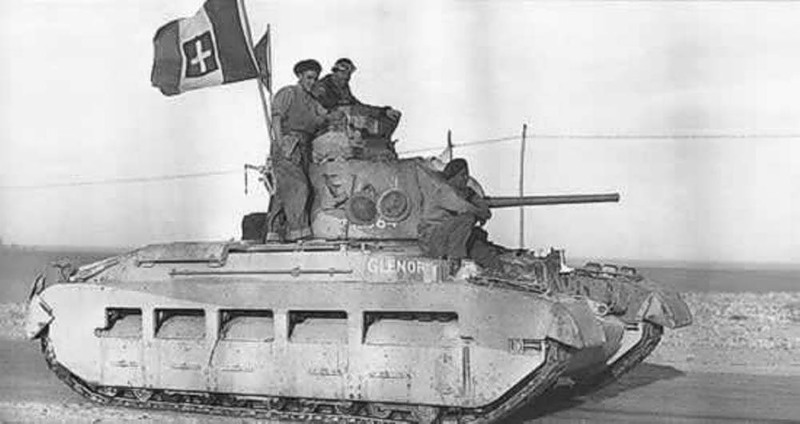
All Italian outposts surrounding Tobruk, Libya were captured by the Allies.
Meanwhile, en route to Derna, Libya, in one of the first tank battles in this arena, the British 4th Armoured Brigade pushes back Italian forces at Mechili. 8 medium Italian tanks are destroyed and one captured. The British lose one cruiser and six light tanks.
The Chiefs of Staff ask Wavell to plan for a possible invasion of Sicily in the event of “dissension” between Italy and Germany.
With the fall today of the frontier post of Liboi, on the Tana River in Kenya, British Lieutenant General Cunningham is poised to advance from Kenya into Italian Somaliland. At the same time South African troops are moving across Kenya’s northern frontier districts to Moyale for an advance northwards. Cunningham’s 12th African Division, made up of East, West and South Africans, has been pushing further south, heading for Jubaland (Southern Italian Somaliland). This is arid country, where thorn thickets stretch to the horizon, and tactics are reduced to tiny groups ambushing other tiny groups. Everywhere there are flies. “Hit them, hit them hard and hit them again!” Cunningham said when his action against the Italians began last month. Some soldiers assume that he meant the flies. Six months ago Britain had one battalion and a brigade of King’s African Rifles in Kenya. Now it has 75,000 men, mostly from African colonies, South Africa and India. Cunningham aims to cross into Italian Somaliland as far as the river Juba and the port of Kismayu, before a major advance further into the territory and onto Ethiopia after the rains in June. Facing him is an army on paper of 100,000 Italian and 200,000 African troops. In reality it is less formidable. One-third is tied down by Ethiopian guerrillas, and another third is defending Eritrea against the British in Sudan. In addition, the Italians are so short of petrol that they cannot concentrate large numbers in any key spot. General de Simone, the Italian commander who seized British Somaliland last August, is aware of this, and is forming a line on the river Juba to try to force the British into linear warfare where their mobility would be useless.
Rumanian Prime Minister General Ion Antonescu successfully completed suppressing an Iron Guard inspired military coup, resulting in the Iron Guard being forced out of a governing role and losing its government protection. During the three-day civil war, won by Antonescu with support from the German army, members of the Iron Guard instigated a deadly pogrom against Jewish residents in Bucharest.
Chief of State Philippe Petain personally selected a super-council of 188 mem bers today to help him govern France but left the body without legislative powers. The council, which includes 69 senators and deputies, will meet solely at his call to discuss only those matters he determines, but he is not obligated to follow its decisions. Whether even the minutes of the group’s meetings, which will be secret, arc to be published rests solely with the elderly marshal who created the group to “give advice and assure useful contact with the people.”
A German He-114 seaplane from armed merchant cruiser Atlantis attacked British ship Mandasor 300 miles east of the Seychelles in the Indian Ocean. Atlantis soon arrived, stopping Mandasor with gunfire, killing 6. A launch from Atlantic drove away sharks with machine gun fire as the Germans rescued 82 survivors. Mandasor was eventually sunk with a torpedo. As the He 114 aircraft attempted to land in the water for recovery, the rough seas caused her to capsize and become lost. Four Allied cruisers later arrived on the scene in response, but Atlantis had already departed.
U-123, commanded by Kapitänleutnant Karl-Heinz Moehle, sank Norwegian steamer Vespasian (1570grt) in 55N, 15W. At 2148 hours, U-123 fired one torpedo at an unescorted steamer and observed the ship to sink by the bow after being hit aft about 290 miles west-southwest of Rockall. The target was most likely the Vespasian (Master Peder Johnsen) which was reported missing after straggling from convoy OB.276 due to bad weather in approximately 55°N/15°W on 23 January. The 1,570-ton Vespasian was carrying ballast and was bound for British Guiana.
Battleship HMS King George V, which had departed Scapa Flow on the 15th, was met in Chesapeake Bay by US destroyer HMS Lansdale. The new British ambassador to the United States, Lord Halifax, was safely delivered.
Light cruiser HMS Phoebe arrived at Scapa Flow after escort duty with convoy WS.5B.
Destroyer HMS Inglefield departed the Nore for Scapa Flow after repair at 1700, and arrived at 1730/26th.
British steamer Corheath (1096grt) was sunk on a mine one mile 270° from Botany Buoy in Thames Estuary. Three crewmen were lost.
British steamer Tasmania (6405grt) was damaged on a mine 11½ miles 90° from Rattray Head. She was unable to enter Aberdeen due to bad weather and returned to Methil, arriving at Methil on the 25th. She left Leith in tow for the Tees on 3 February.
Submarine HMS Triumph, which was unable to leave her dock at Malta due to bombing on the 21st, was successfully cleared from the dock on the 24th. The submarine was able to proceed on patrol at 1830.
Submarine HMS Upholder departed Malta to patrol off Tripoli.
German tanker Nordmark replenished German heavy cruiser Admiral Scheer at sea. The tanker also contacted captured Norwegian tanker Sandefjord on the 24th.
Convoy OB.278 departed Liverpool, escorted by destroyers HMS Saladin, HMS Sardonyx, and HMS Skate, corvettes HMS Anemone, HMS Kingcup, and HMS Mallow, and anti-submarine trawlers HMS Northern Pride and HMS St Elstan. The escort was detached on the 27th when the convoy dispersed.
Today in Washington, President Roosevelt motored to Annapolis, boarded the yacht Potomac and sailed down Chesapeake Bay to meet Viscount Halifax, the new British Ambassador, who arrived on the British battleship King George V. He returned to Washington this evening accompanied by the Ambassador.
With the Senate in recess, the Foreign Relations Committee approved the nomination of Dean G. Acheson to be an Assistant Secretary of State and plans of a subcommittee for hearings next week on the Lend-Lease Bill.
The House passed the bill authorizing the $350,000,000 cargo ship construction program and the bill extending the time in which defense industries may apply for plant amortization certificates and adjourned at 4:42 PM until noon Monday. It received the Doughton bill to raise the national debt limit to $65,000,000,000 and remove tax exemptions from future Federal securities and the President’s request for an appropriation of $175,000,000 for clothing and equipment for the Army. The Foreign Affairs Committee continued hearings on the Lend-Lease Bill and decided to hear Army and Navy chiefs in secret on Monday.
U.S. Secretary of Navy William “Frank” Knox sent a secret memorandum to U.S. Secretary of War Henry L. Stimson regarding the likelihood of an attack on Pearl Harbor in the event of hostilities between the United States and Japan. “MY DEAR MR. SECRETARY: The security of the U. S. Pacific Fleet while in Pearl Harbor, and of the Pearl Harbor Naval Base itself, has been under renewed study by the Navy Department and forces afloat for the past several weeks. This reexamination has been, in part, prompted by the increased gravity of the situation with respect to Japan, and by reports from abroad of successful bombing and torpedo plane attacks on ships while in bases. If war eventuates with Japan, it is believed easily possible that hostilities would be initiated by a surprise attack upon the fleet or the naval base at Pearl Harbor. In my opinion, the inherent possibilities of a major disaster to the fleet or naval base warrant taking every step, as rapidly as can be done, that will increase the joint readiness of the Army and Navy to withstand a raid of the character mentioned above. The dangers envisaged in their order of importance and probability are considered to be: (1) air bombing attack, (2) air torpedo-plane attack, (3) sabotage, (4) submarine attack, (5) mining, (6) bombardment by gunfire. Defense against all but the first two of these dangers appears to have been provided for satisfactorily…” Copies were designated for the commander in chief of the Pacific Fleet and the commandant of the Fourteenth Naval District.
Lord Halifax arrived at Chesapeake Bay, Maryland, United States aboard battleship HMS King George V. He had arrived to take up his new post as the British ambassador to the United States. Appealing for speedier American help to shatter the “Nazi power,’ Britain’s new ambassador, Lord Halifax, arrived in the U.S. capital tonight after a secret dash across the Atlantic in a brand new dreadnaught and a history-making rendezvous with President Roosevelt. Casting aside protocol, Mr. Roosevelt went to meet Lord and Lady Halifax who had arrived aboard the battleship King George V off the Annapolis naval academy. The president proceeded into Chesapeake bay aboard the yacht Potomac to the fog-shrouded anchorage of the 35,000-ton British warship, and Lord Halifax and his party were taken on the Potomac. It was aboard the presidential yacht that the president greeted the new ambassador and Lady Halifax, after which the Potomac cruised slowly back to Annapolis.
The House of Representatives continued its rapid progress in defense matters today. The developments included:
— Passage, by a voice vote, of the urgently requested bill for $350,000,000 in appropriations and contractual authority for construction of 200 new cargo ships.
— Passage of a bill for indefinite extension of the time during which defense industries may take advantage of the terms of the 1940 Revenue Act permitting five-year amortization through tax credits on plant expansions.
— Introduction by Chairman Doughton of the Ways and Means Committee of a bill to raise the debt limit from $49,000,000,000 to $65,000,000,000 and to remove tax exemptions from future issues of government securities.
— Receiving a message from President Roosevelt asking for immediate consideration of a bill to appropriate $175,000,000 for clothing and equipment for an army of 1,400,000 men, expected to be in barracks by June 1.
— Indications that within a few days the President would ask for deficiency appropriations totaling about $2,000,000,000 to care for defense commitments not covered by regular appropriation bills of the Seventy-sixth Congress.
— Passage of the Cargo Vessel Bill brought to $1,559,000,000 the amount appointed or authorized this week by the House for defense purposes. The House specifically appropriated $313,500,000 for the cargo vessels, and ratified $36,500,000 already made available by President Roosevelt to expand shipbuilding facilities.
In a survey just completed by the American Institute of Public Opinion, it is shown that since last Spring a growing number of Americans — now 71% — have come to believe a German victory in Europe would effect their lives and fortunes directly or indirectly; that America’s economic security no less than her military security might be at stake, Dr. George Gallup, the institute’s director, reports.
William R. Castle, who was President Hoover’s undersecretary of state, told the house foreign affairs committee today that the pending lend-lease bill would make President Roosevelt a dictator over Britain as well as the United States. “Through his control of the supplies flowing out from what he pleases to call this ‘arsenal of democracy,’ he would become supreme in all military matters, British as well as American,” Castle said. Thus, he asserted. Mr. Roosevelt could dominate Britain as long as the war lasted.
Directors of the chamber of commerce of the United States tonight endorsed aid to Great Britain, but expressed opposition to the lease-lend bill before congress because the president was “specifically excluded from the restraining influence of any law.”
The U.S. has rejected an appeal from the Vichy government to admit Jewish refugees from Germany, of whom there are now many thousands in unoccupied France. The Vichy government argued that Jewish refugees added to its food and relief difficulties, and asked the United States, either alone or in conjunction with Latin-American countries, to open its doors to German Jewish refugees. However, the United States declined to pass this request on to Latin-American governments for fear of seeming to put pressure on them. The United States has two reasons for declining to admit these refugees: firstly, it believes that refugees should not be distinguished on racial and religious grounds; secondly, no change could be made in the existing immigration laws with their system of quotas. A U.S. spokesman added that his government did not want to be a party to forced migration which might have “serious and unhappy consequences to the economic and social equilibrium” in the receiving states.
A comprehensive plan for improving the often criticized procedure of federal administrative agencies, covering but going beyond the proposals of the Logan-Walter bill, was laid before Congress today by Attorney General Jackson. It was the product of nearly two years of study by a group of lawyers and scholars headed by Dean G. Acheson, newly appointed Assistant Secretary of State and former Under-Secretary of the Treasury. In the main the plan provides a mechanism for speedier and more Independent adjudication of disputes between private interests and the various federal agencies, together with definite steps intended to narrow the field of controversy still further. The committee sided with opponents of the Logan-Walter bill passed by Congress but vetoed by President Roosevelt, which provided for judicial review of agency decisions. The committee held that there is adequate provision in present law for ultimate review of such decisions by the courts and that further machinery of that sort was unnecessary.
The Interior Department motorship North Star arrives at Bay of Whales, Antarctica, to take part in evacuating West Base of U.S. Antarctic Service.
The motion picture “High Sierra” opens at the Strand Theater in New York City. Directed by Raoul Walsh, this crime drama based on a W.R. Burnett novel stars Ida Lupino, Humphrey Bogart, Arthur Kennedy, Joan Leslie, Henry Hull, Barton MacLane and Cornel Wilde. This film makes Bogart a star.
German raider Atlantis sank British steamer Mandasor (5144grt) 300 miles east of the Seychilles in 4-18S, 61-00E. Two British crewmen were lost, one died and sixteen were taken prisoner. Two native crewmen were lost and 60 taken prisoner. Cruisers HMS Canberra, HMS Leander, HMAS Sydney, and HMS Colombo were brought to the area to search, but no contact was made. Cruiser Leander departed Colombo on the 24th and searched the area. Australian light cruiser Sydney remained in the area for three days. After searching, cruiser HMS Leander refueled at Addu Island on the 27th and arrived back at Colombo on the 30th.
Thai aircraft bombed the airfield at Angkor near Siem Reap, Cambodia, French Indochina; the resulting dogfights would be the final air battle of the Franco-Thai War.
A Thailand-Indo-China peace conference will meet in Tokyo as soon as the local forces have concluded an armistice, the newspaper Asahi reports. Charles Arsene Henry, the French Ambassador, and Phya Sri Sena, Thai Minister, will represent their countries, assisted by technical experts from Bangkok and Indo-China.
The Australian Prime Minister, Robert Menzies, leaves Melbourne, bound for Britain.
Dow Jones Industrial Average: 128.52 (+0.18)
Born:
Neil Diamond, American singer-songwriter (“Sweet Caroline”; “I’m A Believer”; “Solitary Man”), in Brooklyn, New York, New York.
Aaron Neville, American Grammy Award-winning R&B, soul, and pop singer, and keyboardist (Neville Brothers; “Don’t Know Much”), in New Orleans, Louisiana.
Michael Chapman, British progressive folk-rock guitarist and singer-songwriter (Looking for Eleven; Fully Qualified Survivor), born in Leeds, England, United Kingdom (d. 2021).
Dan Shechtman, Israeli scientist and Nobel laureate in Chemistry (2011, for ‘quasicrystals’), in Tel Aviv, Israel.
Jerry Hopkins, AFL linebacker (Denver Broncos, Miami Dolphins, Oakland Raiders), in Chalk Bluff, Texas.
Jerry Overton, NFL defensive back (Dallas Cowboys), in El Dorado Springs, Missouri.
Died:
Tommy Bond, 84, Irish baseball pitcher and right fielder (Triple Crown 1877; Boston Red Caps; first man born in Ireland to play MLB).
Naval Construction:
The Royal New Zealand Navy Isles-class minesweeping trawler HMNZS Killegray (T 174) is laid down by Cook, Welton & Gemmill (Beverley, U.K.); completed by Holmes.
The Royal Canadian Navy Bangor-class (VTE Reciprocating-engined) minesweeper HMCS Chedabucto (J 168) is laid down by the Burrard Dry Dock Co. Ltd. (Vancouver, British Columbia, Canada).
The Royal Australian Navy Bathurst-class minesweeper-corvette HMAS Gawler (J 188) is laid down by Broken Hill Pty. Ltd. (Whyalla, South Australia, Australia).
The Kriegsmarine (German Navy) Type VIIC U-boat U-562 is launched by Blohm & Voss, Hamburg (werk 538).
The Royal Navy Fairmile B-class motor launch HMS ML 181 is commissionned.
The Royal Navy harbor defence motor launch HMS HDML 1038 is commissionned.
The Royal Navy ocean boarding vessel HMS Maplin (F 107), formerly the cargo ship Erin, is commissioned. Her first commanding officer is A/Commander John Owens Davies, RNR. She is fitted out as a fighter catapult ship. Returned to her owner on 1 August 1942.
The Royal Australian Navy Bathurst-class minesweeper-corvette HMAS Lismore (J 145) is commissioned. Her first commanding officer is Lieutenant Stanley Hamill Crawford, RANR(S).
The Nihon Kaigun (Imperial Japanese Navy) B1 type (I-15-class) submarine HIJMS I-17 is commissioned. Her first commanding officer is Commander Nishino Kozo.
 History Diaries