Allied troops have captured Tobruk, Libya, but fighting would continue at outposts outside the city for another day. The British rush to get Tobruk Harbor back in operation as a depository of British supplies. They begin Operation PARALLAX, which aims to sweep the harbor of mines and restore the port facilities. Minesweeping trawlers HMT Arthur Cavanagh and Milford Counties begin sweeping the harbor today, while boom vessel HMS Magnet arrives to restore order in the port.
General O’Connor of XIII Corps, fresh off another victory over the Italians at Tobruk (where all remaining resistance has ended), quickly sends his British and Australian units northwest and north, respectively, to continue Operation COMPASS. An advance guard of the Australian 6th Division, supported by British units, is ordered to advance on Derna located about 100 miles (161 kilometers) by road west-northwest of Tobruk. British land and air forces Thursday smashed at the defenses of Derna, last Italian stronghold in the eastern reaches of Libya, and reported a shattering aerial bombardment of four German air bases in Sicily where Nazi dive-bombers are massed. General Sir Archibald Wavell’s 45-day-old desert offensive, wiping out the last remnants of Italian resistance in captured Tobruk and pushing on toward Derna, claimed a staggering total of nearly 100,000 prisoners. On four fronts, from the Mediterranean to the equator, British Empire forces were described as rolling the Italians back in steady drives aimed at smashing Benito Mussolini’s empire and knocking Italy out of the war.
The Italians are sending Special Armoured Brigade (Brigata Corazzato Speciale) under the command of General Valentino Babini (also known as the “Babini Group”) to block the coast road. Italian 10th Army commander General Giuseppe Tellera orders a counterattack against the advancing British Seventh Armoured Division for the 24th. The RAF bombs Derna.
In London, the Admiralty reports to the War Cabinet that recent RAF attacks on Fliegerkorps X bases at Catania, Sicily and elsewhere have been successful. However, the Luftwaffe is still in business and shortly will make its continued vitality known.
The battles around the Klisura Pass continue on 23 January 1941. Greek II Corps counterattacks against small Italian successes and recaptures the heights west of the pass. Some of the most intense fighting of the Greek-Italian war was reported tonight north of Klisura, in the central Albanian sector, where improved weather conditions permitted the Greeks to resume their offensive against Valona, last big southern Albanian port left to the Fascists. The Greeks said they repulsed heavy Italian counterattacks launched in the Klisura area and attacked in turn, taking new positions by heavy fighting. The official Greek spokesman said the Greeks had occupied a series of positions, seized a number of villages and captured 250 prisoners, including officers. He added that the Greeks also took large quantities of mortars, machine-guns, rifles and other war material. Of the fighting in one sector, the spokesman said: “The enemy attempted to check the Greek offensive action but eventually retreated in a hurry after suffering heavy losses.”
British aircraft carrier HMS Illustrious, damaged by Stuka dive bombers on 10 January, completed temporary repairs and departed Malta for Alexandria, Egypt with destroyers HMS Jervis, HMS Juno, HMS Janus, and HMS Greyhound in escort.
Churchill requests that he admiralty arrange for faster carrier borne aircraft to be embarked for service in the Mediterranean, he suggests the “Grumman Martletts or converted Brewsters” as “Fulmars are really not fast enough”.
British motorized troops have advanced approximately 42 miles into the interior of Eritrea in their sharp pursuit of the retreating enemy. Supplies of fuel and provisions are getting through and making it possible to continue motorized operations. The RAF is active, bombing various points throughout the region. Continuing the long-established pattern displayed by the Italians, they quickly give ground under determined attacks.
At Keru Gorge, where they had established a fairly decent defensive position, the Italian 41st Colonial Brigade precipitously retreats during the night of 22/23 January under pressure from Indian 4th and 5th Divisions (primarily the Indian 10th Infantry Brigade). What they forget to do is tell their command, General Ugo Fongoli and his 800 headquarters troops nearby that they are leaving. The General and his troops become guests of His Majesty for the duration of the war. The Indian troops continue pressing forward toward Agordat, and the Italian retreat turns into a fleeing mass of panicked men.
Operation BERLIN begins. Scharnhorst departs Kiel with Gneisenau under the command of Admiral Günther Lütjens. The German battleships Scharnhorst and Gneisenau were spotted in the Great Belt between mainland Denmark and the island of Zealand by a British agent who alerted the Admiralty in London, England, United Kingdom.
Rumanian Prime Minister Ion Antonescu calls in the troops, and the put down the Iron Guard rebellion that began on 21 January. His loyal army commanders assemble 100 tanks and other units from outlying areas and regain control of the Bucharest streets. General Ilie Şteflea’s troops incur 30 deaths and 100 wounded while sending about 200-800 Legionnaires to their eternal rewards. Contrary to international press reports, the Wehrmacht troops in Romania for other purposes never lift a rifle to quell or support the rebellion, but at Antonescu’s request, they afterward stage a mock victory parade that ends in front of the Prime Minister’s building. That gives Antonescu an air of legitimacy and support, but also creates an appearance of German control of the situation which is absolutely false.
The politics of the situation now become extremely muddied. Antonescu is now cast in the role of a Rumanian moderate, while the Iron Guard is shown to be perhaps the most extreme fascistic organization outside of Germany. Iron Guard leader Horia Sima, who disappeared during the rebellion, flees to Germany, while 9,000 Legionnaires left behind are sentenced to prison. The facts of what happened in Rumania never really filtered out to the western press during the war and this episode contributes to the western belief that Hitler has “taken over” Rumania. In fact, Wehrmacht units remain guests of the Rumanian government who try as much as possible to stay out of the internal politics of the country. However, they are present, and the world just assumes they committed crimes.
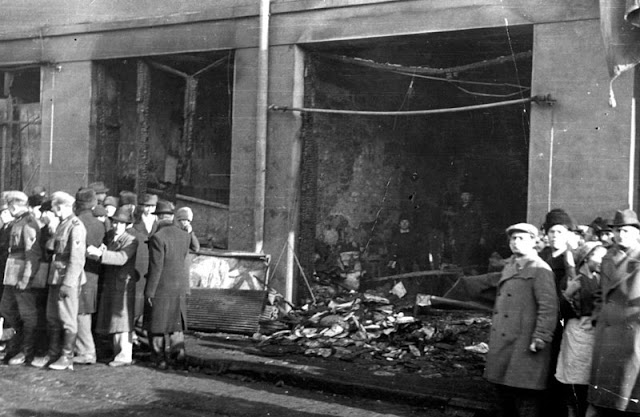
All that said, the true victims of the rebellion are the country’s Jews. The Legionnaires burn down synagogues, destroy 1,274 businesses of one form or another, and collect 200 trucks-worth of stolen items (along with vast sums of money, much of which likely gets buried in backyards and hidden in attics across the country). And even all that pales beside the torture, humiliation by the Iron Guard of at least 125 Bucharest Jews and undoubtedly others from other parts of the country as well. This, too, never really filters out to the international press, and the memory of all such depredations eventually gets dumped in a single bin marked “Hitler.”
Associated Press reports that the revolt in Rumania has been crushed and the Antonescu government has announced that it is in complete control of the situation. The official Bucharest, Rumania radio said in a broadcast early today that the last of the Iron Guard rebels holding the police barracks and city hall there had agreed to end hostilities in which some border reports estimated the dead at 2,000 throughout the country. Total casualties were estimated at 6,000. It was not clear whether all fighting had ceased in Bucharest itself between the dissident Iron Guardists and the government backed by the Rumanian army, but border dispatches said the revolt still was proceeding outside the capital especially in Transylvania province. An air traveler reaching here said that Rumanian troops turned their artillery on rebels holding the Bucharest police barracks, firing at a distance of 300 yards. In Bucharest, Legionary resistance ends before 8 AM, and in the provinces, prior to 11 AM. Nevertheless, Antonescu’s forces stage a massacre of peaceful crowds in Bucharest. At least 360 are killed including many women and children. No Legionaries are killed, they have already peacefully withdrawn on Sima’s orders, as agreed. Trials and executions of other Legionaries are commonplace until June.
American envoy “Wild Bill” Donovan continues his fact-finding mission in the European and Mediterranean region. Today, he stops off at Belgrade, no doubt drawn by the issues in Rumania that are attracting worldwide attention.
General Charles de Gaulle of the “free French” forces asserted tonight, according to a British radio broadcast heard here, that Germany planned to land troops in the French Tunisian naval base of Bizerte on the north African coast. “If the Germans with or without the consent of the Vichy government should land troops in Tunis the whole French empire would arise in a war of liberation,” De Gaulle was quoted as saying in a German-language broadcast of the British Broadcasting Corp. De Gaulle said that “free French” troops were in the front lines of the final assault on the Italian Libyan base of Tobruk.
Commander Vittorio Moccagatta was made the head of the Special Weapons Section of 1a Flottiglia MAS at La Spezia, Italy.
In Sofia, Bugaria, General Boydev, the Bulgarian army Chief of Staff, has agreed terms for co-operation with German military officials.
The slow pace of air operations continues. The Luftwaffe only drops scattered bombs along the east coast of England, and neither side puts bombers in the air after dark.
Norwegian steamers Elizabeth Bakke (5450grt), John Bakke (4718grt), Tai Shan (6962grt), Taurus (4767grt), and Ranja (6355grt) under the direction of British Captain R. D. Binney escaped from Gotenburg in Operation RUBBLE. Binney, the temporary attaché to Stockholm, was on steamer Tai Shan. One rating from destroyer HMS Hunter returned to England aboard the steamer. The steamers narrowly miss German battlecruisers Scharnhorst and Gneisenau in the Kattegat. Light cruisers HMS Naiad (CS 15) and HMS Aurora departed Scapa Flow at 2250/23rd to meet the ships. Light cruisers HMS Edinburgh and HMS Birmingham and destroyers HMS Escapade, HMS Echo, and HMS Electra departed Scapa Flow at 0130/24th. The Elizabeth Bakke was the fastest of the five and proceeded independently.
Light cruisers HMS Naiad and HMS Aurora met steamers Taurus and Tai Shan. They turned these steamers over the CS 18 group and returned to meet John Bakke and Ranja. These two steamers were under air attack when the cruisers found them. Steamer Ranja was strafed by a German aircraft and her First Officer was wounded. Steamer Taurus arrived at Kirkwall at 0430/25th escorted by destroyer HMS Electra. Steamer Tai Shan arrived at Kirkwall at 0536. Steamer John Bakke arrived at Kirkwall at 0700 with light cruiser HMS Aurora. Steamer Elizabeth Bakke arrived at Kirkwall, unescorted at 0903. Destroyer HMS Echo had been sent to escort the steamer into harbor, but did not contact her. Tanker Ranja arrived at Kirkwall at 0815 with light cruiser HMS Naiad. The escorting warships all proceeded to Scapa Flow arriving during the morning of 25 January, the destroyers arriving independently.
Destroyer HMS Atherstone arrived at Scapa Flow to work up after repairs.
Destroyer HMS Eclipse departed Scapa Flow for boiler cleaning at Rosyth, where she arrived at 0800/24th.
Minesweeping trawler HMS Coutier (255grt) T/Lt G. Ashton, DSC) was damaged by mining and brought into Milford Haven.
Minesweeping trawler HMS Ronso (248grt, T/Skipper H. G. Harris RNR) was badly damaged on a mine 2.9 miles 49° from South Foreland. The trawler was repaired and restored to service.
British steamer Lurigethan (3564grt) was set afire by German bombing in 53-46N, 16-00W. She would be sunk on the 26th by U-105.
British steamer Langlegorse (4524grt) was sunk by German bombing from convoy SL.61 in 53-19N, 13-11W. The entire crew was lost.
British steamer Mostyn (1859grt) was sunk by German bombing in 54-30N, 14-52W. Two crewmen were lost. A tug was sent to assist on the 25th, but she was unable to locate the steamer.
During the night of 23/24 January, German minelayers Roland, Cobra, Kaiser, and Skagerrak, escorted by destroyer Richard Beitzen and torpedo boats Iltis and Seeadler, laid mines off the British south coast in Operation SW b.
Aircraft carrier HMS Illustrious escorted by destroyers HMS Jervis, HMS Juno, HMS Janus, and HMS Greyhound departed Malta. Cruisers HMS York, HMS Orion, HMS Ajax, and HMS Bonaventure and destroyers HMS Ilex and HMS Hero under Pridham-Wipple from Suda Bay were to join the aircraft carrier. This movement was covered by battleships HMS Barham and HMS Valiant, light cruiser HMAS Perth, destroyers HMS Hereward, HMS Nubian, HMS Mohawk, HMS Hasty, HMS Diamond, and HMS Griffin. On the 24th, the Pridham Wipple force was attacked by German bombing. Destroyer Hero, which had become detached due to a breakdown of her steering gear, was singled out. Light cruiser Ajax was damaged by the near miss of German bombing in the Mediterranean. The damage did not cause the cruiser any time out of service. No damage was done to any of the ships. Pridham-Wipple was not located and Illustrious finally joined the main force. The forces involved in MBD.2 arrived at Alexandria on the 25th.
This is important not only for the prospects of getting the aircraft carrier back in service (eventually), but it also removes the major catalyst behind Luftwaffe Fliegerkorps X’s recent onslaught of air raids against Malta. Thus, while the Illustrious Blitz may or may not continue, the Illustrious itself is no longer in harm’s way within range of the Stukas. The departure of Illustrious, while good news for the British tactically, also leaves a strategic gap in the Royal Navy’s Mediterranean Fleet which will take time to fill.
Monitor HMS Terror departed Alexandria at 1800 for Sollum to rejoin the Inshore Squadron and later act as anti-aircraft guard ship at Tobruk.
Operation PARALLAX, the clearing of Tobruk Harbour and establishing the port as a base, began. Minesweeping trawlers HMS Arthur Cavanagh and HMS Milford Countess and boom working vessel HMS Magnet were specifically deployed for PARALLAX.
Destroyer HMS Thracian and minelayer HMS Man Yeung laid mines in the approaches to Hong Kong.
Convoy FN.390 departed Southend, and arrived at Methil on the 25th.
Convoy FS.394 departed Methil, escorted by destroyers HMS Cotswold and HMS Westminster, and arrived at Southend on the 25th.
Convoy FS.395 departed Methil, escorted by destroyers HMS Vanity, HMS Versatile, and HMS Wallace and sloop HMS Fleetwood, and arrived at Southend on the 26th.
Colonel Charles A. Lindbergh came before the U.S. House Foreign Affairs Committee to oppose the Roosevelt Administration’s Lend-Lease bill. Lindbergh testified that he would prefer to see “neither side win” in the war and hoped to see a “negotiated peace,” and also expressed his belief that American entry into the war on Britain’s side would still not be enough to defeat Germany without some kind of internal collapse. Lindbergh, a national hero since his nonstop solo flight across the Atlantic in 1927, testifies before the House Foreign Affairs Committee on the Lend-Lease policy and suggests that the United States negotiate a neutrality pact with Hitler. Lindbergh emphatically denounced the British aid bill today as a “major step” toward involvement in a war which America could not hope to win and asserted that if the United States minds its own business, and arms itself reasonably, it is not in any danger. Repeatedly, in answers to questions put by members of the House Foreign Affairs Committee, he said that the combined forces of both Great Britain and the United States could not successfully invade the continent of Europe, unless there should be an internal German collapse. Success, he said, would be dependent upon “a coincidence of miracles.”
Lindbergh is a well-known Isolationist who is supported by, and supports, the America First Committee organized by a Yale student. Lindbergh knows many of the German leaders personally and has deep knowledge of the European aviation situation. Escorted into the chamber by police, he faces a largely hostile committee (most being Democrats behind President Roosevelt’s support of Great Britain). He testifies that he is “in sympathy with the people on both sides” and prefers a negotiated peace. His theory appears to be that a complete victory over Germany would cause huge long-term problems in Europe, both economically and militarily.
It is easy from a vantage point many decades later to criticize Lindbergh’s testimony. In hindsight, though, while Lindbergh’s fears may have been exaggerated, they do find echoes in the Cold War. Even given that his position of isolationism is completely destroyed by subsequent events, it is hard to argue with his prediction on 23 January 1941 that total victory over Germany would mean “prostration in Europe,” both militarily and economically. One must remember that the Holocaust at this point is not a matter of common knowledge and has not geared up yet into factory-like exterminations (some will never forgive Lindbergh for arguing for a policy that would have permitted the continuation of the Holocaust).
Colonel Charles A. Lindbergh was called “one of the strongest appeasers on the American scene” today by State Representative Vernon Cheever, Colorado Springs Republican, who is chairman of the state legislature’s “little Dies” committee. Rep. Cheever, in charge of a state investigation of un-American activities, commented after Lindbergh urged a negotiated peace: “He apparently can’t forget that he once was awarded an iron cross.”
In a parallel move to Harry Hopkins’ special mission to England, it was announced today that Lauchlin Currie, administrative assistant to President Roosevelt, would visit China soon to make an economic survey. Apparently he is to help determine what aid that country should receive if the pending lease-lend bill is passed. Emphasizing the administration’s interest alike in Chinese and British resistance to Germany, Italy and Japan, Currie will go to Chungking at the invitation of the Chinese government and will bear a special message of greeting to Generalissimo Chiang Kai-shek. Known as President Roosevelt’s personal economic adviser, Currie, 38 years old but with an extensive background in economics, will be accompanied by Emile Destres, senior economist of the federal reserve board. He is expected to make an intensive study of China’s whole economic structure to determine the most effective means of helping that country in an economic and financial way. As a close adviser to the president, however, he is expected also to study China’s war needs generally and the strength of Chinese resistance to Japan, much the same thing that Hopkins is believed to be doing in Great Britain.
NOTE: U.S. Army intercepts of Soviet diplomatic traffic (“VENONA”) deciphered after the war will reveal that Currie, along with numerous other Roosevelt Administration figures, is a Soviet agent.
In an effort to minimize the dangers of inflation and give citizens in all walks of life a chance to participate in the preparedness efforts, the Treasury Department is preparing comprehensive plans for financing a major part of defense costs out of private savings instead of out of bank credit. of out of bank credit. The general outlines of the program have been agreed upon, although details are not complete. The program will involve the sale of savings stamps and other small-denomination investments throughout the country. This part of the campaign is to be conducted through the enterprise of local communities and it is hoped to avoid the ballyhoo and hysteria of a centralized drive such as the Liberty Loan campaigns of the World War. Experts at the Treasury have been at work studying the errors and successes of the Liberty Loan experience as well as the war-savings program now being carried out by Great Britain. As a result of their studies, the opinion prevails at the Treasury that the most useful lessons are to be learned from our own experience with War Savings Stamps in 1918 and from the British experience in this war with a public-savings program locally directed and carried on without too much pressure. The emphasis in this part of the campaign will be more upon reasonable economic persuasion than upon excited appeals to patriotism.
Dean G. Acheson, former Under Secretary of the Treasury, was nominated by President Roosevelt today to be Assistant Secretary of State. Acheson will soon play a key role in exacerbating tensions with Japan this Summer by committing the U.S. to an oil embargo while President Roosevelt is out of town.
Only a mile from safety, a big Transcontinental and Western airliner crashed before dawn today as it approached the Lambert-St. Louis Municipal Airport, killing the chief pilot and a TWA employee riding as a passenger and injuring twelve other persons. Flying on instruments, Captain P. W. T. Scott passed over the field at 4:13 AM, and three minutes later he was dead in the wreckage of the ship. J. F. Mott, the other man killed, boarded the plane as a passenger at Kansas City. Half of the others on the plane were injured seriously, while the rest of the passengers suffered minor injuries. Officials who inspected the wreckage of the twelve-ton craft later said it was “a miracle” that the death toll was not much greater.
The groundbreaking ceremony for the National Advisory Committee for Aeronautics’ new Aircraft Engine Research Laboratory (now NASA’s John H. Glenn Research Center at Lewis Field) took place in Cleveland, Ohio.
Municipal Judge Peter Mullins today gave 90-day suspended sentences to the U. S. navy seamen who tore down the Nazi swastika flag from the German consulate in San Francisco last Saturday, and turned them over to naval authorities for further discipline. Harold Sturtevant, 19, and E. G. Lackev, 20, were found guilty of malicious mischief. Judge Mullin said he had been assured by the navy that they would be “dealt with adequately.” Sturtevant and Lackey had been ruled unfit for further service in the navy before the incident in which they tore down the flag that was flying in honor of a German holiday.
A strike of sixty structural steel workers, attributed in one quarter to a jurisdictional dispute between two locals of the American Federation of Labor, threatened today to delay completion at the Philadelphia Navy Yard of what is planned in the national defense program as the world’s largest drydock.
The cleavage between right and left-wing elements in the local New York C.I.O. was sharpened yesterday by disagreement over the lease-lend bill for United States aid to Great Britain. The right-wing unions, which supported President Roosevelt in the national elections and demanded that John L. Lewis quit as C. I. O. president when Mr. Roosevelt was re-elected, are backing the bill. The left-wing forces, anti-Roosevelt and pro-Lewis, are opposing it. The positions of the two groups were made clear in a statement issued by twenty-four union leaders endorsing the measure and in a resolution adopted by the Greater New York Industrial Union Council calling for its defeat.
Although a pre-World War I warship, the battleship USS Arizona is made the flagship of Battleship Division 1 by Rear Admiral Isaac C. Kidd, replacing Rear Admiral Russell Wilson, who himself had relieved Rear Admiral Chester Nimitz.
The stage musical “Lady in the Dark” with music by Kurt Weill, lyrics by Ira Gershwin and book and direction by Moss Hart premiered at the Alvin Theatre on Broadway.
Luftwaffe Oberleutant (USAAF 1st Lieutenant; RAF Pilot Officer) Franz von Werra escapes from a train which is taking him from Halifax, Nova Scotia, where the ship bringing him to Canada from the U.K. had docked, to the POW camp at Neys, Ontario, on the north shore of Lake Superior. At 0530 hours local, the train slows and pulls into a rail yard near Smith Falls, Ontario, and von Werra and another prisoner break a window and jump into the snow along the tracks. The other prisoner is recaptured but von Werra makes his way on foot to Johnstown, Ontario, on the St. Lawrence River, where he steals a rowboat and makes his way across the partially frozen river to Ogdensberg, New York, on the neutral U.S. side. He is caught by U.S. authorities and charged with illegal entry into the U.S resulting in a diplomatic tug-of-war with Canadian officials who want him back. Von Werra makes his way to New York City and, funded by German money, escapes to Mexico and then to Panama, Peru, Bolivia, and, by mid-April, to Rio de Janeiro, Brazil, where he flies back to Germany. On 25 October 1941 von Werra’s plane crashes off the coast of the Netherlands while on a routine Luftwaffe mission. Neither von Werra’s aircraft nor his body were ever found. Von Werra was the only known German prisoner to escape in Canada and make it back to Germany.
While the war, by and large, has not yet extended to the Pacific Ocean aside from scattered attacks by German raiders, the British in Hong Kong decide to make some preparations. They send minelayer HMS Man Yeung and destroyer HMS Thracian to seed some mines in the approaches to Hong Kong.
Extra policemen were on duty throughout the International Settlement at Shanghai today after a quarrel between British and United States members of the Municipal Council and Japanese that resulted in the shooting of W.J. Keswick, British chairman of the Council; O. Okamoto, a Japanese member, and K. Ikeda, the Council’s Japanese secretary.
The Japanese “S” Operation commenced. The Japanese are getting tired of the rather pointless frontier war going on in French Indochina between Thailand and the Vichy French. While the two sides have expressed some interest in Japanese mediation, the war continues. The Japanese decide to hurry things along, so, in a classic example of gunboat diplomacy, they dispatch four cruisers from Kure for Saigon as an expression of their deep interest in a peaceful resolution. The Nihon Kaigun (Imperial Japanese Navy) heavy cruisers Suzuya, Mikuma, Mogami, and Kumano departed Kure, Japan bound for French Indochinese waters. The operation was designed to put pressure on the Vichy French colonial government in the wake of the naval Battle of Ko Chang between the Vichy French and Thailand.
Japan’s mediation of the conflict between Indo-China and Thailand [Siam] has been accepted by France, says a communique issued here tonight. Though there had been some hopes of United States intervention in the dispute, these hopes had to be abandoned and the French Ambassador in Tokyo has now been instructed to take up the question with the Japanese Government.
Hopes that Ambassador Kichisaburo Nomura’s genial personality and sincere desire for peace would miraculously change Japanese-American relations have faded and his departure today for the United States found the press in a gloomy mood. President Roosevelt’s message, Secretary of State Cordell Hull’s statement, the Diet’s surrender of its right of discussion-an action without precedent since the eve of the Russo-Japanese war-and last, but not least, the manner in which the American press ignored Foreign Minister Yosuke Matsuoka’s oration, have enlightened the Japanese public. They now realize that Japan’s critical relations with the United States are not due to a misunderstanding that a good diplomat can remove but arise from a clash of national policies.
Driving rapidly toward the assumption of “full powers,” Prince Fumimaro Konoye, the Premier, prepared today to push a record budget through the lower house of Parliament virtually without debate and to obtain from the upper house a pledge of “no criticism,” which would enable the government to take unprecedented measures without parliamentary consent.
Dow Jones Industrial Average: 128.34 (-0.31)
Born:
(Perry) “Buddy” Buie, American rock songwriter, and record producer (Atlanta Rhythm Section — “So Into You”; “Imaginary Lover”), in Marianna, Florida (d. 2015).
Tom Hoover, NBA and ABA center (NBA: New York Knicks, St. Louis Hawks, Los Angeles Lakers; ABA: Denver Rockets, Houston Mavericks, Minnesota Pipers, New York Nets), in Washington, District of Columbia.
Died:
Dobri Hristov, 65, Bulgarian composer, chiefly of choral works, and music director (Seven Saints Church Sofia. 1911-28).
Naval Construction:
The Regia Marina (Royal Italian Navy) Soldati-class (2nd series) destroyer Corsaro is laid down by Odero Terni Orlando [O.T.O.], Livorno, Italy.
The Royal Canadian Navy Bangor-class (VTE Reciprocating-engined) minesweeper HMCS Wasaga (J 162) is launched by the Burrard Dry Dock Co. Ltd. (Vancouver, British Columbia, Canada).
The Kriegsmarine (German Navy) Type VIIC U-boat U-204 is launched by F. Krupp Germaniawerft AG, Kiel (werk 633).
The Kriegsmarine (German Navy) Type VIIC U-boat U-561 is launched by Blohm & Voss, Hamburg (werk 537).
The Royal Canadian Navy auxiliary minesweeper HMCS Reo II (Z 33) is commissioned.
The Royal Canadian Navy Flower-class corvette HMCS Agassiz (K 129) is commissioned. Her first commanding officer is Lieutenant Bernard Dodds Leitch Johnson, RCNR.
The Royal Navy Flower-class corvette HMS Bittersweet (K 182) is commissioned. Her first commanding officer is A/Lieutenant Commander John Andrew Woods, RCNR. Bittersweet is one of the ten corvettes formally transferred to the Royal Canadian Navy on 15 May 1941, becoming the HMCS Bittersweet.
 History Diaries