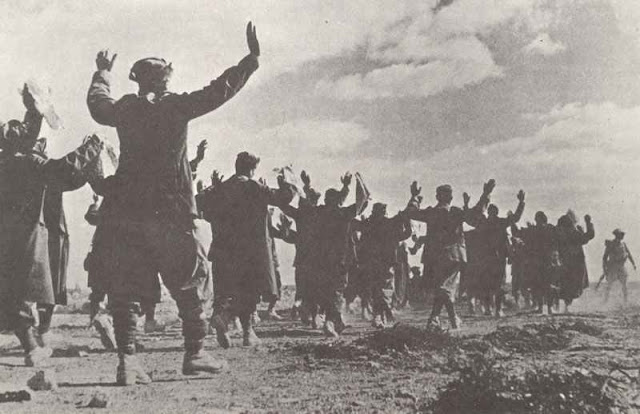
British and Australian forces captured Tobruk and took 25,000 Italians prisoner. The Australian 9th Division completed the capture of Tobruk from the Italian Tenth Army. Australian casualties were 49 dead and 306 wounded, while capturing 27,000 Italian POWs, 208 guns, 28 tanks, many good quality trucks and a large amount of supplies. Italian cruiser San Giorgio was scuttled by her own crew at Tobruk, Libya at 0415 hours. In the afternoon, Brigadier General Vincenzo della Mura surrendered the Italian 61 Infantry Division “Sirte”. Meanwhile, Allied troops continued the attacks throughout the day, with monitor HMS Terror and gunboats HMS Gnat and HMS Ladybird continuing to offer support with their guns. British aircraft sank Italian liner Liguria. Before the end of the day, Admiral Massimilian Vietina surrendered to the Australian troops. For the past few days the main enemy has been a fierce sandstorm, clogging air-intakes on aircraft, tanks and guns breeches and filling the eyes, ears, mouths and noses of men seeking shelter from its blast. But for the past two days the Italian defenders have also had to endure a bombardment of thousands of tons of HE hurled into Tobruk. The barrage has matched the intensity of that at Ypres in 1917 and stopped only this dawn. Australian sappers went forward to cut the barbed wire on the outer perimeter and clear the way for the infantry who had moved to within 1,000 yards of the Italian trenches during the night. Backed by British armor, the Australians faced stiff resistance at first with many Italians dying at their guns. But eventually the resistance faded and white flags were seen above the defending trenches. With the outer ring of defenses breached the tanks could attack the defenders from the rear. Of the three forts within the town, the first was taken by the infantry after fierce hand-to-hand fighting, the other two surrendered quickly afterwards. With the forts taken the town surrendered.
The British report that the desert sandstorms have been more of a hindrance than Italian resistance. This is a highpoint of Australian military success during World War II in the European Theater of Operations. At the end of the day, an Australian soldier’s hat is flown from the highest flagpole over Tobruk (no Union Jack being found). Everyone is having a bit of well-deserved fun, but the rest of Libya remains to be captured.
General O’Connor of XIII Corps wastes no time in re-deploying his forces after the victory. He immediately orders the British 7th Armoured Division northwest toward the Jebel Akhdar Mountains in order to threaten Mechili and the Australian 6th Infantry Division north along the coast road to Derna. The Italians send forward the newly created Italian Special Armoured Brigade (Brigata Corazzato Speciale), General Valentino Babini commanding, to block the Allied advance. Unlike the static garrison forces that the Allies have overcome recently, this is a powerful mobile force with heavy infantry support.
The Italians are increasingly concerned about their grip on North Africa. They send a convoy three passenger liners (Esperia, Conte Rosso, Marco Polo) and a freighter (Victoria) from Naples bound for Tripoli to reinforce the Libyan garrison.
Wavell in a telegram to the War Office relays Lieutenant General Alan Cunningham’s request for more equipment for the East African theatre rather than more men. He believes that small forces, well equipped can achieve greater results.
At Malta, the garrison is apprised by the War Office of scuttlebutt emanating from Rome that suggests the Germans are massing troops in Sicily for the conquest of Malta. However, air reconnaissance shows nothing unusual going on there in that regard. Governor Dobbie sends a reply that he believes the rumors are a “bluff.”
The Italians make no headway on 22 January 1941 with their initial attempt to retake the key Klisura Pass in Albania. Greek II Corps advances and takes villages of Kiafe-louzit and Spi-kamarate on a plateau, nabbing about 500 Italian prisoners. The fighting in this sector is brutal, and while the Greeks have made progress, it is turning into a see-saw battle. The RAF bombs Valona and Berat, while the Italians raid Salonika.
The British Government suppressed two leftist publications that had been critical of the British war effort. They were The Daily Worker, the Communist Party newspaper, and The Week, a mimeographed newsletter edited by Claude Cockburn. Special police of Scotland Yard raided The Daily Worker’s office and stopped publication of an issue that was just going to press. Under actions taken by the Home Office it became an offense to print, distribute, or in any other way assist these two publications. The Home Office declared that the action did not indicate a change in the government’s policy permitting freedom of newspaper criticism of the government but was intended only to suppress openly subversive propaganda.
After listening for two days to critics who felt that his Cabinet was not pressing the war to the fullest extent on the economic and industrial fronts, Prime Minister Winston Churchill had the last word today. The verdict of the House of Commons was, as usual, cheers for the cogency of the Prime Minister’s defense and laughter for the quips that he used liberally today to season what might easily have become a tedious discourse. Mr. Churchill revealed that Great Britain already had 4,000,000 men armed and uniformed, including the Home Guard. This large force, he said, was prepared not only to defend the homes and hearths of this island nation but also to carry the war overseas. He implied that the size of the expeditionary forces that might be sent out would be limited only by the tonnage available to carry men and supplies to distant battlefields.
Palestine Jews are facing the paradox of supporting Prime Minister Churchill’s war effort completely and yet being at odds with British administration there, it was asserted yesterday by Dr. Bernard Joseph, legal adviser to the Jewish Agency for Palestine, the executive body in that country cooperating with the British Government.
4th Indian Division attacked Italian positions at Keru, Eritrea, Italian East Africa, leading to General Fongoli surrendering his 1,200 men. The Italian forces are falling back toward Agordat in the face of General William Platt’s (Commander in Chief East Africa Command) attacks. There is also some skirmishing along the border between Kenya and Italian Somaliland.
It is reported in Belgrade that southeastern Europe, already forced to eat stale black bread and pay exorbitant prices for essential foodstuffs, is now facing new shortages, because so many railway lines have been commandeered for Nazi troop movements and Italian and German shipments of war materials. There is rioting over food regulations in Yugoslavia and Rumania.
Antisemitic violence in Bucharest, Rumania leaves 120 Jews dead in the streets as the Iron Guard uprising continues unabated today. Men, women and children are hunted down by armed gangs. Some survivors flee to Palestine. Prime Minister Ion Antonescu remains holed up in the palace while the Legionnaires run wild throughout the country, but primarily in the big cities. The main targets are Jews in Bucharest, against whom virtually every indignity is inflicted. Rather than sanctuaries for those being persecuted, police stations are the center of the pogrom, with the Legionnaires comprising much of the police force.
The Iron Guard, as is often the case in Europe throughout the war, view this period of time as an opportunity to even up what they view as “old scores” against people they perceive as foreign elements within the local culture. However, while there is pure and unmistakable ethnic animus involved, the Legionnaires also are interested in simply stealing from their victims anything that isn’t nailed down, so it isn’t just about racism and “payback.” Antonescu retains the support of Adolf Hitler (who just wants a stable Rumania he can use to take over the world), and German troops are sympathetic to Antonescu’s government (on Hitler’s orders). This helps Antonescu to begin planning countermeasures using the many loyal elements of the army in the hinterlands. Today is probably the height of the pogrom, and Antonescu orders the army to move in and restore order on the 23rd.
The German Charge d’Affaires in Rumania Dr. Neubacher, gives Horia Sima a solemn promise from both Hitler and Antonescu of complete impunity for Legionaries, and suggests participation in a new government, if resistance ends before noon on January 23.
In Bulgaria, the “Law for the Defense of the Nation” gives Jews one month to leave all public posts, and forces almost all Jewish doctors, dentists and lawyers to give up their practices. A special tax was imposed on all Jewish homes, shops and other property, amounting to 25% of its value.
In Lublin, Poland, Governor Hans Frank tells a meeting of Nazi officials: “We who for 20 years have been fighting beside the Führer cannot be asked to have any consideration left for the Jews.”
RAF Fighter Command launches a Rhubarb sortie over Belgium and Holland. As intended, this draws up Luftwaffe fighter opposition. Feldwebel Mickel of 1./JG shoots down a British Beaufort fighter-bomber to the northwest of Terschelling, West Frisians around 13:00. Another member of I,/JG 1, Uffz. Krause shoots down a Blenheim bomber at Den Helder a couple of hours later for his first victory.
RAF Bomber Command attacks Dusseldorf during the night with 20 bombers.
The Luftwaffe remains quiet. It sends a few raiders across that hit various points in the eastern part of England, but no major attacks.
RAF Bomber Command sends 12 Blenheims to Germany and Holland in daylight; 2 aircraft bombed at Flushing and Ghent. 1 aircraft mistakenly shot down over Lowestoft by anti-aircraft fire.
RAF Bomber Command dispatches 28 Wellingtons and 12 Blenheims to Dusseldorf overnight. No losses.
Light cruisers HMS Arethusa and HMS Nigeria arrived at Scapa Flow at 1805 after patrol.
German battlecruisers Scharnhorst and Gneisenau departed Kiel to raid in the North and Central Atlantic in Operation BERLIN. German battlecruisers Scharnhorst and Gneisenau — “Salmon & Gluckstein” to the British, so named after a popular tobacconist — depart Kiel on Operation Berlin under the command of Admiral Lütjens. To this point, Kriegsmarine sorties into the Atlantic have been quite successful, if you leave aside the destruction of the Admiral Graf Spee, at sea at the war’s start, they have at the very least held their own against the Royal Navy and proved an irritant to the Admiralty. The ships are spotted in the Skagerrak by Swedish naval spies who are happy to tell the British about them (just as the Spanish often supply intelligence to the Germans). The Admiralty quickly plans to shift its heaviest assets to patrol the “Faroes Gap,” the area between Iceland and the Faroes where German ships are furthest from aerial reconnaissance and where they invariably transit to the Atlantic. This response shows the utility of surface ships, as they completely distract the Royal Navy and engender massive countermeasures out of all proportion to the actual threat.
British Admiral Tovey departed Scapa Flow at 2320/25th to intercept with battleships HMS Nelson and HMS Rodney, battlecruiser HMS Repulse, lights cruisers HMS Arethusa, HMS Galatea, and HMS Aurora of the 2nd Cruiser Squadron, HMS Mauritius, HMS Naiad, and HMS Phoebe of the 15th Cruiser Squadron, HMS Edinburgh and HMS Birmingham of the 18th Cruiser Squadron, and destroyers HMS Bedouin (T/D.6) HMS Matabele, HMS Tartar, HMS Punjabi, HMS Escapade, HMS Echo, HMS Electra, HMS Beagle, HMS Brilliant, HMS Keppel, and ORP Piorun. On the 27th, battleship Rodney, light cruisers Edinburgh, Birmingham, and Mauritius, and destroyers Beagle, Brilliant, Keppel, and ORP Piorun were directed to return to Scapa Flow.
Barring developments at sea, the ships would remain at Scapa Flow until 30 January when they would sail to relieve units still on patrol. Battleship HMS Rodney, light cruisers HMS Edinburgh, HMS Birmingham, and HMS Mauritius, and destroyers HMS Brilliant and HMS Beagle arrived back at Scapa Flow at 2345/28th. Destroyers HMS Keppel and ORP Piorun arrived at Scapa Flow at 0700/29th. On the 30th, light cruisers HMS Naiad and HMS Phoebe arrived at Scapa Flow at 1105 and light cruisers HMS Galatea and HMS Arethusa arrived at Scapa Flow from patrol at 1125. Battleships HMS Nelson, battlecruiser HMS Repulse, and destroyers HMS Bedouin, HMS Matabele, HMS Tartar, HMS Escapade, HMS Electra, HMS Echo, and HMS Punjabi arrived at Scapa Flow at 1700/30th after having covered convoy HX.103 on the 29th. Light cruiser HMS Aurora arrived back at Scapa Flow on the 30th.
Minesweeping trawler HMS Luda Lady (234grt, Skipper W. F. Sommers RNR) was sunk on a mine in the Humber. The entire crew was rescued.
Naval tug HMS St Cyrus (810grt, T/A/Lt Cdr P. Allan RNR) was sunk on a mine off the Humber. Allan, T/Lt (E) W. D. Hewitt RNR, most of the crew were lost in the tug.
German torpedo boat T.1 was damaged when she ran aground off Kristiansand. Repairs were done at Horten. She departed on 10 February for Gotenhafen, where the repairs were completed in July.
British steamer Jamaica Planter (4098grt) was damaged by a mine 2500 yards 196° from Neil’s Point, Barry Island. The steamer was beached in Old Harbour, Barry. refloated and beached Whitmore Bay, 13 February.
Greek steamer Kapetan Stratis (3574grt) was sunk by German bombing in 54-34N, 12-08W. The entire crew was lost.
Tobruk was captured by the British. The Italians scuttled their coastal defense ship San Giorgio to prevent it from falling into British hands. The operation was supported offshore by monitor HMS Terror, gunboats HMS Ladybird and HMS Gnat, and destroyers HMAS Stuart, HMAS Vampire, and HMAS Voyager. Monitor Terror and gunboat Gnat returned to Alexandria late on the 21st. The gunboat began boiler cleaning. Destroyer Voyager with defects and a damaged anti-submarine dome was ordered to return to Alexandria. Destroyer HMS Defender departed Alexandria at 0800/23rd to relieve destroyer Voyager.
Italian liner Liguria (15,354grt), immobilized since bombing damage on 5 July, was sunk by British bombing at Tobruk. The liner was later salved.
An Italian convoy of passengers ships Esperia, Conte Rosso, and Marco Polo and steamer Victoria departed Naples for Tripoli on the 22nd, escorted by destroyers Freccia and Saetta to Trapani, then Vivaldi, Tarigo, Malocello, and Da Noli of the 14th Destroyer Division. Submarine HMS Unique fired torpedoes at the convoy off Kerkenah. Steamer Esperia was missed in the attack. The convoy did not know it had been attacked and arrived safely at Tripoli on the 24th.
Convoy OB.277 departed Liverpool, escorted by destroyers HMS Vanquisher, HMS Viscount, HMS Whitehall, and HMS Winchelsea and corvettes HMS Gentian and HMS Verbena. The corvettes were detached on the 26th and the destroyers on the 27th when the convoy was dispersed.
Convoy FS.392 departed Methil, and arrived at Southend on the 24th.
Convoy FS.393 was cancelled.
Convoy SC.20 departed Halifax, escorted by armed merchant cruiser HMS Ranpura and patrol vessel HMCS Otter. The patrol vessel was detached the next day and the armed merchant cruiser on 4 February. On 4 February, destroyer HMS Harvester, corvettes HMS Arbutus, HMS Camellia, and HMS Erica, and anti-submarine yacht HMS Philante joined the escort. The escort was detached on 8 February and the convoy arrived at Liverpool on 8 February.
In Washington today, President Roosevelt received and acknowledged a letter from Associate Justice Justice McReynolds announcing his decision to retire from the Supreme Court on February 1. He conferred with Senators Barkley, Glass, and Harrison and with Governor Harold E. Stassen, of Minnesota, President of the Council of State Governments.
The Senate was in recess. Its Foreign Relations Committee agreed to begin hearings on Monday on the Administration’s Lend-Lease Bill to aid Britain.
The House passed the $909,000,000 bill authorizing new ships, shipyards and gun and ordnance factories for the Navy; passed a bill to increase the number of appointments to the Naval Academy and adjourned at 4:25 PM until noon on Friday. The Foreign Affairs Committee heard Norman Thomas and Hanford MacNider oppose the Lend-Lease Bill and agreed to end hearings on Saturday. The Appropriations Committee approved the $350,000,000 program for the construction of 200 cargo ships.
Senator McNary of Oregon, the 1940 Republican vice-presidential nominee expressed opposition today to giving the chief executive broad authority under the British aid bill. Qualified support for the legislation came, meanwhile, from Senator Norris, Nebraska Independent. The 79-year-old Nebraskan said he favored the principle of the bill, but believed a time-limit should be placed on the powers it would confer upon the president. The day also brought an endorsement of the measure from Jesse H. Jones, secretary of commerce and federal loan administrator. Jones told reporters he thought it unnecessary for him to comment on a substitute proposal of Representative Fish, New York Republican, authorizing the Reconstruction Finance Corp. to lend up to $2,000,000,000 to Britain.
Meanwhile, politicians of all conceivable stripes are taking sides on the Lend-Lease issue. The New York State League of Women Voters endorses the bill, for instance, while former Ambassador to the Court of St. James Joseph Kennedy opposes the bill because he feels that it gives President Roosevelt and the Executive Branch too much power, authority, and discretion.
Norman Thomas, national chairman of the Socialist party, and Hanford MacNider, Assistant Secretary of War under President Coolidge, Minister to Canada under President Hoover and one of the early national commanders of the American Legion, contended in testimony before the House Foreign Affairs Committee today that adoption of the Administration’s Lend-Lease Bill would imperil the democratic structure of the United States.
A prediction that the Administration’s Lend-Lease Bill would become law within sixty days was made today by Senator Barkley, Majority Leader, after a call upon President Roosevelt with Senators Glass and Harrison.
George Gallup of the American Institute of Public Policy (The Gallup organization) reports the results of a poll showing that the majority of the U.S. public supports the idea behind the Lend-Lease Bill (which currently is popularly referred to as the “lease-lend” bill) currently being considered by Congress. Democrats are slightly more enthusiastic than Republicans. The results of the poll are:
Republicans Approve: 62%
Republicans Disapprove: 32%
Republicans Undecided: 6%
Democrats Approve: 74%
Democrats Disapprove: 20%
Democrats Undecided: 6%
George Gallup cautions that these findings do not necessarily mean that the public suddenly wants war. Instead, he states:
“The chief reason why the majority of voters favor this lease-lend plan is that anything which helps England will serve to ‘keep the war in Europe’ and away from our shores. ‘England is fighting our battle’ is a typical comment.”
Thus, far from suggesting that the public would favor a U.S. declaration of war and involvement in the fighting, the findings hint that people are happiest to do anything that keeps the United States out of the war. This issue illustrates how tricky polling can be.
James Clark McReynolds, Associate Justice of the Supreme Court for more than twenty-six years and an implacable foe of the New Deal, informed President Roosevelt today that he would retire on February 1, two days before his seventy-ninth birthday. With the retirement of Mr. McReynolds, President Roosevelt will appoint his sixth Associate Justice, a record exceeded in all the nation’s history by only one President, George Washington. President Taft appointed five Associate Justices, and elevated an Associate Justice to be Chief Justice. News of Justice McReynolds’s action instantly brought speculation as to his successor. In usually well-informed circles Attorney General Jackson and Senator Byrnes of South Carolina immediately stood out, the latter being a newcomer in the field. The report that Mr. Byrnes, an outstanding Administration leader, and a Southerner, might be on the Presidential list, received credence when three of his closest friends, Senators Harrison, Glass, and Barkley called upon President Roosevelt today. The trio said their conference was to discuss the Lend-Lease bill, but this explanation was not accepted as telling all the story. Mr. Jackson, since he has been so often mentioned for the post and has the confidence of President Roosevelt, was the choice of many speculators. Two New Yorkers, Chief Justice Hughes and Associate Justice Stone, are already on the bench.
After an hour and 20 minutes chat today with King Boris in the royal palace, Colonel William J. Donovan, United States observer on a secret mission, found to his dismay and to the king’s that he had lost his diplomatic passport. The royal staff searched the palace high and low, in vain. The Orient Express was held up 20 minutes, then the colonel finally gave up the hunt and boarded the train for Belgrade, Yugoslavia. It looked as if Donovan might have to stay here a while longer, but the United States legation saved the day by arranging for him to cross the border without his passport.
Wendell Willkie departed the United States aboard a transatlantic flight for a “fact finding” mission in Britain. He carries a personal letter to be hand-delivered to British Prime Minister Winston Churchill. This is another of Roosevelt’s personal “fact-finding missions” to Europe by his personal chums, the most recent having been by Harry Hopkins.
William S. Knudsen, Director of the Office of Production Management, said today that he had not given up the goal of producing by July 1, 1942, 33,000 military airplanes to be divided between this country and Great Britain.
Wage increases for all employees under a new scale similar to that won after a strike at the Vultee aircraft plant at Downey, are provided in a labor contract agreement reached today between the C.I.O. and the Ryan Aeronautical Co.
Production at the West Allis plant of the Allis-Chalmers Manufacturing Company, which is working on $26,000,000 worth of national defense orders, was stopped this morning by a strike of the C.I.O. United Automobile Workers Union, bargaining agent for the employees.
Admiral Thomas Hart, Commanding the U.S. Asiatic Fleet, is informed that the Navy Department had decided not to accept Rainbow-3 and that the reinforcements set out in that plan would not be assigned to the Asiatic Fleet.
U.S. heavy cruiser USS Louisville (CA-28) arrives at New York, with $148,342,212.55 in British gold brought from Simonstown, South Africa, to be deposited in American banks, as Operation FISH.
The Andrews Sisters recorded “Boogie Woogie Bugle Boy”.
Canada is becoming a thriving arsenal for democracy herself, Vincent Massey, Canadian High Commissioner to England, said today, speaking before the National Defense and Public Interest Committee on the part played by the Dominion in the war — and also the part played by the United States.
Japan has offered to mediate the border dispute between French Indo-China and Thailand [Siam], and there is a good chance the mediation may prove successful, Domei, the Japanese news agency, said today. The offer was made to representatives of the French Governor General, Admiral Jean Decoux, at noon yesterday in Hanoi. Colonel Tatsuji Koike, acting head of the Japanese military mission, and Consul General Yasushi Hayashi acted for Japan, presumably on instructions from Tokyo. Details of the Japanese plan were not given, but it was believed they would call for greater concessions than Indo-China so far has offered in reply to Thailand’s demands for return of her “lost provinces.” The Japanese representatives said, according to Domei, that Tokyo does not favor a prolongation of the conflict, which is contrary to the Japanese Government’s desire for peace, stability and prosperity throughout East Asia. The French representatives promised an official reply to the offer as soon as instructions could be received from the Governor General, who was on a tour of the interior but was reported to have canceled his program and to be returning to the Winter capital in Saigon. It was believed he would consider the Japanese proposal today and that mediation efforts might get under way within a week.
A ten-year population plan designed to give every Japanese family five children and increase the nation from today’s 67,000,000 to 100,000,000 by 1960 was submitted to the Cabinet today by the Planning Board and approved.
Dow Jones Industrial Average: 128.65 (+0.45)
Born:
Dave Leonhard, MLB pitcher (Baltimore Orioles), in Arlington, Virginia.
Eugene Hasenfus, American Marine and gunrunner involved in the Iran-Contra affair, in Marinette, Wisconsin (d. 2025).
Naval Construction:
The Royal Canadian Navy Bangor-class (VTE Reciprocating-engined) minesweeper HMCS Minas (J 165) is launched by the Burrard Dry Dock Co. Ltd. (Vancouver, British Columbia, Canada).
The Regia Marina (Royal Italian Navy) submarine Acciaio, name ship of her class of 13, is launched by Odero Terni Orlando [OTO], Muggiano, La Spezia, Italy.
The U.S. Navy “R-1”-class submarine USS R-20 (SS-97) is recommissioned at New London, Connecticut.
The U.S. Navy miscellaneous auxiliary USS Kaula (AG-33), formerly the merchant ship Cubahama, is commissioned. Her first commanding officer is Lieutenant Commander William L. Ware, USN.
The Kriegsmarine (German Navy) Type IXC U-boat U-67 is commissioned. Her first commanding officer is Kapitänleutnant Heinrich Bleichrodt.
 History Diaries