At Adolf Hitler’s Berghof residence near Berchtesgaden, Germany, Hitler mentioned to Benito Mussolini and Galeazzo Ciano that Germany viewed the Soviet Union as a threat, but did not reveal the plan to invade. On the second day of Hitler’s conference with Mussolini, Hitler declares that he believes the greatest danger is to come from Russia, not from America.
Mussolini consented to German troops entering Italy. Mussolini apparently agrees to the stationing of limited numbers of German troops in Italy, which is a formality because Mussolini has been urgently requesting German assistance since November or December.
Hitler also asks Mussolini to lean on Spanish leader Francisco Franco to enter the war and cooperate in the subjugation of Gibraltar, Operation FELIX. While the closing of the Mediterranean at the Atlantic end is important, Hitler’s real goal extends far beyond just capturing the British naval base and fortress. He wants to obtain U-boat bases on the Spanish Atlantic coast, which would be closer to the shipping lanes than those in France and also less vulnerable to RAF bombing attacks. Hitler indicates that the Wehrmacht would only need 20 days to prepare to take Gibraltar. This, however, is not something that the Wehrmacht feels is possible, at least during the winter months.
Reichsführer-SS Heinrich Himmler visits Dachau concentration camp. Accompanying him is Anton Adriaan Mussert, one of the founders of the National Socialist Movement in the Netherlands (NSB) and its formal leader. Himmler likes what he sees and is planning to expand the camp system due to the anticipated inflow of new inmates from the territories to be invaded pursuant to Operation Barbarossa. Himmler was organizing the expansion of his system of camps in preparation for the Nazi move East. Himmler was a frequent visitor the various camps around his empire. One of the reasons for the lack of paper trail evidence of orders for the Holocaust is that he so often passed on his encouragement in person.
The German Kriegsmarine ordered the construction of 75 new submarines.
The lines in Albania have stabilized on 20 January 1941 since the Greek capture of the Klisura Pass earlier in the month. The weather inhibits operations by either side in the mountains, but the Italians are planning a riposte to retake the critical pass. The Greeks now have access to the key Italian supply port of Valona, but the Italians are building up their troop strength in the region. There is some movement in the central section of the front, where the Greek II Corps takes possession of the Kala Heights.
The question of British involvement in the land defense of Greece remains a matter of great concern, and not just to the parties directly involved. British Prime Minister Winston Churchill tells the War Cabinet that the Yugoslav regent, Prince Paul, has been in communication with the Greek government about this. According to the War Cabinet Minutes of this date, Prince Paul has warned Greece privately:
“…that if they allowed any British land forces to enter Greece, the Yugoslav Government would allow the Germans to attack Greece through Yugoslavia.”
This helps to explain Greek Prime Minister Metaxas’ recent refusal to accept token British forces on the Greek mainland. This would give the Germans an open road through Yugoslavia to invade his country. The only hope that Greece has in the event of an invasion is to seal off the relatively short Bulgarian border. The long border with Yugoslavia would be virtually impossible to defend against a massive German invasion without the massive British troop presence that Metaxas has demanded, but not received.
General O’Connor’s Australian and British troops make their final preparations for the assault on Tobruk. The tactics will echo those of the assault on Bardia earlier in the month, with initial penetrations followed by engineer work that will provide a lane through which I tanks can penetrate and subdue the garrison. The RAF stages heavy air raids against Tobruk to soften it up for the attack, scoring hits on military barracks and other important areas of the camp. Monitor HMS Terror, gunboats HMS Gnat and Ladybird, and several destroyers bombard the Italian base during the night.
The Royal Navy creates a major operation to remove stricken aircraft carrier HMS Illustrious from Malta, where it is facing unceasing Luftwaffe attacks. Three separate forces are created, Forces A, B, and C. Force C is the most powerful and includes battleships HMS Barham and HMS Warspite. The overall effort is Operation Inspection.
Royal Navy destroyer HMS Gallant, badly damaged by a mine recently (its bow was blown off) and under repair at Malta, is hit again by the Fliegerkorps X. The ship remains under repair, but the damage is extensive and the Admiralty no longer counts on its return. Gallant’s guns are removed and placed on store ship Breconshire.
Churchill enquires of the Commander-in-Chief Home Forces how they would deal with any very large German tanks put ashore in a raid or invasion, the current proposal seemed to be to follow them until they ran out of fuel, then attack the crew.
Churchill telegrams to Roosevelt inviting him to inspect the new battleship, HMS King George V, which is bringing the new ambassador, Lord Halifax, to Annapolis.
Fire-watching becomes compulsory today as part of Britain’s new Defence Regulations, under which men and women aged between 16 and 60 are to register for part-time Civil Defence service. For the time being, the powers of Herbert Morrison, as Minister of Home Security, will only be exercised to require 48 hours of firewatching a month by men during the blackout hours. All factories, offices, shops, cinemas and theatres, churches, blocks of flats and private houses in the danger areas are to arrange fire-watching rotations. Empty properties will be the responsibility of the local authorities. In commercial premises management have the same obligations as employees to take turns of duty in watching for incendiaries and dealing with them, unless the outbreak is so big that the fire brigade must be called. Mr. Morrison explained: “Big buildings will draw their parties within their own walls. Small ones will combine together.” In residential districts, fire-watching parties will be made up, some on patrol with stirrup pumps and sandbags at hand, some within call for when they are needed. No one who is unfit or would suffer exceptional hardship has to enroll.
This new fire-watching requirement is due to the successful Luftwaffe raid on London in late December which caused a firestorm due to incendiaries landing on roofs and being permitted by inaction to start fires. Morrison asked for volunteers, but an insufficient number stepped forward. Thus, a requirement was imposed on everyone. Everyone is required to perform 48 hours of fire-watching during blackout hours per month. Local Home Guard authorities are required to ascertain that all buildings, including abandoned or vacant ones, are watched.
Everyone depends upon each other because for mutual protection, because when buildings near each other burn, the fires can merge to create firestorms that rage out of control and devastate entire neighborhoods. This happened following the Luftwaffe raid of 29 December 1940. Incendiaries are seen as relatively easy to extinguish when they first drop, but once the fire catches hold, it often cannot be contained. Unofficial fire-watchers saved St. Paul’s during the late-December Blitz attack, and the government views that example as a sign that entire cities can be protected through similar, mandatory measures.
Separately, Princess Marina, Duchess of Kent, makes a radio broadcast appeal for volunteers to the Women’s Royal Naval Service (WRNS, the volunteers invariably being referred to as Wrens). Princess Marina is the honorary Commandant of the WRNS. Heretofore, Wrens have served as secretaries, drivers, clerks, ciphers, drivers and telephone operators. As a result of this broadcast, the Wrens are given additional jobs, including radio and air mechanics, maintenance, torpedo and boats’ crews, radar detection finders, cinema operators, gunnery dome operators, submarine attack teacher operators, meteorologists, bomb range markers, vision testers, cine gun assessors, and anti-aircraft target operators.
A Greek citizen in Bucharest kills a German officer. Why, along with the circumstances, is unclear. What is clear is that this sets off a major rebellion by the Iron Guard, who have been on edge recently following several days of “classes” about the Legionnaire Movement. Armed Legionnaires capture several key spots in Bucharest, including the Ministry of the Interior and various police stations. The Iron Guard also controls the media. When Antonescu tries to give a speech, the Legionnaires refuse to broadcast it.
The rebellion is fierce but short-lived. Iron Guard leader Horia Sima instructs his people in the Security Police and Bucharest Police to follow him instead of Antonescu, but he himself disappears. The Legionnaires induce/coerce peasants to go to Bucharest and mill about, but they are not trained soldiers and largely are unarmed. Antonescu is holed up in his palace, with only 15 loyal army officers. He does, however, maintain control over army units outside the vicinity and calls them to his rescue.
One of the telling features of this rebellion is that, while the media is under Iron Guard control, it engages in wildly anti-Semitic slurs and accusations. It broadly hints that Antonescu is just a puppet of Jewish interests (and Freemasons), and casts the blame on a supposed Jewish revolt (when the reverse is the case). Articles published during this period ended with the chilling line:
“You know whom to shoot.”
At day’s end, the revolt remains in full swing.
The Bulgarian Council of Ministers spends eight hours debating the current situation in the Balkans and trying to decide what to do about Hitler’s pressure on them to join the Tripartite Agreement. The Soviet Union also has been interested in having them join the same agreement, though exactly who is joining what this point is in a state of absolute uncertainty. The ministers reluctantly conclude that Germany is just too strong to resist, and they basically reach a consensus to join the Tripartite Pact and become Germany’s ally/satellite. However, they have no desire to commit troops in conjunction with any military adventures by the Wehrmacht.
The Grand Mufti of Jerusalem sends Hitler a letter requesting German assistance in driving the British out so they can retake the entire area of Palestine. This is the beginning of an odious Arab extremist flirtation with Hitler that will culminate in the Mufti helping to raise a Muslim SS division in Bosnia.
The advance elements of Indian 4th and 5th Infantry Divisions continue advancing into Eritrea. Gideon Force, under the command of Orde Wingate, continues to escort deposed Abyssinian Emperor Haile Selassie into the country — when exactly he crosses the border appears to be uncertain, some sources say today, others around the time when the British began their offensive. There also is progress on the Kenyan front by the British, where they capture prisoners and supplies.
While German heavy cruiser Admiral Scheer has been on the loose in the South Atlantic since October 1940, it has not accomplished much. Today, it captures 5597-ton Dutch freighter Barneveld in the Atlantic 1200 miles off Freetown. There are no casualties. The Barneveld is carrying 5 American light bombers, 86 military vehicles and 1000 tons of ammunition. Admiral Scheer transfers the 100-man crew (which includes 51-52 Royal Navy personnel heading for assignments in the Middle East) to captured Norwegian tanker Sandefjord, then sinks the freighter with demolition charges.
Air operations by both sides are light in northwestern Europe. The Luftwaffe drops a few bombs along the southern shore during the day, but nothing happens after dark.
The RAF bombers based near Athens attack Valona today. Italian bombers reciprocate with attacks on Athens and Piraeus, losing one bomber but sinking British 2878 ton freighter Vasco at Piraeus. There are one death and eight other casualties.
RAF Wellington and Blenheim bombers, monitor HMS Terror, and gunboats HMS Gnat and HMS Ladybird attacked Italian positions at Tobruk, Libya overnight.
The Luftwaffe makes scattered raids on Malta again, destroying four houses and severely wounding a civilian. Mass evacuations proceed in the Three Cities area — it is described as an “endless stream of refugees” which number roughly 9000 people. They are sent on buses to shelter in schools, churches, and basically any structure with a roof.
The RAF — including its Rhodesian and South African units — stage raids to support the ongoing offensive in East Africa. One of the raids is on a power plant at Massawa, Eritrea, and there are other targets as well, such as Neghelli. Massawa is one of General William Platt’s ultimate objectives on the coast.
U-94, commanded by Kapitänleutnant Herbert Kuppisch, sank British steamer Florian (3174grt) in the North Atlantic west of the Faroes. At 0042 hours, U-94 fired one G7a torpedo at an unescorted freighter after chasing the ship for about eight hours. The vessel was hit amidships and sank vertically by the stern after 42 seconds about 140 miles west-southwest of the Faroe Islands. This must have been the Florian (Master Laurence Robert Mann) which was reported missing in the North Atlantic after 20 January. The master, 41 crew members and two gunners were lost. The 3,174-ton Florian was carrying ballast and was bound for New York, New York.
Italian submarine Marcello sank Belgian steamer Portugal (1550grt) in 50N, 19W. Steamer Portugal reported missing after 20 January. German intelligence identified this ship as Greek steamer Eleni (5655grt).
A possible breakthrough of a German raider through the Iceland-Faroes passage was detected by W/T traffic. Light cruisers HMS Arethusa and HMS Nigeria departed Scapa Flow for patrol at 0600.
Light cruiser HMS Aurora and destroyers HMS Escapade, HMS Eclipse, HMS Echo, and HMS Electra departed Scapa Flow at 1030 to meet battleship HMS Prince of Wales off Liverpool. When the battleship’s departure was delayed until 25 January, the escort ships were ordered back to Scapa Flow, arriving at 0815/20th.
Destroyer HMS Belmont departed Scapa Flow at 1715 for Liverpool after completing her working up exercises. The destroyer arrived at 1000/22nd.
Minesweeping trawler HMS Relonzo (245grt, T/Skipper A. E. Slater RNR) was sunk on a mine in Crosby Channel, Liverpool. Slater, T/Skipper W. Copeman RNR, and seventeen ratings were lost on the trawler.
Dutch steamer Barneveld (5597grt) was captured by German heavy cruiser Admiral Scheer at 1200 miles from Freetown in 7S, 3E. T/Instructor Lt C. L. Broad, BSc, en route to light cruiser AJAX, Surgeon Lt Cdr W. Greaves MB, CHB, en route to destroyer depot ship HMS Woolwich, Lt A. R. Cheyne, en route to submarine depot ship HMS Medway, were captured and made prisoners of war. The steamer was sunk the next day by the heavy cruiser.
Dutch steamer Heemskerk (6516grt) was badly damaged by German bombing in 53-43N, 16-07W. Eight crewmen were missing. The rest were rescued. The steamer sank on the 21st.
British steamer Tregarthen (5201grt) was damaged by German bombing in 55-54N, 7-00W. The steamer arrived at Oban.
British steamer Vasco (2878grt) was damaged by German bombing at Piraeus. One crewman was killed and eight were wounded.
British steamer Stanpark (5103grt) was sunk German heavy cruiser Admiral Scheer at 9-27S, 3-00W. The entire crew was taken prisoner.
Destroyer HMS Gallant, which had been mined on the 10th, was paid off into dockyard hands after damage by German bombing in Malta Harbor. The anti-aircraft guns from destroyer Gallant were fitted on store ship Breconshire.
For Operation MBD 2, also called Operation INSPECTION, the extraction of damaged aircraft carrier HMS Illustrious from Malta, the following forces were organized:
Force A — Destroyers HMS Jervis (D.14), HMS Juno, HMS Janus, and HMS Greyhound to operate in the vicinity of Suda Bay. Force A departed Suda Bay on the 21st for Malta.
Force B — Light cruisers HMS Orion (VA LF) and HMS Ajax, anti-aircraft cruiser HMS Bonaventure, heavy cruiser HMS York and destroyers HMS Ilex (D.2) and HMS Hero to operate in the vicinity of Suda Bay.
Force C — Battleships HMS Barham and HMS Valiant, light cruiser HMAS Perth, destroyers HMAS Stuart, HMS Nubian, HMS Mohawk, HMS Hasty, HMS Diamond, and HMS Griffin came to short notice at Alexandria.
On the arrival of the convoy AS.12 escorts at Alexandria, destroyer HMS Hereward relieved destroyer HMAS Stuart in the Force C screen.
Convoy OB.276 departed Liverpool, escorted by destroyers HMS Antelope and HMS Anthony, corvettes HMS Orchis and HMS Picotee, seaplane carrier HMS Pegasus, and anti-submarine trawlers HMS Arab, HMS Ayrshire, and HMS Lady Madeleine. Corvette Picotee was detached on the 23rd and the remainder of the escort on the 24th when the convoy dispersed.
Convoy AN.13 departed Alexandria at 1800 escorted by anti-aircraft cruiser HMS Coventry and destroyers HMS Wryneck and HMAS Vendetta with British steamers Ulster Prince (3791grt), Lanarkshire (9816grt), and Port Halifax (5820grt). Corvettes HMS Salvia and HMS Hyacinth proceeded in company to establish a patrol in the Kithera Straits The Kithera Straits patrol began on the 22nd with the corvettes, anti-submarine trawler HMS Kingston Cyanite, Sutherland aircraft from Scaramanga in the Piraeus area, and arrived at Suda Bay on the 22nd and Piraeus on the 23rd.
Anti-submarine trawlers HMS Southern Isle and HMS Southern Maid of the 22nd Anti-Submarine Group departed Alexandria to relieve anti-submarine trawler HMS Amber at Sollum. Minesweeping trawlers HMS Milford Countess and HMS Arthur Cavanagh and boom working vessel Magnet departed also departed Alexandria for Sollum to begin work clearing Tobruk Harbour.
Convoy SL.63 departed Freetown escorted by armed merchant cruiser HMS Canton to 9 February, sloop HMS Milford to 24 January, and corvettes HMS Clematis to 22 January and HMS Cyclamen to 24 January. On 7 February, destroyers HMS Achates and HMS Antelope joined. On 8 February, corvette HMS Picotee joined for the day only. On the 9th, the destroyers were relieved by destroyers HMS Anthony for the day only and HMS Georgetown, sloop HMS Fleetwood for the day only, corvette HMS Heather to 10 February, anti-submarine trawler HMS Ayrshire for the day only, and arrived on 10 February.
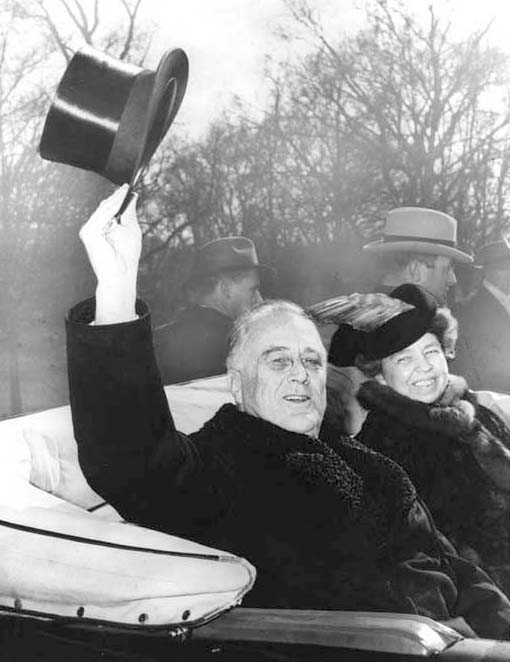
U.S. President Franklin D. Roosevelt was inaugurated for an unprecedented third term. In his inaugural address the President made no mention of the European war, events heating up in the Pacific and in China except for the vague statement “In this day the task of the people is to save the Nation and its institutions from disruption from without.” Franklin Delano Roosevelt, for the third time, was inaugurated as president “of the United States, placing; his hand on the worn family Bible and promising to “preserve, protect and defend the Constitution.” History was made as Mr. Roosevelt again became president, for no other chief executive ever served more than two terms. But the setting aside of the third term tradition probably will lose its historical importance in the maze of far-reaching developments destined to take place in the coming four years, or probably very shortly. The election of Mr. Roosevelt was brought about because of the critical foreign situation, it being the unwillingness of the majority of the voters to make a change at this time. Even in the short time since the election there has been a tum for the worse in the crisis confronting the United States and Mr. Roosevelt takes office with problems so grave that the pages of history must be thumbed back to the Civil war to find a comparison. As he mounts the bridge of the United States ship of state he realizes that only expert guidance can chart its way safely through troubled seas of foreign relations. In his hands rests the destiny of 130,000,000 Americans, the United States itself and possibly all of western civilization.
During his inaugural address, Roosevelt states:
“Democracy alone, of all forms of government, enlists the full force of men’s enlightened will…. It is the most humane, the most advanced, and, in the end, the most unconquerable of all forms of human society. The democratic aspiration is no mere recent phase of human history…. We… would rather die on our feet than live on our knees.”
The inaugural parade which marched “the historic mile” down Pennsylvania Avenue today and past the White House to salute President Roosevelt for the third time provided a dramatic foretaste of things to come in the military program of the United States.
President Roosevelt drafts a letter by hand to be given to Winston Churchill by hand by Wendell Willkie. It quotes from the Henry Wadsworth Longfellow poem “The Building of the Ship”:
Sail on, Oh Ship of State!
Sail on, Oh Union strong and great.
Humanity with all its fears
With all the hope of future years
Is hanging breathless on thy fate.
Churchill, upon the letter’s receipt, proclaims it “an inspiration.” The letter is not famous in and of itself, but for the response that it provokes in Churchill in February which many believe has far-reaching implications.
John G. Winant will be the next United States Ambassador to the Court of St. James, it was learned today. He is expected to be accompanied by a business man who will have the rank of Minister and liaison duties in connection with the United States’ production of war materials, which is becoming more essential to Great Britain daily. The former Governor of New Hampshire has been mentioned often by the British press as a possible successor to Ambassador Joseph P. Kennedy since the latter faded from the scene. His appointment will cause little surprise and will be received with pleasure by his many friends here. Mr. Winant entered the European picture in 1935 when he became assistant director of the International Labor Office at Geneva, moving up to the directorship two years ago. His record as an administrator, coupled with his personality. stamped on the minds of influential Britishers a most favorable impression. The Foreign Office here would not discuss the Ambassadorship until the appointment had passed through. It would not even confirm that its assent had been asked to Mr. Winant’s appointment.
The State Department will reject legislative demands that the department make public the diplomatic reports of Joseph P. Kennedy and William C. Bullitt, according to rumors on Capitol Hill. Mr. Kennedy, who will retire soon as Ambassador to Great Britain, and Mr. Bullitt, former Ambassador to France, were said by senator Wheeler of Montana to have disagreed sharply on the course the United States should pursue in the European war. One legislator told reporters that the State Department would decline to release the reports, even to Congressional committees, on the ground that they were confidential documents of the Executive branch of the government.
Holding that the Federal Government is paramount in its power over aliens and noting that a law for registration of foreign born was enacted last year, the Supreme Court declared today that a Pennsylvania alien registration law was illegal.
The extent to which the Federal Government is building up its strategic materials reserve for national defense was indicated yesterday by the disclosure that between 25,000 and 35,000 bales of raw rubber had been landed at Staten Island in the last four weeks by ships arriving from Singapore.
Syndicated columnist Walter Winchell posts a column in which he writes:
“The Story Tellers: The DAC News reports that a Harlemite watching Father Devine whisk by in a long limousine, wrote: ‘There, but for the grace of God—goes God.’”
As indicated, this quote was made by a “Harlemite” (presumably but not certainly African American) toward a certain obscure neighborhood religious figure, Father Divine (the column misspells his name, showing how obscure he is). The quote apparently (this is uncertain, it may be the other way around) is appropriated by others to refer to Orson Welles, who is at this time engaged in a vicious fight to get his film “Citizen Kane” finished and released. Many in Hollywood deeply resent Welles for any number of reasons, but primarily because he has been able to gain a contract from RKO which gives him exclusive control over the two films therein. This is an unprecedented degree of power by the “Boy Genius.” In general, the quote “There but for the grace of God, goes God” is believed to have originated as a jibe at Welles, but this column is its first known appearance in any media and may be the true source of the phrase.
Béla Bartók’s 6th String Quartet, premieres in NYC.
Chinese Communist leadership defiantly declared a re-organized New Fourth Army after Chiang Kai-shek called for the army’s disbanding due to treachery.
Conflicting reports regarding the seriousness of the breach between the Chinese Government, headed by Generalissimo Chiang Kai-shek, and the Fourth and Eighth Communist armies continue to reach Shanghai. Although there has long been dissension between the two major parties in Chinese resistance to Japan, such dissension has not flared up to such an extent since the Communists agreed to accept General Chiang’s orders for anti-Japanese activities and warfare.
While the Chinese Nationalists and Communists have been fighting each other recently, the Japanese have been fairly quiet. That changes today, with attacks by the Japanese 11th Army against the Chinese 5th War Area along the Huai River near Hsinyang. This is the start of the Battle of Southern Honan.
Shanghai’s Bund this morning, especially around what was the old Central Bank of China, witnessed a colorful ceremony as Wang Ching-wei’s Nanking-sponsored Central Reserve Bank opened its doors and proclaimed its readiness for business.
Japan offers to mediate in the conflict between French Indochina and Thailand.
Japan expanded annual intelligence budget to $500,000 to gather more intelligence on the United States.
Foreign Minister Yosuke Matsuoka told the Japanese Diet today that Japan, Germany and Italy certainly would accomplish their goal of a new world order “if only given time” and expressed hope that the United States “will bend her utmost efforts to allay the impending crisis of civilization.”
Dow Jones Industrial Average: 129.24 (-0.51)
Born:
Perry Lee Dunn, NFL running back (Dallas Cowboys, Atlanta Falcons, Baltimore Colts), in Natchez, Mississippi (d. 2018).
Pierre Lalonde, Canadian singer and television host, born in Montreal, Quebec, Canada (d. 2016).
Naval Construction:
The Kriegsmarine (German Navy) Type VIIC U-boats U-235, U-236, U-237, U-238, U-239, and U-240 are ordered from F. Krupp Germaniawerft AG, Kiel (werk 665–670).
The Kriegsmarine (German Navy) Type VIIC U-boats U-268, U-269, U-270, U-271, U-272, and U-273 are ordered from Bremer Vulkan-Vegesacker Werft, Bremen-Vegesack (werk 33–38).
The Kriegsmarine (German Navy) Type VIIC U-boats U-305, U-306, U-307, and U-308 are ordered from Flender Werke AG, Lübeck (werk 305–308).
The Kriegsmarine (German Navy) Type VIIC U-boats U-341, U-342, U-343, and U-344 are ordered from Nordseewerke, Emden (werk 213–216).
The Kriegsmarine (German Navy) Type VIIC U-boats U-363, U-364, U-365, and U-366 are ordered from Flensburger Schiffsbau-Ges, Flensburg (werk 482–485).
The Kriegsmarine (German Navy) Type VIIC U-boats U-391, U-392, U-393, U-394; U-396, U-397, and U-398 are ordered from Howaldtswerke AG, Kiel (werk 23–26; 28-30)
The Kriegsmarine (German Navy) Type VIIC U-boats U-417, U-418, U-419, and U-420 are ordered from Danziger Werft AG, Danzig (werk 118–121).
The Kriegsmarine (German Navy) Type VIIC U-boats U-469, U-470, U-471, U-472, and U-473 are ordered from Deutsche Werke AG, Kiel (werk 300–304).
The Kriegsmarine (German Navy) Type VIIC U-boats U-635, U-636, U-637, U-638, U-639, U-640, U-641, U-642, U-643, U-644, U-645, and U-646 are ordered from Blohm & Voss, Hamburg (werk 611–622).
The Kriegsmarine (German Navy) Type VIIC U-boats U-669, U-670, U-671, U-672, U-673, and U-674 are ordered from Howaldtswerke Hamburg AG, Hamburg (werk 818–823).
The Kriegsmarine (German Navy) Type VIIC U-boats U-777, U-778, and U-779 are ordered from Kriegsmarinewerft (KMW), Wilhelmshaven (werk 160–162).
The Kriegsmarine (German Navy) Type VIIC U-boats U-821 and U-822 are ordered from Oderwerke AG, Stettin (werk 821–822).
The Kriegsmarine (German Navy) Type IXC/40 U-boats U-841, U-842, U-843, U-844, U-845, U-846, U-847, U-848, U-849, U-850, U-851, and U-852 are ordered from AG Weser, Bremen (werk 1047–1058).
The U.S. Navy Accentor-class coastal minesweeper USS Courlan (AMc-44) is laid down by the Gibbs Gas Engine Co. (Jacksonville, Florida, U.S.A.)
The Royal Navy Dance-class ASW trawler HMS Sword Dance (T 132) is commissioned. Her first commanding officer is T/Lieutenant Robert Dwyer, RNR.
The U.S. Navy patrol gunboat USS Niagara (PG-52) is commissioned. She was launched in 1929 as the steel hulled yacht Hi-Esmaro by Bath Iron Works, Bath, Maine, and acquired by the Navy in 1940. Her first commanding officer is Lieutenant Edwin Warren Herron, USN.
 History Diaries