Benito Mussolini visited Adolf Hitler at Berchtesgaden in Germany, accepting German assistance in North Africa, but not Albania. Hitler noted that he would launch an invasion of Greece if British troops there began to threaten the oil refineries at Ploiesti, Romania. A chastened Mussolini arrived today to plead with Hitler for military aid. The location is significant — until now, the two dictators have met on “equal terms” on their borders. Count Ciano found the Duce “frowning and nervous” on his special train — clearly worried that Hitler would be insultingly condescending to him after Italy’s string of defeats in North Africa, Greece and Albania. Much to his surprise — and obvious relief — Mussolini found Hitler cordial and welcoming. hey discuss Hitler’s initial plans to send forces to the Mediterranean — outlined in Hitler’s most recent Fuhrer Directive, though Mussolini presumably doesn’t know about that, or at least technically shouldn’t unless Hitler personally gives him a copy or tells him about it verbally. Mussolini is planning his own offensive to retake the Klisura Pass, to take place in about a week’s time. The Führer has already agreed to bolster the Italian army in Libya with anti-tank formations and squadrons of the Luftwaffe, and to send an army corps of two and a half divisions to Albania. The price to the Duce is total subordination to Hitler in all military matters.
This conference continues the gradual shift in the relationship between the two men. In the 1920s, Mussolini was dismissive of the Germans and rarely even bothered to meet with Hitler’s emissaries, such as Hermann Göring (who waited months for meetings). Germany’s early military victories in Poland, France, and Scandinavia completely leveled that playing field, and now the Italian reversals in North Africa and particularly Albania have turned Italy into little more than a German satellite. Italy remains independent and Mussolini capable of independent action, but largely because Hitler still views Italy as his most significant ally which is better to have at his side than helping the British.
A competent diplomatic authority said today that the British had drawn up detailed plans for bombing Rumania’s oil fields and rail lines, but were holding their execution in abeyance for fear of the effect on the Greek war.
The front in Albania has stabilized for the time being on 19 January 1941, as much due to the weather as by Italian resistance to the continuing Greek offensive. The RAF bombs Berat, while the Luftwaffe performs reconnaissance over Athens and Piraeus — the main supply port being used by the British.
The British and Australian troops surrounding Tobruk continue their preparations for the conquest of Tobruk. This operation originally was scheduled to begin on the 20th but was postponed for 24 hours due to sandstorms. The weather forces the Royal Navy to cancel Operation IS 1, the bombardment of Tobruk by Monitor HMS Terror, gunboat HMS Aphis, and several other ships. The weather damages Aphis, which has to be escorted to Port Said for repairs.
In identical speeches, Iron Guard speakers at 50 public rallies throughout Rumania, warned enemies of the axis’ “new order” in Europe that it would “be useless and dangerous for anyone to try to sabotage our action.” The speakers, mostly cabinet members of the Nazi-minded Guardist regime, denounced the “avaricious plutocracy of international Jewry and Free Masonry,” charging them with provoking the war and bringing Rumania to the state in which we found her when we took power.” It would not take much to set off a major revolt against the Antonescu government. The Iron Guard has been agitated since the reburial of its founder in November, and they view Antonescu as part of the forces that are oppressing them. Horia Sima remains effectively in charge of members of the Iron Guard rather than the government; they populate large proportions of the Security Police and the Bucharest police and follow his orders even though he is not in the government’s chain of command. The Iron Guard also has a firm hold of the media and widespread support in the countryside.
British motorized units pursuing fleeing Italian soldiers along the 200-mile Sudanese front were believed tonight to have crossed the border into Italian East Africa after forcing the Fascists from Kassala, the last Anglo-Egyptian Sudan city held by Premier Mussolini’s men. Their position precarious after weeks of constant patrol action by the British, the Italians withdrew three days ago from Kassala, only 15 miles from Italian Eritrea. It was only today, however, that the British announced reoccupation of the town the Italians had captured last July. The Italians were said to have left Kassala, capital of a valuable cotton-growing section, almost without firing a shot.
Emperor Haile Selassie of Abyssinia crossed the border between Sudan and Italian Eritrea, traveling toward his home country behind advancing British and Commonwealth troops.
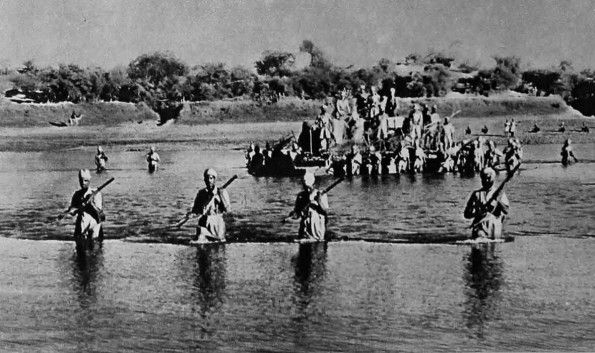
British and Commonwealth troops attacked Italian Eritrea. British Middle East Commander General Archibald Wavell has been assembling large forces in Sudan. He plans attacks from three directions: an advance from Sudan; an offensive from Kenya; and amphibious landings to retake British Somaliland. They face 17,000 Italian troops along the border. The 4th and 5th Indian Divisions and units of the Sudan Defense Force under British General William Platt, launched an attack against the Italians in Eritea, Somaliland, and Ethiopia. The 17,000 Italian troops in the various border positions were led by Lieutenant-General Luigi Frusci. Kassala was taken immediately. The timing for the British offensive was chosen because British intelligence had decoded secret Italian instructions to withdraw that week from Kassala, a town in the Anglo-Egyptian Sudan which had been occupied by the Italians since the summer of 1940. The ability by the British to mount offensives at the same time on two completely separate axes is an indication of growing British military might; but, more significantly, it is a sign of abject Italian military weakness (as proven by British military failures against the Germans in Greece a few months hence). It also is a complete vindication of Winston Churchill’s edgy decision in August 1940 to start sending his Winston Special convoys carrying troops from England to the Middle East despite the looming threat of a German invasion.
The Italians under Lieutenant-General Luigi Frusci having abandoned the key rail junction of Kassala, Sudan, the British take possession without any fighting. This opens a path for a thrust toward Ethiopia. Another thrust is started in Kenya. The aim is the complete expulsion of Italian forces from Italian Somaliland, Ethiopia, Eritrea, and British Somaliland. The RAF is active, bombing Italian assets in the region.
The British have been studiously breaking Italian codes and thus have major advantages in the fighting. Italian commander and Viceroy of Italian East Africa the Duke of Aosta is competent, but his forces are completely out-matched and the British know his orders almost as quickly as his own troops do. The British also are using newly arrived Ethiopian Emperor Haile Selassie to stir up the natives against the Italians who had deposed him.
At Fair Isle, Orkney, the Lerwick lifeboat arrives to collect the German airmen who crashed here two days ago and take them to Shetland. Karl Heinz Thurz, the pilot of the Heinkel He-111, turns 21 today.
British battleship HMS Prince of Wales (Captain John Leach), a member of the King George V-class, is commissioned. This is done prematurely by normal standards, as numerous tests have not yet been done on her (compartment air tests, ventilation tests and thorough testing of her bilge, ballast and fuel-oil systems). The main guns also have many issues that need to be worked on but are not yet apparent. The Admiralty is rushing ships into service due to the looming presence of German battleships Tirpitz and Bismarck.
The Luftwaffe resumes its raids with an attack by 62 bombers on Southampton during the night. Another raid, during the day, targets RAF Feltwell. The RAF sends a few planes across to bomb French targets.
German Luftwaffe aircraft bombed RAF Feltwell in England, United Kingdom.
The Illustrious Blitz continues. German Luftwaffe Stuka dive bombers attacked Valletta Harbour, Malta for the fourth consecutive day in their attempt to finish off the damaged British carrier HMS Illustrious, which was only further damaged with near misses. It is a fierce attack conducted by 80 aircraft in two separate raids. The Luftwaffe scores two misses on Royal Navy aircraft carrier HMS Illustrious and causes it some further damage below the waterline. This damage includes damage to the port turbine and flooding of a boiler room. The shock of the concussions throws the Illustrious up against the wharf, likely damaging it, too. Afterward, the carrier settles down at the stern. Extensive damage is done to the port itself, with the Germans using 1000 kg high explosive bombs, twice the heaviest used previously. A couple of destroyers, HMS Imperial and Decoy, also sustain inconsequential damage.
Fliegerkorps X is under direct orders from Hitler to sink Illustrious, and its presence at Malta has incurred the full fury of the recently arrived Stukas and Junkers Ju 88s based at Catania, Sicily. Senglea suffers more damage, with the church of Our Lady of Victory completely wrecked, and a priory of the Dominican Fathers at Vittoriosa also is destroyed. The Luftwaffe has done more damage in furtherance of the Axis cause to Malta in its first week in the Mediterranean than the Italians have done since entering the war.
The RAF has hits hands full on Malta. A Fairey Fulmar of No. 806 Squadron — part of Illustrious’ complement, now based on Malta — shoots down a Junkers Ju 87 Stuka during the attack, but then is itself shot down (two crew rescued). Governor Dobbie says in his daily report:
“We can take it and enemy morale is visibly affected.”
The British take comfort in the losses they are extracting on the attacking German aircraft. The loss in morale that Governor Dobbie references shown in less aggressive Stuka attacks. It would make sense that, as the air battle over Malta progresses, the most aggressive pilots would tend to get killed first. However, it appears that British claims of downed Luftwaffe aircraft greatly exceed actual losses — which invariably is the case and nothing special regarding Malta. The RAF has lost just five aircraft so far, while the British claim to have downed over 50 Luftwaffe planes either in aerial combat or by ground fire — an extremely inflated figure similar to wild claims made during the Battle of Britain.
Hurricane pilot Flight Lieutenant Jay MacLachan becomes an ace today, downing his fifth enemy aircraft.
Light cruiser HMS Galatea, repairing since 17 October at Chatham, departed Sheerness. The light cruiser arrived at Scapa Flow on the 20th to rejoin the Fleet. CS.2 transferred to light cruiser Galatea on the 23rd.
Destroyer HMS Boreas, under repair at London, was damaged by German bombing.
Corvette HMS Honeysuckle was damaged by mining off Bar Light Vessel. The corvette was repaired in three months at Liverpool.
British steamer Bonnington Court (4909grt) was sunk by German bombing 9.5 cables 275° from Sunk Light Vessel. Two crew members were lost.
Dutch steamer Diana (312grt) was sunk by a mine in 51-18N, 3-10W. Two crewmen were rescued.
British steamer Zelo (2294grt) was damaged by German bombing off Sunk Light Vessel.
Italian submarine Neghelli attacked Greek destroyer Psara in the Aegean.
Anti-aircraft cruiser HMS Calcutta and destroyers HMS Greyhound, HMS Defender, and HMS Janus departed Piraeus at 0800 escorting convoy AS.12 of steamers Clan Cumming (7264grt), Clan MacDonald (9653grt), and Empire Song (9228grt) from Piraeus to Alexandria. British steamer Clan Cumming was damaged by a torpedo at 1153 from Italian submarine Neghelli off Piraeus near San Giorgio Island in 37-15N, 24-04E. The steamer was able to arrive back at Piraeus at 1900 under its own steam with torpedo damage forward, escorted by destroyer Janus. The submarine was sunk by destroyer Greyhound off Crete. The other two ships of the convoy arrived at Port Said on the 21st. Anti-aircraft cruiser HMS Calcutta and destroyers Greyhound, Juno, and Defender proceeded to Alexandria.
Aircraft carrier HMS Illustrious in dock at Valletta, Malta, was damaged by two misses of air bombs. The aircraft carrier was thrown against the wharf and sustained damage below the water line. Her port turbine was fractured and the boiler room flooded. Destroyer HMS Imperial in dock from her October mining was near missed, but not damaged when debris from the dock was blown into the dock. A Fulmar of 806 Squadron from Illustrious was shot down after shooting down a JU 87. Lt R. S. Henley and Naval Airman A. S. Rush were both picked up.
On the 19th, operation IS 1 was cancelled due to bad weather. The cruisers and destroyers were withdrawn for other operations and proceeded to Suda Bay. Gunboat HMS Aphis was having problems with the weather. Two destroyers and an aircraft were sent to assist her. The gunboat was found at 1300 off Damietta. Destroyer HMS Griffin escorted the gunboat to Port Said arriving at 0700/20th. Gunboat Aphis was under repair until 27 January at Port Said.
Light cruiser HMS Ajax departed Alexandria for Suda Bay.
Destroyer HMS Decoy, under repair in dock at Malta, was damaged by German bombing. However, her completion was not delayed.
Convoy OG.50 departed Liverpool escorted by destroyers HMS Malcolm, HMS Shikari, and HMS Skate, sloop HMS Deptford, corvettes HMS Arabis and HMS La Malouine, anti-submarine trawlers HMS Lady Elsa, HMS Wellard, and HMS Zeno, and ocean boarding vessel HMS Marsdale. The destroyers, corvettes, trawlers were detached on the 20th and the ocean boarding vessel on the 22nd. Sloop Deptford escorted the convoy through to Gibraltar, arriving on the 31st.
Convoy FN.387 departed Southend, and arrived at Methil on the 21st.
Convoy FN.388 departed Southend, and arrived at Methil on the 21st.
Convoy AN.12 arrived at Piraeus on the 18th. Escorting heavy cruiser HMS York also arrived at Piraeus.
Convoy BS.13 departed Suez. The convoy was joined on the 20th by sloops HMS Clive and HMS Grimsby. The sloops were relieved on the 22nd by light cruiser HMS Caledon and sloops HMS Flamingo, HMIS Indus, and HMS Parramatta. The convoy was dispersed on the 27th.
Convoy SLS.63 departed Freetown, and arrived at Liverpool on 13 February.
Franklin Delano Roosevelt of New York will be inaugurated tomorrow as the first third-term President in the history of the United States. He will receive the Constitutional oath from Chief Justice Hughes at noon at a traditional spot in front of the Capitol under the gaze of perhaps the largest crowd of people ever to witness an inaugural ceremony, and in the presence of invisible millions who will be listening to the radio in this and many lands to hear what further word the American President may have for a war-stricken world. The weather forecast was for a clear, cold day, in direct contrast to Mr. Roosevelt’s second inaugural four years ago when rain fell in torrents for hours on end, and to his first on March 4, 1933, when wet snow, intermingled with sleet, added to the other discomforts of a disturbed throng of visitors who had found themselves caught in Washington in the midst of a national financial panic.
Wendell Willkie will take a personal message from President Roosevelt to Prime Minister Churchill of England. The president interrupted work on his inauguration address today to pen the message in his own hand and gave it to Willkie during a brief conference they held at the White House. The two men who battled for the presidency in last fall’s political campaign talked In Mr. Roosevelt’s oval study for about 30 minutes. Secretary of State Hull was with them. “We talked about the European situation,” Willkie told reporters as he left, ‘”and the president gave me a very pleasant personal note to Mr. Churchill. It is more than just a formal introduction.” The note, it was learned, introduces Willkie with the comment that he has been trying to keep politics out of the American defense situation and expresses wishes for British success. Its salutation is “Dear Churchill.” The envelope containing the note was addressed “To a certain naval person, kindness of W. Willkie.” Churchill formerly was first lord of the admiralty and shares Mr. Roosevelt’s interest in ships.
President Roosevelt signalized the eve of his unexampled inauguration as a third-term president tonight by recalling an old 1940 issue with a message to the Electoral College that “no dictator would run the risk of a free election.” His communication was received with whoops of delight by a gay crowd of the nation’s notables gathered in the glittering ballroom of the Mayflower hotel for a dinner honoring the presidential electors. The audience had booed the name of Wendell Willkie, last year’s Republican presidential candidate, when Emery L. Frazier, senate clerk, ceremoniously read the roll-call of the state’s electoral vote.
The benefits which totalitarian dictators promise their people will be theirs after victory in a long and hard war have already been vouchsafed to the peoples of the world’s democracies, Attorney General Robert H. Jackson said tonight in a speech to the Presidential electors which was read by Solicitor General Francis Biddle.
Efforts either to modify or to block action on the Administration’s Lend-Lease Bill will be the major business of Congress in the next six days. Most prominent will be the hearing by the House Foreign Affairs Committee of critics and opponents of the measure. Equally important will be the meeting on Wednesday of the Senate Foreign Relations Committee, which it appears may turn out to be almost equally divided between supporters on one side and modifiers and outright opponents on the other. This meeting is expected to decide whether to hold Senate group hearings on the bill, and, if so, when they will begin. With three or four members out of town or not yet committed, the issue is expected to be sharply debated.
Secretary of State Cordell Hull quickly responds to German Chargé d’Affaires Hans Thomsen’s complaint yesterday about the “flag incident” at the German consulate in San Francisco. In diplomatic terms, this is like traveling at the speed of light. Hull promises a complete investigation (which will conclude and whose results will be communicated to the Germans on 25 May 1941).
William S. Knudsen, Director General of the Office of Production Management, called on industry today for an “‘all-out’ performance of American ingenuity, backed by every machine and piece of equipment available,” to supply the guns, tanks, planes and ships needed for defense.
Perry W. Whittlesey, a founder of the Council for America and strong advocate of aid to Britain, was shot and seriously wounded today by his German-Swiss houseboy. Whittlesey, in a statement to police, identified the houseboy as Walter Groebli and said he was a Nazi sympathizer.
Prospects for peace in the Ryan Aeronautical–C.I.O, United Automobile Workers labor contract dispute remained “bright” after a day of negotiations which recessed tonight 36 hours before expiration of the union’s strike deadline.
The Nationalist Chinese, following an order from Chiang Kai-shek, disband the Communist New 4th Army near Maolin in the Yangtse Valley.
Despite the recent French naval victory at Koh Chang, the Thai forces retain the initiative on land. The French retreat behind the Mekong River in the north.
The High Command in Bangkok said today that the Thai [Siamese] flag was raised yesterday over the French protectorate of Cambodia, in French Indo-China, for the first time in more than fifty years.
Japanese Lieutenant General Kazuma Suzuki today described the United States as the “decisive factor” in both the European and Asiatic conflicts. He spoke before an assembly honoring Admiral Kichisaburo Nomura, the new Ambassador to the United States. “It is rash to conclude that China will crumble at an early date.” said General Suzuki, former commander of the Japanese forces in China and an authority on military affairs. “Because of aid from the United. States and Britain,” he declared, “I believe China will keep up resistance for a long period. I believe also that the European war is a long-term conflict. I believe it will be extremely difficult for Germany to carry out a successful landing campaign on British soil. The bulk of the British Navy is unharmed and larger than the German, and Italian navies combined. The Balkan situation remains confused,” General Suzuki continued, “and the future is unpredictable. The decisive factor in both hostilities undoubtedly is the United States. The Japanese must not be content with military preparations but must endeavor to solve their international difficulties by means of diplomacy.”
Born:
Colin Gunton, British theologian known for “The One, The Three And The Many: God, Creation And The Culture Of Modernity”, in Nottingham, England, United Kingdom (d. 2003).
Pat Patterson, Canadian pro wrestler (WWE Hall of Fame; creator Royal Rumble), in Montreal, Quebec, Canada (d. 2020).
Tony Anholt, British actor known for “Howard’s Way”, in Singapore (d. 2002).
Naval Construction:
The U.S. Navy Accentor-Class coastal minesweeper USS Cotinga (AMc-43) is laid down by the Gibbs Gas Engine Co., Jacksonville, Florida.
The Royal Navy Fairmile B-class motor launch HMS ML 153 is commissioned.
The Royal Navy King George V-class battleship HMS Prince of Wales (53) is commissioned. The ship will not be fully completed until March. Her commander at commissioning is Captain Louis Henry Keppel Hamilton, DSO, RN.
 History Diaries