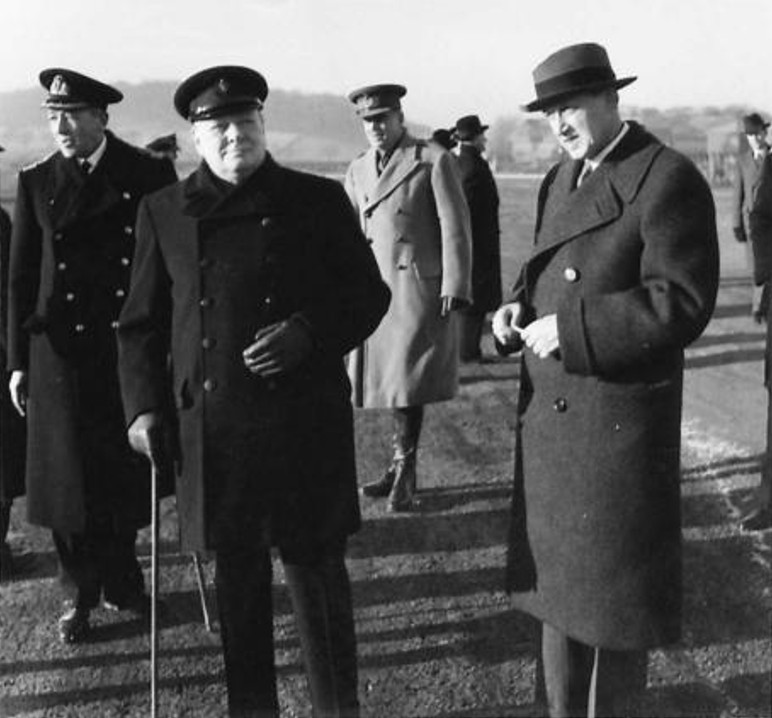
The Australian/British attack on Tobruk, originally planned for 20 January, is postponed 24 hours due to sandstorms. British ships HMS Terror and Aphid bombard Tobruk during the night, and the RAF also raids the port.
On 18 January 1941, following the Greek capture of the key Klisura Pass in Albania, the lines have stabilized. Despite having the pass, which is considered the gateway to the key Italian port of Valona, the Greeks are unable at this time to push further down toward the Italian port. The Italians are building up troops for an attempt to retake the pass.
The British destroyer HMS Castleton was damaged by German bombing while undergoing repairs at Portsmouth.
The British Ministry of Economic Warfare charges that “Some United States producers are helping Germany indirectly by selling Russia commodities in which Germany is deficient. Of these cotton is the most important.” The British Minister of Economic Warfare, Hugh Dalton, alleges that some U.S. producers are skirting the economic blockade of Europe by selling items needed by the Germans to Russia, which then passes them along to the Germans. There also are other potential routes for such transactions (which often involve cotton shipments), such as contraband shipments from the United States to Portugal, thence to Switzerland, and finally to Italy. A route for cotton which does not involve the U.S. is from Turkey north through various neutrals such as Russia.
The Germans do indeed experience a shortage of cotton, which they are attempting to overcome by the use of artificial fibers (with limited success because the ersatz replacements do not insulate as well as natural cotton). Cotton — or the lack thereof by the Germans — will play quite a pivotal role in the war at the end of the year.
There were growing indications today that the British Government, which has maintained a double standard for the treatment of Leftists and Rightists, is about to crack down on the Communists and their sympathizers who are engaging in subversive propaganda.
At Fair Isle, Orkney, an RAF rescue launch, sent to collect the German airmen who crashed yesterday, runs aground at the south end of the island. A second boat is despatched to collect both men and boat. It too runs aground and has to be refloated with the help of the islanders.
Marshal Pétain meets with former minister Pierre Laval to discuss his concerns about Laval. Laval remains a private citizen after the meeting, but this proves to be a key step toward Pétain inviting Laval back into the government.
Only 42 of Belgium’s 2,671 cities, towns and villages escaped damage from bombs, artillery fire or flames during the German army’s swift conquest of that little nation, the U.S. commerce department reported today. In addition, it said, some damage still is occurring as a result of British air raids on German “invasion bases” in Belgium.
A British military mission has been working in the heart of Ethiopia since last July training and arming thousands of tribesmen for a fight against the Italians, it was disclosed officially tonight. The disclosure came less than a week after it became known that little Halle Selassie, dethroned by the Italian conquerors of Ethiopia five years ago, was receiving a constant stream of tribal revolutionary agents in Khartoum, only 300 miles from Ethiopia. There have been estimates that 200,000 Ethiopians were active in guerrilla fighting in the interior.
The British are making exploratory attacks into Abyssinia, and the Italians evacuate Kassala.
A major snowstorm begins over England and the Continent that essentially shuts down air operations on both sides for three days. The Luftwaffe squeezes in a few minor raids during the day, dropping some bombs on the outskirts of London and shooting up a train in East Anglia. Neither side is in the air after dark. The coastal guns at Hellfire Corner (Dover/Calais) are in action during the day.
The Luftwaffe attacks Portsmouth and has some near misses on destroyer HMS Castleton, damaging it further while it is undergoing repairs for an earlier incident. Another Luftwaffe attack on Swansea damages 3489-ton Greek freighter Chelatros.
Following up on a story from 17 January, the locals on Fair Isle, Orkney continue to hold a group of three Luftwaffe airmen who crashed in their reconnaissance Heinkel He 111. The seemingly simple task of retrieving them turns into a nightmare as the first launch sent to take them into custody runs aground on the southern tip of the island, and then a second launch is sent and also runs aground. The islanders help to refloat the craft, and then the Germans are finally taken away.
Feldwebel Mickel of 1./JG 1 downs a Blenheim over the North Sea for his first victory.
RAF Bomber Command dispatches 1 Blenheim during the day to Flushing which turned back.
German Luftwaffe Stuka dive bombers attacked Malta for the third consecutive day, destroying 6 RAF aircraft and damaging many more at the Luqa and Hal Far airfields. Large squadrons of German dive bombers again attacked the British Mediterranean island-fortress of Malta yesterday afternoon amid reports Premier Benito Mussolini intends to see Adolf Hitler today, possibly to discuss further Nazi aid for his forces in Albania and Libya. Informed sources in Berlin said the German fliers scored hits on airplane hangars, barracks and runways of two British airdromes following Thursday’s heavy attack on the city and harbor of Valetta in which more hits on the British aircraft carrier Illustrious were claimed. From Valetta, Malta, came a report that the Germans attacked the Island stronghold three hours Saturday afternoon and five bombers were reported shot down. It made no mention of damage beyond saying the Germans in three days of raiding had nearly equaled the civilian damage caused by the Italian warplanes in eight months.
Aside from half a dozen parked planes lost at the airfields, the British lose two Fairey Fulmars (one man dead) of RAF No. 806 Squadron. The Luftwaffe loses at least five Stukas and Junkers Ju 88s. The Germans lose five men, including two pilots.
The government of Malta is faced with a humanitarian crisis in the bombed areas downtown. Governor Dobbie visits Senglea and Vittoriosa, sees the devastation, and orders an immediate evacuation of the entire Three Cities. He also calls in the troops to help with continuing rescue efforts. These efforts are bearing fruit, as a dozen people — the Costa and Mizzi families — are found alive in a family air raid shelter two days after the start of the Illustrious Blitz. There are others perhaps also waiting to be discovered, so the workers dig around the clock.
The unescorted Norwegian steam merchant Gyda was torpedoed and sunk by the U-58, commanded by Oberleutnant zur See Heinrich Schonder, northwest of Ireland in the northern Atlantic Ocean. Of the ship’s complement, 11 died and 9 survivors were picked up by the Belgian steam passenger ship Ville d´Arlon. The 1,591-ton Gyda was carrying salt and was bound for Bathurst, New Brunswick.
The unescorted British steam merchant Woodbury was torpedoed and sunk by the U-99, commanded by Kapitänleutnant Otto Kretschmer, about 300 miles west of Lands End, England in the eastern Atlantic Ocean. Of the ship’s complement, all 35 survived and reached land by lifeboat. The 4,434-ton Woodbury was carrying canned meat, wheat, and general cargo and was bound for Manchester, England.
British tanker British Union (6,987grt) was sunk by German raider Kormoran at 26-34N, 30-58W. Thirty six crewmen were taken prisoner. Eight crewmen were rescued and one died. German raider Kormoran is operating seven hundred hundred miles (1100 km) west of Western Sahara when the lookouts spot smoke on the horizon just before sunset. The ship is the 6,987-ton British tanker British Union. Kormoran Captain Detmers guesses (correctly) that the ship is an Allied vessel and opens fire, hitting with the third salvo. As the Kormoran approaches in the darkness, the crew of the tanker opens fire but misses. The crew of the Kormoran returns fire and does not miss, starting raging fires. The British crew then abandons ship, and Detmers sinks it with gunfire and three torpedoes (one fails to explode). There are 28 survivors (and a pet monkey) in two lifeboats taken aboard the Kormoran. The British Union was able to get off a distress call during the capture, drawing the British armed merchant cruiser (AMC) HMS Arawa to the scene around midnight. While it does not find the Kormoran, which quickly left the scene, the Arawa does pick up the crew of a third lifeboat missed by the Kormoran. This incident is puzzling to the Admiralty because they are unaware of the presence of the Kormoran and Admiral Scheer is later proven to be far from the scene. There also are reports from the men rescued in the third lifeboat that the Kormoran had fired on the other two lifeboats, a claim later proven to be false.
Norwegian tanker Sandefjord (8038grt) was captured in the South Atlantic by German heavy cruiser Admiral Scheer. German cruiser Admiral Scheer is operating in the South Atlantic. Today, it captures 8,038-ton Norwegian tanker Sandefjord, which is carrying 11,000 tons of crude oil. The Sandefjord is sent with a prize crew to France, where it is renamed Monsun. Some sources place this on the 17th, so I have included this event there as well.
Destroyer HMS Castleton, under repair at Portsmouth, was damaged by near misses of German bombing.
Destroyers HMS Kelly, HMS Kipling, HMS Kashmir, and HMS Jackal arrived at Plymouth from Greenock for anti-submarine duties.
Armed merchant cruiser HMS Asturias captured Vichy French steamer Mendoza (8199grt) sixty miles east of Montevideo. The steamer was taken to Freetown, arriving on 1 February.
Greek steamer Chelatros (3489grt) was damaged by German bombing at Swansea.
German steamer Godfried Bueren (4664grt) was sunk on a mine in the Kattegat.
Light cruiser HMS Gloucester departed Alexandria at 0500 for Port Said to hoist out her DCT which was damaged in the 11 January bombing. The DCT was found beyond repair. Light cruiser Gloucester departed Alexandria on 13 February for Port Said where damaged light cruiser HMS Liverpool’s DCT was fitted on Gloucester.
Sub Lt A. S. Griffith was killed when his Fulmar of 806 Squadron from aircraft carrier HMS Illustrious was shot down off Malta. A second Fulmar of the Squadron was also shot down on this date, but the crew was rescued.
Italian steamer Lelio (1384grt) was sunk on a mine at La Spezia.
Convoy OB.275 departed Liverpool, escorted by destroyers HMS Montgomery, HMS Wild Swan, and HMS Witch, sloop HMS Aberdeen, and corvettes HMS Campanula, HMS Fleur de Lys, HMS Gardenia, and HMS Perwinkle. The escort was detached when the convoy dispersed on the 22nd.
Convoy FS.391 departed Methil, escorted by destroyers HMS Valorous and HMS Vortigern, and arrived at Southend on the 20th.
Convoy BS.12D departed Port Sudan, escorted by destroyer HMS Kimberley and sloop HMS Yarra. The convoy was dispersed off Aden on the 20th.
President Roosevelt threw the files of the State Department’s information on European conditions wide open today for Wendell Willkie, leaving soon for Europe. At the same time, he said he would be glad to have a personal conference with Willkie, an offer which the latter promptly said would be accepted. Details of the meeting remained to be arranged, but it was expected that it would be held tomorrow when Willkie comes here to see Hull. The chief executive directed Secretary Hull to give Willkie, Mr. Roosevelt’s Republican foe in last November’s presidential election, all information the government has received on conditions abroad and to outline fully to him the reasons behind the government’s foreign policy. Willkie, who has endorsed with reservations the president’s lease-lend plan of British aid, will confer with Hull here tomorrow at 3: 30 p.m. at the latter’s apartment. On Wednesday he will leave for London via clipper and, purely as a private citizen, make a survey of conditions there.
President Roosevelt will restrict his inaugural address Monday to about 1,000 words which will take him not more than twelve minutes to deliver, the White House stated today as the nation’s capital prepared, under lowering skies but with a Weather Bureau prediction of crisp, clear weather, for the event. The President, who worked today on the third draft of his inaugural message, was restricting its length because he has outlined his views on the international crisis in a fire side chat and message to Congress, Stephen Early, White House secretary explained. The brevity of the address is in line with plans, upon which Mr. Roosevelt has insisted, for “simple” ceremonies. The usual parade will be shorter. Only a huge air demonstration, if the weather permits, with Army, Navy and Marine Corps planes taking part, will offer a new note. Police precautions for guarding the President were made with scrupulous care. After his experience with a drenching rain in the 1937 inaugural, the President has agreed to ride to the Capitol in a closed automobile but has insisted upon returning to the White House in an open car.
Plans to “freeze” all foreign assets in the United States, similar to the license system covering the American funds of invaded nations, have been completed, it became known here yesterday. The Treasury, with the cooperation of Federal Reserve officials here and in Washington, has carried the matter to the length of drafting an executive order which awaits the signature of President Roosevelt. Such an order would halt the present free flow of German, Japanese and other Axis funds in and out of the United States. Fear of this step is believed to have inspired the recent exodus of German and Swiss money. The advantage of the license system would be that, while tying up holdings of friendly nations as well as those of Axis partners, it would allow control of withdrawals in conformity with interests of the Of the United States.
Joseph P. Kennedy, retiring ambassador to Great Britain, urged tonight that the United States “give the utmost aid to England,” but said he did not feel the nation’s immediate danger justified passage of the “lease-lend” bill in its present form. He declared that this country’s aid to Britain “should not and must not go to the point where war becomes inevitable.” The “lend-lease” bill, he said, conferred upon President Roosevelt “authority unheard of in our history,” and he commented: “I am unable to agree with, the proponents of this bill that it has yet been shown that we face such immediate danger as to justify this surrender of the authority and responsibility of the congress. I believe that after the hearings have been completed there will be revealed less drastic ways of meeting the problem of adequate authority for the president.”
Wendell L. Willkie said today that the Republican Party never could regain control of the American government if in 1941 it “makes blind opposition” to the aid-to-Britain bill and “allows itself to be presented to the people as an isolation party.” The 1940 Republican presidential candidate spoke to about 1,600 persons at the annual luncheon of the Women’s National Republican club in Hotel Astor. He and his wife were guests of honor.
Fullest possible material assistance should be extended to Great Britain by the United States in the interest of her own self-defense, regardless of whether this country ever gets a dollar back in the transaction, William S. Knudsen, Director General of the Office of Production Management, told the House Foreign Affairs Committee today.
Production of 799 airplanes of military type in December, or 99 more than had been predicted for that month by William S. Knudsen, director of the Office of Production Management, was made known today by John D. Biggers, director of production of OPM.
German Consul General in San Francisco, California, displays the prescribed German Reich flag from the consular office in recognition of German national holiday. At noon this day the flag is taken down in the presence of what is described as “a large shouting throng of people” and torn to pieces. German Chargé d’Affaires Hans Thomsen makes “most emphatic protest” over the incident (see 19 January and 25 June). While thousands stood in the street and cheered, an American sailor today ripped a huge swastika flag from its staff at the ninth-story offices of the German consulate-general in San Francisco. The action, which Consul-General Fritz Wiedemann immediately reported to the German embassy in Washington, climaxed a morning of unrest around the office building (26 O’Farrell Street) where the consulate is situated.
A proposed order published today by the National Labor Relations Board concerning charges against the Ford Motor Company would direct that company to reinstate immediately 975 former employes who were replaced after a shut-down of its Kansas City plant in 1937 and to offer re-employment to forty-six others who went on strike there several months ago.
Warner Bros. releases “Honeymoon for Three,” starring Ann Sheridan and George Brent.
The Chinese infighting between the Communists and the Nationalists (Kuomintang) continues, both on the battlefield and in press releases. Nationalist leader Chiang Kai-shek basically has outlawed the communist army, while the communists retaliate today by stating that the recently Nationalist attack on the Communist New Fourth Army by the Kuomintang was “planned by pro-Japanese conspirators and anti-Communist diehards.” Since it is obvious by now that Kai-shek was the one who ordered the operation, this is a direct shot at him by the Communists.
The British government announced that it was closing the Burma Road and Hong Kong for the transit of war supplies to China in hopes that it would lead to better relations with Japan: Continuance of transit of these materials was represented as having a serious effect on Anglo-Japanese relations… What we have therefore made is a temporary agreement in the hope that the time so gained may lead to a solution just and equitable to both parties of the dispute and freely accepted by them both.” During the rainy season in mid-1940 the British also closed it, but at that time kept the reasons murky. This time, the British explicitly do so in hopes of improving relations with Japan. The Burma Road is Nationalist China’s lifeline, with valuable supplies entering from India and Burma. With the Chinese ports closed to them due to Japanese occupation, the Nationalist Chinese have no other trade routes.
The French Indo-China Government announced today it had halted the Thal [Siamese] advance in Western Cambodia by throwing back 750 troops who had been advancing along the road to Sisophon. On the fronts to the north, the Thai invaders shelled Savannaket and bombed Pakse from the air. Earlier, 1,000 Thai troops were reported repulsed west of Pakse.
Dow Jones Industrial Average: 129.75 (+0.21)
Born:
David Ruffin, American soul singer (The Temptations — “My Girl”; “Ain’t Too Proud to Beg”), in Whynot, Mississippi (d. 1991 from an accidental overdose of crack cocaine).
Bobby Goldsboro, American pop and country singer-songwriter (“Honey”), in Marianna, Florida.
Mickey McGuire, MLB pinch hitter, shortstop, and second baseman (Baltimore Orioles), in Dayton, Ohio (d. 2025).
Naval Construction:
The U.S. Navy Accentor-class coastal minesweeper USS Chimango (AMc-42) is laid down by the Gibbs Gas Engine Co., Jacksonville, Florida.
The Royal Navy Hunt-class (Type III) escort destroyer HMS Eskdale (L 36) is laid down by the Cammell Laird Shipyard (Birkenhead, U.K.).
The Royal Navy Flower-class corvette HMS Mimose (K 11) is launched by Charles Hill & Sons Ltd. (Bristol, U.K.); completed by Richardson, Westgarth & Clark. The ship is transferred to the Free French Navy on completion and commissions as the FS Mimosa.
The Royal Navy Flower-class corvette HMS Pentstemon (K 61) is launched by George Philip & Sons Ltd. (Dartmouth, U.K.); completed by Clark.
The Kriegsmarine (German Navy) Type VIIC U-boat U-77 is commissioned. Her first commanding officer is Oberleutnant zur See Heinrich Schonder.
 History Diaries