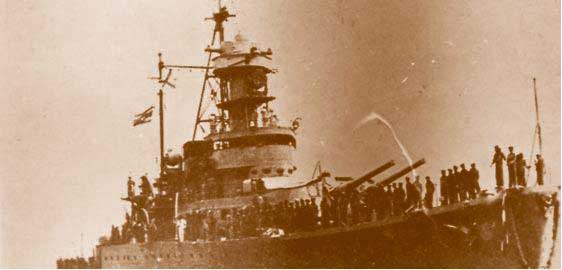
The Battle of Ko Chang was fought in the Gulf of Thailand, resulting in Vichy French victory. A French force led by light cruiser Lamotte Picquet attacked a force of Siamese warships in Indo-Chinese waters. Without loss to themselves, the French damaged Siamese coastal defense ships Sri Ayuthia and Thonburi and sank torpedo boats Trad, Songhkla, and Chomburi during operations in the Ko Chang Archipelago in the Gulf of Siam. Coastal defense ship Dhonburi was badly damaged and stranded. When the ship was towed off, she sank. Defense ship Sri Ayuthia was torpedoed by Lamotte Picquett and beached in the River Chantaboum.
The Far East takes the spotlight today. A small French naval squadron, alternately called Groupe Occasionnel and Task Force 7, approaches the Thai fleet’s anchorage off Ko Chang island at 05:30. Composed of light cruiser La Motte-Picquet, the modern avisos (patrol boat) Dumont d’Urville and Amiral Charner, and the older avisos Tahure and Marne, the force splits into three groups. Aerial reconnaissance reports the presence of Thai torpedo boats. This flight, however, removes the element of surprise — not that that will matter.
The French cruiser quickly sinks three Thai torpedo boats (Chonburi, Trad, and Songkhla) and destroys a shore observation post. The Thais bring up a coastal defense ship, HTMS Thonburi, and the French cruiser destroys it as well (it later sinks, and then is refloated) using both guns and torpedoes. The Thais then send aircraft to attack, getting a hit on the French cruiser, but the bomb is a dud and causes no damage. After damaging two other coastal defense ships, Sri Ayuthia (beached in the River Chantaboum) and Donburi, the French then withdraw, sustaining virtually no damage and having destroyed the entire Thai fleet. The French only lose 11 men.
It is a complete and total French victory (though the Thais later claim more damage caused to the French cruiser than the French or any other sources reveal). The Thais seem to recall this battle with some pride. The Japanese, seeing their tacit and informal ally Thailand in difficulty, quickly step in to arrange a settlement before the French return and start bombarding Bangkok. The French, having great difficulty on land, accept this offer of mediation, and ultimately the Thais acquire all of the lands they originally sought but the French manage to keep the rest (for now). However, there is no doubt left in anyone’s mind after the battle of Ko Chang that the French can still take care of themselves in Indochina.
The Australians and British continue preparing for the next stage of Operation COMPASS, the capture of Tobruk. A bad sandstorm sets back preparations. General O’Connor, commander of XIII Corps, minding the store with General Wavell in Greece, is anxious to begin the attack before the Italians land reinforcements at Tripoli. He also fears that the Chiefs of Staff will divert some of his forces to Greece, crimping his attack plans. In Operation IS 1, monitor HMS Terror and gunboat HMS Aphis set out from Alexandria to prepare to bombard Tobruk in preparation for the attack. They will be joined there by assorted other naval forces.
British Middle East Commander General Archibald Wavell concludes his meetings in Athens and briefly visits with local commanders on Crete before continuing on to Cairo. Wavell lands there with a strong sense of relief, later commenting on the Greek refusal of British ground forces:
“If that offer had been accepted, I should have had to stop my advance at Tobruk; I could not have gone on any further.”
The attack is affected by Wavell’s temporary absence. General O’Connor has been taking instructions from Wavell, which orders at times have not precisely mirrored those received by Wavell himself from Churchill and Whitehall. With Wavell absent, O’Connor has been communicating directly with Wavell’s superiors, and thus there is a subtle change in tone. The Headquarters, British Troops in Egypt, instructs him that there is no plan to advance on Benghazi after taking Tobruk and none should be instituted. With Wavell’s return, however, the advance on Benghazi is back “on” — at least as far as Wavell and O’Connor are concerned. O’Connor complains about “serving two masters,” but history shows that Wavell is the better judge of the tactical possibilities, not London.
The Greeks continue consolidating their hold on the key strategic Klisura Pass in Albania on 17 January 1941. They are not yet able to advance beyond the pass toward the key port of Savona, however, as the Italians are making its defense a top priority. While the Greeks have made significant gains all along the front, they have not broken through to the coast anywhere except by pushing forward on the coast itself.
The British plan a raid (Operation BLUNT) by men of No. 50 (Middle East) Commando (based on Crete) on the Italian base at the island of Kásos, southeastern Aegean. However, the operation is postponed for obscure reasons, and ultimately never takes place. The proposed operation is not a sham or decoy, as several important Royal Navy ships are held in readiness for the operation. The possibility of German participation in the African campaign was seen today when Nazi colonial sources disclosed that thousands of German troops are undergoing rigorous training on the sand flats of east Prussia. Officers of Adolf Hitler’s “south troops” were said to have participated as “official observers” in the near east campaign prior to last October. Returning with first-hand information regarding fighting under tropical conditions these officers were said to have set about instructing soldiers. According to these informed sources, the Nazi troops in east Prussia are under command of the Reich’s colonial specialist, Colonel George Tzschirner, who is said to be thoroughly acquainted with military, political and geographic conditions below the Mediterranean.
In a speech to miners Göring says “There is not task so great that it cannot be solved by a German.” Referring to air-raids he remarks, “Everywhere in the Reich, armament factories are undisturbed. Here and there an occasional bomb has temporarily caused interruptions, but not a single plant, not a single factory of importance, has been destroyed.”
CIGS to Wavell: The refusal of the Greeks of 102 Reg. RHA and company of light tanks for the Albanian front is noted. “…Assume you have explained to Metaxas the information on which our desire to supply forces to meet a German invasion is based … may be the Greeks have information … which causes them to view the German preparations in a different light.”
Sir Fitzroy Maclean, a Scottish member of the diplomatic service who resigned and enlisted as a private in the Queen’s Own Cameron Highlanders., is commissioned a 2nd Lieutenant. Maclean is considered a likely model used by Ian Fleming for the character of James Bond. He also is a close associate of Ralph Bagnold, the leader of the Long Range Desert Group (LRDG).
Prime Minister Winston Churchill, with Harry Hopkins sitting on the platform beside him, declared tonight in an unheralded speech: “We do not require in 1941 large armies from overseas,” but he added Britain would need “far more” American weapons, ships and airplanes than she can pay for. With little cheer to give Britons for the months ahead, Churchill said, nevertheless: “Whatever the suffering, we shall not fail mankind at this turning point of its fortunes!” Proudly, he introduced President Roosevelt’s special envoy to the audience. Gesturing to Hopkins, sitting quietly with his face half hidden in his hand, Church declared: “Mr. Hopkins has come in order to put himself in the closest relation with things here. He soon will return to report to his famous chief the impressions he has gathered in our islands.”
The British troopship Almeda Star was sunk north of Rockall by U-96.
Reichsmarschall Hermann Goering gives a speech in which he downplays the effect of RAF bombing raids. He notes that “Throughout the Reich, armament factories are undisturbed.” Characteristically, though, he does not mention anything about homes, other businesses, or civilian bomb casualties. What matters is armaments production!
Soviet Foreign Minister Vyacheslav Molotov warned Germany against deploying troops in Bulgaria by stating that the Soviet Union considered Bulgaria a security zone. Soviet Foreign Minister Molotov calls German Ambassador E.W. Graf von Schulenburg in to remind him that the Soviet Union considers Bulgaria within its security zone. Molotov also is curious why he hasn’t had a reply to his 25 November 1940 offer to join the Tripartite Pact, and Schulenburg prevaricates, saying that Japan and Italy are the holdups.
It is a quiet day on Malta (only some reconnaissance planes spotted) as both sides size up the results of the Illustrious Blitz of 16 January. Rescue efforts continue on the island, but the Director of the Public Works Department admits that he simply has too few men for the job, saying:
“The number of men available was insufficient to cope with the occasion…. When the men worked long and strenuously during daytime… they could not reasonably be expected to protect their neighbors into the night.”
This cessation of activities is particularly regrettable because many people remain buried alive in the rubble throughout the night and into the next day. It sometimes takes hours by gangs to rescue a single person or a small group of people. In one such case, Reverend Canon John Theuma, a professor at the University of Malta, is said to be buried at his home on Victory Street. After digging for hours, however, the rescuers find him and his family dead. Theuma is emblematic of another tragic issue occurrence here and in England: he and his family had moved back to his home in the city, thinking that the ineffective Italian air raids were nothing to fear.
The town of Swansea is raided by the Luftwaffe and badly hit by 32,000 incendiaries and high explosives. The St. Thomas neighborhood is badly damaged. There are 97 casualties and 55 deaths.
A Luftwaffe Heinkel He-111 crash lands at Vaasetter on Orkney, killing two of its crew. The plane had been on a weather reconnaissance mission when it was pursued and shot down by allied aircraft. The Heinkel, piloted by Leutnant Karl Heinz Thurz (who survives) is shot down by two Hurricane Mk 1 pilots, Pilot Officer Eddie Berry (RNZAF) and Flight Officer R Watson (RCAF) from RAF No. 3 Squadron based at Sumburgh in the Shetland Isles. Three crew members survive (two perish) and are placed under citizen’s arrest by some of the locals, led by George ‘Fieldy’ Stout. Everyone calmly awaits the arrival of the Royal Navy to take care of them.
While air action has died down considerably, there still are the occasional interceptions. Hauptmann (Captain) Herbert Ihlefeld of Stab I./LG 2 shoots down a Spitfire at 16:00 for his 26th claim.
RAF Bomber Command dispatches 1 O.T.U. leaflet sortie overnight to Paris and Lille.
The RAF raids shipping off the Dutch coast, with some small-scale attacks made on Brest, Cherbourg, and some French airfields.
German Luftwaffe Stuka dive bombers again attacked Malta.
The Luftwaffe sends planes against the Suez Canal for the first time, apparently from Sicily. They do not reach the target.
There is an enduring rumor that at some point during World War II, the Germans built a dummy Luftwaffe base in Normandy with planes made of wood as a decoy. Displaying a somewhat sardonic sense of humor, the RAF then obligingly bombed it the next night — with wooden bombs. Since one account places that incident as happening today, might as well handle it here: while there are some German and journalistic “witnesses” to such an event (on various dates, and including a diary entry by William Shirer), there is absolutely no evidence on the Allied side that this ever happened. It may have happened, as anything is possible; there simply is no confirmation because it likely is a complete myth.
U-96, commanded by Kapitänleutnant Heinrich Lehmann-Willenbrock, sank British steamer Almeda Star (14,935grt) in 58-16N, 13-40W. At 0508 hours, U-96 was chasing an unknown steamer that already evaded three G7e torpedoes when the unescorted Almeda Star (Master Harry Cecil Howard, Commodore of the Blue Star Line) was spotted about 35 miles northeast of Rockall. The U-boat then fired a fourth G7e torpedo at the first steamer at 0710 hours, but it was also evaded and the boat forced to dive by gunfire. At 0745 hours, U-96 fired one G7e torpedo at the Almeda Star, which stopped after a hit amidships. As the ship did not sink after being hit in the stern and amidships by two coups de grâce at 0805 and 0907 hours, the U-boat surfaced to shell the ship. The Germans observed four lifeboats and still saw people on deck before opening fire from 0932 to 0948 hours, hitting with about 15 of 28 incendiary shells. Only small fires were started which soon went out, so another torpedo was fired at 0955 hours. The torpedo hit the forepart and caused her to sink by the bow within three minutes in 58°40N/13°38W. Seven destroyers were ordered to search the area, but found no survivors. The master, 136 crew members, 29 gunners and 194 passengers were lost. Among the passengers were 21 officers and 121 ratings of the FAA (749, 750 & 752 FAA-Sqdn) en route to RNAS Piarco, Trinidad. The passengers included Lt Cdr N. G. R. Crawford, Lt J. C.B. Boucher, Lt A. W. N. Dayrell, DSC, of the Instructional Staff, Lt (A) G. V. Aylott and T/Lt (A) R. V. Wrightson RNVR, of 749 Squadron, T/Lt (A) G. A. Alderson RNVR, T/Lt (A) P. G. Aldrich-Blake RNVR, T/Lt (A) L. F. Findlay RNVR, T/Lt (A) G. Williamson RNVR, T/Sub Lt (A) C. J. Davis RNVR, T/Sub Lt (A) D. F. A. McBain RNVR, of 750 Squadron, Lt (A) M. D. Donati, Sub Lt (A) M. H. N. Allen, T/Lt (A) R. W. Anderson RNVR, T/Lt (A) J. Carr RNVR, T/Lt (A) H. C. Friday RNVR, T/Lt (A) E. M. Lamb RNVR, T/Lt (A) W. A. Richardson RNVR, T/Sub Lt (A) J. S. Rowson RNVR, P/T/Sub Lt (A) M. A. Manuel RNVR, P/T/Sub Lt (A) T. H. Trubridge RNVR, of 752 Squadron, Chief Petty Officer Airman A. W. Dicks, Petty Officer Airmen S. E. Andrews, W. S. Bath, I. H. Cook. B. W. A. Evans, E. G. Paksell, and Petty Officer Airman D. A. C. Wynell-Sutherland. The 14,936-ton Almeda Star was carrying general cargo and was bound for Buenos Aires, Argentina.
U-106, commanded by Oberleutnant zur See Jürgen Oesten, sank British steamer Zealandic (10,578grt) in 58-28N, 20-43W. At 0045 hours on 17 Jan 1941 the unescorted Zealandic (Master Frederick James Ogilvie) was hit underneath the forward mast by one G7e torpedo from U-106 about 230 miles west-northwest of Rockall. The ship stopped for a short time, sent distress signals and then continued. The ship sank slowly after being hit amidships by two torpedoes at 0059 and 0127 hours. The Germans observed how the crew abandoned ship in three lifeboats, but they were never seen again. The master, 64 crew members, two gunners and six passengers were lost. The 10,578-ton Zealandic was carrying general cargo and was bound for Brisbane, Australia.
Italian submarine Marcello continues a recent streak of Italian aggressiveness in the Atlantic, spotting a convoy near the Outer Hebrides and moving in for the attack. However, the escorts spot the submarine and attack, damaging the submarine with five depth charges. This forces the Marcello to return to base.
Light cruiser HMS Naiad arrived at Scapa Flow after duty escorting convoy WS.5B.
Corvette HMS Rhododendron was damaged by mining in Liverpool Harbor. The corvette was repaired in three months at Liverpool.
Destroyer HMS Douglas was detached from the escort of armed merchant cruiser HMS Salopian to assist, but was low on fuel and had to proceed to Scapa Flow, arriving at 2200. Destroyer HMS St Albans, also escorting cruiser Salopian, was sent in her place. Destroyers HMS Beagle and HMS Brilliant, after escorting convoy WS.5B, refueled at Londonderry and were sent to search and sweep in the area.
Destroyers HMS Somali, HMS Matabele, HMS Bedouin, and HMS Tartar, completing their escort of battleship HMS King George V, were ordered to carry out an anti-submarine search along the latitude of 58 N, north of Rockall. If no results were obtained, the destroyers were then ordered to return to Scapa Flow. On the 18th, destroyer HMS Beagle was detached to escort steamer Jamaica Planter clear of the danger zone to the Minches. The destroyer then arrived at Scapa Flow at 0700/20th. At 0700/20th, an unsuccessful attack was made on a submarine contact in 59-40N, 17-52W by the Somali group. At 0802 on the 21st, destroyer Tartar attacked a submarine contact. Destroyer HMS Brilliant arrived at Scapa Flow at 1100/22nd. Destroyer Somali developed hull defects on the 22nd. This, all the destroyers low on fuel, caused the 6th Destroyer Flotilla destroyers to proceed to Loch Alsh, arriving at 1830/22nd. The destroyers were able to depart Loch Alsh at 1815/23rd to return to Scapa Flow, arriving at 0500/24th.
Destroyers HMS Lancaster departed Portsmouth and HMS Brighton departed Plymouth en route to Scapa Flow for working up exercises. Destroyer Brighton arrived at 1630/19th. Destroyer Lancaster, after being held up by bad weather, arrived at Scapa Flow at 1200/21st.
Anti-aircraft ship HMS Curacoa departed Scapa Flow at 1130 to meet convoy WN.70. However, the convoy was delayed and the ship was recalled to Scapa Flow, arriving at 1430.
In a sinking redolent with history, the Royal Navy sinks tender Ingénieur Reibell. She had been sunk intentionally as a blockship at Cherbourg during the German invasion of France, but subsequently raised. The Germans turned her into an armed coastal vessel. Not much is known about this incident, including her location. Oh, the historical connection? Her original name was the SS Traffic, and she was built by the White Star Line to ferry passengers to large luxury liners. She took some of the third class passengers to board RMS Titanic in 1912. This is one of several direct connections to the Titanic during World War II, including Titanic officer Charles Lightoller’s famous participation in the Dunkirk evacuation.
British tanker Athelduke (8966grt) was damaged on a mine in 51-21N, 3-20W. The tanker was beached in Whitmore Bay.
Norwegian steamer Thoroy (2671grt) was damaged by German bombing at Avonmouth.
Panamanian tanker Norvik (9555grt) was damaged by German bombing at Swansea.
Norwegian steamer Novasli (3204grt) was damaged by German bombing in the drydock at Swansea.
Operation BLUNT was to have taken place. This was a raid on Kaso by naval forces and Commando troops from Crete. The operation was postponed for twenty four hours. Heavy cruiser HMS York and destroyers HMS Ilex, HMS Mohawk, HMS Juno, and HMS Hereward for the operation were operating north of Kaso Straits. Minesweeper HMS Fareham stood by at Candia. On the 18th, the operation was cancelled. Heavy cruiser York proceeded to Piraeus for escort duty with convoy AN.12. The destroyers returned to Alexandria.
Destroyers HMS Greyhound, HMS Janus, and HMS Defender departed Alexandria to escort convoy AS.12 from Piraeus to Port Said.
Corvettes HMS Hyacinth and HMS Salvia departed Port Said with two merchant ships for Alexandria arriving that day.
Monitor HMS Terror and gunboat HMS Aphis departed Alexandria at 1800 for Operation IS 1, the bombardment of Tobruk during the nights of 18/19 and 19/20 January. Light cruiser HMS Orion, anti-aircraft cruiser HMS Bonaventure, and destroyers HMS Jervis, HMS Nubian, and HMS Hero departed Alexandria at 0400/18th to support this operation. The cruisers operated northeast of Tobruk and the destroyers to the west. Bad weather postponed the operation for twenty four hours. Monitor Terror and gunboats HMS Gnat and HMS Ladybird bombarded positions at Marsa el Shal near Tobruk during the night of 20/21 January.
French submarine Atalante arrived at Oran after departed Toulon on the 14th. The submarine departed Oran on 18 February and arrived at Casablanca on the 20th.
Convoy FN.386 departed Southend, and arrived at Methil on the 19th.
Convoy FS.390 departed Methil, escorted by destroyer HMS Verdun and sloop HMS Egret, and arrived at Southend on the 19th.
Convoy AS.11 arrived at Port Said escorted by corvettes HMS Peony and HMS Gloxinia.
Convoy HG.51 departed Gibraltar, escorted by sloop HMS Folkestone. Destroyer HMS Firedrake joined the escort on the 18th and continued with the convoy until 20 January. On the 30th, destroyer HMS Volunteer and corvettes HMS Bluebell and HMS Candytuft joined the escort. Sloops HMS Egret and HMS Londonderry joined on the 31st. Destroyer HMS Westcott was involved in local escort duties near the destination, and arrived on 3 February at Liverpool.
Convoy BN.13 departed Aden, escorted by light cruiser HMS Caledon, destroyer HMS Kimberley, sloops HMS Flamingo, HMIS Indus, HMS Parramatta, and HMS Shoreham, and gunboat HMS Cricket. The destroyer, sloop Shoreham, the gunboat were detached on the 18th, sloop Parramatta on the 20th, light cruiser Caledon and sloop Indus on the 21st, and sloop Flamingo on the 22nd. Sloop HMS Clive joined on the 22nd and the convoy arrived at Suez on the 24th.
President Roosevelt made clear today that he believed numerous suggestions publicly advanced for limiting powers given him in the lend-lease bill before Congress verged on the absurd. He said that he did not expect to transfer the American Navy to a foreign power. During his press conference, the President ridiculed suggestions that he would abuse power to transfer American warships to foreign powers and one newspaper interpretation that the democracies-aid bill before Congress gave him the right to purchase foreign war fleets. In so doing, through the medium of sarcasm, he replied to opposition attempts in many directions to limit the broad authority granted to the Chief Executive by the measure.
Senator James F. Byrnes of South Carolina gives a national radio address regarding the U.S. posture towards the European war. While a fairly lengthy speech, the thesis is full contained in the opening paragraph:
“There is nothing altruistic about the determination of the United States to aid those nations now defending themselves against the forces of aggression. We are moved by reasons more impelling. We know that our own Democracy is menaced by the forces that now seek to destroy those Democracies across the Atlantic. One conquest only whets the dictators’ desire for more power. If Great Britain falls, the United States will stand practically alone on the brink of the precipice.”
While making clear who he supports, later in the address Byrnes bows to public sentiment that, by some measures, opposes a quick declaration of war:
“The blood of heroic Americans need not be shed. Humming machines in American factories can and will enable Britain to hold the enemy and give us time to arm.”
This speech nicely encapsulates the fine line that the administration is walking, actively opposing Hitler but not actually entering the fighting.
The Turner-McNulty Report was discussed at a White House conference attended by President Franklin D. Roosevelt, Secretary of War Henry L. Stimson, Secretary of the Navy William “Frank” Knox, Chief of Naval Operations Admiral Harold R. Stark, and General of the Army George C. Marshall. As a result of the meeting Roosevelt authorized exploratory talks with the British to proceed using the report as the agenda, but the idea of a land offensive in Europe was not something he was willing to consider. According to Marshall’s notes Roosevelt desired that “the Army should not be committed to any aggressive action until it was fully prepared to undertake it; that our military course must be very conservative until our strength had developed.”
Senator Wheeler, Montana Democrat, said tonight he had learned from “several reliable sources” that Prime Minister Churchill has been “insisting on a declaration of war by this country” and that Harry Hopkins was sent to London as President Roosevelt’s representative to determine “what immediate steps can be taken short of a war declaration.” Wheeler made his statement in commenting on a speech by Churchill tonight in Glasgow a speech made in Hopkins’ presence. In it the British leader said that while Great Britain did not require large armies from overseas in 1941 it did need weapons, ships and airplanes. Wheeler, a leader of senate opposition to Mr. Roosevelt’s lend-lease program for aid to Britain, said that “my understanding is that they (the British) not only want planes and ships at this time, but they also want pilots to man the planes and sailors to man the ships. The next step will be an expeditionary force. Every American ought to realize that Mr. Roosevelt is leading us down the road to war, not step by step, but leap by leap.”
Vice-President-Elect Henry A. Wallace cautioned American farmers today against being “tempted” into any kind of speculative production of agricultural products or land buying by price advances which might result from defense spending. Farmers are faced instead, he said, by the necessity of making additional reductions in production of some crops, particularly those which normally find an outlet abroad, because the war “has damaged our agricultural export trade.” Furthermore, he added, present farm-aid programs may have to be overhauled to meet problems growing out of the war, the defense program and peace, when it comes. These views were expressed by Wallace in his final report as secretary of agriculture, a post he relinquished last September to campaign for the vice-presidency. Pointing out how the war has closed virtually all of Europe except Great Britain as a market for farm products, the report said farmers “will have to think anew about making additional crop shifts.” “This condition may last indefinitely,” it added. “It sharply warns the American farmer to shift his production more nearly to a domestic basis, and he should heed the warning despite the fact that government commodity loans and the ever normal granary may soften the consequences of declining foreign trade.” Looking beyond the war, Wallace declared there was no prospect that agriculture would be able to “rush back into full competitive production.”
Joseph P. Kennedy, former ambassador to Great Britain, will speak over the National Broadcasting Co. red network from 4 to 4: 30 p.m. (P.S.T.) Saturday. In announcing in Washington yesterday that he would make the broadcast, Kennedy said the accent will be on keeping this country out of war.”
Bethlehem Steel, of Lehigh, Pennsylvania, changes its operations to all-out war production of steel plate for ships and tanks, structural steel for defence plants and forgings for guns, shells and aircraft engines. Bethlehem’s 15 shipyards will build 1,121 ships, more than any other shipbuilder in World War II. At peak of production, Bethlehem employs almost 300,000 people, 180,000 of them in shipbuilding.
The hull of the new 42-ton Boeing clipper one of six built for Pan-American airways which in turn plans to sell three to Britain is rolled from the plant at Seattle so its 152-foot wing and tail assembly could be attached.
The first Consolidated Liberator destined for the RAF (AM 258) makes its maiden flight. It will be delivered by air across the Atlantic in March. The prototype Consolidated LB-30A bomber, a variant of the XB-24, makes its maiden flight. Only six are made. The aircraft has been in design since 1938 as an improvement on the B-17 Flying Fortress. This is a pre-production prototype bomber destined for the RAF, though originally ordered by the French. The British find the design lacking (no self-sealing fuel tanks, among other things) and never use them in combat. Later, the main variant of this craft becomes the B-24. The type will go on to have some success: 18,188 are ultimately built. About half of them were actually built by Ford at Willow Run. Of all those bombers, only thirteen are intact today, and only two of those are airworthy.
The U.S. 38th Division is formed using National Guard divisions from Indiana, Kentucky, and West Virginia.
Rear Admiral Thomas Withers relieves Rear Admiral Wilhelm L. Friedell as Commander Submarines Scouting Force, on board light cruiser Richmond (CL-9) (force flagship) at Pearl Harbor, T.H.
23,190 people packed Madison Square Garden to watch Fritzie Zivic successfully defend the world welterweight boxing title against Henry Armstrong. The attendance is an all-time record for any of the different versions of the Garden.
“Caught in the Act,” directed by Jean Yarbrough and starring Henry Armetta and Iris Meredith, is released. There is absolutely nothing special about this film, but we include it just to show that not all films back in the day were classics whose name or stars we all remember (and which then get listed on pages like this, making it seem like every film released back then was another “Citizen Kane”). “Caught in the Act” is a typical mistaken-identity gangster comedy film full of Italian stereotypes, a blond gangster moll, everyone chasing some dumb rube at the center of it all who somehow foils everyone — you get the picture.
Subhash Chandra Bose’s arrest and subsequent release set the scene for his escape to Germany, via Afghanistan and the Soviet Union. A few days before his escape, he sought solitude and, on this pretext, avoided meeting British guards and grew a beard. Late night 16 January 1941, the night of his escape, he dressed as a Pathan (brown long coat, a black fez-type coat and broad pajamas) to avoid being identified. Subhash Chandra Bose escaped from under British surveillance from his Elgin Road house in Calcutta on the night of 17 January 1941, accompanied by his nephew Sisir Kumar Bose, later reaching Gomoh Railway Station (now Netaji Subhas Chandra Bose Gomoh Station) in the then state of Bihar (now Jharkhand), India.
Chiang Kai-shek officially declared the disbanding of the Communist New Fourth Army, after the New Fourth Army incident at Maolin, Anhui Province between the nationalist and communist armies leaves many dead.
A French naval squadron attacked the Thai anchorage at Koh Chang island near the Thai-Cambodian border, sinking two gunboats, damaging a coastal defense ship, and killing 36 men. The French squadron (Rear Admiral Jules Terraux) consisting of light cruiser Lamotte-Picquet, colonial sloops Admiral Charner and Dumont D’Urville and sloops Tahure and Marne, decisively defeats a Thai Navy force in a surface gunnery and torpedo action fought in the Gulf of Siam, sinking coast defence ship Thonburi and torpedo boats Cholbury and Songkhla and damaging coast defence ship Sri Ayuthia and torpedo boat Trat in about two hours.
After having pondered the matter for twelve hours, the Japanese Government has decided not to answer Wednesday’s statement of Secretary of State Cordell Hull of the United States. The ostensible ground for the decision was that after Japan had ignored President Roosevelt’s “fireside chat” and his message to Congress it was unnecessary to reply to Mr. Hull. Younger officials were all set to issue a scorching rejoinder, which, in fact, was already drafted, but senior officials delayed and eventually killed the project. The document was virtually ready for issuance at 11 AM yesterday, but its release was postponed till 3 and then till 7, and finally at 8:30 PM the Cabinet’s Information Bureau announced it would not be issued. By their decision the high authorities concerned have shown that they do not wish to stoke the anti-American fires that almost all editors tried to light yesterday
Dow Jones Industrial Average: 129.54 (-0.39)
Born:
Dame Gillian Weir, New Zealand-British classical organist (Messiaen — Méditations sur le Mystère de la Sainte Trinité), in Martinborough, New Zealand.
Naval Construction:
The U.S. Navy Accentor-class coastal minesweeper USS Turaco (AMc-55) is laid down by Snow Shipyards Inc. (Rockland, Maine, U.S.A.).
The Royal Navy Fairmile B-class motor launch HMS ML 173 is commissioned.
The Royal Navy Shakespeare-class minesweeping trawler HMS Horatio (T 153) is commissioned. Her first commanding officer is T/A/Lieutenant Commander Charles Robertson, RNR.
The Koninklijke Marine (Royal Netherlands Navy) Town-class destroyer HrMs (HNMS) Campbeltown (I 42), formerly HMS Campbeltown (I 42), and originally the U.S. Navy Wickes-class destroyer USS Buchanan (DD-131), is commissioned. Her first commanding officer in Dutch service is Kapitein-Luitenant ter Zee (Commander) Willem Harmsen, RNN.
 History Diaries