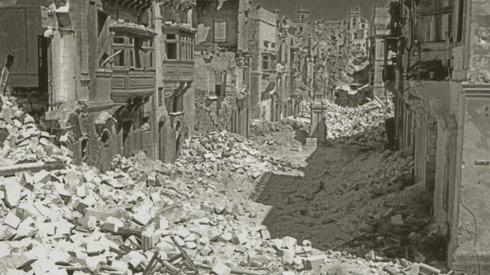
The Germans bombed Malta for the first time, killing 50 people, destroying 200 buildings and damaging the capital city of Valletta. The British aircraft carrier HMS Illustrious was hit and damaged again in Grand Harbour. Eighty German Luftwaffe Stuka dive bombers attacked Valletta Harbor, Malta, trying to finish off damaged British aircraft carrier HMS Illustrious. HMS Illustrious, British destroyer HMS Decoy, and Australian cruiser HMAS Perth, and British ship Essex were damaged, but none sank. 10 German aircraft were lost. Now it is Malta’s turn to withstand the full onslaught of the Luftwaffe. The Fuhrer has ordered the “neutralizing” of the island. In successive waves 80 Stukas hit Valetta harbor, causing major damage to port installations and several nearby churches. The casualty figures are said to be high — and soldiers and sailors were called in to unload ships when stevedores refused to work under fire. The Luftwaffe’s principal target HMS Illustrious was hit by only one bomb, but more damage was caused to her hull be underwater explosions. HMAS Perth was also damaged in the raid. The Maltese population failed to take adequate shelter in today’s raids. Tonight, they are digging deep into Malta’s limestone strata, suddenly aware that, despite the defending British aircraft — which shot down five Stukas today — the Luftwaffe will not let up.
Escorted by Italian fighters, 70 Stukas stage a big raid on Grand Harbor (Parlatorio Wharf) and Valetta Harbour. The Stukas come in relentless waves for almost two hours in the afternoon. Among the destructions are damage to cruiser HMAS Perth and further damage to the previously hit aircraft carrier HMS Illustrious (one more death). Both ships are more damaged by underwater near-misses than by actual hits, with the Perth, in particular, suffering from concussions that bend its propeller shafts. Other ships also sustain damage, including destroyer HMS Decoy and 11,063-ton transport Essex (15 crew dead along with 7 nearby Maltese dockyard workers).
Many of the bombs aimed at Illustrious fall instead within the surrounding ‘Three Cities’ of Senglea, Vittoriosa, and Cospicua. These are Malta’s oldest urban communities, and many historic buildings are obliterated. About 200 houses are destroyed and 500 damaged, with thousands left homeless. Due to the primary target being aircraft carrier Illustrious, which is badly damaged and being repaired in the harbor, this sequence of raids becomes known as the “Illustrious Blitz.”
The attack inflicts more casualties than it otherwise might because the half-hearted Italian attacks have induced many civilians to return to their homes in the area. There are 15 bodies that cannot be identified and dozens of civilian deaths. Valletta also is badly damaged, including heavy damage in Old Mint Street. The defending Hurricane fighters and anti-aircraft guns do what they can and shoot down 5-11 Stukas (accounts vary).
In North Africa, the British Australian troops earmarked for the assault on Tobruk continue their preparations. Burrowed within the semi-circle of a 30-mile defense line which includes a 10-foot tank trap, the 30,000 Italian regulars at Tobruk apparently have been ordered to resist the pending British assault to the death, if necessary. The function of this prospective defense, the British believe, is to permit the remainder of Marshal Graziani’s hard-pressed African army to reorganize in the Benghazi region, about 200 miles west of Tobruk. (The R.A.F. command at Cairo reported today that on Monday and Tuesday nights the Benghazi waterfront, shipping and government buildings were heavily bombed and that returning British airmen strafed Benghazi’s airdrome at Benina, destroying or damaging planes aground.) The presence of German dive-bombers in the Mediterranean and the possibility that their activity may be extended to north Africa has become a most important factor in this arena. The British declare that Italy herself can no longer be regarded as a serious threat; but if the Germans qet in the problem may become difficult. So far, no German planes have appeared in Libya and the Italian air force in the area is not active. With British armored units to the west of Tobruk’s coast-to-coast defense semi-circle, and infantry and artillery to the east and south while warships keep watch on the Mediterranean shore of the Italian base, the British say that Tobruk’s position is about the same as Bardia’s a week before it fell January 5 to the British offensive into Libya.
By now, on 16 January 1941, the Italian Lupi di Toscana division in Albania has been wrecked in the Klisura Pass. It has “ceased to exist as an organized force.” Out of the initial force of many thousands of combat troops, it now is down to 160 officers and men, with over 4,000 casualties and thousands of men captured. While this is an epic disaster, there is a silver lining for the Italians: the lost division has bought time for other Italian units to form a new defensive line in front of the strategic Klisura Pass. In fact, the Italians are organizing a counterattack, but that will take about 10 days to set in motion. This is a decisive moment in the war on the Albanian front because the Italians cannot afford to lose the key port of Valona, through which all of their supplies in the sector flow.
The British and Greeks wind up their consultations in Athens. Prime Minister Metaxas declines the offer of British ground assistance since he considers it too little to affect the outcome but sufficient to provoke the Germans into invading. It should be mentioned, however, that the RAF will continue to operate from Greek soil.
Defeated American Republican Presidential candidate Wendell Wilkie arrives in England, his ship passing that of the new British ambassador to the U.S., Lord Halifax.
Malcolm MacDonald, minister of health, ordered compulsory removal from the entire London metropolitan area of all children under 14 considered likely to suffer “in mind or body” from air attacks if they remain in the capital or its outskirts.
The British troopship Oropesa was sunk in the Western Approaches by the German submarine U-96.
Repeated border clashes on the Russian-Rumanian frontiers, cancellation of passenger rail traffic in Hungary and reports that Germany would take over Rumania formally combined tonight to keep the Balkans in a state of disturbed anxiety. An announcement in Budapest that all traffic on Hungarian railroads, except international trains, would be suspended at midnight led to the supposition in diplomatic circles here that the German military command, which is now running the Magyar railroads, had found drastic steps necessary in order to complete the projected movement of 300,000 troops with full motorized equipment during January. Rumanian rail traffic, except for the movement of German military trains, already is virtually at a standstill. Thirty per cent of Yugoslavia’s trains have been taken off, presumably to accelerate the shipment of supplies being demanded by the Reich.
The Luftwaffe continues its focus on southwest England, switching its attention from Plymouth to perennial target Bristol. The focus of this attack is the port of Avonmouth. The raid by 126 bombers lasts for hours and destroys numerous homes and businesses. There also are scattered bombs drooped elsewhere in southern England.
Hans-Joachim Marseille began a period of rest at home in Berlin, Germany.
81 RAF Bomber Command aircraft overnight attempted to follow up the successful raid of the previous night but fewer crews found the target. Wilhelmshaven reports only light damage with 2 people killed. 5 aircraft — 2 Wellingtons, 2 Whitleys, 1 Hampden — lost. Minor Operations: 3 Wellingtons to Emden and Rotterdam, 2 Blenheims to Boulogne, 4 Hampdens minelaying off Brest. No losses.
The RAF bombs Tobruk and Derna. Other RAF planes attack Maritsa (Maritza), Rhodes, a town named for its local Italian commander named Maritza. The RAF based in Malta raids the Catania airfields, home of Fliegerkorps X, after dark due to their recent success against both the Royal Navy and Malta.
U-96, commanded by Kapitänleutnant Heinrich Lehmann-Willenbrock, sank British steamer Oropesa (14,118grt) in 56-28N, 12W. At 0356 hours the unescorted Oropesa (Master Harry E.H. Croft) was hit in the stern by one G7a torpedo from U-96 southeast of Rockall. A first coup de grâce fired at 0440 hours became a cirle runner, but the two others fired at 0503 and 0559 hours hit underneath the bridge and amidships and caused her to capsize and sink at 0616 hours. The master, 98 crew members, one gunner and six passengers were lost. 109 crew members, one gunner and 33 passengers were picked up by HMS Superman (W 89), HMS Tenacity (W 18) and HMS Westcott (D 47) (LtCdr W.F.R. Segrave, RN) and landed at Liverpool. Included among the passengers lost were T/Sub Lt (E) S. Milliken RNR and T/A/Sub Lt (E) T. M. Phillips RNR, en route to join armed merchant cruiser HMS Queen of Bermuda. The 14,118-ton Oropesa was carrying general cargo including copper and maize and was bound for England.
Aircraft carrier HMS Illustrious was damaged by German bombing in dock. Australian light cruiser HMAS Perth, refitting at Malta, was damaged by a near miss which caused underwater damage aft, including her propeller shafts. Destroyer HMS Decoy, which had completed repairs this day from her November 1940 bombing, was struck by bombs. British steamer Essex (11,063grt) was damaged by German bombing at Malta during the night of 16/17 January. Steamer Essex was damaged further by German bombing on 9 March. Light cruiser Perth departed Malta at 2200/16th and arrived at Alexandria at 1400/18th.
Battleship HMS Barham, aircraft carrier HMS Eagle, light cruiser HMS Ajax and destroyers HMAS Stuart, HMS Dainty, HMS Hasty, and HMS Griffin departed Suda Bay to return to Alexandria. They were joined outside the net by destroyers HMAS Vampire, HMAS Vendetta, and HMS Wryneck from Piraeus. Force X, less destroyers Dainty, Hasty, and Wryneck, arrived at 0700/18th. The three destroyers arrived a half hour later. Aircraft carrier Eagle was out of action, her speed reduced to sixteen knots, due to problems with leaking stern glands.
Heavy cruiser HMS York and destroyers HMS Ilex, HMS Wryneck, HMAS Vendetta, and HMAS Vampire departed Suda Bay to make an anti-submarine sweep in the Kaso Strait before convoy AN.12’s arrival.
Submarine HMS Ursula departed Gibraltar for patrol in the Gulf of Genoa. She arrived at Malta on the 29th.
Submarine HMS Parthian departed Piraeus after a brief duty with the Greek submarine base at Salamis.
Minelaying cruiser HMS Adventure, entering Liverpool Bay from Milford Haven, struck a mine. The damaged cruiser was assisted by tugs. The cruiser was under repair at Liverpool from 23 January to 27 June.
Anti-aircraft ship HMS Curacoa departed Scapa Flow at 1100 to meet convoy WN.69 in Pentland Firth. The ship returned to Scapa Flow after the escort duty at 2230/16th.
Minesweeping trawler HMS Desiree (213grt, P/Skipper E. L. Fiske RNR) was sunk on a mine in the Thames Estuary. There were no casualties on the trawler.
Italian submarine Torelli sank Greek steamer Nicolaos Filinis (3111grt) in 53N, 24W. Three crewmen were lost.
Greek steamer Meandros (4581grt) was badly damaged by German bombing in 55-15N, 11-40W. All crew members were rescued. The steamer was taken in tow, but lost touch with H. M. ship during night. The wreck was subsequently sunk by a Royal Navy ship.
Dutch tanker Onoba (6256grt) was sunk by German bombing in 55-55N, 12-24W. The entire crew was rescued.
British steamer Gladonia (360grt) was damaged by German bombing off Sunk Light Vessel.
British steamer Romsey (509grt) was damaged on a mine in 51-41N, 5-09W. The steamer was beached in Dale Road.
British steamer Skjold (1345grt) was damaged by German bombing north of Lundy Island.
British steamer Llanwern (4966grt) was damaged by German bombing at Avonmouth.
Convoy US.008/1 departed Colombo for Suez with British steamers City of Lincoln (8039grt), Devonshire (11,275grt), Dilwara (11,080grt), Dominion Monarch (27, 155grt), Lancashire (9557grt), Nevasa (9213grt), Rajula (8478grt), Rohna (8602grt), and Thurland Castle (6372grt), Dutch steamers Indrapoera (10,825grt), Johan De Witt (10,474grt), Nieuw Holland (11,066grt) and Slamat (11,636grt), Norwegian steamer Christiaan Huygens (16,287grt), and Egyptian steamer Khedive Ismail (7290grt).
Convoy FN.385 departed Southend, and arrived at Methil on the 18th.
Today in Washington, President Roosevelt sent to Congress a request for an emergency appropriation of $350,000,000 for the construction of 200 cargo vessels and conferred with Secretaries Hull, Knox and Stimson, General George C. Marshall and Admiral Harold R. Stark on the foreign situation.
The Senate confirmed the nomination of Guy D. Swope as Governor of Puerto Rico, heard Senator Sheppard, on the twenty-first anniversary of the Prohibition amendment, advocate its re-enactment as a defense measure, and adjourned at 12:54 PM until 11:15 AM on Monday.
The House heard Representative Tinkham assail the policies of President Roosevelt and Secretary Hull, and adjourned at 3:45 PM until 11:30 AM Monday. The Foreign Affairs Committee heard Secretary Stimson on the aid-to-Britain bill.
U.S. President Franklin D. Roosevelt asked the U.S. Congress for an immediate appropriation of $350 million for the construction of at least 200 new merchant ships [the first of the “Liberty Ships”]. Congress received a request from President Roosevelt today for authority to proceed with immediate “emergency” construction of 200 cargo ships, and a recommendation from the house naval committee that 400 sub chasers and other small craft be added to the fleet. The 600 vessels would cost about $800,000,000 and, in addition, would require a vast expansion of shipbuilding facilities. The House will be occupied the first part of the week in considering the bills unanimously reported by the Naval Affairs Committee, which would authorize a total of $1,209,000,000 in expenditures as follows:
- Construction of 400 vessels of various types for the Navy, 280 of which are to be undertaken immediately, and the other 120 when shipyards are available.
- Expansion of shipyards, or construction of new ones, for which $315,000,000 in authorizations were voted by the committee. This expenditure is expected to push the construction of the two-ocean Navy and deliver many of the new vessels months, and in some cases years, ahead of schedule.
- An authorization of $194,000,000 for doubling the Navy’s ordnance facilities, for the manufacture of guns of all classes, particularly, of “pompoms” and other anti-aircraft equipment.
- An authorization of $300,000,000 for equipping the fleet with the latest anti-aircraft equipment.
Making an unscheduled appearance last night at Town Hall to participate with 1,000 fellow-Americans in the weekly Town Hall of the Air radio program, Wendell Willkie declared that if the American people believed, “as I believe,” that the collapse of Britain would mean the passing of a free way of life from America, then they would grant to President Roosevelt the extraordinary powers he has asked in the Lend-Lease bill.
Early amendment of the Lend-Lease bill to define positively what powers it would confer upon the President was urged by former President Herbert Hoover in a letter to Representative Sol Bloom, chairman of the House Foreign Affairs Committee, which Mr. Hoover made public yesterday. Such clarification of the bill’s powers, he said, should enable concrete debate, eliminate much controversy and greatly contribute to national unity. Mr. Hoover reiterated his position in favor of all possible aid to Britain, short of war, but said he did not approve of our joining in the conflict. The former President said his letter was inspired by the statement of Mr. Bloom in Washington Tuesday that the committee would be glad to hear the views of Mr. Hoover and other prominent persons. He did not indicate whether he intended to ask for such a hearing or intended to let his letter stand as the answer to the invitation.
Secretary of War Stimson asserted today that if Britain should succumb to the Nazis, America would be in danger of invasion from the air, and he urged congress not to forbid President Roosevelt to transfer American warships to nations battling the axis. Senator Wheeler, Montana Democrat, leader of the senate opposition to the lease-lend bill, opened fire on Stimson by telling reporters: “Every informed person in Washington knows that Mr. Stimson was placed in the war department because of his known pro-war attitude. And every informed person knows that high officials of the war department are today working on the assumption that we will probably be in the war by April 1.”
Joseph P. Kennedy, retiring Ambassador to Great Britain, conferred with President Roosevelt unexpectedly today. As he left the White House he said that his radio speech on Saturday night would accent “staying out of war.”
President Roosevelt has a meeting with Admiral Stark, George Marshall, Henry Stimson, and Cordell Hull to discuss a report prepared by Captain Richmond Kelly Turner (director of war plans in Naval Operations) and Colonel Joseph T. McNarney (of the Army War Plans Division). Known as the “Turner-McNarney Report,” this document is titled “Study of the Immediate Problems Concerning Involvement in the War” and is dated 12 December 1940. The Turner-McNarney Report is extremely prescient in predicting how and why the Japanese might begin a war in the Pacific. The report predicts a major Japanese offensive that will aim to “capture the entire area,” and that “The issues in the Orient will largely be decided in Europe.” Roosevelt authorizes exploratory talks with the British regarding the major themes of the report, but he is not yet ready to contemplate sending ground troops to Europe. General Marshall writes of the meeting that Roosevelt feels:
“…the Army should not be committed to any aggressive action until it was fully prepared to undertake it; that our military course must be very conservative until our strength had developed.”
This incident is often overlooked by those who claim that Roosevelt is thirsting to enter the war. What it shows is a President who is quite comfortable letting others fight a war he feels is necessary while the US takes as long as is given to arm to the teeth.
Because of the demands of the national defense program there will be no National Automobile Show this year.
A U.S. Army Air Corps Douglas B-18a Bolo, with seven crewmen, disappears after takeoff from McChord Field, Pierce County, Washington en route to Muroc Field in Southern California. The wreckage is found by local woodsmen on 3 February 1941 on Deschutes Peak, elevation 4322, the highest point in the vicinity. No survivors are found. It appears the pilots simply got unlucky and flew into the only obstruction at their altitude in the area after heavy winds forced them to attempt to return to McChord. The plane was climbing at 45 degrees to clear the ridge but didn’t make it by 50 feet. Officially, it is a case of pilot error.
In the current ‘Aviation’ magazine T.P. Wright, of the Curtis-Wright corporation states that the aircraft industry of the US is at present working upon some 45 or 50 different military models and that this is a condition which does not make for speed. He estimates the present air strength of Germany and Italy at 41,000 planes, of Great Britain at 24,500 and the United States at 6,000.
The War Department announced the formation of the 99th Pursuit Squadron, an African-American flying unit, to be trained at Tuskegee, Alabama, the home of the Tuskegee Institute. This is the famous “Tuskegee Airmen” unit, manned by African-Americans.
Subhas Chandra Bose, a key Indian nationalist, adopts a disguise and flees Calcutta.
French troops launched a successful counterattack against Thai troops at the villages of Yang Dang Khum and Phum Preav in Cambodia, French Indochina, but poor intelligence forced the French to back off from any territory gained. The Thais were unable to pursue the retreating French, as their forward tanks were kept in check by the guns of the French Foreign Legion. This may be considered a tactical victory but a strategic defeat, as the Thais continue their advance.
French light cruiser Lamotte Picquet escorted by sloops Amiral Charner and Dumont D’Urville and old sloops Tahure and Marne as Task Force 7 sortied from Saigon. Their mission is to confront the Thai forces aiming to take possession of portions of the Mekong Delta which they claim the French stole from them in the late 19th Century. The Thai land army is much larger than the French forces, but the French naval forces are superior to anything that the Thais have. The Thai air force has over 140 aircraft, including Mitsubishi Ki-30s.
The French ships are heading for Koh Chang, southeast of Bangkok, one of the largest Thai islands in the Gulf of Thailand. They have the assistance of reconnaissance flying boat Loire 130, which locates the Thai ships. The objective is to wipe out the defending Thai fleet and bombard the country’s coastal cities to force the Thai government to come to terms.
While the Germans have conquered Holland, the Dutch remain a formidable military and colonial power in the Far East. The Japanese reopen negotiations with them in the Dutch East Indies, requesting more raw material deliveries and other concessions.
A newspaper controlled by the Japanese foreign office today described United States Pacific fleet concentrations as “a challenge and a threat” and advised President Roosevelt to withdraw the warships from Hawaii as the best way to keep American troops out of foreign wars. This comment by the Japanese Times came on a day which saw intense activity at the government bureau of information and a spattering of critical headlines as a result of Secretary of State Hull’s declarations of Wednesday before the U. S. house foreign affairs committee.
The police tonight revealed the existence of a foiled murder plot in 1939 against “a certain Japanese dignitary,” who is unnamed but is presumed to have been the then Foreign Minister, Hachiro Arita.
The New Zealand branch of the Women’s Auxiliary Air Force (WAAF) is founded. The plans for this force are to use the women “in some clerical trades and jobs of a domestic nature, peculiar to the feminine temperament and unpopular with men.” The minimum age for enlistment is 18, and the average age is 27. Just over half of women who apply are accepted. This marks the beginning of a permanent integration of women into the New Zealand airforce (RNZAF).
Dow Jones Industrial Average: 129.93 (-1.58)
Born:
Sam Gruneisen, AFL-NFL center and guard (San Diego Chargers, Houston Oilers), in Louisville, Kentucky (d. 2012).
Joe Bonikowski, MLB pitcher (Minnesota Twins), in Philadelphia, Pennsylvania.
Christine Janes, British tennis player, in Loughton, United Kingdom, United Kingdom.
Richard Bohringer, French actor (“Diva”, “I Married a Shadow”), in Paris, France.
Naval Construction:
The Royal Navy Assurance-class rescue tug HMS Frisky (W 11) is laid down by Cochrane & Sons Shipbuilders Ltd. (Selby, U.K.).
The Royal Navy Flower-class corvettes HMS Cowslip (K 196) and HMS Eglantine (K 197) are laid down by Harland & Wolff Ltd. (Belfast, Northern Ireland). Eglantine serves with the Sjøforsvaret (Royal Norwegian Navy) as HNoMS Eglantine (K 197) and is sold to Norway after the war, becoming the KNM Sørøy.
The Royal Navy Hunt-class (Type III) escort destroyer HMS Haldon (L 19) is laid down by the Fairfield Shipbuilding & Engineering Co. (Govan, Scotland). She is damaged in an air raid during construction. After launching, she is transferred to the Free French Navy and commissions as the La Combattante.
The Royal Navy Flower-class corvette HMS Armeria (K 187) is launched by Harland & Wolff Ltd. (Belfast, Northern Ireland).
The U.S. Navy patrol gunboat USS St. Augustine (PG-54) is commissioned. She was converted from a steel hulled yacht, the Noparo (originally named the Viking, built in 1929). Her first commanding officer is Lieutenant Commander Lawrence Litchfield, Jr., USNR.
The Royal Navy Flower-class corvette HMS Snowdrop (K 67) is commissioned. Her first commanding officer is Lieutenant Commander (retired) Leslie Hugh Moorhouse, RNR.
 History Diaries