The Greeks continue to consolidate their grip on the key Klisura Pass on 15 January 1941. The Italian forces have been badly mauled, especially the Lupi di Toscana Division, and many Italians have become POWs. However, both the remaining Italian forces and the weather are preventing the Greeks from exploiting this victory and marching on the strategic port of Valona. The RAF bombs Italian supply lines near Berat.
Air Marshal Longmore joins General Archibald Wavell in Athens, where the two discuss reinforcing the Greeks with British forces. Greek Prime Minister Ioannis Metaxas requests equipment to help in Albania. Wavell offers the immediate transfer of a combined anti-aircraft and anti-tank regiment, but Metaxas refuses. Wavell argues that sending even a token British force will impress the Turks and Yugoslavs to stay out of the war, and even lead them to the Allied side. Metaxas, however, responds that such a small force “would provoke the Germans to attack.” Metaxas only wants British troops on the mainland if they are able to act offensively as well as defensively, and until such time as such forces are available, the British should stay out.
The heart of the issue is Greek mistrust of the British, who they feel are only trying to get Greece involved in the war against Germany. The British also mistrust the Greeks, who they feel will make a separate peace with Italy and leave the British troops with another front to defend in Greece/Albania. Wavell puts on a good show, but he (along with Longmore) already has indicated internally that he does not want to send British troops to the Greek mainland. Metaxas, in a sense, is just playing into his hands and permitting the British offensive in North Africa to continue. However, truth is that the British simply do not have the troops to spare that Metaxas feels would justify a British ground presence in Greece.
The Australian and British troops earmarked for the assault on Tobruk in under a week’s time to continue their preparations. The British 7th Armoured Division is getting its tanks repaired, while the Australian infantry works on the tactics that it successfully employed at Bardia.
The British Admiralty announces the promotion of Vice-Admiral Sir Andrew Cunningham, C-in-C of the Mediterranean Fleet to Admiral. Cunningham was before a board of inquiry only a few months ago, so this is a vote of confidence in him by the Admiralty.
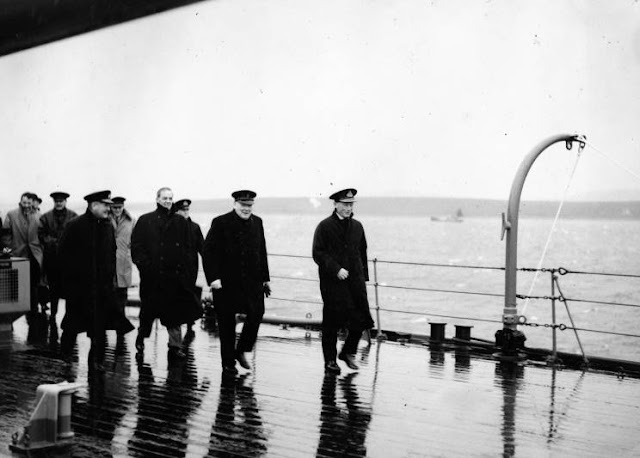
King George and Prime Minister Churchill travel to Scapa Flow to see off Lord Halifax for his voyage to Washington as the new British ambassador. After lunch, battleship King George V departs for the US carrying Ambassador Lord Halifax, escorted by four destroyers, in Operation Parcel. Separately, Sir Gerald Campbell, British High Commissioner to Canada, is transferred to Washington to become British Consul General to the United States.
A unique system of rationing whereby the quantities of bread supplied to the well to do are drastically reduced and the poor receive slightly larger amounts will be introduced in Madrid tomorrow. The official explanation is that “the rich can afford to buy other, more expensive foods to satisfy their hunger.”
“Quartet for the End of Time” by Olivier Messiaen was given its first performance in the POW camp Stalag VIII-A at Gorlitz, Germany (now Zgorzelec, Poland).
German soldiers loot the ancient monastery of Clairvaux, Luxembourg, which was founded in 1115.
British forces mount major attacks on Italian positions from Sudan and Kenya.
Five Years after he was forced into exile Haile Selassie, the Emperor of Ethiopia, is home. He was flown over the frontier from Sudan shortly after 11am by the RAF and was greeted by a welcoming party of British officers, native chiefs and troops from the Ethiopian regular army. The Emperor had been forced into exile by the Italian invasion, pleading in vain for aid at the League of Nations. Today he issued a proclamation urging his people to rebel themselves against the Italian invaders: “Italy is cornered by the grip of Great Britain by sea, air and land power. The Italians will not escape my trusted warriors.” Haile Selassie, who was accompanied by his two sons, thanked the government and people of Britain for their support in his “bitter trials”. So the man who had lived in Bath as plain Mr Smith was once more “His Imperial Majesty — Lion of Judah, king of the Kings of Ethiopia.” His return is expected to boost even further the momentum of British attacks on Mussolini’s faltering empire.
Selassie is not just popular in his own country; many — the Rastafarians — actually consider him to be a living god. Selassie’s return is a harbinger of increased British attacks to wrest the entire region from Italian hegemony. There are reports of uprisings upon his return. Haile Selassie, despite being from an impoverished third-world nation, is one of the enduring figures of 20th Century politics and this is his most stressful period.
The Luftwaffe sends 49 bombers against Derby during the night, and night fighters also attack RAF airfields in the north, including Church Fenton and Driffield. Action during the night is confused, and the darkness prevents British anti-aircraft from operating while RAF bombers are operating. The German night fighters get in some useful practice, tracking RAF bombers back to their bases after their missions and forcing down three of them.
During this night’s action, Oblt. Egmont zur Lippe of 4./NJG 1 shoots down a Whitley bomber over Holland for his second victory claim. Oblt. Albert Schulz of 2./NJG 2 shoots down two Blenheims in fifteen minutes for his first two claims. It is dangerous work, however; another fighter pilot with six claims, Heinrich Kopperschläger of JG 53, perishes in a flying accident.RAF Bomber Command dispatches 2 Blenheims in daylight; 1 bombed a ship off Dutch coast but scored no hits. No losses.
RAF Bomber Command dispatches 96 aircraft overnight; most crews reported good bombing results. RAF Bomber Command attacks Wilhelmshaven with 70-76 bombers out of 96 that set out. The 20 that fail to attack either get lost or turn back. At this stage of the war, that is considered a successful attack. 1 Whitley lost. Wilhelmshaven reports much damage and many fires. Among buildings destroyed or damaged were: the head post office, the main police station, an army barracks, a naval technical school, the main dock offices, 7 large commercial premises and 2 hospitals. At least 22 fire-fighting teams were called in from towns in a radius of 120 km; the men of these teams had to travel in open vehicles over icy roads and then had to fight fires in freezing temperatures. 21 people were killed and 34 injured. The diarist says: ‘The year of 1941 would bring many more heavy raids but none causing such heavy damage as this one.’ Minor Operations: 8 Wellingtons and 1 Whitley to Emden and Rotterdam. No losses.
RAF Bomber Command designates oil targets as the “sole primary targets.” Seventeen plants are designated in cities and cities connected with the oil industry. Hanover, Magdeburg, Bremen and Oppau are listed as targets.
At Malta, a Luftwaffe plane bearing a red cross in a white circle — an internationally recognized symbol for rescue operations that are immune from attack — is spotted at high altitude over eastern Malta. While the RAF does not get airborne in time to shoot it down, the use of this symbol is considered by the RAF to be a ruse. The RAF is notorious for shooting down such planes over the English Channel, which, if they actually are search and rescue planes, is a war crime. However, the British view these planes as performing reconnaissance, particularly since they appear at times when no rescue is needed and fly at altitudes used by reconnaissance planes, not search and rescue missions. This is another sign that the fierce contest of over the Channel is heading down to Malta as well, with the Germans and British gearing up for similarly heated warfare.
The Axis planes also stage a couple of air raids over Malta, but foul weather prevents them from releasing any bombs of consequence. RAF reconnaissance over Catania, Sicily shows that the results of the 13 January British air raid were quite good, with 25 Axis planes destroyed or badly damaged and hangars badly damaged.
Italian submarine Torelli sank Greek steamer Nemea (5101grt) in 52-33N, 24-13W and Norwegian steamer Brask (4079grt) in 52-45N, 23-59W. Seventeen crewmen on steamer Nemea were lost. The steamer was abandoned, but was reboarded on the 16th. Twelve crew members were lost on the steamer Brask. Survivors from steamer Brask were found on the Greek steamer when she was reboarded. The Greek steamer later sank.
The British Prime Minister visited battleship HMS King George V at Scapa Flow. The Prime Minister was brought from Scrabster on destroyer HMAS Napier, arriving at 1240. Minesweepers HMS Sharpshooter and HMS Speedy carried some staff members to the battleship. After a luncheon, the battleship, carrying Lord Halifax, the new British ambassador to the US, departed Scapa Flow at 1630 escorted by destroyers HMS Somali, HMS Matabele, HMS Tartar, and HMS Bedouin. This operation was codenamed PARCEL. The Prime Minister returned to Scrabster on destroyer Napier, departing at 1600/16th.
Destroyer HMS Cottesmore departed Scapa Flow at 1600 for Aberdeen to escort steamer Lochnagar to Stromness, and rendezvoused at 0100/16th. Cottesmore arrived back at Scapa Flow after the escort duty at 1000/16th.
Destroyers HMS Legion and HMS Douglas departed Scapa Flow at 0430 to meet armed merchant cruisers HMS Chitral and HMS Letitia west of Cape Wrath at noon and escort them to their patrol positions. On the 16th, the destroyers transferred to armed merchant cruiser HMS Salopian and escorted her from the patrol position to Cape Wrath.
Sludge vessel Mancunium (1286grt) was sunk on a mine two miles northeast of Bar Light Vessel, Mersey. All crew saved.
British steamer Maywood (1823grt) was damaged on a mine in 51-21N, 3-16W. The steamer was beached in Whitmore Bay, Barry. The steamer was later taken to Barry for drydocking.
British steamer Karri (354grt) was damaged by a mine two miles north of Bar Light Vessel, Mersey. One crewman was lost. The steamer was beached on the 16th at Tranmere. The steamer was taken to Liverpool arriving on 10 April for drydocking.
British trawler Stalker (197grt) was damaged by German bombing in Hawke Roads, Grimsby. The trawler anchored in Hawke Road, Grimsby. The trawler later sank but was refloated and repaired.
Submarine HMS Tetrarch departed Piraeus after a brief duty with the Greek submarine base at Salamis.
Submarine HMS Regent sank Italian steamer Citta Di Messina (2472grt), which departed Tripoli on the 11th for Benghazi, escorted by torpedo boat Centauro, in 32-59N, 14-11E off Benghazi.
Armed merchant cruiser HMCS Prince Henry arrived in Bermuda for workups.
Norwegian oil refinery tanker Pelagos (12,083grt) and whalers Star XXI (298grt), Star XXII (303grt), Star XXIII (357grt), Star XXIV (361grt), and Star XIX (249grt) were captured by German raider Pinguin in 59S, 3W. Norwegian whalers Star XIX and Star XXIV were scuttled when intercepted by Sloop HMS Scarborough on 13 March in 45N, 23W. The rest of the tankers and whalers, less the three whalers which escaped to the Falklands, captured on 14 and 15 January later arrived in France.
From the 15th to the 17th of January, German tanker Nordmark embarked food stores from captured British refrigerator ship Duquesna (8651grt) at sea. The German tanker then took the British ship in tow.
Convoy FS.388 departed Methil, escorted by destroyer HMS Garth and sloop HMS Fleetwood, and arrived at Southend on the 17th.
Convoy FS.389 departed Methil, escorted by destroyers HMS Vivien and HMS Wallace, and arrived at Southend on the 17th.
Convoy HX.103 departed Halifax, escorted by battleship HMS Royal Sovereign, destroyer HMCS Restigouche, and corvette HMS Arrowhead. The destroyer and the corvette were detached the next day.
Convoy BHX.103 departed Bermuda on the 13th escorted locally by armed yacht HMCS Elk and ocean escort armed merchant cruiser HMS Montclare. The convoy rendezvoused with convoy HX.103 on the 18th and the armed merchant cruiser was detached. The battleship was detached on the 26th. On the 27th, destroyer HMS Vanquisher and corvettes HMS Gentian and HMS Verbena joined the convoy and were detached later that day. On the 28th, destroyers HMS Viscount, HMS Whitehall, and HMS Winchelsea joined the convoy and were detached on the 31st, and arrived at Liverpool on 1 February.
In Washington today, President Roosevelt conferred with the Apostolic Delegate, the Most Rev. Amleto Cicognani, and with Clark Eichelberger, of the Committee to Defend America by Aiding the Allies.
With the Senate in recess, the Temporary National Economic Committee discussed its final report.
The House also was in recess. Its Foreign Affairs Committee heard Secretaries Hull and Morgenthau on the Aid-to-Britain Bill. The Naval Affairs Committee heard naval officers on bills to supplement the defense program and approved a bill authorizing $300,000,000 to equip ships with anti-aircraft defenses.
U.S. Secretary of State Cordell Hull addressed the House of Representatives’ Committee on Foreign Affairs during its hearings on House Resolution 1776, the Lend-Lease Bill. Hull advocated the passage of the bill and his address is commonly titled as “The Defense of the United States: Speed is Our Greatest Need Today.” Secretary of State Cordell Hull and Treasury Secretary Henry Morgenthau Jr. warned congress in blunt terms today that Great Britain faces a financial dilemma which only President Roosevelt’s loan-lease bill can prevent and that the United States may be drawn into the European war regardless of the course it pursues. Both appeared before the house foreign affairs committee in support of the far-reaching British aid bill. Secretary of War Henry L. Stimson will testify tomorrow.
Opposing the granting of further powers to President Roosevelt, District Attorney Dewey of New York City declared here today that the President’s Lend-Lease Armaments Bill “would bring an end to free government in the United States and would abolish Congress for all practical purposes.”
President Roosevelt authorized today the issuance of general licenses for export control. Such a move had been recommended to him by Colonel Russell L. Maxwell, administrator of export control. An executive order made public at the White House authorized Colonel Maxwell to issue blanket licenses within his discretion to cover the export of materials which are important for war purposes and are subject to licensing control. The action, which will be applied first to Canada, is a move to expedite the process which until now has required the granting of individual licenses.
Approval of the U.S. Navy’s request for $300,000,000 to equip the fleet with modern anti-aircraft devices was voted today by the House Naval Affairs Committee and similar action by the committee tomorrow was indicated on requests for funds to double the ordnance manufacturing facilities, greatly increase the shipbuilding facilities of private yards and more than double the “mosquito fleet.” Construction of 280 small ships quickly was stressed. In all, the request totaled nearly $1,000,000,000. Only the technicality of language contained in the bills prevented approval this afternoon of all requests, the committee deciding to recall Rear Admiral Samuel M. Robinson, chief of the Bureau of Ships, before deciding upon the language of the measure to be recommended to the House. Admiral Robinson and Rear Admiral W. R. Furlong, chief of the Bureau of Ordnance, were the only witnesses today. Admiral Robinson indicated to the committee the Navy strategists considered the dive-bomber the most serious threat to the security of the fleet. He recommended the appropriation to permit a large-scale installation of the 1.1 inch “pom-pom” rifles as an anti-aircraft defense, as well as armor and other installations which would aid in resisting air attacks, in the light of reports from European engagements.
The first contingent of American soldiers to leave for military bases recently acquired from England sailed for Newfoundland from the Brooklyn army base today on the old German liner Amerika, seized by the U. S. In the World war and refitted as “swankiest” army transport afloat. In the ranks were doughboys from the Second, Third and Seventh corps areas New York, New Jersey, Delaware, Pennsylvania, West Virginia, Maryland and the Midwest. Officers asked that the exact number of men aboard and “the type or numerical designation of units” be excluded from press reports “in the best interests of national defense.” Army officials said the ship would be used as a floating barracks for about five months while land barracks were being constructed.
A two-day strike at five plants of the Eaton Manufacturing Co., makers of airplane engine parts, was settled last night, but federal conciliation efforts to prevent a threatened strike at the Ryan Aeronautical Co. plant in San Diego, California, made little headway. Harry C. Malcom, federal conciliator, reported that officials of the Ryan company and the C.I.O. United Automobile Workers remained deadlocked on a wage dispute and said that arbitration would be sought if necessary to prevent a strike which the union negotiators have been authorized to call. The strike would tie up orders for $11,400,000 of military planes.
Replying to opponents of his proposal to build 500 airplanes a day in automotive plants, Walter F. Reuther of the United Automobile Workers (C.I.O.) asserted today that contrary to the popular impression, less than 10 per cent of the automobile industry’s potential capacity was being used or would be used under present plans for turning out planes.
An engineer for the Aluminum Corporation of America, said today that not only was there no general shortage of aluminum for the aircraft industry but that the industry was on the way to being geared for the peak load required for the airplane defense program of 3,000 craft a month.
RKO Pictures studio head George J. Schaefer has his lawyers study the issue of whether or not to release Orson Welles’ forthcoming motion picture, “Citizen Kane.” Schaefer believes strongly in Welles and the picture but wants to make sure that there are no legal issues involved in releasing it. The RKO lawyers review the film and ask Welles to cut three minutes of its running time to satisfy their concerns about a possible defamation action by William Randolph Hearst. Welles complies.
Bette Davis tonight took her meals standing up as a result of an accident In which she fell into a clump of cacti while making a desert scene for a picture. The noted star was supposed to jump a few feet from an airplane which was nosed into a sand dune. She jumped, rolled over and landed against the clump of cacti, with painful consequences. Dr. Lester Clark, studio physician who accompanied the movie party to the desert for scenes in “The Bride Came C. O. D.,” reported he “operated” on Miss Davis with a pair of tweezers, removing 45 of the thorns.
In Iceland, 133 miles-per-hour winds sank three PBY Catalina aircraft of US Navy squadron VP-73 and sank two PBM Mariner aircraft of US Navy squadron VP-74.
In Kiangsi, central China, growing tension between rival Nationalist and Communist factions, which flared into open violence last week when the 10,000 strong New Fourth Army of the Communists was surrounded and disarmed, is likely to be made worse by the Nationalist Kuomintang ruling that the New Fourth must now be disbanded. The incident is feared to have severely damaged the Chinese war effort and removed any prospect of further military collaboration between the two rivals against Japan. Communists are denouncing the disarming as part of a Nationalist-Japanese plot. The Communists fear that 25,000 comrades who are still in Kiangsi, which is Nationalist dominated, face a similar danger. They claim that the original Nationalist order to the New Fourth to cross the Yellow River was always intended to trap it. Chairman Mao tells his troops not to trust the Nationalist Chinese.
Presaging increased Japanese aerial activity against Chungking, Chengtu, and other Szechwan Province cities and also the Chungking-Lanchow highway, at least 200 Japanese planes are being concentrated at various airfields near Hankow and Wuhu.
Thai troops attacking toward Pakse dislodge the Vichy French defenders. The main Thai force advances in the Sisophon sector.
Ships of the French Groupe Occasionnel squadron made rendezvous at 1600 hours 20 miles north of Poulo Condore (Con Dao) archipelago south of French Indochina, and began moving toward the Thai-Cambodian border at 2115 hours.
A movement is under way to impress on all Japanese at home and abroad, particularly those living in the United States and British territory, the mounting danger of a Pacific conflict because of the increasing hostility of the “British-American alliance” to Nippon, the Japanese Domei news agency said tonight in a radiocast. The movement was launched by the National Service association, according to the broadcast. It will be started with a series of lectures in Tokyo beginning January 18, Nationalists in Japan long have been agitating for a return of Japanese residents of the United States and possessions in “retaliation” for the action of the State Department in summoning home American residents of Japan and the Japanese-controlled areas of China.
Foreign Minister Yosuke Matsuoka’s latest reference to the German-Italian-Japanese pact today did nothing to clear up the ambiguities with which his previous utterances have surrounded Japan’s obligations. Speaking at a gathering to say farewell to Lieutenant General Hiroshi Oshima, who is about to return to Berlin as Ambassador, the Foreign Minister treated the alliance as the basis for relations between the contracting parties and as an ideological bond. “The three-power pact has laid down the basis for German-Japanese relations, but its active use depends on the future,” he told a public gathering that included the German and Italian Ambassadors and many of their warmest Japanese supporters. “Japan’s effort to construct a new order in East Asia, which began in 1931, and the German-Italian effort to break down the Versailles system have something in common in their fundamental objectives. We all are pushing for the construction of a new world order. “It is not by chance that Japan and Germany have become united. Their alliance goes beyond mere interest or profit and expresses spiritual unity founded on the ideology that both share.”
The Japanese Navy formed the 11th Air Fleet with the 21st, 22nd, and 24th Air Flotillas with Vice Admiral Eikichi Katagiri in command and Rear Admiral Takijiro Onishi as his chief of staff.
Dow Jones Industrial Average: 131.51 (-0.93)
Born:
Captain Beefheart, [Don Glen Vliet], avant-garde musician (“Bongo Fury”) and artist, in Glendale, California (d. 2010).
Earsell Mackbee, NFL cornerback (Minnesota Vikings), in Brookhaven, Mississippi (d. 2009).
Don Lisbon, NFL halfback (San Francisco 49ers), in Youngstown, Ohio.
Naval Construction:
The Royal Navy Bangor-class (VTE Reciprocating-engined) minesweepers HMCS Gananoque (J 259) and HMCS Goderich (J 260) are laid down by the Dufferin Shipbuilding Co. (Toronto, Ontario, Canada).
The Kriegsmarine (German Navy) Type IXD2 U-boat U-179 is laid down by AG Weser, Bremen (werk 1019).
The Royal Navy Flower-class corvette HMS Godetia (K 226) is laid down by John Crown & Sons Ltd. (Sunderland, U.K.); completed by Clark.
The Kriegsmarine (German Navy) Type 1936A (Mob) destroyer Z34 is laid down by AG Weser (Deschimag), Bremen (werk 1004).
The Royal Navy Isles-class minesweeping trawler HMS Hoxa (T 16) is launched by Cook, Welton & Gemmill (Beverley, U.K.); completed by Amos & Smith.
The Royal Navy Isles-class minesweeping trawler HMS Fara (T 162) is launched by Cochrane & Sons Shipbuilders Ltd. (Selby, U.K.); completed by Amos & Smith.
The U.S. Navy Accentor-class coastal minesweeper USS Observer (AMc-91) is launched by F. L. Fulton (Antioch, California, U.S.A.).
The Royal Navy Bangor-class (Reciprocating-engined) minesweeper HMS Felixstowe (J 126) is launched by Lobnitz & Co. Ltd. (Renfrew, Scotland).
The Royal Navy Flower-class corvette HMS Anchusa (K 186) is launched by Harland & Wolff Ltd. (Belfast, Northern Ireland).
The Kriegsmarine (German Navy) Type IID U-boat U-151 is commissioned. Her first commanding officer is Oberleutnant zur See Hans Oestermann.
The Kriegsmarine (German Navy) Type VIIC U-boat U-554 is commissioned. Her first commanding officer is Kapitänleutnant Dietrich Lohmann.
The Royal Navy Flower-class corvette HMS Fennel is commissioned. Her first commanding officer is Lieutenant Commander John Norman Smith, RCNR. She is transferred to the Royal Canadian Navy on 15 May 1941, becoming the HMCS Fennel.
The U.S. Navy Wickes-class destroyer USS Ward (DD-139) is recommissioned, with Lieutenant Commander Hunter Wood, Jr. in command. She will, at the end of this year, fire the first shot of the Pacific War at Pearl Harbor.
The U.S. Navy Gleaves-class destroyer USS Gwin (DD-433) is commissioned. Her first commanding officer is Lieutenant Commander John Martin Higgins, USN.
 History Diaries