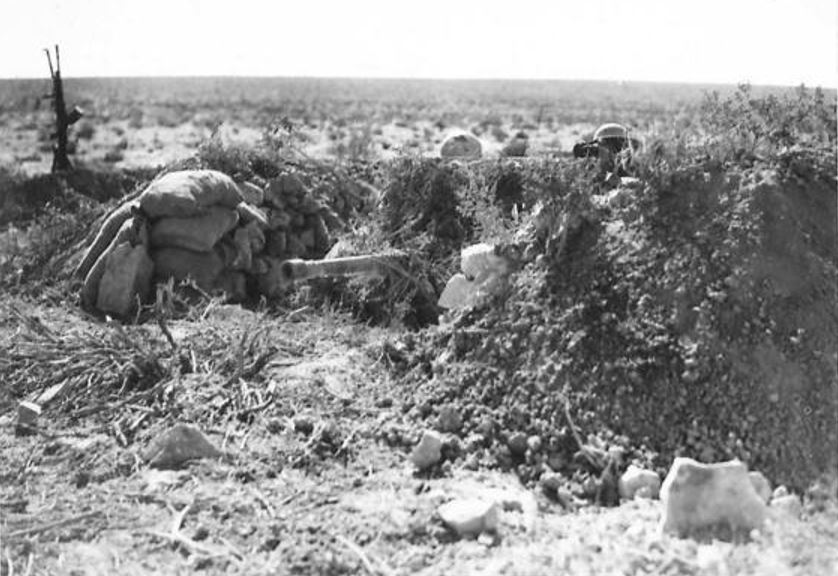
British Commander-in-Chief Middle East General Wavell met Greek Prime Minister Ioannis Metaxas and Greek Commander-in-Chief General Alexandros Papagos in Athens, Greece. The Greeks tell Wavell that they only have four divisions on the Bulgarian front (Yugoslavia is not on anyone’s mind at this time) versus 13 in Albania. Already, the Greeks are heavily outnumbered by the German forces assembling in Romania and Bulgaria. Papagos asked Wavell for 9 divisions of British troops plus air support, but Wavell only offered 2 or 3 divisions. Papagos, who thought 2 to 3 divisions was too few to effectively deter a German invasion while still putting Greece in an indebted position, rejected the offer.
Mussolini, meanwhile, continues his visit to Albania to confer with his generals about stopping the Greeks. After it is over, he will head to Berchtesgaden to confer with Hitler.
In North Africa, the British reported “no change” In the siege of 30,000 Italian troops holed up at Tobruk. Nine grounded airplanes believed to have been German Junkers were reported destroyed by the R.A.F. in an attack on Catania airport in Sicily.
The British continue to reinforce Malta. Light cruisers HMS Orion and HMAS Perth land troops there. Perth is laid up at Grand Harbor for a few days with machinery issues.
On the Albanian war front, Greek infantry were reported striking deeper into Italian defense lines toward Berati, in central Albania, with a Greek spokesman declaring the advance was continuing to “develop satisfactorily” north of Klisura against stiffened Fascist resistance. Berati lies south of Tirana, capital of Albania, and northeast of Valona, Italy’s last major port in southern Albania. Greek and British planes were reported at the frontier to have bombed Valona heavily today, damaging the Albanian port and the northern part of the town itself. Six persons were reported killed and 38 wounded. Also reported bombed was an Italian military camp at Kanina near Valona, where two officers and 23 men were killed and about 50 injured. The official Greek radio reported early today that non-combatants were evacuating Valona and Berati, two of the most important Italian bases in Albania toward which the Greeks were reported to be driving. The Italian Toscana Division is partially surrounded and the remainder scattered.
Britain’s war effort now is costing about $53,000,000 a day. It cost $38,000,000 daily in 1940. Army, navy and air force costs combined averaged about $47,628,000 daily in the first 11 days of 1941. The rest went for interest and management, national debt and ordinary expenditures.
George Crosses are gazetted for Sub-Lt John Bryan Peter Duppa-Miller (b. 1903) and AB Stephen John Tuckwell (b.? d.1966), RNVR who dealt with a mine which had fallen into soft mud in a tributary of Barling Creek. In all, they disposed of ten mines in their work together.
In London, Lord Woolton, the Minister of Food, spiked the guns of speculators when the prices of 21 foodstuffs were pegged today as the level at which they stood at the beginning of last December. Prices of many of them will fall, but retailers welcomed his action. They say that they have been forced to buy supplies at inflated prices. Chickens, which come under the order, have risen since December from 2/3 a pound to 3/3. Price controls also apply to coffee, cocoa, honey, tinned food, meat paste, rice and pasta, pickles and sauces, jellies and custard, biscuits, nuts and processed cheese. “I am always glad to catch the speculator,” said Lord Woolton. Further price controls are expected soon on jam, syrup, treacle and tinned soup.
A survey of the cost of living just completed by the Ministry of Labour shows that families earning less than GBP250 a year spend GBP 1/14/1 per week on food, out of an average family budget of GBP 4/6/3. They survey was begin in 1937 and presumably does not take into account the recent wartime price rises as goods become scarce.
British Information Minister Alfred Duff Cooper told the B.B.C.’s radio audience tonight that the spirit of France is “alive today and growing in vigor.” Britain, he said, has evidence that sympathy for her cause in France is “growing with remarkable rapidity.” That sentiment, he added, “not unnaturally” is growing faster In occupied France, “where the hateful presence of the Germans reminds the people day by day of what they have lost and what is their one hope of regaining it.”
Former Belgian Justice Minister Victor de Laveleye suggested in a BBC radio broadcast that Belgians use a V sign as a symbol of resistance, since the French and Flemish words for “victory” both started with the letter V. Within weeks the “V for victory” sign began appearing on walls in Belgium, northern France and Holland.
Rumanian Prime Minister General Ion Antonescu met with German Chancellor Adolf Hitler at Salzburg. They discussed the question of Romanian participation in the eventuality of a war with the Soviet Union. Antonescu appeared disposed to such participation under certain conditions. Hitler backs Antonescu against the Iron Guard, which is fascist but unsupportive of Antonescu. Antonescu indicates that he would be supportive of Operation Barbarossa if he can eliminate the Iron Guard, which thus becomes a sort of quid pro quo, and together they discuss how to do that.
French government propagandists tonight fired at Britain their harshest criticism since the Dakar fiasco and the naval battle at Mers el Kebir, shattering any thought that the breach between the former allies might be narrowing. It was the first clean-cut statement of French policy toward Britain since Pierre-Etienne Flandin succeeded Pierre Laval as foreign minister a month ago. Some observers thought the timing of the denunciation might be significant, coming as it did soon after the arrival of American Ambassador William D. Leahy and President Roosevelt’s renewed assurances of all-out aid of the democracies in their fight against aggressors. The official propaganda service took as its occasion for the blast a radio speech by Alfred Duff Cooper, British minister of information, to Latin America. The entire propaganda handout tonight was devoted to a French rebuttal of Duff Cooper’s speech. It definitely cast France on the side of Italy, Spain and Portugal as against Britain.
Daily Keynote from the Reich Press Chief: The Minister has explained that we must avoid giving air shelters the reputation of being military barracks. This is in fact what is happening due to a multitude of prohibitions and regulations that have merely caused people to feel annoyed and indignant. The Minister suggests that certain absolutely necessary rules of conduct should be displayed in the air shelters in a summarized form as the “Ten Commandments of the Air Shelter.”
A deep frost has set in across Europe, which is particularly harmful to inmates at German concentration camps and ghettos such as those at Lodz and Auschwitz. Death tolls spike rapidly during chills due to insufficient food and heat.
The American United Press News Agency in Berlin reports: Reliable sources have just informed us that the German have begun dismantling the Maginot Line. Once the fortifications have been removed, they then plan to parcel up the land into hereditary farms.
German auxiliary cruiser Pinguin captured 14 ships of a Norwegian whaling fleet in a single operation. German raider Pinguin has been stalking the Norwegian whaling fleet (under British charter) in the South Atlantic (near Antarctica) since mid-December 1940. The whaling ships have been gaily chatting over the radio with each other, completely oblivious to any need for security or the dangers lurking so far from home. Captain Ernst-Felix Krüder has the luxury of timing his approach for a moment of maximum vulnerability, and today is such a day: the whaling ships are tied together transferring oil. Pinguin simply sails alongside them and sends over a couple of prize crews — no muss, no fuss.
The whole event is over within 45 minutes without a shot fired or a single radio signal sent. Krüder tells the Norwegian crew that nothing, really, has changed; they should continue with their work, only, instead of the British paying them for their wares, the Reich will. Pinguin then sails off to find capture a factory ship nearby and associated vessels. All told, Pinguin rounds up 36,000 tons of shipping, 20,000 tons of whale oil, and 10,000 tons of fuel oil.
With the Norwegian ships secured, Captain Krüder then runs hard for five days halfway to the Sandwich Islands, at the end of which he has his radio operator send a long message which Krüder knows will fix his location through triangulation. He then returns to the Norwegian fleet, having succeeded in misleading any pursuers. Compare this with a different decision made by Admiral Günther Lütjens in May 1941 aboard the Bismarck and you see the difference between a clever man… and a dead one.
Associated Press reports that Germany and Russia have signed a series of treaties today in Moscow including a new trade agreement designed to aid Germany’s war effort. This new deal involves “many billions of marks.” Other agreements recognize trade deals that Germany has previously signed with the Baltic States, now absorbed by the Soviet Union. The agreement includes “the greatest grain deal in history” and could be called an “economic plan” as well as a deal.
Army General, Chief of the General Staff and Deputy Commissar of Defense Kirill Meretskov — a Hero of the Soviet Union — is abruptly dismissed from his posts without explanation. Stalin later sees him at the Bolshoi, and, in front of others, has this to say to Meretskov:
“You are courageous, capable, but without principles, spineless. You want to be nice, but you should have a plan instead and adhere to it strictly, despite the fact that someone or other is going to be resentful.”
Stalin will give Meretskov an object lesson on what it means to be “strict” in the Lubyanka after Operation Barbarossa starts. This is another step on a very tortuous and even torturous journey for Meretskov within the upper echelons of the Red Army. His career is by no means over, but Stalin will have his way with him before he restores Meretskov to any commands.
The disagreement appears to be personal (at least at this point), but Stalin has a reputation within the Red Army for acting ruthlessly toward his generals, dismissing them, practically killing them (and sometimes killing them) and then — when all seems lost for them — suddenly re-appointing the survivors to significant posts again. Without over-simplifying it or diminishing matters, Stalin’s relationships with his generals at times resembles that of an abusive spouse. Firing them and even torturing them on very flimsy grounds is a challenging managerial technique — at least for subordinates — by which Stalin asserts his dominance and expresses his displeasure with certain characteristics of his generals.
There is very little air activity during the day or night across the Channel. Electrical power is restored in Plymouth, bombed heavily in recent days, but gas remains off and will for some time.
RAF Bomber Command dispatches 3 Blenheims during the day; all turned back.
The RAF attacks Benghazi and Assab in Italian Eritrea.
Italian submarine Cappellini sank British steamer Eumaeus (7472grt) at 8-55N, 15-03W. Twelve crewmen and about fifteen naval ratings were lost. A Walrus aircraft from the seaplane carrier HMS Albatross dropped life rafts to the survivors.
German raider Pinguin captured Norwegian oil refinery ships Ole Wegger (12,201grt) and Solglimt (12,246grt) and Norwegian whalers Pol VIII (298grt), Pol X (354grt), Pol IX (354grt), Torlyn (247grt), Globe VIII (297grt), Pol VII (338grt), and Thorarinn (249grt) in 59S, 3W. Whalers Globe VIII, POL VII, and Thorarinn escaped to the Falkland Islands.
Battleship HMS Rodney, with destroyers HMS Echo, HMS Electra, and HMS Keppel, arrived back at Scapa Flow after repairing weather damage at Rosyth.
Destroyer HMS Punjabi arrived at Scapa Flow after temporary duties in the Western Approaches.
Destroyer HMS Eskimo departed Scapa Flow for Immingham for rudder repairs.
Destroyer HMS Broadway departed Scapa Flow for the Clyde after completing working up exercises. The destroyer arrived at Greenock at 1600/15th.
Minelaying cruiser HMS Adventure laid mines in minefield ZME.15 in St Georges Channel.
Minesweeper HMS Fitzroy was damaged by mining in the North Sea. The ship was beached at Harwich. Repair from 30 January to 31 May was done at Sheerness.
Light cruiser HMS Orion and Australian light cruiser HMAS Perth landed troops at Malta. Light cruiser Perth with machinery defects was berthed at Malta from 14 to 17 January. Light cruisers Orion and HMS Bonaventure and destroyer HMS Jaguar departed Malta for Alexandria, arriving on the 16th.
Destroyers HMS Ilex, HMS Wryneck, HMAS Vendetta, and HMAS Vampire departed Suda Bay to join the EXCESS convoy. The destroyers arrived back at Suda Bay at 0900/16th when it was found the destroyers were not required.
Submarine HMS Rover arrived at Malta from patrol with battery defects.
Corvettes HMS Hyacinth and HMS Salvia arrived at Port Said from EXCESS convoy duty. On the 16th, the corvettes departed Port Said escorting two steamers to Alexandria, where they arrived on the 17th.
German pilot ship Borkum (280grt) was lost when she was stranded at Hubert Gat.
Convoy OB.274 departed Liverpool, escorted by destroyers HMS Veteran and HMS Wolverine and corvettes HMS Arbutus, HMS Camellia, HMS Delphinium, and HMS Erica. Destroyer HMS Beverley joined on the 15th. The three destroyers were detached on the 16th. The remainder of the escort was detached on the 17th when the convoy dispersed.
Convoy FN.383 departed Southend, and arrived at Methil on the 16th.
Convoy FN.384 did not sail.
Convoy AN.12, escorted by five Greek destroyers departed Port Said for Piraeus with twenty four ships, five of which were British. Minesweeper HMS Derby was in the escort of convoy AN.12. On the 17th, the minesweeper was detached to Suda Bay to relieve minesweeper HMS Fareham. Convoy AS.11 departed Piraeus with ten ships of which three were British. Anti-aircraft cruiser HMS Calcutta, escorting convoy AS.11, was detached at dusk on the 15th to join convoy AN.12 at daylight on the 17th. Corvettes HMS Peony and HMS Gloxinia departed Suda Bay on the 13th and joined AS.11, escorting it to Port Said. The corvettes then proceeded to Alexandria, arriving 20 January.
In Washington today, President Roosevelt, at a press conference, denounced the phrase “plow under every fourth American boy” used by opponents of his Lend-Lease program to aid Great Britain; issued an Executive order for the induction into the Federal service of six National Guard divisions and a number of lesser units of the Guard; conferred with Secretaries Ickes and Perkins and others on a home. defense program, and discussed plans for his inauguration with Joseph E. Davies, chairman of the Inauguration Committee, and Melvin Hildreth, chairman of the Invitation Committee.
The Senate received the Lodge concurrent resolution for the creation of a joint committee to coordinate legislative control over the national defense program: received eighteen bills to supplement the naval expansion program, the Wiley bill to restrict the distribution of foreign propaganda in the United States and the Glass bill to strengthen government supervision over banks; heard Senator Capper criticize the British aid bill and adjourned at 12:35 PM until noon on Thursday.
The House was in recess, but its Naval Affairs Committee continued hearings on the naval defense program.
Displaying more anger than he has shown in many a day, President Roosevelt today declared that critics of his aid-to-Britain plan were guilty of the “rottenest” and “most dastardly” untruths when they charged that the plan would result in “plowing under every fourth American child.” The president named no names at a press conference, but it was immediately recalled that Senator Wheeler, Montana Democrat, embattled opponent of the Roosevelt plan, had said in a speech Sunday night that “the lend-lease-give program is the new deal’s triple A foreign policy plow under every fourth American boy.” As soon as he heard of the president’s remarks today, Wheeler shot back with a statement that “apparently the president lost his temper.” He expressed the hope that his “plow under” statement would prove untrue, but added that every speech of the president leads the country a step “closer to war.”
Secretary Hull was scheduled today as the first witness to appear on behalf of President Roosevelt’s Lend-Lease Bill for aid to the Allies when the House Foreign Affairs Committee begins consideration of the measure tomorrow. Secretaries Morgenthau and Stimson have been invited by Chairman Bloom to follow Mr. Hull at the hearing, which will be open to the public and held in the large Ways and Means hearing room in the new House office building. The Secretaries of the Treasury and of War are expected to appear during tomorrow’s session, making way for Secretary Knox and William S. Knudsen, director of the Office of Production Management, who have been invited for Thursday. Representative Bloom emphasized that the doors of the Foreign Affairs Committee would be open to opponents as well as supporters of the bill. While he had no specific plans for inviting such personages as Messrs. Hoover, Willkie, Landon, Kennedy, Bullitt and Dewey, he said he was sure the committee would be glad to hear them all, if they wanted to appear.
Wendell L. Willkie received yesterday a telegram from Representative Hamilton Fish inviting him to testify before the Foreign Relations Committee of the House on the Administration’s Aid-to-Britain Bill. He replied at once that he would be glad to appear if the committee wanted him, but could not fix a definite date until he had completed his arrangements for his projected trip to England.
Plans for a home-defense program in which every citizen can take part were made today by President Roosevelt at a conference with two Cabinet members and other government officials.
Far-reaching proposals to speed defense output including general six-day week in defense industries and government authority to draft labor as well as industry “if the situation gets serious enough” were urged today by Glenn L. Martin, Baltimore aircraft manufacturer. In testimony before a congressional committee investigating defense production lags, Martin also advocated that there be:
— 1. One directing head of defense production because “you can’t run this show by committee in these times.”
— 2. A government coordinating agency with power to draft idle machine tools and put them to work on defense materiel and authority to curtail non-military production and turn the increased capacity to the defense effort.
Asserting that aluminum shortages have been experienced “pretty much” throughout the aircraft industry, Martin told the House Naval Affairs Committee he felt “sure” there would be an increase in production if a coordinating committee would survey sources of supply and remove bottlenecks. Martin, whose company now has navy contracts for 311 patrol bombers, told the committee that the six-day week in defense industry is “essential” and would increase production 12 or 15 percent.
Warning against partisanship or unnecessary delay, Winthrop W. Aldrich, chairman of the Chase National Bank, urged yesterday that President Roosevelt’s “lend-lease” program for aid to Great Britain receive “overwhelming support in Congress and throughout the country.”
C.I.O. United Automobile Workers tonight empowered their labor contract negotiators, deadlocked on the wage issue with the Ryan Aeronautical Co., to call a strike “if and when necessary.” The authorization was announced by Richard T. Frankensteen, chief C.I.O. negotiator, who emphasized the vote merely gave the bargaining committee discretionary power to take such action if deemed advisable, and did not necessarily mean steps to effect work stoppage would be taken. Balloting on the strike authorization began this morning by union members of the company’s night shift, and was completed tonight at a meeting of the day crew. The union claims 1,060 of the company’s approximately 1,600 employees are U A.W. members. L. H. Michener, regional U.A.W. director, announced the vote as 731 for, 27 against, and one blank ballot.
The government stepped into a labor dispute involving a defense industry yesterday and demanded strike-closed plants in Ohio and Michigan be reopened. Elsewhere on the labor front accusations of “labor profiteering” and “hiding behind national defense” were exchanged by a labor leader and an airplane company; William Green, president of the A.F.L., accused a C.I.O. union of a “deliberate attempt to sabotage the national defense program;” and it was learned that the C.I.O. steel workers union would ask three big steel companies for wage increases. The government’s position in the Ohio and Michigan strikes, involving five units and about 3,500 employees of the Eaton Manufacturing Co., was stated by James F. Dewey, a labor department conciliator. Dewey said in Detroit that he would insist as a “defense measure” that the plants be reopened and that differences be adjusted after the plants were running. Dewey told the Eaton Manufacturing Company and the C.I.O. United Automobile Workers that unless the strike which has closed the company’s five plants was ended immediately he would “take drastic action.”
On or about this date, Nicholas B. Schenck, head of Metro-Goldwyn-Mayer’s parent company, approaches RKO Pictures studio head George J. Schaefer with a proposed offer: drop “Citizen Kane” for cash. Schenck, acting on behalf of Louis B. Mayer and other Hollywood executives, offers Schaefer $805,000 to completely eliminate the film (which roughly is what it has cost to make). The Hollywood bosses are worried about the effect that alienating William Randolph Hearst might have on their own businesses — Hearst lackey Louella Parsons has been threatening them with exposés of their own business practices if they don’t lean on Schaefer to drop “Kane.” Schaefer does not want to take the deal but tells Schenck that he will talk to his lawyers and figure out what to do then.
In New York City, brothers Anthony and William Esposito held up a man in a Fifth Avenue office building, shot him dead and then led police in a daytime chase through Manhattan. Both men were eventually apprehended, but not before a police officer was slain and a cab driver wounded in the throat. The trial would become one of the most famous insanity defense cases in history.
Winter’s icy fist hammered temperatures down to new seasonal lows in many parts of the east yesterday as a cold wave moved in from Canada, driving away comparatively mild weather. At Mt. Washington, New Hampshire, the mercury dropped to 30 degree below zero; at Boston, it was 4 above. New York City shivered In the coldest day of this season in 10 above. Elsewhere in the state, stiff winds accompanied mercury drops to as low as minus 32.
New Zealand Division light cruiser HMS Leander departed Aden for Colombo carrying out an anti-raider patrol en route. The light cruiser arrived at Colombo on the 21st and was assigned to the 4th Cruiser Squadron of the East Indies Station.
Encircled and out of ammunition, the Chinese Communist New 4th Army is destroyed by the Nationalist Chinese 3rd War Area along the Yangtze River near Maolin, China.
French Indo-China, confronted with pressure from Japanese forces in the northeast, and Thai (Siamese) border attacks to the west, prepared today to change military commanders. General Mordant arrived at Saigon from France to become commander in chief of the Indo-China Army, succeeding General Maurices Martin, who will leave for France January 16. A government communiqué denied reports that Indo-China forces had withdrawn thirty-five miles from the Thailand border near Sisophon. The communiqué reported artillery duels across the Mekong River and a Thai air raid on Pakse.
Japan’s relations with the United States following the conclusion of the Japan-Axis alliance received first place in Premier Prince Fumimaro Konoe’s address to eighty leading members of the House of Representatives this afternoon. The proceedings were private and the press controls are now so efficient that secrecy is a reality, but the fact that the government has deemed it necessary to hold private conferences with four separate influential groups before the Diet session opens reveals its anxieties. One of these anxieties is the public’s growing consciousness that relations with the United States have drifted into a dangerous position. When an influential journal like The Oriental Economist can declare that Foreign Minister Yosuke Matsuoka’s policy, as far as it concerns Britain and the United States, has been a failure, it is symptomatic of widespread uneasiness.
Dow Jones Industrial Average: 132.44 (-0.81)
Born:
Faye Dunaway, American actress (“Chinatown”, “Bonnie and Clyde”, “The Thomas Crown Affair”), in Bascom, Florida.
Milan Kučan, 1st President of Slovenia, in Križevci, Gornji Petrovci, Kingdom of Yugoslavia.
Gibby Gilbert, American golfer (Masters 1980 runner-up), in Chattanooga, Tennessee.
Naval Construction:
The Royal Navy “O”-class destroyer HMS Onslaught (G 04) is laid down by the Fairfield Shipbuilding & Engineering Co. (Govan, Scotland).
The Royal Navy Flower-class corvette HMS Jasmine (K 23) is launched by Ferguson Shipbuilders Ltd. (Port Glasgow, Scotland).
The Royal Navy “O”-class destroyer HMS Oribi (G 66) is launched by the Fairfield Shipbuilding & Engineering Co. (Govan, Scotland).
The Royal Navy landing ship infantry HMS Queen Emma (4.180), formerly the Dutch passenger ship Koningin Emma, is commissioned. Her first commanding officer is Lieutenant Commander Edward John Robert North, RNR.
The Royal Navy landing ship infantry HMS Princess Beatrix (4.44), formerly the Dutch passenger ship Prinses Beatrix, is commissioned. Her first commanding officer is A/Commander Thomas Bennett Brunton, RN.
The Royal Australian Navy auxiliary minesweeper HMAS Toorie is commissioned.
The Royal Navy Shakespeare-class minesweeping trawler HMS MacBeth (T 138) is commissioned. Her first commanding officer is T/Lieutenant Reginald Michael Thorne, RNR.
The Royal Navy “T”-class (First Group) submarine HMS Torbay (N 79) is commissioned. Her first commanding officer is Lieutenant Commander Anthony Cecil Capel Miers, RN.
The Вое́нно-морско́й флот СССР (ВМФ) (Soviet Navy) Project 26bis (modified Kirov-class) light cruiser Molotov is commissioned.
 History Diaries