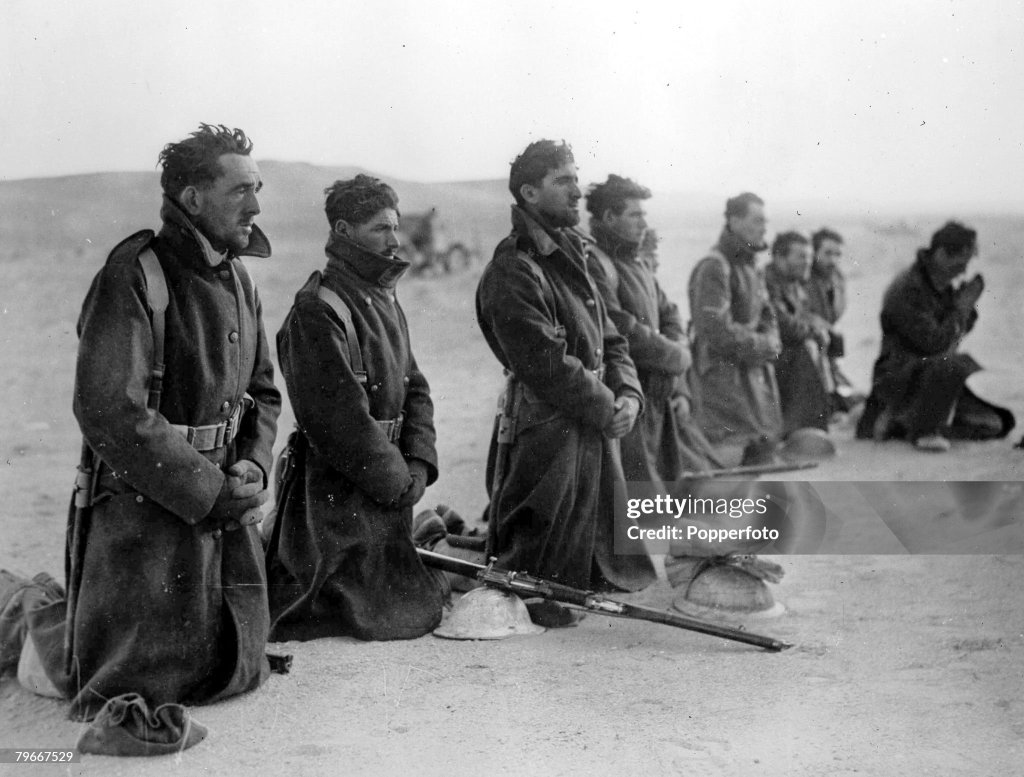
The Greek army is now advancing towards Valona, Albania, the Italian base port on the Adriatic, harrying the Italians through the frozen Albanian mountains. Valona is reported to be crowded with 30,000 wounded and frost-bitten soldiers waiting to be shipped home. However, the logistical difficulties of continuing the advance, and increasing numbers if not competence on the Italian side mean the offensive is losing strength. There will be only limited movement on the front between now and April, when the arrival of German troops will transform the situation.
The Greek government announces the victory at Klisura Pass on 13 January 1941 around noontime. It becomes a day of national celebration, with Premier Metaxas and King George appearing on a balcony together. The Greeks continue to press forward through the snow and howling winds. The Tuscano division is retreating in disarray, with one of these battalions surrounded and on or about this date surrendering. The gateway appears open to the key port of Valona, and taking it would go a long way toward ending the war and completing the conquest of Albania — if the Italians can’t find a way to bar the Greek advance.
While in public everything appears to be going wonderfully for the Greeks, behind the scenes there are growing worries in England and Athens. The Germans are known to be massing in Romania, and they easily could slip through Bulgaria to invade Greece from the northeast. General Papagos, the Greek Commander-in-chief, informs British Middle East Commander General Archibald Wavell that Greece would need substantial reinforcements to deter the Wehrmacht. The British Chiefs of Staff already have made the decision to send troops to Greece, but Wavell does not have nine divisions in his entire theater of operations.
The Italians, of course, are in worse shape than the Greeks at the moment. Mussolini arrives in Albania for talks with the prime minister there. He has Chief of the Defense Staff Ugo Cavallero take over from General Ubaldo Soddu, who is relieved of command in Albania and thus has more time for his real passion, composing soundtracks to movies.
As for the Germans, they indeed are assembling a striking force in Rumania. Where and when it will be used is in doubt. Speculation worldwide is that Hitler will invade Bulgaria, and then funnel the Wehrmacht across its border to Greece in order to bail out Mussolini. Hitler, however, does not want to invade Bulgaria, which the Soviet Union clearly and unequivocally has warned him is part of its “security zone.” Thus, Hitler is exerting pressure on King Boris of Bulgaria to sign the Tripartite Pact. German troops already are infiltrating into Bulgaria, clad in civilian clothes, to prepare for the attack on Greece.
After two months of trying to hold off Greek attacks. General Ubaldo Soddu relinquished command of Italian forces in Albania today to General Ugo Cavallero, Premier Mussolini s current No. 1 military chieftain, in the third army shakeup since November 10. This latest overhauling of the Albanian command came as Italy credited the new German-Italian air offensive in the Mediterranean with the ninth bomb or torpedo hit on British warships within four days. An official announcement said General Soddu, 57-year-old veteran of every one of Italy’s wars since 1900 and II Duce’s under-secretary of war when he was sent to Albania, “has been relieved because of poor health.” Italian authorities insisted that the situation behind the lines in Albania was satisfactory. General Cavallero, himself a veteran of three wars, retains his position as chief of staff, a post In which he succeeded Marshal Pietro Badoglio, who resigned “at his own request” In a high command shakeup December 6.
Reuters News Agency reports: British operations are progressing well around Tobruk. Artillery has been placed in sizeable strength and drinking water depots have been set up for the troops. The Italian garrison is now surrounded. The perimeter at Tobruk is quiet, with the Australian 6th Infantry Division methodically preparing for its next assault on an Italian fortress, and the British 7th Armoured Division repairing its tanks and getting is supplies in order. General Wavell takes this lull to fly to Athens, where he pays a courtesy call on King George II and Prime Minister General John Metaxas. They do not discuss business today, but will tomorrow.
Italian aerial reconnaissance spots British vehicles and tanks 80 kilometers (50 miles) southeast of Derna, Libya.
Adolf Hitler begins another round of diplomatic events. These will take place from 13-20 January 1941 and include visits from Mussolini, General Antonescu of Romania, and others. The first to visit is King Boris III of Bulgaria. Hitler asks the king to join the Tripartite Pact and permit passage of German troops through Bulgarian territory into Greece. Hitler’s overarching objective, however, is to get Bulgaria to declare war on Great Britain. King Boris demurs and makes no promises at this time.
Hitler met with Boris III of Bulgaria at the Berghof. Bulgaria stalled in response to German demand to join the Tripartite Pact. King Boris of Bulgaria, “invited” to Germany by Hitler, has been given a series of demands by the Fuhrer which would bring Bulgaria into the war on Germany’s side. Hitler wants Bulgaria to join Germany, Italy and Japan in the Tripartite Pact; to allow German troops to pass through its territory in order to attack Greece; and to take an active part in Axis military operations.
An official German radio broadcast in English, picked up tonight by N.B.C., had this to say about Wendell L. Willkie’s qualified endorsement of the program to aid Britain. “It should not be forgotten that Mr. Willkie, too, is the representative of big business and a member of those same circles which in England saw their salvation only in war, and which did not hesitate to provoke the present conflict for the sake of saving their own skin and money bags.”
James Joyce, Irish author whose “Ulysses” was the center of one of the most bitter literary controversies of modern times, died in a Zurich hospital early today despite the efforts of doctors to save him by blood transfusions. He would have been 59 years old February 2. Joyce underwent an intestinal operation Saturday afternoon for a perforated ulcer. His wife and son were at the hospital when he died.
Ivan Konev becomes Commander-in-chief of the North Caucasus Military District, while Andrey Yeryomenko (Eremenko) takes over as commander of the prestigious 1st Red Banner Far Eastern Army based in eastern Siberia.
The Luftwaffe bombed Plymouth and killed 26 people. German aircraft dropped 106 high explosive bombs on Plymouth, England, United Kingdom, damaging the Sherwell Congregational Church on Tavistock Road, City Hospital at Freedom Fields, gas works at Coxside, and Corporation electricity works at Prince Rock (26 killed, 117 wounded). Electricity would be restored on the following day, but gas would not be restored for three weeks. Patrol Officer George Wright and Leading Fireman Cyril Lidstone of Auxiliary Fire Service would be awarded George Medals for putting out a fire on an oil tank that might otherwise have exploded. Many residents of Plymouth are left homeless. Because the gas works at Coxside are hit, Plymouth is without gas for three weeks — which is a major issue in the middle of winter. An electrical plant at Prince Rock also is hit, stopping electricity for a day.
RAF Bomber Command sends 1 Blenheim during daylight to Nordhom airfield, just over the German border with Holland, this aircraft did not return.
RAF Bomber Command dispatches 24 Wellingtons and Whitleys overnight to Wilhelmshaven, Dunkirk and Boulogne. Good bombing claimed at Wilhelmshaven but the town diary has no entry; cloud over the French ports. 12 Hampdens minelaying off Brittany ports. No losses from any operation.
Wellington bombers of No. 57 Squadron RAF attacked Ostend, Belgium.
RAF bombers attacked the German submarine base at Lorient, France overnight.
A Halifax bomber carrying out flight tests experiences engine failure and crashes near Baldersby St. James, killing all six onboard.
In Malta, there are two air raid alerts. One of them involves Junkers Ju 88s which apparently are on a get-acquainted flight, as they fly over the island in perfect formation but do not attack. This is an omen of things to come, as Fliegerkorps X based at Catania, Sicily now has more than just Stukas with which to attack.
A quiet day at sea.
Battlecruiser HMS Repulse, light cruisers HMS Edinburgh and HMS Birmingham with destroyers HMS Somali, HMS Tartar, HMS Eskimo, HMS Bedouin, HMS Escapade, and HMS Eclipse arrived at Scapa Flow at 0100. Destroyer Eskimo was found to have defects to rudder requiring docking.
British steamer Wooler (507grt) was damaged by German bombing at Victoria Wharf, Plymouth. The steamer arrived at Southampton in tow on 2 February.
Light cruisers HMS Orion and HMAS Perth arrived at Piraeus at 0230 to embark passengers from the EXCESS convoy. Perth also embarked a number of RAF personnel from aircraft carrier HMS Eagle for Malta. The cruisers departed at 0600 that morning and proceeded to Malta.
Convoy FS.387 departed Methil, escorted by destroyers HMS Versatile and HMS Vimiera, and arrived at Southend on the 16th.
President Roosevelt was in Hyde Park today.
The Senate was in recess but will meet at noon tomorrow.
The House defeated a motion to transfer the Aid-to-Britain bill from the Foreign Affairs to the Military Affairs Committee, transacted other business and adjourned at 1:55 PM until noon Thursday.
President Roosevelt began work today on a rough draft of the address he will deliver next Monday at his third inauguration, The address, as did his annual and budget messages to congress and a radio talk to the country December 29, was expected to mirror conditions and problems in a world at war.
Senator Wheeler, Montana Democrat, said tonight that Wendell L. Willkie “is just as war-minded as President Roosevelt” and then suggested that the chief executive appoint him Secretary of State or ambassador to Great Britain “so we will have a completely war-minded administration.” Wheeler referred to Willkie’s statement endorsing generally the administration’s aid-to-Britain legislation. Wheeler, leader of the opposition to the British aid bill, said that while he was “perfectly willing to sell Great Britain anything we manufacture in the United States,” he did not want to “finance Britain’s war, or China’s war, or Greece’s war.” “If we start financing one side in every war,” he told reporters, “we will not only be bankrupt but we will be involved in war all over the world.”
Wendell L. Willkie’s endorsement of the Administration’s “Lend-Lease” bill, with amendments, appeared yesterday to have materially complicated the task of selecting a new Republican national chairman to succeed Representative Joseph W. Martin Jr. of Massachusetts. While Republican leaders manifested a marked determination to avoid a public discussion of the stand taken by their 1940 nominee most of them conceded privately that it was likely to inflame old wounds within the party and possibly bring about new alignments.
President Roosevelt today indirectly thanked Wendell Willkie for supporting the Administration bill to grant “blank check” powers to the Chief Executive to aid Great Britain and her allies. He made known, however, that he would not make a formal statement about the support of “any one individual.”
Verne Marshall, chairman of the No Foreign War committee, was subpoenaed today to appear in Washington tomorrow before the federal grand jury investigating campaign expenses. Almost simultaneously with service of the subpoena here, O. K. Armstrong, a committee incorporator, announced in Washington he had resigned as a committee member and as field director because of differences with Marshall. In disclosing here that he had been subpoenaed, Marshall said he did not know why, but “assumed” it was because he was the committee chairman. “It should be emphasized once more,” he said, “that the purpose of the No Foreign War committee is to prevent the United States from being dragged into Europe’s endless economic war, which has nothing whatever to do with the ideals of true democracy, and to prevent the lending, leasing or giving away of our national defenses, so long as the president continues to warn us of the imminent peril of aggression upon us.”
The U.S. government extends U.S. citizenship by birth to all residents born in Puerto Rico.
Chairman Carl Vinson of the House Naval Committee expressed the opinion today that the necessity of continually improving military and naval planes might prevent production of 50,000 craft annually, the goal set by the Administration.
The U.S. Supreme Court today upheld the constitutionality of the sweeping espionage act of 1917 which makes it a crime to obtain or transmit any “information respecting the national defense to be used to the injury of the United States or to the advantage of any foreign nation,” friend or foe. Two men, convicted in California of violating the act in 1938 by furnishing to Russia naval intelligence reports which they deemed “innocuous, contended that the statute was so broad that it might even proscribe the publication of crop reports by newspapers if a jury held that such information was connected with “national defense.” The court said, however, that the provisions of the act were “not simple prohibitions against obtaining or delivering to foreign powers information which a jury may consider relating to national defense.” In that case, it added, the law might be invalid.
The U.S. Supreme Court decided Sibbach v. Wilson & Co., a landmark case affirming the validity of the new Federal Rules of Civil Procedure, particularly Rule 35 (physical examinations), establishing they were procedural, not substantive, and therefore within Congress’s authority to delegate to the Supreme Court for uniform federal court procedures, though it limited contempt sanctions for refusing a physical exam. In this case, which involves a car accident in Indiana, the appellant had appealed lower court rulings that held she was required to submit to a physical examination pursuant to FRCP 35(a). The court has diversity jurisdiction, meaning, the case is in federal court because the appellant and respondent reside in different states.
Appellant’s argument is that Indiana state law does not require her to undergo a physical examination and that state law controls on such a substantive issue rather than federal law. Thus, the appellant claims she should not be required to undergo the exam. The respondent wants the uniform federal civil procedure rules applied in every federal court case regardless of how the plaintiff originally obtained federal jurisdiction.
The Court holds that in diversity proceedings, the determining factor as to whether to apply uniform federal rules or state laws is whether the rule in question is substantive in nature, or merely procedural. Procedural rules are those that simply address the manner or means through which substantive law may be adjudicated. Substantive rules to be applied are those of the state in which the court is based, while procedural rules to be applied are those contained in the uniform federal statutes.
In this particular case, the Supreme Court holds that state law controls the issue of a physical examination because that involves a substantive matter and not just how the case should be tried. Thus, the appellant does not have to submit to the physical examination because Indiana law does not require one.
Labor contract negotiations between the Ryan Aeronautical Co. and the C.I.O. United Automobile Workers were taken over by a federal conciliator today in an effort to avert a threatened strike at the plant. Richard T. Frankensteen, chief C.I.O. negotiator, charging the Ryan management with “hiding behind and raising a false cry of national defense,” said a strike vote would be taken at 10 a.m. and 8 p.m. tomorrow. C.I.O. leaders said the month-old negotiations were deadlocked on the wage issue. The U.A.W. has demanded an increase in the minimum hourly wage of from 50 to 75 cents. The company, in a counterproposal, suggested a minimum wage of 50 cents for beginners with automatic increases of four cents each after four and eight-month periods.
Coast guardsmen working in a high sea off Florida removed the last of 200 passengers from the grounded luxury liner Manhattan tonight and brought them safely ashore. The nearest thing to a mishap ended happily when guardsmen grabbed a woman who lost her balance while being lowered to a small surf boat and nearly fell overboard. No one was injured and there was nothing resembling hysteria among the passengers, bound on a pleasure cruise from New York to San Francisco. Plans were made to have the tug Willet, using kedge anchors to take advantage of swells lifting the ship, attempt early tomorrow to pull the Manhattan free. There was no immediate explanation of why the 24.000-ton ship went aground last night, some 250 yards from shore under a clear and moonlit sky.
Seven National Guard units from Iowa, Louisiana, New York, Pennsylvania and South Carolina are inducted into Federal service. The units are:
— One Field Artillery Brigade
— One Cavalry Regiment (Horse-Mechanized)
— One Coast Artillery Regiment (Antiaircraft) (Colored)
— One Coast Artillery Regiment (Harbor Defense) (Type B)
— One Field Artillery Regiment (155mm Gun) (Motorized)
— Two Field Artillery Regiment (155mm Howitzer) (Truck-Drawn)
The behind-the-scenes battles between William Randolph Hearst and RKO Studios over Orson Welles’ “Citizen Kane,” nearing its premiere, continue. Today, the Hollywood Reporter has a front-page story describing how the Hearst chain of newspapers is applying pressure on all of Hollywood — and not just RKO — to get RKO Pictures studio head George J. Schaefer to quash the film. The strategy, the Hollywood Reporter states, will be for the Hearst newspapers to run a series of pieces decrying Hollywood’s practice of hiring immigrants and refugees to do jobs that could be filled by Americans.
Many of these immigrants, of course, are world-famous specialists such as Marlene Dietrich who are busy becoming U.S. citizens as quickly as they can (she already has, as has Albert Einstein). A goodly proportion also is Jewish and fled Europe due to fear of Hitlerism. Einstein fled Europe when he learned that his home had been confiscated for use as a Hitler Youth camp. For them to return now would be tantamount to a death sentence.
Hearst gossip columnist Louella Parsons, still smarting from being scooped by former protégé Hedda Hopper, indeed has been calling the studios and making these threats. The other studio bosses — including Louis B. Mayer and Nicholas Schrenck, the boss at Metro-Goldwyn-Mayer’s parent company — are considering how to respond in some kind of unified fashion.
The Modernaires vocal group joins the Glenn Miller Orchestra on a permanent basis today.
The number 1 song in the U.S.A. on this date, according to Billboard magazine, is “Frenesi” by Artie Shaw.
The attacks continue by the Nationalist Chinese 3rd War Area against the encircled portions of the Chinese Communist New 4th Army near Maolin on the Yangtze River.
The Thai [Siamese] Army, supported by the air corps, crossed into French Indo-China and claimed for Thailand a sector across the northeastern frontier, the Thai High Command reported tonight. The communiqué did not specify where the frontier was crossed, but Thailand has claimed some territory in the Laos district of Indo-China across the Mekong River. The High Command said the advance was continuing and that French forces were falling back. The communiqué declared that another advance was being made farther south, into Cambodia, where fighting was described as fierce.
Bombings were reported today on both sides of the Mekong River frontier, where border warfare continued between Thai and French Indo-Chinese forces. Three of Thailand’s bombers were said to have attacked Pakse today and Thai guns were said to have shelled the Indo-China town of Vientiane for two hours yesterday, killing an undisclosed number of natives.
French Admiral Jean Decoux ordered Capitaine de Vaisseau Régis Bérenger to plan an attack on the Thai Navy within the coming days.
Premier Prince Fumimaro Konoe and the highest army and navy officials met for four hours last night in a tea-house session that the press said was prompted by “the increased delicacy of United States-Japanese relations.”
The Japanese Government is launching another anti-spy campaign, but foreigners are not implicated this time, and the scare is mainly for the instruction of munition workers and “anti-espionage defense maneuvers” are to be staged for three days beginning Friday in the populous industrial districts around Tokyo and Osaka.
Dow Jones Industrial Average: 133.25 (-0.24)
Born:
Meinhard Nehmer, East German bobsledder (Olympic gold medals, GDR, 2-man and 4-man, 1976; 4-man, 1980), in Boblin, Germany.
Pasqual Maragall, Spanish politician, Mayor of Barcelona and President of Catalonia, in Barcelona, Spain.
Carl Dobkins Jr., American singer (“My Heart Is an Open Book”), in Cincinnati, Ohio (d. 2020).
Died:
James Joyce, 58, Irish novelist and poet (“Dubliners”, “A Portrait of the Artist as a Young Man”, “Ulysses”, “Finnigan’s Wake”), from a perforated ulcer.
Naval Construction:
The Royal Navy Isles-class minesweeping trawler HMS Jura (T 169) is laid down by the Ardrossan Dockyard (Ardrossan, Scotland); completed by Plenty.
The Royal Navy Bangor-class (Turbine-engined) minesweeper HMS Dornoch (J 173) is laid down by the Ailsa Shipbuilding Co. Ltd. (Troon, Scotland).
The Kriegsmarine (German Navy) Type VIIC U-boat U-597 is laid down by Blohm & Voss, Hamburg (werk 573).
The U.S. Navy Benson-class destroyers USS Laffey (DD-459) and USS Woodworth (DD-460) are laid down by the Bethlehem Shipbuilding Co. (San Francisco, California, U.S.A.).
The Royal Navy White 73 foot-class motor torpedo boat HMS MTB 43 is commissioned.
The Royal Navy Flower-class corvette HMS Petunia (K 79) is commissioned. Her first commanding officer is Lieutenant Commander George Victor Legassick, RNR.
 History Diaries