Hitler issues Führer Directive 22, ordering preparations for reinforcements to be sent to aid Italian armies in North Africa (Operation SUNFLOWER) and Albania (Operation ALPINE VIOLETS):
The Führer And Supreme Commander Of The Armed Forces.
The Führer’s Headquarters. 11th January, 1941. 13 copies.
Directive No. 22 — German Support For Battles In The Mediterranean Area
The situation in the Mediterranean area, where England is employing superior forces against our allies, requires that Germany should assist for reasons of strategy, politics, and psychology.
Tripolitania must be held and the danger of a collapse on the Albanian front must be eliminated. Furthermore the Cavallero Army Group must be enabled, in cooperation with the later operations of 12th Army, to go over to the offensive from Albania.
I therefore order as follows:
- Commander In Chief Army will provide covering forces sufficient to render valuable service to our allies in the defense of Tripolitania, particularly against British armoured divisions. Special orders for the composition of this force will follow. Measures will be so timed that this formation can be transported to Libya in conjunction with the movement now in progress of one Italian armoured and one motorised division to Tripoli (from about 20th February).
- X Air Corps will continue to operate from Sicily. Its chief task will be to attack British naval forces and British sea communications between the western and eastern Mediterranean. In addition, by use of intermediate airfields in Tripolitania, conditions will be achieved for immediate support of the Graziani Army Group by means of attack on British port facilities and bases on the coast of western Egypt and in Cyrenaica. The Italian Government will be requested to declare the area between Sicily and the North African coast a closed area, in order to facilitate the task of X Air Corps and to avoid incidents with neutral shipping.
- German formations in the approximate strength of one Corps, including 1st Mountain Division and armoured units, will be detailed and made ready to move to Albania. The movement of 1st Mountain Division will begin as soon as the High Command of the Armed Forces has received Italian approval of this. Meanwhile, after discussion with the Italian Command in Albania, it will be decided what further forces in Albania can usefully be employed for an operational attack, and how they and the Italian divisions would be supplied. It will be the task of the German forces: (a) To act as immediate stiffening in Albania in case further critical situations should arise. (b) To enable the Italian Army Group to go over to the offensive at a later date with the purpose: (1) of breaking through Greek defenses at a decisive point for extensive operations; (2) of opening the passes west of Salonika from the rear, thereby supporting a frontal attack by the List Army.
- Instructions for the chain of command of German forces engaged in North Africa and Albania and on the limitations which will be applied to the employment of these troops will be laid down by the High Command Of The Armed Forces in cooperation with the Italian Armed Forces Staff.
- German transports available in the Mediterranean and suitable for the purpose will be used, in so far as they are not already on convoy duties to Tripoli, for the passage of forces to Albania. The group of Ju 52 transport aircraft stationed in Foggia will also be employed in moving troops. Every effort will be made to complete the movement of the main body of German forces to Albania before the movement of the covering force to Libya (see paragraph 1), which will require the bulk of German shipping. Signed, Adolf Hitler.
This directive is an admission of weakness, not strength, in the Axis. While Hitler gives passing lip service to “Italian approval” of these troop movements, the Italians have been asking for help for a month. Führer Directive No. 22 is only necessary because of Italian military failures, and while Germany has plenty of military force available and sitting idle, this directive opens up an entirely new sector of German responsibility that it never should have had to worry about. There is a vast amount of territory to cover in the Mediterranean, and it would have been vastly better for the Axis if the Italians had been able to hold their own there — but they can’t.
The Greeks completed the Capture of Klisura Pass. Mopping-up operations, in which the Greeks have captured about 100 more Italians and additional quantities of war material, were reported by the high command today. Although its communique mentioned only “restricted local cleaning up operations,” dispatches from the front reported progress Saturday from captured Klisura toward Berati under cover of low-flying Greek and British warplanes. Heights dominating the road toward Berati, about 30 miles north of Klisura, were reported occupied. An earlier Athens radio report had said the Greeks found 400 Italian dead in one part of the abandoned Klisura lines and that many wounded, abandoned in the retreat, were being cared for by Greek field surgeons. Italian 7th Infantry Division Lupi di Toscana and the remnants of Italian 3rd Alpine Division Julia launched a failed counterattack on Klisura Pass in Albania, which was captured by the Greeks on the previous day.
Greek II Corps has captured the key Klisura Pass by 11 January 1941. It is considered the gateway to the vitally important Italian port of Valona. The Italian Lupi di Toscana Division, which went into action after a 24-hour forced march and no preparation and no maps, continues to get mauled in its counterattack, with one of its battalions surrounded. The part of the division that has not been surrounded retreats to its starting point before launching the desperate counterattack.
Italy’s Marshal Rodolfo Graziani made no move today to relieve his beleaguered garrison at Tobruk, 80 miles inside Libya, but the British moved up troops and guns under massive air protection and plopped shells into the seaport’s semi-circle of defenses from four carefully-placed batteries. The guns of Tobruk replied, but aside from these artillery duels there was no fighting on the fourth day of the siege. R.A.F. patrols were out all day yesterday on the road west of Tobruk leading to Derna, where British mechanized ground forces also are operating, but there was no conclusive engagement with Fascist airmen. Despite his tremendous losses, Graziani still has a considerable army to the west, but the fact that it is not coming up leads the British to believe that Tobruk will fall.
The Australians and English tighten their hold on Tobruk. General Wavell will have to complete its capture soon before Greece sucks up more of his remaining troops.
In southwest Libya, the British Long Range Desert Group (LRDG) boldly drives south into Murzuk, their objective, after almost being spotted by an Italian reconnaissance plane. They drive straight through town to the Beau Geste fort at the southern end. En route, they capture the town’s postmaster, Signore Colicchia, who they find cycling toward the fort with the day’s mail. The sentries in the fort spot the approaching British vehicles (23 in all) and close the gate. The LRDG then splits up, with half remaining outside the fort to contain the garrison while the rest go to shoot up the nearby airfield.
At the airfield, the LRDG men subdue about 20 soldiers guarding three Ghibli light bombers. They then destroy the planes and the hangar. Pat Clayton, in command of the New Zealanders, takes out an Italian machine-gun nest by driving over it. After destroying everything worthwhile there, the LRDG reforms in town and destroys the Italian fuel stores, ammunition, and everything else worthwhile in the town. They also damage the Murzuk fortress, which is impregnable to their light arms. The LRDG then leaves the town at about 16: 00 and heads back toward British lines the way they had come. Overall, the Italians have ten killed and fifteen wounded, while the British lost two men and three wounded.
The raid has a devastating effect on Italian morale. The attack was completely unexpected and far behind the front. Damage at Murzuk airfield is never repaired, and in fact, remains exactly as the LRDG left it for decades after. More than any other single incident, this raid creates the legend of the LRDG.
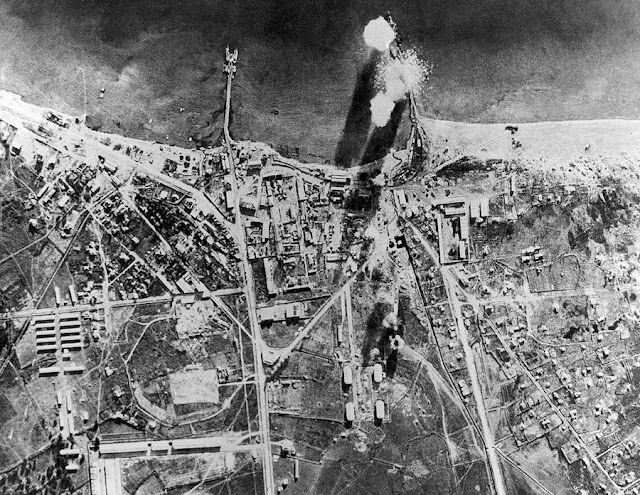
The Luftwaffe continues its attacks on the Royal Navy warships involved in Operation EXCESS, and once again draws blood. Having damaged heavy cruiser HMS Southampton on the 10th, Fliegerkorps X (2 Staffeln, Sturzkampfgeschwader 2) returns in the afternoon and finishes the job. The cruiser is hit three more times and must be abandoned. Cruiser HMS Gloucester, traveling in company with Southampton, also is hit (a bomb passes through five decks without exploding) and set on fire (9 deaths). Italian submarine Settimo fires three torpedoes at the Southampton, but it remains afloat. Royal Navy submarine HMS Orion later administers the kill shot. There are 668 survivors of Southampton, 80 dead and 87 other casualties (accounts vary on exact numbers).
Operation EXCESS basically concludes. Perversely, all the freighters and warships carrying troops and equipment reach Malta without any damage. However, the Royal Navy has lost destroyer HMS Gallant and light cruiser HMS Southampton, while having new aircraft carrier HMS Illustrious damaged to the point of sinking. Overall, Operation EXCESS has been a disaster for the Royal Navy due to the new, unexpected presence of the Luftwaffe operating out of Sicily.
In Malta, the dockyard workers swarm over HMS Illustrious in order to make her seaworthy again. They ignore the mangled flight deck and instead concentrate on repairing leaks and the ship’s steering.
The Royal Netherlands “Princess Irene” Brigade was formed in Congleton, U.K.
A 6.2 Mw earthquake in the Jazan Province of Saudi Arabia killed around 1,200.
The bitterly cold winter weather across many parts of Europe is also affecting the ordinary Germans, who are finding that their meagre coal rations are insufficient to heat their flats and houses. The situation seems unlikely to improve. Next week the Security Service of the SS is to produce one of its regular reports for the Berlin government on the conditions and mood of the country, which is expected to reveal acute shortages of coal for households and small businesses throughout the Reich. This shortage is in spite of current record coal production, and can be blamed mostly on the Nazi government’s policy of giving priority to the armaments industry. But in some areas the weather has dealt a double blow: it has boosted demand for coal, but has frozen many of the canals and rivers on which new supplies are carried.
German-born chess champion Emanuel Lasker died due to illness in the middle of a match against Frank Marshall in New York City.
The second round of Soviet wargames concludes. General Georgy Zhukov, in command of the “Red” or Soviet forces, scores a convincing victory over General Kulik, in command of the “Blue” or German forces. The Soviets choose to publicize this round of the war games and not the first, which was won convincingly by the “Blue” forces. Of course, both of the “winning” sides were commanded by Zhukov, a fact which the Stavka notices.
The Luftwaffe, true to form, hits Portsmouth again for the second night in a row. A lucky hit on the main water main while the tide is out — the Luftwaffe has been planning raids in conjunction with the tides recently, to good effect — cripples firefighting efforts. The one saving grace for the British is that many locals have gone elsewhere for this Saturday night. The City of London also is attacked by 137 aircraft. A bomb penetrates Bank Station, killing 51 people and causing a crater so large that the army has to build a bridge across it.
In London, the Central line ticket hall of Bank station suffered a direct hit from a German bomb. The roadway collapsed into the subways and station concourse, killing 111 people. The blast travelled through the tunnels and killed people sleeping on the escalators and platforms, as well as throwing others in the path of trains. People died underground and on the surface and, in the aftermath of the bombing, an emergency bridge was built over the huge crater to enable traffic to continue moving around the busy interchange in the heart of the Square Mile.
The RAF orders No. 11 ( Blenheim) and No. 112 (Gladiator) Squadrons to Greece. To bring No. 11s strength up to establishment, No. 39 handed its Blenheims over and re-equipped with the first Martin Marylands to reach the Command. With a top speed of 278 mph and a bomb load of 2,000 lb, they were also used for photo-reconnaissance.
First test flight of the unsuccessful Polikarpov I-185 (M-71).
RAF Bomber Command sends 19 Blenheims on widespread cloud-cover raids; 9 bombed targets. 1 aircraft lost.
RAF Bomber Command dispatches 35 Hampdens and Wellingtons overnight; 17 claimed to have bombed primary targets. No losses. Wilhelmshaven reports 1 house burnt down, a barn destroyed by an exploding Flak shell and a boy killed by a falling Flak-shell splinter. Minor Operations: 11 Wellingtons to Turin and 5 Hampdens minelaying in the Baltic north of Lubeck. The bombers hit Turin with good accuracy, starting fires at both the Royal Arsenal and a ball-bearing factory. 1 Wellington, of 9 Squadron, returning from Turin force-landed in Vichy France and the crew destroyed the plane by fire before being interned.
During the night 16 British aircraft from Scampton, Lincolnshire attacked battleship Tirpitz at Wilhelmshaven, Germany to little effect.
German Luftwaffe Oberst Werner Ennecerus led a dive bomber attack on British cruisers HMS Gloucester and HMS Southampton 120 miles east of Sicily, Italy, hitting Gloucester with one 500kg bomb that failed to explode (9 killed, 13 wounded) and Southampton with two 500kg bombs (98 killed). Southampton was abandoned by the 727 survivors at 1900 hours, then was scuttled by a torpedo from cruiser HMS Orion at 2000 hours. Further east, the Allied convoy Excess, which the cruisers were protecting, reached their destinations of Malta, Egypt, and Greece.
In German bombing attacks on the Vosper yard at Portsmouth, Motor torpedo boats MTB.37, MTB.39, MTB.40, MTB.74, MTB.75, and MTB.108 were destroyed on the stocks.
Naval drifter HMS Uberous (92grt, Skipper M. M. Anderson RNR) was lost when she ran aground off Londonderry.
Convoy rescue ship Beachy (1600grt) was sunk by German bombing in 53-29N, 16-24W. Five crewmen were killed. Anti-submarine trawler HMS Arab rescued the survivors of the ship on the 29th.
Swedish steamer Bertha (1216grt) was sunk by mining between Saltholm and Middelgrund. Thirteen crew members were rescued. Four crewmen were missing.
British tanker British Fidelity (8465grt) was damaged on a mine in 51-22N, 3-05W. The tanker’s engines were totally disabled. She was towed to Cardiff.
British steamer Greyfriars (1142grt) was damaged by German bombing one mile west of 59A Buoy, off Grimsby. Five crewmen were lost. The steamer drifted ashore near Chapel St Leonards during the night of 11/12 January. The steamer was refloated on the 14th and was towed to Hull.
British fishing vessel Oriole (172grt) was sunk on a British mine two and a half miles north of Stakken North Point, Faroes. The entire crew was lost.
Light cruisers HMS Gloucester and HMS Southampton with destroyer HMS Defender steaming from Malta to join convoy ME.6 was attacked by German bombers in 34-54N, 18-24E at 1500. Light cruiser Southampton was badly damaged at 1605. Light cruiser Gloucester picked up thirty three officers and 678 ratings of which four officers and fifty eight ratings were wounded. Destroyer HMS Diamond picked up sixteen wounded ratings. Light cruisers HMS Orion and HMAS Perth and destroyers HMS Jervis and HMS Janus were detached at 1645 to assist. However, destroyers HMS Juno and HMS Nubian, low on fuel, were detached to join the convoy. Destroyer HMS Hero joined the Force A screen. Destroyers HMS Mohawk and HMS Griffin, after delivering destroyer HMS Gallant, departed Malta to 1700 to assist. Lt Cdr S. H. Balfour, Lt Cdr J. F. C. Barker-Hahlo, Midshipman G. E. Davidson, Commissioned Gunner A. W. Davis, Lt (D) D. J. Fairweather, Cdr (E) R. W. Fyfe, Paymaster Sub Lt C. K. Gray, Lt (E) J. A. Guest, Paymaster Midshipman A.B. Holmes, T/Paymaster Sub Lt V.B. Lloyd-Smith RNVR, Midshipman J. M. Mocatta, Surgeon Lt T. J. Morton RNVR, T/Instructor Lt J. E. Oliver, P/T/Sub Lt L. F. Page RNR, A/Lt R. H. S. Pemberton, Gunner H. C. Player, Paymaster Lt N. L. C. Richards, Paymaster Midshipman E. Roynon-Jones, Major H. E. F. Shackleton, RM, Warrant Engineer F. J. White, fifty nine ratings, and fifteen RAF ratings were killed. Cdr C.B. Tinley, OBE, Commissioned Gunner L. C. Koester died of wounds on the 17th and 12 January, respectively. T/A/Surgeon Lt Cdr W. C. Sloan RNVR, was wounded.
Light cruiser HMS Gloucester was struck on the roof of the forward 6″ director. The bomb passed through five decks without exploding. Sub Lt R. H. Basford, SARNVR, one rating, and seven Marines were killed on light cruiser Gloucester and T/Lt (E) J.B. E. Mattei and thirteen ratings were wounded. Light cruisers HMS Orion and HMAS Perth and destroyers HMS Jervis and HMS Janus joined that night. Light cruiser Orion scuttled light cruiser HMS Southampton. Light cruiser Gloucester’s Walrus returned to the ship during the attack. The Walrus ditched alongside destroyer HMS Diamond which took off the crew then scuttled the aircraft.
Battleship HMS Barham, aircraft carrier HMS Eagle, light cruiser HMS Ajax, destroyers HMAS Stuart, HMS Wryneck, HMAS Vendetta, HMAS Vampire, and HMAS Voyager departed Alexandria as Force X to cover the EXCESS convoy in the Aegean and later launch an air strike on Rhodes. This force joined Force A west of Crete at 0730/12th. Force X was sent to Suda Bay to refuel, where the force was reinforced by destroyers HMS Ilex, HMS Juno, HMS Hasty, HMS Mohawk, and HMS Griffin. After refueling, battleship Barham, aircraft carrier Eagle, light cruiser Ajax with destroyers Stuart, Juno, Hereward, Hasty, and Dainty departed Suda Bay on the 13th. Destroyers Ilex, Wryneck, Vampire, and Vendetta, after sweeping in Kithera Strait at dawn joined the Force at noon. Destroyers Vampire and Vendetta were detached to investigate explosions which proved to be underwater volcanic activity. The destroyers then patrolled in Kaso Strait. Destroyers Ilex and Wryneck were detached to sweep towards Stampalia and then with Vampire and Vendetta proceeded to Piraeus to escort the EXCESS convoy to Alexandria. An air strike scheduled for the evening of 13 January on Rhodes was cancelled due to poor weather conditions.
On the 14th, four Swordfish were sent to search the Libyan coast between Derna and Tolmeita. Lt (A) D. R. Hoar, A/Sub Lt (A) G. J. Woodley RNVR, Naval Airman H. J. S. Frank of 824 Squadron from aircraft carrier HMS Eagle were lost when their Swordfish ditched after running out of fuel. A search by destroyer HMS Mohawk did not locate the crew. Later on the 14th, an air strike of eight Swordfish were flown off to strike at an Italian convoy, but returned without making contact that evening.
Convoy FN.381 departed Southend, and arrived at Methil on the 13th.
Convoy BN.12A departed Aden, escorted by anti-aircraft cruiser HMS Carlisle and destroyers HMS Kandahar and HMS Kimberley, and arrived at Suez on the 15th.
Convoy HX.102 departed Halifax, escorted by armed merchant cruiser HMS Voltaire.
Convoy BHX.102 departed Bermuda on the 9th escorted by ocean escort armed merchant cruiser HMS Ranpura. The convoy rendezvoused with convoy HX.102 on the 15th and the armed merchant cruiser was detached. The convoy was joined on the 23rd by destroyers HMS Wild Swan and HMS Witch, sloop HMS Aberdeen, and corvettes HMS Campanula, HMS Fleur De Lys, HMS Gardenia, and HMS Periwinkle. The armed merchant cruiser was detached on the 22nd. Destroyers Wild Swan and Witch were detached on the 25th and corvette Gardenia on the 27th. On the 28th, sloop Aberdeen and corvettes Campanula, Fleur De Lys, and Periwinkle were detached, and arrived at Liverpool on the 29th.
A poll indicated today that the administration could count on a majority of the Senate Foreign Relations committee to support its legislation giving President Roosevelt broad powers to send war supplies to nations resisting “aggressors.” Eight committee members said they were for the measure; four declared against it; four said they had not made up their minds, and five were either unavailable or made no statement. Before the committee acts, however, two new members will be chosen to fill vacancies and the leadership certainly will pick appointees who favor the program. In addition, it was indicated that the administration would receive the votes of at least three of those now uncommitted, making a total of 13 of 21 members for the measure. It was learned that Democratic Leader Barkley of Kentucky would call a meeting of his party’s steering committee promptly to select the new committee members.
President Roosevelt started his weekend vacation in a happy mood, confident that Congress would act favorably on the “blank check” bill introduced yesterday to give him the broadest sort of powers in carrying out his plans for his aid to the democracies.
Administration leaders in Congress displayed a conciliatory attitude toward the various limitations some members will seek to include in the “Lend-Lease” bill to convert the United States into the “arsenal of democracy” which President Roosevelt advocated in his annual message to Congress. It appeared to be their present opinion that any proposed change in the language of the bill would be sympathetically considered, provided that it did not detract from the main objective of the proposal. This frame of mind appeared to stem from the agreed importance of the proposed step rather than from any doubt of the number of votes at the Administration’s disposal. There appeared to be every confidence that sufficient solidarity exists to put the measure through Congress in whatever form desired, but this confidence is tempered by the desire to preserve the maximum of national unity in the process.
Senator George of Georgia, chairman of the Foreign Relations Committee, predicted today that the Senate, at least, would attach to the bill a requirement that “the best security possible” be exacted from the governments to be aided, that some form of return would be made to the United States for any war materials transferred under the bill. He expressed this opinion in response to a question whether he believed the bill would permit outright gifts by the President. “We do not want to adopt a parsimonious policy,” he continued, “under which we give with one hand and take back with the other.”
However, the important assistance the United States expects to be able to extend, in the interest of its defense, to those nations which are considered to be resisting aggression, should merit as nearly as possible an equivalent return when peace is restored, Mr. George said. He cited the British holdings of American and other foreign securities as an example of what he meant by an adequate gauge of future compensation, and added that American participation in the British tin and rubber trade might be considered a form of important compensation in the future.
Senator Nye, North Dakota Republican, predicted today there are between 30 and 35 “positive votes” in the Senate for a declaration of war against Germany, should President Roosevelt request it. Nye is a leader of the Senate non-interference bloc, but he holds little hope of defeat of the president’s sweeping lend-lease bill to aid Great Britain, which he termed “a declaration of war.” the measure, which already had been assigned to the foreign affairs committee.
Secretary of State Cordell Hull tonight announced that agreement had been reached by the United States and Great Britain on sites for eight American air and naval bases to be constructed on British possessions in the western hemisphere. Formal 99-year, rent-free leases will be signed, officials added, as soon as an American mission composed of Charles Fahy, assistant solicitor-general; Colonel Harry J. Malony, U. S. Army, and Commander Harold Biesemeier, U. S. Navy, work out technical details with British officials. They will go to London via Lisbon on the clipper leaving January 17. The sites agreed upon were those recommended by a board of American experts, headed by Rear Admiral John W. Greenslade, which inspected proposed sites in the autumn.
An appeal on grounds of patriotism and the “terrible urgency” of the situation to all of industry engaged on defense work to end the two-day week-end “blackout” and go on the six-day week will probably be made soon by the new Office of Production Management.
William Randolph Hearst has banned his chain of newspapers from covering RKO pictures due to his outrage over Orson Welles’ forthcoming “Citizen Kane.” The front page of today’s Daily Variety screams, “HEARST BANS RKO FROM PAPERS.” Hearst has his lawyers working over the weekend to draft a temporary restraining order to enjoin RKO from distributing “Citizen Kane,” which Hearst feels is personally defamatory. So far, RKO remains determined to release the picture. He also continues to look for other means to apply pressure on the studio.
U.S. liner Manhattan runs aground off Lake Worth Lagoon, Florida, about nine miles south of Palm Beach. The captain and first officer both are later suspended for negligence in this incident. The ship is refloated and repaired just over three weeks later.
Rear Admiral Harold M. Bemis relieves Captain Eugene T. Oates as Commandant, Sixteenth Naval District and Navy Yard, Cavite, P.I. Captain Oates had been acting commandant since the incapacitation of Rear Admiral John M. Smeallie in December 1940.
The US Army Air Corps orders two prototypes of the Northrop XP-61, along with two wind-tunnel models. This is a large, all-metal, twin-boom fighter carrying a crew of three. The XP-61 is designed to be a heavily armed night fighter used to intercept Luftwaffe bombers attacking London at night. Lieutenant General Delos C. Emmons, based in London, has used the latest progress by the British in airborne radar to craft the requirements and specifications for this plane. Ultimately, this project will turn into the Northrop P-61 Black Widow. This is the second twin-boom fighter design for which the USAAC has ordered prototypes recently, the other being the Vultee XP-54 on 8 January 1941.
Army Air Corps announced the control of robot planes, either by radio from the ground or from another plane, had been tested successfully.
The Marine Corps’ first parachute jumpers, scheduled eventually to form the nucleus of a battalion of 400 men in the organization’s two new mechanized divisions, have entered the second stage of their training here — making actual parachute descents from a navy blimp at altitudes of more than 2,000 feet.
Comedian Stan Laurel and actress Virginia Ruth Rogers remarry for the 2nd time
German raider Atlantis, having recovered from grounding on a rock in the uninhabited Kerguelen Islands and completed various maintenance projects, departs to resume its patrol. It leaves behind one man, a sailor whose grave is reckoned to be the German war grave of World War II that is the furthest south.
The Nationalist Chinese (Kuomintang) continue to press in on encircled elements of the Communist Chinese New 4th Army at Maolin on the Yangtze River.
The Thai Army continues to attack into the Mekong Delta.
The reported threat of the Thai [Siamese] Government to bomb three French Indo-China cities in current border warfare brought a warning from French officials today that if the cities were attacked, French planes would bomb Bangkok, Thai capital. French troops also were said to have clashed with Thai forces in “spirited fighting” at three places on the fronts in Cambodia.
Japan had no “improper” designs on the Netherlands Indies and the responsible heads of the Japanese Government were doing their utmost to avoid war with the United States, Britain and the Netherlands, Kenkichi Yoshizawa, head of the Japanese mission in Batavia, said today in an interview.
Australia already is committed to a war expenditure of more than 200,000,000 in the year ending next June 30. This compares with 270,000,000 spent in the whole of the last war. The new program has propelled Australia into an industrial revolution.
Dow Jones Industrial Average: 133.49 (-0.1)
Born:
Dave Edwards, big-band saxophonist, in Opelika, Alabama (d. 2000).
Jimmy Velvit, rock and roll singer, in Coalgate, Oklahoma.
Naval Construction:
The Kriegsmarine (German Navy) Type VIIC U-boat U-598 is laid down by Blohm & Voss, Hamburg (werk 574).
The U.S. Navy net laying ship USS Aloe (AN-6), lead ship of her class of 30, is launched by the Lake Washington Shipyard (Houghton, Washington, U.S.A.).
The Kriegsmarine (German Navy) Type 1936A destroyer Z26 is commissioned.
 History Diaries