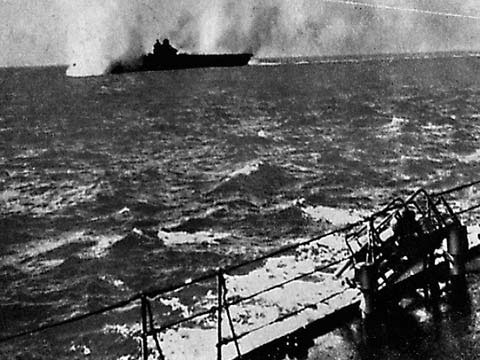
The British aircraft carrier HMS Illustrious was severely damaged by Stukas as it escorted a convoy to Malta. The Royal Navy’s luck with its Malta convoys finally runs out despite the fact that Convoy MW.5 ½ makes it to Grand Harbour without any damage (and turns around and leaves in under four hours) and Convoy ME.6 departs from there without incident.
While the Italian air force remains largely ineffective, the German Luftwaffe now is around to generate some real results. The ships of British Operation Excess reach the Sicilian Strait, and that provides a target that is just too tempting to ignore. Crack Luftwaffe unit Fliegerkorps X, now based on Sicily and with pilots specially trained for service on unfinished aircraft carrier Graf Zeppelin, sends 30 Junkers Ju 87 Stukas against the warships passing from west to east just south of Malta. They illustrate what the Italians could have been accomplishing all along. The order from Oberstleutnant Karl Christ, Kommodore of the Stukagruppen:
“The Illustrious has got to be sunk.”
The Stukas are successful in finding and bombing the brand-new Royal Navy aircraft carrier HMS Illustrious. It is part of Force A, and the Stukas hit it half a dozen times; they also badly damage cruiser HMS Southampton, but the Illustrious is the prize.
The Axis operation is clever, with two Savoia SM79 torpedo bombers sent first to draw off the defending fighters and disrupt the formation. After that, the Stukas come on in successive waves that last into the late afternoon. The Illustrious has 200 casualties (83-125 deaths, accounts vary) and, with her steering wrecked, barely makes it to nearby Malta with blazing fires and a pronounced list caused in part by all the water used to fight the fires. Captain Boyd on the Illustrious even has to hoist the ominous flag signal, “I am not under control.” However, the engines are carefully controlled to keep the carrier on course, and it is able to make 17 knots. The RAF also loses five Swordfish and five Fulmars in the attack. The fires on the Illustrious take another four hours to put out after the carrier makes port around 22:15.
The Royal Navy’s problems do not end there. Destroyer HMS Gallant hits a mine about 120 miles west of Malta, which blows off her entire bows all the way back to the bridge. There are 58 deaths, 25 other casualties, and 85 crew survive. After being towed back to Grand Harbor stern-first, the Gallant is written off and her remaining guns and equipment used in other ships.
Battleships HMS Warspite and Valiant also receive minor damage, with on dead and two wounded on the latter. An Italian submarine, the Settimo, attacks the warships, but without success.
The Italians also sortie, but with less success than the Germans. Italian torpedo boats attack the Operation EXCESS ships in the Sicilian Narrows off Cape Bon. The Italians only lose one of their own, torpedo boat Vega. In fighting off the Italian attack, however, Royal Navy light cruiser HMS Bonaventure uses up 75% of its ammunition and sustains one death and four other casualties (one of whom later also perishes). Italian torpedo boat Circe barely gets away with splinter damage.
Britain’s batteries in Libya shelled Italian-held Tobruk today in the initial blow of an attack patterned after that which reduced Bardia, 50 miles to the east, five days ago. Nearly cut off by an encircling movement of British mechanized units 50 miles to the west, Tobruk was rapidly being surrounded by British land forces, while its perimeter of outer defenses was battered by big siege guns rolled into place from Bardia. The British, conceding it would take some time to bring up their full siege strength, said it was too early to speak of an “assault.”
Greek troops, with the recently arrived Greek 5th Cretan Division, captured Klisura Pass in Albania after 4 days of fighting. While Greeks at home rejoiced in the streets over fresh victories in Albania the forces at. the front today reportedly pushed past captured Klisura toward Valona, last important port in southern Albania held by the Italians. Greek troops occupying Klisura found it had been burned and pillaged, a general headquarters communique said tonight. Most of the townspeople had deserted the town, but 600 Italian soldiers were taken prisoner and four guns, some tanks, more mortars and, automatic guns were captured, the communique added.
The Italians pull out of Klisura Pass on 10 January 1941, handing it to the Greeks. Well, not all of the Italians; some of them are encircled and will become Greek POWs. The Toscana Division, which marched 24-hours straight to run into the battle without preparation or rest, is devastated. The Julia Division which has been holding the pass, however, retreats in reasonably good order. The Cretan 5th Division of II Corps leads the Greek victory.
The capture of the pass has been a Greek priority due to the access it provides to the key Italian port of Valona. Expectations soar that the Greeks can now storm down and take the port. British Middle East Commander in Chief Archibald Wavell sends Greek Commander in Chief a congratulatory telegram. The Italians do not retreat very far, however, and the Greeks experience great difficulty in exploiting this success.
Britain has asked Yugoslavia for a clearer definition of the Yugoslav viewpoint in the event of “decisive developments” in Albania, an authoritative neutral source told the United Press tonight. Competent observers here believe that Germany will not allow the Greeks to capture Valona because that would open the Adriatic to the British fleet, thereby menacing the entire Italian Adriatic coast. They believe that each Greek success proportionately increases the chances for direct German intervention in the Italo-Greek war.
British Prime Minister, Winston Churchill, received confirmation from intercepts of German signals, decrypted at Bletchley Park, that the German build-up in Rumania formed a grave threat to Greece. He promptly ordered draft contingency plans for the commitment of a British expeditionary force to the Greek mainland.
After days of deliberation, the Chiefs of Staff and the Defence Committee have made their decision regarding priorities in the Mediterranean sector. They cable Wavell that:
“[A]ssistance to Greece must now take priority over all operations in the Middle East once Tobruk is taken, because help for the Greeks must, in the first instance at least, come almost entirely from you.”
Churchill insists that assistance to Greece must be top priority after the capture of Tobruk. But Wavell denies this, saying that the German build-up is a “…move in a war of nerves designed with object of helping Italy by upsetting Greek nerves, inducing us to disperse our forces in Middle East and to stop our advance in Libya. Nothing (repeat nothing) we can do from here is likely to be in time to stop German advance if really intended…”
The Chiefs of Staff, however, are firm. They base their decision not just on a strategical assessment, but on Ultra decryptions. They instruct Wavell to begin preparing the strong ground and air forces to Greece, including three Hurricane squadrons, a squadron of tanks, and anti-aircraft troops and guns.
Churchill, of course, is behind all this. Somewhat incongruously, though, he tells visiting Roosevelt crony Harry Hopkins today that he does not really believe anything can be accomplished in Greece. Hopkins cables Roosevelt that Churchill:
“…thinks Greece is lost — although he is now reinforcing the Greeks — and weakening his African Army — he believes Hitler will permit Mussolini to go only so far downhill — and is now preparing for the attack which must bring its inevitable result.”
Thus, for some reason, Churchill is supporting a shift in priorities that he knows must be a failure. It is an odd posture, presumably based upon high-level geopolitical calculations upon which subsequent events shed no light.
Lord Derby, speaking to Rossall School in Fleetwood, Lancashire, told the boys that after the war there would be a commercial battle for the markets of the world, and he urged: “Fit yourselves for that battle, because it will be battle, make no mistake about it.”
The first of the RAF “circus” operations was conducted. These operations were daylight raids by small numbers of bombers with large fighter escorts against short-range ‘fringe’ targets in northern France, with the aim of bringing Luftwaffe fighters to battle in circumstances favorable to the RAF. The attack consisted of six Bristol Blenheims of No.114 Squadron escorted by nine squadrons of fighters and targeted supply dumps at the Foret de Guines south of Calais.
The German civil administration in the Netherlands ordered the registration of all Jews in the country. The registration of Jews began in Holland following a decree by Reich Commissar for Occupied Netherlands Artur Seyss-Inquart. The decree stated the “Registration of all persons of part or full Jewish blood. Sec. 2 defines as a Jew any person one of whose grandparents was a full blooded Jew. Any grandparent who belonged or belongs to the Jewish religious community is considered as such. Failure to register entails an imprisonment not exceeding 5 years and the confiscation of property.”
Of course, those who register may wind up in more difficulty than just losing their property and being imprisoned. Many people must make very hard choices.
A new German-Soviet treaty was signed confirming spheres of influence and affirming trade agreements. Germany and the Soviet Union signed an agreement setting several ongoing issues. The agreement formally set the border between Germany and the Soviet Union between the Igorka River and the Baltic Sea. It extended the trade regulations of the 1940 German-Soviet Commercial Agreement until August 1, 1942 and increased deliveries above the levels of year one of that agreement. The new agreement settled trading rights in the Baltic States and Bessarabia and calculated the compensation for German property interests in the Baltic States now occupied by the Soviets. Finally the new agreement covered the migration to Germany within two and a half months of ethnic Germans and German citizens in Soviet-held Baltic territories and the migration to the Soviet Union of Baltic and “White Russian” “nationals” in German-held territories. Secret protocols in the new agreement stated that Germany would renounce its claims to one piece of Lithuanian territory in the “Secret Additional Protocols” of the German–Soviet Boundary and Friendship Treaty and would be paid 31.5 million Reichsmark (7.5 million dollars.).
The Soviets are quite happy with the agreement, announcing:
“This new economic agreement marks a great step forward.”
With perfect hindsight, we can agree that it does “mark a great step forward,” but not quite in the manner the Soviets intend.
The second round of Soviet war games continues. General Zhukov is doing quite well in command of the “Red” or Soviet forces, which heartens the Stavka.
In Operation MONSOON, Royal Navy aircraft carrier HMS Furious flies off 39 Hurricanes and 9 Fulmars to Takoradi, Ghana.
After dark, the Luftwaffe sends 150 bombers against Portsmouth. They drop 50,000 incendiaries, and despite increased British efforts to extinguish them quickly, over two dozen large fires destroy large swathes of the working-class sections of the city and six churches. The historic Guildhall is hit and the fires melt its copper cupola. Aside from the bomb damage, there are 171 deaths and 430 injured. The Guildhall was heavily damaged and would remain closed until 1959.
RAF Bomber Command dispatches 6 Blenheims of 114 Squadron during daylight which were escorted by 72 fighters in this first Circus operation. The Blenheims bombed a German ammunition depot in the Fork de Guines, south of Calais. None of the Blenheims were lost. 2 further Blenheims, dispatched on cloud-cover raids to Emden and Nordholz, turned back. The “Circus” operations begin. The British launch a large daylight raid over the Pas de Calais. The tables now have turned: rather than the Luftwaffe trying to entice the RAF fighters into battle, now the RAF tries to entice the Bf 109s into the air. About 72 RAF fighters and a tiny force of six Blenheim bombers target an ammunition dump south of Calais. After dark, Bomber Command hits Brest, where Kriegsmarine cruiser Admiral Hipper continues to linger.
RAF Bomber Command dispatches 12 Whitleys overnight to attack warships in Brest harbour. No losses.
The RAF bombs Italian airfields at Benina, Benghazi, and Berea. The Fleet Air Arm raids Palermo on Sicily.
Direction finding readings 300 miles west of Bloody Foreland caused a sortie from Scapa Flow. Battlecruisers HMS Hood (VA BCS) and HMS Repulse, light cruisers HMS Edinburgh (VA 18th CS) and HMS Birmingham, and destroyers HMS Somali, HMS Bedouin, HMS Tartar, HMS Eskimo, HMS Escapade, and HMS Eclipse departed Scapa Flow at 0101 on the 11th. When no contact was made, the ships arrived back at Scapa Flow at 0100/13th. Before arriving, battlecruiser Hood was detached to Rosyth for refitting. She was joined by destroyers HMS Echo, HMS Electra, and HMS Keppel, which departed Scapa Flow at 2300/12th, in Pentland Firth and arrived at Rosyth on the 13th.
Minelaying cruiser HMS Adventure laid mines in minefield ZME.14 in St Georges Channel during the night of 10/11 January.
Destroyer HMS Jackal departed Scapa Flow at 1000 for Devonport following a short series of exercises.
Anti-aircraft ship HMS Curacoa departed Scapa Flow to escort convoy WN.66 from Pentland Firth to the latitude of Buchan Ness. The ship arrived back at Scapa Flow on the 11th.
Anti-aircraft ship HMS Tynwald, while fitting out at Portsmouth, was damaged by German bombing.
British P/T/Sub Lt W. D. C. Hughes RNVR, P/T/Sub Lt N. A. Koelges RNVR, were killed when their Swordfish of 812 Squadron crashed near Halton.
British steamer Middlesex (9583grt) was sunk on a mine at 0.8 miles 198° from Flat Holm Island. The entire crew was rescued.
German tanker Nordmark replenished German supply ship Eurofeld (5947grt) at sea.
At Dawn, the EXCESS convoy escorts encountered Italian torpedo boats Vega and Circe off Cape Bon. Light cruisers HMS Southampton and HMS Bonaventure, escorted by destroyers HMS Hereward and HMS Jaguar, sank Vega, but Bonaventure expended 75% of her ammunition and there were no reserves in Alexandria. One rating was killed and four were wounded, with one dying of wounds on 4 April, in cruiser Bonaventure. Torpedo boat Circe escaped with only splinter damage, but she was attacked later in the day by Malta based aircraft. At 0815, the EXCESS convoy and its escorts, undamaged, joined Cunningham’s Force A. At 0834, destroyer HMS Gallant (Lt Cdr C. P. F. Brown) struck a mine off Pantelleria in 36-27N, 12-11E. The destroyer’s bow was blown off. Fifty eight ratings were killed and twenty five were wounded. A Fulmar of 806 Squadron from aircraft carrier HMS Illustrious was shot down sixty miles southwest of Malta. Sub Lt I. L. F. Lowe was wounded, but was rescued by destroyer Jaguar. Naval Airman R. D. Kensett was killed. Destroyers Hereward and Jaguar joined Force A.
At 1000, light cruisers HMS Gloucester and HMS Southampton were ordered to stand by destroyer HMS Gallant. Off Malta, the cruisers were detached at 0500/11th. Destroyer Gallant was towed to Malta by destroyer HMS Griffin and escorted by light cruiser HMS Bonaventure and destroyer HMS Mohawk. Anti-aircraft cruiser Bonaventure and destroyer Jaguar remained at Malta to return to Gibraltar. However, on the 14th, they sailed with light cruiser HMS Orion to Alexandria. Cruiser Bonaventure carried non-essential personnel from aircraft carrier HMS Illustrious. The ships arrived at Alexandria on the 16th.
At 0800/10th, convoy MW.5 ½ arrived at Malta. On the 10th, convoy ME.6 of steamers Volo (1587grt), former Italian Rodi (3220grt), Pontfield (8290grt), Ulster Prince (3791grt), Devis (6054grt), Norwegian tanker Hoegh Hood (9351grt), tanker Trocas (7406grt), and oiler RFA Plumleaf (5916grt) departed Malta at 0700 escorted by corvettes HMS Peony, HMS Salvia, HMS Gloxinia, and HMS Hyacinth. Anti-aircraft cruiser HMS Calcutta joined the convoy later in the day for anti-aircraft support. Convoy ME.5 ½ of steamers Waiwera (10,800grt) and Lanarkshire (9816grt) departed Malta at 1130 escorted by destroyer HMS Diamond. Both convoys safely arrived at Alexandria on the 13th. Destroyer HMS Janus departed Malta at 1200 and joined Force A. Steamer Essex (11,063grt) arrived at Malta at 2045 escorted by destroyer HMS Hero. Heavy cruiser HMS York was detached at 1830 to join the EXCESS convoy.
At 1235 to 1245, heavy air attacks developed on Cunningham’s force in 36-00N, 13-12E. HMS Illustrious was hit by six bombs and was forced to retire to Malta for repairs escorted by HMS Hasty and HMS Jaguar. Eighty three officers and men were killed on the aircraft carrier. Lt P. M. Gregory of air staff, A/Sub Lt H. N. Loudon, A/Sub Lt (A) J. Marshall, Petty Officer Airman J. D. Bushell of 806 Squadron, Lt N. McI. Kemp, Lt (A) F. S. Beales, Sub Lt (A) A. L. O. Wray RNVR RNVR, of 815 Squadron, Lt E. W. Clifford, Lt (A) R. G. Skelton, P/Sub Lt (A) A. F. X. Mardel-Ferreira RNVR, P/T/Sub Lt (A) E. A. Perkins RNVR, of 819 Squadron, T/Lt (E) N. H. Pitts, Gunner W. R. Anstis, P/Lt A. G. E. Manisty, RM, were killed. Sixty six ship ratings, A/Flying Officer J. W. Harris, RAF, fifteen RAF ratings, thirty three FAA ratings were lost. Marshall and Petty Officer N. E. Tallack were killed when their Skua, which would not start, was destroyed on the deck in the bombing. Officers wounded were Cdr G. H. Beale, T/Sub Lt (A) W. H. Clisby RNVR, of 806 Squadron P/T/Paymaster Sub Lt A. V. Drummond RNVR, Lt G. R. M. Going of 819 Squadron, Boatswain D.B. Howe, Lt H. R.B. Janvrin of 815 Squadron, Lt R. F. Kipling, Sub Lt (A) I. L. F. Lowe of 806 Squadron, Lt (A) W. D. Morford of 819 Squadron. Five Swordfish aircraft were destroyed in the bombing and four others were damaged, but repairable. Five Fulmars of 806 Squadron were lost. The aircraft carrier arrived at Malta at 2145.
Battleship HMS Warspite was also hit by a bomb, but it did not cause damage. Battleship HMS Valiant was near missed by several bombs. One rating was killed and two were wounded by splinters.
Italian submarine Settimo fired torpedoes at a light cruiser in 35-22N, 16-15E. Italian submarine Settimo attacked British units escorting the EXCESS convoy that night and into the morning of 12 January, without success.
In Operation MONSOON, aircraft carrier HMS Furious departed Freetown on the 6th with light cruiser HMS Delhi and destroyers HMS Isis and HMS Encounter. On the 10th, thirty nine Hurricanes and nine Fulmars were flown off to Takoradi, the aircraft carrier and light cruiser HMS Neptune departed Takoradi. The light cruiser was detached to Lagos for fuelling on the 10th. The aircraft carrier departed Freetown on the 16th, escorted by light cruiser Neptune and destroyers ISIS and Encounter. The ships proceeded to Gibraltar due to a shortage of fuel in the ships. Aircraft carrier Furious arrived back in the Clyde on 5 February and began refitting at Greenock.
French steamer Cantal (3178grt) departed Fort de France for Casablanca on 28 December. The steamer was intercepted by British ocean boarding vessel HMS Maron at 29-35N, 21-20W and sent to Gibraltar, arriving on the 14th. The steamer was sent to England in convoy HG.57 on 24 March.
Convoy OB.272 departed Liverpool, escorted by destroyer HMS Westcott, ocean boarding vessel HMS Crispin, sloop HMS Wellington, corvettes HMS Candytuft and HMS Honeysuckle, and anti-submarine yacht HMS Surprise. The yacht was detached later that day and the corvettes on the 13th. The remainder of the escort was detached on the 14th when the convoy dispersed.
Convoy FN.380 departed Southend, and arrived at Methil on the 12th.
Convoy FS.385 departed Methil, escorted by destroyers HMS Vesper and HMS Woolston, and arrived at Southend on the 13th.
Convoy SL.62 departed Freetown escorted by armed merchant cruiser HMS Pretoria Castle to 28 January. On the 28th, corvette HMS Mallow and anti-submarine trawlers HMS Northern Pride and HMS St Elstan joined to 3 February. Destroyers HMS Jackal to 1 February, HMS Saladin, HMS Skate and corvette HMS Kingcup joined on the 30th and destroyers HMS Sardonyx and HMS Scimitar and corvette HMS Anemone joined on the 31st, and arrived at Liverpool on 3 February.
Convoy SLS.62 departed Freetown. The convoy was escorted by sloop HMS Folkestone from 25 January to 4 February. On the 30th, destroyer HMS Volunteer and corvette HMS Tulip joined the convoy and escorted it to 4 February.
Convoy BS.12B departed Suez, escorted by sloops HMS Clive and HMS Grimsby, and arrived at Port Sudan on the 13th.
Today in Washington, President Roosevelt attended a luncheon of the Women’s National Press Club, conferred with Senator George of the Foreign Relations Committee and Senator Bankhead and left for a weekend at Hyde Park.
The Senate received and discussed the Administration’s bill proposing to give President Roosevelt unprecedented powers to aid Great Britain and other countries fighting the totalitarian powers; received Senator Wiley’s proposed constitutional amendment to require a referendum before a declaration of war, heard eulogies of Senator Neeley, who left the Senate today to become Governor of West Virginia, and adjourned at 1:06 PM until noon on Tuesday.
The House discussed the Administration’s defense-aid bill, received the Ford bill to bar aliens from representing labor in collective bargaining and adjourned at 2:31 PM until noon on Monday. The Naval Affairs Committee ended questioning of Admiral John H. Towers on defense production.
President Roosevelt submitted H.R. 1776, better known as the Lend-Lease bill, to Congress. Lend-Lease legislation was introduced in the U.S. Congress with a bill, assigned the patriotic number “1776,” by Representative John McCormack of Massachusetts. Legislation granting President Roosevelt sweeping powers to aid nations battling the axis was introduced in congress today and contained one major surprise: A provision which would permit repair of British warships in United States navy yards. It proposes that the United States provide arms to Great Britain without immediate payment — a reversal of the “cash and carry” policy. This essentially grants Great Britain unlimited credit to spend the nation’s money as it sees fit.
Just prior to the bill’s introduction, President Roosevelt holds a press conference at 10:55 a.m. which he disarmingly begins by claiming “Don’t think I have any news this morning.” During it, he addresses some of the most consequential decisions of the 20th Century. First, he announces that he has signed a “proclamation” restricting the export of six key strategic materials: copper, brass, bronze, zinc, nickel, and potash. This appears aimed as much against Germany as Japan, the usual target of such sanctions.
The reporters, however, are much more interested in the Lend-Lease bill. Roosevelt downplays the whole thing and instead goes off on a weird tangent, talking about unrestrained population growth in Puerto Rico and the rest of the Caribbean. When pulled back to the lend-lease bill, though, he emphasizes “speed is a great essential” in getting the “British aid bill” passed and that “it is proper to call attention to those very simple statements of fact.” Basically, he wants to ram this extremely consequential bill through quickly so that “quick action can be taken.” It is an astonishingly brief explanation of far-reaching legislation that will affect the entire world’s destiny and brings to mind similar attitudes toward extremely significant legislation of the 21st Century.
Experts on international law said tonight that President Roosevelt’s Lend-Lease bill to aid aggression resisting nations raises a host of legal questions subject to conflicting interpretations. One expert cited, as an example, the provision authorizing this government to “test, inspect prove, repair, outfit, recondition or otherwise to place in good order any defense article” of “any country whose defense the president deems vital to the defense of the United States.” In plainer language, that provision means that British ships either warships or merchantmen could enter U.S. ports for repairs, improvement or any other work. No restriction is imposed on the time the ships could remain or the character of work which could be performed. The right of belligerent ships to repair damage in neutral ports has been the subject of many international controversies. The most generally-accepted version, however, has been that they could enter neutral ports to repair ordinary tea damage but not damage resulting from battles. On the other hand, many neutral powers have permitted belligerent vessels to stay in their ports for a few days to repair battle damage. Also, most neutrals permit belligerent ships to stay In port 24 hours, occasionally longer, to refuel or take on supplies.
Although there was considerable outspoken criticism of the Administration’s bill to aid the democracies after it was introduced in Congress today, it was impossible to gauge the strength of the opposition in Senate or House with accuracy.
Urging every “red-blooded American” to support President Roosevelt’s foreign policy, former New York Governor Alfred E. Smith predicted last night that the war would end sooner “than most people think,” and that “if we give full aid to Britain, the empire of Hitler will fall to pieces as fast as it was put together.”
The results of a Gallup poll were published asking Americans, “Which of these two things do you think it is more important for the United States to try to do — to keep out of the war ourselves, or to help England win, even at the risk of getting into the war?” 60% said help England, 40% said keep out. A separate question asked, “If you were asked to vote on the question of the United States entering the war against Germany and Italy, how would you vote — to go into the war, or to stay out of the war?” 88% said stay out, 12% said go in. These results present a much more mixed picture than some of the other Gallup polls taken during the past year. All of them show a country that has not yet been convinced to declare war. These results must hearten the America First Committee and other isolationists.
Before the House Committee on Naval Affairs, Rear Admiral Towers stated that, in the past year, only 445 planes were obtained by the navy. He attributed the small output to “indecision and vagueness” on the part of the administration. Admiral Towers said that the Navy’s goal is 16,000 fighting planes. At present there are 2,590 in use, and, of these, very few are modern.
Louella Parsons (gossip reporter of the Hearst newspaper chain) and two of William Randolph Hearst’s lawyers receive a private screening of Orson Welles’ “Citizen Kane.” It is still in rough-cut form, without music, but Parsons sees enough to know it is big trouble. She is outraged (perhaps as much by being scooped by Hedda Hopper a week earlier, humiliating her to her boss, as by the film itself). Parsons stalks out of the film before it is even finished, a rather rare occurrence for a film that widely is considered (subsequently) perhaps the greatest motion picture ever produced.
Parsons wastes no time. She quickly calls RKO Pictures studio head George J. Schaefer and threatens a lawsuit if he releases the film. She then rings up Radio City Music Hall and threatens them not to screen it. She also calls her boss, Hearst, who immediately imposes a ban by all of the papers in his chain from promoting any RKO films at all — not just “Citizen Kane.” This begins with Ginger Rogers’ “Kitty Foyle,” in theaters for less than two weeks and considered one of the top films of 1940. With no television, there are few outlets besides newspapers (and radio) to promote films.
Schaefer is a big believer in Welles and the film, so he does not back down in response to the threats. Welles also has a contract giving him final cut (the first such deal in Hollywood history), so Schaefer has little leverage over what is in the film. Parsons, furious at making no progress with the studio boss, then begins calling other studio heads and prominent people in the industry to get RKO blacklisted. She also threatens Welles with exposure of his illicit affair with actress Dolores del Rio. Welles responds by issuing a statement that the film is not about Hearst at all — but anyone who knows the true meaning of the first word spoken in the film, “Rosebud,” knows that to be just a smokescreen (which includes Hearst and presumably Parsons). Hearst is furious about the entire situation and has his lawyers prepare to file a temporary restraining order against the picture’s release.
The Vought SB2U-3 Vindicator carrier dive bomber makes its first flight.
The U.S. Navy Auxiliary USS Bear (AG-29) returns to Bay of Whales, Antarctica, to evacuate West Base; the evacuation is under the supervision of Commander Richard H. Cruzen, second-in-command of the U.S. Antarctic Service. The mission is successful, but they leave behind the famous snow cruiser in its ice cage.
During air attack on British force off Malta, carrier HMS Illustrious is bombed and damaged by Luftwaffe JU 87s; Lieutenant Commander Frederick P. Hartman, U.S. Naval Observer on board, is consequently commended for gallantry in action.
Joseph Kesselring’s “Arsenic & Old Lace” premieres in NYC.
The Nationalist (Kuomintang) forces continue to attack the encircled portions of the Communist Chinese New 4th Army near Maoling on the Yangtze.
The Thais attack in their quest to wrest control of portions of the Mekong Delta from the French. Thailand considers these “lost provinces” that it thinks the French stole late in the 19th Century. The Thai infantry is supported by tanks and advances toward Battambang.
High Thai officials said tonight that the Thailand-Indo-China border conflict was “perilously near the status of a full-dress war” but insisted Thailand would seek a peaceful settlement if French officials sent plenipotentiaries to Bangkok. An alleged French effort to bomb Bangkok would result in Thai retaliation, “bomb for bomb,” officials said. A High Command communiqué this morning said that a French plane attempted to attack Bangkok at 1:30 AM and added that the Thai Air Force would carry out reprisals by bombing Phnom Penh, the capital of French Cambodia; Saigon, “Winter capital” of Indo-China, and Dalat.
Bangkok was blacked out suddenly at 1:30 AM, when, according to the High Command, three French planes crossed the frontier. One raider allegedly attempted to penetrate an eastern province, another a northeastern province and the third “vainly tried to penetrate Bangkok’s defenses.” Anti-aircraft batteries were in action and Thai pursuit planes took off into a moon-lit sky and engaged the raiders, driving them off after they had “dropped some bombs and caused some damage.” The communiqué added that two French planes bombed Ubol, Korat and Srisakes, killing one child in Srisakes. Thai forces are continuing their advance in the Aranya sector, it was said, meeting with no resistance.
Reinforced French troops today recaptured a fort near Somrong in Northern Cambodia and ousted Thai forces, French authorities announced tonight. A Thai plane was reported shot down near Siemreap in Southern Cambodia, and continued artillery shelling was reported across the Mekong River on both sides.
The ultra-nationalist Japanese newspaper Kokumin, describing President Roosevelt’s attitude towards Japan as “challenging” today urged the government to abandon its plan to send Admiral Kichisaburo Nomura to Washington as this country’s ambassador. The canceling of Admiral Nomura’s appointment, Kokumin said, “would give a clear indication of Japan’s firm determination against the mad anti-Japanese policies of the present U.S. administration.”
The Japanese Cabinet today approved urgent plans for defense against air raid presented by Lieutenant General Eiki Tojo, the War Minister. All important establishments are to be equipped with anti-aircraft defenses. Materials for them will receive priority.
German raider Orion begins a refit at Maug Island in the Japanese-administered Northern Marianas.
Dow Jones Industrial Average: 133.59 (+0.2)
Born:
Maggie Peterson, American actress (“The Andy Griffith Show”), in Greeley, Colorado (d. 2022).
Died:
Frank Bridge, 61, English composer, violinist, and conductor.
John Lavery, 84, Irish painter.
Joe Penner, 36, American comedian (heart failure).
Naval Construction:
The Royal Navy Bar-class boom defense vessel HMS Barfoam (Z 182) is laid down by W. Simons & Co. Ltd. (Renfrew, Scotland).
The U.S. Navy Accentor-class coastal minesweeper USS Tapacola (AMc-54) is laid down by the Snow Shipyards Inc. (Rockland, Maine, U.S.A.).
The Kriegsmarine (German Navy) Type VIIC U-boat U-560 is launched by Blohm & Voss, Hamburg (werk 536).
The U.S. Navy stores ship USS Aldebaran (AF-10) is commissioned. Her first commanding officer is Commander Royal William Abbott, USN.
The U.S. Navy transport USS George F. Elliott (AP-13) is commissioned. Her first commanding officer is Captain Harry Gates Patrick, USN.
 History Diaries