Australian 6th Division and British 7th Armoured Division completed the encirclement of Tobruk, Libya. 25,000 Italian troops were now trapped. British motorized troops iwere declared today to be (driving far beyond Tobruk, Apparently drawing up about that important Italian Libyan base the western arc of the same semi-circle of steel that had smashed Bardia, and heavy Italian plane losses were reported by the royal air force. Some British field units, said R.A.F. headquarters, had penetrated the desert west of Tobruk as far as Gazala, 40 miles away, and there seized 35 Fascist warplanes that had been put out of action by British bombers. British general headquarters itself rounded out the general picture in a single sentence: “While preparations for the reduction of Tobruk are proceeding, our mechanized forces are now operating west of the town.”
Australian 6th Infantry Division and British 7th Armoured Division have Tobruk encircled on the landward side. The 25,000 Italian defenders place great faith in fortifications remarkably similar to those that failed earlier in the month at Bardia.
The Long Range Desert Group (LRDG) continues driving toward Murzuk, the Italian administration center in southwestern Libya which its soldiers plan to attack. They cross a main Italian road, then spend a tense time brushing away traces of their vehicle crossing marks. It is a tense time, as if an Italian convoy happened along at this time, the entire surprise attack endeavor might be ruined. However, they are not spotted.
Operation EXCESS, a typical 1940-41 supply operation to Malta, continues. Royal Navy aircraft carrier Ark Royal despatches five Swordfish torpedo bombers of RAF No. 821X Squadron to reinforce the RAF presence on the island. The Italians attempt an air raid on the Royal Navy ships, but it is beaten off with the loss of two SM 79 bombers to a Fulmar of 808 Squadron (Lt. Tillard). The Italians also lose two modern Macchi MC 200 Saetta (Arrow or Lightning) fighters during the day over Malta (island sources claim that four are shot down by Hurricanes and one by anti-aircraft fire, so it may be five planes altogether, but accounts differ).
The Greek offensive to capture the key Klisura Pass continues on 9 January 1941. The Klisura Pass is considered the gateway to the strategic Italian port of Valona. Greek II Corps is attacking, with 1st Division on the left and 15th Division on the right. Defending is the Italian Julia Division.
The Italians frantically deploy the Lupi di Toscana division immediately after a 24-hour forced march in a blizzard. The Toscana has no maps, has not reconnoitered the terrain, and is not in communication with the Julia Division. The Greek 11th Division joins the 15th Division in its attacks on the right flank and makes good progress, surrounding part of the Toscana. The Julia Division begins pulling back from the pass. It is another absolute fiasco for the Italian military.
Four Italian destroyers (Ascari, Carabiniere, Folgore and Fulmine) shell Greek bases at Porto Palermo, Albania.
Despite the continuing Greek success against the hapless Italian military, everyone is looking over their shoulders toward the German forces assembling in Romania and Bulgaria — for “training.”
The British Chiefs of Staff and Defence Committee continue reviewing and weighing the conflicting priorities of the North African and Greek theaters. Today, the Chiefs of Staff wire Air Officer Commanding in the Middle East Air Marshal Arthur Murray Longmore that:
“…for political reasons, priority must now be given to Greece… Absence of British help might put Greece out of the war, keep Turkey out and cause most serious political consequences both here and in America.”
The units to transfer will be forwarded on the 10th. Longmore is not a fan of this decision, feeling that the battle in North Africa is far from over despite the huge recent successes in Operation Compass.
President Roosevelt’s crony, Harry Hopkins, arrives in London to schmooze with Churchill. Hopkins is a member of Roosevelt’s kitchen cabinet who literally lives upstairs at the White House. He is on hand to assess the British will to win and is escorted all across the country personally by Winston Churchill. This is the first of Hopkins’ unofficial visits to a key ally which will go a long way to smoothing relations within the sometimes fractious coalition-to-be.
Churchill apologizes in person to de Gaulle over the Muselier affair.
Churchill also writes to Roosevelt explaining that many of the 50 destroyers handed over in 1940 had not yet entered service. This is because they need extensive refitting to prepare them for service in the north western approaches. “This is inevitable in the case of ships laid up for long periods, and the Admiralty is giving your Naval Attaché here details of the work found to be necessary …in case you want to work up any of the remaining destroyers in your yards.”
New U.S. Ambassador to France Admiral William D. Leahy meets with Marshal Petain.
Separately, Secretary of State Cordell Hull gives French Ambassador Gaston Henry-Haye a diplomatic note of this date, entitled, “Refugee Problem in France.” In the note, Hull notes numerous procedural obstacles to the U.S. accepting German Jewish refugees currently living in Vichy France, as requested by the French. The biggest problem apparently is that:
“… forced migration in which people in great numbers are intended to be driven anarchically upon the receiving states [will create] unhappy consequences to the economic and social equilibrium of all.”
Hull concludes by flatly denying this French request and even any further attempts to discuss it at all:
“Accordingly, while this Government holds the view that the time will come when such conditions of order and peace will prevail in the world as will warrant a humane and orderly approach to the migration problem by the Governments collaborating in mutual confidence and mutual respect, it does not believe that any useful purpose can be served by discussing migration problems bilaterally with the French Government or multilaterally with the several Governments at this time.”
The Chantiers de Jeunesse [Youth Workshops] in France, voluntary until now, are slated to become mandatory for all men of age 20. Their duration also is extended to eight months. The entire organization is of a paramilitary character, with the men wearing uniforms, marching, and engaging in work designed to be of an educational character. The “educational” part is broadly defined, as the objective is to teach the young men to work together toward some common purpose, such as gathering firewood or building paths or creating ironwork. There are 52 camps with between 1500-2200 young men at each camp, and the daily routine very much resembles a Scout or summer camp — but with extreme discipline and often backbreaking work in harsh conditions.
Adolf Hitler and his top military leaders completed the two-day conference at Hitler’s residence of Berghof in München-Oberbayern, Germany. Hitler held a conference with his generals to discuss plans to attack the Soviet Union. Hitler, as usual at this stage of the war, is painting in broad strategic strokes. He figures that, by attacking the Soviet Union, the Japanese will be induced to launch their own campaign in the Far East, which will draw off US attention and forces. He basically shelves Operation FELIX for the time being — but it remains on the back burner. His focus has turned to what the Italians should have been able to do by themselves, drive the British out of the Mediterranean.
Hitler does not seem to attach any significance to the economic might of the United States (and the Soviet Union) and how that might translate into the Allies being able to fight two major wars simultaneously, one in the Pacific and another in North Africa/Europe. To be fair, the U.S. Navy also doubts this U.S. ability at this time, as reflected in its most recent Rainbow plans. These plans envisage a holding operation in the Pacific while resources are devoted to the Atlantic — another possibility that Hitler does not seem to consider likely. Essentially, he just figures that Japan takes care of the U.S. and keeps it occupied — a huge assumption. Everybody is about to learn quite a few basic lessons about how economic might translates into military power.
In Bucharest, Rumania, a Jewish hospital is seized and shut down, and the patients thrown out. Within weeks a vicious pogrom will sweep Bucharest.
The second set of Soviet war games proceeds. General Zhukov, in command of the “Red” or Soviet forces, is doing well against the “Blue” or German forces led by General Kulik. This series is tilted somewhat in favor of the Red forces, as the Red Army is given the initiative from the start from the original border — a scenario unlikely to happen in a real war, at least at the beginning of a conflict.
The Indian 5th Infantry Brigade continues transferring from Egypt to Sudan for future operations there.
From the hills surrounding the Italian fort of Gubba, Ethiopia, just 25 miles from the Sudanese frontier, Tigrean and Amharic guerrillas today watched three antiquated RAF planes bomb the fort. As it happened the bombs all missed, but what matters to the guerrillas is that the Italian air force no longer has a monopoly in the air. Allied air support means that the guerrillas can move out of their caves, and march in daylight. Already mule trains are making their way up the Ethiopian escarpment with arms, and a British military mission is now establishing itself in Ethiopia.
The Luftwaffe continues its period of primarily sporadic daylight raids by lone raiders, with small raids against London (67 aircraft) and Liverpool during the night. The major raid is against Manchester with about 143 bombers total.
RAF Bomber Command dispatches 1 Blenheim in daylight to Antwerp which turned back.
RAF Bomber Command dispatches 135 aircraft overnight — 60 Wellingtons, 36 Blenheims, 20 Hampdens and 19 Whitleys — to bomb synthetic-oil plants. Only 56 aircraft reported bombing the designated targets. Gelsenkirchen reports bombs in the city and in the surrounding towns of Buer, Horst and Hessler. One person was killed in Gelsenkirchen. 1 Whitley lost. Minor Operations: 15 Wellingtons to Rotterdam, 1 Blenheim to Calais and 4 Hampdens mine-laying in Kiel Bay. No losses.
Coastal Command chips in with attacks on Brest, where the Admiral Hipper continues to linger. The Luftwaffe night fighter forces continue gaining experience, as Oblt. Reinhold Eckhardt of 6./NJG 1 destroys a British Whitley bomber over Nijmegen.
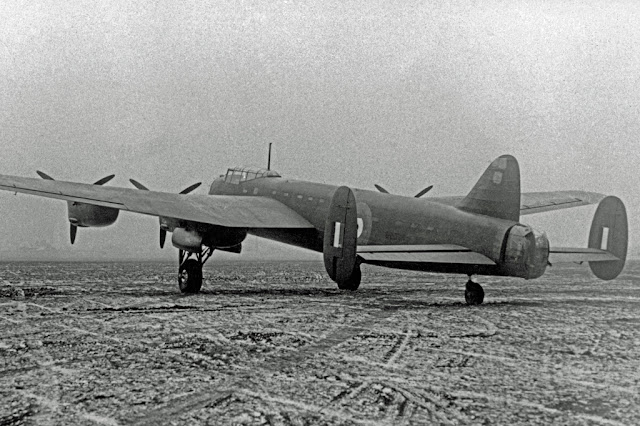
The Avro Lancaster had its first flight. The Avro Mk III Manchester, BT308 made its first flight equipped with four Rolls-Royce Merlin engines in place of the two Rolls-Royce Vultures used on earlier models. The model did retain the three fins and twin outboard rudders (the central fin had no movable control surface) of the Manchester I. The BT308 received the “Lancaster” name immediately after this flight. It has a longer range and heavier bomb-load than any other British bomber. The aircraft that flew today, however, is only a prototype, and it will be some months yet before it is ordered into production as the Lancaster Mk. I. Even so, as the Avro chief test pilot, Bill Thorne, took her into the air, the managing director Sir Roy Dobson turns to the designer, Roy Chadwick, and said: “Oh boy, oh boy … what an aeroplane! What a piece of aeroplane!” The Lancaster becomes possibly the most famous RAF bomber of all time, after bearing the brunt of the Bomber Command offensive in Europe. Basically, the re-design — aside from everything else — is a success simply due to the substitution of the Merlins for the original Vulture engines, which have proven to be a disaster in terms of power and reliability. This plane, the Lancaster, has a longer range and heavier bomb load than any other British bomber — in fact, it is the very bomber that Hitler and Goering need very badly.
The RAF orders three squadrons of Hurricane Mk. I fighters and two of Blenheim light bombers to Greece to join the two RAF fighter squadrons equipped with Gladiator Mk. I and II biplane fighters already there. The three Hurricane squadrons arrive in Greece between January and April. The two Blenheim squadrons arrive in January and March.
The Malta-based Wellingtons raid Messina. Damage is done to oil facilities, but they miss the ships in the harbor.
Today is known as the first Luftwaffe raid on Malta. There actually were scattered Stuka appearances over the island in 1940, but this is the beginning of the sustained German appearance in the Mediterranean and the first real Luftwaffe attacks on strategic targets by Fliegerkorps X. The Stukas appear just before sunset and attack the port of Marsaxlokk, without scoring any hits on shipping.
U-105, commanded by Kapitänleutnant Georg Schewe, sank British steamer Bassano (4843grt) in 57-57N, 17-42W. At 1814 hours the unescorted Bassano (Master Dunsley Harwood Casson) was hit just aft of amidships by one of two G7e torpedoes from U-105 and sank by the stern northwest of Rockall. One crew member was lost. The master, 48 crew members, two gunners and five passengers were picked up by HMS Wild Swan (D 62) (LtCdr C.E.L. Sclater, RN) and landed at Liverpool. The 4,843-ton Bassano was carrying iron, steel, and grain and was bound for Hull, England.
Naval drifter HMS Dusky Queen (40grt) was lost when she ran aground in the Dover Straits.
Minesweeper HMS Saltburn was damaged by the near miss of a German air bomb in Portsmouth dockyard. The minesweeper spent no time out of service.
Vichy French ocean liner Lamoricière (Commandant Milliaseau) gets caught in a storm about 10 km northeast of Cap Favaritx, Minorca, Spain. It has aboard 122 crew and 272 passengers. Despite sending out distress calls that bring several ships to her assistance, the Lamoricière capsizes during the night. There are 292 deaths, including the captain.
The Lamoricière was responding to a distress call herself, from 1708 ton freighter Jumièges. The Jumièges also vanishes on or around this date, taking with her 20 crewmen.
Aircraft carrier HMS Ark Royal, escorted by HMS Renown, and HMS Sheffield, and destroyers HMS Faulknor, HMS Forester, HMS Fury, HMS Fortune, and HMS Firedrake, flew five Swordfish of 821X Squadron to Malta. A Swordfish of 818 Squadron, returning from a diversionary raid on Cagliari, force landed in the sea 130 miles from the Fleet. Lt A. H. Appleton and Sub Lt R. I. W. Goddard were rescued by destroyer Foxhound. Two Italian bombers were shot down by a Fulmar of 808 Squadron. One crewman from one bomber was picked up by destroyer Foxhound; two crew of the other bomber were picked up by destroyer Forester. Force H reversed course and returned to Gibraltar after the EXCESS convoy was joined by light cruisers HMS Gloucester and HMS Southampton and destroyer HMS Ilex off Cape Bon. At that time, light cruiser HMS Bonaventure and destroyer HMS Jaguar were detached to Malta and returned to the force shortly before dusk that evening.
Submarine HMS Pandora sank Italian steamers Palma (2715grt) and Valdivagna (5400grt) in 39-15N, 9-44E off Cape Carbonara, Sardinia.
Submarine HMS Parthian (4208grt) sank Italian steamer Carlo Martinolich (4208grt) in 38-28N, 16-44E off Calabria.
Submarine HMS Rover unsuccessfully attacked a small steamer with artillery in 32-23N, 23-21E.
Greek submarine RHS Nereus unsuccessfully attacked a steamer off Brindisi.
Greek submarine RHS Triton unsuccessfully attacked an Italian submarine off Otranto.
Italian coastal steamer Giovanni Mari (636grt) was sunk on a mine twelve miles from Bardia.
Italian destroyers Ascari, Carabiniere, Folgore, and Fulmine bombarded Greek positions at Porto Palmermo, Albania.
Italian submarine Beilul fired torpedoes at two ships in a convoy in 35-25N, 26-28E. All missed.
Italian submarine Glauco reported shelling an 8,000 ton steamer in 53N, 17W. The submarine claimed two shell hits, but no confirmation is available.
British steamer Dorset Coast (646grt) was damaged on a mine in 51-24N, 3-08W. The steamer was brought into Penarth Dock.
French trawler Urania departed Saint Pierre et Miquelon for Casablanca on 28 December. The trawler was intercepted by a British ocean boarding vessel on the 9th and sent into Gibraltar arriving on the 11th.
Convoy FS.384 departed Methil, escorted by destroyer HMS Wolfhound and sloop HMS Egret. Patrol sloops HMS Guillemot and HMS Sheldrake were with the convoy on the 10th, and arrived at Southend on the 11th.
In Washington, President Roosevelt conferred with defense officials and Congressional leaders on proposed legislation to give him “blank check” authority to extend material aid to democratic countries at war with totalitarian powers. He received several callers, including Norman H. Davis of the American Red Cross.
The Senate received the Wagner bill for the creation of a postemergency economic advisory commission and the Capper bill for a constitutional amendment to limit Presidential tenure to two four-year terms, elected Senator Neely chairman of the Judiciary Committee and recessed at 12:31 PM until noon tomorrow. The Campaign Expenditures Investigating Committee heard testimony on campaign loans in New York, New Jersey and elsewhere.
The House was in recess. Its Naval Affairs Committee questioned Admiral John H. Towers on naval defense production.
Described by administration supporters as a “blank check” both as to money and power, historic legislation authorizing President Roosevelt to lend war equipment to the enemies of the axis was ready tonight for introduction in congress. Late in the day, Mr. Roosevelt met with his cabinet and congressional advisers In his circular, green-walled office, and together they gave the measure, under which Congress would approve an historic declaration of American foreign policy, a final and minute going-over. The measure will be the broadest grant of executive power by Congress since the earliest days of the New Deal. It will authorize the President to have manufactured and procure essential equipment and supplies for transfer to such other countries as he sees fit, and under such, terms and conditions as he decides will best serve the peace and security of the United States.
Carl Vinson, chairman of the powerful House Naval Affairs Committee, served notice today that congress is prepared to get tough with anybody or anything that interferes with national defense. He sounded the warning during a committee inquiry into rearmament production lags after Naval Aeronautics Chief John H. Towers testified that a strike is imminent at a plant making 1,900 military aircraft engines. Vinson warned that “at the proper time” legislation will be presented to deal with labor situations that delay production. “Congress is not going to sit quietly by and permit anything to interfere with the procurement and delivery of the defense program,” he said. Towers said the strike threatened the Ranger Engineering Corp. plant in Farmingdale, New York.
The House Naval Committee, seeking methods of speeding up the fleet expansion program, heard testimony today that the army and navy may be forced to call reservists among airline and test pilots to active duty within six months. Rear-Admiral John H. Towers, chief of naval aviation, told the committee that commercial airlines and aircraft factories were to be formally notified of the possibility and advised to start training replacements at once. Some committee members said privately the proposal was indicative of “a serious situation,” but there was no interpretation of Towers’ references to June 30 as the date such pilots might be needed. Although Towers said there were about 400 naval reservists among the 2,000-odd airline pilots.
Senator Byrd, Virginia Democrat, contended today that the administration had resorted to “juggling” of budget figures to “cover up” increases in non-defense spending and to give the impression that expenditures of this type were being reduced to offset rising armament costs. “It is a trick budget,” he said In a statement, “to the extent that effort is being made to create the impression that there is reduction in federal non-defense spending.” This impression, he asserted, resulted in part from “a juggling operation which has moved appropriations for so-called normal or non-defense expenditures into broadened budgetary defense categories.” At the same time the Virginian expressed the opinion it was “possible and probable” that direct and contingent liabilities of the government would reach or exceed $70,000,000,000. “Without retrenchment and economy in normal expenditures,” he added, “it would be possible for the United States within the next two or three years to have a total gross debt of $100,000,000,000.”
A Senate committee received a detailed account today of how R. J. Reynolds member of the wealthy tobacco family and new Democratic national treasurer, lent $275,000 to finance radio time for President Roosevelt during the campaign. Oliver A. Quayle, general manager and until recently treasurer of the Democratic National Committee, testified before the senate group investigating campaign expenditures that he made a telephone appeal to Reynolds who promptly produced the funds needed. Senator Tobey, New Hampshire Republican, immediately charged that Reynolds’ loans to Democratic state committees in New York and New Jersey were schemes to “circumvent terms of the Hatch act,” which he said limited an individual’s contribution to $5,000 and the total outlay of a national political organization to $3,000,000.
Former Senator Ernest W. Gibson, Vermont Republican who served an interim term in the senate after the death of his father, was chosen tonight to succeed William Allen White, publisher, as chairman of the Committee to Defend America by Aiding the Allies. Lewis W. Douglas, president of Mutual Life Insurance Co. and former director of the federal budget, was elected chairman of the national board. White was “unanimously” elected honorary chairman and a member of the executive committee. He accepted both positions. Gibson will spend four days a week at the job of chairman, sharing his duties with Douglas.
The War Department moved today to strengthen the Army’s Atlantic defenses by unifying the command of three separate establishments. The Departments of Puerto Rico and the Panama Canal Zone and the Trinidad base command were ordered united into the Caribbean Defense Command, under the direction of Lieutenant General Daniel Van Voorhis at Panama. Secretary Stimson told reporters that troops will sail soon for duty in Newfoundland, at one of the bases leased from Great Britain. Large extensions of forces in the Atlantic were indicated, but he declined to give details. When the Secretary of War said that if an important number of troops were assigned to any other sites they would be grouped in the Caribbean command, he was asked if this meant that the Trinidad garrison would be enlarged to a point comparable with those at Panama and in Puerto Rico.
After a six-hour strike which “blacked out” traffic lights in the busy Loop district of Chicago, cut off elevator service in public buildings and halted garbage collections in the country’s second largest city, unionized municipal employees agreed this afternoon to a compromise schedule of wage cuts for all city workers earning more than $3,000 a year.
The first demonstration of small screen, color television is given by the Columbia Broadcasting System (CBS). The TV fails miserably, since the Radio Corporation of America (RCA) has pretty much wrapped up the patent process on color TV at the time.
The Nationalist Chinese (Kuomintang) 3rd War Area begins reducing encircled communist troops of the New 4th Army near Maolin on the Yangtze River.
An immense strengthening of Generalissimo Chiang Kai-shek and his National Government with regard to the Chinese Communist Armies that are supporting him is seen here as a result of spectacular political and other alliances engineered by General Chiang in the last few months.
French military authorities reported tonight the destruction of at least forty Thai (Siamese) war planes as brisk border fighting shifted to air and artillery battles. French communiqués did not mention land activity, but earlier tonight a general French withdrawal of five to ten miles within the frontier of Cambodia Province was acknowledged. French seaplanes operating from Tonle Sap [“Great Lake”] in Cambodia aided land planes in attacking Thai airdromes, the French reported as the undeclared war gained momentum. Simultaneously, Thai planes bombed Indo-China towns, and the French said there had been twenty-two casualties at Siemreap, near the northern end of Tonle Sap.
The Dutch remain a major military presence in the Dutch East Indies. The U.S. sends Rear Admiral Purnell (“Speck” Purnell was Chief of Staff to ADM Hart, Commander of the US Asiatic Fleet) to meet Dutch military representatives in Java. This shall continue until January 18, 1941.
U.S. Navy transport William Ward Burrows (AP-6) arrives at Wake Island with first increment of workmen (80 men and 2,000 tons of equipment of Contractors Pacific Naval Air Bases) to begin building a naval air station there.
Dow Jones Industrial Average: 133.39 (+0.37)
Born:
Joan Baez, folk musician (“The Night They Drove Old Dixie Down”, “Diamonds and Rust”) and activist, on Staten Island, New York.
Gilles Vaillancourt, Canadian politician (mayor of Laval, Quebec, 1989–2012), in Laval-des-Rapides, Quebec, Canada.
Ron Goodwin, NFL split end and flanker (Philadelphia Eagles), in Phillips, Texas (d. 2013).
Naval Construction:
The Kriegsmarine (German Navy) Type VIIC U-boat U-410 is laid down by Danziger Werft AG, Danzig (werk 111).
The Royal Navy ocean boarding vessel HMS Registan (F 106) is commissioned. Her first commanding officer is A/Commander Eric Arthur Divers, RNR.
HMS Pimpernel (K 71) is commissioned. Her first commanding officer is Lieutenant Frederick Harold Thornton, RNR.
The Sjøforsvaret (Royal Norwegian Navy) Town-class destroyer HNoMS Bath (I 17), formerly the Royal Navy HMS Bath (I 17), and originally the U.S. Navy Wickes-class destroyer USS Hopewell (DD-181), is commissioned. Her first commanding officer is Kaptain Christian Fredrik Thestrup Melsom, RNoN.
The Вое́нно-морско́й флот СССР (ВМФ) (Soviet Navy) Project 7-class (Gnevny-class) destroyer Rekordny (Рекордный, “Record breaking”) is commissioned.
 History Diaries