The Soviet Union has complied with the vast majority of important arms control provisions, according to private Congressional testimony by a ranking State Department official. The same State Department official also said in private Congressional testimony that the United States would risk starting an arms race that it might lose, if it responded to purported Soviet violations with American actions that run counter to the unratified arms limitation treaty of 1979. The disclosure of the testimony was made against a background of repeated charges by some Reagan Administration officials that the Soviet Union has routinely violated arms control treaties. The State Department testimony was given early last year in a closed-door session of the Senate Armed Services Committee and was recently published by the committee in an unclassified form. The State Department views run counter to Defense Department assertions, and provide a look at the deep divisions within the Administration on the issue of Soviet compliance with arms treaties. The Defense Department has asserted that the Soviet Union has a “policy of treaty violation.” Defense Secretary Caspar W. Weinberger has recommended to the White House that the United States take a number of steps that would conflict with the unratified 1979 treaty in order to respond to a purported pattern of Soviet violations.
Defense Secretary Caspar W. Weinberger said today that without continued increases in United States military spending the Soviet Union would lose interest in an arms control agreement. In a speech that one aide described as “his keynote address” in support of the budget President Reagan will send Congress next month, Mr. Weinberger said that if Congress allowed the military budget to go into decline, American credibility would drop and the Soviet Union would back away from the negotiating table. “Moscow’s willingness to accept an agreement, I think, will be determined primarily, if not only, by its judgment about what the United States will do in the absence of an agreement,” he said. He said a steady climb in military budgets was “a very necessary condition for any effective arms reduction agreement.”
The first U.S. cruise missiles to be deployed in West Germany have arrived at an American base. German television and the West German news agency said that an unknown number of the 96 cruise missiles scheduled to be deployed in the country arrived at Hahn Air Base, 55 miles southwest of Frankfurt, for storage at a camp in the nearby village of Hasselbach. There was no official confirmation of the reports. The North Atlantic Treaty Organization nations agreed in 1979 to deploy 108 Pershing 2 missiles and 464 cruise missiles to counter Soviet SS-20 missiles aimed at Western Europe.
British Defense Secretary Michael Heseltine resigns after the ‘Westland affair’ at a Cabinet meeting. The Secretary, Michael Heseltine, long considered a likely contender for leadership of the Conservative Party, is at odds with Prime Minister Margaret Thatcher over efforts by two multinational consortiums to buy a stake in Britain’s only helicopter manufacturer, troubled Westland. Mr Heseltine stormed out of a meeting at Number 10 today saying his views on the future of the Westland helicopter company were being ignored. He said the final straw came when Mrs. Thatcher insisted all his public comments on Westland would have to be vetted by officials before being released. In a statement to reporters later this afternoon, Mr Heseltine said: “If the basis of trust between the Prime Minister and her Defence Secretary no longer exists, there is no place for me with honour in such a Cabinet.”
Westland P.L.C., Britain’s faltering helicopter maker, hardly seems to be worth fighting over. The company lost $:95.3 million, or $137 million, last year, and is short of orders to keep its plants running. After he was brought in as a turnaround specialist last year, Sir John Cuckney, Westland’s chairman, scoured Europe like an executive mendicant, looking for aerospace corporations to rescue his financially troubled company. But he found no takers.
Lech Walesa, founder of Poland’s outlawed Solidarity trade union, urged the government to reform the nation’s corrections system and release its remaining political prisoners. In an appeal sent to the Roman Catholic primate, Cardinal Josef Glemp, the 1983 Nobel Peace Prize winner said that conditions for the more than 100,000 prisoners in Polish jails must be improved as part of a general reform. “The requirement that all political prisoners are freed is the main demand of the people and a condition for any dialogue between the people and the authorities,” he said.
More than 600 balloons carrying the slogan “Keep Sunday Special” were released in London to launch a campaign against plans to let stores open freely on the Sabbath. Church leaders, trade unionists, some major retailers and politicians of Britain’s main parties joined in battle against a government proposal for the total deregulation of Sunday trading. They described it as an attack on tradition, arguing that it would bring higher prices, the closing of thousands of small shops and a fundamental change in national life. Current law forbids Sunday trading but allows numerous exceptions and has been widely flouted.
Israeli Prime Minister Shimon Peres failed to win backing from his “inner cabinet” on resolving a border dispute with Egypt, officials said. The 10-man body met for five hours to discuss new Egyptian proposals on a small strip of Sinai beach called Taba, the return of Cairo’s ambassador to Israel and improved trade and tourism relations. Peres wants to accept Egypt’s call for the border dispute to go to arbitration. Foreign Minister Yitzhak Shamir, leader of the rightist bloc, says Cairo should first return its ambassador to Israel. before the land dispute is settled.
Druze militiamen and Lebanese Army soldiers loyal to President Amin Gemayel, a Christian, fought with artillery and tanks today in the mountains overlooking Beirut. Explosions could be heard in the capital as the combatants on the Suk el-Gharb front traded shells and rockets and fired at each other from tank positions. The police said a multifactional security committee had been asked to meet on resolving the flareup.
The clash is the second major battle in the hills nine miles east of the capital since the warring factions signed an armistice accord in Damascus, Syria, on December 28. Nabih Berri, leader of the mainstream Shiite movement Amal and a leader who signed the accord, today accused Mr. Gemayel of obstructing the carrying out of the agreement. The pact, negotiated over three months with Syrian support, provides for a mechanism for ending the civil war in Lebanon within 12 months. It also calls for a new political arrangement to deprive the Christians of their traditional majority in government in favor of parity with the Muslim half of the population.
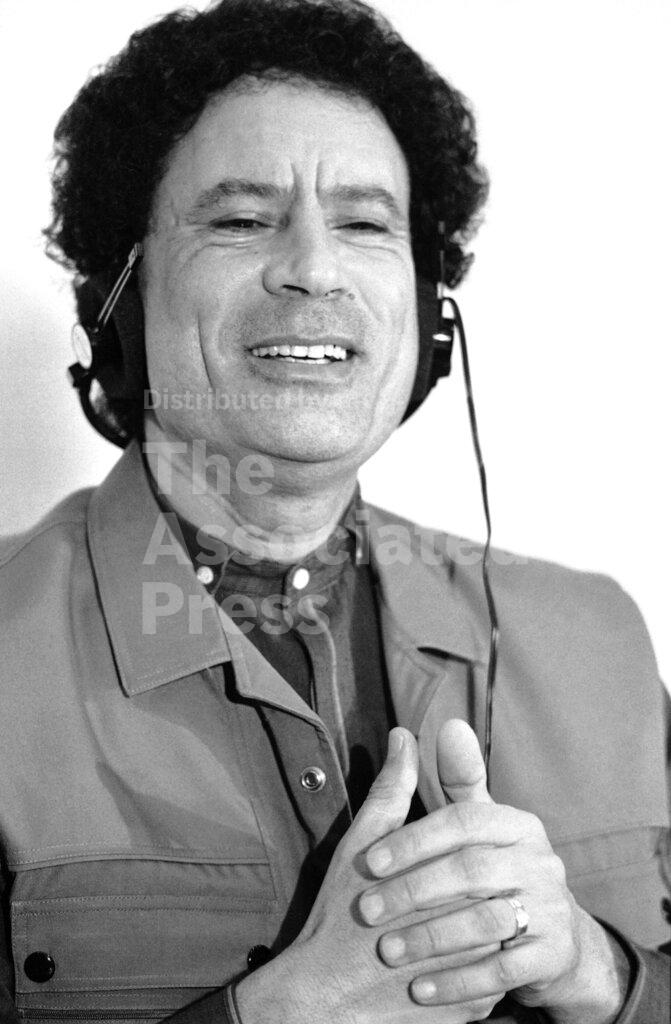
Washington stopped pressing American allies to impose economic sanctions against Libya for its purported support of international terrorism in the face of universal refusal by other countries to act against the Qaddafi Government. Secretary of State George P. Shultz acknowledged at a news conference that the Administration had not had “a lot of success” with the allies on sanctions. He said the United States had cut economic ties with Libya because it was “the right thing” to do to demonstrate American opposition to the policies of Col. Muammar el-Qaddafi, the Libyan leader. In Tripoli, Colonel Qaddafi warned today that continued American hostility toward his country would lead to “more cooperation” between Libya and the Soviet Union. A result, he said, might be the transformation of Libya into a Communist nation, a Cuba in the Arab world. The Soviet Union said the American sanctions and the movement of United States naval forces toward Libya posed a “threat to peace and security not only in the Mediterranean area but outside it as well.” But an official statement published by the press agency Tass stopped short of threatening Soviet intervention if the United States used military force against Libya.
America’s biggest banks froze hundreds of millions of dollars in Libyan Government deposits yesterday, carrying out President Reagan’s executive order. Although the President’s directive left questions, bankers said they were able to put through the basic elements of a deposit freeze because of their experience in 1979 sequestering the assets of Iran. The banks received formal notice of Mr. Reagan’s order, issued Wednesday, in a letter sent yesterday by the Federal Reserve, which is the chief contact between the nation’s banks and the Government. The Federal Reserve informs the banks about matters of national security.
Colonel Muammar el-Qaddafi warned that continued American hostility toward Libya would lead to closer Libyan ties with Moscow, possibly transforming it into a Communist nation in the Arab world. The result, he said, might be the transformation of Libya into a Communist nation, a Cuba in the Arab world. The Libyan leader also said Palestinian “freedom fighters” had hurt their cause by killing civilians in attacks like those on the Rome and Vienna airports December 27, and called upon Palestinians to limit their struggle to “military Israeli objectives.” The Libyan leader issued the warning to the United States and his counsel to Palestinians in an interview at the Babl el-Azzazir military barracks in Tripoli with five Western reporters after a news conference attended by more than 60 foreign and Libyan journalists. All five Western reporters at the interview were women.
Italy is banning arms sales to Libya, Rome announced. It also moved to prevent Italian companies from taking over business from Americans who withdraw because of the United States economic sanctions against the Qaddafi Government. The moves, announced after a meeting of the Cabinet, constituted the first concrete European policy response to Mr. Reagan’s call on Tuesday for allied action against Libya for its purported support of terrorist groups. The United States has linked Libya to the Palestinian terrorists accused of the attacks at the airports here and in Vienna December 27. Nineteen people, including five Americans, were slain and more than 110 wounded.
Chancellor Helmut Kohl invoked West Germany’s national interests and the lives of German expatriates today as he explained his Government’s refusal to follow the United States in imposing economic sanctions on Libya. “I can well understand the reaction of the Americans, but I ask them to understand that we have 1,500 Germans there,” Mr. Kohl said at a news conference, referring to his countrymen who work in the North African nation. “When I became Chancellor I took an oath swearing to defend the interests of the German people,” he said. “It is obvious that I must put German interests first, and when I do it can produce a difference of opinion” with the United States, he added.
Authorities in India’s Punjab state placed about 40,000 security personnel on alert and arrested more than 100 Sikh activists on the eve of a large-scale attempt to disrupt traffic in the state. The radical All-India Sikh Students Federation called the blockade to press for the release of Sikh youths jailed after the June, 1984, army assault on the Golden Temple of Amritsar. The once-outlawed group said that 6,000 of its members will stop all traffic entering or leaving Punjab. The Press Trust of India reported that armed guards will be posted on buses.
Corazon C. Aquino, who has expressed willingness to let Communists who renounce violence enter the Government if she becomes president, vowed today to use “every available resource of the republic” against any who continue the rebellion. A campaign news release quoted the opposition presidential candidate as saying she would fight anyone “who seeks the overthrow of the democratic Government and the dismantling of our sacred democratic institutions, our cherished values, and our fundamental belief in God.” The statement was issued by Mrs. Aquino’s Manila office while she campaigned in the northern Philippines.
Haitian troops occupied five cities after violent demonstrations against the regime of President-for-Life Jean-Claude Duvalier. Reports from the Caribbean island said arrests were carried out in the occupied cities of Gonaives, Jeremie, Petit Goave, Miragoane and Cayes and that there were clashes between police and protesters. In Miragoane, a Haitian priest, identified only as Father Goin, complained in a telephone interview of police brutality against the demonstrators. Five people have been killed since the demonstrations against the Duvalier regime began in late November.
Fulfilling their pledge to extend the war to all parts of the country, leftist guerrillas carried out a surprise sabotage attack early today on this prosperous coffee town, 45 miles west of the capital and far from the rebels’ accustomed theater of operations. As many as 100 guerrillas blew up a block of shops, sacked the local bank, wounded four town civil defensemen and demolished the machinery at the local coffee processing plant in a two-hour hit-and-run raid. It ended at 1:30 A.M. when an air force gunship flew over the town, according to local residents. The principal objective of the attack seemed to be economic sabotage, with the most important target the all-important coffee harvest now in full swing. Nationwide, the harvest provides more than half of El Salvador’s export earnings, and local officials estimated the damage here at more than $1 million. In a separate attack Wednesday night, another rebel unit reportedly destroyed a coffee processing plant in Nejapa, 10 miles north of San Salvador, the capital.
Guatemala’s President-elect said today that he would convene a meeting of Central American Presidents here next week. The meeting, which would be the first of its kind since the leftist Sandinista Front took power in Nicaragua six years ago, is scheduled for Wednesday, the day after Marco Vinicio Cerezo Arevalo is to assume the Guatemalan presidency. The Central American leaders are among foreign dignitaries expected to attend the inauguration. Mr. Cerezo and his associates have indirectly criticized United States policy in the region for what they say is its excessive reliance on force. No United States representatives are to take part in the meeting Wednesday.
Union officials joined leaders of the movement against South Africa’s policy of racial separation today to call for a consumer boycott of Shell Oil Company products. Organizers said the boycott was the opening of a new campaign to get companies to withdraw their investments from South Africa. “Shell is the first company on our list,” said Randall Robinson, co-chairman of the Free South Africa Movement. “It is not the last.” The Washington-based group has organized protests at the South African Embassy here for more than a year to press South Africa to dismantle the country’s official policy of racial separation.
The leader of the outlawed and exiled African National Congress called today for a “rapid, extensive escalation” of his organization’s war against white rule and said civilians would die in the process. At a news conference in Lusaka, the Zambian capital, Oliver Tambo seemed to give an ambiguous response when asked who was responsible for a Dec. 23 bomb explosion at Amanzimtoti, south of Durban, that killed five white civilians, some of them children. Such attacks were not part of the Congress’s strategy, he said, but it was possible that field units might disobey orders from senior commanders. The inference, some commentators here said, seemed to be that youthful radicals with access to explosives might now be growing impatient with the Congress’s stated policy of attacking only strategic military and economic targets.
The on-again, off-again mission of the space shuttle Columbia was rescheduled for blastoff tomorrow morning between 3:55 and 6:33 PST, after mechanics retrieved a broken electrical sensor from inside an important engine fuel line, but a foreboding weather forecast still threatened to ground the ship. Problems caused by the wayward sensor forced NASA officials to cancel the launching on Thursday. It was the fifth time since December 18 that the flight had been delayed.
The State of the Union Message will be different this year, according to White House officials. They said that President Reagan would deliver a substantially shortened, thematic speech on January 28 rather than the usual long list of issues. The officials said the address on January 28 would seek to set the context for what they expect to be a difficult debate in Congress over Mr. Reagan’s first budget under a new law that requires successive annual spending cuts to balance the Federal budget by the end of the decade. The tactic is one of several major planning decisions made recently by Mr. Reagan’s senior aides, returning their attention to domestic matters after a period of preoccupation with the terrorist attacks in Rome and Vienna on December 27. In other developments, aides said Mr. Reagan was nearing a decision on a new Secretary of Agriculture and had decided to try to give some relief from budget cuts to the Department of Defense and the National Aeronautics and Space Administration.
President Reagan meets with leaders of the Asian American Voters Coalition (AAVC).
President Reagan discusses American Prisoners of War and military personnel Missing-in-Action in Southeast Asia.
The I.R.S. will withhold any 1985 tax refunds due to 750,000 people who have defaulted on Federal loans totaling $1.6 billion, the Federal budget office announced. It is the first attempt by the Government to intercept tax refunds due defaulters. The program will apply to people who failed to repay $1.6 billion in loans from five agencies: the Department of Education, the Veterans Administration, the Department of Housing and Urban Development, the Agriculture Department and the Small Business Administration. Most of the defaulters are students or former students who have not repaid education loans.
Nuclear plant workers were unaware of the critical safety significance of their improper overfilling and heating of a chemical storage tank that burst last weekend, according to Richard L. Bangart, the head of the Federal group investigating the fatal accident at a Kerr-McGee plant in Gore, Oklahoma. It was the first official indication that worker training failures played a major role in the accident, which killed one man and sent about 100 people to a hospital.
Three Mile Island nuclear plant’s owners announced disciplinary action against a top manager and 16 other employees in the falsification of records at the Unit 2 reactor before its near-meltdown in 1979. Employees trying to cover up unacceptably high rates of leakage of reactor-cooling water falsified test records, the three utilities that own TMI — near Harrisburg, Pennsylvania — and its operator, GNP Nuclear Corp., said in a report. TMI’s Unit 2 was crippled on March 28, 1979, in the nation’s worst commercial nuclear power accident. The disciplinary actions ranged from written reprimands to loss of two weeks’ pay. No one was fired.
As many as 15 Miami police officers may be involved in a drug ring allegedly responsible for four killings and trafficking in $15-million worth of cocaine, officials said. Internal investigators in the city force said they are seeking information about the involvement of nine Miami officers from Metro-Dade County police investigators. Six Miami officers already face charges in connection with the ring, which prosecutors say was responsible for the drownings of three drug dealers in July and the death of a fourth trafficker in August.
Federal drug agents in New York said that they smashed a major cocaine-and-heroin ring that was supplying the New York area and seized $5.8 million — the largest amount of cash ever taken from one suspect. The agents raided the Mineola, New York, home of Philip Alexander Vasta late Wednesday and found 25 cartons stuffed with $20 bills, 16 pounds of cocaine and 14 pounds of heroin worth nearly $8 million, agents said. They arrested Vasta, 46, John Charles Sforza, 59, of Whitestone, Queens, and Edward Gerald Margiotta, 24, of Bronxville, New York.
A report said that nearly 10% of America’s river miles and 20% of its lake waters have been spoiled or are seriously threatened by runoff pollution coming mainly from farms. The national study of what is known as non-point source pollution found that agriculture was the primary source of these water-quality problems, far more than other factors, such as urban areas, mines and hydroelectric projects.
The Postal Service rescinded a January 18 postage rate increase for nonprofit groups and other preferred-rate mailers. The Postal Service board reversed itself after it discovered a miscalculation that would have resulted in a $5-million overcharge in second-class newspaper rates. The board said it will discuss rate changes February 4. The Postal Service had adopted the latest increase Tuesday, to make up for a $72-million shortfall in federal subsidies.
Military pathologists and dentists have been unable to identify the remains of 135 of the 248 soldiers from the 101st Airborne Division killed in a plane crash in Newfoundland on December 12, a spokesman said. The spokesman, Maj. Ilona Prewitt, said one reason for the difficulty in identifying the remains was that medical and dental records had been on the same plane, contrary to Army regulations, and had been destroyed in the crash. Major Prewitt also said it was possible that not all of the remains had been recovered from the crash site at Gander. She said a new team of engineers and other soldiers was sent there Tuesday to search for remains and personal effects. All the dead were members of the 101st Airborne Division on their way home from peacekeeping duty in the Middle East.
A municipal court judge ruled today that seven teachers and administrators of the McMartin Preschool must stand trial on charges of sexually abusing 14 children who attended the school. Judge Aviva K. Bobb of Los Angeles Municipal Court made her ruling from the bench after having heard pretrial testimony in the case over the last 20 months, and after listening to a plea for mercy from one of the defendants. The school, in suburban Manhattan Beach, was closed after the charges were brought in March 1984. In the crowded courtroom, Judge Bobb told each of the defendants that she had found “probable cause” that they had sexually abused some or all of the 14 children, who remain as witnesses in the highly publicized case. Probable cause is the legal standard by which a defendant can be held for trial in Superior Court in California.
The Supreme Court late today cleared the way for the execution Friday morning in South Carolina of James Terry Roach, who pleaded guilty to murdering two teen-agers when he was 17. With two dissenting votes the court refused to grant a stay to Mr. Roach, 25 years old, who was scheduled to die at 5 AM for the October 1977 slayings of Tommy Taylor, 17, and Carlotta Hartness, 14.
Faulty leadership by Dartmouth’s president “places the college in real jeopardy,” according to a faculty study, which says that “the style and pace of decision-making on the part of the president have resulted in a sense of recurrent crisis.” Dissatisfied faculty members have criticized the method or content of dozens of decisions made by the president, David T. McLaughlin.
The economic toll of AIDS will total $6.3 billion for the first 10,000 American cases, according to the first published estimate of the national impact of the disease. The costs include $1.4 billion in hospital expenses and nearly $5 billion in earnings lost because of disability and premature death.
Cases of a gonorrhea resistant to penicillin are increasing rapidly, Federal health officials said today. For the first time physicians in all 50 states have reported this strain of the disease. The National Centers for Disease Control, which has been monitoring cases in the United States for many years, said an epidemic of the resistant gonorrhea in south Florida was “without precedent in the United States” and compared it to the rates of this disease seen in Southeast Asia, where it was first reported. “The C.D.C. is embarked on a major control program in order to try to limit the spread of this disease,” said Dr. Jonathan Zenilman of the agency’s branch for sexually transmitted diseases.
After losing a patent battle with Polaroid, Kodak must give up its instant camera business. The Eastman Kodak Company was flooded yesterday with calls from owners of its suddenly obsolete instant camera seeking information about a company exchange offer. Kodak, charged by Polaroid with infringing on patents, was barred beginning yesterday by a court injunction from making any more instant cameras or film. Since film will not be available, the instant cameras already sold become useless.
Geo. A. Hormel & Company said today that it would reopen its meatpacking plant with new employees despite efforts by Minnesota Governor Rudy Perpich to resolve a five-month strike by union workers with an independent fact-finder. Charles Nyberg, vice president of Hormel, said the company would open its plant here Monday with replacement workers and would not make another offer to the 1,500 meatpackers who walked out last Aug. 17. Mr. Perpich wanted a neutral factfinder to analyze the contract offer.
Barry Bingham Sr. announces he is selling The Louisville Courier-Journal and The Louisville Times amid familial disputes. In a poignant memorandum posted on The Courier-Journal’s bulletin board, Mr. Bingham called the decision to sell an “unwelcome duty.” He also mentioned the “divergent interests” of his children, apparently in reference to a struggle over the company that has pitted Mr. Bingham’s three children against each other. The announcement prompted the resignation of Barry Bingham Jr., the newspapers’ editor and publisher, who was vice chairman and operating head of the combined companies. In a statement, Barry Jr., who had opposed the sale, described his father’s decision as “irrational and ill-advised” and added, “It is difficult not to view this action as a betrayal of the traditions and principles which I have sought to perpetuate.”
A long-awaited January thaw arrived in the Midwest, while Gulf Coast residents shivered through a winter storm that dumped heavy snow, rain and sleet over Texas, Louisiana and southern Arkansas. In the Northeast, it was 3 below in Limestone, Maine, but temperatures climbed into the 50s across the Great Plains and reached the 40s in the Midwest, where some regions were as much as 40 degrees warmer than Wednesday. The thaw was welcomed by Midwesterners, who suffered through the second coldest December on record.
Lucia Chase died at her Manhattan home at the age of 88. Miss Chase was a founder of the American Ballet Theater and helped make it one of the world’s great dance troupes in 35 years as its co-director.
The New York Islanders repeat their greatest shutout margin (9-0) vs the Pittsburgh Penguins.
Stock prices continued their descent as investors, alarmed by the market’s sudden change in direction, unloaded equities. Unlike Wednesday, when the Dow Jones industrial average plunged 39 points, selling pressure yesterday was primarily in secondary issues. But at one point, the blue-chip indicator was off 23 points. In the end, it declined only 8.38 points, to 1,518.23. Volume on the Big Board was a busy 176.5 million shares.
Dow Jones Industrial Average: 1518.23 (-8.38)
Born:
Raphael Diaz, Swiss National Team and NHL defenseman (Olympics, 2010, 2014, 2018, 2022; Montreal Canadiens, Vancouver Canucks, New York Rangers, Calgary Flames), in Baar, Switzerland.
Jonathan Compas, NFL center (Tampa Bay Buccaneers), in Orange, California.
Died:
Lucia Chase, 88, American ballerina and co-founder of American Ballet Theater.
 History Diaries