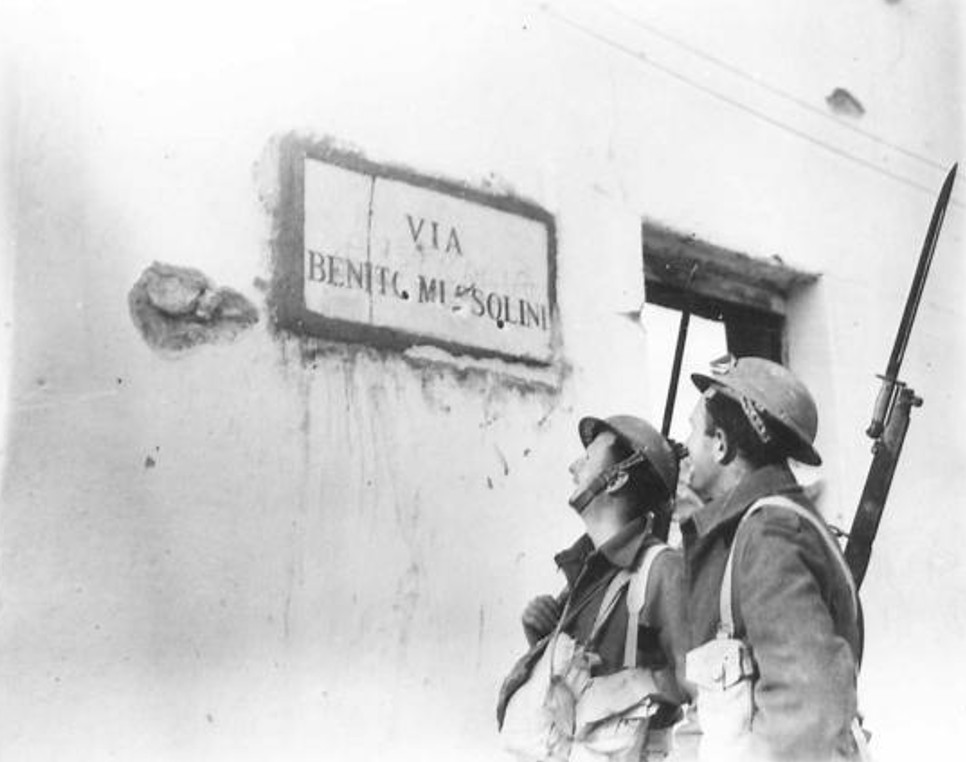
Britain’s mechanized desert cavalry, “hell on wheels,” as they call it, rolled guns into place before Tobruk and other troops took up positions today for a siege of that virtually surrounded Italian base. The stage was all set for the pounding to commence by land, sea and by air. Tobruk’s outer defenses have been felt out by armored patrols and the British declared other units have flanked it from the west.
Australian 6th Division began reconnaissance patrols around Tobruk, Libya. Overnight, a patrol reached the Italian defensive perimeter. The Australian 6th Division begins active patrols around the Tobruk perimeter, probing Italian defenses. They find a similar layout to the one at Bardia, two defensive lines with antitank ditches, barbed wire, and concrete pillboxes.
Greek Commander-in-chief Papagos on 8 January 1941 launches a major attack on the Italian Julia division defending Klisura Pass. The Greek II Corps leads the attack, with the 1st Division on the left and the 15th and 11th Divisions on the right. The Greeks make good progress in very hard fighting, putting themselves in a position to finally capture the pass.
The Klisura Pass is considered necessary for the Greeks to press on and take the critical Italian port of Valona and free troops for the defense of eastern Greece against an anticipated German invasion from Bulgaria. The Italian commander in Albania, Cavallero, immediately begins transferring troops from other sectors with which he intended to launch his own offensive.
The Greeks in Albania begin to attack Klisura in their continuing offensive but their progress farther north is not as successful, especially around Berat. Reports from the Albanian battlefront early today said Italians in the Mokra Mountains were reinforcing their lines with heavy guns, capable of firing 16 miles, and that Fascist planes were persistently dive-bombing and strafing the Greeks. At the same time a government spokesman said one area of the coastal sector north of Chimara had been entirely mopped up before the Italians had time to throw up defenses to cover retreat.
General Archibald Wavell, British Middle East Commander, replies diplomatically to Prime Minister Churchill’s insinuations of the past couple of days that his army has become a haven for slackers:
“…I can assure you that I have always had question of rearward services constantly in mind and have been as anxious as anyone to cut down on non-fighting units. Except for anti-aircraft. … But the more I see of War, especially present-day War, the more I am impressed by the part that administration plays. The Air Ministry is also becoming concerned about the build-up of German forces in Rumania and the halting of the Greek advance without capturing the port of Valona in Albania. Thus leaving the way forward for an Italian offensive in the spring perhaps with German assistance especially from the Luftwaffe.”
This dispute about the “Tooth-to-tail Ratio” will continue on both sides, though it really has not begun yet on the German side. As much as anything, such concerns are a sure sign of a military that is overstretched and unable to meet all of the threats that are popping up. Wavell, incidentally, is absolutely correct that modern wars are won not by valor in combat (alone), but by logistics and weaponry. This is a lesson that is and will be hammered home brutally to some participants during the course of the conflict.
Roosevelt observer “Wild Bill” Donovan arrives in Cairo for talks with British Middle East Commander General Wavell.
At Malta, cruisers HMS Gloucester and HMS Southampton dock just long enough to disembark their troops, then head back out to sea. These troops buttress the island’s antiaircraft defenses.
The Long Range Desert Group (LRDG) approaches the Italian administration center of Murzuk, in the southwest corner of Libya and hundreds of miles distant from other British forces. They are aided by local French and tribesmen. Their intent is to attack the Italian airfield and headquarters at Murzuk both to disrupt Italian administration and to incite violence throughout Libya.
Operation EXCESS, the latest supply operation for Malta, continues with a complicated series of ship movements. Force A departs from Suda Bay, Crete and heads toward Malta. Force B warships arrive at Malta and disembark their troops, then quickly depart for escort duties of convoys still headed toward the island. Force D is reinforced by Australian light cruiser HMAS Sydney and the destroyer HMAS Stuart. Force D then joins Force A southeast of Malta but then switches to escort Convoy ME 6. So far, Operation EXCESS is running as smoothly as previous convoys and virtually without incident.
The British meat ration, cut only yesterday to the equivalent of 32 cents worth per person per week, was sharply reduced again tonight this time to the equivalent of 23 cents worth after a virtually meatless weekend. The people were told frankly they must choose between steaks and victories.
Lord Baden-Powell, 83, founder of the Boy Scout movement and hero of the Boer War, died today at Nyeri, his home in Kenya colony. A lineal descendant of the early American settler John Smith, Lord Baden-Powell had resided in Africa since 1937, when he was forced by failing health to abandon his active life in London.
Adolf Hitler convenes a meeting of his senior military advisors at Berchtesgaden. He admits that Germany cannot invade England until it is “crippled” and the Luftwaffe “has complete air superiority.” Neither of those things has happened or appears likely to happen any time soon (though the U-boat campaign is showing great promise in the former area). Hitler places his hopes on eliminating all opposition on the Continent, relying on the clear superiority of the Wehrmacht on land. Hitler plans to shore up the Italians both in Greece and North Africa, but he does not trust them and wants no communications to them which they can pass along to the British.
This meeting is the beginning of Hitler’s acknowledgment that he has no real allies in Western Europe. He does not trust the Italians, and he knows now the Vichy French and Spanish will never help him conquer the British. Planning for Operation ATTILA, the occupation of Vichy France and seizure of the French fleet at Toulon continues.
Hitler evidently has been paying attention to events in Washington, too. President Roosevelt’s veiled threats during his recent State of the Union speech obviously did not escape his attention. He tells his leaders that war with the United States may be approaching as well. Hitler and his cronies live under the delusion that the US cannot intervene on the Continent in any time frame that might affect the current wars in progress or others being contemplated. This is because of, among other reasons, the so-far successful U-boat campaign and the huge head start that Germany has in military preparations and achievements.
While Hitler is busy with his war conference at the Berghof, Winston Churchill is holding similar meetings at Whitehall. The Defence Committee is studying the Balkan situation. Anthony Eden, having a busy day, strongly advocates sending British troops to Greece immediately in order to induce Turkey to join the Allied side and form a “Balkan bloc.” Churchill himself says that “there was no other course open to us but to make certain that we had spared no effort to help the Greeks who had shown themselves so worthy.” Thus, the matter basically is decided, although it must be ascertained whether it is possible.
The Chiefs of Staff thus cable Commander-in-Chief of the RAF’s Middle East Command Air Marshal Sir Arthur Murray Longmore and ask him if air units are available for immediate transfer to Greece. Longmore replies that he wants to keep his units supporting General Wavell’s advance, but he does not have the final say. Discussions of the Defence Committee on this key strategic question continue into the 9th.
Admiral William D. Leahy, USN (Retired) presents his credentials as Ambassador to France at Vichy. This comes one day after Roosevelt accepted former ambassador Bullitt’s resignation.
Just as Charles de Gaulle was about to give the British an ultimatum to free Emile Muselier, commander of the Free French naval forces, failing which all relations between Free France and Britain would be immediately severed, he is informed that the whole affair was a mistake. The documents that the British intelligence presented were fakes and the culprits, two men introduced into the Free French security services on British recommendation, had confessed. These men, Commandant Howard and Adjutant Colin, had a personal grudge against the vice-admiral, and had contrived to compromise him by forging Vichy documents. The British release Vice Admiral Muselier, imprisoned since New Year’s day on espionage and treason charges. The British MI5 intelligence branch concludes that Muselier has been set up with fake documents planted by two security people (Commandant Howard and Adjutant Colin) hired on their own recommendation. The reasons for the smear are murky, apparently, Muselier offended Howard in some way and he had Colin draw up the phony documents which, among other things, suggested that Muselier compromised Operation MENACE (the failed attack on Dakar). Secretary of State for Foreign Affairs Anthony Eden tenders a note of abject apology.
This decision avoids a very sharp rupture in Anglo/French relations. Charles de Gaulle views the entire affair as a plot by MI5 to discredit him personally, and had been on the brink of turning his back on the British — to the extent possible, as he essentially is a British client ruler — had the charges not been dropped.
This is a much better outcome politically than if Winston Churchill had followed his initial inclinations and had Muselier shot outright. However, de Gaulle forever after holds a grudge against the British intelligence service due to this incident. Muselier, for his part, returns to his duties in charge of Free French naval forces.
It has taken the better part of a year, but the port facilities at Narvik, Norway have been repaired. It is the key port for the shipment of Swedish iron ore to German war factories. Today, the first freighter departs for Germany carrying ore.
Rumanian warships “emphatically warned” a group of Soviet warships, estimated to number nine, to keep out of Rumanian waters, naval circles in Constanza reported today. It was understood that the Russian warships evidently crossed from Odessa and steamed to within short distance of Sulina, Rumanian port at the mouth of the Danube.
Bulgarian Premier Bogdan Philoff, just back from a visit to Vienna “for his health,” was reliably reported tonight to have called on King Boris III after a meeting with cabinet ministers at the winter resort of Cham-Kouria, 50 miles from Sofia. Officials who refused even to confirm that the cabinet meeting had taken place discounted reports heard In Belgrade that Philoff had rejected a German request for passage of troops through Bulgaria and was relying on Soviet Russia to bolster Bulgarian resistance. Presumably Philoff told other ministers and the king of his trip to Vienna, from which he returned yesterday.
The second round of war games begins. This time, General Zhukov commands the Soviet forces, and General Kulik commands the invading “Blue” forces.
Lord Baden-Powell, the inspiration for the Boy and Girl Scout movement, passes away at age 83. Baden-Powell is one of the very few prominent British people ever to have kind words for Hitler’s “Mein Kampf,” calling it “A wonderful book, with good ideas on education, health, propaganda, organization etc. — and ideals which Hitler does not practice himself.” Having spent the last few decades of his life in Africa, he passes away in Kenya.
The Luftwaffe sends a few scattered raiders across during the day but stays on the ground after dark.
RAF Bomber Command sends 5 Blenheims to Holland during daylight; all turned back.
RAF Bomber Command dispatches 48 Hampdens, Wellingtons and Whitleys overnight, 32 to Wilhelmshaven, 16 to Emden. During the night, 7 British Wellington bombers from Feltwell, Lincolnshire attacked battleship Tirpitz at Wilhelmshaven, which suffered light damage from near misses. Crews reported bombs straddling the Tirpitz and many fires. Wilhelmshaven reports heavy damage in various parts of the town with 12 people killed and adds the comment that this was the first large raid for the local air-raid services. 9 Hampdens minelaying in the Elbe. No losses from any operation.
British Wellington bombers from Malta attacked Italian battleships Guilio Cesare and Vittorio Veneto moored in Naples, Italy. Guilio Cesare was badly damaged by 3 near misses but Vittorio Veneto was hit without serious damage. Both ships would be moved to La Spezia, Italy and repaired, out of the range of the Malta bombers.
The Royal Air Force bombed Naples. The RAF air command on Malta launches a night raid against Naples. The Italians have dispersed their fleet to Naples and other points, but the RAF is tracking them down. Battleship Giulio Cesare is damaged slightly by three near misses and must be moved to La Spezia for repairs. It is not as significant a blow as it might be, because the Italians are not using their capital ships anyway — though they have plenty of fuel to do so if they wished.
Another benefit of the mission for the British is that it induces the Italians to move their battleship Vittorio Veneto to La Spezia as well, to get it out of harm’s way — a rather incongruous way to handle what should be your mightiest offensive weapon. The Italian naval command at this point appears obsessed with keeping a “fleet in being,” a strategy that in a calculated fashion uses the threat of warships to draw enemy airpower away from on-shore targets. There are pros and cons to this strategy, which certainly appears to fit with the overall Italian mindset during the conflict, but essentially removes these warships from active operations where they might actually be of strategic use (such as off North Africa or Albania).
The flag of CS 18 was transferred from light cruiser HMS Manchester to light cruiser HMS Edinburgh. Light cruiser Manchester departed Scapa Flow at 0128 on the 11th for refitting and stiffening in the Tyne.
Light cruiser HMS Arethusa arrived at Scapa Flow after guard ship duties at Oban.
Destroyers HMS Jackal and HMS Broadway arrived at Scapa Flow at 1100 from Plymouth to carry out exercises and working up.
Anti-aircraft ship HMS Curacoa departed Scapa Flow at 1300 to escort convoy WN.65 from the Pentland Firth until moonset. The cruiser arrived back at Scapa Flow at 1000/9th.
Minelaying cruiser HMS Adventure laid mines in minefield ZME.12 in St Georges Channel.
Minelayer HMS Teviotbank, escorted by destroyer HMS Intrepid, laid minefield BS.48 off the East Coast of England.
Trinity House Tender Strathearn (683grt) was sunk on a mine in 51-45N, 1-10E. Fifteen crewmen and passengers were lost.
British steamer Clytoneus (6278grt) was sunk by German bombing in 56-23N, 15-28W. The entire crew was rescued by armed merchant cruiser HMS Esperance Bay and destroyer HMS Wild Swan.
Naples was bombed by British Malta based bombers. Italian battleship Cesare was damaged by three near misses, but later repaired at La Spezia. Battleship Veneto, escorted by the 19th Destroyer Division, was sent to La Spezia to take her out of the reach of Malta bombers.
Force A refueled destroyers at Suda Bay, arriving at 1230. The Force departed at 1400.
Force B, the British HMS Gloucester force, arrived at Malta during the morning and disembarked their troops. Destroyer HMS Janus remained at Malta for docking. Force B then departed to join the EXCESS convoy.
Australian light cruiser HMAS Sydney, having completed her refit, departed Valletta, escorted by Australian destroyer HMAS Stuart. These ships rendezvoused with Force D. They all then joined Force A at 1030/9th southeast of Malta. Light cruiser Sydney and destroyer Stuart were detached from Force A at 1240 for Alexandria. Force D was detached from Force A at 1330 to cover the convoys and provide anti-aircraft support for convoy ME.6 on the 10th.
Convoy OB.271 departed Liverpool, escorted by destroyers HMS Vanquisher, HMS Viscount, HMS Whitehall, and HMS Winchelsea and corvettes HMS Gentian and HMS Rhododendron. The escort was detached when the convoy dispersed on the 12th.
Convoy FN.378 departed Southend, and arrived at Methil on the 10th.
Convoy FN.379 did not sail.
Convoy AS.10 of seven British and three other ships, escorted by five Greek destroyers, departed Piraeus, and arrived at Suda Bay on the 8th and at Port Said on the 10th.
Convoy HG.50 departed Gibraltar escorted by corvettes HMS Geranium and HMS Jonquil until 12 January. On the 12th, the corvettes were relieved by sloop HMS Scarborough. French corvette La Malouine joined the convoy on the 20th. On the 21st, destroyers HMS Hesperus, HMS Jackal, HMS Malcolm, HMS Shikari, HMS Skate, and HMCS Skeena, corvette HMS Arabis, and anti-submarine trawler HMS Wellard joined the convoy. Corvette Arabis was detached on the 23rd and destroyer Skate on the 24th, and arrived at Liverpool on the 26th.
Today in Washington, President Roosevelt sent to Congress the annual budget message and conferred with officials and other callers.
The Senate received proposed constitutional amendments to prohibit child labor and to limit the tenure of office of a President; received the Tydings resolution calling for an automatically balanced budget; the Vandenberg bill to replace the Tariff Commission with an Economic Defense Board; numerous other bills and resolutions, and adjourned at 1:06 PM until noon tomorrow. The Campaign Expenditures Committee heard testimony regarding a loan of $100,000 by R. J. Reynolds to the New Jersey State Democratic Committee.
The House received the Rankin bill to increase House membership to 450, heard Republicans criticize Mrs. Roosevelt for her comments on their failure to applaud the President’s message on the state of the Union, and adjourned at 1:44 PM until noon on Friday.
U.S. President Franklin Roosevelt requested the U.S. Congress to pass a defense budget in the size of US$10,811,000,000 for fiscal year of 1942. Following President Roosevelt’s militaristic State of the Union address, his administration releases a proposed budget of $17.5 billion for the Fiscal Year 1942 (beginning 1 July 1941). This budget includes a massive $10.8 billion war (defense) budget (it is still called the War Department, not the Department of Defense, at this point). With military expenditures exceeding 50% of all government spending, this is a record peacetime commitment, the highest in U.S. history.
Congress reacted in various ways today to President Roosevelt’s $17,485.000,000 budget measure, most members expressing themselves in general terms, pending a closer study of the document. One paragraph of the message particularly, that dealing with borrowing, in which Mr. Roosevelt questioned the “significance of a statutory debt limit (now at $49,000,000,000) except as it serves as a fiscal monitor,” was reserved by many members for future comment after they have studied the matter more carefully. Senator Byrd of Virginia, a leading Senate economy advocate, immediately attacked the proposal for “throwing out” the statutory debt limit. He said, in part: “The suggestion made by the President in his budget message today to abolish completely the statutory debt limitation fixed by Congress is dangerous and will be an additional incentive to extravagance. What we need today is to curtail drastically non-defense spending and raise more money from current taxation rather than lay an emphasis on increasing the public debt.”
Definite progress on the formula and set-up for financing American aid to Britain, Greece, China and other possible non-Axis Allies was reported today after a series of conferences in which Secretaries Hull and Morgenthau and Congressional leaders took part. Two separate meetings were held between the Administration spokesmen and the legislators, the first. attended by Speaker Rayburn and Representative McCormack, majority leader, and the other by Senator Barkley, majority chief of the Senate, and Senator Harrison, chairman of the Finance Committee. All refused to discuss the meaning of the conferences other than to confirm that they dealt with President Roosevelt’s Lend-Lease proposal for advancing war materials to the Allies.
Due to lingering disagreements about whether the U.S. Pacific fleet should be based at Hawaii (among other things), President Roosevelt decides to replace Admiral James Richardson as Commander in Chief Pacific Fleet (CinCPac) and CinCUS (should the Pacific and Atlantic fleets ever merge). Admiral Husband E. Kimmel will replace him effective 1 February 1941. In addition, Admiral Ernest J. King, an advocate of a strong U.S. naval presence in the Pacific, will become Commander in Chief, Atlantic Fleet (CinCLant). Richardson will hold no further active commands.
The U.S. Navy reorganized its fighting forces today into three United States fleets and raised the limit of its enlisted personnel to provide crews at full wartime strength for ships under construction. Secretary Knox announced the changes, which were authorized by President Roosevelt. At the same time the navy secretary told his press conference he did not believe the United States could spare more destroyers for Great Britain without “impairing” our fleet. Under the reorganization, the naval force will consist of an Atlantic fleet, a Pacific fleet and an Asiatic fleet. Each will operate under a commander-in-chief. Rear Admiral Husband E. Kimmel, who will head the Pacific fleet, also will be commander-in-chief of the combined forces. He will have the rank of admiral and will succeed Admiral James O. Richardson, who has held the post for little over a year. Richardson was ordered to report to Knox for duty, but the secretary did not disclose what his new assignment would be. The authorized enlisted strength of the navy was raised to 232,000 men including both regulars and reserves on active duty. The present personnel numbers about 191,000 compared with 145,000 enlisted men in the navy last July. The increase in the limit was effected under Mr. Roosevelt’s powers to change the navy’s authorized strength in an emergency.
A tiny Nazi flag was burned today in a Los Angeles courtroom cuspidor by Municipal Judge Ida Mae Adams “as a protest against subversive activities.” The flag, 4 by 6 inches in size, had been introduced in evidence at the preliminary hearing of Pedro V. Rodriguez, 39, a seaman, on charges of assault with a deadly weapon on Mrs. Eva J. Sandstrom, who allegedly displayed the flag on her mantel. Rodriguez was charged with assaulting Mrs. Sandstrom with a pocket knife because she allegedly refused to remove the flag from her home. Judge Adams ordered Rodriguez held for trial and following the hearing she placed the flag in the cuspidor and applied a match to it, commenting that she did not burn’ the flag as “an overt act against Germany,” but as a protest against subversive activities. “This is not the true German flag,” the judge said as she watched it burn, “but an outlawed flag. There are many German-American citizens here and they should not be insulted by having the Nazi flag flown In the country of their adoption.” Both Mrs. Sandstrom and Rodriguez are naturalized citizens. She is a native of Germany and he of Portugal.
Twelve hundred students and officials of Kansas University tonight were submitting to a new influenza epidemic vaccine that may contain a long-sought medical answer. The vaccine was developed by the Rockefeller institute of New York and is not released for general use.
American mogul William Randolph Hearst, owner of the Hearst newspaper chain, forbids any of his newspapers from accepting ads for Orson Welles’ motion picture “Citizen Kane,” slated for release later in the year. The film was generally interpreted as a psychological study of Hearst, portrayed as the fictional Charles Foster Kane. In March 1941, Welles threatens to sue Hearst for trying to suppress the film, and RKO movie studio if it fails to release it. The film premieres 1 May 1941, at the RKO Palace in New York. The members of the American Film Institute have voted this film as Number 1 on the list of the 100 Greatest American Films Ever Made.
Welles’ “Citizen Kane” is nearing completion. Newspaper critics have received an advance rough-cut screening (minus the score), and gossip columnist Hedda Hopper (uninvited) watches and later writes that the film is a “vicious and irresponsible attack on a great man” — the great man being William Randolph Hearst. Hearst hears about this and remonstrates with his own gossip columnist, Louella Parsons, about why she hasn’t told him that the film was calculated to attack him.
Parsons, on or about this date, then angrily demands a private screening of the film herself (apparently she did not crash the critics’ screening like Hedda). She threatens a lawsuit (on Hearst’s behalf” and hints darkly about other means of professional retaliation. Nobody messes with William Randolph Hearst, not only because of his money, power, and influence as the boss of a national chain of newspapers but also because of the dead guy once found on his private yacht. RKO Pictures studio head George J. Schaefer accedes to Parsons’ demands and schedules a private screening for her (and Hearst’s lawyers) on 10 January.
The BBWAA in The Sporting News poll names the 1940 All Star team: Hank Greenberg, LF; Joe DiMaggio, CF; Ted Williams, RF; Frank McCormick, 1B; Joe Gordon, 2B; Luke Appling, SS; Stan Hack, 3B; Harry Danning, C. The pitchers are Bob Feller, Bucky Walters, and Paul Derringer.
Accepting the recommendation of its subcommittee, the Canadian war council excludes Japanese-Canadians from military service.
Royal Thai Air Force aircraft attacked French positions at Siem Reap and Battambang in Cambodia, French Indochina.
Martial law was proclaimed today in the twenty-four Thai [Siamese] provinces bordering French Indo-China.
Although the regular Parliamentary session will reopen on January 21, the Japanese Government has decided to discuss the national situation in advance of that date with an informal body selected by itself. Some members of both houses will be included in the group, together with business and financial leaders, prominent newspaper men and others.
Army Minister Tojo Hideki issues a military decree, “Instructions For the Battlefield,” which essentially commands Japanese soldiers to fight to the death rather than be captured.
The Imperial Japanese Navy aircraft carrier HIJMS Zuikaku departed Hiroshima, Japan for Truk, Caroline Islands.
Contract workers arrive on Wake Island onboard the USS William Ward Burrows. They are to construct a naval air station (NAS) there.
Dow Jones Industrial Average: 133.02 (+0)
Born:
Graham Chapman, comedian, writer, actor, and member of the Monty Python comedy troupe, in Leicester, England, United Kingdom (d. 1989).
Little Anthony [Gourdine], American rhythm and blues singer (Little Anthony and the Imperials — “Goin’ Out of My Head”), in Brooklyn, New York, New York.
Boris Vallejo, Peruvian illustrator, in Lima, Peru.
Died:
Robert Baden-Powell, 1st Baron Baden-Powell, 83, British Army officer and founder of the Scout Movement.
Naval Construction:
The Kriegsmarine (German Navy) Type VIIC U-boat U-559 is launched by Blohm & Voss, Hamburg (werk 535).
The Royal Navy MMS I class motor minesweeper HMS MMS 8 (J 508) is commissioned. Her first commanding officer is Lieutenant F. L. Perkins, RNVR.
The Royal Australian Navy “N”-class destroyer HMAS Nizam (G 38) is commissioned. Her first commanding officer is Lieutenant Commander Max Joshua Clark, RAN.
 History Diaries