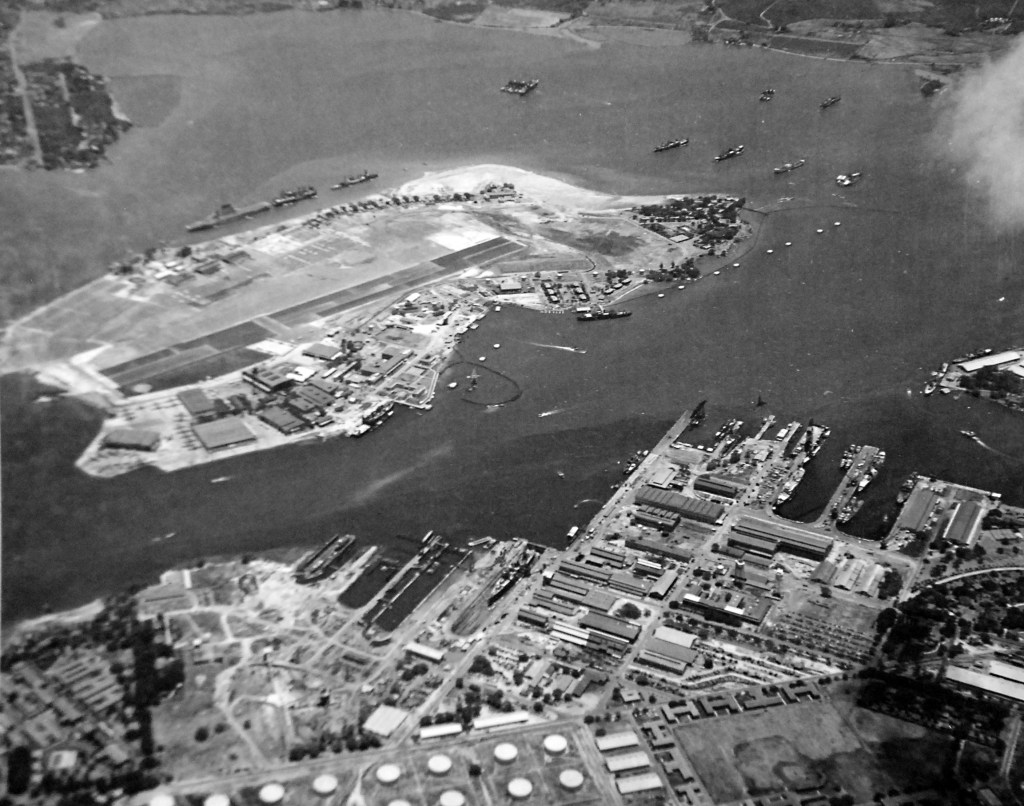
Japanese Admiral Isoroku Yamamoto presented Minister of the Navy Koshirō Oikawa with his ideas for a war against the United States in a memorandum titled Gumbi ni kansuru shiken (Views on Preparations for War). Yamamoto proposed a crippling first strike on American forces in the first few hours of the war, something that could best be accomplished by an air attack on the U.S. fleet at Pearl Harbor.
In one of those eerie coincidences, just as the U.S. Navy is raising concerns about security at Pearl Harbor, the Japanese Navy is beginning to plan a strike against that very target. Admiral Isoroku Yamamoto submits an assessment, Gumbi ni kansuru shiken (Views on Preparations for War). It proposes that the best strategy against the United States would be to destroy the U.S. fleet at Pearl Harbor in the opening raid of a future war. However, at no point does he suggest invading or conquering the United States.
Yamamoto’s plan is not widely approved of within the Japanese high command. The conventional Japanese strategy in any event of war with the United States has been to patiently wait for the United States to advance across the Pacific, and gradually whittle away its striking power using submarines, surface vessels, and airplanes. This is virtually a mirror image of the U.S. strategy proposed by the U.S. Navy, which envisages a purely defensive war in the Pacific while the main effort focuses on Europe. The Yamamoto plan envisages scoring a dramatic victory in the war’s opening hours and then trying to secure a peace deal to consolidate gains in Japan’s real areas of interest: the Dutch East Indies, British bases in Hong Kong and Singapore, and the Philippines, among others.
There is a potential problem with Yamamoto’s plan: it relies upon U.S. willingness to make a deal quickly. However, this may not be possible in the event of a surprise attack that arouses U.S. war passions. Thus, a formal declaration of war and then an attack is the preferred way to go in order to leave open this avenue of resolution.
Britain’s official comment on President Roosevelt’s “help-our-friends”. speech strikes a ringing note of confidence that the critical corner of the war has already been turned. “Fresh encouragement” has come from the United States, the London statement said, “at a time when there is good cause to believe that the tide of war is turning.” Behind this lies the conclusion of British war leadership that Italy has already been knocked out of the war in effect; and that disaster awaits Germany if she strikes to retrieve the situation, either against England or in the Balkans. In contrast with that British attitude, an Italian cabinet utterance “solemnly reaffirming” Fascist fidelity to the Berlin-Rome axis and the will to fight to a finish is possibly significant. It was timed to offset Rome’s admission of the fall of Bardia, yet it was clearly aimed at defeatism in Italy of unknown strength. The Rome version of the Fascist disaster at Bardia hardly squares with known facts as reported by neutral eye-witnesses on the spot. These eye-witnesses concur in British reports that the Italians surrendered on a scale that embarrassed the victors. Nothing was said officially here about the total number of Italian troops now put out of action, but official quarters in London estimated that 94,000 had been rendered “ineffective” 70,000 prisoners plus the dead, wounded and missing. In announcing that the Tobruk airport at El Adem, some 15 miles to the south of Tobruk itself had been abandoned and fell without a struggle, the British thus indirectly laid claim to an effective command of the air at least along the entire 70 miles of coastal area from Bardia. The approaches to Tobruk’s harbor were declared cut off by British warships; the coastal road in both directions toward Bardia and westward 700 miles toward Tripoli lay under the shadow of British fleet guns. Thus, while the main forces of the British imperial army were gathered for the grand assault, British informants suggested that the estimated 50,000 Italians defending Tobruk must elect to stand, or give in, without effective reinforcements. The Fascists, driven from Egypt, with heavy losses at Sidi Barrani, at Bardia and elsewhere, were said also to have lost no less than half of the presumably irreplaceable guns, supplies, munitions and motor transport which they bad brought up at the start of their disastrous invasion of Egypt.
Advance forces of the British army were declared officially 70 miles west of fallen Bardia to occupy the military airport serving Tobruk, the main Italian base in Libya, and seized 40 Fascist planes grounded there by R.A.F. action. The Australian 19th Brigade reaches the perimeter defenses on the eastern side of Tobruk. The Australian 6th Division and British 4th Armoured Division nearly surrounded Tobruk, Libya after capturing Acroma 10 miles to the west. Australian 6th Division, under the leadership of Major General Iven Mackay, has largely completed mopping up at Bardia. Its units now have moved on to Tobruk and captured Acroma, 10 miles to the west of the fortress. This point overlooks the coast road and puts the Australians in commanding position to interdict any Italian relief efforts (though none seem forthcoming). The British troops are outrunning their supplies and thus need to pause their operations for a spell, but Italian resistance is not one of their problems.
British Prime Minister Winston Churchill sends another cable to Middle East Commander Archibald Wavell regarding what Churchill sees as wastefulness in the Middle East army. Churchill expands upon his earlier hints that the Middle East Command is becoming a haven for slackers, deriding the low “tooth-to-tail” ratio of fighting men to supply troops.:
“You have well over 350,000 troops on your ration strength and the number of units which are fighting or capable of fighting appears to me disproportionately small.”
In other words, Churchill is implying that the majority of soldiers under Wavell’s command are unproductive shirkers. Churchill also comments:
“Rations of heavy munitions workers are being cut down to levels of which British armies except in actual operations have never dreamed. Severe stringency in human rations and the slaughter of cattle through lack of feedstuffs lie before us. The voyage round the Cape imposes an almost prohibitive burden.”
This, too, is cutting, implying that the soldiers under Wavell’s command are living “high on the hog” whilst the workers back home are starving.
The enmity between Churchill and Wavell is well-known and enduring. Churchill is displaying a typical churlish reaction to victories by someone you inherently dislike: if you can’t attack the results (which have been fabulous victories by Wavell), you attack the means or wastefulness by which those results were achieved (Hitler proves good at this, too).
Wavell adopts a philosophical posture in response to these peevish comments, implying that Churchill’s understanding of warfare is simply out of date:
“Winston’s tactical ideas had to some extent crystallized in the South African war [of 1898-1900].”
This is another instance of catty infighting within the British high command, exemplified by the recent ousting of Air Marshal Dowding and Air Vice-Marshal Keith Park, victors of the Battle of Britain, from their commands in late 1940.
AOC-in-C, Middle East, Arthur Longmore, Air Officer Commanding In Chief, RAF Middle East, receives a signal from Churchill. “Greatly admire your brilliant support of Army operations. We shall soon be as usual torn between conflicting needs. Probably four or five squadrons will be required for Greece and yet you will have to carry the Army forward in Libya.”
British Prime Minister Winston Churchill told his Chiefs of Staff, via General Hastings “Pug” Ismay, that the “speedy destruction of the Italian Armed Forces in North East Africa must be our prime overseas objective in the opening months of 1941.”
The British Long Range Desert Group (LRDG), having resupplied with gasoline carried by the French over the Tibesti mountains by camel, leaves its encampment near Tazerbo in western Libya. It proceeds toward its target, Murzuk, a major Italian administration center.
Operation EXCESS is proceeding. A typical 1940-41 supply convoy to Malta, it includes numerous diversions and large Royal Navy forces at heading in all sorts of different directions. Force H from Gibraltar, led by battleship HMS Malaya and aircraft carrier HMS Essex, heads out in Operation MC 4 to protect four freighters carrying troops and supplies. Other large formations, Forces A, C, and D, depart from Alexandria to cover supply ships heading from that direction (Operation MW 5 1/2). Force D includes tanker Brambleleaf, which the Royal Navy ships take to Suda Bay, Crete.
British Prime Minister Winston Churchill sent a survey to Chiefs of Staff Committee to examine the likely developments in Libya, East Africa, Spain, North Africa, and the Balkans: “The attitude of Yugoslavia may well be determined by the support we give to Greece … But the defence of Britain came first: the task of preventing Invasion, of feeding the Island, and of speeding our armament production must in no way be compromised for the sake of any other objective whatsoever.”
The Greek forces at the Klisura Pass on 7 January 1941 prepare to launch a major attack against the Italian troops defending the pass. This is the gateway to the key Italian supply port of Valona, and Greek Commander-in-chief Papagos is intent on taking the port quickly so that he can shift troops to the east to defend against an anticipated German attack by way of Bulgaria.
Himmler writes to Seyss-Inquart, inviting him to Wewelsburg castle to discuss “Many important and ultimate matters.”
Marshal Mannerheim writes Reichsmarschall Hermann Göring a letter. He requests that Germany release artillery pieces that Finland had purchased, but that had been captured aboard ships in Norwegian harbors during Operation Weserübung. This is one of an increasing number of amicable contacts between the two nations in early 1941.
Russia’s powerful Black sea fleet tonight was reported massing off the principal Bulgarian port of Varna. Usually reliable quarters in Vichy said that Soviet war vessels have taken up a menacing position on the Black sea coast less than 100 miles from the Bulgarian-Turkish frontier.
Increasing tension in the Balkans, a Russian Black sea battleship sailed up one of the mouths of the Danube river and anchored near Sulina, Rumania, Tuesday, the Daily Express reported today in a dispatch datelined Bucharest. Russia, the express added, is expected to take over the port of Sulina in the event of new German moves in the Balkans. Sulina is on a central mouth of the Danube in Rumanian Dobruja between Bessarabia and southern Dobruja, the areas annexed last year by Russia and Bulgaria respectively.
The Somali Camel Corps in Kenya is dissolved, reorganized and equipped with tanks from South Africa.
The Luftwaffe makes a very unexpected move and launches a heavy daylight raid on London. This is the first major daylight raid in months. The bombers are over the city for almost four hours, damaging parts of fifteen different districts. Other bombers attack scattered points up and down the coast, with a lone raider targeting Coventry as well.
Hitler places Luftwaffe I. Gruppe, Kampfgeschwader 40 (I./KG 40) with its FW-200 Kondor’s based at Merignac Airfield, Bordeaux, directly under the command of Doenitz.
RAF Bomber Command dispatches 1 Blenheim to Bremen during daylight which turned back.
Bomber Command gives priority to targets related to the German oil industry. But the effectiveness of the attacks is highly overestimated.
Light cruiser HMS Mauritius arrived at Scapa Flow to work up and join the 10th Cruiser Squadron.
Light cruisers HMS Manchester and HMS Edinburgh arrived at Scapa Flow at 1540 from patrol.
Destroyer HMS Kelly departed Scapa Flow at 1900 and proceeded to Greenock, arriving the next day. The destroyer’s working up was completed and she joined destroyers HMS Kipling, HMS Kashmir, and HMS Jersey of the Flotilla. On the 18th, the four destroyers arrived at Plymouth for duty in the Western Approaches.
Destroyer HMS Meynell departed Scapa Flow at 1400 to proceed to Aberdeen and escort steamer Ben My Chree to Lerwick and back to Aberdeen. The ships arrived at Lerwick at 0930/8th. Destroyer Meynell arrived back at Scapa Flow at 1530/9th.
Motor torpedo boats MTB.32 and MTB.34 laid minefield PW.1 in Zuydcote Pass. German torpedo boats Kondor and Wolf laid minefield RENATE off Dover on the 7th. Returning, torpedo boat Wolf was mined and sunk north of Dunkirk in British minefield PW.1 on the 7th. RN Motor torpedo boats laid seven more PW minefields in January.
Italian submarine Nani was sunk by Corvette HMS Anemone, en route to join convoy HX.99, south of Iceland in 60-15N, 15-27W. Free French corvette La Malouine assisted in the attack.
British steamer H. H. Petersen (975grt) was sunk on a mine in 52-22N, 2-05E. The crew was rescued.
Force H sortied from Gibraltar on the 7th to cover the EXCESS convoy. Units participating were battlecruiser HMS Renown, battleship HMS Malaya, aircraft carrier HMS Ark Royal, light cruiser HMS Sheffield, and destroyers HMS Faulknor, HMS Forester, HMS Fortune, HMS Firedrake, HMS Foxhound, HMS Fury, and HMS Duncan. Operation MC.4, the EXCESS convoy, which arrived in convoy WS.5 A, had departed Gibraltar on the 6th. The convoy consisted of British steamers Essex (11,063grt), en route to Malta, Clan Cumming (7264grt), Clan MacDonald (9653grt), and Empire Song (9228grt), en route to Piraeus. Another merchant ship, Northern Prince (10,917grt) was to have participated, but she ran aground at Gibraltar. The four hundred troops on Northern Prince were embarked in anti-aircraft cruiser HMS Bonaventure. The EXCESS convoy was escorted by anti-aircraft cruiser Bonaventure and destroyers HMS Hereward, HMS Jaguar, HMS Hasty, and HMS Hero. Battleship Malaya was with the EXCESS convoy until Force H returned to Gibraltar twenty five miles north of Bizerte.
The British Fleet with battleships HMS Warspite and HMS Valiant, aircraft carrier HMS Illustrious, and destroyers HMS Jervis, HMS Nubian, HMS Mohawk, HMS Dainty, HMS Greyhound, HMS Gallant, and HMS Griffin of Force A departed Alexandria on the 7th to cover the EXCESS convoy. Heavy cruiser HMS York and light cruiser HMS Orion of Force D departed Alexandria at 0300 to cover the passage of Force C through the Kaso Strait. Force C was oiler RFA Brambleleaf and corvettes HMS Salvia, HMS Hyacinth, HMS Gloxinia, and HMS Peony. Force C refueled the corvettes at Suda Bay on the 8th and proceeded independently to Malta. Light cruisers HMS Ajax and HMAS Perth departed Piraeus to rendezvous light cruiser Orion and heavy cruiser York at Suda Bay at 0800/8th. Later on the 8th, light cruisers Orion, Ajax, and Perth departed Suda Bay to cover Force C and for the EXCESS operation. Light cruiser Ajax was detached to return to Alexandria.
Submarines HMS Triumph and HMS Upholder were at sea south of Sardinia.
Submarine HMS Pandora was at sea to the east of the other two submarines.
Submarine HMS Usk departed Gibraltar on the 7th and arrived at Malta on the 17th.
Submarine HMS Rover attacked a convoy in 32-15N, 23-36E. Italian steamer Edda (6106grt) was not damaged. Torpedo boats Clio and Castore counter-attacked and damaged the submarine. The damage required thirteen days to repair at Malta.
During the night of 7/8 January, Italian destroyers Vivaldi, Malocello, Da Noli, and Tarigo and torpedo boats Sagittario and Vega laid minefields X 2 (180 mines) and X 3 (180 mines) north of Cape Bon.
Convoy FS.381 departed Methil, escorted by destroyers HMS Garth and HMS Versatile, and arrived at Southend on the 9th.
Convoy FS.382 departed Methil, destroyer HMS Vimiera and sloop HMS Weston, and arrived at Southend on the 9th.
Convoy FS.383 departed Methil, escorted by destroyer HMS Verdun and sloop HMS Londonderry, and arrived at Southend on the 10th.
Convoy OG.49 departed Liverpool escorted by destroyer HMS Anthony and sloop HMS Rochester. The convoy was joined the next day by destroyers HMS Antelope and HMS Georgetown, armed boarding vessels HMS Crispin and HMS Manistee, seaplane tender HMS Pegasus, and corvettes HMS Heather and HMS Picotee. On the 11th, destroyers Antelope, Anthony, Georgetown, seaplane tender Pegasus, corvettes Heather and Picotee were detached. On the 14th, the ocean boarding vessels were detached. Convoy OG.49 arrived at Gibraltar on the 21st, escorted by sloop Rochester.
Convoy MW.5 ½ departed Alexandria at 1400 with transport Breconshire and steamer Clan Macaulay for Malta, anti-aircraft cruiser HMS Calcutta, and destroyers HMS Defender and HMS Diamond.
Following up on statements made during his State of the Union address the previous day, U.S. President Franklin D. Roosevelt issued Executive Order 8629 on the Office of Production Management and the Office for Emergency Management. The order established the Office of Production Management within the Office for Emergency Management in order to “Formulate and execute in the public interest all measures needful and appropriate in order to (1) increase, accelerate, and regulate the production and supply of materials, articles and equipment and the provision of emergency plant facilities and services required for the national defense, and (2) to insure effective coordination of those activities of the several departments, corporations, and other agencies of the Government which are directly concerned therewith.” The Council for this new organization is comprised of industrialist William S. Knudsen, labor leader Sidney Hillman, U.S. Secretary of the Navy William “Frank” Knox, and U.S. Secretary of War Henry L. Stimson.
Former ambassador William C. Bullitt has submitted his resignation as ambassador to France — he already has been replaced by Admiral William D. Leahy, who today already is in Vichy — and President Roosevelt today accepts it “with great reluctance.” By coincidence (perhaps), Bullitt also gives a stirring speech at the University of North Carolina, Chapel Hill today. He states in pertinent part:
“At this time of danger, each American must ask himself each day not what he can get from his country but what he can give to his country, and must ask himself each night: ‘Have I given enough?’ “
Anyone with an ear for history will recognize that this quotation is quite similar to another quote from a certain 1961 JFK inauguration speech.
The present shortage of aircraft engines will exist for at least another eighteen months, Rear Admiral John H. Towers, chief of the Bureau of Aeronautics of the Navy Department, told the House Naval Affairs Committee today.
Mrs. Franklin D. Roosevelt said today that the failure of the Republicans in Congress to applaud the President’s message yesterday shocked her because it seemed to her to reflect a partisan reaction to the enunciation of principles deserving of applause by all.
Philip Murray, president of the C.I.O., will soon turn over to President Roosevelt, members of the Cabinet and the defense agencies, a plan for the increased utilization of the productive capacities of the steel industry for defense purposes.
The machine tool industry, through the National Machine Tool Builders Association, meeting in Washington today, pledged to William S. Knudsen that it would enlarge its previously announced program for 1941.
Leaders of nineteen national unions affiliated with the Building Trades Department of the American Federation of Labor decided today upon a no-strike policy on defense construction. The unions represented a combined membership of 1,500,000, it was stated.
American planes have made their first appearance with the British near eastern forces in the present offensive in Libya and have done “exceptionally good work,” the Royal Air Force disclosed tonight. The first were Martin bombers. While only a few are being used so far, observers said they seem adapted to the desert air warfare, which offers many special problems, such as navigating in sandstorms and screening sand out of the mechanism. The current arrivals of American aircraft in Egypt were described as a “trickle,” which air officials said they hoped would increase steadily.
Admiral James O. Richardson, Commander, U.S. Fleet, endorses a report by Rear Admiral Claude C. Bloch (Cdr., 14th Naval District) on the unpreparedness of both Hawaii and Pearl Harbor and forwards this to Admiral Stark. This will bring to a head the simmering dispute between Admiral Richardson and the President, resulting in Richardson being relieved of command at Pearl Harbor. Richardson concurs with Bloch’s 30 December 1940 assessment that there should be aircraft allocated to Hawaii for long-range reconnaissance patrols. This all will resurface during the Hart Inquiry Proceedings in 1942.
Rear Admiral William D. Leahy, United States Ambassador to France, said today there could be no minimizing of his country’s war production effort in behalf of the democracies and sought to correct the existing impression in Europe that the United States had traded off a lot of scrap iron to Great Britain instead of fifty serviceable destroyers.
Colonel William J. Donovan, on an undisclosed mission from the United States, arrived tonight in Cairo by plane from London. While he declined to discuss the purpose of his visit it was understood he will furnish the American government with a first-hand account of the situation and of operations in the Middle Eastern war theater. He is staying at the British embassy.
“Inner Sanctum Mysteries” aka The Inner Sanctum, created by producer Himan Brown and based on the imprint of Simon & Schuster mystery novels, premieres on the NBC Blue Network. Host Raymond Edward Johnson (who goes by his first name on the show) maintains a sardonic tone that borders on high camp. The mysteries themselves are straightforward tales that could have been taken from the works of Edgar Allan Poe or Sir Arthur Conan Doyle. The show is a huge radio hit and the forerunner of television shows such as “Alfred Hitchcock Presents” and “The Outer Limits.”
In a split decision, a Special Committee of the Canadian Cabinet War Committee recommended that Japanese Canadians not be allowed to volunteer for the armed services on the grounds that there is strong public opinion against them.
The New Fourth Army incident occurred in China when 80,000 forces of the Kuomintang attacked the Communist New Fourth Army in Maolin, Anhui Province, ending the co-operation of the two factions to fight the Japanese instead of each other. Kuomintang forces under orders from Chiang Kai-Shek fire on surrounded Communist New Fourth Army at Maolin, Anhui Province, killing or capturing 7,000 troops.
Major Evans F. Carlson, former United States Marine Corps officer, has arrived in Hong Kong after a four-month visit in nine Chinese Provinces of the West and Southwest. He said he was satisfied China’s resistance was still formidable. He found the military forces more numerous and more effective than two years ago, but stressed that economic reforms were needed. He said China must stop the huge flow of Japanese goods from the coast which is accomplished by the bribery of Chinese officials. He said there was much war profiteering by Chinese merchants and others everywhere, with Kweichow the worst province in this respect and Kwangsi the least offender because of the excellent control by Generals Li Tsung-jen and Pai Chung-hsi. There is much hoarding by Chinese who invest money in commodities such as rice, creating monopolies and shortages and arrests and executions appear to have had little effect, he continued.
Representatives of all the kingdoms and provinces that compose this French colony are meeting at the government palace to consider a situation made precarious by border fighting with Thailand [Siam] and increasing Japanese pressure in the north. Many of the delegates heard President Roosevelt’s message to Congress, which was regarded as encouraging. Among officials and populace, however, apprehension for the future was increasing visibly. Frequent Japanese-French incidents are occurring at Hanoi and Haiphong. The Japanese no longer are concealing their intention to make their occupation permanent, despite the fact that they forced their way into the colony on the pretext of using it as a temporary base for military operations against China, it is said. Road markers in Japanese have been posted on the Haiphong-Hanoi highway; special Japanese telephone lines link the Japanese-held airports of the two cities, and the Japanese have bought much building material for barracks. Many Japanese civilians are arriving every week at Haiphong and Saigon. The Yokohama Specie Bank has begun operations at Haiphong.
The Japanese Government has no opinion to express on President Roosevelt’s and is concerned message only with how the policy indicated in the message will be worked out. This statement, published in Asahi, represents the only inkling of official views that has appeared.
Commander-in-Chief of the Combined Fleet Admiral Isoroku Yamamoto presented his ideas for a war with the United States in a memorandum titled Gumbi ni kansuru shiken (“Views on Preparations for War”) to the Navy Minister, Oikawa Koshiro, and Rear Admiral Onishi Takajiro. Yamamoto argued that the navy needed to greatly expand its air forces and that the wait and react strategy always ended in failure during exercises. Furthermore he felt that the power of aircraft and submarines made it unlikely that a decisive gun battle would ever take place and the navy needed better training for the numerous smaller engagements that would most likely occur. Most significantly he proposed a crippling first blow at America’s main battle force in the first few hours of the war. Factors dictated that this could best be accomplished by an air attack by several carrier divisions on the U.S. Pacific Fleet at Pearl Harbor. This was followed by a meeting between Yamamoto and Onishi on January 26 or 27 during which Yamamoto explained his ideas. Onishi was selected by Yamamoto to develop the idea since he was the chief of staff of the land-based 11th Air Fleet and was a fellow air advocate and a noted tactical expert and planner.
Dow Jones Industrial Average: 133.02 (+0.19)
Born:
Frederick Drew Gregory, American USAF Colonel and astronaut ( NASA Group 8 , 1978; STS-51-B [Challenger], 1985; STS-33 [Discovery], 1989; STS-44 [Atlantis], 1991), in Washington, District of Columbia.
John E. Walker, English chemist (1997 Nobel Prize for Chemistry for adenosine triphosphate), in Halifax, West Yorkshire, England, United Kingdom.
Jim Stiger, NFL halfback (Dallas Cowboys, Los Angeles Rams), in Carthio, Texas (d. 1981, of a heart attack).
Iona Brown, English violinist and conductor, in Salisbury, England, United Kingdom (d. 2004).
Rod Hicks, American bassist (Paul Butterfield Blues Band), in Detroit, Michigan (d. 2013).
Naval Construction:
The Royal Canadian Navy Flower-class corvette HMCS The Pas (K 168) is laid down by the Collingwood Shipyards Ltd. (Collingwood, Ontario, Canada).
The Royal Canadian Navy Flower-class corvette HMCS Prescott (K 161) is launched by the Kingston Shipbuilding Co. (Kingston, Ontario, Canada).
The Royal Navy Thornycroft 55 foot-class motor torpedo boat HMS MTB 217 is commissioned.
 History Diaries