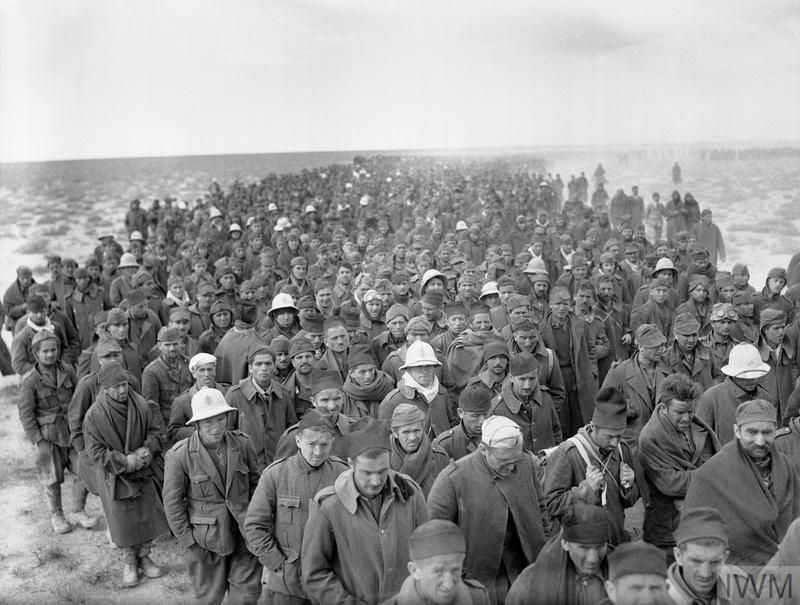
British 4th Armoured Division advanced 50 miles from Bardia, Libya to capture Belhamed to the east of Tobruk and the airfield at El Adem 8 miles to the south. Patrols were now conducted 10 miles west of Tobruk at Acroma. Advance units of the Allied force reach the outer defenses of Tobruk after taking El Adem airfield to the south. Patrols to examine the Italian defenses begin immediately. The Tobruk garrison is 25,000 men with 220 guns and 70 tanks. Lieutenant General Enrico P. Manella is in command. There are other Italian units still in positions farther west in Libya.
The possibility that British desert troops might sweep past the Italian seaport base at Tobruk and plunge on more than 250 miles across the Libyan sands to attack Benghazi arose tonight even as the advance guard of British motorized units threatened Tobruk’s outer defenses. Tobruk, 70 miles across the desert from Bardia, Which the British captured yesterday, is the next natural objective. But it was not quite certain when the British would open a drive on Tobruk or whether they would pass it up for the time being for bigger game — the Cyrenican capital across the desert. At any rate, the Royal Air Force pounded Tobruk in heavy raids similar to those loosed upon Bardia in the 48 hours preceding the final land attack which culminated in its capture yesterday.
With yet another major British objective — Bardia — now crossed off the list, Churchill begins thinking about which theater of operations presents the greater threat: Greece or North Africa. He cables his Middle East Commander, General Wavell, to hurry things along because there are other pressing priorities:
“Time is short. I cannot believe Hitler will not intervene soon [in Greece and other Balkan states].”
Given that Wavell has just won another resounding victory and perhaps expects some thanks or congratulations rather than another lesson in the obvious, this perhaps comes as a bit of a downer.
Churchill, however, does not stop there. He even implies that Wavell’s army has become a haven for slackers, urging that Wavell do something “about purging rearward services” and shifting more of the rear echelon establishment into the front line. Churchill further elaborates by commenting that more forces should be shifted to Greece, including aircraft, artillery and “some or all of the tanks of the 2nd Armoured Division, now arrived and working up in leisurely fashion in Egypt.” These are all implied criticisms of Wavell’s leadership, extending disagreements and resentments between the two men that have been bubbling to the surface since the quick loss of British Somaliland in August 1940.
This is a familiar theme that leaders on both sides will take up from time to time, the length of the supply “tail.” However, modern armies require large-scale logistical support, and cutting back on that can result in degradation of combat effectiveness by those who do carry rifles.
Meanwhile, the Germans are doing more than subtly sniping at each other. Today, General Geisler begins operations with his Junkers Ju 87s of Fliegerkorps X from their new bases in Sicily. They attack Royal Navy units involved in Operation EXCESS.
As part of Operation EXCESS, a convoy mission to Malta, Group B of Operation MC 4 departs from Alexandria. Operation Excess is designed to reinforce Malta with additional troops, and ships are coming from both Alexandria and Gibraltar.
RAF planes drop propaganda leaflets on Italian positions in North Africa. The leaflets emphasize the moral superiority of British war aims and recent British successes in Egypt and Libya.
In southwest Libya, the British Long Range Desert Group (LRDG) is camped near Tazerbo and continues patrolling to learn as much as possible about its objective, regional center Murzuk and its airfield. The men hear today that Bardia, about 700 miles to the east, has fallen via special poles they construct to aid communications. This is no small force; there are 23 vehicles and 76 men. Included in the group are Coldstream Guards and New Zealanders. They are all under the command of Lieutenant Colonel Bagnold, with Major Pat Clayton leading the raid itself.
In the Greco-Italian War in Albania, Greek forces launched an assault trying to take the strategically important Klisura Pass. Minor operations continue on 6 January 1941 in the Klisura Pass and elsewhere. Greek Commander-in-chief Papagos is preparing a renewed effort at Klisura in an effort to secure the vital Italian port of Valona (Vlorë) before anticipated German intervention, which is projected to begin any time on or following 15 January. The Italians are fighting hard at Klisura, using Fiat-Ansaldo M13/40 tanks.
Overnight, Greek destroyers shelled the Albanian port of Valona (Vlorë). Twenty miles to the south, Italian destroyers Alfieri, Carducci, Fulmine, and Gioberti, and torpedo boats Partenope, Pallade, Romeda, and Altair shelled Greek positions at Porto Palmermo. The Greek offensive against Italian positions in the mountains of Albania reached the strategically important Klisura Pass on the river Vjosë, which, if captured, would allow Greek forces in the center of the front to link up with troops on the coast, but it was met with stiff resistance.
A Free French force under Lieutenant Colonel Jean Colonna d’Ornano attacked Murzuk airfield in southwestern Libya from Chad, capturing the airfield, but d’Ornano was killed in action.
The Great Powers are becoming increasingly interested in Greece as perhaps their next proxy battlefield. Hitler’s plans for Operation Marita are well known, and becoming known at this time outside of his own country (it is impossible to hide the Wehrmacht troop movements in Romania, and the cover story of it being related to “training” is wearing thin). British Prime Minister Winston Churchill today memos his military aide, General Ismay, stating:
“We must so act as to make it certain that if the enemy enters Bulgaria, Turkey will come into the war… It is quite clear to me that supporting Greece must have priority after the western flank of Egypt has been secured.””
Hitler also remains preoccupied with Turkey and maintains close diplomatic relations with it — as do the British.
Churchill today promised that Britain would go to the help of Greece in the event of a German advance in the Balkans. In a letter to the Chiefs of Staff Committee the Prime Minister says: “It is quite clear to me that supporting Greece must have priority after the western flank of Egypt has been secured.” He says that more Hurricane squadrons should be sent from the Middle East along with some artillery regiments and “some or all of the tanks of the 2nd Armoured Division, now arrived and working up in leisurely fashion in Egypt.”
The Indian 11th Infantry Division transfers from Egypt to Sudan.
In Sudan, Wavell flies to Khartoum to see Platt and urge him to bring forward his attack on the Italians in Eritrea, now assisted by 4th Indian Division. He also sees Haile Selassie to discuss he re-entry to his country.
The Irish government sends the Germans an official note of protest regarding recent air attacks on Dublin and the Irish coast to the south. The Luftwaffe bombed Ireland for three straight nights and killed several people. Many in Ireland and Great Britain do not think these bombings were accidental at all, but an intimidation tactic.
With German troops massing in southern Rumania less than 150 miles from Turkey’s frontier, Premier Refik Saydam today assured the national assembly that Turkish foreign policy aimed to secure the “safety of the nation … in complete reliance upon our allies.” Britain is one of Turkey’s avowed allies, and Soviet / Russian relations long have been cordial. It became known here that more than 50 prominent Turks in Istanbul had received unsigned postcards written in German stating that “Germany will invade England.” Authorities immediately began an investigation of these “New Year’s cards” which apparently were mailed inside Turkey and displayed a map of England on one side.
The war games that began on 2 January conclude today. General Zhukov, in charge of the “Western” or “Blue” forces, has achieved a victory over Colonel-General D.G. Pavlov commanding the “Eastern” or “Red” forces. The precise outcome is somewhat murky, as the accounts of this exercise rely upon memoirs from those involved (some of whom did not survive the war). Another exercise is planned to begin on 8 January, with Zhukov commanding the “Red” side and General Kulik commanding the “Blue” side.
Air operations remain light. RAF Coastal Command attacks German convoys off Norway and the Dutch coast. The Luftwaffe sends a few raiders against London and Kent but stays on the ground after dark.
RAF Bomber Command dispatches 3 Blenheims on daylight missions; 1 aircraft bombed and hit a tanker off the Hook of Holland. No losses.
Adolf Hitler subordinated I Wing of Kampfgeschwader 40 to the Kriegsmarine to support U-boat operations, obliging a request from Karl Dönitz. When Hermann Göring learned of the decision he pressed Hitler to reverse it, which eventually happened but led to the creation of the Fliegerführer Atlantik in its place. The inter-service rivalries in the Wehrmacht continue. Admiral Karl Dönitz has requested control over air units — specifically Focke-Wulf Fw 200 Condors — in order to aid U-boat operations in the Atlantic. He hopes that they will operate as the U-boats’ “eyes” and spot ships and convoys that the U-boats — at surface level — cannot see.
Hitler approves this request today, shifting I,/KG 40 to the Kriegsmarine’s control. However, Reichsmarschall Hermann Goering controls all air units in the Reich (under Hitler, of course). Seeing this as an infringement on his own authority, Goering quickly objects to the transfer. As a sort of compensation, Hitler returns KGr 806 (Junkers Ju 88s) from Kriegsmarine control and gives them to Field Marshal Sperrle’s Luftflotte 3 for attacks on England. For now, though, the Condors remain with the Kriegsmarine, and this marks the start of a permanent increase in cooperation between German air units and U-boats. However, KG 40 itself is in poor shape and proves to be of little value to Dönitz.
Ju-87s of the Luftwaffe’s X, Fliegerkorps under General Geisler begin operating out of Sicily.
U-124, commanded by Kapitänleutnant Georg-Wilhelm Schulz sank British steamer Empire Thunder (5965grt) in 59-14N, 12-43W. At 1137 hours the unescorted Empire Thunder (Master William Dowell), on her maiden voyage and a straggler from convoy OB-269 due to an engine breakdown, was torpedoed and sunk by U-124 about 100 miles north-northeast of Rockall. Nine crew members were lost. The master and 29 crew members were picked up by HMS Kingston Onyx (4.54) (Lt R. Walgate, RNR) and landed at Stornoway, Hebrides on 8 January. The 5,965-ton Empire Thunder was carrying ballast.
Due to suspected raider D/F signals, battlecruiser HMS Repulse with destroyers HMS Bedouin, HMS Electra, and HMS Escapade departed Scapa Flow at 0401 to cover convoy HX.99. Destroyer HMS Mashona setting out on this sortie collided with destroyer HMS Sikh at buoy at Scapa Flow. The destroyer was unable to proceed and was taken to West Hartlepool for docking on the 9th. Destroyer SIKH was docked at Scapa Flow for temporary repairs. The destroyer departed Scapa Flow for the Tyne on the 18th, escorted by destroyer HMS Punjabi but was forced to return due to a snow storm. The destroyer sailed again at 1000/20th escorted by destroyer HMS Whitshed and arrived in the Tyne at noon on the 21st. Destroyer Whitshed continued to Chatham to return to the Nore Command. Light cruisers HMS Manchester and HMS Edinburgh departed Scapa Flow at 0401 and proceeded to position 63N, 04W. Armed merchant cruisers HMS Chitral, HMS Letitia, HMS Wolfe, and HMS Cilicia at sea were advised of the signals. Armed merchant cruisers Chitral and Letitia returned to the Denmark Strait. Later this day, destroyers HMAS Napier and ORP Piorun and armed merchant cruisers Chitral and Letitia refueled at Reykjavik. When refueling was completed, the destroyers escorted the cruisers to the Minches. The destroyers arrived back at Scapa Flow after this duty on the 11th. Battlecruiser HMS Renown and destroyers Bedouin, Escapade, and Electra arrived back at Scapa Flow at 1940/7th.
Destroyer HMS Brilliant departed Scapa Flow at 0110 for Greenock to join destroyer HMS Beagle in the escort of convoy WS.5B. Destroyer Brilliant arrived at Greenock at 1700.
Destroyer HMS Somali arrived at Scapa Flow from Rosyth following repairs to her gun shield.
Anti-aircraft ship HMS Curacoa departed Scapa Flow to escort convoy WN.64 from the Pentland Firth to moonset. The ship arrived back at Scapa Flow at 1000/7th.
Tug Lion (87grt) was sunk on a mine two and a half cables 320° from No. 5 Medway Buoy. All crewmen were lost.
British trawler Gadra (219grt) was sunk on a British mine one and a half miles off Myling Head, Faroes. Seven crewmen of a ten man crew were lost.
Aircraft carrier HMS Eagle with four destroyers departed Alexandria for flying exercises.
Light cruisers HMS Gloucester and HMS Southampton embarked twenty five officers and 484 other ranks of Army and RAF for Malta. The light cruisers and destroyers HMS Ilex and HMS Janus departed Alexandria at 1315. This group was designated Group B for Operation MC.4.
The 9th Italian Destroyer Division of destroyers Alfieri, Carducci, Fulmine, and Gioberti and the 14th Torpedo Boat Division of torpedo boats Partenope, Pallade, Romeda, and Altair shelled Greek positions at Porto Palmermo in Albania.
Greek steamer Antonis (3729grt) was sunk by German raider Kormoran at 8-17N, 23-32W. The entire crew was made prisoners of war. German Hilfskreuzer (Auxiliary Cruiser) Kormoran (Korvettenkapitän Theodore Detmers) sinks 3729 ton Greek collier Antonis in the mid-Atlantic. The 29 men (and 7 sheep) on board are taken as prisoners. This incident sends Royal Navy heavy cruisers HMS Norfolk and Devonshire searching fruitlessly for the Kormoran, which of course quickly departs the scene. This is another incidence where the exaggerated value of surface raiders is demonstrated, as the Royal Navy expends huge amounts of effort trying to track the Kormoran down, while the much more effective U-boats attract little attention except at the times of sinkings.
Heavy cruiser HMS Norfolk, which departed the UK on 18 December for the South Atlantic, was attached to the South Atlantic Command. The heavy cruiser was involved immediately in searching for the German raider Kormoran on the SL convoy route. Heavy cruiser HMS Devonshire was searching for the armed merchant cruiser at the last known position. This search continued until 29 January.
German tanker Nordmark replenished German heavy cruiser Admiral Scheer at sea.
New Zealand Division light cruiser HMS Leander departed escort of convoy BN.12 and took over convoy BS.12 in the Red Sea. Convoy BS.12 arrived at Aden on the 11th.
Convoy FN.377 departed Southend, and arrived at Methil on the 8th.
Convoy HX.101 departed Halifax, escorted by armed merchant cruiser HMS Ausonia, corvette HMCS Collngwood, and patrol vessel HMCS Otter. The corvette and the patrol vessel were detached the next day.
Convoy BHX.101 departed Bermuda on the 3rdescorted by ocean escort armed merchant cruiser HMS Rajputana. The convoy rendezvoused with convoy HX.101 on the 9th and the armed merchant cruiser was detached. On the 17th, the armed merchant cruiser was detached and destroyer HMS Ambuscade, corvettes HMS Aubretia, HMS Heartsease, and HMS Hollyhock, and anti-submarine trawlers HMS Angle, HMS Daneman, and HMS Lady Lillian joined. Corvette Aubretia and the three anti-submarine trawlers were detached later that day. Destroyer Ambuscade was detached on the 20th, corvette Hollyhock on the 21st, corvette Heartsease on the 22nd, and arrived at Liverpool on the 22nd.
In Washington, President Roosevelt delivered to Congress his annual message on the state of the Union, sent to Congress the nominations of Guy J. Swope to be Governor of Puerto Rico and Charles Harwood to be Governor of the Virgin Islands, and conferred with William S. Knudsen and Sidney Hillman, members of the Advisory National Defense Commission; Senator Wagner and Harold D. Smith, Director of the Budget.
The Senate met in joint session with the House to hear the President’s message, elected Senator Harrison president pro tempore, received numerous bills and adjourned at 3 PM until noon on Wednesday.
The House, after hearing the President’s message, received the Dies resolution for two more years of life for the committee to investigate un-American activities, the annual report and recommendations of the Interstate Commerce Commission, the May bill to repeal the Johnson Act and many other bills, and adjourned at 2:47 PM until noon on Wednesday.
U.S. President Franklin D. Roosevelt made the Four Freedoms speech during his State of the Union address. He proposed four fundamental freedoms that all the people of the world ought to enjoy: freedom of speech, freedom of worship, freedom from want, and freedom from fear. U.S. President Franklin D. Roosevelt gave his eighth annual message to Congress which is now known as the Four Freedoms speech in which he proposed four fundamental freedoms humans “everywhere in the world” ought to enjoy: “In the future days, which we seek to make secure, we look forward to a world founded upon four essential human freedoms. The first is freedom of speech and expression… The second is freedom of every person to worship God in his own way… The third is freedom from want… The fourth is freedom from fear… To that high concept there can be no end save victory.” President Roosevelt today also promised that the United States would serve as an arsenal for the democracies. He also proposed that the United States should not lend money to Great Britain, but should supply weapons to be paid for after the war was over. The President said that Britain and its allies did not need American manpower. They did need billions of dollars’ worth of weapons. The time was near, the President went on, when the Allies would not be able to pay for those weapons in ready cash: “We cannot and we will not tell them they must surrender because of their present inability to pay for weapons which we know they must have.”
The President therefore did not recommend to Congress that the United States should grant Britain and the Allies loans which would have to be repaid in dollars. “I recommend,” he said, “that we make it possible for those nations to continue to obtain war materials in the United States, fitting their orders into our own program.” Mr. Roosevelt said that he spoke at a moment of unprecedented danger in American history. “The democratic way of life,” he said “is at this moment being directly assailed either by arms or by the secret spreading of poisonous propaganda.” Recalling the example of Norway, he said that German agents might seize strategic points in America. Gravely and earnestly, President Roosevelt informed congress that “a swift and driving increase in our armament production” was the immediate need of a critical period and appealed for widespread personal sacrifices in a national effort to defeat the axis powers lest they win abroad and then attack the Americas. “Let us say to the democracies,” said, “we Americans are vitally concerned in your defense of freedom. We are putting forth our energies, our resources and our organizing powers to give you strength regain and maintain a free world. We shall send you, in ever-increasing numbers, ships, planes, tanks, guns. This is our purpose and our pledge.”
The idea also has an antecedent from an unlikely source: the 1939 New York World’s Fair (which only closed at the end of October 1940). The Fair’s four freedoms were:
— Freedom of religion
— Freedom of speech
— Freedom of the press
— Freedom of assembly
Roosevelt’s final Four Freedoms list is a fundamental recitation of concerns which sometimes echo, if not outright paraphrase, the US Constitution, but also extend the Constitution with Roosevelt’s own New Deal agenda (not included in the “Four Freedoms” but also listed in the speech are such things as jobs, equality of opportunity, and civil liberties). In effect, Roosevelt is proposing that US Constitutional — and his own philosophical — priorities should be the template for the entire world. That is, whether the rest of the world agrees or not — but mass acceptance of these principles, or “freedoms,” is assumed.
While Hitler is busy trying to craft a New World Order by dividing the world up into military spheres of influence, Roosevelt is doing the same thing in a philosophical fashion (in fact, he actually uses the phrase “new order” in reference to the Axis and proposes instead the term “moral order.”
One of the ironic aspects of Roosevelt’s speech lies in how he describes “freedom of fear”:
“…which, translated into world terms, means a world-wide reduction of armaments to such a point and in such a thorough fashion that no nation will be in a position to commit an act of physical aggression against any neighbor – anywhere in the world.”
In fact, President Roosevelt will preside over the greatest arms buildup in the history of the world. That defense establishment essentially remains into the 21st Century, with US defense expenditures continuing to amount to more than that of all other nations put together. There was no “reduction of armaments” under President Roosevelt, and there was none after his tenure, either. It is easy to say that Roosevelt’s arms buildup was necessary, as well as that of post-war US governments — but it takes a certain myopic or ethnocentric point of view to refuse to see your own arms buildup as not violating the “freedom from fear.” Apparently, it is okay if the other guys feel fear as long as you and those who agree with you do not. I’m not trying to be political here, just pointing out some inescapable realities of how the world works and how high-minded principles can’t square with them.
Nobody can really argue with Roosevelt’s list; that would be like saying that you are in favor of repressing or mistreating people. In a sense, the Four Freedoms speech is the dawn of the age of political correctness, where any dissent makes you morally a “bad person,” though that takes decades to gather steam.
The speech provides a moralistic framework for US intervention abroad which ultimately is not necessary during the Roosevelt years, but helps to frame World War II (from the US perspective) as “the Good War” (some would say the last good war). It also imbues a conscious moralism to US foreign policy which never leaves — moralism which is not always applied or justified in the same ways, particularly during US military interventions. However, this moralism does imbue US military adventurism with the aspect of a modern Crusade (in fact, General Eisenhower’s memoir is entitled “Crusade in Europe,” so some at the time saw this, too). Some key US allies never follow these Four Freedoms (notably the USSR), so everything is relative in the context of the Four Freedoms. Again, those inescapable realities again.
The Four Freedoms will remain a catchphrase to which Roosevelt will return time and again and will inform the creation of the United Nations, perhaps his most lasting legacy.
Also included in the speech, almost casually and with almost no elaboration, is another tremendous topic with immediate ramifications: Lend Lease. While once again he does not use this term, President Roosevelt does everything but say the words. After noting in the abstract that Great Britain is about to run out of money — with an actual shipment of British gold leaving for the United States on this very day — Roosevelt says:
“I do not recommend that we make them a loan of dollars with which to pay for these weapons — a loan to be repaid in dollars. I recommend that we make it possible for those nations to continue to obtain war materials in the United States, fitting their orders into our own program. And nearly all of their material would, if the time ever came, be useful in our own defense.”
In this way, in a single paragraph, Roosevelt announces a new policy that essentially turns Great Britain into a client state, a very willing mercenary army for the United States. Roosevelt makes this even plainer in the following paragraph when he reassures his listeners that “we are free to decide how much should be kept here and how much should be sent abroad to our friends.” Not only does Roosevelt decide what goes where, but the British will wind up paying for the privilege of accepting these American handouts. It is an artful way of ramping up the munitions industries without actually going to war or, really, having any legal pretext at all (though that will soon follow).
Reaction on Capitol Hill to President Roosevelt’s message to the Congress calling for further material aid to Britain was predominantly favorable in the ranks of both major parties, although adverse comments came from Senators Wheeler, Taft and Shipstead and also from some members of both parties in the House.
President Roosevelt’s demand in his annual message for a swift increase in the arming of the United States and measures to implement his policy of “all out” aid to the democracies is to be followed by a series of specific legislative proposals hardly matched in number and importance since the early days of participation by the United States in the first World War.
President Roosevelt notified the nation today that he will ask congress for new taxes to help finance the multi-billion dollar defense program when he submits his budget message Wednesday. The budget reportedly will call for an additional $10,000,000,000 for defense and $7,000,000,000 for regular governmental operations, the latter group being cut sharply below previous high levels. Best guess is that the national debt will stand at slightly more than $47,000,000,000 at the close of the present fiscal year next June 30 and that another $8,000,000,000 or so will be added during 1942.
Without making any comment on the detailed motives of his mission, Harry L. Hopkins, President Roosevelt’s especially assigned personal envoy to Great Britain, left for London today on the Yankee Clipper. “I will be back when I have finished,” he said as he boarded the Lisbon-bound flying ship. “It won’t be too long.”
At MIT in Boston, A prototype centimetric radar is operational on the roof of the Radiation Laboratory, three weeks after work started on the project.
Further steps involving the expenditure of more than $83,000,000, to catch up with the shortage of airplane engines, were reported today by the War Department.
The USAAC 22nd, 23rd, and 32nd Fighter Squadrons, all operating Curtiss P-40 Warhawk fighters, were assigned to Losey Field in Puerto Rico.
U.S. Navy heavy cruiser USS Louisville (CA-28) departs Simonstown, South Africa for New York, having taken on board $148,342,212.55 in British gold for deposit in American banks (see 22 January). That is about $2 trillion in 21st Century value. This shipment, part of Operation Fish, will be used to pay for armaments and other items in the United States. In its path lies German heavy cruiser Admiral Scheer (which today is replenishing its fuel stocks from tanker Nordmark), but the ocean is vast and the odds of the two ships encountering each other is remote. Even then, the USS Louisville is a heavy cruiser that can take care of itself. If anything were to happen to this shipment, there could be cataclysmic consequences.
U.S. Navy battleship USS Missouri (BB-63) is laid down at the Brooklyn Navy Yard — quite a coincidence given President Roosevelt’s speech today, in light of the events of 2 September 1945.
Unknown young actor Richard Widmark makes his radio debut on the CBS drama “The Home of the Brave.”
Everybody in Canada who could get near a radio listened to President Roosevelt’s message to Congress this afternoon, and it is no exaggeration to say that business was halted virtually everywhere until the broadcast ended. Canadians were cheered by the promise of increased aid.
Passengers returning yesterday from South America on the American Republics liner Uruguay, which brought 198, asserted that Nazi activities continued to flourish in Argentina and Brazil.
The Nationalist (Kuomintang) government purchases 100 H81A-2 Curtiss Tomahawks (P-40Bs). These are intended for use by the American Volunteer Group (AVG), which Claire Chennault is still forming. Their armament is 2 x 0.5 in. and 4 x 0.3 in. machine guns, which is fairly substantial for this period of time, though 20 mm cannon would be better.
The Nationalist Chinese 3rd War Area attacks the retreating Communist New 4th Army near Maolin on the Yangtze.
Three columns of Japanese were flung back with casualties of 3,000, the Chinese Central News Agency reported tonight, in a four-day battle on the northern front where some of the severest fighting of the Sino-Japanese war has occurred in the past two weeks. Veteran troops of the invader began the assault on December 22, the agency reported, against Chinese entrenchments in the Tai Shang mountain range abutting Shansi, Hopei and Honan Provinces. The Japanese commander was said to have ordered a retreat to Yellow River positions after the battle.
Admiral Jean Decoux, Governor General of French Indo-China, in a message published in Hong Kong today, denied reports of Japanese designs on Saigon, chief city and port of Southern Indo-China, and Cam Rahn Bay, naval base on the southeast coast. The Decoux message was addressed to Louis Reynaud, French Consul General here, who, in releasing it said the implication was that France was determined not to relinquish control of these two strong points. Admiral Decoux also denied reports that the Japanese were demanding exclusive use of the railway from Halphong and Hanol to the Chinese border at Lạng Sơn. M. Reynaud said the Japanese had about 100 planes in Northern Indo-China, but these were used only for raids against China [where they have been bombing the Burma Road] and not for any southward push in Indo-China.
Negotiations by which Japan expects to obtain economic concessions in French Indo-China, including valuable supplies of rubber and rice, were resumed today after a New Year recess.
French military authorities tonight claimed destruction of at least 40 Thai (Siamese) warplanes as brisk border fighting shifted to air and artillery battles. The French communiques did not mention land activity, implying there was no change since earlier tonight when a general French withdrawal of 5 to 10 miles within the frontier of Cambodia province was acknowledged. French seaplanes operating from Tonle Sap (great lake) in Cambodia aided land planes in attacking Thai airdromes, the French reported as the undeclared war gained momentum. Simultaneously, Thai planes bombed Indo-Chinese towns and the French said there were 22 casualties at Siemreap, near the northern end of Tonle Sap. Sporadic artillery dueling was reported in progress across the Mekong river boundary and at various points along the Cambodian battle front. The French nevertheless insisted that Thailand’s baby blitzkrieg the most ambitious campaign in weeks of sporadic border fighting was merely “fireworks.” While frontier forces “retired to new defense lines” in Cambodia, that part of southwestern Indo-China which juts into Thailand, friction developed in northern Indo-China between Japanese soldiers and the French at Hanoi, the capital, and Haiphong, principal northern seaport.
Local Dutch authorities in the Netherlands East Indes arrest Nationalist leaders.
New Zealand Division light cruiser HMS Achilles departed Auckland escorting British steamer Empress of Russia (16,810grt) to Fiji. They arrived on the 9th. The light cruiser departed Fiji on the 10th to return to Auckland.
Dow Jones Industrial Average: 132.83 (+0.43)
Born:
Cornell Gordon, AFL-NFL cornerback and safety (AFL Champions and Super Bowl III Champions-Jets, 1968; New York Jets, Denver Broncos), in Norfolk, Virginia.
Tamara Lund, Finnish actor, singer and opera singer, in Turku, Finland (d. 2005, of stomach cancer).
Died:
Charley O’Leary, 65, American baseball shortstop, 1904-13 & 1934 (Detroit Tiger, St. Louis Cardinals; oldest MLB player to collect a hit and score a run at 58 for St. Louis Browns, 1934), and coach, 1913-37 (Cardinals, NY Yankees, Chicago Cubs, Browns), of peritonitis.
Franz Hessel, 60, German writer (“Spazieren in Berlin” [“Walking in Berlin”]), poet, and translator (Marcel Proust), dis from complications of a stroke suffered while in an internment camp.
Naval Construction:
The Royal Indian Navy Basset-class minesweeping trawlers HMIS Patna (T 255) and HMIS Calcutta (T 339) are laid down by the Hooghly Docking & Engineering Company, Ltd. (Calcutta, India).
The U.S. Navy 77-foot Elco patrol motor torpedo boat USS PT-25 is laid down by the Electric Launch Company Ltd. (Elco), (Bayonne, New Jersey, U.S.A.).
The U.S. Navy Gleaves-class destroyers USS Forrest (DD-461) and USS Fitch (DD-462) are laid down by the Boston Navy Yard (Boston, Massachusetts, U.S.A.).
The U.S. Navy Iowa-class battleship USS Missouri (BB-63) is laid down by the New York Navy Yard (New York, New York, U.S.A.).
The Royal Navy destroyer depot ship HMS Hecla (F 20), lead ship of her class of 2, is commissioned. Her first commanding officer is Commodore 2nd class Cyril George Bucknill Coltart, RN.
The Royal Navy Flower-class corvette HMS Dianella (K 07) is commissioned. Her first commanding officer is T/Lieutenant James Gavin Rankin, RNR. Name changed from HMS Daffodil on 26 October 1940 prior to commissioning.
 History Diaries