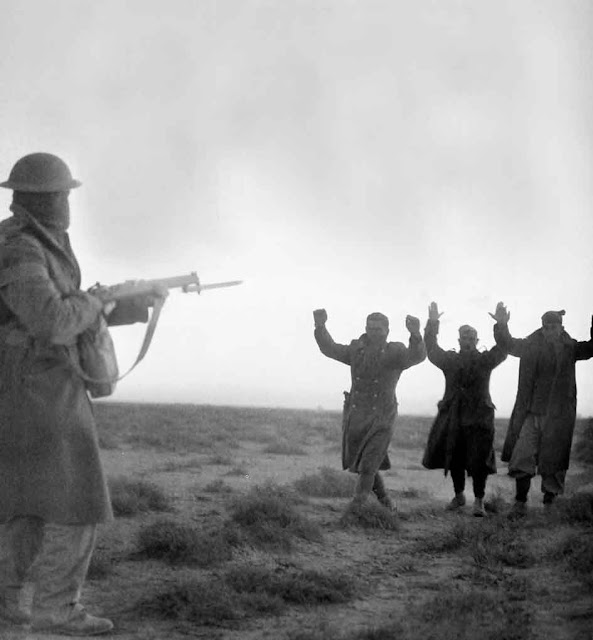
Having cut the Bardia fortress in two, the Australians now go about reducing the two Italian pockets on either side. The 19th Australian Infantry Brigade advances to the south with six Matilda tanks and, along with the 17th Australian Brigade pressing from the other side, eliminates resistance there. The northern pocket then surrenders.
The Battle of Bardia ended in Allied victory when the last remaining Italian forces surrendered. Australian 6th Division troops (XIII Corps, the re-designated Western Desert Force), supported by 6 remaining British Matilda tanks, captured the last Italian defensive position at Bardia, Libya, and the remaining Italian force surrendered soon afterwards. In the battle for Bardia, the Italians suffered 1,000 killed, 3,000 wounded, and 36,000 taken prisoner; 2,000 Italians were able to withdraw to Tobruk, Libya. Australians suffered 130 killed and 326 wounded. The Allies captured a large quantity of Italian equipment, including 26 coastal guns, 7 medium guns, 216 field guns, 26 anti-aircraft guns, 41 infantry guns, 146 anti-tank guns, 12 medium tanks, 115 tankettes, 708 trucks, and water pumps capable of producing 400 tons of fresh water per day.
Next on the agenda is Tobruk, also to be attacked by the Australians later in the month. Middle East Commander Archibald Wavell already is looking past Tobruk. He tells his Chief of Staff in a note that Benghazi now is the ultimate objective of Operation Compass. However, his superiors in London now are beginning to worry about German intervention in Greece, so how much commitment Wavell will receive from them remains an open question.
The Italians, of course, are not happy about another military catastrophe. Radio Rome claims that the garrison was overwhelmed by 250,000 men and 1000 aircraft, when in fact only a single Australian Division, the 6th Division, was involved. General Rodolfo Graziani, however, has a better grasp of what actually is happening. Due to the inability to stop Major General Richard O’Connor’s offensive, Italian General Rodolfo Graziani made the decision to completely abandon the region of Cyrenaica and ordered the Tenth Army to fall back through Beda Fomm.
Learning of Rodolfo’s plan to fall back to Beda Fomm, O’Connor devised a new plan with the goal of destroying the Tenth Army. With the Australians pushing the Italians back along the coast, he detached Major General Sir Michael Creagh’s 7th Armored Division with orders to turn inland, cross the desert, and take Beda Fomm before the Italians arrived.
Field Marshall Wavell sets out ultimate objective as Benghazi, to be taken within the next week.
Greek mountain troops in Albania, fighting off fierce Italian counterattacks, took more than 200 additional prisoners and pushed their lines north of strategic Klisura to dominating heights commanding the valley leading toward Valona, a Greek government spokesman announced early today. The fighting at the Klisura Pass continues on 5 January 1941, without much change. Elsewhere, the lines have pretty much settled in for the winter.
The real action regarding the Italian/Greek war no longer is taking place in Greece, Albania or Italy. The British receive intelligence today suggesting that the Germans will be in a position to invade not only Greece but also Yugoslavia and Bulgaria no later than 15 January. This would greatly expand the British defense issues in the Mediterranean Basin. In fact, Hitler is nowhere near being in a position to launch such an operation so soon, and Yugoslavia and Bulgaria are not on the agenda at all yet — but he indeed is working on Greece.
General Papagos also is aware of the growing threat of German participation. He plans to make a final lunge for the key Italian port of Valona before they can intervene, and this decision will guide much of the coming action. The theory is that if he takes Valona, Papagos then can shift troops to meet a German invasion from Bulgaria. To do that, however, he has to act fast in Albania.
In Malta, two men receive the George Cross for defusing unexploded bombs: Captain R L Jephson Jones and Lieutenant W M Eastman, RAOC.
Admiral William D. Leahy, USN (Retired) arrives in Vichy as U.S. ambassador. In view of the icebound conditions in the South of France, possibly the greatest courtesy shown to Admiral Leahy, the new United States Ambassador, on his first day in France was that the train to which his special car was attached steamed into the Vichy station exactly on scheduled time, two minutes before midnight.
The progress of the political tug-of-war going on behind the scenes in Vichy is being watched in German official quarters with a curiosity that is not without a deep suspicion that a powerful clique in the Petain government is desperately determined to sabotage a French-German post-war rapprochement.
Rexist leader Léon Degrelle makes a speech in Liege, Belgium in which he professes devotion to the Germans and Adolf Hitler. Degrelle’s Rexist party never has been particularly popular in Belgium, and many even in his own party are not comfortable with this association.
Amy Johnson, record-breaking aviation pioneer of the 1930s, was killed when the Airspeed Oxford trainer she was delivering as an Air Transport Auxiliary ferry pilot came down in the Thames Estuary in Southern England, United Kingdom. It was sadly ironic that a woman who navigated her way solo from England to Australia in 1931 got lost in bad weather. Running out of fuel, she bailed out thinking she was over London. Landing in the freezing water, she was dragged under a rescue boat by her parachute and chopped to death by the propellers. The crew of the naval trawler Haslemere saw her bale out of the plane. The trawler’s captain, Lieutenant-Commander W E Fletcher, dived into the sea despite the heavy swell and reached her, but was unable to support her. He was so exhausted by his valiant efforts and so frozen by the bitter sea that he died in hospital. Miss Johnson’s family heard of the accident when they were telephoned by Miss Pauline Gower, the head of the ATA which ferries aircraft from factories to the front line squadrons. “Amy has been flying as a ferry pilot for six months,” her mother said tonight. “She was intensely happy in the knowledge that she was working for her country in this way; in fact, I have never known her as light-hearted as she has been during recent months.” Jim Mollison, Amy Johnson’s former husband, is also serving with the ATA. Amy Johnson took off from Squire’s Gate airfield in Blackpool and was headed for Kidlington in Oxfordshire.
The water is very rough and Johnson’s body is never found. There is an inscription for Johnson on the Air Forces Memorial at Runnymede due to her ATA service. There is some controversy over this incident. One theory is that there was a passenger in the plane who also perished — but, if so, that person never has been identified, and why that would be the case creates some mystery. Another theory is that British anti-aircraft fire brought her down after she strayed off course, mistaking her plane for a Luftwaffe intruder. Both theories have some tantalizing evidence that appears credible. This is another case where the government records that remain sealed under the 100-year rule may offer some insight.
The Ulster Unionist Council, which stands for continued union with the British Crown, declares that Southern Ireland’s [Eire’s] neutrality is “deliberately prejudicing Britain’s prospects of success in a struggle which means as much for one country as the other.”
Ireland is to take the brunt of the British system of issuing Navicerts. The Minister of Economic Warfare announced that after January 22, exports from Eire will be as liable to search on the high seas as exports from enemy territory, unless the cargo is accompanied by a navicert.
All Russian envoys to Balkan capitals have been summoned to Moscow for immediate consultation, it was understood tonight. Reports spread of an impending German “peaceful occupation” of Bulgaria, perhaps within two or three days. Usually well-informed quarters said that Wednesday has been fixed as the “zero hour” for a march of German armed forces into Bulgaria from their new Rumanian bases. Nazi quarters said that Russia will not interfere in any way “with any forthcoming German action in Bulgaria.” One German source went so far as to say that, as result of the recent Berlin visit of Soviet Premier Foreign Commissor Viacheslaff M. Molotoff, Russia will give Germany “a free hand’ in Bulgaria.
War games continue in the Soviet Union. Georgy Zhukov, commanding the “German” forces, is beating Colonel-General D.G. Pavlov, commanding the Red Army. This stage will end tomorrow.
U.S. Navy heavy cruiser USS Louisville makes port at Simonstown, South Africa as part of Operation Fish, the transport of British gold to New York. It begins loading $148 million gold immediately for departure on the 6th. These essentially are Great Britain’s last reserves and will be used to pay for war material.
On the Channel Front, air operations are very light due to the weather. The Luftwaffe makes small attacks on London and nearby areas, and British Coastal Command raids the port of Brest, but essentially it is a “free day” for both sides.
RAF Bomber Command dispatches 4 Blenheims during daylight; 1 aircraft bombed Flushing. No losses.
RAF Bomber Command sends 12 Hampdens on minelaying missions overnight to Brest, Lorient and St-Nazaire. 1 aircraft lost
RAF bombers hit Palermo, Naples and its suburbs, and a chemical factory at Crotone.
Italian submarine Cappellini sank British steamer Shakespeare (5029grt) from dispersed convoy OB.262 at 18-05N, 21-10W. Eighteen crewmen and two gunners were lost on the steamer. Italian submarine Cappellini gets in a gun battle with, and sinks, 5029-ton British freighter Shakespeare off of Morocco. The Cappellini tows the boats of the 22 survivors to within sight of land at Cabo Verde. This is quite generous of the Italians and captain Salvatore Todaro, considering that one of their own men was killed in the gun duel.
German tanker Nordmeer reaches Vigo, Spain, after her voyage from the Netherlands West Indies.
Light cruiser HMS Emerald was damaged while leaving dockyard at Plymouth. The damage was assessed to require four to seven days to repair. She was able to depart Portsmouth on the 12th for the South Atlantic.
Sloop HMS Lowestoft, arriving with convoy FS.378, was damaged by a mining in the Thames Estuary. The sloop was able to arrive at Sheerness on the 5th. The sloop was repairing to 3 October at Chatham.
Destroyer HMS Churchill departed Scapa Flow at 1200 for the Clyde following working up.
Destroyer HMS Southdown departed Scapa Flow for Rosyth at 2000 following working up.
Destroyers HMS Blencathra and HMS Tynedale departed Scapa Flow at 2030 for Portsmouth following working up.
Destroyers HMS Cottesmore at 1030 and HMS Belmont at 1400 arrived at Scapa Flow to work up.
Minelaying cruiser HMS Adventure laid mines in minefield ZME.11 in St Georges Channel.
Lt Cdr W. E. Fletcher, commanding officer of barrage balloon vessel trawler HMS Haslemere, drowned attempting to rescued a downed pilot near East Knock John Buoy in the English Channel.
British steamer Temple Moat (4427grt) was damaged by German bombing in 55-20N, 18-55W. One crewman was killed. The steamer arrived at Gareloch on the 9th.
Dutch steamer Alioth (5483grt) was damaged by German bombing near Cork Light Vessel. The steamer grounded in entrance to the fairway at Harwich. Steamer Alioth was refloated and arrived at Ipswich on the 10th.
The seas in the Atlantic are rough, and survival in the frigid water has a very low probability. Dutch 6718 ton freighter Soemba capsizes and sinks in the heavy swells. There are 34 deaths and 24 survivors, picked up by fellow convoy member Rydboholm.
German auxiliary patrol vessel Vp.306 (trawler Fritz Hincke, 391grt) was sunk on a mine near Ymuiden.
Light cruiser HMS Kenya and corvettes HMS Clematis, HMS Cyclamen, HMS Geranium, and HMS Jonquil arrived Gibraltar escorting British troopship Empire Trooper (13,994grt) from Ponta Delgada. The troopship’s troops were disembarked at Gibraltar and the troopship began repairs completed in March. Aircraft carrier HMS Argus, heavy cruiser HMS Berwick, and destroyers HMS Forester, HMS Fury, HMS Foxhound, and HMS Wishart departed Gibraltar to cover as they proceeded northwards. On the 6th, destroyers Forester, Fury, and Foxhound arrived back at Gibraltar. On the 7th, destroyer Wishart was detached and returned to Gibraltar. Heavy cruiser Berwick proceeded to Portsmouth. Repairs to the cruiser were begun on the 17th and were completed on 10 May. Aircraft carrier Argus proceeded to the Clyde, arriving 14 January.
Italian coastal steamer Vulcano (273grt) was sunk on a mine at Tobruk.
Convoy OB.270 departed Liverpool, escorted by destroyers HMS Wild Swan and HMS Witch, and corvettes HMS Campanula, HMS Fleur De Lys, HMS Gardenia, and HMS Periwinkle. Sloop HMS Aberdeen joined on the 6th. The escort was detached when the convoy dispersed on the 8th.
Convoy FN.376 departed Southend, escorted destroyer HMS Wolfhound and sloop HMS Egret, and arrived at Methil on the 7th.
President Roosevelt, in a personally-delivered report on “The state of the union,” will outline to congress at 2 PM tomorrow his program for what many expect to be the most momentous session of the national legislature since World war days. Congressional leaders predicted that the chief executive would devote most of the message to the subject of arming the United States and Britain, and that he would explain in detail the proposal he advanced at a recent press conference for providing Britain with war equipment under a “Lend-Lease” arrangement calling for repayment in goods and raw materials rather than cash.
In the chamber of the House, with its failing glass and steel roof shored up with temporary girders so that it looks more like an airplane assembly plant than a legislative hall, Mr. Roosevelt is expected to give details of his Lend-Lease plan for aiding the British to withstand Hitler’s attacks until the full power of our “great arsenal for democracy” is brought into the conflict. The new Congress, which began its existence Friday and which is expected to continue its active functioning with little respite for the full two years of its life, will have its regular routine job of making appropriations for the next fiscal year beginning July 1. This job must be completed in six months, and will be the basic run-of-the-mill activity of the legislature in that period. However, the problem of defense — how to make it go faster, how to finance it, and how its results shall be used in the critical world situation — promises to override the routine job at all points and in fact to inject itself into the routine at many points.
The first example of this is the proposal of Representative Woodrum, Democrat of Virginia, for the creation of a joint committee of ranking members of the House Ways and Means and Appropriations Committees to block any nondefense spending spree under the guise of defense needs. Mr. Woodrum, leader of the House “economy bloc,” holds that creation of such a committee, uniting the leaders of the House appropriations-making committee with those of the group charged with providing a program for raising the money, might help keep the easy spending groups of the House in line and lead toward an ultimate balancing at least of the nondefense budget. This proposal is expected to get early consideration in the House, where revenue proposals must originate and where the spade-work on appropriations is done. The proposed super-committee would be bipartisan and its creation already has been approved by House Representative Martin, Republican leader, although he has asserted that the proposal comes a year too late.
President Roosevelt, with a ruling that housing shortages exist in eleven areas where important national defense work is in progress, cleared the way today for government construction of 6,446 new family dwellings.
The U.S. Navy heavy cruiser Louisville (CA-28) arrives at Simonstown, South Africa to take on board Britain’s last negotiable asset, $148 million in gold, for deposit in U.S. banks to help pay for American guns and ammunition (see 6 January).
Eleven Navy fliers, including four who parachuted from a storm-tossed Navy bomber in Texas on Thursday, perished last night in a flaming naval transport which crashed in a rainstorm on Mother Grundy Peak, thirty-five miles southeast of San Diego.
Harry L. Hopkins, personal and special envoy of President Roosevelt to Britain, will leave on tomorrow morning’s Clipper from New York for Lisbon.
A policy of no strikes in the metal industries working on national defense orders was adopted here today by the chief officers of thirteen international unions in the metal trades affiliated with the metal trades department of the American Federation of Labor.
The musical play “No For An Answer” by Marc Blitzstein premiered at Mecca Temple in New York City.
A 9,000-strong contingent of the Chinese Communist New Fourth Army became surrounded by overwhelming Chinese Nationalist force at Maolin, Anhui Province, China.
Apparently copying the Germans’ technique, Japanese planes last week showered incendiary and explosive bombs on towns in the Szeyap district, including Toishan. about 100 miles west of Hong Kong, which is the homeland of many Chinese residents of America. A number of towns along the Canton-Hankow railway also were attacked and many casualties resulted. Movements of goods are being made at night to avoid bombings. The expected move toward Shiukwan has not materialized, but 50,000 Japanese troops are reported to be still concentrated near Canton. Chinese report that large airplane reinforcements have arrived in Kwangtung Province.
Japanese planes bombed Kunming, terminus of the Burma Road, today for the third time since Wednesday. Ten dive-bombers attacked the northeastern section of the city, inflicting about twenty casualties.
Well-informed Thai (Siamese) quarters tonight were pessimistic about the possibility of a peaceful settlement of the Thai-Indo-Chinese border dispute, following a new and violent outbreak of fighting on the frontier, and predicted the outbreak of a “full-dress war” within a week.
Japan’s plans for a new world order are interwoven with her alliance with Germany, Foreign Minister Yosuke Matsuoka declared in a radio address to Japanese communities abroad today. The address was first broadcast for the Americas, then for the army in China and a third time for Japanese in the South Seas.
Born:
Chuck McKinley, American men’s singles tennis player (Wimbledon, 1963), in St. Louis, Missouri.
Dave Watson, AFL guard (Boston Patriots), in Barbour County, Alabama (d. 2021).
Hayao Miyazaki, Japanese filmmaker (“Spirited Away”, “The Boy and the Heron”), in Bunkyō, Tokyo, Japan.
Died:
Amy Johnson, 37, English aviatrix (first female pilot to fly alone from Britain to Australia), in a plane crash while ferrying aircraft for the RAF.
 History Diaries