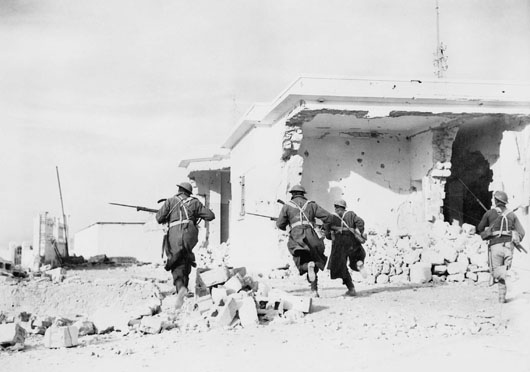
Allied forces reached Bardia and took many Italian troops prisoner. Bardia’s defenses were reported falling fast today under the mighty shock of every weapon in the British arsenal — warships, dive bombers, artillery, tanks, and grenades — and British military headquarters declared it was all up with that Italian Libyan port and base. While the British attack went on to subdue the last ounce of resistance, it was stated that nearly half of the arc of concrete, stone and steel defending the town already had been taken, along with a fourth to a third of the estimated 20,000 Fascist troops beleaguered there for 19 days. “Over 8,000 prisoners are now in our hands,” said a terse general headquarters communique tonight. It reported merely that “operations are proceeding satisfactorily.” The only hope left to the remaining Italians, the British said, was to surrender now.
After an entire day of fighting, Allied troops reached Bardia, Libya at about 1600 hours, splitting the Italian defenders into two groups, shaking Italian morale, causing large numbers of Italian troops to surrender. Jokingly emulating Winston Churchill, British Foreign Secretary Anthony Eden said “[n]ever has so much been surrendered by so many, to so few.” On the same day, Italian General Bergonzoli and his staff withdrew from Bardia toward Tobruk.
Having blown a hole through the Italian defenses on the 3rd, the Australian 6th Division under Major General Iven Mackay today pushes through to the sea, capturing the port of Bardia and bisecting the Italian garrison. While Italian troops hold out in pockets north and south of the town, they cannot be resupplied and they have few fortifications between themselves and the Australians. Already, thousands of Italians are streaming to the rear as prisoners. The battle will go on for quite some time, but essentially today’s advance decides the outcome.
The Italians are in complete disarray. General Bergonzoli and his retinue depart on foot for Tobruk. The Italians, as has been the case since the start of Operation COMPASS, are only too ready to surrender. There are reports of hundreds, even thousands, of Italians surrendering to isolated Australian units. The number of POWs already exceeds 10,000.
General Archibald Wavell, Commander in Chief Middle East Command, orders British forces to advance into Cyrenaica, to exploit their victory against the Italians. 7th Armoured Division under Major General Michael Creagh detours around Bardia and marches toward Tobruk. With the battle for the Bardia essentially decided already despite the Italian holdouts, Middle East Commander General Archibald Wavell quickly begins shifting forces toward the next major target, Tobruk. He sends the 7th Armoured Division (Major General Michael Creagh), which has been idle since the early stages of Operation COMPASS, toward the port without bothering it with Bardia, which it bypasses. The 7th Armoured is headed to cut Tobruk off from supply from the west. While Bardia is strategically important, Tobruk is the real prize in eastern Libya and has much more formidable defenses.
Far to the west, the recently renamed British Long Range Desert Group (LRDG) under Colonel Bagnold is approaching Murzuk, the Italian District Headquarters in the Fezzan Province. They intend to raid the oasis town — which had been 1300 miles from any other British forces when they set out, but now, after Operation Compass, only 700 miles away — to stir up Libyans against their Italian occupiers. This also is a good chance for cooperation with Free French in the area, who help out the LRDC men with supplies, and local Tuareg and Tibesti tribesmen. Today, the British camp out near some lava beds southwest of Tazerbo, where they will stay for three days. The Italians have no idea they are there, of course.
British torpedo bombers attacked an Italian supply convoy off Cape Bon, Tunisia; the attack is a failure.
The Greeks and Italians continue fighting for control of the Klisura Pass on 4 January 1941. Greek forces launch a drive westwards, towards Valona from Berat to Klisura against the Italians in Albania.
French Brigadier General Charles-Andre de Gaulle, Commander-In-Chief Free French Forces, demands the immediate release of the commander of the Free French Naval Force and Merchant Marine, Vice-Admiral Emile-Henri Muselier. He was arrested by the British for espionage on January 2. Muselier is accused of, among other things, betraying the British/Free French assault on Dakar in late 1940, Operation MENACE.
Resistance fighters Honoré d’Estienne d’Orves and Jan Doornik meet for the first time at a cafe in Montparnasse, Paris, to set up a second network of the French Resistance.
Aviatrix Amy Johnson was ordered to fly an Airspeed AS.10 Oxford aircraft from Prestwick, Scotland, United Kingdom to RAF Kidlington, Oxfordshire, England, United Kingdom.
Hitler meets with Bulgarian Prime Minister Bogdan Filov in Berlin and continues his campaign of trying to coerce an alliance with Bulgaria. Adopting a threatening tone (recently used by Hitler with Admiral Darlan in France, too), Hitler broadly hints that the Wehrmacht troops already taking positions for Operation MARITA in Rumania would be enough to take care of themselves against all comers. Hitler wants Filov to sign the Tripartite Pact, but Filov demurs and returns to Sofia to discuss the brewing crisis with his ministers.
Balkan apprehension of a German thrust across Bulgaria was fed tonight by fears Germany will obtain a Soviet pledge of non-intervention by promising Russia territorial concessions and respect for her interest in the Dardanelles. There was no confirmation such a deal is in the making, but informed sources believed Germany would attempt to come to an understanding with Russia before moving through Bulgaria in a drive for Salonika and the Aegean. Belief Germany will cross Bulgaria, with or without Sofia’s permission, was increasing. One German source said flatly Germany “will not permit Valona and Durazzo to become an Italian Dunkirk and at all costs she will prevent Britain from attaining full mastery of the Mediterranean.”
The Soviet war games that began on 2 January continue. General Zhukov, in command of the “Western” or “Blue” forces, opposes General D.G. Pavlov. While Pavlov is given a numerical advantage, Zhukov is doing quite well with his (paper) forces.
Dublin and some adjoining areas are again bombed by the Luftwaffe. The Luftwaffe once again bombs Dublin. This has become a diplomatic incident, with the Irish government complaining to the German government. It also is leading to the suspicion that these attacks on Irish soil may not all be accidental. The other Luftwaffe raids of the night are in the western part of England, so it is quite possible that the Luftwaffe planes were off course.
RAF Bomber Command dispatches 2 Blenheims during daylight which turned back.
RAF Bomber Command dispatches 53 Hampdens, Wellingtons and Whitleys overnight to attack major German naval units believed to be in Brest harbour. Cloud and heavy Flak produced indecisive bombing results. 24 Blenheims to Hamburg but weather conditions were poor and Hamburg records contain no mention of any attack. Bomber Command targets Brest during the night, where German cruiser Admiral Hipper is anchored between voyages. No major damage reported, and the air lights up with German flak. Other bombers visit Hamburg. The weather is brutal, and not much is accomplished by either side today. Minor Operations: 9 Wellingtons to Duisburg, 4 Blenheims to Rotterdam, 5 Hampden mine-laying off Lorient and 2 O.T.U. sorties. There were no losses in any operation on this night.
The RAF raids Elbasan.
Light cruiser HMS Arethusa departed Scapa Flow to relieve light cruiser HMS Naiad on guard duties at Oban. When relieved, light cruiser Naiad proceeded to the Clyde.
Anti-aircraft ship HMS Curacoa departed Scapa Flow to join convoy WN.63 from Pentland Firth until dark. The ship arrived back at Scapa Flow at 0830/5th.
Destroyers HMS Icarus and HMS Intrepid departed Scapa Flow at 0200 for Rosyth en route to the Nore.
Destroyer HMS Napier and Polish destroyer ORP Piorun departed Scapa Flow at 2000 to meet and escort armed merchant cruisers HMS Wolfe and HMS Cilicia from the North Minches to their Northern Patrol stations. The destroyers then escorted armed merchant cruisers HMS Letitia and HMS Chitral from the patrol area to the North Minches.
Destroyer HMS Leamington departed Scapa Flow at 1800 for Londonderry after completing working up exercises.
An RAF Lockheed Hudson bombs and sinks Norwegian 1326 ton freighter Snyg near Hadyret southeast of Haugesund, Norway. As with many European ships, this one — built in 1918 — was named after another freighter which had just been sunk during World War I. The crew is rescued by a German patrol boat, M-1103.
Battleships HMS Warspite, HMS Barham, and HMS Valiant, aircraft carrier HMS Illustrious, and destroyers HMS Ilex, HMS Janus, HMS Juno, HMS Greyhound, HMS Griffin, HMS Diamond, HMS Gallant, HMAS Voyager, and HMS Dainty returned to Alexandria. Shockingly, the Italian fleet has not bothered to put in an appearance despite the fact that, at least on paper, it has at least parity with the British naval forces.
Italian torpedo boat Pegaso, escorting Italian steamers Ezilda Croce (1230grt) and Pallade (1131grt) from Tripoli, was attacked by British torpedo planes near Cape Bon. No damage was done, and arrived at Palermo on the 5th and Naples on the 9th.
In air operations from Aircraft carrier HMS Formidable, Lt I. Easton and Naval Airman J. A. Burkey in a Fulmar of 803 Squadron failed to return from a reconnaissance flight over Dakar. It was later found that they had been shot down and interned at Dakar by French Vichy forces. Both were liberated at the end of 1942.
Convoy FN.375 departed Southend, escorted by destroyers HMS Vanity and HMS Westminster, and arrived at Methil on the 6th.
Convoy FS.379 departed Methil, escorted by destroyers HMS Vivien and HMS Wallace, and arrived at Southend on the 6th.
Convoy FS.380 was cancelled.
Convoy BN.12A departed Suez, escorted by sloop HMS Yarra, and arrived at Port Sudan on the 6th.
While President Roosevelt worked today on the message he will deliver in person before a joint session of Congress Monday, reports circulated in legislative quarters that a huge new government corporation might be created to handle the projected lease-lend program of aid to Britain. Mr. Roosevelt was said to have completed only a rough outline of his message, which some officials believe will call for placing the nation on a virtual wartime production basis. One official White House caller, unwilling to be quoted by name, expressed the belief the message would “amplify” the president’s fireside chat of last Sunday and “be more concrete.” In that address Mr. Roosevelt urged that America be made the “arsenal of democracy and declared the security of the United States was “greatly dependent” on the outcome of England’s war against an “unholy alliance.”
The weekend was to be devoted by members of Congress to those undramatic but essential details of organization which accompany the opening of a new session. Neither branch of Congress met today, but both the Democrats and Republicans of the Senate held conferences to perfect their party organizations.
Although he said “a pretty good batch” of fighting ships would join the fleet this year, including two new 35,000-ton battleships, Representative Carl Vinson, Georgia Democrat, chairman of the House Naval Committee, said today that the defense program would have to be both expanded and accelerated.
Seven U.S. naval patrol bombers and the seaplane tender USS Pelican were based at the Alameda (California) naval air station today, first permanent force of the new center for navigation, gunnery and bombing instruction. The planes arrived from Seattle yesterday under command of Lieutenant Commander W. L. Erdmann.
Contracts for defense plant expansion, construction and equipment totaling almost $700,000,000 have been awarded to date, according to a compilation published by the National Defense Commission.
The American people are ready to roll up their sleeves and go to work to speed production of guns, warplanes, tanks, warships and other essentials for rearmament, a nation-wide survey by the American Institute of Public Opinion indicates, according to Dr. George Gallup, its director. 89% support hiring enough workers for (three) round-the-clock shifts, working 24 hours each day.
Senator Carter Glass, Democrat, of Virginia, celebrated his eighty-third birthday anniversary today by asserting that the United States Navy should be sent “over to blast hell out of Germany.”
Senator Burton K. Wheeler told a New York delegation of the American Peace Mobilization today that he would rather see the United States give war supplies to Great Britain than to lease or lend them. “Whene’er you lend, you lose a friend,” he recalled.
The defense program should break the back of unemployment by the end of 1941, according to Secretary of Labor Frances Perkins, who made public her annual report today. The Secretary estimated that 5,000,000 to 6,000,000 jobs would be available in the next eighteen months for those now idle.
Senator Gillette of Iowa asked the State Department today to check reports that the Japanese Government was conscripting “American citizens of Japanese ancestry in Pacific Coast States and the Territory of Hawaii.”
The House Committee on Un-American Activities recommended today, in another part of its preliminary report, the enactment of legislation which would bar from the benefits of reduced postage rates under the International Postal Union all printed propaganda directed against the United States.
The German-born actress Marlene Dietrich becomes a naturalized U.S. citizen. Marlene Dietrich, a top German film star (“The Blue Angel”) who fled Germany upon Adolf Hitler’s assumption of power, becomes a naturalized US citizen. There are many dates given for Dietrich’s actually becoming a US citizen, a process that she began in the mid-1930s, but this appears to be the final step in the process.
Bugs Bunny was identified by name for the first time, in the short cartoon Elmer’s “Pet Rabbit.” Bugs has been developing since his first appearance in “Porky’s Hare Hunt” (30 April 1938), but really has only been identifiable as Bugs since his 27 July 1940 outing in “A Wild Hare” (and which recently has received an Academy Award nomination for Best Cartoon Short Subject). “Elmer’s Pet Rabbit” is considered Bugs’ second true outing. Bugs Bunny makes his debut identified in a title card that simply says, “featuring Bugs Bunny”(“Bugs” is the nickname of the character’s first director, Ben Hardaway). Original illustrators Charlie Thorson and Cal Dalton would refer to their bunny character as “Bugs’ bunny,” and the name stuck after it was rather casually put in a model sheet (this is a very famous story in the animation world, though little-known elsewhere). Bugs Bunny’s real name, revealed later, is George Washington Bunny, and Mel Blanc later recalled they were considering “Happy Rabbit” (or “Happy Wabbit” as Elmer Fudd would say).
They are still working on the character at this juncture, and this Bugs Bunny looks and sounds less like the Bugs known in later years than he did in the previous July’s “A Wild Hare.” Chuck Jones directs this time, and Mel Blanc voices Bugs (though he is uncredited). Cartoons at this point in time are considered adult entertainment, and they bring vivid technicolor to the Saturday night at the Bijou at a time when virtually everything else there is in black and white.
Lieutenant-General Harold Alexander takes command of the British I Corps in Burma.
United States and Japanese officials stood pat tonight in their wrangle over blame for a New Year’s eve cabaret incident, each holding the other’s forces responsible for the clash which ended in the arrest of five U.S. Marines by Japanese officers. The Japanese refused the demands of Col. Allen H. Turnage, U. S. Marine commander in Peiping for an apology, punishment of those responsible and assurances against a repetition of such arrests. They answered that the Americans were responsible and issued a counter-demand for apologies. Then Colonel Turnage refused. After a conference lasting several hours, the Marine commander was said to have told the Japanese his demands still stood. Previously, he had declared he would take the matter to “a higher authority” unless they met his demands. Is the American view, the five Marines were insulted by armed and drunken Japanese civilians, then arrested by gendarmes and threatened with firearms. This version said four of the five were injured and all were held 17 hours. According to a Japanese statement published in the local controlled press, the efforts of two interpreters to reason with the Marines after one had snatched a pipe from a plainclothes Japanese gendarme resulted only in the incident assuming “enlarged proportions.”
The Chinese Communist New Fourth Army moved out of Yunling, Anhui Province, China.
United States and Japanese officials stood firm tonight in their wrangle over blame for a cabaret incident Monday, each holding the other’s forces responsible for the clash that ended in the arrest of five United States Marines by Japanese police.
Stations of the American Convent Mission in China’s Hupeh Province “have been repeatedly bombed by Japanese fliers in the past eight months, despite the display of the American flag,” Hjalmar Gravem of Minneapolis, Minnesota, a representative of the mission, said today.
The Vichy French government grants French Indochina dominion status. French Indochina is granted dominion status and tariff autonomy by decree. This sounds like it is a major step toward independence, but many disagree with this interpretation. Dominion status grants Marshal Petain ultimate control over the colony rather than Parliament. He is an autocrat, as opposed to the fairly liberal Parliament, so some consider this a step backward for local rule. Dominion status also does nothing with regard to the continuing conflict with Thailand, which, among other things, has its eye on major portions of the Mekong Delta. It also does nothing to mollify Vietnamese nationalists/communists such as Ho Chi Minh, who continue strategizing some kind of revolt to achieve independence.
Destroyer HMS Stronghold began minelaying around Singapore. By 8 March, the destroyer had laid Minefield No.2 of six lines of mines and Minefield No.3 of eleven lines of mines.
Dow Jones Industrial Average: 132.4 (+0.39)
Born:
Maureen Reagan, American political activist and first daughter of Ronald Reagan and Jane Wyman, in Los Angeles, California (d. 2001).
Kermit Alexander Jr., NFL cornerback and safety (Pro Bowl, 1968; San Francisco, Los Angeles Rams, Philadelphia Eagles), in New Iberia, Louisiana.
John Bennett Perry, American actor (“Falcon Crest”), and singer (The Serendipity Singers), in Williamstown, Massachusetts.
Died:
Henri Bergson, 81, French philosopher (“Le Rire”, Nobel Prize for Literature, 1927).
Naval Construction:
The Kriegsmarine (German Navy) Type VIIC U-boats U-595 and U-596 are laid down by Blohm & Voss, Hamburg (werk 571 and 572).
The Royal Navy MMS I-class motor minesweeper HMS MMS 39 (J 539) is launched by the Richards Ironworks Ltd. (Lowestoft, England, U.K.).
The Kriegsmarine (German Navy) Type VIIC U-boat U-203 is launched by F. Krupp Germaniawerft AG, Kiel (werk 632).
The Royal Navy Flower-class corvette HMS Larkspur (K 82) is commissioned. Her first commanding officer is Lieutenant Stuart C. B. Hickman. On 17 March 1942 she is transferred under Reverse Lend-Lease to the U.S. Navy, become the USS Fury (PG-69).
The Kriegsmarine (German Navy) Type VIIC U-boat U-72 is commissioned. Her first commanding officer is Korvettenkapitän Hans-Werner Neumann.
 History Diaries