Standing amid the ruins littering the city of London after German bombs had all but wrecked it, Prime Minister Winston Churchill today snapped a grim rebuke to a woman who shouted “What about peace?” “Peace?” the bulldog-visaged leader of the nation asked in a tone of incredulity after staring hard at her. “Peace? When we have beaten them.” “They gave us something last night, didn’t they, Winnie?” a man called. “And we’ll give them something back,” Churchill retorted.
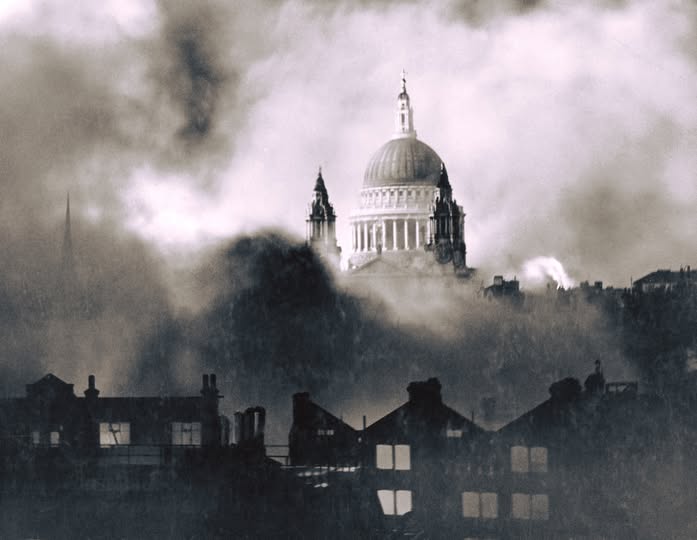
The famous photograph “St Paul’s Survives” was taken by Herbert Mason of St Paul’s Cathedral in London during the air raid that was nicknamed the Second Great Fire of London.
Troops are drafted in to clear the bombed streets of London of rubble and to demolish unsafe buildings.
The encircled 20,000 Italian defenders of Bardia, under merciless siege for 13 days within the ruins of the Libyan base, have increased their artillery fire in an effort to disrupt British preparations for a final assault on the town, it was stated officially today. The Italian artillery fire failed, however, to cause any appreciable damage or interupt preparations for the final assault, “which are proceeding smoothly,” today’s British Army communique said.
The Australian 6th Division continues preparing for its assault on Bardia scheduled for 2 January 1941. Bardia now is cut off from relief by the Australian 16th and 17th Brigade troops. While Tobruk is not invested, the British do have patrols of the 7th Armoured Division in that general area.
An accounting on Malta shows that the Christmas Appeal to fund parties for refugee children provided enough money to fund 45 parties all across the island. Not only was cash raised, but also toys, food, candy, and free entertainment.
Some fighting develops on 30 December 1940 in the central sector in Albania between Greek 2nd Corps and the defending Italians for possession of strategically important Klisura Pass (Kelcyre). The Greeks have not yet launched their main attacks there, but they already are having success against the Italians, who are showing a pronounced willingness to surrender.
Greek forces have broken through strong Italian entrenchments constituting the advance defenses of Valona, Italy’s big Albanian coastal base, the Greek radio reported tonight. The radio said that Greek warriors also had smashed through Italian defenses in the Klisura and Pindus sectors where Italian Bersaglieri units were dislodged. Italian troops in Albania took to skis today to battle the counter-invading Greeks, but the Greek high command announced that the experiment collapsed when the Fascists kicked off their runners and scattered. The scene of the action was not disclosed, but it was one of a series of local engagements in which the Greeks said they took more than 1,000 prisoners, including an entire battalion and its officers, and added to their store of captured Italian guns and supplies. King George II of Greece tonight praised the achievements of his army in driving the Italians out of Greece and expressed confidence that the New Year would bring further successes. A British royal air force communique told of two raids yesterday on Valona.
The Greek High Command decides to continue the advance with only the central Greek force, 2nd Corps, and orders it to take Kelcyre. Bitter fighting ensues, the Italians throwing in 5 divisions, the Greeks three and a half divisions, heavy losses are reported on both sides. But the advancing Greeks, by clever tactics, capture Kelcyre and clear away the Italian salient.
Admiral and Mrs. Leahy arrive in Lisbon onboard the USS Tuscaloosa. They will proceed to Vichy, where the Admiral will take up his post as U.S. Ambassador to France.
Admiral Doenitz, commander of the U-boat fleet, gives a speech to the OKW in which he touts the value of the long-range Focke-Wulf FW Condor patrol planes:
“Just let me have a minimum of twenty Fw 200s solely for reconnaissance purposes, and the U-boat successes will shoot up!”
While they have their own issues, the Condors are the Luftwaffe’s only four-engine aircraft and have proven quite serviceable in actions against the convoys, both from reconnaissance and attack perspectives.
In Germany, UFA releases “Wunschkonzert,” a film set in part at the 1936 Olympics and named after a popular radio program in which soldiers from around the Reich call-in requests for songs. While she does not receive top billing (except on some film posters), the lovely (Dutch) Ilse Werner steals the movie and becomes one of Germany’s top film stars (and also a radio and television star during the war). Werner builds on this success to become known for her trademark whistling as part of her singing act. “Wunschkonzert” becomes the highest-grossing film in UFA history and, in an excellent example of synergy, propels the radio show on which it is based to new heights of popularity. All that said… it is not a very interesting film for modern audiences, with a rote and maudlin love-triangle plot, obvious German propaganda touches and, inexplicably, no singing from one of the Reich’s top singing stars, Wagner.
With Germany pouring soldiers into Rumania at top speed, Hungary called more men to her army today in what some circles viewed as another phase of the vast Nazi preparations for war or any other outbreak in the Balkans. Simultaneously, reports from Sofia, Bulgaria, said German troops were deploying along the Russian border in the northern Dobruja section of Rumania near the disputed Danube river mouth, as well as opposite the Bulgarian shores of the ice-filled Danube river near Giurgiu. The Sofia reports also said the mouth of the Danube, control of which Russia has demanded, had been mined by the Germans, who supervise the river outlet through their domination of Rumania. Thousands of Hungarian men of military age were handed mobilization cards last night and today. This additional call-up coincided with reports of fresh Russian military activity on highways running from Lwow in Russian Poland to the Slovak frontier.
British General Oliver Leese becomes commander of the West Sussex County Division of the Home Defense.
Churchill telegrams the Foreign Secretary to express his wish that Haile Selassie be allowed to re-enter Abyssinia and unite the various tribes in a general revolt against the Italians, with the aid of the 64,000 troops in Kenya.
The Luftwaffe sends only a single bomber over East Anglia and Kent during the day and does not operate during the night of 30/31 December. They have been using X-Gerät beams to guide their bombers and using about ten bombers from KG 100 which are specially outfitted to receive such beams to guide them to the targets.
London digs out from the Second Great London Fire caused by the Luftwaffe raid on the night of 29-30 December. Royal Engineers and other troops are brought in to bring order to ravaged streets and dynamite destroyed buildings in the City of London. The incendiaries have fallen in about a two-and-a-half-mile diameter centered near St. Paul’s Cathedral. The boroughs of Poplar and Westminster, near the Thames River, are hit the hardest. The authorities count a total of 1500 fires, with 52 of them listed as “serious,” 28 as “major,” and six as “conflagrations.”
The Air Staff comes out with new guidelines. They want a person on every building ready to quickly douse incendiaries, which are easy to extinguish if caught quickly. A “fire-watching” system is set up in which everyone is held responsible for protecting their own house or business.
The export version of the Bell P-39 Aircobra, the Bell P-400 Airacobra, is flown for the first time by an RAF pilot in England. Christopher Clarkson takes the plane up and has no issues. The plane is highly touted, and a production run of 675 aircraft destined for England is scheduled.
RAF Bomber Command dispatches 2 Blenheims to north Germany during the day; they turned back.
RAF Bomber Command: 2 Group: Operation Instruction No. 41 — the radio-countermeasures station at Cheadle (Cheshire) would obtain information on enemy operations, usually from the German W/T messages passing after bombing. The Blenheims would be despatched when the estimated time of return of the enemy bombers was known.
The RAF raids Taranto, Naples, and Palermo. This apparently is done by the Wellingtons stationed on Malta.
The Italians raid Malta again. This time, they actually fly over the island and drop some bombs, unlike on the 29th. The raid around 11:30 damages Luqa Airfield but causes no casualties on either side.
In Libya, RAF bombers continued to bomb Italian defensive positions at Bardia and airfields at Tobruk, Derna, Benina.
Destroyer HMS Venomous, which had departed the Clyde on the 29th, was mined at the entrance to Liverpool harbor near the B.2 Buoy. Destroyer Venomous was repaired at Liverpool completing on 18 February.
Hunt-class destroyer HMS Meynell was completed. Following working up, destroyer Meynell was assigned to the 21st Destroyer Flotilla operating from the Nore.
British steamer Calcium (613grt) was sunk on a mine in 53‑25N, 03‑45W. One crewman was killed on the British steamer. Steamer Calcium collided with British steamer Sodium (608grt) while she was alongside providing assistance.
British tanker Dorcasia (8053grt) was damaged on a mine three miles 250° from Bar Light Vessel, Mersey.
The weather is very rough in the North Atlantic, leading to ships colliding and others running aground. The convoy system places numerous ships unusually close to one another, and today that causes some damage.
British steamer City of Bedford (6402grt) of convoy SL.58 was sunk in an accidental collision south of Ireland with British steamer Bodnant (5342grt) of convoy OB.264 in 60‑03N, 23‑01W when the two convoys converged. Rear Admiral J. C. Hamilton Rtd, convoy Commodore in steamer City of Bedford, was lost in the steamer.
Force H, battlecruiser HMS Renown, aircraft carrier HMS Ark Royal, destroyers HMS Faulknor, HMS Duncan, HMS Hasty, HMS Hero, HMS Jaguar, and HMS Firedrake arrived at Gibraltar. Light cruiser HMS Sheffield also arrived escorting steamer Essex. Battlecruiser HMS Renown had suffered weather damage and went directly into dock at Gibraltar.
Heavy cruiser HMS Hawkins arrived at Freetown.
Australian destroyer HMAS Waterhen sank Anti-submarine trawler HMS Bandolero (913grt, Lt Cdr F. M. W. Harris RNR) in an accidental collision in the Gulf of Sollum. There were no casualties in the trawler. Destroyer Waterhen was escorted from the area by destroyer HMS Mohawk and arrived at Alexandria on 1 January. The destroyer was repaired at Port Tewfik in a month.
Convoy OB.267 departed Liverpool escorted by destroyers HMS Amazon and HMS Ambuscade, corvettes HMS Heartsease, HMS Hollyhock, and HMS Marguerite, and anti-submarine trawler HMS Lady Lillian. The escort was detached on 2 January.
Convoy FN.371 A departed Southend. The convoy arrived at Methil on 1 January.
In Washington today, President Roosevelt received a number of callers, including Secretary Morgenthau and Arthur Purvis, head of the British Purchasing Commission. Another was Captain Allen Kirk, American naval attaché in London, who reported to the Chief Executive.
The Senate met and recessed at 12:32 PM until noon Thursday.
The House adjourned at 12:25 PM until noon Thursday.
In next to their last assembling in the longest Congressional session on record both House and Senate met perfunctorily today to go through the motions required by the Constitution — that neither House can recess for more than three days without consent of the other.
Polls suggest that President Roosevelt’s “Arsenal of Democracy” speech was the most successful he has ever given. 75% of the population was aware of it and more than 60% agreed with what he said.
A poll for Fortune magazine shows that where a year ago American businessmen looked unsympathetically on the predicament of Britain and France, now the majority are determined to do whatever need to be done to help Britain defeat Hitler.
Encouraged by countrywide favorable reaction to his “fireside” plea that America make herself “the arsenal of democracy,” President Roosevelt today turned attention to practical steps to speed up the flow of material aid to the countries at war with the totalitarian Axis. He conferred for more than an hour at luncheon with Arthur B. Purvis, head of the British Purchasing Mission, and with him and Secretary Morgenthau went over aid proposals which he expects to lay before the new Congress soon after it convenes. High among these was understood to be the scheme which the President recently outlined of lending or leasing vital equipment and supplies to England as a means for obviating the depletion of that nation’s gold and American resources which the British have said will soon result under the “cash-and-carry plan” of purchases being followed at present. Meanwhile, there were indications that the President might follow up his pledge of “all-out” aid to foes of the Berlin-Rome-Tokyo Axis by extending this same lend-lease plan to such countries as Greece and China, as well as to Britain. Most Important of these signs came from Secretary Morgenthau, who said that his own understanding of the plan was that it “might apply to anybody” — “anybody” meaning any nation at war with one or more of the Axis nations.
The American John Q. Public may have to get along next year with a minimum of mechanical and style changes in his new automobile, washing machine and lawnmower. That was the immediate meaning placed by defense authorities today on President Roosevelt’s statement last night that the production of consumer and luxury goods would have to yield, if and when necessary, to the “primary and compelling purpose” of defense. The greatest “bottleneck” in the rearmament drive, officials asserted, was in the field of machine tools. This industry is loaded down with orders for the machines needed to make airplane engines, guns, shells and other defense equipment. Existing machine tools are also being adapted to defense production in many instances. Consequently, the authorities said the first items of consumer goods that must yield to the manufacture of munitions are those requiring machine tools. New models of automobiles, washing machines, lawnmowers and other mechanical gadgets for the family normally require a large part of the machine tool industry’s output. William S. Knudsen, director of the office of production management for defense, had already indicated to the automobile industry that changes would have to be held to a minimum in 1942 models, and similar action concerning other types of consumer machines is predicted.
Verne Marshall, chairman of the No Foreign War committee, said today that the administration had rebuffed a Nazi offer to negotiate an “honorable and just” peace with the allies through President Roosevelt in 1939, but the State Department promptly announced that it had received “no feasible” peace proposal. Marshall told a press conference that W. R. Davis, New York oil operator who, he said, had sold expropriated Mexican oil to the axis powers before the war, brought the peace offer to this country in a document initialed by Hermann Göring.
Asserting that the idea of a Nazi invasion of America was “fantastic,” Senator Burton K. Wheeler, Montana Democrat, tonight answered President Roosevelt’s plea for greater aid to England with a call for immediate peace in Europe before, he said, America becomes involved in “the insanity” of war. As a “working basis for a just peace, he suggested eight points: 1. Autonomous Poland and Czechoslovakia. 2. Restoration of an independent France, Holland, Norway, Belgium and Denmark. , 3. Restoration of Alsace-Lorraine to France. 4. Restoration of German colonies. 5. Protection of all racial and religious minorities in all countries. 6. Internationalization of the Suez Canal. 7. No Indemnities or reparations. 8. Arms limitation.
California Governor Culbert Olson and Los Angeles Mayor Fletcher Bowron dedicate the Arroyo Seco Parkway (Pasadena Freeway, State Route 110) in California. Note that parts of the freeway were first opened to traffic on 20 July December, but this dedication marks the entire route as open and ready for traffic.
As a fact sheet put out by Caltrans puts it:
“It has the distinction of being the first freeway — a grade-separated, limited-access, high-speed divided road — in the urban western United States. Termed an “engineering marvel,” it was the initial stretch of road for what would become the world renowned Los Angeles metropolitan area freeway system.”
The Arroyo Seco Parkway roadbed remains in the 21st Century exactly where it was laid out in the 1930s. It remains in good shape partly because trucks were banned from it shortly after its construction. Designed to accommodate 27,000 vehicles at an average speed per day, the highway has been widened and now handles about 122,000 vehicles per day. It reverted to its original name in 2010. Incidentally, at the dedication ceremony, five Native American leaders, including Chief Tahachwee of the Kawie tribe that lived in the Arroyo, smoke a 150-year-old peace pipe to celebrate this “modern progress.” It is the first freeway in the western U.S. and is designated as a historic engineering landmark by the American Society of Civil Engineers in 1999.
Vice Admiral Claude C. Bloch, as Commander of the 14 Naval District headquartered at the Pearl Harbor, wrote a letter to the Navy Department concerning the inadequacy of the defenses at Pearl Harbor. In the letter he complained of inadequate local defense forces and pointed out that he had no planes for distant reconnaissance and that for such reconnaissance requisition would have to be made on the forces afloat. His specific complaint is that there are not enough long-range Consolidated PBY Catalina patrol planes to complete a proper search radius of the islands. This letter was forwarded with a strong endorsement by Admiral James O. Richardson, the Commander in Chief of the United States Pacific Fleet.
In fact, Admiral Bloch at no point has a single PBY to perform searches, though he can use some of the Navy’s planes when they are not needed by the fleet. Admiral Kimmel, with no patrol planes, will decide not to conduct air patrols at all despite the occasional availability of planes. Instead, the planes are devoted to fleet protection. There are many practical issues involved in this decision, including the lack of spare parts in Hawaii and the strain that endless patrols would place on the inadequate flight crews.
Admiral Bloch, incidentally, is the highest-ranking Jewish officer in the U.S. armed forces during World War II.
U.S. Navy heavy cruiser USS Tuscaloosa (CA-37) arrives at Lisbon, Portugal, and disembarks Admiral and Mrs. Leahy, who will then proceed to Vichy via Madrid and Barcelona, Spain, and Montpellier, France (see 8 January 1941).
The motion picture “The Hunchback of Notre Dame” opens at the Radio City Music Hall in New York City. Directed by William Dieterle, this drama stars Charles Laughton, Sir Cedric Hardwicke, Thomas Mitchell, Maureen O’Hara and Edmond O’Brien.
Screen Star Clark Gable entered the Johns Hopkins hospital in Baltimore today for examination and treatment of a shoulder injury. He and his actress wife, Carole Lombard, were to remain at the hospital. The shoulder was injured by falling bricks ubout three years ago in filming ths picture “San Francisco.”
The Yankees swap sore-armed Monte Pearson to the Reds for outfielder Don Lang and cash. Tomorrow, they’ll Bump Hadley to the Giants for the waiver price and trade infielder Bill Knickerbocker to the White Sox for catcher Ken Silvestri. The military will claim Silvestri for the next 4 years.
MI-6 agents in Tokyo have interviewed one of the crewmen taken from the Automedon and later landed in Japan by the German-captured Ole Jacob. The crewman reveals that the secret communications carried by the Automedon have fallen into German and Japanese hands. That information, which describes in detail British defenses in the Pacific region, indeed is in the hands of Japanese and German authorities.
Convoy VK.1 departed Sydney for Auckland on the 30th with steamers Empire Star (11093grt), Port Chalmers (8535grt), Empress of Russia (16810grt), and Maunganui (7527grt) escorted by New Zealand Division light cruiser HMS Achilles.
As a result of the German raider attacks on shipping in the Nauru Island area on 6 to 8 December, shipping was organized into the convoys to pass through the Tasman Sea.
Dow Jones Industrial Average: 131.04 (+0.93)
Born:
Philippe Cousteau, French diver and cinematographer, son of Jacques Cousteau, in Toulon, Var department, France (d. 1979).
José Pedro Pérez-Llorca, Spanish lawyer who served as the minister of foreign affairs from 1980 to 1982, in Cádiz, Spain (d. 2019).
James Burrows, American television director (“Cheers”), in Los Angeles, California.
Mel Gibson, NBA guard (Los Angeles Lakers), in Cordova, North Carolina.
Died:
Gjergj Fishta, 69, Albanian Franciscan, poet, translator and politician.
Childe Wills, 62, American automobile designer.
Naval Construction:
The Royal Navy Bangor-class (VTE Reciprocating-engined) minesweepers HMS Bayfield (J 08) and HMS Canso (J 21) are laid down by the North Vancouver Ship Repairs Ltd. (Vancouver, British Columbia, Canada). They are transferred to the Royal Canadian Navy on completion and commission as HMCS Bayfield (J 08) and HMCS Canso (J 21).
The Royal Navy “U”-class (Second Group) submarines HMS Unbroken (P 42) and HMS Unison (P 43) are laid down by Vickers Armstrong (Barrow-in-Furness, U.K.). They are later transferred to the Вое́нно-морско́й флот СССР (ВМФ) (Soviet Navy), becoming the “V”-class submarines V-2 and V-3.
The Royal Navy Bangor-class (Turbine-engined) minesweeper HMS Boston (J 14) is launched by Ailsa Shipbuilding Co. Ltd. (Troon, Scotland).
The Royal Navy “U”-class (Second Group) submarine HMS Umpire (N 82) is launched by the Chatham Dockyard (Chatham, U.K.).
The Royal Navy Flower-class corvette HMS Violet (K 35) is launched by W. Simons & Co. Ltd. (Renfrew, Scotland).
The Royal Navy “U”-class (Second Group) submarine HMS Undaunted (N55) is commissioned. Her first commanding officer is Lieutenant James Lees Livesey, RN.
The Royal Navy Flower-class corvette HMS Kingcup (K 33) is commissioned. Her first commanding officer is Lieutenant Robert Arthur Dillon Cambridge, RNR.
The Royal Navy Hunt-class (Type I) escort destroyer HMS Meynell (L 82) is commissioned. Her first commanding officer is Lieutenant Commander William Howard Farrington, RN.
 History Diaries