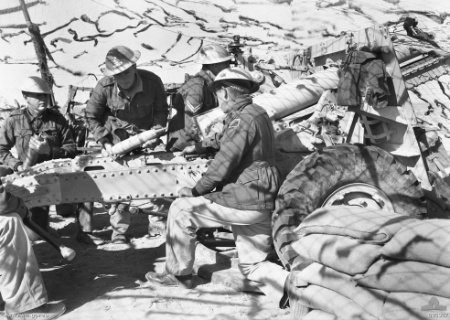
British guns poured shells into the Italian base town of Bardia today in continued preparation for a final attack on the Fascist stronghold in northeastern Libya, 15 miles from the Egyptian border. The British said their guns met “comparatively little response from the Italian garrison.”
A Greek advance guard which penetrated the outskirts of Italy’s northern Albanian base at Lin on Lake Ohrid has been forced to withdraw from the border town and the main Hellenic forces are now preparing for a new attack on it, according to frontier dispatches reaching here today. Greek forces were reported today to have edged closer to Valona, their next goal, by threatening Italian control at three points guarding the approaches to that southern Albanian port. Action continued slow because of heavy snow which has piled up to depths of six feet in some parts of the northern front. A strong north wind has made the weather bitterly cold for two days. At Tepeleni, Greek machineguns were trained on the road connecting with Italian bases to the northwest.
Mussolini sacks Ubaldo Soddu, the Italian commander in Albania, after only four weeks. Ugo Cavallero takes over for Soddu, combining his position as Chief of the General Staff (which he has held for only three weeks) with overall command in Albania. After reviewing the situation, Cavallero concludes that the “period of crisis [was] almost overcome.”
Vichy France created a commission for Jewish affairs.
Estimates of the number of German troops moving across Hungary rose from the original 300,000 to 600,000 today as reports indicated that at least some of them might remain in Hungary. The bulk of them were bound for Rumania. Hungarian and Rumanian censorship blotted out many details of the movement and destination but there were enough confirmed facts to keep the Balkans nervous. Hungary’s minister of agriculture, Michael Teleki, resigned today because, it was reported, he differed with the government over the mass movement of German troops through Hungary. Other dissension within the government also was reported but it could not be learned whether more resignations might be expected.
Belgrade was reported in a state of active apprehension over reports that possibly 350,000 German troops were moving through Hungary and Rumania and that fresh Nazi divisions had been seen along the Italo-Yugoslav border. German patrols were said to be stationed all along rail lines in Hungary. Nazi concentrations were reported along the Rumanian border with Bulgaria and along the Rumanian-Soviet frontier.
Pursuant to the decisions made at the Cairo conference on 28 December, the Australian 6th Infantry Division practices its assault scheduled for the morning of 2 January 1941 using an elaborate mockup of the Italian perimeter.
The Italian troopship Sardegna was torpedoed and sunk by the Greek submarine Proteus, which was then rammed and sunk by the destroyer Antares.
A large German air raid on London using incendiary bombs during the night of December 29-30 is heavy and destructive. The Old Bailey, the Guildhall, and eight churches designed by Christopher Wren including St Paul’s Cathedral are destroyed or badly damaged. 244 German Luftwaffe bombers drop 30,000 incendiaries on the historic city center of London, England, United Kingdom, destroying the London Guildhall and eight Wren churches. St. Paul’s Cathedral, however, is saved by clergymen who successfully prevented the flames on the roof from spreading. Casualties are inestimable. Low water pressure hampers the efforts of fire fighters, but a rain storm sweeping in from the German-held continent aids their struggle. Damage runs into “millions of pounds,” and casualties are believed extraordinarily heavy in a pre-midnight raid that turns the horizon scarlet at dawn. At the height of the raid launched by hundreds of German bombers, ground workers working desperately to control the flames see squadron after squadron of Spitfire and Hurricane fighter planes dive into the midst of the bombers under a roof of brightly illuminated clouds. The fires can be seen for miles; great pillars of flames that sweep the clouds and illuminate the sky clashes between the attacking and defending planes. Many witness this gripping battle despite the rain of explosive bombs dropping down toward the beacon fires. Across this fire-swept panorama in the capital are the struggling shadows of the firemen and volunteers who are tossing hundreds of geysers of water and bags of sand on the flames. But there are so many fires that the water pressure goes low. Cable communications from London to New York are disrupted and wireless contact, too, for a time. After a lapse of several hours the Associated Press correspondent succeeds in getting New York by telephone. In the aftermath the Government orders that “fire-watchers” be stationed on all factories, offices, and shops to act as spotters to provide early warning. This order proves to be very unpopular with Trade Unions.
The Luftwaffe launches a relatively moderately sized raid against London of 136-244 bombers (accounts vary) which only lasts from 18:00 to 21:30. However, it is a very specially planned raid, intended to create a firestorm and timed specifically to coincide with low tide in the River Thames, hampering firefighting efforts. The Germans drop 22,068 incendiaries and 127 tons of high explosives. The attack originally was planned to be a maximum effort lasting all night long, as in September and October, but a storm blows up during the evening and keeps the follow-up bomber waves on the ground.
The incendiaries create a firestorm in the City of London, with over 1500 fires combing in three major centers that themselves later combine. Incendiaries individually are not terribly difficult to deal with, but typically multiple incendiaries fall on roofs near each other, and the small fires they create individually combine to create larger fires.
The headline for the attack is that eight historic Christopher Wren churches are destroyed — which certainly is terrible — but the damage goes far beyond that. It includes the utter destruction of the 500-year-old Guildhall, Paternoster Row with an estimated 5 million books, and about a dozen churches in addition to the Wren ones. This becomes known as the “Second Great Fire of London,” the first being in 1666. Fortunately, for the damage caused, casualties are relatively light, with over 160 civilian deaths, 14 deaths of firemen, and 250 firemen injured.
The number of incendiaries dropped is larger than usual, and the British government quickly takes steps to try and minimize their effectiveness. Incendiaries create powerful effects only if left to work unhindered, so the government mandates fire-watching and makes workers responsible for dousing them at their places of business. Clergymen and 200 volunteer firewatchers (“St. Paul’s Watch,” recruited from the Royal Institute of British Architects) at St. Paul reportedly saves the church by actively patrolling the roof and putting out incendiaries before they can set uncontrollable fires — exactly what the government wants everyone to be doing.
The attack is considered to be the most destructive of the entire war in Britain, with the devastation from Islington to St. Paul’s Churchyard. This attack leaves a lasting impression. Arthur “Bomber” Harris, Deputy Chief of the Air Staff, watches the bombing from the roof of the Air Ministry. He comments: “Well, they have sown the wind.”
Two Gloster Gladiators of the Irish Air Force fail to intercept a Luftwaffe Ju-88 that penetrates Irish airspace from Waterford over to Dublin. AA fire also fails to hit the intruder.
RAF Bomber Command dispatches 27 Blenheims, Wellingtons and Whitleys overnight to Frankfurt, Hamm, Boulogne and airfields, but few aircraft reached these targets. 2 Wellingtons were lost.
For the first time in weeks, the Italians raid Malta with multiple bomber formations. However, as has often been the case during the war, the Italian bombers remain offshore and do not drop any bombs on the island.
The RAF raids Bardia and Italian airfields at Tobruk, Derna, and Benina.
Hunt-class escort destroyer HMS Cottesmore was completed, and following working up, was assigned to the 21st Destroyer Flotilla operating from the Nore.
Destroyer HMS Blencathra departed Scapa Flow at 0130 to search for a British aircraft in the sea 10° east of South Ronaldsay. The aircraft was not located and she was ordered to return to Scapa Flow at 1300 that day.
Destroyer HMS Eskimo, escorting battlecruiser HMS Repulse, was detached in 60-05N, 21-50W to escort destroyer HMS Worcester to the Minches. Eskimo arrived at Scapa Flow at 1050/31st.
Submarine HMS Trident stopped Panamanian steamer Router off Ponta Delgada and fired torpedoes at her when she tried to enter port. Royal Navy submarine HMS Trident (Lt.Cdr. G.M. Sladen, DSC, RN) spots a “darkened ship” entering Punta Delgada, Azores. After the ship acts suspiciously and suddenly breaks for the harbor entrance, the Trident fires five torpedoes at it — which all miss and some of which explode on Delgada Point, constituting possibly the only war damage in the Azores. The submarine almost is sunk by one of its own torpedoes which “failed to discharge” and simply falls to the ocean floor beneath the Trident and explodes. The ship, meanwhile, turns out to be the 4856-ton Panamanian Bonita, whose captain perhaps thought the British sub was a U-boat.
German steamer Adriana (997grt) was sunk on a mine off the Elbe.
German 5642-ton freighter PLM-23 runs aground in a storm off Scharhörn in the Wadden Sea and is written off. This formerly was a French ship which the Germans seized on 5 August 1940.
Steamer Trevarrack (5270grt), straggling from convoy SLS.58, was damaged by German bombing in 55‑34N, 09‑30W. Destroyers HMS Highlander and HMS Harvester went to her assistance.
Steamer Catrine (5218grt) was damaged by a mine in Liverpool Bay and next day, the 30th, struck a second one near Q.1 Buoy, Queen’s Channel, Liverpool.
Tug Monarch (41grt) was sunk by German bombing off Radcliffe Cross Buoy.
Destroyer HMS Newport was out of service with only one engine working.
Destroyer HMS Salisbury was out of service with condenser problems.
Aircraft carrier HMS Argus and light cruiser HMS Dunedin with destroyers HMS Fortune and HMS Foxhound arrived at Gibraltar with steamers Northern Prince, Clan Macdonald, and Empire Song of the WS.5 A convoy on the 29th.
Aircraft carrier HMS Furious, light cruiser HMS Dunedin, destroyers HMS Forester and HMS Fury departed Gibraltar for Freetown.
Anti-aircraft cruiser HMS Bonaventure arrived at Gibraltar.
Submarine HMS Unique departed Gibraltar for Malta, arriving 6 January.
Italian steamers Sardegna (11,452grt), Italia (5203grt), and Piemonte (15,209grt) departed Valona for Brindisi for Valona escorted by torpedo boat Antares on the 29th. Greek submarine Proteus sank Italian steamer Sardegna east of Saseno in 40-31N, 19-02E in the Southern Adriatic. However, torpedo boat Antares sank Proteus (Lt Cdr M. Hatsikostantis) in the counterattack.
Destroyers HMS Jervis, HMS Nubian, HMS Mohawk, HMS Juno, HMS Greyhound, and HMS Griffin departed Alexandria to carry out an anti-submarine sweep. The sweep was covered by light cruiser HMAS Perth and anti-aircraft ship HMS Coventry. Ship Coventry’s T/bow fell off in heavy seas and she was forced to return to Alexandria. The destroyers returned to Alexandria on the 30th after making no contact.
Australian destroyer HMAS Voyager intercepted and brought in Italian ketch Zingarella (190grt) which was transporting British prisoners of war from Bardia to Tobruk.
Convoy FN.371 departed Southend, and arrived at Methil on the 31st.
Convoy FS.374 departed Methil, escorted by destroyers HMS Vimiera and HMS Worcester and sloops HMS Hastings and HMS Weston, and arrived at Southend on 1 January.
Convoy FS.375 departed Methil, escorted by destroyers HMS Vesper and HMS Vortigern and sloop HMS Londonderry, and arrived at Southend on 1 January.
A total of 31 ships of convoy OG.48 joined up from Liverpool, Oban, Glasgow and Bristol, and were escorted by destroyer HMS Westcott and corvette HMS Candytuft from 29 December to 2 January. Sloop HMS Scarborough escorted the convoy from 29 December to 4 January when she was detached. Sloop HMS Folkestone escorted the convoy from 30 December to 9 January. Corvette HMS Bluebell joined the convoy on the 30th and was detached on 2 January. The convoy arrived at Gibraltar on 9 January.
Convoy HG.49 of twenty eight ships departed Gibraltar. The convoy was given a local escort by anti-submarine trawlers HMS Kingston Jacinth, HMS Kingston Chrysolite, HMS Kingston Turquoise, and HMS Kingston Topaze on the 29th. Sloop HMS Leith escorted the convoy from 29 December to 15 January. Sloop HMS Bridgewater from convoy SLS.60 escorted the convoy on 3 January before transferring to convoy SW 5B. Destroyers HMS Georgetown and HMS Anthony, CAM ship HMS Pegasus, corvettes HMS Heather and HMS Picotee, and anti-submarine trawlers HMS Lady Madeleine and HMS Arab joined the convoy from convoy OG.49 on 11 January. These ships remained with the convoy until its arrival at Liverpool on 15 January.
Convoy BN.11B departed Aden, escorted by light cruiser HMS Caledon and sloops HMS Auckland and HMS Shoreham. Sloop HMS Yarra joined on the 31st. The escorts were detached on 1 January. The convoy arrived at Suez on 4 January.
U.S. President Roosevelt, in one of his famous “fireside” chats, tells the American people that he wishes the United States to become the “arsenal of democracy” and to give full aid to Britain regardless of threats from other countries. President Roosevelt used the phrase “Arsenal of Democracy” during a radio address promising to help the United Kingdom fight Nazi Germany by providing them with war supplies.
President Roosevelt broadcasts a fireside chat, urging the country to increase production in preparation for war and to become the “arsenal of democracy”, but also promising to keep the United States out of the fighting. In his broadcast to the American nation, President Franklin Roosevelt declared that the United States would not be deflected, by Axis threats, from its policy of providing Great Britain and her Allies with all possible aid short of war. He further declared that the risk of war would not deter America in the slightest degree, and that victory by those resisting aggression was of paramount interest to the United States, and that he was confident that the Axis powers would not win the war. President Roosevelt tonight flatly rejected proposals that the United States initiate a peace movement, promised that American soldiers would not be sent to Europe, and confidently predicted that the axis powers would lose the war. He appealed to the nation to turn itself into a “great arsenal of democracy,” and pledged that his government would expand its short-of-war aid to Great Britain. The president defended American aid to China, asserting that Chinese resistance to Japan is helping keep aggression away from the shores of the United States and is an essential part of American policy which rests on almost unlimited aid to Britain. Without mentioning Adolf Hitler or Benito Mussolini by name, he attacked the German and Italian dictators in scathing and defiant terms, asserting that no “threat” from either of them could weaken American determination. The “new order” which the Rome-Berlin-Tokyo axis professes as its objective was denounced by Mr. Roosevelt as an “unholy alliance of power and self to dominate and enslave the human race.” He asserted that this nation’s ability to keep out of the war will be affected by the outcome of the Battle of Britain. “Our national policy is not directed toward war,” he said. “Its sole purpose is to keep war from our country and our people.” He said that national defense production must not be impeded by strikes or lockouts. Similarly, he said that Americans must “discard the notion of ‘business as usual’,” and that the defense effort “must not be blocked by those who fear the future consequences of surplus plant capacity,” because “the possible consequences of failure of our defense efforts now are much more to be feared.” The nation’s present efforts, he said, “are not enough.” He called for “more ships, more guns, more planes, more of everything.”
He concludes that “I believe that the Axis powers are not going to win this war,” and sets forth the agenda:
“I have the profound conviction that the American people are now determined to put forth a mightier effort than they have ever yet made to increase our production of all the implements of defense, to meet the threat to our democratic faith. As President of the United States, I call for that national effort.”
Reading or listening to the speech out of context, one could easily assume that the United States is at war and fighting for its life. Instead, the reality is much different: there is a war, but the United States is not part of it, and there is no sign that it ever need be a part of it. However, the thrust of the “Arsenal of Democracy” is clear: the Axis must be defeated, and the United States is going to make that happen. The strategy appears to be, at least for the moment, to build the weapons but let the British and Britain’s fighting allies take the casualties. This speech is generally viewed as introducing the concept of “Lend-Lease” to the American people, though Roosevelt had used that phrase previously and does not use those words in this address.
After listening to President Roosevelt’s radio address tonight, official Washington got set for action on the program outlined by the President. The form and extent of that action probably will not develop until after the new Congress convenes and receives the definite proposals which the Administration is expected to submit, but the Presidential address left little doubt in its wake that a policy had been enunciated which would be translated forthwith into official action. Among persons conversant with the situation there seemed to be little question after the President’s address that steps would soon be taken by this government to commandeer for the benefit of the British several hundred thousand tons of foreign shipping tied up in American waters as a result of the war. The legal basis for this move is understood to have been laid and the matter awaits only a fundamental decision of policy which President Roosevelt is expected now to make in the next few days and in favor of informal British requests for this measure of assistance.
As far as national defense was concerned, there was little doubt that the President’s demand that the United States be made an “arsenal of democracy” would have overwhelming legislative support. Attacks upon it, if any are made, are likely to be sporadic and isolated. Even in the matter of aid to Britain there were few, if any, among the extreme isolationists who took direct issue with the President. Indeed, the so-called non-interventionists took up a position in what might be called the “reserve trenches” in a demand that the President affirm and reaffirm his determination to keep the United States out of the war at all honorable costs. Only a few Congressional leaders were in Washington tonight; most of them were away for the holidays. Those who could be reached for comment on the speech expressed no disapproval of the President’s insistence on all possible efforts to build up a strong defense for the Western Hemisphere.
President Roosevelt’s address tonight brought a mixture of praise and criticism, with Senator McCarran, Nevada Democrat, expressing disappointment that the chief executive had not made “a positive statement” that this country would not become involved “in foreign entanglements.” Senator Schwartz, Wyoming Democrat, told reporters that “it does no harm to tell the truth, and that is what the president has done.” “It was a very able statement,” Schwartz continued. “It very clearly explains the actual facts and outlines a program that the American people will support. It will cut the ground from under a lot of isolationists who have not thought through the situation.” From Senator Johnson, Colorado Democrat, came a statement that there was “nothing new” in the president’s address. McCarran declared that he had hoped “the president would be more explicit with the people of the country as to what we were actually doing for national defense and as to what we were doing to keep out of foreign wars.”
The administration, according to an AP dispatch, is drafting a $17 billion budget for fiscal 1942 (begins in September 1941). This includes $10 billion for armaments.
U.S. Secretary of War Henry Stimson tells President Roosevelt (according to his diary entry of this date):
“You cannot build a civilization based upon the questions of religion, which is what our civilization has been based on, and not recognize questions of right and wrong in the dealings between nations.”
Secretary of War Stimson urges that the U.S. Navy be used to escort convoys to the UK.
Superman co-creator Joe Shuster was arrested in Miami Beach, Florida for the “suspicious behavior” of looking into an automobile as if preparing to steal it. The following day he was sentenced to 30 days in prison until someone thought to give Shuster a pen and paper so he could prove his identity. Shuster drew a perfect illustration of Superman and the police let him go free.
The New York film critics announced today they had chosen “Grapes of Wrath” as the best motion picture of 1940 and awarded their best-performance scrolls to Charles Chaplin as “Phooey” Hynkel in “The Great Dictator” and to Katharine Hepburn as Tracy Lord in “The Philadelphia Story.” John Ford was voted the year’s best director for “Grapes of Wrath” and “The Long Voyage Home.” Last year he was named for his work on “Stagecoach.” The critics’ special award went to Walt Disney, Leopold Stokowski and their associates for the production of “Fantasia.” The French film, “The Baker’s Wife,” starring Raimu, was voted the year’s best foreign-language picture.
The reigning NFL champion Chicago Bears defeated an all-star team 28–14 in the National Football League All-Star Game at Gilmore Stadium in Los Angeles.
Large scale hostilities flared again today along the French Indo-China frontier, and the Thai [Siamese] High Command declared French forces had retreated after two clashes. The communiqué said the French left arms and ammunition behind when they were forced back yesterday in the Aranyapredes district. A later engagement, in which large forces of Indo-Chinese troops were said to have been involved, was reported to have lasted two hours. Then, the communiqué said, the French again were repulsed with many casualties. The communiqué reported also that the Thai Navy had left for “defense measures” in the Gulf of Siam, south of the disputed frontier.
Authoritative circles in Hanoi, the capital of French Indo-China, alleged today that the Japanese planned a coup d’état in Thailand simultaneously with increased Japanese pressure for bases in Southern Indo-China where agents of the Japanese-sponsored Chinese Government were alleged to be spies for Thailand. These sources said an intercepted letter from Tokyo, addressed to a Japanese commercial agent in Bangkok, had disclosed that four Japanese en route to Bangkok as a good-will mission had been instructed by the government to organize a coup d’état by the Thai Army, which has been receiving increased aid from Japan. This increased aid, these sources said, included thirty-three pursuit planes and twenty-five bombers delivered early in December. The freighter Bangkok Maru, it was said, was en route to Bangkok with 950 tons of munitions and guns and another ship was sailing from Japan soon with tanks.
French Indo-China authorities are seeking to combat Japanese pressure for a foothold in Southern Indo-China while combating Thailand’s anti-French activities. Japanese army officers in Hanoi recently flew frequently to Bangkok, causing the French to suspend their air line to halt espionage. But a Japanese line still is operating. Japanese “tourists” in Southern Indo-China are increasing in number and seek to penetrate French military zones in Cambodia and Laos, it was said. Thirty Japanese were recently accompanied on a tour of the south by Japanese officials. They tried to enter the zones. Earlier the French arrested two carloads of Japanese, including eight officers. They were returned to Saigon under escort.
Information reached Manila that the European war was being extended into the sea lanes of the Pacific both by Nazi surface raiders and by the work of Axis agents. These agents, it was said, sabotage British and Allied cargoes in neutral ports and place time bombs aboard British and Allied vessels. Reports circulated that Germany was urging Japan to drive to the south against Indo-China and the Netherlands Indies in an effort to embroil the United States in difficulties in the Orient.
Born:
Brigitte Kronauer, German author (“The Scheik of Aachen”), in Essen, Germany.
Peter Koelewijn, Dutch rock musician and songwriter (“Get Off That Roof”), in Eindhoven, Netherlands.
Jeannot Gilbert, Canadian NHL and WHA centre (Boston Bruins, Quebec Nordiques), in Grande Baie, Quebec, Canada.
John Upham, Canadian MLB pinch hitter, pitcher, and outfielder (Chicago Cubs), in Windsor, Ontario, Canada.
Naval Construction:
The Royal Navy Isles-class minesweeping trawler HMS Pladda (T 144) is laid down by Cook, Welton & Gemmill (Beverley, U.K.); completed by Holmes.
The Royal Navy Hunt-class (Type III) escort destroyer HMS Derwent (L 83) is laid down by Vickers Armstrong (Barrow).
The Вое́нно-морско́й флот СССР (ВМФ) (Soviet Navy) “K” (Katjusa)-class submarine K-56 is launched by Baltiyskiy Zavod (Leningrad, U.S.S.R.) / Yard 189.
The Вое́нно-морско́й флот СССР (ВМФ) (Soviet Navy) “M” (Malyutka)-class (3rd group, Type XII) submarine M-102 is commissioned.
The Вое́нно-морско́й флот СССР (ВМФ) (Soviet Navy) “M” (Malyutka)-class (3rd group, Type XII) submarine M-103 is commissioned.
The Royal Navy Hunt-class (Type I) escort destroyer HMS Cottesmore (L 78) is commissioned. Her first commanding officer is Lieutenant John Charles Anthony Ingram, RN.
 History Diaries