Italy asked Germany for assistance in the Greco-Italian War. Mussolini formally requested German aid against the Greeks in Albania. At first Hitler is prepared to send in one of his experienced mountain divisions, but then changes his mind and refuses to become involved.
Greek I Corps, operating in the coastal sector, captures Nivitsa on 28 December 1940. About 580 Italians surrender. The Italian Regia Aeronautica raids Preveza, which is an important Greek naval base.
Greek commander-in-chief, Alexandros Papagos decides to call a halt to the Greek offensive. The Greek advance has been sputtering for some time, given the twin difficulties of winter weather and firmer Italian resistance, and the Italians have been reinforcing their troops in Albania. This order will take effect on 6 January 1941, but in essence, the offensive ends on today’s date. Local offensive operations continue, but they are of no strategic significance. The Greeks have saved their country (for the time being) and advanced into Albania, but they have captured virtually no points of true strategic significance during their advance through the mountains and along the coast. The Greek offensive becomes known as the Epic of 1940.
The concentration of British forces about beleaguered Bardia was officially reported proceeding “smoothly” today, while British artillery thundered steadily at that vital Italian base in Libya. Advance motorized detachments went on clearing the country to the west, general headquarters announced, and four additional Italian guns were captured. The number of Fascist prisoners of war in hand and counted was put at 38,114, some 10,000 of them non-Italians. To these captives the British attributed two stories that the Italian defenders of Bardia, ordered by Premier Mussolini himself to “die rather than give up,”, would turn that base into a “second Alcazar” and that the Italian command was urgently strengthening the defenses of the port of Tobruk, to the west, in fear of any early British attack there. The reference to Alcazar was to the 10-week defense of Spain’s military academy at Toledo during the civil war by the forces of Francisco Franco.
British monitor HMS Terror bombarded Bardia, Libya keeping up pressure on the 40,000 besieged Italian troops.
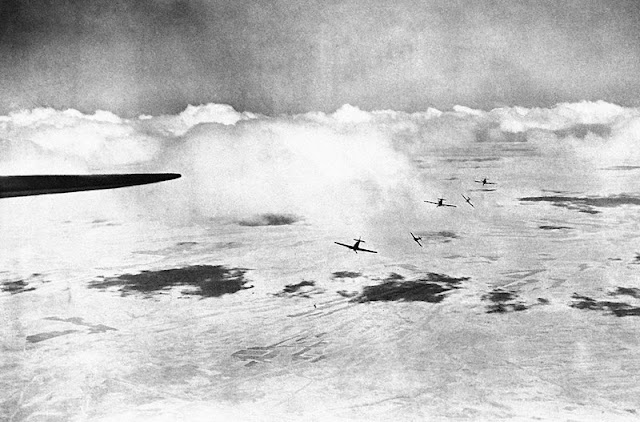
The Australian 6th Division is in their first action near Bardia. This is the Second Australian Imperial Forces’s first battle and involves an attack on an Italian frontier fortress. The preliminary operations began several days before the main attack was launched. The Australian 6th Division is moving into position opposite Bardia and its 40,000 Italian troops. It has not seen action yet, and today exchanges shots with the Italians for the first time. Monitor HMS Terror bombards Bardia, unmolested by the Italian air force, which is getting mauled by the RAF. Hawker Hurricanes today shoot down three Italian bombers and a CR 42 fighter. The CR 42 biplanes clearly are outclassed by modern aircraft, particular when opposed by experienced RAF pilots who know how to counteract the biplanes’ greater maneuverability.
General Wavell, Commander of British forces in the Middle East, meets in Cairo with General Richard O’Connor, Commander of the Western Desert Force, and Major General Iven Mackay, commander of the 6th Australian Division (16th, 17th, and 19th Australian Infantry Brigades). Mackay’s troops are designated to lead the assaults on Bardia and Tobruk, with the advance in Libya to have priority over everything else. Thus, Mackay forms his own time and plan of attack.
Mackay sets the offensive start date as 05:30 on 2 January 1941. Studying aerial photographs, he sees that the Italians have two main defensive lines fortified with concrete bunkers, anti-tank ditches, and barbed wire. Overcoming this will require extensive artillery support to blow holes through the defenses. Mackay’s plan:
— Seize a “bridgehead” through the first line of defenses by isolating the area with artillery preparation and staging demonstration attacks elsewhere on the 17-mile line;
— Immediately follow with combat engineers to fill in the anti-tank ditch, cut the wire and clear the area of mine.
— Funnel I-tanks through the gap and overcome the heaviest Italian defenses in the southern part of the line.
The Australians build a full-scale replica of the Italian defensive line for practice. This helps to time the start of the operation so that daylight breaks just as the breakthrough is achieved (in theory).
Italy’s Virginio Gayda topped an axis press offensive against the sending of American supply convoys to Britain by way of neutral Ireland with the assertion today that this would start the war spreading to the western hemisphere and the Pacific ocean. The editor of II Giornale d’ltalia said Japan, tied to Rome and Berlin by an “all for one and one for all” pledge against outside intervention in eastern or western war, is “watchful” and “with her large means and wide Asiatic influence, would not allow without immediate reaction an extension of the European and Asiatic conflict.” “Direct responsibility,” Gayda warned, would fall on the Washington government for the “reaction” which such “intervention” would provoke on the part of the axis and Japan. Gayda, like Berlin commentators of yesterday, declared the dispatch of American convoys to Ireland would be an open violation of United States neutrality, tantamount, in the axis view, to the beginning of United States intervention in the war. He indicated the axis powers would make every effort to prevent such ships from reaching their destinations.
As the world media has been noticing recently, about 500,000 German troops are in the process of passing through Rumania to Bulgaria in preparation for Operation MARITA, the projected invasion of Greece. The Deutsches Heeres Mission in Rumania (DHM), under the command of General Erik Hansen, keeps the Rumanian government informed. The forces assembling are the 12th Army under the command of Field Marshal Wilhelm List. While List outranks Hansen, this is a delicate situation requiring extreme tact both with the two host countries — Rumania and Bulgaria — and the very interested outside observers, the Soviet Union and Great Britain.
The Army High Command (OKH) wants to reinforce the impression that the German presence in Rumania is only, as billed, for training purposes, so the division-sized DHM technically controls Field Marshal List and Twelfth Army. Liaison staffs are competent at what they do, but they are not equipped to control the operations of an army, so this places a strain on German deployments.
This information comes from Oberkommondo des Heeres (OKH), “Instructions on Command Relationships in Rumania,” December 28, 1940, BA-MA RL 2 II/271. I point this out because there are two competing commands in the Balkans, OKH and OKW (the overall Germany military high command). While the OKW technically is superior and controls not only the army but the Luftwaffe and Kriegsmarine, the army is the overwhelmingly dominant military force in Eastern Europe. OKH begins its practice of basically doing what it wants and resenting “interference” by OKW. This bifurcation of authority — basically, both commands exert equal authority within the theater — is a brewing problem that eventually will have to be addressed. For now, however, there are no major disagreements between the two command staff.
Vichy France remains an important world power outside the confines of European France. Today, it sends General Henri Dentz to Beirut to take command of French forces there. These forces have an uneasy relationship with the British next door in Palestine.
The Luftwaffe focuses on England’s south coast today, hitting Southampton both during the day and after dark. German bombers attacked two destroyers under construction at Southampton, England, United Kingdom; future destroyer Norseman was blown in half, and future destroyer Opportune was also heavily damaged.
RAF Bomber Command dispatches 59 Hampdens, Wellingtons and Whitleys overnight to Rotterdam, Antwerp, Boulogne and Lorient. 1 Hampden and 1 Whitley lost 7 Hampdens minelaying off Kiel and St-Nazaire.
The issue of bomber accuracy has been brewing with the RAF for some time. Today, the RAF completes a detailed examination of aerial photo-reconnaissance of 24 December 1940 attacks on two oil installations at Gelsenkirchen. That oil target has been targeted several times. Gelsenkirchen has two oil plants. The attacks to date have involved the following attacks:
— Plant No. 1 — 162 attacking aircraft — 159 tons of bombs.
— Plant No. 2 — 134 attacking aircraft — 103 tons of bombs.
The RAF uses as its yardstick that 100 tons of bombs should eliminate an oil plant. Both of the Gelsenkirchen plants have received that much attention, and Plant No. 1 has received over 50% more than that amount. Post-raid reports suggest that there should be 1,000 craters in the vicinity of the oil plants. However, the photos show that neither plant has sustained any major damage, and there are only about a handful of craters in the vicinity.
This provides evidence that targeting specific targets is ineffective. This conclusion is buttressed by the recent experience at Mannheim, where Bomber Command targeted the city center — but completed major targets there such as the railway station. In fact, many of the bombs did not even hit Mannheim, with some bombers releasing their bombs on nearby cities or to no purpose. These results begin to call into question Bomber Command’s “Oil Plan,” in which German oil infrastructure receives bomber priority. However, for now, the British continue assigning priority to refineries and the like.
German heavy cruisers Scharnhorst and Gneisenau begin Operation BERLIN, an attempted breakout into the Atlantic together. However, severe storms damage Gneisenau, forcing the two ships back to port within a few days. Scharnhorst goes to Gotenhafen (Gdynia), while Gneisenau gets repaired at Kiel. This operation is under the command of Admiral Günther Lütjens.
Light cruiser HMS Bonaventure spotted the German blockade-runner Baden (8204 GRT) en route from the Canaries to France and sank her by torpedo. A capture was not possible due to bad weather.
Battleship HMS Nelson and destroyers HMS Bedouin, HMS Tartar, HMS Sikh, and HMS Beagle departed Scapa Flow at 1415 to patrol eastward of the Iceland Faroes Channel. Light cruiser HMS Edinburgh was ordered to join this force in 63N, 03-55W at noon on the 29th. This force remained at sea until 1100/31st when it returned to Scapa Flow.
Anti-aircraft cruiser HMS Curacoa departed Scapa Flow at 1000 and escorted convoy WN.60 from the Pentland Firth. The cruiser was detached after dark, but due to poor visibility, she could not enter Scapa Flow until the next morning.
Polish destroyer ORP Piorun departed Greenock at 1315 to work up at Scapa Flow. The destroyer arrived at Scapa Flow at 1230/29th.
Destroyers HMS Vimy and HMS Bulldog departed Scapa Flow at 0845 to meet light cruiser HMS Mauritius in Pentland Firth and escort her to the Clyde, arriving on the 29th. Destroyers HMS Southdown and HMS Tynedale, which had been escorting cruiser Mauritius, proceeded to Scapa Flow. Destroyer Vimy left the Clyde to refit at Portsmouth where she arrived at 1050/31st. Destroyer Bulldog left the Clyde to refit at Liverpool where she arrived on the 30th.
In a German bombing raid on the Thornycroft yard at Southampton, destroyers HMS Norseman and HMS Opportune, under construction, were badly damaged. Destroyer Norseman was almost blown in half.
Destroyer HMS Valorous was damaged in a collision with minesweeping trawler HMS Libyan (202grt) in Sheerness Harbor. The destroyer was repaired at Chatham completing on 11 January.
British steamer Lochee (964grt) was damaged on a mine four miles northeast by north of Bar Light Vessel, Mersey.
Tug Canute (271grt) was damaged by German bombing at Southampton.
German battleships Scharnhorst and Gneisenau departed Kiel to raid in the Atlantic. However, the German ships had to return to Kiel on 2 January when Gneisenau was damaged by heavy weather.
Ocean boarding vessel HMS Camito intercepted French trawler Senateur Duhamel (913grt) in 33‑44N, 10‑26W. The trawler was taken to Gibraltar.
Monitor HMS Terror bombarded the Bardia area.
Light cruiser HMS Southampton after joining convoy WS.4B in mid-December at 22°S, arrived at Suez with the convoy on the 28th.
Aircraft carrier HMS Furious escorted by destroyers HMS Faulknor and HMS Firedrake arrived at Gibraltar on the 28th. The destroyers Faulknor and Firedrake with HMS Hasty and HMS Jaguar immediately went back out to sea at 1100/29th and escorted aircraft carriers HMS Ark Royal and HMS Renown into Gibraltar the next day.
Light cruiser HMS Neptune departed Freetown.
Heavy cruiser HMS Cornwall arrived at Simonstown.
Convoy OB.266 departed Liverpool escorted by destroyers HMS Scimitar and HMS Skate, corvette HMS Clarkia, armed boarding vessel HMS Crispin, and anti-submarine trawler HMS Man O War. The convoy was joined on the 29th by corvettes HMS Arabis and HMS Mallow, and anti-submarine trawlers HMS Northern Dawn, HMS Northern Pride, and HMS St Elstan. The escort, less the armed boarding vessel, were detached on the 31st. Crispin was detached the next day.
Convoy FN.370 departed Southend, escorted by destroyer HMS Garth. Destroyer HMS Versatile and patrol sloop HMS Widgeon joined on the 29th. The convoy arrived at Methil on the 30th.
President Roosevelt worked long hours today on the report on defense and aid to Britain to be given the nation tomorrow night in a radio address which some officials believed would be his most important since the European war began. As the chief executive revised a rough draft dictated on Christmas eve, organizations and individuals continued to write and telegraph suggestions for the talk, and a prominent Democratic senator Wheeler of Montana issued a warning against going too far on the British help question lest the United States become embroiled in the conflict. When Mr. Roosevelt broadcasts from his study from 9:30 to 10 PM tomorrow over major networks, it will be his fifteenth “fireside chat” since he entered the White House. The last was on May 26, 1940.
A preliminary audit of British resources in the United States has revealed that Great Britain will run out of cash to pay for purchases of arms and munitions here “in the early Autumn” of next year, authoritative sources disclosed today.
Sixty percent of American voters favor aiding Britain, even at the risk of getting into the war, a new survey by the American Institute of Public Opinion has shown, according to Dr. George Gallup, its director.
The War Department announced late today that it is sponsoring an intensive drive to “farm out” certain defense orders to small firms in an effort to speed up the rearmament program. The War Department will at once apply the British formula of “bits and pieces,” Americanized through the “farming out process,” to the national defense program to speed production. Joseph L. Trecker, president, and his brother, Francis Trecker, assistant chief engineer, of the Milwaukee milling machine firm of Kearney & Trecker, have been appointed dollar-a-year men to direct the “farming out” program because of their success with French war orders. The department said that Kearney & Trecker had been working twenty-four hours a day, seven days a week, in the manufacture of equipment under the defense program and had been able to maintain a steady flow of production because of the farming out of production to hundreds of small firms located at places ranging from Marblehead, Massachusetts, to Kansas City.
The No Foreign War Committee sent to President Roosevelt tonight a telegram, signed by 3,500 “common people,” urging him “not to lend or give away the defenses of the nation.”
Complete reorganization of the personnel of the National Labor Relations Board with a view to eliminating those employes who have shown bias and a partisan attitude as well as those who have indicated their objection to “the American system of government,” was recommended today in the final report of the House committee investigating the NLRB and the National Labor Relations Act. The report asserted that the board’s actions had jeopardized “the entire program of national defense” and the fundamental concepts upon which the government is based.
The committee called on Congress to study the entire field of labor relations, reiterated its earlier report on the need for amending the Wagner Act and suggested that the Senate follow the action of the House in adopting seventeen amendments. The report asserted that the committee’s inquiries had revealed the existence of a large group of board employees motivated by concepts of class conflict and influenced by leftist doctrines. They fraternized with Communist sympathizers, it was said, and in other ways had convinced the committee that they were “unfit for the task of fair and impartial administration of the act.” Prompt dismissal also was recommended of all board employees who were members of the former League for Peace and Democracy and the League Against War and Fascism.
The labor division of the National Defense Advisory Commission was swamped today with messages from officials of the American Federation of Labor, the Congress of Industrial Organizations and the railroad unions protesting against the War Department’s award of an order of $1,387,500 for 1,500 light reconnaissance ears to the Ford Motor Company. The War Department announced confirmation of this contract yesterday, overruling Sidney Hillman, labor defense commissioner, who had protested when the contract was made, November 27. He charged that the Ford labor policies were In conflict with the Wagner Act.
About five million aliens were listed under the law requiring their registration in the United States.
U.S. Army officers said today that military plans called for eventual concentration of at least 500 army planes in Hawaii. They noted also that this force could be reinforced whenever needed by overnight flights from the Pacific coast. The army, they added, planned to replace the B-18 bombers in Hawaii with a larger four-motored type of bomber, but the change might be delayed because of planes being sent to Britain. They indicated that when the larger bombers arrived an undisclosed number of B-18’s would be transferred to the Philippines. The War Department, according to the officers, had redesignated the 18th bombardment wing at Hickam Field as a heavy type wing, effective January 1, and decided to form three squadrons in Hawaii. The air force personnel in Hawaii now number 6,000 officers and men.
Warner Bros. releases “Santa Fe Trail,” a rousing pre-Civil War actioner directed by Michael Curtiz about the insurrection led by abolitionist John Brown. This is one of two wartime films in which Ronald Reagan and Errol Flynn appear together (the other is “Desperate Journey” (1942)). Also appearing is Alan Hale, (the father of Skipper from Gilligan’s Island). Raymond Massey absolutely walks away with “Santa Fe Trail,” playing a messianic, demented John Brown who feels a personal calling to free the slaves. Why it is named “Sante Fe Trail,” incidentally, is one of those enduring mysteries, though the trail does kind of feature in the early parts of the film. This film marked a major step up in Ronald Reagan’s career after he blew out the stops in “Knute Rockne, All-American” as George Gip.
This is part of a brief round of films portraying (later) Confederate soldiers in a positive light. In that sense, it follows in the tracks of “Gone With The Wind” (1939), but this suffers by being filmed in black and white (though with the novel Vitasound process). This film could not get made today with the same political orientation, at least by a major studio. It is in the public domain.
Michael Curtiz, incidentally, was born Mihaly Kertesz in Hungary fought in World War I for the Austro-Hungarian Army and emigrated to the .U.S in 1926. You might remember his film from a couple of years after this, “Casablanca,” and maybe “King Creole” (1958) starring some guy named Elvis Presley. Supposedly, one of the most focused, single-minded directors ever, even after all his success, at the end of his life he was living in a small apartment in Sherman Oaks (and still making top films). Truly one of the greats in Hollywood history, not a doubt about it, even though he is little-remembered. “Santa Fe Trail” is one of his best films, too. “A great day for the Hungarians” — bonus points for you, if you know what film that, is from.
Official circles in Singapore believe that the clash between Thailand and Indo-China is largely the result of Japanese instigation on both sides and that Japan is “fishing successfully in troubled waters.”
Foreign Minister Yosuke Matsuoka asserted today that “Japan is in great sympathy with the present hard plight of France and has not the slightest intention of taking advantage.”
Richard Sorge, a long-time Soviet “sleeper” operative who pretends to be a strong Third Reich supporter, works as a correspondent in Tokyo for the Frankfurter Zeitung. A hearty, hail-fellow-well-met party-thrower type, Sorge disingenuously pumps his contacts at the German embassy for secrets while they are enjoying his cocktails and the ladies who frequent his get-togethers. Today, 28 December 1940, Sorge sends his first warning to Moscow that the Germans are planning to attack the USSR.
While a committed Communist with excellent contacts within the German diplomatic corps, the Soviets don’t really think too much of Sorge and his “scoops.” In fact, they probably would have executed Sorge during one of the 1930s purges if he hadn’t been in Japan — as they did some of his colleagues. The men in the Kremlin discount much of the information that Sorge sends when it does not jibe with their preconceptions. Stalin reputedly comments that Sorge is that “bastard who set up factories and brothels in Japan.” True, Sorge adopts the air of a half-drunk ladies man… as he listens intently to the attachés and Japanese “in the know” boasting about what was going on “back in Berlin.” Even if Stalin’s comment is valid… Sorge knows what he’s talking about. He also becomes an inspiration for a debonair fictional spy named James Bond, though the real thing is infinitely more fascinating. There are memorials and statues to this guy all over the place.
Holland remains a world power overseas. Japanese negotiators arrive today in Batavia, Netherlands East Indes, to increase purchases of raw materials such as oil.
Having stocked up at Kobe, Japan, German supply ship Emland leaves port to meet up with German raiders in the Pacific and the Indian Ocean. Meanwhile, having shelled Nauru on the 28th, German raider Komet heads east, then south, to elude Royal Navy pursuers.
Dow Jones Industrial Average: 130.11 (+0.6)
Born:
Lonnie Liston Smith, jazz, soul and funk keyboardist (Cosmic Echoes; Magic Lady), in Richmond, Virginia.
Alvin Singleton, American composer (“After Fallen Crumbs”; “Shadows”), in Brooklyn, New York, New York.
Neon Park [Martin Muller], American illustrator of album covers (Little Feat; Frank Zappa), in Berkeley, California (d. 1993).
Jerry Grote, NBA guard (Los Angeles Lakers), in Montebello, California (d. 2025).
Dave Washington, AFL tight end (Denver Broncos), in Oroville, California.
Naval Construction:
The U.S. Navy Gar-class submarine USS Grouper (SS-214) is laid down by Electric Boat Co. (Groton, Connecticut, U.S.A.).
The Royal Navy MMS I-class motor minesweeper HMS MMS 20 (J 520) is launched by George Forbes (Peterhead, England, U.K.).
The Kriegsmarine (German Navy) Type VIIC U-boat U-402 is launched by Danziger Werft AG, Danzig (werk 103).
The Royal Navy Flower-class corvette HMS Celandine (K 75) is launched by the Grangemouth Dry Dock Co. (Grangemouth, Scotland); completed by N.E. Marine.
The Royal Canadian Navy Flower-class corvette HMCS Galt (K 163) is launched by the Collingwood Shipyards Ltd. (Collingwood, Ontario, Canada).
The Marinha do Brasil (Brazilian Navy) Marcilio Dias-class destroyer Mariz e Barros (M 1) is launched by Arsenal de Marinha do Rio de Janeiro (Ilha das Cobras, Rio de Janeiro, Brazil).
The Royal Canadian Navy Prince-class armed merchant cruiser HMCS Prince David (F 89) is commissioned. Her first commanding officer is T/Commander William Barclay Armit, RCNR.
The Kriegsmarine (German Navy) Type IID U-boat U-148 is commissioned. Her first commanding officer is Oberleutnant zur See Hans-Jürgen Radke.
 History Diaries