They murdered an 11-year-old American girl. Any American who supports the Palestinians is a moron, period, Full Stop.
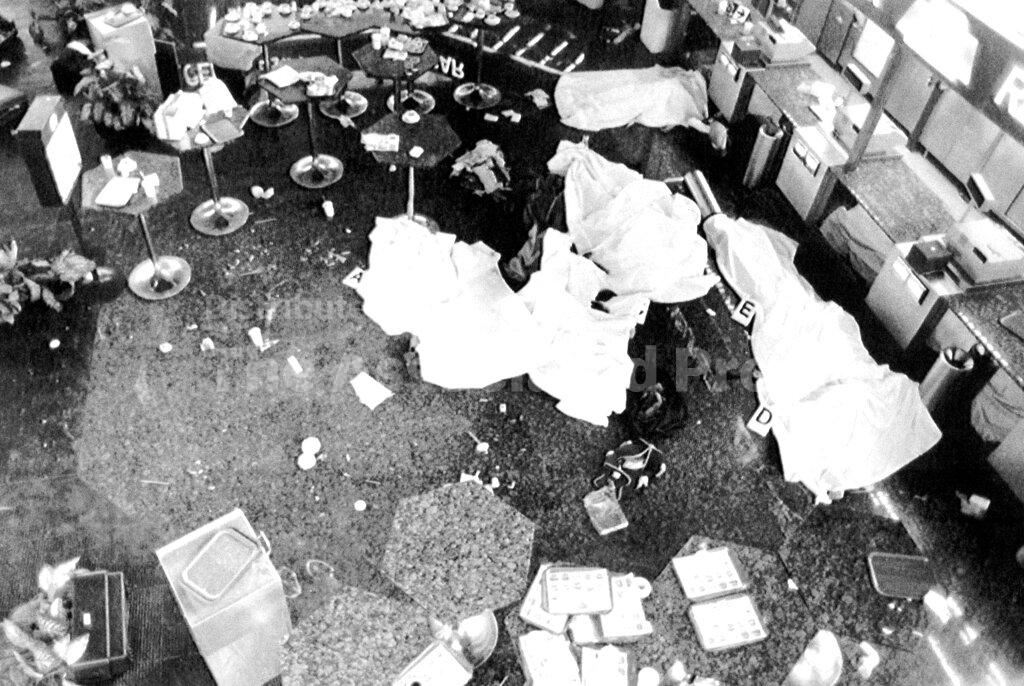
Palestinian guerrillas open fire inside the Rome and Vienna airports. The Rome and Vienna airport attacks were two major terrorist attacks carried out on 27 December 1985. Seven Arab terrorists attacked two airports in Rome, Italy, and Vienna, Austria, with assault rifles and hand grenades. Nineteen civilians were killed and over a hundred were injured before four of the terrorists were killed by El Al Security personnel and local police, who captured the remaining three. Authorities said the terrorists in Rome also lobbed grenades and fired indiscriminately with Soviet-made assault rifles into crowds of New York-bound passengers checking in at Pan American World Airways and Trans World Airlines.
At 08:15 GMT, four Arab gunmen walked to the shared ticket counter for Israel’s El Al Airlines and Trans World Airlines at Leonardo da Vinci-Fiumicino Airport outside Rome, Italy, fired assault rifles and threw grenades. They killed 16 and wounded 99, including American diplomat Wes Wessels, before three of the attackers were killed by El Al security, while the remaining one, Mohammed Sharam, was wounded and captured by the Italian police. The dead included General Donato Miranda Acosta, Mexican military attaché, and his secretary, Genoveva Jaime Cisneros.
Minutes later, at Schwechat Airport (Vienna International Airport) in Vienna, Austria, three terrorists carried out a similar attack. Hand grenades were thrown into crowds of passengers queuing to check in for a flight to Tel Aviv, killing two people instantly and wounding 39 others. A third victim died on 22 January 1986, of hand grenade wounds sustained in the attack. First response came from several Austrian police officers, who opened fire on the terrorists. They were supported by two plainclothes El Al security guards who helped to repel the attackers. Over 200 bullets were fired during the fight. The terrorists seized a Mercedes outside the terminal and fled, with Austrian police and El Al security guards giving chase. They killed one terrorist and captured the other two several miles from the airport after a short car chase and gun battle.
In all, the two strikes killed 19, including a child, and wounded around 140. Some contemporary reports claimed the gunmen originally intended to hijack El Al jets at the airports and blow them up over Tel Aviv; others concluded that the attack on waiting passengers was the original plan and that the Frankfurt airport was meant to be hit as well. The attacks came after increased security due to recent hijackings and official Interpol warnings that airports might be targeted by terrorists during the holiday season.
Israel held the P.L.O. responsible for the attacks in Rome and Vienna, despite the denial of the Palestine Liberation Organization, and made it clear that Israel would respond at the proper time and place. But Israeli analysts said Israel’s ability to retaliate had been limited by Syria’s decision to move mobile surface-to-air missiles into Lebanon. Israeli authorities first blamed the attacks on the Palestine Liberation Organization (PLO), but its leader, Yasser Arafat, denied the accusations and denounced the strikes. The PLO expressed ‘indignation at the criminal act” and asserted that the attacks were coordinated as part of a “plot against the Palestinian cause”, intending to force Austria and Italy into severing ties with the Palestinians. PLO officials recalled that Arafat had recently pledged that coordinated armed Palestinian resistance would be confined to Israel and the occupied territories.
Responsibility for the two attacks was later claimed by the Abu Nidal Organization (ANO) in retaliation for Operation Wooden Leg, the Israeli bombing of PLO headquarters in Tunis on 1 October 1985. Libya was accused by the US of funding the terrorists who carried out the attacks; although they denied the charges, they did praise the assaults. According to published reports, sources close to Abu Nidal said Libyan intelligence supplied the weapons and the ANO’s head of the Intelligence Directorate’s Committee for Special Missions, Dr. Ghassan al-Ali, organized the attacks. Libya denied these charges as well, notwithstanding that it claimed they were “heroic operations carried out by the sons of the martyrs of Sabra and Shatila.” Italian secret services blamed Syria and Iran.
The surviving terrorist in the Rome airport attack, Syrian national Mahmoud Ibrahim Khaled (Khalid Ibrahim), was sentenced to 30 years imprisonment in 1988. He was released early on good behavior in June 2010 and was living in Rome in 2011. He was employed, and had a girlfriend. In an interview with Il Messaggero, he condemned terrorism, expressed remorse for the attacks, and said that he prays for God’s forgiveness. In 1987, an Austrian court sentenced the two surviving terrorists in the Vienna airport attack to life imprisonment.
Two young Americans died in Rome. They were Natasha Simpson, the 11-year-old daughter of a foreign correspondent in Rome, who was headed to New York with her family, and John Buonocore 3d, a 20-year-old college student heading to Wilmington, Delaware, after a semester in Rome. Natasha Simpson was killed apparently as her father, Victor L. Simpson, a New Yorker who is the news editor for The Associated Press in Rome, tried to shield her from the bullets. Mr. Simpson, 43, was wounded in the right wrist and hand.
The United States said today that those who carried out the terrorist attacks in Rome and Vienna were “beyond the pale of civilization” and that all nations must join in “bringing to justice those responsible.” Referring to resolutions against terrorism passed recently by the United Nations General Assembly and Security Council, the State Department said, “These latest outrages demonstrate again that terrorism threatens all nations.” “In line with the resolution passed unanimously earlier this month by the United Nations General Assembly,” said Charles E. Redman, a department spokesman, “we call upon all members of the world community to join us in combating forcefully these criminal acts and bringing to justice those responsible.” Larry Speakes, the White House spokesman, told reporters aboard Air Force One that Mr. Reagan was told of the airport attacks at 7 A.M., before he boarded the plane for a trip to California.
Taped New Year’s Day greetings will be exchanged by President Reagan and the Soviet leader, Mikhail S. Gorbachev, the White House said. The announcement said the exchanges would give Mr. Reagan his first chance to talk to the Soviet people directly on television and would give the Soviet leader the same chance to speak to the American people. The announcement came as Mr. Gorbachev, in Moscow, offered a cautiously upbeat assessment of relations between the Soviet Union and the United States, saying points of “potential convergence” had emerged in arms control talks. Late today, the news divisions of the American networks indicated that they all planned to broadcast both addresses. he speeches, both of which are to be broadcast on Wednesday, are to be three to five minutes long and will contain New Year’s greetings, the officials said. One White House aide said Mr. Reagan’s tone would be “optimistic” on improvements in United States-Soviet relations. “We, of course, welcome this as an important event,” said Larry Speakes, the White House spokesman, in the announcement of the agreement.
Mikhail S. Gorbachev offered a cautiously upbeat assessment of relations between the Soviet Union and the United States today, saying points of “potential convergence” had emerged in arms talks. Addressing foreign diplomats at a year-end reception in the Kremlin, Mr. Gorbachev, the Soviet leader, said, “There has been an exchange of signals between East and West of late that has opened up some hope, I would put it even more cautiously, a gleam of hope, for headway to mutually acceptable solutions.” Mr. Gorbachev also said the Soviet Union was “firmly set on seeing essential progress in 1986 in the cause of a political settlement in the Middle East, Central America, around Afghanistan and in southern Africa and in the Persian Gulf area.” Several diplomats said the atmosphere at the reception seemed usually relaxed and friendly. It was the first year-end reception for diplomats at which Mr. Gorbachev, who became General Secretary of the Communist Party in March, was host.
Negotiations are under way for at least 10 major performing arts groups from the Soviet Union and an equal number from the United States to participate in an exchange program. The proposed exchange, it was disclosed yesterday, is part of the cultural agreement signed at the Geneva summit meeting between President Reagan and Mikhail S. Gorbachev, the Soviet leader. The negotiations were discussed during a news conference held yesterday in Los Angeles by Dr. Armand Hammer, chairman and chief executive officer of the Occidental Petroleum Corporation. Dr. Hammer had a large hand in arranging an exhibition, previously announced, of 40 Impressionist and post-Impressionist art works from Soviet museums that will be shown in this country at the National Gallery of Art in Washington, the Los Angeles County Art Museum, and the Metropolitan Museum in New York. The tour will be financed by Occidental Petroleum.
Some 235 Polish tourists have failed to return to three ships docked at a West German port over the Christmas holidays, officials said today. The Federal Border Police said the first group of Poles failed to return from a shopping excursion on Christmas Eve in the Baltic port of Travemunde, near the East German border. So far 68 Poles have applied for political asylum in Hamburg. More such filings are expected after the New Year holiday, a city official said. On December 24, a group of tourists failed to return to the vessel Wilanow. The next day a group did not reboard the Lancut and Thursday a group did not return to the ferry Pomeranja.
Finland has expanded its air defenses in the far north since a stray Soviet missile crashed there a year ago, a senior Foreign Ministry official said today. The incident on December 28, 1984, made world headlines. Moscow later paid compensation and, in a rare step, apologized to Finland and Norway, whose airspace the missile also violated before it crashed. The Finnish official did not say what measures were being taken, but military sources said Finland was upgrading radar surveillance and expanding its air base at Rovaniemi.
Algeria’s National Liberation Front ruled out a multiparty system for the country and strongly denounced opposition groups in a resolution published in Algiers today. The resolution was adopted by a special convention that ended Thursday after approving a new draft of the country’s national charter, an ideological platform to be put to a referendum on January 16. The document said the convention had demonstrated “deep attachment to national unity and unity of the political organization,” and it denounced “destructive elements hostile to the options of the revolution.” That was apparently a reference to various groups of dissidents, some of whose leaders were convicted of illegal activities by a special security court this month.
Leftist rebels today modified their conditions for continuing a Christmastime truce, saying that they “no longer consider ourselves obligated to keep our forces in a passive position.” Their announcement on the guerrilla radio station Venceremos followed rebel assertions of widespread Government violations of the holiday truce that began on Tuesday. The truce is scheduled to last through next Thursday. The broadcast said, “Our units will abstain from sabotage of the electric system and transportation and from taking over highways to facilitate the peoples’ celebrations until January 2.” There were no confirmed reports of fighting today, although accusations were exchanged of violations during the first three days of the scheduled 10-day truce.
Mali’s border conflict continued, with Mali accusing Burkina Faso of torturing to death Malian officials in four villages. The villages are in a disputed border zone. Burkina Faso, formerly known as Upper Volta, accused Mali of breaking a cease-fire.
Mali and Burkina Faso, at war over a border dispute, have agreed to a cease-fire at the request of other West African nations, according to a radio report today in Dakar, Senegal. The report, monitored here by the British Broadcasting Corporation, said the heads of state of the two countries had agreed to end hostilities as of midnight last night. They were responding to a request from Abdou Diouf, president of Senegal and chairman of the Organization of African Unity, Felix Houphouet-Boigny, president of Ivory Coast, Gnassingbe Eyadema, president of Togo, Mathieu Kerekou, president of Benin, and Seyni Kountche, president of Niger, the radio report said. The cease-fire after three days of fighting was agreed to on the condition that each country from any territory it had occupied and that the borders as they existed before the conflict began would be respected, the broadcast added.
The Nigerian Government today named 14 officers, including General Mamman Vatsa, a member of the Armed Forces Ruling Council, who it said were behind an unsuccessful coup to overthrow President Ibrahim Babangida. The government announced last week that it had thwarted the coup and arrested those responsible. The Information Minister, Colonel Anthony Ukpo, said at a news briefing that the plotters also included Brig. M. M. Nasarawa, commandant of the army’s infantry school in Jaji. General Vatsa was the most senior officer on the list, but Colonel Ukpo did not say if he was leader of the plot.
In what may be Africa’s most expensive but least known emergency food program, airplanes of the International Committee of the Red Cross are flying about 400 tons of food weekly into Angola’s fertile central highlands. The airlift is helping to feed 200,000 people who are suffering from malnutrition in an area that was once the breadbasket of Angola. It is not drought that has caused fields to lie fallow. Insterad, guerrillas of the Union for the Total Independence of Angola, led by Jonas Savimbi, have made it unsafe to cultivate the land or to transport crops to market.
Swazi villagers said today that South African troops crossed into the southeastern corner of the country this week and threatened to attack them if they gave shelter to guerrillas. Pretoria has recently repeated warnings to its black neighbors that it would ignore international boundaries to pursue attackers. A Swaziland police spokesman, Solly Mkhonta, said he was aware South African troops had crossed the border in the sparsely populated Lavumisa area, but he had no details. In Pretoria, a South African Army spokesman said no confirmation of the allegation could be found despite all possible inquiries. “If more facts become available,” he said, the South African Army “will obviously be prepared to investigate further.” The spokesman said South Africa “wishes to live at peace with its neighbor Swaziland.”
Lavumisa residents said that a South African patrol fired at a man who was trying to cross the border fence illegally on Christmas Eve, but that he was not hit and fled into the bush on the Swazi side. People Are Warned on A.N.C. The residents said that border patrols, usually of 8 to 10 men, crossed into Swaziland four or five times that evening and on Christmas Day and warned that the patrols would attack the residents if they sheltered members of the African National Congress. The African National Congress, outlawed in South Africa, is the main guerrilla organization fighting to end white domination by force. One villager told reporters that the soldiers said, “If we see any suspected member of the A.N.C. crossing from Swaziland into South Africa, we will shoot that person and attack the area from which he came.” The African National Congress took responsibility for a series of land mine blasts in the last month near South Africa’s northern border with Zimbabwe that killed six white people and a black farm worker.
The United States economy seems headed for a fourth consecutive year of expansion in 1986, but its course will be marred by gradually rising inflation and stubbornly high unemployment, according to a consensus of business and academic forecasters. The possibility of a recession, which at various times in the last year has seemed just over the horizon, has receded and is no longer regarded as an apparent threat. One important reason is the roaring bull market in stocks and bonds. By making investors richer, it has raised both confidence and the outlook for consumer spending, which accounts for two-thirds of the economy.
President Reagan virtually wrapped up his 1987 budget proposal before heading for California today. A top aide said Mr. Reagan had managed to pare the deficit to “close to $145 billion,” still more than the mandatory limit. The White House chief of staff, Donald T. Regan, said there were still “some finishing touches” needed for the first blueprint to be submitted under the new balanced budget law. President Reagan pared the deficit to “close to $145 billion” and virtually wrapped up his 1987 budget proposal before leaving for vacation in California, the White House chief of staff, Donald T. Regan, said. However, the $145 billion is still more than the mandatory limit of $144 billion. White House aides said that goal would be reached.
President Reagan travels to California for the New Year’s holiday.
The drowning of three drug suspects was charged to three Miami police officers in a murder indictment. The authorities said the drownings occurred in the course of a police theft last July of more than 300 kilograms of cocaine. One other officer and two civilians were also arrested in the case. “It is alleged that on July 28 six individuals dressed as police officers entered Jones Boat Yard,” said a written statement from the Metro-Dade County Police, which made the arrest of the City of Miami officers. “The individuals approached six other men guarding 300 to 400 kilos of cocaine,” the statement said. “The approach caused the six guards to jump into the Miami River, causing the death of three of them.” Police spokesmen said they did not know what happened to the cocaine. That much uncut cocaine, 650 to 900 pounds, could be worth as much as $20 million on the street.
Redistricting of 7 Chicago wards approved by a Federal judge is expected to increase the minority population and possibly shift the balance of power in the City Council. However, Federal District Judge Charles Norgle said he would not rule until Monday on whether the redistricted wards should hold early elections or wait for the regularly scheduled elections in 1987. Early elections could give Mayor Harold Washington, the city’s first black Mayor, the opportunity to increase his support on the Council before his 1987 re-election campaign.
A Federal investigation into the awarding of city contracts is a politically motivated attempt to embarrass Chicago Mayor Harold Washington, a City Council member has charged. The Justice Department has refused to confirm reports that there is an investigation. Two Aldermen have acknowledged being wined, dined and offered free trips by a reputed confidence man who posed as a businessman seeking a city contract. The confidence man was working as a Government informer, according to reports in Chicago newspapars.
Governor Richard W. Riley today declared an emergency in South Carolina’s overcrowded prisons and ordered a sentence rollback of 90 days that could mean freedom for about 150 inmates. The move, which affects only prisoners convicted of nonviolent offenses, was requested earlier this month by the State Department of Corrections under the Emergency Powers Act of 1983. As of today there were 9,224 inmates in the state’s 26 prisons — 1,248 more than the safe operating capacity as set by the South Carolina Budget and Control Board, said Hal Leslie, a spokesman for the corrections agency.
New Bedford (Massachusetts) fishermen walked out after rejecting boat owners’ demands for a larger share of profits. About 750 fishermen set up picket lines in the Massachusetts port. Boat owners did not want a strike, but were prepared “for a long siege,” an attorney for 32 of the owners said. “During the winter months, it’s cheaper to tie up than give in to demands,” he said.
Meat cutters from the United Food and Commercial Workers union, who rejected a contract offer Thursday, will vote again on the same contract Sunday, a union official said tonight. The vote could end an eight-week strike at nearly 1,000 southern California supermarkets, one of the longest and most violent in the area’s history. Gerald McTeague, chief negotiator for the meat cutters, said three of the six locals that voted Thursday approved the proposed contract. The total vote of the six locals was 2,040 against the contract and 1,640 in favor.
One of the largest oil spills in Washington State’s history, now even bigger than originally believed, was coating more beaches today along the Dungeness Spit. The spill, caused when the 883-foot tanker Arco Anchorage ran aground in Port Angeles Harbor last Saturday, has killed more than 400 birds. Jerry Aspland, president of Arco Marine, which own the tanker, today revised the estimate of the size of the spill to 189,000 gallons, nearly twice the size of the company’s earlier estimate. The oil that leaked from the tanker initially drifted 15 miles eastward from Port Angeles Harbor to Dungeness Spit, a narrow reef that juts into the Strait of Juan de Fuca and is the home of a wildlife refuge. The Coast Guard said today that the oil was moving westward and coating beaches along the outside of the spit.
The Federal Aviation Administration today proposed new regulations that would require domestic airlines to visually inspect and eventually replace a key component in thousands of Pratt & Whitney jet engines. The regulations, which would affect 1,840 engines in this country, are the result of problems that came to light after the crash of a Midwest Express Airlines twin jet DC-9 in Milwaukee last September 6 that killed all 31 people aboard.
A national consumer group today criticized Congress and the Administration for “a year of virtual inaction” on consumer issues, including health care, financial services and food and drug safety. The National Consumers League reviewed nine areas and assigned a grade of C to the House and D’s to the Senate and the Administration.
For better than a decade, Colorado’s front range cities have enjoyed the beauty of their natural setting with the comforts of a robust economy, and nowhere in the state were these benefits as happily married as in this university town north of Denver. The spectacular rise of the Flatirons and of Longs Peak in Rocky Mountain National Park form a backdrop for the city, where zoning codes have maintained a village quality: small shops, well-kept old buildings and colorful, if crowded, streets. But the economy that created Boulder is slipping, jobs are being lost, tax revenue is flat and there is talk again about whether one of Colorado’s best residential addresses is becoming one of the state’s worst addresses for factories and workers. “You’ve got to look at the attitude of people in Boulder County,” said Wayne Wooten, an electrical maintenance worker. “You get the impression that Boulder is antibusiness.”
For as long as anyone can remember, growers in the bountiful San Joaquin Valley have said that farming in the United States can be divided into two parts: California and the rest of the nation. With more than 200 crops and a growing season that spans most of the year, California agriculture was considered too diversified to be laid low by the capriciousness of the weather and marketplace that periodically shook the the Middle West’s Farm Belt, with its high dependence on wheat, corn and a few other crops. But, concedes Henry J. Voss, president of the California Farm Bureau Federation, “We were wrong.” Hundreds of growers in the state have lost their farms this year through foreclosures or distress sales. And before the current troubles end, Mr. Voss predicted, about 25 percent of the state’s 35,000 full-time farmers will have “zero net worth” and will be forced out of business.
Florida citrus growers reported scattered damage to fruit yesterday after a second night of record cold, while winds gusting to 40 miles an hour drifted snow around the Great Lakes. But the severe weather eased as Florida warmed up and a storm edged east from the Middle West. Fog continued to keep some flights grounded in the West. The weather was blamed for at least 17 deaths in eight states. Inspectors for the Florida Crop and Livestock Reporting Service checked Florida citrus groves yesterday, but damage estimates were not expected to be available for days. Temperatures overnight were in the mid-20’s over parts of the 600,000-acre citrus belt for four hours, the level at which fruit can be damaged. Records were broken in at least six Florida cities, including the 23 degrees at Daytona Beach that broke a record of 27 degrees set in 1935.
In the Liberty Bowl game, Baylor beats 12th-ranked Louisiana State, 21–7 at Memphis, Tennessee.
Stock prices advanced across a broad front yesterday, but traders said the day’s modest trading volume gave an exaggerated lift to prices. The Dow Jones industrial average rose 16.51 points. to 1,543.00, benefiting also from renewed expectations of a discount-rate cut.
Dow Jones Industrial Average: 1543.00 (+16.51)
Born:
Paul Stastny, Canadian NHL centre (NHL All-Star 2011; Colorado Avalanche, St. Louis Blues, Winnipeg Jets, Las Vegas Golden Knights, Carolina Hurricanes), in Quebec City, Quebec, Canada.
Kimberly Beck, WNBA guard (Seattle Storm), in Atlanta, Georgia.
Tivon Pennicott, Jamaican-American jazz saxophonist (Celery Juice), in Marietta, Georgia.
Died:
Harry Hopman, 79, Australian tennis player, coach (Davis Cup captain 1939-1967, won 16), of a heart attack.
 History Diaries