Christmas Day.
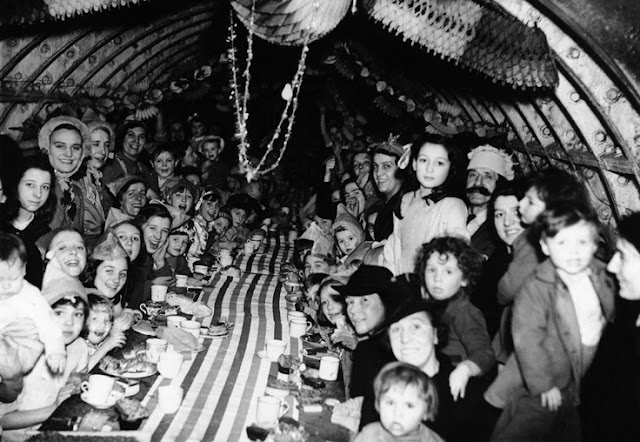
Britons snatched a day of Christmas peace from a winter of death-dealing war today, hearing at the same time a call from King George VI and ministers of the fighting services for renewed efforts on “the path of victory.” Under a tacit Yuletide truce, no sirens sounded and no bombs fell. The nation, with the shadow lifted for this brief spell, reverted almost to the “Merrie England” of other days. Thousands flocked to churches to pray for victory and for their loved ones with the army, the navy and the air force. The people of London, the king and Prime Minister Winston Churchill alike spent the day quietly with their families. Churchill found release from the cares of state in the antics of the baby grandson who bears his name.
Reichsführer Hitler observed the day with war workers and soldiers at an undisclosed place somewhere “in the west,” while his high command took note of a Christmas cessation of British and German bombardment in a communique.
The Greek army in Albania spends Christmas at the snow covered Albanian front. A few services are held for front line troops and a convoy of 100 taxis from Salonika (Thessalonica) which had left a few days earlier arrives bringing Christmas treats for the troops. Liquor and sweets are distributed to as many along the front as possible. Dimitry commented on two nice bottles of liquor which was given to him and his men. They gathered at the wooden shack in a wooded area near their positions and toasted one another. Elsewhere on the front when one of the taxis arrived with its cargo of Christmas goods, the driver (who spoke fluent Italian) offered his services to the Greek officer in command who ordered him to cross the lines with a flag of truce and offer the Italians some liquor and cigarettes. The Italians accepted the gift and the two sides in that area honored a truce on this Christmas Day. However, elsewhere the Greeks do press their attacks in places like the valley of River Devoll, with little success.
General Wavell issues a limp Order of the Day wishing everyone a Merry Christmas (as does Governor Dobbie on Malta and other commanders), but the forward troops are poorly provisioned and communications into Libya are stretched. There aren’t enough trucks to bring the men turkeys, but every man at least is given a tin of bully beef and a double rum ration. British morale is at a high due to recent victories, making such inconveniences seem trivial.
The perimeter at Bardia is quiet, as the Italians and British celebrate Christmas separately. As on other fronts, there is a tacit cease-fire for the day that is not ended until after dark. There aren’t any meetings as during World War I, but nobody wants to get in a firefight and die on Christmas.
In the face of intensified Italian air attacks, British forces besieging Bardia were reported today to be “pushing forward preparations to deal with the situation” at the Fascist base in eastern Libya. With Bardia already under heavy artillery fire in its ninth day of siege, the British general headquarters communique which announced the preparations was interpreted as the approach of the “zero hour” for an all-out attack on the Italian garrison of 20,000. Picked desert troops, who led in the offensive that took Sidi Barrani and pushed on 15 miles along the Libyan coast, were expected to make the assault with the support of tanks and other mechanized units. The R.A.F. also was active in the western desert. The Middle East command’s communique reported bombing attacks on the airdromes at Tmimi and Gazala in which “all bombs fell within the target area.”
In Malta, Governor Dobbie visits the troops throughout the island. Officers serve Christmas Dinner to other ranks, a first for the British Army. Thus begins a tradition that survives today.
Hitler continues his meandering tour of troops and fortifications along the French coast. His train takes him to Beauvais, where he meets with French Admiral Jean-François Darlan. Near Beauvais, Adolf Hitler met with Darlan. Hitler was in a foul mood and declared he was offering military collaboration with Vichy France one last time, and if France refused again it would be “one of the most regrettable decisions in her history.”
Hitler then visits KG 26 (“Löwengeschwader”), which at this time is one of the only formations using the SC 2500 bomb, a special 2400 kg bomb filled with a 40/60 Amatol mixture of RDZ, TNT, and aluminum. Having visited JG 26 on the 24th, Hitler apparently does not want to be seen as slighting the bomber pilots, who at this point are the ones taking the war to the British. Hitler then visits Cretz and then Metz. After that, once again he spends the night on his train, this time parked in a tunnel near Metz.
Hitler’s meeting with Darlan reveals his underlying frustration with Petain and the other European rulers who refuse to ally themselves with him. Coming close to one of his angry rants that only his insiders are privy to, Hitler warns Darlan that if France doesn’t cooperate militarily, it would be “one of the most regrettable decisions in her history.” For his part, Darlan is able to offer everything but military cooperation. Darlan is one of those equivocal figures throughout the conflict who both sides want to use. However, he only manages to anger just about everybody, a strange case of playing the middle against both sides (to reverse the common expression).
Large movements of additional German troops into Rumania are reported, and fears grow that Germany is preparing for action in the Balkans.
Premier Eamon de Valera of Ireland appealed to the United States for food and weapons. Ireland may not be at war, but it suffers from the German blockade and certainly gets no sympathy from the British.
There are many rumors arguments about exactly when, and whether, Stalin received a copy of Fuhrer Directive No. 21 of 18 December 1940 regarding Operation Barbarossa. This is the Directive that spells out Hitler’s intention to invade the Soviet Union at some point on or after 15 May 1941. By some accounts, today the Soviet Attaché in Berlin sends a copy to Stalin. In any event, Stalin stupidly refuses to believe Hitler’s intentions — right up to the actual attack in June 1941.
For the first time in history, Bethlehem is celebrating a darkened Christmas. While Mussolini’s air menace hangs over the city even the windows of the Church of the Nativity have been obscured by blue. At Jerusalem the Stations of the Cross are dark and silent. Despite the blackout, members of the church are determined to make it a Christmas to remember for hundreds of Empire troops in the city. The Church of the Nativity had been lit from within by a myriad candles, and the traditional sheep are being roasted in the fields near the manger.
German Admiral Wilhelm Meisel aboard cruiser Admiral Hipper ordered an attack on Allied convoy WS.5 in the morning, taking advantage of mist and rain; the convoy had been detected on the previous day and the ship’s crew had been shadowing it through the night, but failing to realize it was heavily escorted. At 0808 hours, Admiral Hipper fired on troopship Empire Trooper (16 soldiers killed) and freighter Arabistan, but she was soon chased off by a corvette and three cruisers. In retreat, Admiral Hipper fired at her pursuers, striking cruiser HMS Berwick at the rear gun turret, killing 4. Carriers HMS Argus and HMS Furious launched aircraft to hunt for Admiral Hipper as she retreated toward Brest, France for repairs, but the German cruiser would not be found. Later on the same day, 150 miles to the east, Admiral Hipper detected and sank British ship Jumna; 111 survivors in the water were left to drown.
Amazingly, Admiral Hipper then manages to slip away virtually unscathed toward Brest, its original destination. It is one of the greatest escapes by a surface ship of the war. Fortunately for the Hipper, visibility is poor and the Skuas launched by HMS Furious can’t locate it. One of the Royal Navy ships of Force H sent from Gibraltar to intercept Hipper, HMS Renown, sustains hull damage in the rough winter seas and thus also can’t find it. Hipper gets a bonus when 150 miles to the east it stumbles upon independent 6804-ton British sailing freighter Jumna on the way to Brest and sinks it (taking Rear Admiral HB Maltby Rtd) in passing. Hipper, knowing it is being chased, does not stop to pick up the 111 men in the water. They all drown.
In this way, the Royal Navy, which has been searching frantically throughout the North and South Atlantic for Admiral Hipper for weeks, finally gets its wish and locates the German cruiser. Admiral Hipper becomes the first big Kriegsmarine ship to reach the French Biscay ports. It is a very embarrassing day for the Royal Navy despite the paucity of losses and not one that the histories of the war spend a lot of time on.
Much further to the south, heavy cruiser Admiral Scheer rendezvouses somewhere in the South Atlantic with raider Thor, supply ship Nordmark, and “floating delicatessen” refrigerated ship Duquesa. It is fair to surmise that the sailors on the three German ships enjoy a hearty Christmas meal from the Duquesa’s large stock of fresh meat and eggs.
In Antarctica, Ernest Earl Lockhart and his comrades enjoy a quick toast on their travels across the continent as part of the overall expeditions of Admiral Byrd. They (and their dogs) make the Little America III base after a long journey, the final sprint having covered 34 miles in less than 16 hours across the ice, including stops. Incidentally, this is the expedition using the notorious giant red Snow Cruiser, which on this date is sitting in an ice cave specially carved out for it near the base.
Air operations by both sides are extremely quiet. There are scattered Luftwaffe reconnaissance missions, but no organized attacks. The RAF only makes reconnaissance and patrol flights.
Two FAA Martlet I fighters of No. 804 Squadron RAF, on patrol over Scapa Flow, Scotland, United Kingdom, intercepted and destroyed a prowling Junkers Ju 88 aircraft, the first victory for a U.S.-built aircraft in British service. Martlets are slightly modified Grumman Model G-36As aka F4F Wildcats.
British pilots in Santa Claus roles bombarded Corfu today with Christmas gifts for children of the defenseless island which has been a frequent target of Italian planes. People of the island had been informed in advance of the appearance of the planes, and large crowds gathered about the “target area.” Vice-Air Marshal J. H. Dalblao of the R.A.F., In a message to the Corfu prefect, said the gifts were “tokens of our admiration for your courage In the face of heavy and constant attack and as appreciation of the kindnesses shown our airmen who have had to land at Corfu.”
The Italians raid Corfu for the 23rd time, killing 15 people. They originally intended to invade the island, but times have changed. It is incidents like this, an unnecessary air attack on Christmas day, that make the Greeks absolutely furious at the Italians, even above and beyond the invasion itself.
Destroyers HMS Intrepid (Cdr D.20) and HMS Icarus arrived at Scapa Flow at 0900 from Immingham.
Convoy WS.5A was escorted by heavy cruiser HMS Berwick, light cruiser HMS Bonaventure, which was en route to the Mediterranean Fleet, via Cape Horn, light cruiser HMS Dunedin and corvettes HMS Geranium, HMS Jonquil, HMS Cyclamen, and HMS Clematis, which were en route to the South America Station, also escorted the convoy. Seven hundred miles west of Finisterre, German heavy cruiser Admiral Hipper attacked the convoy. She first made contact by radar during the afternoon of 24 December, but did not realize at this time that it was a strongly escorted troop convoy. After an unsuccessful torpedo attack at 0353, the decision was to wait until dawn to attack. When visual contact was made with the convoy at 0808, it came as a surprise to sight Berwick. The German cruiser took heavy cruiser Berwick under fire at 0839. Due to poor visibility, complicated by smoke and spray, she then shifted to the merchant ships damaging troopship Empire Trooper (13,994grt, former German Cap Norte captured in October 1939) in 43‑58N, 24‑15W. British steamer Arabistan (5874grt) was slightly damaged by Admiral Hipper gunfire. When the convoy scattered, damaged troopship Empire Trooper was escorted by corvette Cyclamen to Ponta Delgada, arriving on the 27th. The ships for Gibraltar proceeded directed to their destination.
Between 0842 and 0956, Heavy cruiser HMS Berwick, three miles ahead of the convoy, was in action intermittently for thirty three minutes, light cruiser HMS Bonaventure, on the starboard side of the convoy, for twenty four minutes, corvette HMS Clematis briefly. Light cruiser HMS Dunedin laid smoke. Aircraft carrier HMS Furious flew off Skuas to attempt to locate Admiral Hipper, but was unable to do so in poor visibility. German heavy cruiser Admiral Hipper was able at 0905 to damage heavy cruiser Berwick with hits to her X turret, abreast B turret below the waterline, disabling B turret, amidships putting a four inch gun out of action, on the side belt where it was deflected into the bulge. However, Admiral Hipper was forced to break off the action at 0914. Cruiser Berwick sustained four Marines killed and one seriously wounded in the engagement. As she withdrew, Admiral Hipper contacted and sank independent steaming British steamer Jumna (6078grt) in 44‑51N, 27‑45W. Steamer Jumna was from dispersed convoy OB.260 and bore the Commodore of convoy OB.260 Rear Admiral H.B. Maltby Rtd which was lost with the steamer.
Battlecruiser HMS Renown, aircraft carrier HMS Ark Royal, destroyers HMS Faulknor, HMS Firedrake, HMS Fortune, HMS Foxhound, HMS Duncan, HMS Wishart, HMS Hero, and HMS Hereward departed Gibraltar to intercept Admiral Hipper. However, battlecruiser Renown sustained hull damaged from high speed running in heavy seas. Destroyers Duncan and Hero were detached to assist troopship Empire Trooper. When sufficient screen arrived at the troopship, the destroyers returned to Gibraltar. Before arriving, they were ordered to join battlecruiser Renown and aircraft carrier Ark Royal.
Light cruiser HMS Naiad was ordered to rejoin the convoy.
Light cruiser HMS Kenya departed Plymouth 25 December to escort convoys SL.59 and SLS.59.
Battlecruiser HMS Repulse and light cruiser HMS Nigeria with destroyers HMS Somali (D 6), HMS Matabele, HMS Mashona, and HMS Eskimo departed Scapa Flow at 1500 to protect two of the western most convoys HX.97 and SC.16 then at sea. On the 29th, the Repulse group met armed merchant cruiser HMS Worcestershire which was escorting convoy HX.97. Battlecruiser Repulse and destroyers Somali and Matabele arrived back at Scapa Flow at 0600/31st.
Battlecruiser HMS Hood and light cruiser HMS Edinburgh with destroyers HMS Cossack, HMS Escapade, HMS Echo, and HMS Electra was already at sea. The force patrolled north of the Shetlands and east of the Faroes until 29 December, when they arrived back at Scapa Flow. Light cruiser Edinburgh was detached to the battleship HMS Nelson force on the 28th.
Light cruisers HMS Bonaventure and HMS Dunedin arrived at Gibraltar on the 26th.
Light cruiser HMS Naiad arrived at Scapa Flow on the 27th.
Destroyers HMS Somali and HMS Eskimo arrived at Scapa Flow for refueling on the 31st.
Destroyers HMS Mashona and HMS Matabele arrived at Scapa Flow for refueling on 1 January.
British troopship Empire Trooper put into Ponta Delgada and was joined by four corvettes on the 27th.
Light cruiser HMS Kenya and corvettes HMS Geranium, HMS Jonquil, HMS Cyclamen, and HMS Clematis escorted troopship Empire Trooper from Ponta Delgada on the 30th for Gibraltar. These ships were sighted by Submarine HMS Trident later that day and first identified as enemy. The British ships were identified before an attack could be made.
Destroyers HMS Duncan and HMS Hero, which joined troopship Empire Trooper and at 1000/29th, were ordered to join Force H. The convoy reassembled on the 28th, less damaged troopship Empire Trooper, arrived at Freetown on 6 January 1941.
On 8 January, the convoy departed Freetown for Capetown. The convoy now included British steamers Empire Ability (7603grt), Adviser (6348grt), Barrister (6200grt), and Benrinnes (5415grt).
The local escort from Freetown was sloops HMS Milford and HMS Bridgewater, destroyers HMS Velox and HMS Vidette, and corvettes HMS Calendula and HMS Asphodel. The ocean escort was British cruisers HMS Norfolk, HMS Devonshire, and HMS Hawkins. Heavy cruisers Hawkins and Norfolk took the Capetown section into Capetown arriving on 22 January. The Durban section arrived on 26 January escorted by heavy cruiser Devonshire. The convoy departed Capetown on 27 January and rendezvoused with the Durban section off Durban. British steamer Talamba (8018grt) and Dutch steamer Nieuw Holland (11,066grt) joined at Durban.
Heavy cruiser HMS Shropshire departed as an escort from Durban and continued with the convoy until 30 January when she was relieved by light cruiser HMS Enterprise. Light cruiser HMS Ceres also departed with the convoy from Durban and continued until relieved by armed merchant cruiser HMS Hector on 4 February. Light cruiser Ceres took steamers Orbita and Nieuw Holland to Mombasa. Armed merchant cruiser Hector was detached on 11 February. Sloop HMS Grimsby was escorting from 6 to 7 February.
Light cruiser HMS Caledon, sloops HMS Grimsby and HMS Flamingo, and Indian sloop HMIS Indus joined the convoy on 11 February for the Red Sea passage. The convoy arrived at Aden on 14 February and Suez on 16 February.
Gunboats HMS Aphis and HMS Ladybird arrived at Alexandria.
Submarine HMS Otus attacked a submarine in 33‑20N, 22‑43E north of Derna.
Convoy FS.370 departed Methil, escorted by destroyers HMS Valorous and HMS Versatile, and arrived at Southend on the 27th.
Convoy FS.371 departed Methil, escorted by destroyer HMS Woolston and sloop HMS Lowestoft. The convoy arrived at Southend on the 28th.
Convoy BS.11A departed Suez, escorted by anti-aircraft cruiser HMS Carlisle and destroyers HMS Kimberley and HMS Kingston. The convoy was dispersed off Aden on the 29th.
In Washington, President Roosevelt and wife Eleanor attend Christmas mass at First Congregational Church. Subsequently, they host a Christmas party. President Roosevelt attended church services in the morning, then carved a plump Christmas turkey, in the White House and received a call from Prince Olav and Crown Princess Martha of Norway.
Also in Washington, a movement for a negotiated peace found a spokesman in Senator Burton K. Wheeler, Montana Democrat, who declared the United States government now is in a position to “force peace in Europe” and urged President Roosevelt to take the initiative. A call for a determined effort by the United States to “force peace in Europe” was sounded by Senator Wheeler of Montana as he returned to the capital today to prepare for the session of Congress opening next month. “The President should make a determined effort to bring the warring nations of Europe together,” Mr. Wheeler said. “He should insist that a just peace be worked out. There are two views about the European war prevalent in WashIngton. First is the group which wants to see the war continued until the German Government is exterminated. And they want to see that done even if it means total war on our part. Second, there are those of us who want to see Great Britain win, but we believe that peace could be brought about at this time if a sincere effort is made.” This effort should be made before any additional aid is granted to Great Britain, he said. In speaking of assistance to that country. he reiterated previous assertions that he regarded the President’s plan to lend or lease arms as “an erosion of our Neutrality Act.”
Mountainous waves battered the Southern California shoreline today and washed away four blocks of boardwalk at Venice and 100 feet of concrete walk at Cabrillo Beach. Carried on a 6.3-foot tide, breakers smashed at some Venice beach homes, but sandbag barricades erected last week during an earlier high tide prevented damage.
Although the weather and road conditions’ in almost all parts of the country were ideal for driving yesterday, more than 252 persons were killed this Christmas in automobile accidents, according to a survey made by The Associated Press.
Death claimed Agnes Ayres, 42, one of the brightest stars of the silent film era, on Christmas day. She had been ill for several weeks. Miss Ayres skyrocketed to fame opposite Rudolph Valentino in “The Sheik.” The advent of the talkies marked her decline in pictures. Recently, in attempting a comeback, she said: “It cost me a half million dollars to learn the value of a nickel, but I wouldn’t trade the experience for all that money back again.”
The Rodgers and Hart stage musical “Pal Joey”, starring Gene Kelly and Vivienne Segal, premiered at the Ethel Barrymore Theatre on Broadway.
One of the most fateful sessions in Japan’s short parliamentary history was formally opened by the Emperor this morning with the customary minute-long speech. United States Ambassador Joseph C. Grew, British Ambassador Sir Robert Leslie Craigie and the new Australian Minister, Sir John Latham, attended the ceremony. All present knew that it might mark the end of Japan’s effort to establish liberal institutions.
Born:
Pete Brown, British musician and lyricist (Cream — “I Feel Free”; “White Room”; “Sunshine of Your Love”), in Ashtead, Surrey, England, United Kingdom (d. 2023).
Pete Jaquess, AFL-NFL cornerback and safety (AFL All-Star, 1964; Houston Oilers, Miami Dolphins, Denver Broncos), in Earth, Texas.
Died:
Agnes Ayres [Hinkle], 42, American actress (“Souls at Sea”), of a cerebral hemorrhage.
Naval Construction:
The Вое́нно-морско́й флот СССР (ВМФ) (Soviet Navy) “S” (Stalinec)-class (2nd group, Type IX-modified) submarine S-10 is commissioned.
 History Diaries