Christmas Eve, 1940
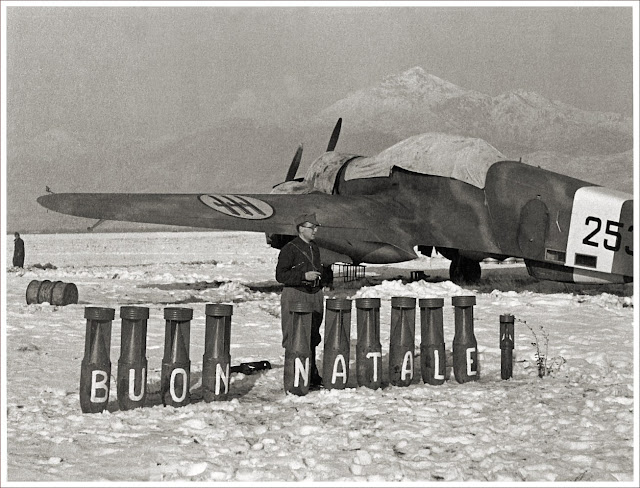
This is the second Christmas of war for the millions of Europe. It makes a strange pattern, and not a cheerful one. But still it is Christmas, and today it is in the hearts of everyone. There is no truce; indeed, the full fury of a new assault may be days, or even hours away. But the bells of Bethlehem ring bravely, though the bells of England are mute, for it is these bells which will give the alarm of invasion.
A Christmas bonus is being distributed within the Reich — an additional 26 ounces of rice and vegetables, plus just over a pound of sugar, jam and coffee. But the bonus has not prevented a rash of black-market deals for food and presents. A confidential report by the SS in Dortmund this month reported that “the tracking down of game and poultry began some time ago and exorbitant prices are being demanded”. Goose is costing ten Reichsmark per pound.
Authoritative German sources here reported tonight that the Luftwaffe proposed to refrain from bombing England from tonight until December 27 as a sort of Christmas truce provided the Royal Air Force carried out no attack upon Germany or German-held territory. The report gained credence from the fact that no aerial action was reported over Britain since early today while no British aerial attack apparently had been made upon Germany tonight. It was recalled, however, that Prime Minister Winston Churchill rejected a proposal for a Christmas armistice advanced recently in the House of Commons.
Seen in downtown London in a shop window:
“Christmas is 1,940 years old, and Hitler is only fifty-one. They can’t spoil our Christmas.”
The little Judean city of Bethlehem was shrouded in its first blackout in history while the ageless drama of Christ’s birth was re-enacted early today at the Church of the Nativity in bomb-proofed gloom instead of the traditional blaze of Christmas light. Even the bonfires in shepherds’ fields about the city were put out early lest they guide Italian air raiders to the little city. Only the stars shone through the blackness of war to light the pilgrims’ way to the Church of the Nativity.
Pope Pius declared today that in the search for the new order of the future men and nations must triumph over hatred, over mistrust, over the notion that might makes right, over economic maladjustment and “cold egoism.” In a Christmas Eve message to the College of Cardinals he said that while the war goes on there is little hope for such a restoration. Nevertheless, he expressed a “heartfelt wish” that when the guns shall have fallen silent at last humanity and its leaders “will be sufficiently matured intellectually and capable in action to prepare the ground of the future for a new order that will be solid, true and just.” “We pray God,” he added, “that it may so happen.”
Reinforced British land, sea and air forces today were reducing Italy’s Libyan base of Bardia to a blazing desert hell where 20,000 entrapped Fascist troops are reported facing the tortures of a water famine. The ninth day of siege of the Libyan stronghold found Britain’s desert blitzkrieg throwing a flaming wall around the Italian forces entrapped there. The British general headquarters reported in today’s communique that the concentration of imperial forces and artillery “preparations” is proceeding. With the water shortage within Bardia reported to be acute, British military leaders believe that Bardia may “fall like a ripe plum.”
Wavell to C.I.G.S.: “We now have 88 field guns and 22 medium guns and howitzers opposite Bardia but still require further supply of ammunition. Enemy bombing continues to be active and is hampering use of Sollum harbour. Transport and water are causing difficulty. Can give no date for attack yet. Enemy resistance strong where tested. Prisoners now number 40,000. Weather has been cold.”
The Italian defense in Libya is firming, as in Greece. However, the Italian forces in Libya make no attempt to relieve the besieged garrisons in Bardia and Tobruk despite fairly obvious indications that the British troops in Libya are over-extended.
Greek forces tonight were reported within about 15 miles of the Albanian seaport at Valona, Italy’s vital supply base on the Adriatic, while the blacked out streets of Athens resounded to Christmas greetings of “Kronia polla!” (“Many years of life to you”).
The Greek 3rd Army Corps, which was advancing through the Devoli and Tomori valleys of Albania, is now 12 miles east of Berat. The central Greek assault group, 2nd Corps, is pinned down by strong Italian resistance and has not advanced far beyond its initial positions near Kelcyre. 1st Corps on the Greek left flank reach Tepelena (Albania) where they meet substantial resistance. Nevertheless part of the corps has successfully advanced along the coast and taken Himare. But the Greek troops could not hold the areas of Kelcyre and Tepelena. The Greeks are unable to carry out a broad encirclement due to the continually growing numbers of the Italian forces, who are receiving a steady stream of reinforcements from Italy.
The Greeks continue struggling through the winding valleys and mountain passages of central Albania on 24 December 1940. The Greek III Corps is about 12 miles east of Berat, while Greek II Corps is motionless near Kelcyre. Greek I Corps is still on the move, reaching Tepelena. Italian defense is stiffening as reinforcements flow across the Adriatic and the lines of communication to supply ports shorten. The Greeks, meanwhile, now are facing some of the problems faced by the Italians when they began their offensive in October, such as lengthy supply lines over goat tracks and through mountain defiles.
Benito Mussolini is thoroughly disgusted by the failures of his troops. He pens a letter to Italian military commander Ugo Cavallero, complaining that the fall of Himara a couple of days ago was due to high Greek morale.
The George Cross is gazetted for Lt William Marsden Eastman (1911-80) and Capt Robert Llewellyn Jephson-Jones (b. 1905), of the Royal Army Ordnance Corps, who disarmed some 275 bombs on Malta from mid-June to mid-November, when the Royal Engineers took over the task of disposal from the RAOC.
Lieutenant William Marsden Eastman and Captain Robert Llewellyn Jephson-Jones of the Royal Army Ordnance Corps receive the George Cross. Based on Malta, they disarmed 275 bombs without any training before the Royal Engineers arrived and were able to take over this hazardous work.
No Midnight Mass is held in Malta due to the continuing curfew.
The Anti-Jewish Law for the Protection of the Nation is approved by the Bulgarian Government, to take effect on 23 January 1941. Among other measures, the law:
— Forces Jews to change their names;
— Restricts where Jews may live;
— Confiscates Jewish property;
— Excludes Jewish workers from public jobs;
— Excludes Jews from certain trades;
— Establishes quotas for Jews in universities.
The law goes well beyond those specific provisions, though. It also levies a one-time tax of 20% of Jewish net worth — not income — and also prohibits secret organizations of any kind, particularly Freemasonry. That said — and of course, it all is very bad — the law does not provide for the deportation of Jews to German extermination camps such as Auschwitz. Well, at least not all Jews, but the law does provide for the deportation of Jews from recently acquired territories which formerly were parts of Greece and Yugoslavia. The law takes its lead from the German Nuremberg Laws and obviously is passed due to German influence and pressure. The last thing the Bulgarians want is to be left to face the Soviet Union alone.
On this Christmas Eve at Auschwitz, the SS set up a Christmas tree, with electric lights, on the roll-call square. Beneath it, they placed the bodies of prisoners who had died while working or frozen to death at roll call. Former prisoner Karol Świętorzecki later recalled that Lagerführer Karl Fritzsch referred to the corpses beneath the tree as “a present” for the living, and forbade the singing of Polish Christmas carols.
Having spent the night on his train parked in a tunnel north of Boulogne — which was bombed during the night — Adolf Hitler resumes his tour of coastal fortifications in France. He proceeds to Desvres, where Hitler visits the squadron Von Lützow (encamped somewhere outside of town). At 12:30 hours Hitler joined the Christmas lunchtime activities there, then proceeds to Saint-Etienne-au-Mont and the castle Point-de-Briques. Afterward, around dinnertime, he travels to Abbeville and visits JG 26, led by Adolf Galland, the leading scorer in the entire Luftwaffe. JG 26 is known as the “Abbeville Kids” and is based there for much of the war.
Arriving at 16:05 and staying just short of an hour, Hitler gives a brief address in which he states that the U-boats and lack of interference by the Soviets will make ultimate victory certain. Needless to say, this visit is a tremendous honor and privilege for the Schlageter Squadron, considered the elite Luftwaffe fighter formation on the critical Channel front (though of course some other squadrons also have their partisans). Hitler’s visit to this Geschwader instead of others speaks volumes.
After giving his speech, Hitler proceeds from Abbeville to Laboissière. He spends another night in his train, parked in a tunnel outside of town.
An unofficial two-day Christmas truce began in the aerial war between Britain and Germany. While absolutely unofficial and unrecorded, today begins a virtual two-day cessation of hostilities between the RAF and Luftwaffe on the Channel front. It is reminiscent of the “Christmas Truce” of World War I, but not nearly as well-known and without any joint parties being held. Everyone just needs a break after a very hard year. Both sides’ pilots are fierce competitors, but they also respect valor on both sides regardless of what insignia is on the outside of an aircraft.
There are no night bombing operations, though the Luftwaffe engages in some strafing runs against trains during the day and drop a few random bombs.
Oberfähnrich Hans Joachim Marseille joins 3,/JG 27 at Döberitz. Marseille has 8 kills and is renowned for his ability in the German press. However… Marseille also is widely known within the Luftwaffe as a prima donna who does not follow orders, abandons his wingmen (who then get shot down), and freelances in order to get more victories. He also is a “British ace,” having lost more of his own mounts than just about any other Experte.
Group Captain John Alexander Kent is awarded the Virtuti Militaire (Polish VC) for his services with 303 (Polish) Squadron. He already has won the DFC. Kent joined the 303 on 2 August 1940 and, in one notorious engagement, faced 40 Bf 109s alone and shot down two of them, damaging a third, while escaping alive. Kent is known as a strict disciplinarian, a “born leader” according to his DFC citation.
In an address to his fighter pilots at Abbeville, France, Hitler tells them that German U-boat successes and the neutralization of the USSR make victory certain.
U-65, commanded by Korvettenkapitän Hans-Gerrit von Stockhausen, sank tanker British Premier (5872grt) at 06‑20N, 13‑20W, 200 miles southwest of Freetown. At 1641 hours on 24 Dec 1940 the British Premier (Master Francis Dalziel), a straggler from convoy SLS.60, was hit by two G7a torpedoes from U-65 and sank 200 miles southwest of Freetown. The master, 30 crew members and one gunner were lost. Nine crew members were picked up on 3 Jan 1941, by HMS Hawkins (I 86) (Capt H.P.K. Oram, RN) and landed at Freetown. On 3 Feb 1941, four surviors were picked up after 41 days in an open boat (25 days without food) by HMS Faulknor (H 62) (Capt A.F. de Salis, RN) off the west coast of Africa and landed at Freetown. The 5,872 ton British Premier was carrying crude oil and was bound for Swansea, Wales.
German cruiser Admiral Hipper detected Allied convoy WS.5 700 miles west of Cape Finisterre, Spain late in the afternoon. The convoy was consisted of 19 troopships and freighters; not noticing that it was escorted by two carriers, three cruisers, and four corvettes, the German commander Admiral Wilhelm Meisel prepared the crew for an attack in the morning.
Battlecruiser HMS Hood, light cruiser HMS Edinburgh, and destroyers HMS Cossack (D 4), HMS Escapade, HMS Echo, and HMS Electra departed Scapa Flow at 1730 to patrol east of the Iceland Faroes Passage to intercept outbound or inbound raiders. Battlecruiser HMS Hood leads a force to patrol from Scapa Flow to patrol in the Iceland/Faroes “gap” in search of the German raiders known to be in the Atlantic, but which have yet to be located. It is fashionable for later historians to denigrate the Hood’s strength, but the Admiralty for all intents and purposes views the Hood as equivalent to a battleship and disposes of it as such — as in this incident.
Light cruisers HMS Phoebe and HMS Aurora were sent to Oban to give anti-aircraft protection to the port after a raid. Aurora departed two days later, but Phoebe was there until 7 January.
Destroyers HMS Kelly, HMS Blencathra, and HMS Tynedale departed Scapa Flow at 2000 to search for a German submarine bombed by a Walrus in 60-25N, 02-34W off Muckle Flugga at 1530. Kelly was ordered on the 25th to return to Scapa Flow where she arrived at 0730/26th.
Destroyer HMS Montgomery arrived at Scapa Flow at 1420 from Stornoway to work up.
Destroyer HMS Vimy departed Scapa Flow at 1300 to meet British steamer Ben My Chree off Aberdeen and escort her to Lerwick. After disembarkation, the steamer was returned to Aberdeen and destroyer Vimy arrived at Scapa Flow at 1700/27th.
Auxiliary minesweeper HMS Mercury struck one of her own mines south of Ireland. She was taken in tow by minesweeper HMS Goatfell, but sank in tow on the 25th.
Drifter Lord Howard (98grt) was sunk in a collision in Dover Harbor.
Steamer Peterton (5221grt) was damaged by German bombing in 54‑51N, 13‑13W.
Submarine HMS Regent unsuccessfully attacked an Italian steamer off the Libyan coast.
Greek submarine Papanicolis (Lt Cdr Milton Aatrides, RHN) sank Italian steamer Firenze (3952grt) east of Saseno in the Adriatic in 40-34N, 19-02E.
Convoy OB.264 departed Liverpool escorted by destroyers HMS Active, HMS Antelope, and HMS Georgetown, corvettes HMS Heather and HMS Picotee, and anti-submarine trawler HMS Lady Madeleine. The escort was detached on the 29th.
Convoy FN.367 departed Southend, and arrived at Methil on the 26th.
Convoy FS.369 departed Methil, escorted by destroyer HMS Cotswold and sloops HMS Fowey and HMS Pelican, and arrived at Southend on the 26th.
Convoy WS.5A, being escorted by light cruiser HMS Naiad, was turned over to heavy cruiser HMS Berwick. Naiad turned back to England. Destroyers HMS Hero, HMS Hereward, HMS Firedrake, HMS Vidette, and HMS Velox were ordered to meet convoy WS.5A on the 27th.
Convoy SLS.60 departed Freetown escorted by sloop HMS Bridgewater for that day.
As traditional carols brought the message of Christmas to the city and nation last night millions of Americans, their homes stocked with food and rich gifts, looked forward to a day of cheer and festivity, despite the gloom of war and uncertainty in the world.
It will be America’s last Christmas at peace until 1945.
President Roosevelt sent forth a “Happy Christmas” greeting to the nation tonight in an address warning against cynicism and defeatism and praying for a “peaceful chance” for humanity to strive for world betterment. Lighting a 30-foot cedar Christmas tree at dusk near the White House, he observed sadly that except for little children, Christmas, 1940, could not be “merry.” “But for most of us it can be a happy Christmas,” he continued, “if by happiness we mean that we have done with doubts, that we have set our hearts against fear, that we still believe in the golden rule of all mankind, that we intend to live more purely in the spirit of Christ, and that by our works, as well as our words, we will strive forward in faith and in hope and in love.”
A serious shortage of aluminum tubings, forgings, and to some extent aluminum castings, has resulted in a situation acute enough to raise the question in the National Defense Advisory Commission of taking priorities out of the hands of the aluminum industry and subjecting them to mandatory government action. It was reported in aircraft circles that half the airplane manufacturing companies were in the position of the Northrop Aircraft Corporation, the general manager of which announced yesterday that he was being forced to curtail production because of inability to obtain aluminum. The companies thus embarrassed, it was said, were largely those seeking to expand production with especial rapidity, and mainly those making lighter machines. The shortage, it is understood, does not affect companies which have been working up by moderate spurts toward maximum production.
A desert storm that poured nearly four inches of water through the streets of Palm Springs washed out railroads and highways in the vicinity of the California resort today.
The second of the two New Hampshire earthquakes struck. New Hampshire experiences a classic aftershock earthquake after the one that hit on 20 December. This one is slightly more powerful, registering 5.6 on the moment magnitude scale as opposed to 5.3 for the first one. The quake is centered in central New Hampshire, just north of the lakes. There are additional aftershocks in the following months, but this is the one that causes the most damage throughout the New England region. That said, casualties and serious damage are almost nonexistent.
Adoption of a system of “fool-proof identification” of employees engaged in national defense work was urged today by Commissioner Norman J. Griffin after the discovery of two unauthorized workmen at the Frankford Arsenal.
The U.S. 1st Marine Aircraft Wing completed its transfer to the west coast of the United States. On the same day, the 2nd Marine Brigade was activated under the command of Colonel Henry L. Larsen at Camp Elliott, California, United States.
The transport USS William Ward Burrows departed Honolulu for Wake Island with the first increment of workmen (80 men and 2,000 tons of equipment of Contractors Pacific Naval Air Bases) to begin building a naval air station there.
A full Canadian corps will be formed in Britain, it was announced in Ottawa today by Colonel J Saul, the Canadian defence minister. The Canadians will join an impressive array of troops now mustered under the Imperial banner. The land forces currently in action are those in East and North Africa. Sudanese, South Africans, Indians and Cypriots are embroiled in East Africa while, under General Wavell in North Africa, there are Australians, New Zealanders and Indians all fighting for a “mother country” which hardly any of them have visited.
Colonel J. Saul of the Canadian Defence Ministry announces that a full Canadian Corps will be formed in Great Britain.
Former fishing vessel HMCS BC Lady commissioned & employed by RCAF.
Corvettes HMCS Chambly and HMCS Cobalt arrived at Halifax from builders in Quebec City, PQ & Port Arthur, ON, respectively.
Mahatma Gandhi wrote his second letter to Hitler, addressing him as “Dear Friend” and appealing to him “in the name of humanity to stop the war. You will lose nothing by referring all the matters of dispute between you and Great Britain to an international tribunal of your joint choice. If you attain success in the war, it will not prove that you were in the right. It will only prove that your power of destruction was greater. Whereas an award by an impartial tribunal will show as far as it is humanly possible which party was in the right.”
As with the first letter, British authorities seize this letter in transit, so Hitler never sees either one (and this is one of the reasons we know Gandhi wrote and sent them at all). And that raises a certain suspicion…
There is a big “however” to all this. There are some who claim that this letter (and the more famous August 1939 letter) is a British forgery. Gandhi is not known to have been a particularly prolific letter-writer, with most of “his” letters actually written by others. In addition, Gandhi is known to have written his letters by hand, whereas the letters produced by the British always are neatly typed without errors and signed by Gandhi in a manner whose authenticity some doubt. The gist of this letter would, indeed, have been of propaganda value to the British at the time. It also would have given British Intelligence delicious fun to turn the tables on their principal Indian antagonist and use him for their own propaganda purposes (and in the process smear Gandhi by association with the “Dear Friend” salutation). It also seems odd that Gandhi would have written the letter in (absolutely perfect) English, which was not native to either sender or recipient.
On balance, both letters appear to be forgeries — but draw your own conclusions, because many historians take them at face value. This probably is an example of “Black Ops” or “Black Propaganda,” something at which MI5 excels throughout the conflict. However, there is no proof of that — perhaps because it is done so well. As an aside, many papers from the war remain under a 100-year exclusion and not everything is known about all of the types of covert activities that went on.
During the night, the British in India stage an “imitation German air raid.” In a suburb of Calcutta, a plane bearing Luftwaffe insignia (but apparently an RAF plane) bombs a small village, starting fires. The local Air Raid Precaution (ARP) organization extinguishes the fires quickly and rescues people from the bombed homes. Overall, the “test” or “simulation” is reckoned a success. It is an odd, real-life live-fire exercise that must result in some casualties, but there is no record of any. This bizarre incident is recounted in a publication, Amrita Bazar Patrika, of today’s date.
The government in Tokyo formally announced today that Japan and Thailand [formerly Siam] had agreed to respect each other’s territorial integrity and to consult on all questions of common interest under a five-year treaty signed December 6. The treaty does not, however, provide for mutual assistance in case either party is attacked by a third power, the announcement said. The Cabinet Information Bureau described the pact as making “a valuable contribution” toward “political progress in East Asia.”
Fighting continued today without let-up in various sectors of the Thai-French Indo-Chinese frontier, a Thai High Command communiqué reported. Heavy firing occurred yesterday on the upper Mekong River, where the French opened rifle, artillery and machine-gun fire and Thai forces retaliated vigorously for five hours. Casualties were reported to be heavy on the French side. A French armored boat and an armed speedboat were damaged, the High Command said, and two other craft sunk. Last night French forces at Thakhet sent 120 shells across the frontier, said the communiqué. Thai guns replied until the French were quiet.
German raider Komet makes a stop at Rabaul in order to lay mines. However, they need to use their ship’s boat to lay the mines and the engine malfunctions. Unable to seed the mines, Captain Kurt Weyher then decides to sail back to Nauru and finally destroy the phosphate-loading terminal there.
Dow Jones Industrial Average: 128.89 (+0.48)
Born:
Janet Carroll, actress, in Chicago, Illinois (d. 2012).
Anthony S. Fauci, American immunologist, in Brooklyn, New York.
Died:
Billy Hill, 41, American songwriter.
Naval Construction:
The Royal Navy Flower-class corvette HMS Nettle (K 212) is laid down by Alexander Hall & Co. Ltd. (Aberdeen, Scotland). She is transferred to the Royal Indian Navy before completion and commissions as HMS Hyderabad (K 212).
The Kriegsmarine (German Navy) Type IXD2 U-boat U-178 is laid down by AG Weser, Bremen (werk 1018).
The Royal Navy Bar-class boom defense vessel HMS Barrington (Z 59) is commissioned.
 History Diaries